Posts tagged ‘Texas’

25/08/2016

TV Show Spotlights Middle Class Anxieties in China – China Real Time Report – WSJ

A hit Chinese TV drama that tells the story of three families who sent their young teens to study abroad has surfaced middle-class doubts about their future in the country.
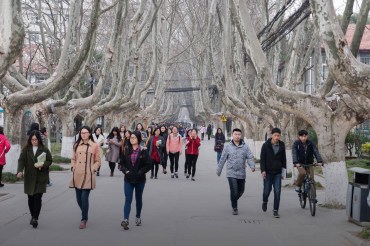
“A Love for Separation,” based on a novel by Lu Yingong, started screening last week and grabbed the public’s attention despite competing with the Olympic games for viewers. Users on the cultural website douban.com gave the show an average score of 8.2 out of 10.

Some critics say it reflects a widespread anxiety among China’s middle class: they constantly feel insecure and believe that the only way for their children to get a better life is to leave China and pursue their dreams elsewhere. The story line has triggered discussions about the country’s test-based education system and about “tiger” mothers, fathers and teachers. Many scenes of domestic conflict in the show center around the children’s test scores.

In one clip circulating on social media, Fang Duoduo, a ninth-grader, yells at her father, “You want respect from me? You only treat me like an exam machine!”

In this still from the TV show “A Love for Separation,” the character Fang Duoduo’s mother helps with her homework late at night.

PHOTO: SCREENSHOT

Stress about the highly-competitive gaokao, or college entrance exam, is one of the reasons why some parents would rather send their kids abroad to study.

In the show, Duoduo’s mother tells her, “If you can’t make sure you in the top 100 right now, you won’t enter a key senior high school. If you can’t enter a key senior high, you won’t enter a key university. If you can’t enter a key university, you whole life is done.”

In China, college admission hinges on the gaokao, which can only be taken once annually. Competition is so intense that parents would do anything to make sure their kids’ sail through the exam without interruptions. Last summer, a Sichuan family made headlines when it emerged that a mother hid from her daughter news of her father’s death for nearly two weeks until she’d finished taking the test, for fear it would influence her results.

The show reflects a “collective anxiety” among the middle class, the writer Huang Tongtong said in an article on her public WeChat account.

“Do you sometimes feel like everything you own is so fragile? Is it merely a fluke that you have the kind of life you live? Do you have the confidence that your children can live a good life? These are the questions that each one of us has to face,” Ms. Huang wrote.

Frustrated with a rigid education system and a growing list of grievances, more and more well-off Chinese parents send their children away when the children are increasingly young. More than 520,000 people left China to study abroad last year, up nearly 14% from 2014, according to China’s education ministry.

In a survey of 458 Chinese millionaires by China Citic Bank and Hurun Report, 30% of them said they plan to send their children to attend senior high schools overseas, while 14% of them said their children should leave at a younger age, for junior high school.

In the U.S. alone, Chinese students make up about half of the 60,815 foreign pupils in high schools and 6,074 in primary schools.

“The show makes me so sad. I used to argue with my parents all because of my scores. Study is the most important issue in my family. Only study study hard, there was never love and care,” said one user on the Twitter-like Weibo platform in China.

Source: TV Show Spotlights Middle Class Anxieties in China – China Real Time Report – WSJ

21/07/2015

Indian Companies Invest Billions, Create Thousands of Jobs in the U.S. – The Numbers – WSJ

As India attempts to thaw its business environment and attract the interest of foreign companies, a hundred Indian firms have together made investments worth more than $15 billion in America, according to the findings of a new survey by the Confederation of Indian Industries and audit firm Grant Thornton International Ltd.

The findings, which were released in a report titled “Indian Roots, American Soil” on Tuesday, suggest that Indian companies in the U.S., most operating in the information-technology sector, have created thousands of jobs there and show a growing interest in hiring more American workers in the next few years.

Indian outsourcing companies in the U.S. have in recent months been criticized for depending too much on foreign staff — H1-B visa holders – instead of hiring locals.

The 100 Indian companies surveyed are spread across all 50 U.S. states, the report said. Here are the main numbers from the report.

91,000

The survey says Indian firms have created more than 91,000 jobs in the U.S., most of them concentrated in New Jersey, where they have hired over 9,000 people. In California, more than 8,000 people work for Indian companies.

$15.3 billion

The total value of tangible investments – for example in real estate or equipment — made in the U.S. by the surveyed companies. Texas has received the largest amount — almost $3.85 billion from 17 Indian companies, most in the information-technology and telecom sectors. The report didn’t give a timeframe for these investments.

40%

The percentage of surveyed companies that do information-technology business is 40%. The report also highlights the emergence of Indian companies in the pharmaceutical and manufacturing sectors, which each accounted for 14% of the firms surveyed.

84%

That’s the proportion of companies in the survey that plan to make more investments in the U.S. in the next five years. California, New Jersey, New York and Texas are the “most promising states for expected future investment,” the report said.

90%

The forecast for hiring local U.S. employees is also encouraging, the survey reveals. Almost 90% of the companies responded positively when asked if they foresaw hiring locally in the coming five years.

via Indian Companies Invest Billions, Create Thousands of Jobs in the U.S. – The Numbers – WSJ.

08/07/2014

The Chinese Turn Their Rooftops (and Closets) Into Minifarms – Businessweek

Roger Mu, an entrepreneur from Texas now living in Shanghai, scoured local markets for jalapeño peppers but to no avail. Homesick for homemade salsa, he eventually decided to grow his own. Since he was iving in a cramped Shanghai apartment with no outdoor lawn or garden, this wasn’t a simple proposition. But he did have some space available: in the closet.

The Chinese Turn Their Rooftops (and Closets) Into Minifarms

Mu studied manuals about hydroponics, a technique for growing plants that doesn’t require soil but rather uses nutrient-infused water to deliver plant nutrition. The plants’ roots find support by growing around pebbles, sand, woodchips, or anything granular they can weave around, rather than soil. It’s perfect for limited space—and limited small-scale farming. Mu used a special light borrowed from a video-production company to jump-start photosynthesis.

The first batch of 60 peppers turned out to be delicious. Next he tested his technique with heirloom tomatoes and cucumbers. Success—he had everything he needed to make the perfect salsa. Mu also realized that his homegrown vegetables were healthier than many store-bought options. “Food safety and quality in China is a bit iffy,” he says, “considering all the pesticides, fertilizers, and pollution dumped into fields here.”

via The Chinese Turn Their Rooftops (and Closets) Into Minifarms – Businessweek.

Law of Unintended Consequences

continuously updated blog about China & India

ChiaHou's Book Reviews

continuously updated blog about China & India

What's wrong with the world; and its economy

continuously updated blog about China & India