Posts tagged ‘Uber (company)’

15/12/2016

PepsiCo CEO Indra Nooyi Is Latest Indian American to Sign Up to Help Donald Trump – India Real Time – WSJ

Chairman and CEO of PepsiCo. Indra Nooyi is the latest Indian American to be hand-picked by U.S. President-elect Donald Trump to advise him and help him run the country.
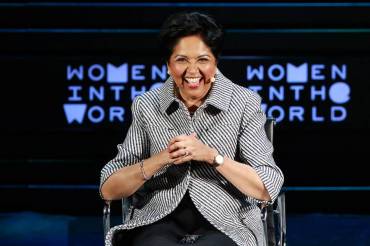
Ms. Nooyi’s appointment to his strategic and policy forum was announced Wednesday by Mr. Trump’s transition team as one of three new appointments to the 16-member group. SpaceX Corp’s Elon Musk and Uber Technologies Inc.’s Travis Kalanick were the other two appointments.

The forum will be called upon to meet frequently with Mr. Trump to discuss his economic agenda.“America has the most innovative and vibrant companies in the world, and the pioneering CEOs joining this Forum today are at the top of their fields,” Mr. Trump said in a news release. “My Administration is going to work together with the private sector to improve the business climate and make it attractive for firms to create new jobs across the United States from Silicon Valley to the heartland.”

Seema Verma, president and founder of SVC Inc. arriving at Trump Tower on November 22, 2016 in New York City.

Mr. Trump last month nominated Indian-American Seema Verma, CEO and founder of SVC Inc ., a U.S.-based health policy consulting company to serve as Administrator of the Centers for Medicare and Medicaid Services. “She has decades of experience advising on Medicare and Medicaid policy and helping states navigate our complicated systems,” he said.In November, Mr. Trump picked South Carolina Gov. Nikki Haley who is Indian in origin to serve as U.S. ambassador to the United Nations.

Ms. Nooyi, who was born in Chennai, India and later went to Yale University to study public policy and management, will have a direct line, along with others in the group, to Mr. Trump to advise him on economic policy, job creation and productivity, said the release.

Source: PepsiCo CEO Indra Nooyi Is Latest Indian American to Sign Up to Help Donald Trump – India Real Time – WSJ

13/08/2016

U.S. and UK tech startups welcome in China – with a little supervision – The Stack

U.S. and UK tech startups welcome in China – with a little supervision Martin Anderson. Editor, The Stack, Friday 12th August

On August 1st Travis Kalanick, CEO and co-founder of Uber, finally admitted defeat regarding the company’s three-year crusade to gain a foothold in China, with the ‘merging’ (most consider it a ‘sale’) of Uber’s Chinese operations with local incumbent Didi Chuxing. Whatever Kalanick may have recovered from the concession, it seems unlikely that Uber will recoup the billions it has already poured into its most distant territory. But there was no alternative – by January of this year, the Uber board was urging that the ride-sharing giant – such an indefatigable combatant in so many contested territories – throw in the towel.

Ultimately Didi was going to win this battle; despite cash and equity of $28 billion vs Uber’s $68 billion, Didi had reserved $10 billion to strengthen its grip on this fundamental societal change in China – almost on a par with what the  better-financed Uber was willing to invest.

A headline-grabbing contest of this nature gives the false impression of China as isolationist in terms of cooperating with global tech startups – it isn’t. The country runs a UK-China tech incubator in Shenzhen, backed by Tencent and providing crucial advice on the peculiarities of the Chinese market to Brit startups. The deal even offers free office space, business counsel and pitch opportunities. Whilst willing to repel boarders on the scale of Uber, China has no problem in contributing to a post-Brexit UK brain drain.

Likewise Alibaba runs a similar scheme to increase tech migration from the United States – almost impossibly tempting for new companies dazzled by the economy-of-scale that Chinese success promises, and struggling for attention in saturated home markets. Perhaps the most useful aspect of these international schemes is the business advice from native sources – western entrepreneurs see huge opportunities in Chinese numbers, yet fail to take account of national psychology; either on an individual level (the Chinese consumer), or at the level of a state which is well aware of its riches – and needs only as much western genius to exploit them as serves its future interests in the post-sharing economy.

Source: http://email.thestack.com/q/11mUpgMA6G1pvcOkWw5ppxj/wv

16/12/2014

India’s Senseless Ban on Uber: Rape Is the Real Problem – Businessweek

The alleged rape of an Uber passenger by her driver in New Delhi on Friday and his arrest over the weekend is another sad chapter in India’s ongoing battle with violence against women. While official statistics suggest the country witnessed 25,000 rapes in 2012, survey evidence suggests numbers perhaps 10 times as high.

Police escorting the hooded Uber driver following his court appearance on rape charges

The government’s response to the incident was to immediately ban Uber operations in Delhi. Alhough this might offer a welcome sign of political commitment to tackle violence, it doesn’t make sense. The police in India have been accused of multiple rapes, and tourists have been raped on a train and in a traditional Delhi taxi this year; the government has not shut down the police force, the railways, and traditional taxi services. It has singled out Uber, perhaps more because it is a high-profile, politically weak service than because of any risks riders may face.

In fact, there are good reasons to think Uber can provide a safer experience than India’s traditional transportation options do. Unlike the vast majority of rape cases in the country, the alleged perpetrator in the Uber case was arrested within hours of the incident. That’s not a surprise: Uber’s procedures guaranteed that there was considerable information available on the suspect. The company provided police with the name, age, and photo of the driver, along with his bank verified address, car details, and trip and route data. That’s a much higher level of knowledge than passengers have when they hail a cab off the street.

via India’s Senseless Ban on Uber: Rape Is the Real Problem – Businessweek.

15/12/2014

This Is What India’s Radio Cabs Are Doing to Make Women Safer – India Real Time – WSJ

Indian authorities and radio taxi operators in the national capital have stepped up security measures to ensure passenger safety in the aftermath of an alleged rape of a female passenger by a driver contracted to the international car booking service Uber Technologies.

Transport authorities in New Delhi have ordered radio fleet taxi companies and web-based operators to submit database of their drivers whose credentials need to be checked and have asked them to come up with a revised safety plan to be put in place by early next year, a Delhi police official, who did not wish to be named said Monday.

“A list of around 20,000 drivers has been submitted so far out of which the background details of more than 10,000 still need to be verified,” he said.

Last week, Delhi’s transport department barred Uber from operating its ride-hailing system in the national capital until it got the proper licenses. Uber on Thursday said it would suspend its service in the capital while it reviewed its screening processes. The department had stated that only six registered radio taxi companies would now be allowed to continue operating in New Delhi.

The cab operators in New Delhi, for their part, said they have certain safety rules in mind that they would submit by Dec. 31 to the transport department.

via This Is What India’s Radio Cabs Are Doing to Make Women Safer – India Real Time – WSJ.

Law of Unintended Consequences

continuously updated blog about China & India

ChiaHou's Book Reviews

continuously updated blog about China & India

What's wrong with the world; and its economy

continuously updated blog about China & India