Posts tagged ‘United Nations Security Council’

22/12/2016

Are India and Pakistan set for water wars? – BBC News

India is stepping up efforts to maximise its water use from the western rivers of the Indus basin, senior officials have told the BBC.

The move would involve building huge storage facilities and canals.

The three rivers flow through Indian-administered Kashmir but most of the water is allotted to Pakistan under an international treaty.

Experts say Delhi is using the water issue to put pressure on Pakistan in the dispute over Kashmir.Relations have deteriorated since a deadly militant attack on an Indian base in September. Pakistan denies any link to the attack.

Why India’s water dispute with Pakistan matters

Kashmir: Why India and Pakistan fight over it

Kashmir profiled

Indian Prime Minister Narendra Modi has said a government taskforce is finalising details of the water project, which he has made a priority.

“The ball has started rolling and we will see some results soon, most of them will be about building new storages in the basin,” one top official said on condition of anonymity.

Another senior official said: “We are quite familiar with the terrain as we have already built a number of structures there.

But he added: “We are talking about few years here.

“How much water is at stake?

India wants to “maximise” its use of water from the Indus, Chenab and Jhelum rivers. Millions of people in both countries depend on water in the rivers.

An official with India’s water resources ministry insisted that this action would be “well within” the terms of the Indus Water Treaty (IWT).

India began reviewing the treaty after the militant attack in Indian-administered Kashmir in September in which 19 soldiers were killed.Delhi accused Islamabad of being behind the attack and relations have plummeted, leading to a rise in cross-border tensions.

The IWT was signed in 1960 and allocated the three eastern rivers – the Ravi, Beas and Sutlej – of the Indus basin to India, while 80% of the three western ones – the Indus, Jhelum and Chenab – was allotted to Pakistan.

India says it has not fully utilised the 20% of water given to it in the three western rivers. Pakistan disputes this.

Officials in Delhi said the IWT allows India to irrigate 1.4 million acres of land using water from those rivers.

But they say only 800,000 acres are irrigated at present.

They added that the building of hydropower projects would also be accelerated.

India currently generates around 3,000MW of hydroelectricity from the western rivers, but the Indus basin is said to have a potential of nearly 19,000 MW.

How safe is the water treaty?
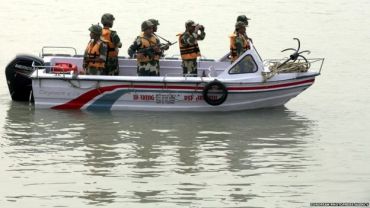
 

Pakistan is watching India’s moves closely.

India shares a heavily militarised international border with Pakistan

Speaking in an open debate of the United Nations Security Council on “water, peace and security” last month, Pakistan’s ambassador to the UN, Maleeha Lodhi, denounced any use of water as an “instrument of coercion and war”.

“The IWT is equally a good case study of what could go wrong if such agreements are not honoured or threatened by one of the state parties to be abrogated altogether.

“Water experts say the treaty seems to have at least survived because India is not talking about withdrawing from it.

But, they believe, maximising use of water from the western rivers in the Indus basin can still fuel tensions.

Islamabad is already unhappy with some of India’s existing water projects.It has asked the World Bank, which brokered the signing of the treaty between the two countries, for a court of arbitration to consider two Indian hydropower projects in the Indus basin.

India has objected to this move, prompting the bank to pause the dispute process while it tries to persuade the two countries to resolve their disagreements, fearing that otherwise the treaty itself could be in peril.

In 1987, Delhi suspended the Tulbul navigation project on the Jhelum river after Pakistan objected to it.But sources within India’s Water Resources Ministry say this project could now be revived.

“The decision to review the suspension signalled the Modi government’s intent to revive it irrespective of Pakistan’s protests,” the Times of India newspaper wrote.

“As an implication, India gets to control Jhelum water, impact Pakistan’s agriculture.

“What else could India do?

Some experts say India could also demand a review of the IWT.

“The review can be used to demand more rights over the western rivers,” says Himanshu Thakkar, a regional water resources expert with South Asian Network on Dams, Rivers and People.

Some water resources analysts believe Delhi will also have to be mindful of China before making any major move.

In September, Tibet blocked a tributary of the Yarlung Zangbo river (known as the Bramhaputra in India) as part of its most expensive hydro project, Chinese state-run news agency Xinhua reported.

The news came just when Indian media were suggesting that Delhi could pull out of the IWT.

“We need to remember that China is an upper riparian country in Indus and Bramhaputra basins and it is also Pakistan’s closest ally,” said Mr Thakkar.

Many experts agree that completing such huge and complex infrastructure projects may not be as swift as some Indian officials suggest.

Source: Are India and Pakistan set for water wars? – BBC News

20/01/2015

Obama’s Seven Habits for a Highly Successful India Visit – India Real Time – WSJ

U.S. President Barack Obama’s upcoming visit to India won’t be his first trip to the country.

Mr. Obama and the First Lady last swept through Delhi and Mumbai in November 2010 in a carefully- choreographed charm offensive, addressing sensitive issues such as Pakistan and the U.N. Security Council, while finding time to dance at a high school and speak a bit of Hindi.

Much has changed in India since Mr. Obama last arrived on its shores: the government, the prime minister, the number of international coffee and burger chains. Many things haven’t altered however and by the time he leaves next week, the president will be something of an old hand in the world’s largest democracy. By visiting a second time, he becomes the only serving U.S. president to have made two official trips to India.

1. Back a Bid

India has for years coveted a permanent seat on the United Nations Security Council. In Mr. Obama’s 2010 visit, he used a speech to the Indian Parliament  to back the country’s inclusion “in the years to come” as a permanent member of the council with power of veto.

2. Tread Carefully on Pakistan

Any world leader visiting India must choose their words on the country’s rival Pakistan carefully.  In the same speech to the Indian Parliament, Mr Obama said the U.S. insisted Pakistan limit terrorist-safe havens within its borders, adding: “We must also recognize that all of us have an interest in both an Afghanistan and a Pakistan that is stable, prosperous and democratic—and none more so than India.”

3. Make a Trade Announcement…

Mr. Obama was in Mumbai when he announced a loosening of restrictions on U.S. exports to India. The move was aimed at making it easier for U.S. companies to export technology for military and non-military use after the U.S. imposed controls on trade with India in dual-use technologies — items that have both military and peaceful purposes – after India’s nuclear-weapons tests in 1998.

The president said: “We’re taking the necessary steps to strengthen this relationship.”

4. …And Ask for Something Back

Mr. Obama asked India to reduce barriers in sectors such as agriculture, retail and telecommunications to promote trade. “In a global economy, new growth and jobs flow to countries that lower barriers to trade and investment,” he said.

U.S. President Barack Obama and Indian Prime Minister Manmohan Singh, embrace following a joint statement and press conference at Hyderabad House in New Delhi, India, Nov. 8, 2010. Associated Press

5. Work on Chemistry

Ahead of the 2010 meeting, both Mr. Obama and then-Indian Prime Minister Manmohan Singh echoed each other’s language on the relationship between their two countries. “I think the India-United States relationship has entered a new phase,” Mr. Singh said before Mr. Obama’s visit.

6. Pick Your Battles

There was much speculation that Mr. Obama would touch on the issue of the outsourcing of U.S. jobs to India during his 2010 visit. In the end, he deftly sidestepped the issue in the name of healthy competition:

“There are many Americans whose only experience with trade and globalization has been a shuttered factory or a job that was shipped overseas,” he said, adding that many Americans still had a “caricature” of India as a place with call centers where U.S. jobs have been outsourced.

On another touchy subject, Kashmir, Mr. Obama let Mr. Singh do the talking. Mr. Singh said he wanted to reduce tensions with Pakistan, including over Kashmir, but could not do so unless Islamabad cracked down on terrorism.

U.S. President Barack Obama bows as he arrives to deliver a speech at Parliament House in New Delhi Nov. 8, 2010. Agence France-Presse/Getty Images

7. Visit the Right Places, Wear the Right Things, Use the Local Lingo

Photogenic India provided Mr. and Mrs. Obama with ample visual material. Mrs. Obama gamely joined children dancing at a high school in Mumbai, eventually persuading the president to join her. She also took part in a game of hopscotch and urged students at a college in Mumbai to “keep dreaming big huge, gigantic dreams–for your community and for your world.”

Perhaps the most arduous part of the visit of any dignitary to another country is avoiding any faux pas, embarrassing photographs or poor sartorial choices.

Mr. Obama’s staff carefully chose Humayun’s tomb in New Delhi as an appropriate tourist destination for the president.

Meanwhile, Michelle Obama’s outfits were carefully scrutinized for any embarrassing mistakes – which she seemed to avoid.

Mr. Obama rounded off the whirlwind tour with the crowd-pleasing cry in Hindi of ‘jai hind!’, or ‘hail India!’ at the end of his speech to the Indian Parliament.

via Obama’s Seven Habits for a Highly Successful India Visit – India Real Time – WSJ.

06/09/2013

China urges U.N. role on Syria after U.S. says gives up

reuters: “China’s Foreign Ministry urged a role for the U.N. Security Council in resolving the crisis in Syria on Friday after the United States said it had given up trying to work with the council on Syria, accusing Russia of holding it hostage.

A Free Syrian Army fighter poses for a picture as he holds an RPG launcher in Raqqa province, eastern Syria September 4, 2013. Picture taken September 4, 2013. REUTERS/Nour Fourat

U.S. Ambassador to the United Nations Samantha Power’s remarks on Thursday left no doubt that Washington would not seek U.N. approval for a military strike on Syria in response to an August 21 chemical attack near Damascus.

She said a draft resolution Britain submitted to the five permanent council members last week calling for a response to that attack was effectively dead.

Asked about those comments, Chinese Foreign Ministry spokesman Hong Lei said the Security Council needed to be used.

China supports the important role that the U.N. Security Council plays in properly resolving the Syria issue,” Hong told a daily news briefing in Beijing.

“We hope that relevant parties can continue communications and coordination and hold deep consultations so as to resolve the relevant issue in a peaceful way,” he added.

China has called for a full and impartial investigation by U.N. chemical weapons inspectors in Syria into the August 21 attack, and has warned against pre-judging the results. It has also said that whoever uses chemical weapons had to be held accountable.

“China believes that a political solution is the only realistic way out on the Syria issue. Given the current circumstances, a political solution is of utmost importance,” Hong said.

“We also hope the international community can work together and push for the holding of an international conference on the Syria issue at an early date.”

Russia and China have both vetoed previous Western efforts to impose U.N. penalties on Syrian President Bashar al-Assad.

But China has also been keen to show it is not taking sides and has urged the Syrian government to talk to the opposition and take steps to meet demands for political change. It has said a transitional government should be formed.”

via China urges U.N. role on Syria after U.S. says gives up | Reuters.

See also: https://chindia-alert.org/political-factors/geopolitics-chinese/

07/03/2013

* North Korea warns U.S. of preemptive nuclear strike

Perhaps North Korea has learnt from the lessons of past wars with the US. Losers such as Germany and Japan benefited hugely from American aid, whereas winners such as North Vietnam did not benefit for decades after beating the Americans. Indeed even American allies like the UK had to pay the full Second World War loan for over 50 years.

So, if North Korea fought the US and lost, it reasons, unlimited aid will be forthcoming; perhaps more than China is willing to contribute.

That seems to be the only rational explanation for the continued belligerence of North Korea.

Reuters: “North Korea threatened the United States on Thursday with a preemptive nuclear strike, raising the level of rhetoric while the U.N. Security Council considers new sanctions against the reclusive country.

North Korean soldiers attend a military training in this picture released by the North Korea's official KCNA news agency in Pyongyang March 6, 2013. REUTERS-KCNA

North Korea has accused the United States of using military drills in South Korea as a launch pad for a nuclear war and has scrapped the armistice with Washington that ended hostilities in the 1950-53 Korean War.

North Korea, which has one major ally, neighboring China, threatens the United States and its “puppet”, South Korea, on an almost daily basis.

“Since the United States is about to ignite a nuclear war, we will be exercising our right to preemptive nuclear attack against the headquarters of the aggressor in order to protect our supreme interest,” the North’s foreign ministry spokesman said in a statement carried by the official KCNA news agency.”

via North Korea warns U.S. of preemptive nuclear strike | Reuters.

12/02/2013

* China joins U.S., Japan in condemning North Korea nuclear test

China has a difficult choice: act firmly and materially by reducing aid and upset and possibly destabilise North Korea  that may lead to a reunified Korea facing the West. Or act softly and North Korea goes merrily on its own sweet way as it has done for decades; and may be the cause of an intentional or inadvertent nuclear war. The world and esp the US will be watching carefully.

Reuters: “North Korea conducted its third nuclear test on Tuesday in defiance of existing U.N. resolutions, drawing condemnation from around the world, including from its only major ally, China, which summoned the North Korean ambassador to protest.

An activist from an anti-North Korea civic group burns a portrait of North's leader Kim Jong-un during a rally against North Korea's nuclear test near the U.S. embassy in central Seoul February 12, 2013. REUTERS-Kim Hong-Ji

The reclusive North said the test was an act of self-defense against “U.S. hostility” and threatened further, stronger steps if necessary.

It said the test had “greater explosive force” than the 2006 and 2009 tests. Its KCNA news agency said it had used a “miniaturized” and lighter nuclear device, indicating that it had again used plutonium which is more suitable for use as a missile warhead.

North Korean leader Kim Jong-un, the third of his line to rule the country, has presided over two long-range rocket launches and a nuclear test during his first year in power, pursuing policies that have propelled his impoverished and malnourished country closer to becoming a nuclear weapons power.

China, which has shown signs of increasing exasperation with the recent bellicose tone of its neighbor, summoned the North Korean ambassador in Beijing and protested sternly, the Foreign Ministry said.

Foreign Minister Yang Jiechi said China was “strongly dissatisfied and resolutely opposed” to the test and urged North Korea to “stop any rhetoric or acts that could worsen situations and return to the right course of dialogue and consultation as soon as possible”.

China is a permanent member of the UN Security Council.”

via China joins U.S., Japan in condemning North Korea nuclear test | Reuters.

21/03/2012

* UN unites on Syria – including China and Russia

President Bashar al-Assad of Syria . Original ...

President Bashar al-Assad of Syria . Original background. (Photo credit: Wikipedia)

Reuters: “The UN Security Council, including Russia and China, threw its weight on Wednesday behind

Mr. Kofi Annan, former General Secratery of th...

In a statement approved by all its 15 members, the council threatened Syria with unspecified “further steps” if it failed to comply with Annans peace plan, which calls for a ceasefire and demands swift access for aid agencies.

Although the original statement was diluted at Russias demand, editing out any specific ultimatums, the fact that all world powers signed up to the proposal dealt a serious blow to President Bashar al-Assad as he battles a popular uprising.

via U.N. unites on Syria, sanctions set for Assads wife | Reuters.

Law of Unintended Consequences

continuously updated blog about China & India

ChiaHou's Book Reviews

continuously updated blog about China & India

What's wrong with the world; and its economy

continuously updated blog about China & India