Posts tagged ‘United States Environmental Protection Agency’

22/03/2016

Indians Have the Worst Access to Safe Drinking Water in the World – India Real Time – WSJ

India has the highest number of people in the world without access to safe water, a report released to mark World Water Day showed Tuesday.

The country has 75.8 million people, at least 5% of its 1.25 billion population, without access to clean water, the report by WaterAid, a water and sanitation nonprofit headquartered in London, says.

The majority of those people come from impoverished communities–living on around $4.31 a day–and are forced to collect dirty water from open ponds and rivers or spend most of what they earn buying water from tankers, the report  says.

Source: Indians Have the Worst Access to Safe Drinking Water in the World – India Real Time – WSJ

16/02/2016

India and China Have Most Deaths From Pollution – China Real Time Report – WSJ

More than half of the 5.5 million deaths related to air pollution in 2013 happened in India and China, according to a new study.

About 1.4 million people in the South Asian nation and 1.6 million in its northern neighbor died of illnesses related to air pollution in 2013, researchers at the University of British Columbia in Canada said.

The Indian and Chinese fatalities accounted for 55% of such deaths worldwide, the study said.

Researchers studied risk factors for death and disease around the world and found that air pollution, both indoors and outdoors, was one of the leading contributors to global fatalities.

The inhalation of emissions from power plants, vehicles, the burning of crop stubble before replanting, and wood or open fires in homes are some of the leading causes of deaths from air pollution, the report said.

The number of premature deaths linked to air pollution worldwide will increase over the next two decades unless more aggressive targets are set to curb it, researchers studying India and China’s air said at a meeting Friday in Washington D.C.

A major contributor of poor air quality in India is linked to the burning of wood and cow dung for cooking and keeping warm, particularly in the winter months. These methods are popular among India’s rural and urban poor, who don’t have access to electricity or cleaner fuels.

Household air pollution from cooking with wood “is primarily a problem in rural areas of developing countries of the world,” said Michael Brauer, a professor at the University of British Columbia’s School of Population and Public Health, in Canada.

Over the past few months, levels of tiny insidious particles, known as PM 2.5, in the Indian capital New Delhi have often exceeded amounts deemed safe by the United Nations World Health Organization.

Taking their lead from Beijing, Indian authorities in January experimented with restricting cars on roads for two weeks in New Delhi to reduce emission levels. Delhi Chief Minister Arvind Kejriwal said Thursday the city would revive the restrictions for 15 days, starting April 15.

Scientists said vehicle emissions contribute only 20% to 40% of pollution in Delhi, saying other sources of the particulate matter include the burning of dung, rubbish and leaves and the use of diesel backup generators, which kick in when Delhi’s patchy electricity supply cuts out, as well as emissions from small-scale industries such as brick kilns.

A federal environmental court in New Delhi said Feb. 4 it wanted officials to improve air quality by asking authorities to reduce the number of traditional cremations that use wood to burn bodies, a widespread practice in majority Hindu India.

In China, outdoor air pollution from burning coal was found to be the biggest contributor to poor air quality, causing an estimated 366,000 deaths in the country in 2013. Scientists predict 1.3 million premature deaths will take place in China by 2030 if coal combustion remains unchecked.

“One of the unique things about air pollution is you cannot run, you cannot hide from it. We know that if you improve air quality everybody benefits, so from a health perspective reducing levels of air pollution is actually an incredibly efficient way to improve the health of the entire population,” Mr. Brauer said.

Source: India and China Have Most Deaths From Pollution – China Real Time Report – WSJ

10/12/2015

Why Delhi Doesn’t Have a Beijing-Style Response to Pollution – China Real Time Report – WSJ

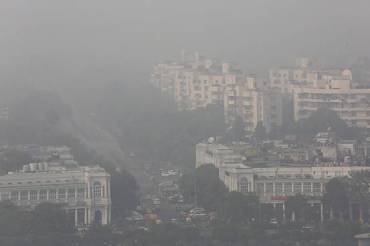
The cities of Delhi and Beijing share a dubious honor as the world’s most-polluted capitals. But their response to dangerous levels of air pollution separates them.

Earlier this week, Beijing for the first time issued a red-alert for pollution, triggered when authorities forecast air-quality levels above 300 for at least three consecutive days.

On China’s government index, a measure of overall air quality, the maximum reading of 500, is described by the government as “severely polluted.” The Chinese administration immediately sent cars off the roads, shut factories and urged schools to close.

In Delhi, where air was similarly dirty, life went on as normal. The starkly different responses prompted some in the Indian capital to question why their government wasn’t taking Beijing-style measures to combat the smog. For sure, plans are underway in India to tackle the capital’s filthy air.

On Friday, Delhi’s government announced it would impose restrictions on the number of cars on its roads from Jan.1. Residents in the Indian city can look up air-pollution data on the website of The System of Air Quality and Weather Forecasting and Research, known as Safar, which uses data collected at 10 locations in the city. On that index, air quality in the city regularly hits “very poor” conditions when levels of PM 2.5 — insidious particles in the air including dirt, soot, smoke and liquid droplets — spike.

These tiny particles are thought to be particularly dangerous because they can lodge deeply in the lungs and cause inflammation, infection and lead to diseases including cancer. Readings on the Safar monitor are calibrated from “good” to “severe.” The Delhi Pollution Control Committee also publishes raw pollution data but doesn’t give qualitative readings alongside.

The U.S. Embassy, which measures pollution on monitors at its compound in the capital and around the country, warns the very young and elderly to remain indoors whenever air quality becomes what it calls hazardous. But none of the readings currently trigger alerts, or responsive action, by Delhi’s government. That’s because India is a democracy, said Ashwani Kumar, chairman of the Delhi Pollution Control Committee, an arm of the state government.

China, of course, is a one-party state. The idea that alerts should tell people to stay indoors when smog hits was  “absurd,” Mr. Kumar added, and people “should decide for themselves what to do with the pollution information.” However, he said the Delhi Pollution Control Committee does plan to introduce an app so that information is available to residents with smartphones. Less than 10% of Indians own a smartphone. It also proposes to install around 70 big screens in strategic locations around the city advising residents what they can do to reduce pollution, Mr. Kumar added. The idea of an environmental alert system is not alien to India.

Source: Why Delhi Doesn’t Have a Beijing-Style Response to Pollution – China Real Time Report – WSJ

13/07/2015

China says 75 percent of cities failed to meet air standards in June | Reuters

Nearly 75 percent of China’s big cities failed to meet air quality standards in June, the environment ministry said on Monday, an improvement over the same month last year, as the country continues to wage “war on pollution.”

General view of downtown Shanghai on a hazy night January 25, 2015. REUTERS/Aly Song

Nineteen cities met air quality standards every day, the Ministry of Environmental Protection said in a statement on its website (www.mep.gov.cn), compared to five at the same time last year.

Air quality in the capital Beijing was subpar on almost 60 percent of the days in June and saw levels of PM2.5 – particulate matter with a diameter of 2.5 micrometers that can penetrate deep into the lungs – rise 11 percent compared to the same period last year.

Amid growing public disquiet about smog and other environmental risks, China said last year it would “declare war on pollution” and it has started to eliminate substandard industrial capacity and reduce coal consumption.

Last year, nearly 90 percent of China’s 74 big cities failed to meet air quality standards.

The state standard is 35 micrograms of PM2.5 per cubic meter, but the government does not expect to bring the national average down to that level before 2030.

In April, the vice minister for environmental protection announced a two-year inspection campaign to root out fake air quality data and accused some local governments of manipulating the data to meet national standards.

via China says 75 percent of cities failed to meet air standards in June | Reuters.

26/05/2015

Coal-fired plants in Beijing on way out with new ban|Society|chinadaily.com.cn

Beijing will ban new coal-fired thermal power plants after the four existing ones are expected to be replaced by gas-fired plants by 2017, according to the municipal economic planner.


http://www.gettyimages.com/detail/137085643

The replacement is being made in an attempt to reduce coal consumption to achieve better air quality.

“The closure of the coal-fired power plants will greatly improve air quality, considering that 22 percent of air pollutants are from coal consumption,” said Zhang Wangcai, deputy director of the Beijing Development and Reform Commission’s Energy Bureau.

Two gas-fired thermal power plants have been operating since October and have reduced coal consumption by 3.95 metric tons annually, he said.

Beijing has also restricted coal consumption by companies and households for heating in the past two years by supplying them with gas or other cleaner fuels instead.

“By the end of this year, we will reduce coal consumption by 8 million tons,” Zhang said, adding that a reduction of 7.1 million tons has already been achieved.

Li Xiang, deputy head of atmospheric environment management at the Beijing Environmental Protection Bureau, said the reduction of coal consumption at the two power plants has been a major reason for the better air quality in the capital in the first four months of this year.

She said people in the capital have seen a distinct improvement in air quality in the first four months, during which there were 57 days when the quality was better than the national standard – eight days more than during the same period last year.

The concentration of PM2.5 – air particles of 2.5 micrometers or less in diameter that can penetrate the lungs and harm health – has been lowered by 19 percent and the number of days with serious pollution reduced by 42 percent year-on-year.

On Thursday, authorities launched efforts to reduce air pollution in support of the bid to host the 2022 Winter Olympics.

Zhang said the government will make further efforts to reduce emissions of air pollutants, including restricting coal consumption as planned, which will further improve air quality.

In addition to the two thermal power plants already operating, another will start working in July and a fourth will be ready to operate in November next year, he said.

By 2017, Beijing will have all its power generated by clean-energy gas, and coal consumption will be cut by 9.2 million tons annually – the equivalent amount used for the four coal-burning thermal power plants.

Gas consumption will increase to 24 billion cubic meters in 2017, of which 98 percent will be supplied through a variety of channels including foreign countries, Zhang said, adding that Beijing consumed 11.3 billion cubic meters of gas last year.

The Ministry of Environmental Protection released the list of air quality in April in the 74 major cities on Monday.

In April, seven of the 10 cities with the worst air pollution were in Hebei province, but the region of Beijing, Tianjin and Hebei province has witnessed a clear improvement in air quality, said Luo Yi, head of the ministry’s Environmental Supervision Bureau.

The PM2.5 concentration in the region has been reduced on average by 18.3 percent year-on-year and was 16.3 percent lower in April than in March, he said.

via Coal-fired plants in Beijing on way out with new ban|Society|chinadaily.com.cn.

18/04/2015

Apple Grows its Own Solar Farms in China – China Real Time Report – WSJ

Call it savvy public relations or plain good investing, but Apple is becoming a solar-power developer in China.

News Thursday that the Cupertino, Calif.-based company is partnering with SunPower., a major U.S. solar-panel maker, to build two solar power plants in China’s southwestern Sichuan province, highlights Apple’s attempts to offset its growing carbon footprint in China, where it is expanding at a rapid pace.

Although financial terms weren’t disclosed, SunPower said Thursday that Apple will co-own the projects, which have the combined capacity of 40 megawatts.

Apple has previously said it wants to be carbon neutral everywhere it operates, but that admirable goal is considerably absent in China, where the bulk of its products are made. Until now, unhappiness over air pollution mainly has been directed at the Chinese government, but Apple — already under fire over labor and customer-support issues –could become a major target. Initiatives like these could go a long way toward making sure its image in China remains favorable.

Apple tends to be financially involved in clean-energy projects only when they provide electricity for its operations. Apple and SunPower, for example, have partnered together in the U.S. to develop six solar power plants, all of which provide at least some power to Apple’s facilities.

In this case, however, Apple’s solar plants are being built in Sichuan’s remote Aba Tibetan and Qiang autonomous prefectures, far from Apple’s corporate offices, retail stores or manufacturing partners. The region is known for its rolling grasslands, where herders take yaks and sheep to graze, and where multi-colored Tibetan prayer flags are strung up along the slopes of hills.

In an interview on Thursday with China’s official Xinhua news agency, Apple’s vice president of environmental initiatives, Lisa Jackson, said the solar plants will be located in grasslands primarily used for raising yaks. Ms. Jackson, who was previously head of the U.S. Environmental Protection Agency, said Apple will take care to minimize the impact of construction on the environment. An Apple spokeswoman said Friday in an email that Apple and its local partners won’t use cement to install solar panels or dig trenches for wires during construction.

Apple has been expanding quickly in China as it attempts to go after the country’s burgeoning middle class. The company currently has 21 retail stores in mainland China and hopes to double that number by the end of next year. Although Apple’s latest efforts to produce clean energy in China might be a drop in the bucket when compared with amount of fossil fuels consumed by its manufacturing partners, Ms. Jackson told Xinhua that the company hopes to lead by example for its more than 330 suppliers.

Apple’s latest projects join a wave of new solar farms under construction in western China. Solar-panel makers, Chinese policy banks and other clean-energy developers are all piling into the business after China revived its solar industry amid the country’s ambitious targets to add as much as 18 gigawatts of solar-power capacity by the end of this year.

via Apple Grows its Own Solar Farms in China – China Real Time Report – WSJ.

Law of Unintended Consequences

continuously updated blog about China & India

ChiaHou's Book Reviews

continuously updated blog about China & India

What's wrong with the world; and its economy

continuously updated blog about China & India