Chindia Alert: You’ll be Living in their World Very Soon
aims to alert you to the threats and opportunities that China and India present. China and India require serious attention; case of ‘hidden dragon and crouching tiger’.
Without this attention, governments, businesses and, indeed, individuals may find themselves at a great disadvantage sooner rather than later.
The POSTs (front webpages) are mainly 'cuttings' from reliable sources, updated continuously.
The PAGEs (see Tabs, above) attempt to make the information more meaningful by putting some structure to the information we have researched and assembled since 2006.
China-based innovators applied for a record-setting number of invention patents last year.
The country accounted for more than a million submissions, according to an annual report by the World Intellectual Property Organization (Wipo). It said the figure was “extraordinary”.
Many of the filings were for new ideas in telecoms, computing, semiconductors and medical tech.
Beijing had urged companies to boost the number of such applications.
But some experts have questioned whether it signifies that the country is truly more inventive than others, since most of China’s filings were done locally.
What is a patent?
A patent is the monopoly property right granted by a government to the owner of an invention.
This allows the creator and subsequent owners to prevent others from making, using, offering for sale or importing their invention into the country for a limited time.
In return they must agree for the patent filing to be publicly disclosed.
To qualify as an “invention” patent, the filing must contain a new, useful idea that includes a step – a new process, improvement or concept – which would not be obvious to a skilled person in that field.
Some countries – including China – also issue other types of patents:
Utility model patents. The ideas must still be novel, but it is less important that there is a “non-obvious step”
Design patents. These require the shape, pattern and/or colour of a manufactured object’s design to be new, but do not require there to be a novel technical aspect
Skewed figures
A total of 2.9 million invention patent applications were filed worldwide in 2015, according to Wipo, marking a 7.8% rise on the previous year.
China can lay claim to driving most of that growth. Its domestic patent office – the Property Office of the People’s Republic of China (Sipo) – received a record 1,101,864 filings. These included both filings from residents of China and those from overseas innovators who had sought local protection for their ideas.
The tally was more than that of Sipo’s Japanese, South Korean and US equivalents combined.
Applicants based in China filed a total of 1,010,406 invention patents – the first time applicants from a single origin had filed more than one million in a single year.
But they appeared to be reticent about seeking patent rights abroad.
According to Wipo, China-based inventors filed just 42,154 invention patent applications outside their borders – Huawei and ZTE, two smartphone and telecoms equipment-makers, led the way.
There was a rise in the number of medical tech patent filings from China
By comparison US-based inventors sought more than five times that figure. And Japan, Germany and France also outnumbered the Asian giant.
One patent expert – who asked not to be named – suggested the disparity between Chinese inventors’ local and international filings reflected the fact that not all the claims would stand up to scrutiny elsewhere.
“The detail of what they are applying for means they would be unlikely to have the necessary degree of novelty to be granted a patent worldwide,” he said.
But Wipo’s chief economist said things were not so clear cut.
“There is clearly a discussion out there as to what is the quality of Chinese patents,” said Carsten Fink.
“But questions have also been asked about US and other [countries’] patents.”
And one should keep in mind that China is a huge economy.
“If you look at its patent filings per head of population, there are still fewer patents being filed there than in the United States.”
Patent boom
Part of the reason so many applications were made locally was that China set itself a target to boost all types of patent filings five years ago.
Sipo declared at the time that it wanted to receive two million filings in 2015.
The government supported the initiative with various subsidies and other incentives.
Adding together China’s invention, utility and design patents, its tally for 2015 was about 2.7 million filings, meaning it surpassed its goal by a wide margin.
One London-based patent lawyer noted that Chinese firms were not just filing patents of their own but also buying rights from overseas companies.
“This all goes to show the growth of the telecoms and high-tech industries in China, and that these companies are playing a more significant role globally than hitherto,” said Jonathan Radcliffe from Reed Smith.
“The fact we are now seeing them suing and being sued for patent infringement in Europe and in the US on subject matter such as mobile phones and telecoms standards – and indeed seeing Chinese companies suing each other over here in Europe for patent infringement – shows that they have truly arrived.”
AFTER the wildest political upsets this year, here’s a prediction for next: China will deem its relations with America to be entering something of a golden period.
The prediction is no more outlandish than others that have recently come true. But is it madness? On the campaign trail, Donald Trump singled out China as the prime culprit ripping jobs and business out of the United States “like candy from a baby”. Mr Trump threatened a trade war. He promised that, on day one as president, he would label China a currency manipulator. He said he would slap a punitive tariff of 45% on Chinese imports. For good measure, he also promised to tear up the climate agreement that President Barack Obama signed with his counterpart, Xi Jinping, in September—a rare bright point in the bilateral relationship.Throw in, too, amid all the disarray inside Mr Trump’s transition team, the names being bandied about for those who will be in charge of dealings with China. They hardly reassure leaders in Beijing. Possibles for secretary of state, for instance, are Rudy Giuliani, New York’s former mayor, who has little experience of China, and John Bolton, a hawk who is actively hostile to it.
And yet China is starting to look on the bright side. Driving the growing optimism in Beijing is a calculation that, if Mr Trump is serious about jobs and growth at home, he will end up in favour of engagement and trade. Put simply, protectionism is inconsistent with “Make America Great Again”. From that it flows, or so Chinese officials hope, that Mr Trump’s campaign threats are mainly bluster. Yes, he is likely formally to label China a currency manipulator. But that will trigger investigations that will not be published until a year later. Even after that, there may be few immediate practical consequences.
What is more, China’s leaders may divine in Mr Trump someone in their mould—not delicate about democratic niceties and concerned above all about development and growth. Reporting on the first phone conversation earlier this week between Mr Xi and Mr Trump, the normally rabid Global Times, a newspaper in Beijing, was gushing. After Mr Xi urged co-operation, Mr Trump’s contribution to the phone call was “diplomatically impeccable”; it bolstered “optimism”, the paper said, in the two powers’ relationship over the next four years. Indeed, thanks to his “business and grass-roots angles”, and because he has not been “kidnapped by Washington’s political elites”, Mr Trump “is probably the very American leader who will make strides in reshaping major-power relations in a pragmatic manner.”
No doubt optimism among more hawkish Chinese is based upon calculations that Mr Trump’s administration will prove chaotic and incompetent, harming America first and playing to China’s advantage in the long game of America’s decline and China’s rise. “We may as well…see what chaos he can create,” the same newspaper was saying only a week ago. And Chinese leaders are delighted to see the back of Barack Obama. They hate his “pivot” to Asia. They are bitter that Mr Obama’s “zero-sum mindset” never allowed him to accept Mr Xi’s brilliant proposal in 2013 for a “new type of great-power relations” involving “win-win” co-operation. How could Mr Obama possibly think that the doctrine boils down to ceding hegemony in East Asia to China?
And so, it is not hard to imagine what gets discussed in the first meeting between the two leaders, after Mr Trump’s inauguration. In his victory speech, the builder-in-chief promised a lot of concrete-pouring: “highways, bridges, tunnels, airports, schools, hospitals”. Mr Xi will point out that he has a fair amount of expertise in construction, too. It comes from running a vast country with more than 12,000 miles (18,400km) of bullet-train track where America has none, and a dam at the Yangzi river’s Three Gorges which is nearly as tall as the Hoover Dam and six times its length. Mr Xi will offer money and expertise for the president-elect’s building efforts, emphasising that China’s help will generate American jobs. In return, it would be an easy goodwill gesture for Mr Trump to reverse Mr Obama’s opposition to American membership of the Chinese-led Asian Infrastructure Investment Bank, and to lend more support to Mr Xi’s “Belt and Road” plans for building infrastructure across Asia and Europe. Advisers to Mr Trump suggest that is already on the cards.
The other leadership transition
A honeymoon, then, that few predicted. China certainly wills it. A calm external environment is critical for Mr Xi right now. He is preparing to carry out a sweeping reshuffle of the party’s leadership in the coming year or so. His aim is to consolidate his own power and ensure that he will have control over the choice of his eventual successors. That will demand much of his attention.
But don’t expect the honeymoon to last. For one, China may well have underestimated the strength of Mr Trump’s mercantilist instincts. It may also have second thoughts should a sustained dollar rally complicate management of its own currency. And even though America’s panicked friends have been this week, as the New York Times put it, “blindly dialling in to Trump Tower to try to reach the soon-to-be-leader of the free world”, Trumpian assurances of support have been growing for the alliances that China resents but that have reinforced American power in East Asia since the second world war. (As The Economist went to press, Japan’s prime minister, Shinzo Abe, was about to become the first national leader to meet the president-elect; he will reassure Mr Trump that Japan is taking on a bigger role in defending itself.)
And then who knows what might roil the world’s most important relationship? No crisis has recently challenged the two countries’ leaders like the mid-air collision in 2001 of a Chinese fighter jet and an American spy plane. Yet some similar incident is all too thinkable in the crowded, and contested, South and East China Seas. Remember, it is not just Mr Trump who is wholly untested in a foreign-policy crisis of that scale. Mr Xi is, too.
U.S. lawmakers should take action to ban China’s state-owned firms from acquiring U.S. companies, a congressional panel charged with monitoring security and trade links between Washington and Beijing said on Wednesday.
The report recommended Congress prohibit U.S. acquisitions by such entities by changing the mandate of CFIUS, the U.S. government body that conducts security reviews of proposed acquisitions by foreign firms.
“The Commission recommends Congress amend the statute authorizing the Committee on Foreign Investment in the United States (CFIUS) to bar Chinese state-owned enterprises from acquiring or otherwise gaining effective control of U.S. companies,” the report said.CFIUS, led by the U.S. Treasury and with representatives from eight other agencies, including the departments of Defense, State and Homeland Security, now has veto power over acquisitions from foreign private and state-controlled firms if it finds that a deal would threaten U.S. national security or critical infrastructure.
If enacted, the panel’s recommendation would essentially create a blanket ban on U.S. purchases by Chinese state-owned enterprises.
The report “has again revealed the commission’s stereotypes and prejudices,” Chinese Foreign Ministry spokesman Geng Shuang said in Beijing.
“We ask that Chinese companies investing abroad abide by local laws and regulations, and we hope that relevant countries will create a level playing field,” he told a daily news briefing.
EXTRA WEIGHT
The panel’s report is purely advisory, but could carry extra weight this year because they come as President-elect Donald Trump’s transition team is formulating its trade and foreign policy agenda and vetting candidates for key economic and security positions.
Congress also could be more receptive, after U.S. voter sentiment against job losses to China and Mexico helped Republicans retain control of both the House and the Senate in last week’s election.
Trump strongly criticized China throughout the U.S. election campaign, grabbing headlines with his pledges to slap 45 percent tariffs on imported Chinese goods and to label the country a currency manipulator on his first day in office.
“Chinese state owned enterprises are arms of the Chinese state,” Dennis Shea, chairman of the U.S.-China Economic and Security Review Commission, told a news conference.
“We don’t want the U.S. government purchasing companies in the United States, why would we want the Chinese Communist government purchasing companies in the United States?”
The recommendation to change laws governing CFIUS was one of 20 proposals the panel made to Congress. On the military side, it called for a government investigation into how far outsourcing to China has weakened the U.S. defense industry.
The 16-year-old panel also said Congress should pass legislation that would require its pre-approval of any move by the U.S. Commerce Department to declare China a “market economy” and limit anti-dumping tariffs against the country.
The United States and U.S. businesses attracted a record $64.5 billion worth of deals involving buyers from mainland China this year, more than any other country targeted by Chinese buyers, according to Thomson Reuters data.
The push into the United States is part of a global overseas buying spree by Chinese companies that this year has seen a record $200 billion worth of deals, nearly double last year’s tally.
CFIUS has shown a higher degree of activism against Chinese buyers this year, catching some by surprise. Prominent deals that fell victim to CFIUS include Tsinghua Holdings’ $3.8 billion investment in Western Digital (WDC.O).
Overall, data do not demonstrate CFIUS has been a significant obstacle for Chinese investment in the United States. In 2014, the latest year for which data is available, China topped the list of foreign countries in CFIUS review with 24 deals reviewed out of more than 100 scrutinized by CFIUS.
Although the number of Chinese transactions reviewed rose in absolute terms, it fell as a share of overall Chinese acquisitions, the report noted, and the vast majority of deals reviewed by CFIUS were cleared.
Theresa May has promised to work for a “golden era” in the UK’s relations with China, as the country’s vice-premier visits London for talks.
Ma Kai‘s trip follows Mrs May’s decision after coming to power to delay approval of the part-Chinese-financed Hinkley Point C nuclear power plant.
The project was given the go-ahead, after China warned that “mutual trust” was needed between the countries.
Mr Ma is meeting Chancellor Philip Hammond to discuss investing in the UK.
Speaking before the eighth UK-China Economic and Financial Dialogue got under way, Mrs May said: “I’m determined that as we leave the European Union, we build a truly global Britain that is open for business.”
As we take the next step in this golden era of relations between the UK and China, I am excited about the opportunities for expanding trade and investment between our two countries.”
‘Mutual benefits’
There will be an announcement that the Chinese contractor CITIC Construction is to invest £200m in the first phase of the £1.7bn London Royal Albert Docks project, headed by the Chinese developer ABP.
Philip Hammond promises ‘constructive’ US talks
And the UK will in turn invest up to £40m in the Asian Infrastructure Investment Bank based in Beijing, for a fund to help developing countries to prepare infrastructure programmes.
Mr Hammond, who is hosting the Chinese delegation at London’s Lancaster House, said: “The mutual benefits are clear. China is the world’s second-largest economy. UK exports to China have grown rapidly and Britain is home to more Chinese investment than any other European country.”
US President-elect Donald Trump has said he wants to apply 45% tariff barriers to Chinese imports in an effort to protect free trade.
Mr Hammond told the BBC: “Britain’s always believed that the best way long-term to protect and promote prosperity is free markets and free trade.”
President Trump has just been elected by the American people. He will want to consult with his advisers, talk to officials and I’m sure we will have a very constructive dialogue, as we do with the Chinese, with the new American administration.”
He added: “It’s about getting the right balance in the global trading system, so that we can have the benefits of open markets, while being properly and appropriately protected.”
One of Mrs May’s first acts on becoming prime minister during the summer was to order a review of the project to build Hinkley Point C, in Somerset, part-financed by China.
Writing in the Financial Times in August, Liu Xiaoming, China’s ambassador to the UK, said: “If Britain’s openness is a condition for bilateral co-operation, then mutual trust is the very foundation on which this is built.”
Right now, the China-UK relationship is at a crucial historical juncture. Mutual trust should be treasured even more.”
The UK government approved Hinkley Point C in September, saying it had imposed “significant new safeguards” to protect national security.
Prime Minister Narendra Modi headed to Japan on Thursday to seal a landmark nuclear energy pact and strengthen ties, as China’s regional influence grows and Donald Trump’s election throws U.S. policies across Asia into doubt.
India, Japan and the United States have been building security ties and holding three-way naval exercises, but Trump’s “America First” campaign promise has stirred concern about a reduced U.S. engagement in the region.
Such an approach by Washington could draw Modi and his Japanese counterpart Shinzo Abe even closer, said foreign policy commentator and former Indian ambassador M.K. Bhadrakumar.
Officials in New Delhi and Tokyo said a deal that will allow Japan to supply nuclear reactors, fuel and technology is ready for signing after six years of negotiations to find a way around Tokyo’s reservations about such an agreement with a country that has not signed the nuclear Non-Proliferation Treaty (NPT).
India says the NPT is discriminatory and it has concerns about nuclear-armed China as well as its long-time rival Pakistan.
Japan, the only country to have suffered a nuclear attack, has been seeking assurances from New Delhi that it would not conduct nuclear tests any more.
Indian foreign ministry spokesman Vikas Swarup said the two sides had reached a broad agreement on nuclear collaboration as early as last December and had since been trying to finalise the document.
A “legal, technical scrub” of the agreed text has now been done, he said, but added that he could not pre-judge the outcome of Modi’s summit talks with Abe over Friday and Saturday.
A Japanese ruling party lawmaker said the two sides will sign an agreement during Modi’s visit. A Japanese foreign ministry spokesman declined to comment.
JAPANESE AIRCRAFT ALSO DISCUSSED
The nuclear agreement with Japan follows a similar one with the United States in 2008 which gave India access to nuclear technology after decades of isolation.
That step was seen as the first big move to build India into a regional counterweight to China.
India hopes to lift ties with the United States to a new height, Modi said in a message to U.S. President-elect Donald Trump on Tuesday.
A final deal with Japan could also benefit U.S. firms.
India is in advanced negotiations with U.S.-based Westinghouse Electric, owned by Japan’s Toshiba, to build six nuclear reactors in southern India, part of New Delhi’s plan to ramp up nuclear capacity more than ten times by 2032.
“Japan is keen to put aside it’s staunch non-proliferation principles and engage with the lucrative Indian programme,” said Manpreet Sethi, nuclear affairs expert at the Centre for Air Power Studies, a New Delhi think-tank.
But the agreement will still have to be ratified by the Japanese parliament, she said.
Japan’s Yomiuri newspaper said the main accord will likely be accompanied by a separate document stipulating that Tokyo will suspend nuclear cooperation if India conducts a nuclear test. Initially, Japan wanted that inserted into the agreement itself, but India resisted, it said.India has declared a moratorium on such testing since its last explosions in 1998.
The two countries have also been trying to close a deal on the supply of amphibious rescue aircraft US-2 to the Indian navy, which would be one of Japan’s first sales of military equipment since Abe lifted a 50-year ban on arms exports.
India’s Defence Acquisitions Council met earlier this week to consider the purchase of 12 of the planes made by ShinMaywa Industries, but failed to reach a decision.
An Indian government source said opinion within the military was divided over whether to buy the aircraft when it was struggling to find resources to replace ageing and accident-prone submarines and address a shortage of helicopters.
A Japanese defence source said Japan was considering a cost reduction, which would mean a price cut for India as well as for the Japanese navy which it supplies. A US-2 currently costs about 13 billion yen ($123 million).
China launched its longest manned space mission on Monday, sending two astronauts into orbit to spend a month aboard a space laboratory that is part of a broader plan to have a permanent manned space station in service around 2022.
The Shenzhou 11 blasted off on a Long March rocket at 7:30 am (2330 GMT) from the remote launch site in Jiuquan, in the Gobi desert, in images carried live on state television.
The astronauts will dock with the Tiangong 2 space laboratory, or “Heavenly Palace 2”, which was sent into space last month. It will be the longest stay in space by Chinese astronauts, state media reported.
Early on Monday, Fan Changlong, a vice chairman of China’s powerful Central Military Commission, met astronauts Jing Haipeng and Chen Dong and wished them well, state news agency Xinhua reported.
“You are going to travel in space to pursue the space dream of the Chinese nation,” Fan said.”With all the scientific and rigorous training, discreet preparation, and rich experience accumulated from previous missions, you will accomplish the glorious and tough task… We wish you success and look forward to your triumphant return.”
Shenzhou 11 is the third space voyage for Jing, who will command the mission and celebrate his 50th birthday in orbit.
In a manned space mission in 2013, three Chinese astronauts spent 15 days in orbit and docked with a space laboratory, the Tiangong 1.Advancing China’s space program is a priority for Beijing, with President Xi Jinping calling for the country to establish itself as a space power.
China insists its space program is for peaceful purposes.
Shenzhou 11, whose name translates as “Divine Vessel”, will also carry three experiments designed by Hong Kong middle school students and selected in a science competition, including one that will take silk worms into space.
The U.S. Defense Department has highlighted China’s increasing space capabilities, saying it was pursuing activities aimed at preventing other nations using space-based assets in a crisis.
China has been working to develop its space program for military, commercial and scientific purposes, but is still playing catch-up to established space powers the United States and Russia.
China’s Jade Rabbit moon rover landed on the moon in late 2013 to great national fanfare, but soon suffered severe technical difficulties.
The rover and the Chang’e 3 probe that carried it there were the first “soft landing” on the moon since 1976. Both the United States and the Soviet Union had accomplished the feat earlier.
China will launch a “core module” for its first space station some time around 2018, a senior official said in April, part of a plan for a permanent manned space station in service around 2022.
Russia and India are expected to sign a deal on Saturday for the delivery of an advanced air defence system to Delhi, a Kremlin official has said.
The S-400 missiles are Moscow’s most sophisticated aircraft defence system.Yuri Ushakov said the agreement would be signed at a summit in Goa where President Vladimir Putin will hold talks with Indian PM Narendra Modi.
India is also hosting a Brics summit in Goa this weekend involving Brazil, Russia, India, China and South Africa.
“An agreement on the delivery of S-400 ‘Triumph’ anti-missile defence systems and other deals will be signed as a result of the talks,” Russian news agencies quoted Mr Ushakov as saying.
Russia’s missiles send robust signal
The Kremlin earlier this week said the talks with Mr Modi would focus on “a wide range of matters of bilateral relations, especially trade and economic ties”.
The S-400 surface-to-air missiles have been deployed to Syria, where Russian forces have been operating in support of the government of President Bashar al-Assad.Russia and India were close allies during the Cold War, but recently the relationship has become more complex.Talks have been held annually since 2000 and hosted alternately by Moscow and Delhi.
India’s global army of expatriates–which does everything from writing software in Silicon Valley to building skyscrapers in in Qatar–is the world’s most generous when it comes to number of dollars sent home, but this year they have become a bit stingy.
Recently released World Bank estimates predict the Desi diaspora will send home $65.45 billion this year. While that is just above remittances into China ($65.17 billion) and tens of billions beyond any other country, it is a 5% decline from last year.
The last time India saw a bigger slide in remittances was back in 2004 when remittances fell 11%.
Globally, remittances are expected to edge up about 1% this year, the World Bank predicted, so why is India underperforming?
The main problem is that many of the Gulf Cooperation Council countries have been struggling with the decline in oil prices. That has meant they are hiring fewer Indians, providing fewer perks to their international employees and in some countries even restricting the number of foreigners that can be hired.
“This year the South Asia region would see a decline of 2.3% in remittances to the region due mainly to the impact of declining oil prices and labor market nationalization policies on remittances from GCC countries,” the report said. “Moving forward remittance growth in the region is expected to remain subdued.”
Some parts of the southern state of Kerala and other regions in India that depend on remittances are already starting to feel the pain from the decline in oil riches.
The World Bank expects remittance growth to return, expanding 2.2% in South Asia next year and 2.3% the year after that. Globally remittance growth will likely be stuck below 4% for years, the bank said.
“Remittances continue to be an important component of the global economy, surpassing international aid. However this ‘new normal’ of weak growth in remittances could present challenges for millions of families that rely heavily on these flows. This, in turn, can seriously impact the economies of many countries around the world bringing on a new set of challenges to economic growth,” said Augusto Lopez-Claros, Director of the World Bank’s Global Indicators Group.
In 2011, we tried our hand at predicting the ways in which, in the decade to come, Chinese consumers would change their preferences and behaviors.
This article takes stock of those predictions.
Why check in now? One reason is we’re about halfway to 2020. Another is a comprehensive new McKinsey survey, which follows nearly ten years of previous research that includes interviews with more than 60,000 people in upward of 60 cities in China. Along the way, we’ve bolstered our own team’s data on consumer preferences and behavior with a number of complementary analyses and models, including McKinsey’s macroeconomic and demographic studies of Chinese urbanization and income development. We’ve also interviewed academics to draw out the major trends shaping the course of the Chinese economy, such as its rapidly aging population, the growing independence of women in society, and the postponement of critical life milestones, such as marrying and having children.
We’ve done it all with the abiding belief that companies getting ahead of the trends can build their brands and offerings to fit a rapidly evolving set of consumer needs in China. Deeper and more nuanced understanding of Chinese consumers can help reveal fresh opportunities—for new entrants and incumbents alike—and signal those areas where established players may need to be more wary.
Looking back nearly five years on, it is plain that Chinese consumers are evolving along many, though not all, of the lines we’d predicted. While geographic differences persist, Chinese consumers are, on the whole, more individualistic, more willing to pay for nonnecessities and discretionary items, more brand loyal, and more willing to trade up to more expensive purchases—even as their hallmark pragmatism endures.
Evolving geographic differences
Much of the research we described five years ago highlighted the vast differences we found among consumers in China’s various cities and regions. Just as it was then, generalizing about Chinese consumers continues to be almost as difficult (and maybe as foolish) as it is to generalize about European consumers.
We predicted these differences would remain—and even grow more significant, especially in the consumption patterns and tastes that relate to discretionary items. To help companies better tailor their go-to-market approach, we grouped most cities in China into clusters based on their similarities, including their geographic proximity and the transportation infrastructure that connects them.
As the economic structure in each of the 22 biggest city clusters has evolved—and as each of them has been affected differently by the recent slowdown of China’s economy—significant differences, for instance, in consumer confidence, do indeed persist between these clusters.
For instance, some 70 percent of consumers in the Fuzhou–Xiamen city cluster, which lies on the coast across from Taiwan, said in our latest report that they are confident their income will significantly increase over the next five years. In that same report, the Byland–Shandong city cluster, which lies on the coast between Beijing and Shanghai, was comparatively pessimistic, with only 33 percent of its consumers expressing such confidence.
Furthermore, when our latest survey compared the consumers in the Shanghai area to those around Beijing and Hangzhou, certain spending attitudes also showed marked differences. For example, brand loyalty increased much faster in Shanghai (24 percent increase in three years versus just 7 percent in Beijing and 9 percent in Hangzhou), as did the willingness to pay for better or healthier products.
Despite geographic differences, there are broad similarities among Chinese consumers. These mirror the general trends economists have found among consumers around the world as economies develop. The general tendency is for consumers, as they earn more, to spend a lower percentage of their income on food, a little more on healthcare, and even more on travel and transportation, as well as on recreational activities. It was no great stretch then, in our report five years ago, to predict a significant shift in consumption from necessities and seminecessities into discretionary categories.
Sure enough, our new survey shows Chinese consumers following the anticipated pattern. When we asked how they plan to increase spending as their income increases, dramatically fewer consumers said they will increase it on food (46 percent in the latest survey, compared to the 76 percent who said they would do so three years earlier).
Responses trended slightly up for healthcare products (from 16 percent to 17 percent), and increased for travel (from 14 percent to 23 percent) and leisure (from 17 percent to 25 percent).
Aspirational trading up
In our previous predictions, we also argued that as the income of Chinese consumers grew, they would aspire to improve their quality of life by not only spending more on discretionary items, but also by shifting their spending to more expensive items in the same categories.
In necessity categories such as food, for example, we predicted consumers would be willing to spend more for healthier versions of the same products—for instance, that olive oil would grow much faster than less healthy (and less expensive) oils. In semi-necessity categories like apparel, we predicted people would buy more special-occasion and premium brands. We anticipated that the strongest beneficiaries of these changes would be in the more discretionary and aspirational categories, such as skincare and automotive. So what has happened so far?
Premium categories have really accelerated. Comparing cosmetics purchases between 2011 and 2015, 44 percent of consumers have traded up their purchases, compared with 4 percent who traded down. Even for rice, 25 percent of consumers traded up versus 3 percent who traded down. Automotive was not included in our survey, but sales data from the Traffic Management Bureau of the Ministry of Public Security in China suggest significant trading up. In 2011, 51 percent of the renminbi spent on cars by Chinese consumers were for autos cheaper than 100,000 RMB. These sales accounted for only 43 percent of the market. Cars selling for 100,000 to 250,000 RMB grew twice as fast with a compound annual growth rate (CAGR) of 19 percent versus 9 percent. And cars with price tags between 250,000 and 400,000 RMB grew the fastest of all, with 23 percent CAGR.
Emerging senior market
In 2011, we observed a big generational difference between consumers in their late 50s and early 60s, who were very conservative spenders, and all of the age cohorts younger than them.
We predicted that by 2020, as the needs of consumers over the age of 55 changed along with their economic confidence, their spending habits would follow suit, making this age group worth pursuing by consumer-product companies. If anything, we underestimated the speed and force with which this trend would unfold.
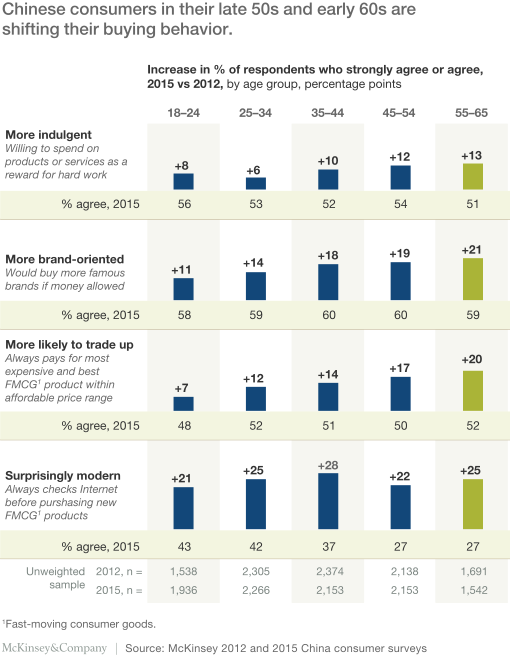
By 2015, the 55–65 age group had started to shift even faster than the rest of the population. For example, 52 percent of the people in this age group showed a preference for premium products, compared to just 32 percent in 2012. They leaped from being the most conservative age group to the one most likely to trade up. Similarly, the preference for famous brand names among these older buyers jumped by more than 20 percent, fully closing the previous difference among cohorts. As Exhibit 1 shows, these older consumers don’t shy away from indulgences, and they have grown more likely to use the Internet to research their purchases, even if they still do so less often than younger consumers.
Exhibit 1
That said, the upper age group has remained more pragmatic and cost conscious than any other age group, as we discuss in the following section.
The still-pragmatic consumer
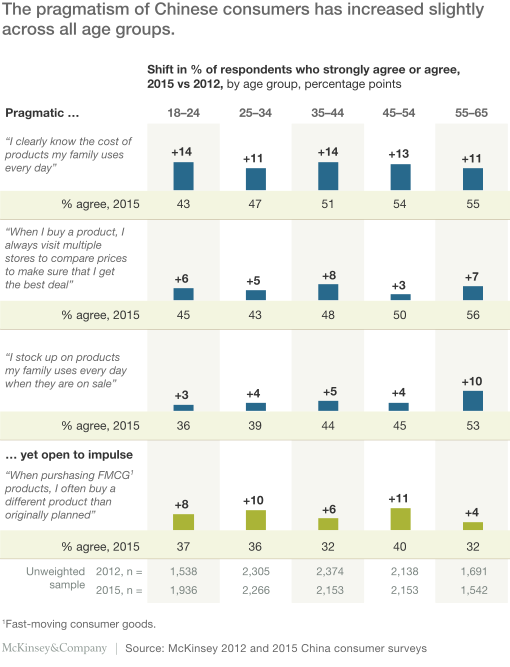
Back in 2011, even as we were predicting changes in the behavior and preferences of Chinese consumers, we also saw ways in which their essential pragmatism would likely stay the same. For instance, we anticipated that impulse buying would remain lower than in other countries and that value for money would continue to be an important consideration when choosing products and services. Interestingly, Chinese consumers across all age groups have, in some ways, become even more pragmatic. They’re now even more likely to compare prices across multiple stores, to be more price aware, and to stock up on promotions. That said, they’re now willing to buy more often on impulse (Exhibit 2).
Exhibit 2
The individual consumer
We also predicted that as Chinese consumers aspire to a better life and trade up their purchases, they would become more discerning and gradually more individualistic. This would lead, for example, to a shift toward more healthy choices, more user-friendly products, and products and brands that better fit their personality. This could be a big opportunity for niche brands—and a threat to the mass-market brands that had won big in previous years by using scale and ubiquitous availability, supported by the trust gained by heavy advertising.
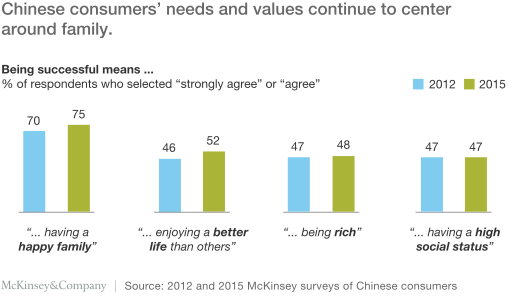
Our latest research certainly shows a decrease in consumption in categories deemed less healthy and a willingness to spend significantly more on health and more environmentally conscious categories. It also shows consumers are more likely to spend more to indulge themselves and more likely to try new technology. While their consumption choices have become more individualistic, though, it is important to note that family values continue to be at the top of their priorities (Exhibit 3).
Exhibit 3
One area our predictions missed, however, was by anticipating that consumers, as they became more individualistic in their choices, might focus less on basic product reliability and safety. Perhaps in part because of a number of more recent food scandals, however, consumers seemed more concerned with these issues in 2015 than they were before.
The increasingly loyal consumer
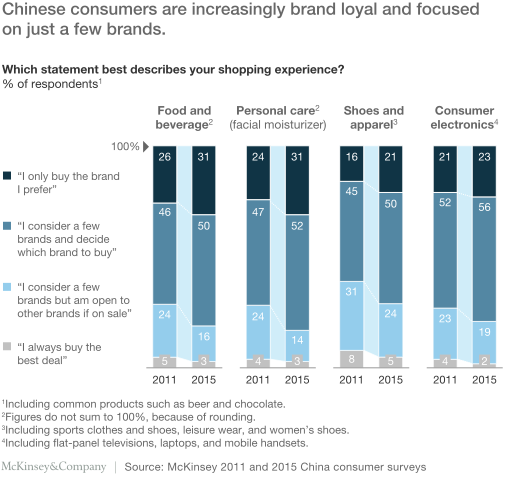
When our team first started researching Chinese consumers, nearly ten years ago, many of us were surprised by their fickle attitude toward brands. Fewer than half of consumers tended to stick with their favorite brands, compared, for example, with almost three quarters of US consumers.
As we debated this tendency while making our predictions, we wondered if, in the clash between pragmatism and individualism, brand loyalty would stay low, increase, or even decline. Ultimately, we decided it would increase as the emotional benefits of brands became more important to consumers and as increased choice and availability of branded products (online and off) would allow consumers to optimize for price and convenience without changing choices too often.
Our recent research confirmed the changes we anticipated. Consumers are now significantly less likely to buy a brand that is not already among their favorites, continuing the upward trend we observed in 2011 (Exhibit 4).
Exhibit 4
The modern shopper
Our 2011 predictions were bullish on e-commerce, predicting that Chinese consumers would adapt their channel choices even faster than has occurred in developed markets.
We estimated that by 2020, online consumer-electronics purchases would jump to 40 percent, from about 10 percent. More mainstream categories would rise to 15 percent, and some categories, such as groceries (now below 1 percent), could reach about 10 percent. These changes are occurring even as the enduring pragmatism and diligence of the Chinese consumer continue to be in place. Our latest research shows that consumers of all age groups are much more likely to collect information online, even on fast-moving consumer goods, than they were just three years ago.
In 2015, online food and beverages sales (excluding fresh) reached 7.2 percent: reaching our predicted 10 percent in five years looks very likely. The online share of consumer-electronic purchases, meanwhile, has reached a whopping 39 percent in 2015, and it now looks possible that by 2020 it will be about 50 percent of overall sales.
Looking from today’s perspective at our 2011 predictions, it is impressive to see the evolution of Chinese consumers—even as their most characteristic traits endure. Certainly, we’ll check in on their progress as we get ever closer to the year 2020. Making predictions may be difficult, especially about the future—as US Baseball Hall of Famer Yogi Berra famously observed. But they can still provide valuable foresight for executives.
While India may be known for its oppressive pollution, poverty and bureaucracy, it’s a better place to be sent to work than China or even the United States according to a recent survey.
An HSBC report that tried to break down what it’s like to be an expatriate in different countries this week surprisingly ranked India ahead of the world’s two biggest economies.
In its HSBC Expat Explorer 2016 report based on an online survey of 27,000 expats this year, the bank ranked India 26th out of 45 countries. While that is on the bottom half of the rankings, the U.S. did worse at 30th as did China at 34th.
How is that possible?
One factor was the Indian economy. Even though it is decades behind China and the U.S. it is still the fastest growing major economy in the world right now. That means globe-trotting executives and entrepreneurs don’t feel like they have been relegated to the backwaters when they work in India.
“More than half (51%) of expats in India believe the country is a good place for them to progress their career, compared with 42% across Asia-Pacific,” said the report, which ranked India 10th for “entrepreneurship,” better than China which got the 16th rank. India was also rated by expats as “a good place to start a business,” about 7% more than China in the region.
“Expats in India are also able to save more, with 44% saying that living there has accelerated their progress towards making longterm savings and investments, compared with 39% across the region,” said the report.
More important for the rankings this year though was family and friends.
The expats who responded to the HSBC survey gave India much higher marks in terms of ease of integrating with the locals as well as cost of raising children.
Of course the report also showed how India continues to underperform in many areas including quality of life and safety.India’s overall ranking slipped this year. Last year it was 17th out of 39 countries just below the U.S. but still better than China.
“The slight drop in India’s ranking is due to a range of factors, for example, expat parents in India have reported that the country is more expensive to bring up a child than last year,” said the bank when asked about India’s lower ranking this year.
Why did India, China and the U.S. perform worse than last year? That’s because they faced new competition from 6 other countries which were not a part of last year’s survey, including Norway and Austria which were ranked 6th and 7th in 2016.
On the top of the rankings this year was Singapore, New Zealand and Canada.








 CHINDIA ALERT: You'll be living in their world, very soon