Chindia Alert: You’ll be Living in their World Very Soon
aims to alert you to the threats and opportunities that China and India present. China and India require serious attention; case of ‘hidden dragon and crouching tiger’.
Without this attention, governments, businesses and, indeed, individuals may find themselves at a great disadvantage sooner rather than later.
The POSTs (front webpages) are mainly 'cuttings' from reliable sources, updated continuously.
The PAGEs (see Tabs, above) attempt to make the information more meaningful by putting some structure to the information we have researched and assembled since 2006.
When workers are paid differently for little reason, even the higher-paid ones are less productive and happy, a new study suggests.
Economists at Columbia University and University of California, Berkeley, have shown that workers seem to be highly averse to pay inequality, just as primatologist Frans de Waal’s capuchin monkeys famously threw food at their keepers when they were rewarded differently.The new study reveals a sharp drop in output, attendance and social cohesion among groups of workers paid differently compared with groups where everyone was paid the same.
In a study the authors claims is the largest such experiment ever conducted, 378 Indian workers—with differing levels of productivity—were trained and hired into month-long seasonal contract jobs, working in factories that produced low-tech items such as ropes and brooms.
They were organized in teams of three workers. All 378 were paid either 240 rupees ($3.59) a day to turn up to work, or 5% more or 5% less than that amount.
In most of the teams, the three workers were paid the same amount. But, crucially, in some, workers’ pay differed according to the workers’ individual levels of productivity (which had been determined earlier). This clever design meant the economists could compare the performance of workers who earned the same amount—either high, middle or low—but differed according to whether they were members of equally or unequally paid teams.
U.S. and UK tech startups welcome in China – with a little supervision Martin Anderson. Editor, The Stack, Friday 12th August
On August 1st Travis Kalanick, CEO and co-founder of Uber, finally admitted defeat regarding the company’s three-year crusade to gain a foothold in China, with the ‘merging’ (most consider it a ‘sale’) of Uber’s Chinese operations with local incumbent Didi Chuxing. Whatever Kalanick may have recovered from the concession, it seems unlikely that Uber will recoup the billions it has already poured into its most distant territory. But there was no alternative – by January of this year, the Uber board was urging that the ride-sharing giant – such an indefatigable combatant in so many contested territories – throw in the towel.
Ultimately Didi was going to win this battle; despite cash and equity of $28 billion vs Uber’s $68 billion, Didi had reserved $10 billion to strengthen its grip on this fundamental societal change in China – almost on a par with what the better-financed Uber was willing to invest.
A headline-grabbing contest of this nature gives the false impression of China as isolationist in terms of cooperating with global tech startups – it isn’t. The country runs a UK-China tech incubator in Shenzhen, backed by Tencent and providing crucial advice on the peculiarities of the Chinese market to Brit startups. The deal even offers free office space, business counsel and pitch opportunities. Whilst willing to repel boarders on the scale of Uber, China has no problem in contributing to a post-Brexit UK brain drain.
Likewise Alibaba runs a similar scheme to increase tech migration from the United States – almost impossibly tempting for new companies dazzled by the economy-of-scale that Chinese success promises, and struggling for attention in saturated home markets. Perhaps the most useful aspect of these international schemes is the business advice from native sources – western entrepreneurs see huge opportunities in Chinese numbers, yet fail to take account of national psychology; either on an individual level (the Chinese consumer), or at the level of a state which is well aware of its riches – and needs only as much western genius to exploit them as serves its future interests in the post-sharing economy.
The country could create sustainable economic conditions in five ways, such as promoting acceptable living standards, improving the urban infrastructure, and unlocking the potential of women.
Twenty-five years ago, India embarked on a journey of economic liberalization, opening its doors to globalization and market forces. We, and the rest of the world, have watched as the investment and trade regime introduced in 1991 raised economic growth, increased consumer choice, and reduced poverty significantly.
Now, as uncertainties cloud the global economic picture, the International Monetary Fund has projected that India’s GDP will grow by 7.4 percent for 2016–17, making it the world’s fastest-growing large economy. India also compares favorably with other emerging markets in growth potential. (Exhibit 1).
The country offers an attractive long-term future powered largely by a consuming class that’s expected to more than triple, to 89 million households, by 2025.Exhibit 1
Liberalization has created new opportunities. The challenge for policy makers is to manage growth so that it creates the basis for sustainable economic performance. Although much work has been done, India’s transformation into a global economic force has yet to fully benefit all its citizens. There’s a massive unmet need for basic services, such as water and sanitation, energy, and health care, for example, while red tape makes it hard to do business. The government has begun to address many of these challenges, and the pace of change could accelerate in coming years as some initiatives gain scale.
From our vantage point, India has an exciting future. In the new McKinsey Global Institute report India’s ascent: Five opportunities for growth and transformation, we look at game-changing opportunities for the country’s economy and the implications for domestic businesses, multinational companies, and the government. The five areas we focus on by no means provide a comprehensive assessment of India’s prospects, but we believe they are among the most significant trends. Foreign and Indian businesses would do well to recognize these opportunities and reflect on how to exploit them.
1. From poverty to empowerment:
Acceptable living standards for allThe trickle-down effect of economic liberalization has lifted millions of Indians from indigence in the past two decades. The official poverty rate declined from 45 percent of the population in 1994 to 22 percent in 2012, but this statistic defines only the most dismal situations. By our broader measure of minimum acceptable living standards—spanning nutrition, water, sanitation, energy, housing, education, and healthcare—we find that 56 percent of Indians lacked the basics in 2012.
The country will need to address these gaps to achieve its potential. The task is certainly within India’s capacity, but policy makers will have to promote an agenda emphasizing job creation, growth-oriented investment, farm-sector productivity, and innovative social programs that help the people who actually need them. The private sector has a substantial role to play both in creating and providing effective basic services.
2. Sustainable urbanization:
Building India’s growth enginesBy 2025, MGI estimates, India will have 69 cities with a population of more than one million each. Economic growth will center on them, and the biggest infrastructure building will take place there. The output of Indian cities will come to resemble that of cities in middle-income nations (Exhibit 2).
In 2030, for example, Mumbai’s economy, a mammoth market of $245 billion in consumption, will be bigger than Malaysia’s today. The next four cities by market size will each have annual consumption of $80 billion to $175 billion by 2030.Exhibit 2To achieve sustainable growth, these cities will have to become more livable places, offering clean air and water, reliable utilities, and extensive green spaces. India’s urban transformation represents a huge opportunity for domestic and international businesses that can provide capital, technology, and planning know-how, as well as the goods and services urban consumers demand.
3. Manufacturing for India, in India
Although India’s manufacturing sector has lagged behind China’s, there will be substantial opportunities to invest in value-creating businesses and to create jobs. India’s appeal to potential investors will be more than just its low-cost labor: manufacturers there are building competitive businesses to tap into the large and growing local market. Further reforms and public infrastructure investments could make it easier for all types of manufacturing businesses—foreign and Indian alike—to achieve scale and efficiency.
4. Riding the digital wave:
Harnessing technology for India’s growthTwelve powerful technologies will benefit India, helping to raise productivity, improving efficiency across major sectors of the economy, and radically altering the provision of services such as education and healthcare. These technologies could add $550 billion to $1 trillion a year of economic value in 2025, according to our analysis, potentially creating millions of well-paying, productive jobs (including positions for people with moderate levels of formal education) and helping millions of Indians to enjoy a decent standard of living.
5. Unlocking the potential of Indian women: If not now, when?
Our research suggests that women now contribute only 17 percent of India’s GDP and make up just 24 percent of the workforce, compared with 40 percent globally. In the coming decade, they will represent one of the largest potential economic forces in the country. If it matched the progress toward gender parity of the region’s fastest-improving country, we estimate that it could add $700 billion to its GDP in 2025. Movement toward closing the gender gap in education and in financial and digital inclusion has begun, but there is scope for further progress.
Public-sector efforts to address the five areas are under way. The government is attempting to improve the investment climate and accelerate job creation—India’s ranking on the World Economic Forum’s Global Competitiveness Report climbed to 55 in 2015–16, from 71 a year earlier. Officials are moving to make the government more efficient, using technology that can leapfrog traditional bottlenecks of a weak infrastructure. One billion Indian citizens, for example, are now registered under Aadhaar, the world’s largest digital-identity program and a potent platform for delivering benefits directly to the poor.
Realizing India’s promise will require national, state, and local leaders to adopt new approaches to governance and the provision of services. To meet the people’s aspirations, these officials will also need new capabilities. The requirements include private sector–style procurement and supply-chain expertise, deep technical skills for planning portfolios of infrastructure investments, and strong project-management capabilities to ensure that large capital projects finish on time and on budget. Training will be needed to help staff members use digital technologies to automate and reengineer processes, manage big data and advanced analytics, and improve interactions among citizens through digitized touchpoints, online-access platforms, portals, and messaging and payment platforms. The government could acquire these capabilities by adopting quality-oriented procurement policies and taking advantage of secondments from the private sector. For businesses, India represents a sizable market but will require a granular strategy and a locally focused operating model.
No single report can capture all the changes taking place in the country, but we have tried here to identify the most significant trends. Foreign and Indian businesses should consider how their strategies will be influenced by them. Policy makers should focus on helping all stakeholders to capitalize on them. By any measure, the challenge is daunting, but success could give a historic boost to India’s economy.
For two days in row, Chinese swimmer Fu Yuanhui clambered out of the Olympic pool in Rio clueless about her breakthrough performances: breaking personal records and clinching a bronze medal.
Each time a poolside reporter had to break the news to the bubbly 20-year-old, whose vivacious epiphanies on live television have broken the Chinese internet.“I was so fast! I’m really pleased!” Ms. Fu exclaimed Monday after learning that she swam the 100-meter backstroke semifinal in 58.95 seconds, a new personal best. “I’ve already… expended my primordial powers!”
After Tuesday’s final, when told that she trailed the silver medalist by just 0.01 second, Ms. Fu replied, “Maybe it’s because my arms are too short.”
Her gleeful candor made her an overnight online sensation. Fans feted her as “Primordial Girl” in online memes and viral videos spoofing her exuberant expressions. Her Weibo microblog following swelled more than sixfold to 3.8 million users.
China has a new sports star, and never mind that she didn’t finish first. In a country long obsessed with winning gold medals, Ms. Fu’s newfound fame seemed to signal shifting social perceptions about the meaning of sport.
“‘Primordial Girl’ and the netizens who appreciate her have taught all of us a lesson: sport is about the struggle and, especially, enjoyment, but most definitely not about spinning gold,” the Communist Party’s flagship newspaper, People’s Daily, said in a Tuesday commentary.
“The warm support from netizens,” according to the newspaper, “shows that public attitudes toward competitive sport and the Olympics have sublimated to a higher level.
”Ms. Fu’s fans, for their part, credited her “authentic” demeanor, which contrasted with the mild mien typical of Chinese Olympians. “We love your happy optimism and strong personality,” a Weibo user wrote on Ms. Fu’s microblog. “That’s what makes a true athlete.
”Winning used to be everything for China’s Olympians, virtually all of whom came through a grueling state-run sports regime that fetishized success. Athletes who strike gold can expect fame and fortune, while those who disappoint often suffer neglect or even ignominy.
Liu Xiang, a hurdler who became the first Chinese man to win an Olympic gold in athletics at the 2004 Athens Games, saw public adulation turn into anguish and anger at the Beijing Games four years later, when an injury forced him to withdraw just before running his first race.E
China nonetheless crowned a grandly staged Beijing Olympics by topping the gold-medal tally for the first time, with 51 in all. Their gold haul dropped to a second-place 38 at the 2012 Games in London, and some Chinese pundits expect a further slip in Rio, to between 30 and 36.
State media, for its part, has tried to manage public expectations about China’s ebbing gold rush.
“As we mature in mentality, learn how to appreciate competition, and become able to calmly applaud our rivals, we’d showcase the confidence and tolerance of a great country,” state broadcaster China Central Television said Sunday in a Weibo post after a goldless first day.
“We still need our first gold medal to boost morale, but what we really need is to challenge ourselves, surpass ourselves,” CCTV said. By Tuesday Chinese athletes had racked up eight golds, alongside three silvers and six bronzes.The message seems to be filtering through, with many Chinese fans appearing more tolerant of athletes who underperformed.
Among the beneficiaries was Ning Zetao, a swimmer who won widespread popularity at last year’s world championships with his boyish good looks—and a 100-meter freestyle gold.
After crashing out of the same event in Rio at the semifinal stage on Tuesday, the 23-year-old appeared philosophical about his failure.
“I’ve done my best,” he told a CCTV reporter.
His comments found a receptive audience among his Weibo fandom. “This is Ning Zetao’s first time participating in the Olympics,” one user wrote. “Don’t give him too much pressure!”
5 Sectors That Will Benefit From India’s Proposed Tax OverhaulIndia’s upper house of Parliament on Wednesday approved an overhaul of the country’s tax system that, if passed in the lower house, will lead to the implementation of a nationwide goods-and-services tax, or GST.
The GST will make cars more affordable in India as it will reduce the taxes levied on the vehicles.India currently has four factory-gate tax rates of 12%, 24%, 27% and 30%, depending on the vehicle’s specifications. On top of that, there are value-added taxes, which range from 12.5% to 14.5%.
The GST will subsume all theses levies into one and passenger vehicles will likely fall into one of two tax bands: 18% to 20% for regular cars, and up to 40% for luxury autos.
2 Logistics
Haulage and logistics companies will be able to reduce transit hours because the simplified system will mean that their drivers won’t have to wait for so long at borders to pay levies.
Currently, some companies use smaller transporters that charge lower fees because they are able to avoid paying taxes due to the inefficient system. But a more transparent tax system will mean the smaller companies are more likely to pay, leveling the field for larger players.
India’s leading 10 listed logistics companies command less than 5% of the overall market, according to a KPMG report. Stocks of some companies such as AllCargo Logistics Ltd. and Transport Corp of India Ltd. have gained more than 15% in the past month in anticipation of the passage of the GST legislation.
3 Media and entertainment
Cinema multiplex operators now pay entertainment taxes as well as several other levies to federal and state governments. The entertainment tax can be as high as 27% and operators must pay that as well as a service tax of about 15% on advertising revenue.
GST is expected to cut that tax bill, lowering operational costs and boosting margins.
Motilal Oswal Securities says that a GST rate of 18% may improve operating profit of PVR, the largest listed multiplex operator, by as much as 26%.
4 Retail
Consumers’ disposable income is expected to rise in the medium term if the GST rate turns out to be lower than current levies, boosting demand.
A more efficient tax system will also mean that market-stall owners and roadside vendors are more likely to pay tax, analysts say. That will create a more level playing field for larger shops and retailers who already pay.
The retail sector will likely also benefit from lower logistics costs as well as a fall in rental costs. Retailers currently shell out about 10%-15% of their operating expenditure on rent and infrastructure services, on which service tax is levied. But that levy would be reduced post-GST, benefiting retail companies like Future Enterprises Ltd. and Shoppers Stop Ltd.
5 Cement
Overall tax for the cement sector will likely to come down if the GST rate is set at 18%, Kotak Securities says.
After the implementation of the uniform tax, cement companies would likely pay about 920 rupees ($13.78) in tax per ton, down from about 1,320 rupees currently, the broker says. It also expects cement firms to benefit from a more efficient logistics system. This will cut costs for consumers and also help the government achieve its aim to provide housing for all by 2022.
In mid-2013, the trio decided to devise solar air conditioners based on their previous experience in the market but, after some pilots, they discovered the idea was commercially unviable.
From the ashes of their second enterprise, they did manage one small gain — a connected controller that reduced energy use by 30% during the night. Using this, they pushed their entrepreneurial energy in a new direction — towards the rapidly emerging opportunity in the internet of things (IoT) , or devices and objects that send and receive data over the internet. Rather than build large systems for this, their new venture Oakter is thinking much smaller. It is building out a series of IoT-based devices to “smarten” homes across India.
In around two years of operation, Oakter’s controllers have smartened some 10,000 gadgets, claims Shishir Gupta, without disclosing the number of homes his controllers have been installed in currently. The startup’s full launch hasn’t even happened, he says, since it is still reaching out informally to consumers. Around Diwali this year, Oakter is expected to make a big-bang offline launch and expects to reach 10,000 homes in a year and revenues of Rs 100 crore by 2018-19.
“Within 10 years, IoT will transform the way we manage our lives,” says Shishir. There are plenty of data points to back his enthusiasm. In 2008 itself, there were more objects connected to the internet than people, and technology researcher Gartner forecasts that by 2020 there will be nearly 21 billion connected devices. If the ATM was perhaps the first popular connected device in the early 1970s, hundreds of companies have since shown an interest in getting wired up.
IoT’s the Thing
In the US, the largest technology market, there has been a mixed response to various kinds of IoT. According to CB Insights, a tracker of this kind of deal data, deal volume is on track to surpass 2015’s total by 30%. Fundingwise, 2016 should be a robust year for IoT in the West, and the second year in a row of $1.2 billion-plus in funding. Several startups in the field raised significant amount of funding, including IoT software and services company Greenwave Systems ($45 million Series C), commercial drone developer Airware ($30 million Series C), and connected HVAC and lighting company Enlighted ($25 million Series D financing).However, deal flow looked less upbeat on a quarterly basis, with both value and volume declining in the second quarter of 2016. After an increase in the first quarter with 54 transactions, deal-making fell 26% quarter-over-quarter. And funding fell from $328 million to $325 million — a 9% quarter-on-quarter decline. At a global level, there is massive potential.
According to a statement from Gartner’s research chief Peter Sondergaard, the incremental revenue generated by IoT suppliers is estimated to reach $309 billion per year by 2020. This growth opens up new business opportunities, as half will be attributed to new startups and 80% will be in services, not products. Manufacturing, healthcare and insurance are expected to lead the IoT race.
Some of this entrepreneurial interest is being generated in India, too. For example, in May this year, Entrepreneurship and Venture Capital (EVC), an early stage investor, launched a $50 million unit to focus on IT.
Qualcomm Ventures, the VC arm of the global chipmaker, recently unveiled its $150 million India fund and made its first investment of $10 million in healthcare IoT venture Attune Technologies. In early July, a centre of excellence for IoT was launched jointly by software industry lobby Nasscom, the department of electronics and information technology and the Education and Research Network. This centre can house up to 40 startups and the model is expected to be replicated nationwide.
An Indian government body has recommended provisional anti-dumping duty on imports of hot-rolled steel products, a government statement said on Tuesday, to reduce overseas purchases of the alloy and shield local mills.
The anti-dumping duty will come into effect after New Delhi formally notifies the tax.
The Directorate General of Anti Dumping recommended the duties on steel products from China, Japan, South Korea, Russia, Brazil and Indonesia, the statement said.Indian steelmakers such as the Steel Authority of India (SAIL.NS) , JSW Steel (JSTL.NS) and Tata Steel (TISC.NS) had lobbied for protectionist measures to prevent cheap overseas purchases that were undercutting local mills and squeezing margins.
A Donald Trump presidency could help India, according to a panel of India’s top strategic thinkers.
The businessman and television personality, known for his pledge to shake up the global status quo and “make America great again,” could help Indian business by squashing free-trade deals that disadvantage the South Asian nation and while also opening up a larger role for India’s military, speakers at a Brookings India event in Delhi said Monday.
Mr. Trump’s plan to make Asian allies pick up more of the slack for defense spending in the region would “open up a huge amount of space for India” in global affairs, said C. Raja Mohan, director of Carnegie India.
Meanwhile, Mr. Trump’s opposition to the Trans Pacific Partnership would also be a bonus for India, which never signed the deal, said Brookings India’s Harsh V. Singh. Mr. Trump says such deals disadvantage U.S. workers. Many Indian companies “would breathe a sigh of relief” if the trade deal, which favors signatories like Vietnam and Malaysia over India, was squashed, Mr. Singh said.
Mr. Trump has already sent jitters through the Asian security community by saying: “Many countries are not paying their fair share,” for U.S. military protection. By contrast his opponent Hillary Clinton, is seen as someone who would most likely leave relationships unchanged with major allies.
For India, which has no U.S. military bases on its soil, the prospect of life with a diminished American presence in east Asia and the Middle East would mean a sharpening of divisions in the region, but also allow it to expand its influence and invent a new global role for itself, said Mr. Mohan.
The changes could be as large as those that accompanied the withdrawal of the British military from the region post World War II, a shift that saw the birth of modern India in 1947, he said.
Still, if Mr. Trump wins office, he will likely withdraw U.S. support and investment for Indian renewable energy, the Hindustan Times’ Foreign Editor Pramit Pal Chaudhuri said. Protectionist policies could be “a disaster” for the global economy, triggering a spate of trade wars, Mr. Chaudhuri said.
Chronically low oil prices are disrupting a critical financial lifeline across Asia and depriving economies of much-needed hard currency.
The flow of cash, or remittances, from Asian citizens working in the Gulf soared when the price of oil was high, boosting growth across the board. The billions of dollars in annual inflows paid for necessities such as schooling and health care and helped propel families into the middle class for the first time.
Now that money is disappearing, perhaps permanently, as laborers lose work in oil-driven Mideast countries. That’s adding a new threat to growth in some Asian nations and depriving them of currency inflows they need to balance their national accounts and keep their currencies from depreciating too quickly.
A barrel of Nymex crude is now trading at around $41, up from below $30 earlier this year. But prices are a long way from the peak of the boom and aren’t expected to return to previous highs soon. In February 2014, a barrel of crude cost more than $100.
Demonstrating the pressures of sustained low prices, thousands of Indian workers protested in Saudi Arabia on Saturday at being left without jobs, pay and food after they were laid off. The Indian government stepped in over the weekend to hand out food to hungry workers.
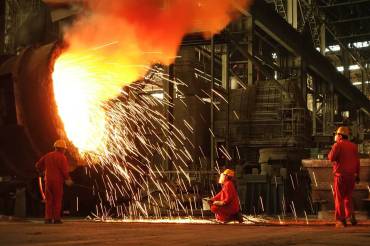
China’s steel industry is a test case for the nation’s ability to restructure overbuilt parts of the economy, and so far it’s not going very well.
Seven months into 2016, China has cut just 30% of the 45 million tons of steel capacity it has pledged to pare this year. And a Renmin University study found that more than half of China’s steel companies are “zombies.
”They define zombie firms as companies that have received below-market interest rates for two years running — a sign that they are being artificially propped up by their local governments or other government financing. Essentially, they are dependent on cheap financing to stay alive.Steel firms led the list, with 51.4% zombies in the sector, followed by the property sector, with 44.5% zombies and construction with 31.2%.
Renmin economists said local governments long nurtured sectors such as steel with the central government’s blessing. Now that the pressure is on to scale back, they tend to resist central government calls for cuts, given the impact on jobs, local economic growth and officials’ promotions, economists say.
An indication of that resistance is seen in recent data. Despite calls from Prime Minister Li Keqiang on down to turn off blast furnaces and shutter steel production lines, the industry posted record daily crude steel production in June, driven by easy money policies and a speculation-fueled upturn in the property market — which is itself suffering from overcapacity. Industry Vice Minister Fei Feng told reporters this week he didn’t expect a recent rebound in steel prices to last.
“For the purpose of political performance and maintaining stability, local governments continued to give blood to those zombie firms in various forms that were on the brink of bankruptcy,” the Renmin report said, adding that governments should interfere less in how companies operate and accelerate reform of state companies.
Officials have blamed this year’s slow progress on capacity trim on the lengthy negotiations required to allocate those cuts among China’s 28 provincial governments.
China, which accounts for half of global steel production, remains confident it will fulfill capacity cut targets for 2016, industry Vice Minister Feng told reporters, adding that the reductions so far this year are in line with expectations.
In all, China has vowed to cut up to 150 million tons of extraneous steel production over the next five years. Even that goal targets only 10% of the nation’s excess steel capacity, which is currently around 30%, according to industry analysts. This comes as rising exports fuel tension with overseas companies and labor groups alleging that China is selling steel at prices below its cost of production.
Beijing’s counter argument is a bit of a circular one: The problem isn’t that China is making too much steel, but that global demand is inadequate.
A disproportionate number of steelmakers are state-owned enterprises, a group that accounts for some 55% of China’s corporate debt but only produces 22% of economic output, according to International Monetary Fund data. China’s corporate debt hit approximately 145% of gross domestic product in 2015, up from less than 100% in 2007, according to the International Monetary Fund, a level it characterized as “high by any measure.
”Across all sectors, zombie firms make up 7.5% of the 800,000 industrial companies between 2005 and 2013 that Renmin studied, down from a peak of about 30% in 2000 shortly before China embarked on its last serious reform of the state sector. President Xi Jinping has called for state companies to remain a core part of China’s economy.
As companies age, they are increasingly likely to become zombies. About 30% of firms founded more than three decades ago qualify as zombie firms, according to Renmin’s research, compared with just 3% among firms with less than five years’ history.


 Liberalization has created new opportunities. The challenge for policy makers is to manage growth so that it creates the basis for sustainable economic performance. Although much work has been done, India’s transformation into a global economic force has yet to fully benefit all its citizens. There’s a massive unmet need for basic services, such as water and sanitation, energy, and health care, for example, while red tape makes it hard to do business. The government has begun to address many of these challenges, and the pace of change could accelerate in coming years as some initiatives gain scale.
 In 2030, for example, Mumbai’s economy, a mammoth market of $245 billion in consumption, will be bigger than Malaysia’s today. The next four cities by market size will each have annual consumption of $80 billion to $175 billion by 2030.Exhibit 2To achieve sustainable growth, these cities will have to become more livable places, offering clean air and water, reliable utilities, and extensive green spaces. India’s urban transformation represents a huge opportunity for domestic and international businesses that can provide capital, technology, and planning know-how, as well as the goods and services urban consumers demand.





 CHINDIA ALERT: You'll be living in their world, very soon