Posts tagged ‘United States’

23/04/2012

* GM to Add 600 China Dealerships

WSJ: “General Motors Co. plans to add 600 dealerships in China this year, about a 20% increase, as the auto maker looks to bolster its presence here amid growing competition and an economic-growth slowdown.Chief Executive Dan Akerson on Monday outlined steps GM is taking to boost sales and market share in China, where it is the largest foreign auto maker.

The addition of 600 dealerships would bring the companys dealer network in China to 3,500 stores, up from 2,900 at the end of 2011.  At that size, Chinas dealers would begin to rival the companys U.S. network of 4,400.

GM is adding new models and factory capacity and expanding a technology center near its China headquarters in Shanghai, which will soon be its second-largest global development center. The largest is in Warren, Mich., near its Detroit headquarters. Like GM, many of the worlds major auto makers are expanding in China, concentrating on a market expected to grow to more than 30 million vehicle sales by the end of the decade from 18.5 million last year.”

via GM to Add 600 China Dealerships – WSJ.com.

If you are looking for a business opportunity in China, go for a tyre franchise. The vast majority of Chinese cars have yet to have their first set of tyres replaced!

22/04/2012

* Time to Start Thinking by Edward Luce

Time to Start Thinking is a book destined to spark debate among liberals and conservatives alike. Drawing on his decades of exceptional journalism and his connections in Washington and around the world, Luce advances a carefully constructed and controversial argument that America is losing its position at the top of the world’s pecking order. He supports this argument with his interviews with key players in politics and business, from U.S. senators, senior White House officials, Fortune 100 chief executives, and many others, including Bill Gates and Admiral Mike Mullen.

Luce’s central thesis is that America is sleepwalking into economic and geopolitical decline. In a tightly argued book, Luce turns his attention to a number of critical issues set to determine America’s future: the changing structure of the U.S. economy, the continued polarization of American politics, the debilitating effect of the “permanent election campaign,” the challenges involved in the overhaul of the country’s public education system, the desperate situation facing America’s middle class, and the health of American innovation in technology and business.

His conclusion investigates America’s dwindling options in a world where the pace is increasingly being set elsewhere. Luce turns particular attention to Washington—he identifies the city’s insidious lobbying culture, the politicians’ constant need to fund raise, and the lack of bipartisanship as key stumbling blocks to an effectively functioning political system.

As distressing as it is important, Time to Start Thinking presents an America in economic, social, and political crisis. Those unwilling to face up to this reality may be tempted to blindly trust in American exceptionalism—but Luce argues that it is American pragmatism that will be the key to securing America’s future, if it is to be secured.

via Time to Start Thinking by Edward Luce.

Related article: http://www.nytimes.com/2012/04/08/books/review/time-to-start-thinking-by-edward-luce.html?pagewanted=all

From my limited understanding of Americans, I suspect that more non-Americans than Americans will bother to read this book. Which will be a great shame.

16/04/2012

* US Alert as China’s Cash Buys Inroads in Caribbean

New York Times: “A brand new $35 million stadium opened here in the Bahamas a few weeks ago, a gift from the Chinese government. The tiny island nation of Dominica has received a grammar school, a renovated hospital and a sports stadium, also courtesy of the Chinese. Antigua and Barbuda got a power plant and a cricket stadium, and a new school is on its way. The prime minister of Trinidad and Tobago can thank Chinese contractors for the craftsmanship in her official residence.
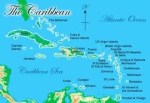
China’s economic might has rolled up to America’s doorstep in the Caribbean, with a flurry of loans from state banks, investments by companies and outright gifts from the government in the form of new stadiums, roads, official buildings, ports and resorts in a region where the United States has long been a prime benefactor.

The Chinese have flexed their economic prowess in nearly every corner of the world. But planting a flag so close to the United States has generated intense vetting — and some raised eyebrows — among diplomats, economists and investors. “When you’ve got a new player in the hemisphere all of a sudden, it’s obviously something talked about at the highest level of governments,” said Kevin P. Gallagher, a Boston University professor who is an author of a recent report on Chinese financing, “The New Banks in Town.”

Most analysts do not see a security threat, noting that the Chinese are not building bases or forging any military ties that could invoke fears of another Cuban missile crisis. But they do see an emerging superpower securing economic inroads and political support from a bloc of developing countries with anemic budgets that once counted almost exclusively on the United States, Canada and Europe.

China announced late last year that it would lend $6.3 billion to Caribbean governments, adding considerably to the hundreds of millions of dollars in loans, grants and other forms of economic assistance it has already channeled there in the past decade. Unlike in Africa, South America and other parts of the world where China’s forays are largely driven by a search for commodities, its presence in the Caribbean derives mainly from long-term economic ventures, like tourism and loans, and potential new allies that are inexpensive to win over, analysts say.

American diplomatic cables released through WikiLeaks and published in the British newspaper The Guardian quoted diplomats as being increasingly worried about the Chinese presence here “less than 190 miles from the United States” and speculating on its purpose. One theory, according to a 2003 cable, suggested that China was lining up allies as “a strategic move” for the eventual end of the Castro era in Cuba, with which it has strong relations.

via U.S. Alert as China’s Cash Buys Inroads in Caribbean – NYTimes.com.

While the US is trying to encroach on China’s backyard with military alliances with Australia and other South Pacific nations, China is encroaching the US backyard too, but with stadiums, roads and other civilian projects.

03/04/2012

# Does a country’s national games mimic its mindset?

Chess Set (Shatranj in Iranian), glazed fritwa...

Chess Set (Shatranj in Iranian), glazed fritware, 12th century. New York Metropolitan Museum of Art. (Photo credit: Wikipedia)

I have a hypothesis that a country’s mindset mimics its national sports and games.

For instance, the Chinese and Japanese are keen on chess and Go. These are games of strategy and take a long-term view. Indians say they invented chess. In any case they do play it well. Perhaps not as good as the Russians. Wonder why the Russians lost the ‘cold war’?

The British play soccer – a very dynamic game, but also cricket which is one of strategy and patience. These games may explain the divergent behaviour of the British – colonial conqueror and commonwealth sustainer?

Americans love their football and baseball. Both are what I call start and stop games. You play a set of tactics and then regroup. I wonder if that explains the lack of clear success in wars like Iraq and Afghanistan?

The Middle East used to play a game from which polo was derived. Their game involved riding on horses and trying to capture and throw the head of a goat (or in medieval times, the head of a defeated enemy) into the opponents’ goal. Individual courage and devil-may-care ruled the tactics. Perhaps that means the West will never ‘win’ in Iraq and Afghanistan.

Don’t forget that Iran has both Middle East roots and also claim to have invented chess. The term ‘check mate’ comes from ‘shah mat‘ meaning the king is dead in Farsi.

What do you think of my hypothesis? What are India’s national games? Kabaddi? Hockey? Cricket? How do these explain the Indian mindset?

See also: 


30/03/2012

* China driving US exports

China Daily: “The United States exported more than $100 billion in goods and services to China in 2011 and 30 states now count the country as one of their top three export markets.That’s according to a report released by the Washington-based US-China Business Council on Wednesday.

Between 2000 and 2011, US exports to China rose by 542 percent – going from $16.2 billion in 2000 to a record $103.9 billion in 2011 – while its exports to the rest of the world only increased by 80 percent. After the recent recession, the US exports to China regained momentum faster than the country’s exports to any other place in the world, the council said.”The annual report said China is the third most common destination for US exports, just behind Canada and Mexico, which border the US and have a free-trade agreement with it.

“Exports to China are vital to America’s economic health and create good jobs for American workers,” said Erin Ennis, vice-president of the US-China Business Council, which represents about 240 American companies doing business in China. Wang Haifeng, director of international economics at the Institute for International Economic Research, a think tank under the National Development and Reform Commission, said the export figures reveal a great opportunity. “The fact that a record was set in US exports to China, which shows the great potential of US exports, not only reduces the trade imbalance between the top two economies but also alleviates unemployment in the US and speeds up the US economic recovery,” he said.

Related articles: China’s Surprising U.S. Buying Spree – Businessweek (businessweek.com)via China driving US exports|Economy|chinadaily.com.cn.

There are some Cassandra’s who are concerned that in the foreseeable future, military conflict between America and China is inevitable. My personal view is that as more and more bilateral trade between America and China builds up, the chance of war between them becomes less and less probable. The two countries are so interdependent that war between them would be tantamount to ‘civil war’. You might say that has happened in most countries sometime in their past. You will be right. So I’m not saying peace is inevitable or forever, only that war is not inevitable and less likely.

21/03/2012

* US exempts 11 states from Iran sanctions; China, India excluded

Reuters: “The United States exempted Japan and 10 EU nations from financial sanctions because they have significantly cut purchases of Iranian oil, but left Iran’s top customers China and India exposed to the possibility of such steps.

The decision means banks in these countries have been given a six-month reprieve from the threat of being cut off from the U.S. financial system under new sanctions designed to pressure Iran over its nuclear program.

The list did not include China and India, Iran’s top two crude oil importers, nor U.S. allies South Korea and Turkey, which are among the top-10 consumers of Iranian oil.

Japan, China and India combined buy close to half of Iran’s crude exports of 2.6 million barrels a day, providing crucial foreign exchange for the OPEC member.”

via U.S. exempts 11 states from Iran sanctions; China, India exposed | Reuters.

14/03/2012

* 40 years on: senior US diplomat recalls China trip as “single most dramatic, important event” in career

Extract from Xinhua: “For 74-year-old Winston Lord, former U.S. assistant secretary of state, his trip to China with former U.S.

English: US President Richard Nixon and Chines...

President Richard Nixon 40 years ago was “the single most dramatic and most important event” in his decades-long career. …

Years of hostility between China and the United States dispersed after Nixon’s world-stunning visit to China on Feb. 21, 1972, allowing the most powerful country and most populous one in the world to join hands in carving out a new future.

Lord, then a top aide to U.S. National Security Adviser Henry Kissinger and the first U.S. official to visit China after 22 years of mutual hostility and isolation, was proud of first secret trip to China in 1971.

“We were flying secretively from Pakistan to Beijing on a Pakistani plane, and as the plane got close to the Chinese air space, border, I was in the front of the plane, and Dr. Kissinger was in the back of the plane, so as we went into Chinese territory, I was the first. I always told everyone, and Kissinger agrees, that I was the first American official to visit China in 22 years,” said a beaming Lord.”

via Senior U.S. diplomat recalls China trip as “single most dramatic, important event” in career – Xinhua | English.news.cn.

Just over 40 years ago, President Nixon visited China, started ‘ping pong’ diplomacy and giant panda diplomacy. The rest, dear friends, as they say, is history. Nixon may have been dishonoured for the Watergate affair. But history, hopefully, will remember him well for inviting China to rejoin the modern world.

04/03/2012

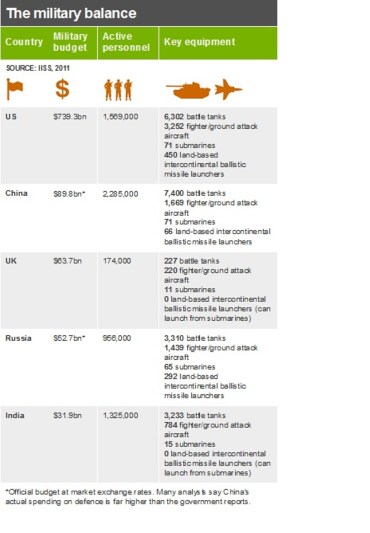
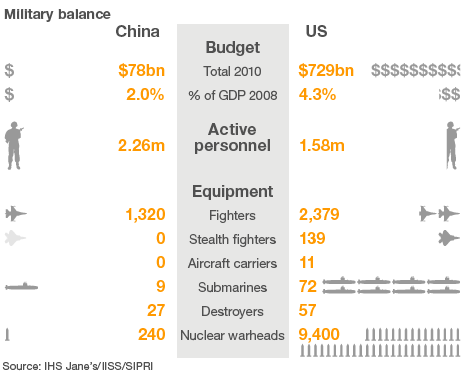
* Chinese defence budget exceeds $100bn (against US budget of over $700bn)


Extract from Xinhua: “China said Sunday it plans to raise its defense budget by 11.2 % to 670 billion yuan (106.4 billion U.S. dollars) in 2012. …

China’s military spending mainly comprises the living expenditures of service people, expenses for training and maintenance, and spending on equipment, he said. The costs for research, experiment, procurement, repair, transport and storage of all weapons and equipment, including new types of weapons, are included in the defense budget that is published every year, the spokesman said.

… Compared to other major countries, China’s military spending is low given its population of 1.3 billion, vast land area and long coastlines, Li said. While China’s military spending amounted to 1.28 % of its GDP in 2011, that of the United States, Britain and other countries all exceed 2 %, said Li. …

By June last year, China had sent a total of 2,044 peace-keeping personnel to 12 peace-keeping zones around the world, and the Chinese navy has sent escort vessels to the Gulf of Aden and waters off the coast of Somalia to protect thousands of commercial vessels from China and other countries, according to Li.”

http://news.xinhuanet.com/english/china/2012-03/04/c_131445012.htm

See also: https://chindia-alert.org/political-factors/geopolitics-chinese/

A significant rise. But still less than 1/7 of US spend, though the latter is expected to halve over the next few years. Also, salary and living expenses for up to 3 million service personnel does cost a pretty penny!


03/03/2012

* US military ties with India growing

Times of India: “Ties between the US and Indian militaries are growing, a senior defense official said on Friday, noting recent bilateral security talks between the two countries reaffirmed the partnership and the growing US interest in advancing it.

Acting under secretary of defense for policy James Miller joined Indian defense secretary Shashi Kant Sharma in co-chairing the 12th annual US-India defense policy group dialogue in New Delhi Feb 21 and 22.”

http://timesofindia.indiatimes.com/india/Military-ties-with-India-growing-US/articleshow/12121013.cms

Undoubtedly another attempt at ‘encircling’ China policy by US. Earlier this year US and Australia agreed closer military cooperation. This will, no doubt, cause some reaction from the Chinese military eventually.

Law of Unintended Consequences

continuously updated blog about China & India

ChiaHou's Book Reviews

continuously updated blog about China & India

What's wrong with the world; and its economy

continuously updated blog about China & India