Posts tagged ‘Uyghur people’

01/12/2013

China claims territories of 23 countries, but only has borders with 14

This article does not give a source ref. However, if it is correct, then together with the new “air defence zone” (https://chindia-alert.org/2013/12/01/china-japan-and-america-face-off-the-economist/), the requirement for Uighur students to demonstrate “approved political views” (https://chindia-alert.org/2013/12/01/xinjiang-college-says-approved-political-views-needed-to-graduate-reuters/) and recent spar with India (https://chindia-alert.org/2013/12/01/china-india-spar-over-disputed-border-reuters/) all point to a new belligerent China. Not good news at all for the world community.

See also: https://chindia-alert.org/political-factors/chinese-tensions/

04/11/2013

In China’s Xinjiang, poverty, exclusion are greater threat than Islam | Reuters

If the analysis in this report is correct, then it is good news for China and Xinjiang. Alleviating poverty is difficult, but far easier than eliminating religious extremism.

“In the dirty backstreets of the Uighur old quarter of Xinjiang\’s capital Urumqi in China\’s far west, Abuduwahapu frowns when asked what he thinks is the root cause of the region\’s festering problem with violence and unrest.

A police officer stops a car to check for identifications at a checkpoint near Lukqun town, in Xinjiang province in this October 30, 2013 file photo. REUTERS/Carlos Barria/Files

\”The Han Chinese don\’t have faith, and the Uighurs do. So they don\’t really understand each other,\” he said, referring to the Muslim religion the Turkic-speaking Uighur people follow, in contrast to the official atheism of the ruling Communist Party.

But for the teenage bread delivery boy, it\’s not Islam that\’s driving people to commit acts of violence, such as last week\’s deadly car crash in Beijing\’s Tiananmen Square – blamed by the government on Uighur Islamist extremists who want independence.

\”Some people there support independence and some do not. Mostly, those who support it are unsatisfied because they are poor,\” said Abuduwahapu, who came to Urumqi two years ago from the heavily Uighur old Silk Road city of Kashgar in Xinjiang\’s southwest, near the Pakistani and Afghan border.

\”The Han are afraid of Uighers. They are afraid if we had guns, we would kill them,\” he said, standing next to piles of smoldering garbage on plots of land where buildings have been demolished.

China\’s claims that it is fighting an Islamist insurgency in energy-rich Xinjiang – a vast area of deserts, mountains and forests geographically located in central Asia – are not new.”

via In China’s Xinjiang, poverty, exclusion are greater threat than Islam | Reuters.

01/11/2013

Tiananmen crash ‘incited by Islamists’ – BBC News

China\’s top security official says a deadly crash in Beijing\’s Tiananmen Square was incited by the East Turkestan Islamic Movement.

The crash occurred on Monday when a car ploughed into a crowd then burst into flames, killing three people inside the vehicle and two tourists.

Police have arrested five suspects, all from the western region of Xinjiang, home to minority Uighur Muslims.

Security has also been tightened in Xinjiang, which borders Central Asia.

China often blames the ETIM group for incidents in Xinjiang. But the BBC correspondent in Beijing says few believe that the group has any capacity to carry out any serious acts of terror in China.

Uighur groups claim China uses ETIM as an excuse to justify repressive security in Xinjiang.

via BBC News – Tiananmen crash ‘incited by Islamists’.

28/06/2013

Death toll from Xinjiang attacks rises to 35

SCMP: “Beijing yesterday raised the death toll from a series of attacks in Turpan , Xinjiang , on Wednesday from 27 to 35.

e22b4f2d9201a0f19cff5f0782b8ea82.jpg

Twenty-four were killed by rioters, including two policemen, Xinhua said, adding that 16 of them were Uygurs. Police killed 11 rioters, while 21 police officers and civilians were injured.

Xinhua said an unspecified number of “mobsters” stormed the government office, the police station, the People’s Armed Police base and a construction site in Lukqun township, Shanshan county, at around 5.50am on Wednesday. The authorities did not mention that a PAP base was also among the targets of attacks until yesterday.

It said four suspected rioters who were injured had been detained.

It was the first Chinese-language report on the incident released by Xinhua, which carried an English report roughly seven hours after the attacks.

Neither report mentioned the number of attackers, their ethnicity or what caused the attacks. But yesterday’s report branded the incident a “violent terrorist attack”.

A visitor to Turpan yesterday said he saw a roadblock with armed police officers and about 20 police vehicles.

A resident said a helicopter arrived on the scene along with many police and soldiers.

The Global Times, a tabloid affiliated with the People’s Daily, yesterday quoted an unnamed regional official as saying that “earlier this year local police handled a case in which a store was attacked, which might have triggered that violence”.

The attack came less than two weeks ahead of the fourth anniversary of ethnic clashes between Han Chinese and Uygurs in Urumqi , the regional capital, which left nearly 200 dead. Two months ago, 15 policemen or officials and six assailants were killed in another conflict in Bachu county, Kashgar , which involved attackers armed with knives and axes and the burning of a house.

A Lukqun resident told the South China Morning Post by phone that local officials had told people to stay at home and be vigilant soon after the violence on Wednesday, adding that dozens of militia soldiers from his village were patrolling the streets.

It was the deadliest unrest in the region since the media-savvy Zhang Chunxian became regional party secretary in April 2010, less than a year after the bloody clashes in Urumqi.”

via Death toll from Xinjiang attacks rises to 35 | South China Morning Post.

See also:

26/06/2013

Violence in China’s Xinjiang ‘kills 27’

BBC: “Riots have killed 27 people in China’s restive far western region of Xinjiang, Chinese state media report.
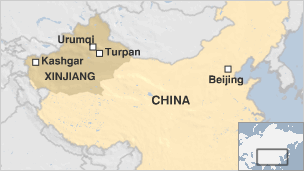
Map

The violence broke out in Turpan prefecture early on Wednesday.

Police opened fire after a mob armed with knives attacked police stations and a local government building, Xinhua news agency quoted officials as saying.

There are sporadic outbreaks of violence in Xinjiang, where there are ethnic tensions between Muslim Uighur and Han Chinese communities.

Confirming reports from the region is difficult because information is tightly controlled.

China’s state media have been quick to issue an official version of events regarding the latest round of violence in Xinjiang, but it will be tough to verify those reports.

Xinjiang lies on China’s remote north-west border and it is difficult for foreign media to travel there. Many people on both sides of the conflict are reluctant to speak to visiting journalists for fear of reprisals if they dispute the government’s stance.

Unfortunately Xinjiang usually hits international headlines when violence flares between the region’s minority ethnic Uighur Muslims and the majority Han Chinese. Many Uighurs contend that their language and religion are being smothered by an influx of Han Chinese migrants.

Xinjiang is a large geographic area rich in oil and gas deposits. Soon it will also become a major supplier of coal to China’s energy-hungry cities. The region’s fertile land also grows produce that is shipped to the rest of the country. The Han Chinese who move to Xinjiang hope to benefit from the region’s untapped resources.

The violence occurred in Turpan‘s remote township of Lukqun, about 200km (120 miles) south-east of the region’s capital, Urumqi.

The Xinhua news agency report, citing local officials, said rioters stabbed people and set police cars alight.

Seventeen people, including nine security personnel and eight civilians, were killed before police shot dead 10 of the rioters, it said.

At least three others were injured and were being treated in hospital, it added.

The Xinhua report did not provide any information on the ethnicity of those involved in the riot or on what sparked it.

But Dilxat Raxit, a spokesperson for the World Uighur Congress, an umbrella organisation of Uighur groups, told the Associated Press news agency the violence had been caused by the Chinese government’s “sustained repression and provocation” of the Uighur community.

In 2009 almost 200 people – mostly Han Chinese – were killed after deadly rioting erupted in Urumqi between the Han Chinese and Uighur communities.

In April an incident in the city of Kashgar left 21 people dead.

Uighurs and Xinjiang

Uighurs are ethnically Turkic Muslims. They make up about 45% of the region’s population; 40% are Han Chinese

China re-established control in 1949 after crushing short-lived state of East Turkestan. Since then, large-scale immigration of Han Chinese. Uighurs fear erosion of traditional culture.

The government said the violence began when “terrorists” were discovered in a building by officials searching for weapons.

But local people told the BBC that the violence involved a local family who had a longstanding dispute with officials who had been pressurising the men to shave off their beards and the women to take off their veils.

Uighurs make up about 45% of Xinjiang’s population, but say an influx of Han Chinese residents has marginalised their traditional culture.”

via BBC News – Violence in China’s Xinjiang ‘kills 27’.

See also: https://chindia-alert.org/political-factors/chinese-tensions/

29/05/2013

Settlers in Xinjiang: Circling the wagons

The Economist: “In a region plagued by ethnic strife, the growth of immigrant-dominated settlements is adding to the tension

MANY hours’ drive along what was once the southern Silk Road, through a featureless desert landscape punctuated by swirling dust-devils and occasional gnarled trees, a curious sight eventually confronts the traveller: row upon row of apartment blocks with vivid red roofs, as if a piece of Shanghai suburbia has been planted in the wilderness (see picture). Following the military-style nomenclature of immigrant settlements in China’s far west, it calls itself 38th Regiment. It is home to thousands of people, in a spot where just a few years ago there was nothing but sand.

The town is the latest addition to a vast network of such communities in the Xinjiang Uighur Autonomous Region, China’s biggest province by land area and also its most ethnically troubled. Neighbouring Tibet has long been roiled by ethnic tension, too, but rarely has it witnessed the kind of violence that has troubled Xinjiang: a low-level insurgency involving ethnic Uighurs whose Muslim faith and Central Asian culture and language set them apart from the Han Chinese who dominate places like 38th Regiment. On April 23rd, 21 people were killed near Kashgar during an encounter between police and alleged separatists. An explosion of inter-ethnic violence in 2009 in the regional capital, Urumqi, that left nearly 200 dead, by official reckoning, exacerbated the divide. The expansion of the settlement network is deepening it further.

To use its full name, the 38th Regiment of the 2nd Agricultural Division is part of the Xinjiang Production and Construction Corps. This state-run organisation, usually referred to as the bingtuan (Chinese for a military corps) controls an area twice the size of Taiwan, broken into numerous parts scattered around the province (see map). A few bits are city-sized. Most are more like towns or villages. Of their total population of more than 2.6m people, 86% are ethnically Han Chinese. In Xinjiang as a whole, in contrast, Han officially make up just over 40% of the 22m inhabitants. The rest are Uighurs and a few other ethnic groups.”

via Settlers in Xinjiang: Circling the wagons | The Economist.

24/04/2013

* China’s Xinjiang hit by deadly clashes

BBC: “Clashes in China’s restive Xinjiang region have left 21 people dead, including 15 police officers and officials, authorities say.

Map

The violence occurred on Tuesday afternoon in Bachu county, Kashgar prefecture.

The foreign ministry said it had been a planned attack by a “violent terrorist group”, but ethnic groups questioned this.

There have been sporadic clashes in Xinjiang in recent years.

The incidents come amid rumbling ethnic tensions between the Muslim Uighur and Han Chinese communities. In 2009 almost 200 people – mostly Han Chinese – were killed after deadly rioting erupted.

Nothing is stopping foreign journalists from booking flights to Xinjiang after hearing reports of violence there. However, simply travelling to the region doesn’t guarantee the ability to dig out the truth behind this story.

In 2009, dozens of foreign reporters were permitted to join an official tour of Urumqi, the capital of Xinjiang, after clashes between minority ethnic Uighur residents and majority Chinese Hans killed 197 people.

Their experiences were mixed. Some reporters were able to speak to a variety of people on the ground, while others faced harassment and intimidation.

The situation remains the same today. Reporters who travel to the area are closely followed by government minders. Locals often hesitate to answer questions, fearing reprisals from government authorities.

Uighur exile groups often provide accounts that differ from the official Chinese government reports. Reconciling the two can be tricky.

The situation isn’t any easier for Chinese journalists. China’s propaganda departments have warned domestic news outlets against conducting their own independent reporting on sensitive Xinjiang stories, ordering them to reprint official stories from China’s major state news agencies.

It is very difficult to verify reports from Xinjiang, reports the BBC’s Celia Hatton.

Foreign journalists are allowed to travel to the region but frequently face intimidation and harassment when attempting to verify news of ethnic rioting or organised violence against government authorities.”

via BBC News – China’s Xinjiang hit by deadly clashes.

See also: https://chindia-alert.org/prognosis/chinese-challenges/

02/04/2013

* Uyghur Jailings Highlight Chinese Media Controls

Eurasia review: “China’s jailing of 20 ethnic Uyghurs this week on terrorism and separatism charges using online activism as a basis for their conviction reflects government moves to increase media controls and use weak laws to suppress voices in the troubled Xinjiang region, Uyghur rights groups say.

Xinjiang Uyghur Autonomous Region in China

The courts said the 20 Uyghur Muslims had had their “thoughts poisoned by religious extremism” and used cell phones and DVDs “to spread Muslim religious propaganda,” the government of the Xinjiang Uyghur Autonomous Region said on its official news website.

Nineteen of them were given prison sentences ranging from 5 years to life in prison in Xinjiang’s Kashagar prefecture while the 20th suspect was sentenced to 10 years in jail on the same day in the Bayingolin Mongolian Autonomous Prefecture.

They were accused of using the Internet, mobile phones and digital storage devices to organize, lead and participate in an alleged terrorist organization with the intent to “incite splittism,” reports have said.

Leading Uyghur activist Rebiya Kadeer of the Munich-based World Uyghur Congress (WUC) said that the sentences showed the new Chinese leadership’s “indifference for human rights and democracy” and that it will “continue with the ‘strike hard’ practices of the previous regimes.”

“It further indicates that the Chinese government will not contribute to the peaceful resolution of the conflict in the region in the near future, preferring instead to continue its counterproductive and destructive practices,” the WUC president said in a statement Thursday.”

via Uyghur Jailings Highlight Chinese Media Controls Eurasia Review | Eurasia Review.

04/08/2012

* China – Muslim Fasting Discouraged

NY Times: “Several local governments in the western region of Xinjiang have ordered Muslim restaurants to stay open during the holy month of Ramadan and are telling civil servants and students to continue to eat and drink during daylight hours, when Muslims generally fast. Ramadan began on July 20.

A notice on the Web site of the health bureau of Urumqi, the regional capital, said local officials had discussed “increasing eating and drinking during Ramadan” and were urged “to increase the monitoring of collective eating with supplied food at work units.” The goal was to “guarantee the health of the masses,” the posting said. Local governments have been putting in place such policies for several years.

Southern Xinjiang and Urumqi have a large number of Uighurs, Muslims who often express discontent with ethnic Han, who dominate China.”

via China – Muslim Fasting Discouraged – NYTimes.com.

So while national government tries to be sympathetic with Muslims, local officials do the opposite.

See also:

03/08/2012

* 20 Sentenced in Terrorism Case

NY Times: “China has sentenced 20 people to up to 15 years in prison for advocating violence and separatism in the western region of Xinjiang, where the central government has clamped down on dissent and restricted religious practices. The state-run newspaper Xinjiang Daily said Thursday that courts in the region had found that the 20 had organized and participated in terrorist groups. The courts said four of them made illegal explosives, the newspaper reported.

The report did not cite any violence linked to the defendants. It named only five people, all with Uighur names. Xinjiang is home to a large population of minority Uighurs but is ruled by members of China’s Han ethnic majority. Violence between the groups in recent years has left nearly 200 people dead. Dilxat Raxit, a spokesman for the exiled World Uyghur Congress, said that the accused used the Internet to obtain government-controlled information and to express political views. He said the terrorist charges and verdicts were politically motivated.”

via China – 20 Sentenced in Terrorism Case – NYTimes.com.

See also: 

Law of Unintended Consequences

continuously updated blog about China & India

ChiaHou's Book Reviews

continuously updated blog about China & India

What's wrong with the world; and its economy

continuously updated blog about China & India