Posts tagged ‘Vladimir Putin’

14/10/2016

India and Russia to sign air defence deal – BBC News

Russia and India are expected to sign a deal on Saturday for the delivery of an advanced air defence system to Delhi, a Kremlin official has said.

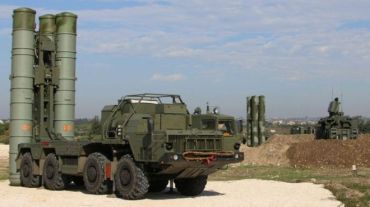
The S-400 missiles are Moscow’s most sophisticated aircraft defence system.Yuri Ushakov said the agreement would be signed at a summit in Goa where President Vladimir Putin will hold talks with Indian PM Narendra Modi.

India is also hosting a Brics summit in Goa this weekend involving Brazil, Russia, India, China and South Africa.

“An agreement on the delivery of S-400 ‘Triumph’ anti-missile defence systems and other deals will be signed as a result of the talks,” Russian news agencies quoted Mr Ushakov as saying.

Russia’s missiles send robust signal

The Kremlin earlier this week said the talks with Mr Modi would focus on “a wide range of matters of bilateral relations, especially trade and economic ties”.

The S-400 surface-to-air missiles have been deployed to Syria, where Russian forces have been operating in support of the government of President Bashar al-Assad.Russia and India were close allies during the Cold War, but recently the relationship has become more complex.Talks have been held annually since 2000 and hosted alternately by Moscow and Delhi.

Source: India and Russia to sign air defence deal – BBC News

06/10/2016

Chinese people optimistic about the future, says Pew survey – BBC News

At a time of Brexit and talk of a wall between the United States and Mexico, it seems the Chinese are embracing international engagement.

They think their country’s power is rising, that their living standards will keep improving, that corruption is being cleaned up and that air pollution should be fixed even if it means slowing down economic growth.

These are the views which have emerged from a broad survey from Washington-based the Pew Research Center.

Elsewhere there is fear and uncertainty. Here optimism trumps all.

When asked about economic globalisation, 60% of people said it is a good thing and only 23% think it is bad for China.

While some China watchers are warning that this country’s mounting local government debt could mean that a hard landing is on the way, Chinese people don’t appear to share this pessimism.

Nearly 90% of respondents amongst this group of 3,154, interviewed face-to-face in China earlier this year, think that the state of their country’s economy is either “very good” or “somewhat good”.

GETTY IMAGES – Chinese people seem to remain optimistic

Looking into the future things will apparently get even better: 76% of people think the economy will improve over the next 12 months, 70% said their personal financial situation will improve and eight out of 10 people believe that their children will have a better standard of living than they do.

Bread and butter issues

It’s not that people are without concerns.

“Corrupt officials” is at the top of the table when it comes to people’s worries (83% said this was a “very big” or “moderately big” problem) and yet here too we see optimism.

Some 64% of them said that President Xi Jinping‘s massive anti-corruption drive would improve the situation over the next five years.

Running down the concern list, an alarmingly high number of people see income inequality and the safety of food and medicine as “very big” problems.

This should give the Chinese Communist Party pause for concern.

If you enjoy monopoly power on the basis that you are delivering “socialism with Chinese characteristics” then a small group of ultra-rich driving around in their sports cars and showing off their wealth while most struggle to pay the rent is surely at odds with your central message.

Then, if ordinary Chinese people can’t even trust the food and medicine they are giving their children, the possibility for social unrest over bread and butter issues is looming large.

The environment also emerges as a massive challenge with water and air pollution at the front of people’s minds.

Air pollution is so bad in China that half of those polled said their country should fight air pollution harder even if it means sacrificing economic growth.

GETTY IMAGES – Emissions from coal-powered industries, cars and heating systems generate the smog

Only 24% saw air deterioration as a necessary price to pay.

When it comes to the war of ideas in the top echelons of power here, those ministers in favour of tougher environmental protection measures could do worse than table this research.

A “major threat” to China?

The South China Sea and other geo-strategic tensions offer some of the most bleak opinions.

Nearly six out of 10 people think that territorial pressures with neighbours could lead to military conflict; 77% say their way of life needs to be protected from “foreign influence” (up by 13 percentage points since 2002) and only 22% say China should help other nations.

Regarding relations with rival superpower the United States people views are complex and, at times, seemingly contradictory.

Around half of Chinese respondents rated the US favourably but more than half think that Washington is trying to prevent China from becoming an equal power.

About 45% said that US power and influence poses a “major threat” to China. In fact the US came in at number one as the top international threat to the country.

GETTY IMAGES – More than half of Chinese people think that Washington is trying to prevent China from becoming an equal power

It’s interesting that some would see the Obama administration’s so-called “pivot to Asia” as a greater threat than say jihadist extremist groups just across the western border promoting bloody conflict in China’s vast Muslim region of Xinjiang.

Either way, whatever the perceived threat, China is seen as becoming ever more important and with ever more power at its disposal.Information is being controlled here ever more tightly – whether it is coming from the traditional media or sources online – so some analysts will see these views as the inevitable result of messages being delivered to the Chinese people by their government.

This may the be case but, in a world where politicians in various countries are accused of exploiting people’s fear and insecurity, could it be that a quarter of the globe’s population are going around with a smile on their dial because every day they look out the window and to them it just gets better and better?

Source: Chinese people optimistic about the future, says Pew survey – BBC News

01/11/2015

Japan, China and South Korea ‘restore’ fraught ties – BBC News

The leaders of Japan, China and South Korea say they have “completely restored” trade and security ties, at their first meeting in three years.

Japanese Prime Minister Shinzo Abe, South Korean President Park Geun-hye and Chinese Premier Li Keqiang meet for trilateral meeting in Seoul - 1 November

They said in a statement they had agreed to resume regular trilateral meetings, not held since 2012. They also agreed more economic co-operation.

The talks in the South Korean capital Seoul were an attempt to ease ill-feeling fuelled by territorial disputes and historical disagreements. China and South Korea say Japan has not done enough to atone for its troops’ brutality in World War Two.

The BBC’s Stephen Evans in Seoul says the real significance of the talks is that they happened. They were held regularly until three-and-a-half years ago, when they were called off as bad feeling towards Japan intensified. “We shared the view that trilateral cooperation has been completely restored on the occasion of this summit,” South Korean President Park Geun-hye, Chinese Premier Li Keqiang and Japanese Prime Minister Shinzo Abe said in a joint statement, quoted by AFP.

Ms Park said the three leaders had agreed to work together to conclude the Regional Comprehensive Economic Partnership (RCEP), a 16-nation free trade area favoured by Beijing. She said they maintained their goal of “denuclearising” North Korea, AFP reported.

Our correspondent says that South Korea and Japan are torn between their allegiance to the US and their need to get on economically with Beijing. Mr Li met Ms Park on Saturday and the two agreed to try to increase trade, particularly through more Korean exports of food to China and co-operation on research into robotics. The two leaders were joined by Mr Abe on Sunday.

Source: Japan, China and South Korea ‘restore’ fraught ties – BBC News

05/10/2015

India’s Competitive Ranking Surges on the Back of Modi Momentum – India Real Time – WSJ

India leapt 16 places to 55th position in the latest ranking of economies’ competitiveness released by the World Economic Forum Wednesday.

The Geneva-based think tank says India is a “bright spot” among larger emerging markets, which have shown a broader trend of either a decline or stagnation. It attributes the country’s big rise–which comes after five years of decline–to the election of Prime Minister Narendra Modi last year, which ignited optimism about the country’s limping policy changes.

“This dramatic reversal is largely attributable to the momentum initiated by the election of Narendra Modi, whose pro-business, pro-growth, and anti-corruption stance has improved the business community’s sentiment toward the government,” the WEF says in the report, which includes the Global Competitiveness Index 2015–2016 Rankings.

The ranking is based on the assessment of 140 countries on 12 parameters such as infrastructure, macroeconomic environment, institutions, health and education, among others.

The report says the quality of India’s institutions was judged more favorably in the latest ranking while its macro-economic stability has improved, with easing inflation and a gradual drop in the government’s budget deficit since its 2008 peak. Infrastructure has also improved, the report said.

“The fact that the most notable improvements are in the basic drivers of competitiveness bodes well for the future, especially the development of the manufacturing sector,” the report said.

However, India needs to improve its technological readiness: it is one of the least digitally connected countries in the world.Fewer than one in five Indians use the Internet regularly, and fewer than two in five own even a basic cell phone, according to the report.

The ranking of regional rival China has barely budged in the past six years as it has been dealing with rising production costs, an aging population and diminishing returns on the massive capital investments of the past three decades.

However, its 28th position–unchanged  from the previous year–is still much higher than India’s.

China remains by far the most competitive among larger emerging economies. “However, its lack of progress moving up the ranking shows the challenges it faces in transitioning its economy,” the report said.

Switzerland, Singapore and the U.S. were the top three ranked, unchanged from the previous year.

In Asia, Malaysia ranked 18th, up two places, Indonesia ranked 37th, down three notches while Thailand ranked 32nd, down one position.

Among the remaining BRICS group of countries, Brazil was at number 75, plummeting from 57 last year. The Russian Federation was at number 45, up from 53 and South Africa was at 49, better than 56 last year.

Source: India’s Competitive Ranking Surges on the Back of Modi Momentum – India Real Time – WSJ

03/09/2015

China military parade commemorates WW2 victory over Japan – BBC News

China has held a lavish parade in Beijing to mark the defeat of Japan in World War Two, showcasing its military might on an unprecedented scale. President Xi Jinping in his opening speech paid tribute to “the Chinese people who unwaveringly fought hard and defeated aggression” from Japan. He also said the People’s Liberation Army would be reduced by 300,000 personnel, but gave no timeframe.

Soldiers of China's People's Liberation Army (PLA) march at the beginning of the military parade marking the 70th anniversary of the end of World War Two, in Beijing, China, 3 September 2015

China’s growing military power is being keenly watched amid regional tensions. China has several territorial disputes with neighbours in the South China Sea, as well as with Japan in the East China Sea. Ahead of the parade, the US said five Chinese ships had been spotted in the Bering Sea off Alaska for the first time. China’s People’s Liberation Army (PLA) is the world’s largest military, with 2.3 million members. China also has the second biggest defence budget after the US.

Source: China military parade commemorates WW2 victory over Japan – BBC News

12/07/2015

Beijing invites Japanese prime minister to ceremony marking end of second world war | South China Morning Post

President Xi Jinping has officially invited Japanese Prime Minister Shinzo Abe to a ceremony in September commemorating the 70th anniversary of the end of the second world war.

Shinzo Abe speaks at the Japan Summit 2015 on Thursday. Photo: Reuters

Beijing had been waiting for a reply since the invitation was made three weeks ago, Vice-Minister of Foreign Affairs Cheng Guoping said on Friday following a BRICS summit.

Cheng said all leaders from the Shanghai Cooperation Organisation members – Russia, Kazakhstan, Kyrgyzstan, Tajikistan and Uzbekistan – had agreed to attend the September 3 ceremony, which includes a military parade in Tiananmen Square.

Abe had told aides he was willing to visit China, the Asahi newspaper reported.

However, fearing a domestic backlash, he was considering a visit either before or after the ceremony, it said.

A Japanese government source said Abe hoped to talk with Xi on repairing the damage caused by territorial disputes and differing perceptions of history.

Jiang Yuechun , a professor at the China Institute of International Studies, said Abe’s hesitation was understandable.

“If Abe decides to attend the ceremony, it would be a good opportunity to help his country get rid of its historical burden [as an invader]. It would also be a chance to [turn back] Sino-Japanese bilateral ties,” he said.

“Of course, it’s impossible for the two countries to remedy the breach even if Abe does meet Xi, because there are so many problems left by history that have hindered the relationship, such as maritime disputes over the Diaoyu Islands and fishing rights. It will take time to solve these by rational communication.”

Whether Abe’s trip goes ahead could depend on the content of a statement he is expected to make regarding the war anniversary and China’s activities to press sovereignty claims in the East and South China seas. China has urged Abe to include a full apology and note that Japan was engaged in a war of aggression.

Recent speeches by Abe had reflected on Japan’s “wrongdoing” but “offered no apology”, said Sun Cheng, director of the East Asia International Studies Centre at the China University of Political Science and Law.

Sun said the attitude of the US would be key to pushing Japan into an open apology “because Tokyo cares more for Washington’s [approval] than for China’s or South Korea’s”.

To lay the groundwork for Abe’s visit, Shotaro Yachi, the head of Japan’s National Security Council, was planning to travel to China this month to hold talks with Yang Jiechi , the mainland’s top diplomat, a Japanese government source said.

Abe and Xi held talks last November in Beijing and this April in Jakarta on the sidelines of international conferences.

Observers say Beijing hopes to improve its relations with Tokyo before Xi’s visit to the United States in September, while Abe is eager to bolster his domestic support by repairing ties with Beijing amid deliberations on controversial security bills.

Meanwhile, Japan has proposed sending its foreign minister, Fumio Kishida, to Russia from August 31 to September 1. Russian President Vladimir Putin is scheduled to visit Japan within the year.

via Beijing invites Japanese prime minister to ceremony marking end of second world war | South China Morning Post.

06/07/2015

Narendra Modi’s Visit to Central Asia: What to Know – India Real Time – WSJ

India is starting to latch onto the need to forge diplomatic relationships with other countries beyond simple exchange of embassies. However, in the two months of rest between PM Modi’s globe trotting, China formed or reinforced relationship with 28 countries:

  • May:  E U; Japan; Belarus; India; Ireland; Vietnam; Brazil; Colombia, Peru, Chile.
  • June:  Pakistan, Senegal; French Polynesia;  Angola; Sri Lanka; Georgia; Myanmar, Maldives; Uzbekistan; Australia; Czech Republic; Poland; Belgium; USA; Brazil; France.

Some of these were when senior foreign politicians visited China, others when senior Chinese politicians visits abroad.

In 2014, China wooed 167 nations – https://chindia-alert.org/2014/12/31/chinese-diplomacy-2014/ and over 100 in 2013 – https://chindia-alert.org/2013/12/31/who-did-china-woo-in-2013/.  So far 62 in 2015.  Someone in the higher eschelons of Chnese government must have read and espouse Dale Carnegie’s book!

“Less than two months after returning from a journey that took him to China, South Korea and Mongolia, Indian Prime Minister Narendra Modi begins another whirlwind overseas tour on Monday in which he is slated to visit five Central Asian countries, attend two multilateral summits in Russia and talk about issues ranging from trade to yoga to terrorism.

In a series of short trips, Mr. Modi will touch down in Uzbekistan, Kazakhstan, Turkmenistan, Kyrgyzstan and Tajikistan, covering a cluster of strategically-positioned, resource-rich nations not far from India’s borders where China has established robust trade and investment ties. In between, he’ll visit Russia for the annual Brics summit.

Mr. Modi’s main focus is going to be energy: Turkmenistan’s natural gas reserves, for instance, and Kazakhstan’s oil and uranium. In recent years, India’s plans to invest in Kazakhstan’s oil projects have been waylaid by proposals from China, which has a major presence in the country’s oil and gas production.

Efforts to ramp-up the flow of these resources to India have also been complicated by the region’s security risks and geopolitics. A long-pending project with Turkmenistan, for instance, involves constructing a gas pipeline from that country over Taliban-hit Afghanistan and across India’s rival neighbor Pakistan, to India.

The Indian government is looking to kickstart work on the pipeline. In April, during a visit by India’s foreign minister, Sushma Swaraj, Turkmenistan pledged to begin construction of it this year, India said. Ahead of Mr. Modi’s departure, Navtej Sarna, an Indian official, said on Friday that the government “will have to explore how we can move this project forward very quickly,” though he didn’t elaborate on how much progress Mr. Modi and his team were expected to make.

It’s not just the pipeline. Mr. Modi is hoping to push other infrastructure projects too that would connect Central Asia to India – regions that are not far apart on the map but have remained inadequately linked by roads, railways and ports, diminishing opportunities for trade and investment.

A North-South transport corridor that would help move cargo through a more straightforward and cheaper route between Russia and Central Asia on the one hand and India on the other has been in the offing for years. While some infrastructure has been built, big gaps remain. Mr. Modi is hoping to recruit more partners to help fill them.

One crucial link country in this plan is Iran, which has been off limits because of Western sanctions aimed at driving Tehran to end its nuclear program. As Iran and its U.S.-led opponents moved toward a deal this year that would end the deadlock, India in May sought to reinvigorate a port project in Iran’s eastern Chabahar region. Once completed, the port would become a central part of the planned corridor.

These questions of connectivity are important for India’s trade prospects, but they also have a geopolitical  significance. China has in recent months stepped up its diplomatic outreach for its new “Silk Road” belt connecting it to Central Asia and Europe. On a visit to Islamabad in April, Chinese President Xi Jinping unveiled a $46 billion economic corridor that would cut across Pakistan and a disputed territory governed by Pakistan that India also claims. Indian officials have objected to the initiative, both publicly and in meetings with Chinese officials.

At the same time, Mr. Modi is looking to forge closer economic ties with China. This week, he will meet Chinese leaders during the Brics summit in the Russian city of Ufa, where the leaders will discuss, among other regional and global issues, their recently-formed bank. The New Development Bank as it is called is headquartered in Shanghai and will have an Indian banker as its first head. Mr. Modi will also participate in a meeting of the Shanghai Cooperation Organization, a security grouping led by China and Russia, which India is likely to join shortly as a full member.”

via Narendra Modi’s Visit to Central Asia: What to Know – India Real Time – WSJ.

18/06/2015

Venezuela to get $5 billion in funding from China in next few months: PDVSA official | Reuters

Venezuela will receive a loan of $5 billion from China in the coming months for crude oil projects, a director at state-owned Petroleos de Venezuela said on Tuesday.

The flow of crude oil is seen in a container while an oilfield worker works on a drilling rig at an oil well operated by Venezuela's state oil company PDVSA, in the oil rich Orinoco belt, near Cabrutica at the state of Anzoategui April 16, 2015.  REUTERS/Carlos Garcia Rawlins

China has become Venezuela’s principal financier over the last decade, lending more than $46 billion to be repaid in oil.

“It is being discussed right now and will come within a few months,” Orlando Chacin, vice president of exploration and production at PDVSA [PDVSA.UL], said in an interview.

The resources should help the oil company as it handles the severe impact of the drop in crude prices.

Oil makes up 96 percent of the country’s foreign income.

The funds seemed to be part of an overall $10 billion loan a PDVSA source earlier this year said Venezuela had negotiated with the Development Bank of China, half for oil projects.

“They are for many projects,” Chacin said. He said many of those would be in the vast Orinoco Belt, which contains most of Venezuela’s crude, but did not offer more details.

Venezuela is looking to increase crude production in the Orinoco region to offset declines in other traditional areas and to stimulate its struggling economy.

The country’s international reserves hit 12-year lows this month as the economy suffers a recession, high inflation and shortages of basic goods.

via Venezuela to get $5 billion in funding from China in next few months: PDVSA official | Reuters.

11/05/2015

Private banker KV Kamath named first BRICS bank head | Reuters

Indian private banker K.V. Kamath has been named as the first head of a new development bank being set up by the BRICS group of emerging market economies, Finance Secretary Rajiv Mehrishi told reporters on Monday.

K.V.Kamath gestures during the Reuters India Summit at his office in Mumbai in this November 25, 2008 file photo. REUTERS/Stringer/Files

The BRICS – Brazil, Russia, India, China and South Africa – agreed to set up the $100 billion development bank last July, in a step toward reshaping the Western-dominated international financial system.

“Kamath has been appointed as the head of the BRICS bank, the appointment will become effective when he becomes free from his current assignments,” Mehrishi told reporters in New Delhi.

It was agreed then that the New Development Bank, which will fund infrastructure projects in developing nations, would be based in Shanghai. It would be headed by an Indian for a first five-year term, followed by a Brazilian and then a Russian.

via Private banker KV Kamath named first BRICS bank head | Reuters.

08/05/2015

China Parades Closer Ties in Moscow – China Real Time Report – WSJ

When a Chinese honor guard joins a military parade in Russia’s capital this weekend, watched by China’s President Xi Jinping, it will mark more than just a symbolic recognition of the two countries’ contributions to the Allied victory in 1945. As the WSJ’s Jeremy Page reports:

China’s participation also reflects an upgrade of its military ties with Russia, including joint naval exercises and a revival of arms purchases, that could complicate U.S.-led efforts to counter both nations’ expanding military activities, analysts and diplomats say.

The 102 Chinese troops who will join the Victory Day parade in Moscow on Saturday were seen during a rehearsal this week marching through streets near Red Square singing the Russian wartime ballad “Katyusha”, according to video footage posted online.

The only other foreign countries with troops in the parade are India, Mongolia, Serbia and six former Soviet states.

Three Chinese navy ships also made a rare foray into the Black Sea on their way to join commemorations in Russia’s southern port of Novorossiysk on Saturday.

The Chinese ships—two missile destroyers and a supply vessel — will then take part in joint exercises with the Russian navy in the Mediterranean Sea for the first time, according to Chinese and Russian authorities.

Both sides say the drills aren’t directed at other countries, but the timing, after Russia’s 2014 annexation of Crimea, and the location, on NATO’s southern flank, have compounded Western concerns about an emerging Moscow-Beijing axis.

via China Parades Closer Ties in Moscow – China Real Time Report – WSJ.

Law of Unintended Consequences

continuously updated blog about China & India

ChiaHou's Book Reviews

continuously updated blog about China & India

What's wrong with the world; and its economy

continuously updated blog about China & India