Posts tagged ‘World War II’

01/01/2016

‘The Miraculous History of China’s Two Palace Museums’ – China Real Time Report – WSJ

In late 1948 and early 1949, toward the end of the Chinese civil war, Nationalist leader Chiang Kai-shek transported across the Taiwan Strait hundreds of thousands of valuable Chinese artifacts which are now stored in Taipei’s National Palace Museum. Along with its Palace Museum counterpart in Beijing – more famous as the Forbidden City – the museums serve as one of the most poignant reminders of the division of China.
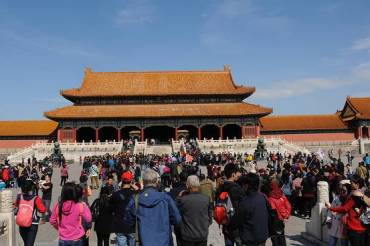
Beijing’s Palace Museum, which celebrated its 90th anniversary in October, was established shortly after the last Chinese emperor, Pu Yi, was forced from his palace, where he had been allowed to stay even after the Chinese republic was founded in 1911.

Intellectuals at the time wanted to set up a Chinese museum along the lines of the great museums in Europe.

Today, millions visit both museums each year, crowding around artifacts such as the Jadeite Cabbage and the Meat-Shaped Stone in Taipei.

Among the visitors are huge tour groups of mainland Chinese tourists, as the Taipei government continues to liberalize travel policies for its neighbor amid a broader detente.

This week, a branch of the National Palace Museum housing exhibits from around Asia was inaugurated in the southern Taiwanese city of Chiayi.

In his book “The Miraculous History of China’s Two Palace Museums,” Hong Kong-based writer Mark O’Neill details the treacherous history of how some of China’s most precious artifacts were rescued from the invading Japanese imperial army in the 1930s and later transported to Taiwan, and the powerful symbolism of the museums.

Source: Writing China: Mark O’Neill, ‘The Miraculous History of China’s Two Palace Museums’ – China Real Time Report – WSJ

01/11/2015

Japan, China and South Korea ‘restore’ fraught ties – BBC News

The leaders of Japan, China and South Korea say they have “completely restored” trade and security ties, at their first meeting in three years.

Japanese Prime Minister Shinzo Abe, South Korean President Park Geun-hye and Chinese Premier Li Keqiang meet for trilateral meeting in Seoul - 1 November

They said in a statement they had agreed to resume regular trilateral meetings, not held since 2012. They also agreed more economic co-operation.

The talks in the South Korean capital Seoul were an attempt to ease ill-feeling fuelled by territorial disputes and historical disagreements. China and South Korea say Japan has not done enough to atone for its troops’ brutality in World War Two.

The BBC’s Stephen Evans in Seoul says the real significance of the talks is that they happened. They were held regularly until three-and-a-half years ago, when they were called off as bad feeling towards Japan intensified. “We shared the view that trilateral cooperation has been completely restored on the occasion of this summit,” South Korean President Park Geun-hye, Chinese Premier Li Keqiang and Japanese Prime Minister Shinzo Abe said in a joint statement, quoted by AFP.

Ms Park said the three leaders had agreed to work together to conclude the Regional Comprehensive Economic Partnership (RCEP), a 16-nation free trade area favoured by Beijing. She said they maintained their goal of “denuclearising” North Korea, AFP reported.

Our correspondent says that South Korea and Japan are torn between their allegiance to the US and their need to get on economically with Beijing. Mr Li met Ms Park on Saturday and the two agreed to try to increase trade, particularly through more Korean exports of food to China and co-operation on research into robotics. The two leaders were joined by Mr Abe on Sunday.

Source: Japan, China and South Korea ‘restore’ fraught ties – BBC News

03/09/2015

China military parade commemorates WW2 victory over Japan – BBC News

China has held a lavish parade in Beijing to mark the defeat of Japan in World War Two, showcasing its military might on an unprecedented scale. President Xi Jinping in his opening speech paid tribute to “the Chinese people who unwaveringly fought hard and defeated aggression” from Japan. He also said the People’s Liberation Army would be reduced by 300,000 personnel, but gave no timeframe.

Soldiers of China's People's Liberation Army (PLA) march at the beginning of the military parade marking the 70th anniversary of the end of World War Two, in Beijing, China, 3 September 2015

China’s growing military power is being keenly watched amid regional tensions. China has several territorial disputes with neighbours in the South China Sea, as well as with Japan in the East China Sea. Ahead of the parade, the US said five Chinese ships had been spotted in the Bering Sea off Alaska for the first time. China’s People’s Liberation Army (PLA) is the world’s largest military, with 2.3 million members. China also has the second biggest defence budget after the US.

Source: China military parade commemorates WW2 victory over Japan – BBC News

09/03/2015

China hints Japan to be invited to war memorial parade | Reuters

China will welcome all national leaders to a military parade marking the 70th anniversary of the end of World War Two, the foreign minister said on Sunday, the strongest sign yet that it could invite wartime enemy Japan.

Sino-Japan relations have long been poisoned by what China sees as Japan’s failure to atone for its occupation of parts of the country before and during the war, and it rarely misses an opportunity to remind its people and the world of this.

In the last two years, ties have also deteriorated sharply because of a dispute over a chain of uninhabited islets in the East China Sea, though Chinese and Japanese leaders met last year in Beijing to try to reset relations.

But the remarks by Chinese Foreign Minister Wang Yi come as the two countries plan to hold their first security talks in four years in Tokyo on March 19, an indication of a possible improvement in strained ties.

“Our goal is to remember history, commemorate the martyrs, cherish peace and look to the future,” Wang said of the parade at a briefing on the sidelines of China’s annual meeting of parliament.

“We will extend the invitation to the leaders of all relevant countries and international organizations. No matter who it is, as long as they come in sincerity, we welcome them,” Wang said in response to a question about whether Japanese Prime Minister Shinzo Abe would be invited.

via China hints Japan to be invited to war memorial parade | Reuters.

30/09/2014

Centripetal and Centrifugal Forces at Work in the Nation-State | Stratfor

“Here begins our tale: The empire, long divided, must unite; long united, must divide. Thus it has ever been.” This opening adage of Romance of the Three Kingdoms, China’s classic novel of war and strategy, best captures the essential dynamism of Chinese geopolitics. At its heart is the millennia-long struggle by China’s would-be rulers to unite and govern the all-but-ungovernable geographic mass of China. It is a story of centrifugal forces and of insurmountable divisions rooted in geography and history — but also, and perhaps more fundamentally, of centripetal forces toward eventual unity.

Tibetan Settlement in India

This dynamism is not limited to China. The Scottish referendum and waves of secession movements — from Spain’s Catalonia to Turkey and Iraq’s ethnic Kurds — are working in different directions. More than half a century after World War II triggered a wave of post-colonial nationalism that changed the map of the world, buried nationalism and ethnic identity movements of various forms are challenging the modern idea of the inviolable unity of the nation-state.

Yet even as these sentiments pull on the loose threads of nations, in China, one of the most intractable issues in the struggle for unity — the status of Tibet — is poised for a possible reversal, or at least a major adjustment. The long-running but frequently unnoticed negotiations have raised the possibility that the Dalai Lama, Tibet’s spiritual leader, may be nearing a deal that would enable him to return to his Tibetan homeland. If it happens, it would end the Dalai Lama’s exile in Dharamsala, India — an exile that began after the Tibetan uprising in 1959, nine years after the People’s Republic of China annexed Tibet. More important, a settlement between Beijing and the Dalai Lama could be a major step in lessening the physical and psychological estrangement between the Chinese heartland and the Tibetan Plateau.

Read rest of article via Centripetal and Centrifugal Forces at Work in the Nation-State | Stratfor.

18/08/2014

Japanese Prime Minister Avoids Controversial War Shrine – Businessweek

On Friday morning, while several members of his cabinet marked the anniversary of World War II’s end by visiting a controversial shrine in Tokyo, Japanese Prime Minister Shinzo Abe wisely decided to sleep in. He had caused a storm last December by paying a visit to the Yasukuni Shrine, which honors Japan’s war dead. By skipping Yasukuni, Abe may have improved the chances of a summit with Chinese President Xi Jinping that could help defuse tensions between the two countries.

The Imperial chrysanthemum crest is displayed at the Yasukuni Shrine in Tokyo

The shrine has long been a problem for Chinese and Koreans. The Chinese media often refers to the shrine as “notorious.” “Each and every visit here by officials upsets and incenses Japan’s neighboring countries,” says a Xinhua commentary published on Friday. The shrine is a symbol “of the brutality of Japanese rule and military expansion,” Lee Won Deog, a professor of Japanese studies at Kookmin University in Seoul, told Bloomberg News. By visiting Yasukuni anyway, Japanese politicians show that “Japan continues to overlook the pain it caused its neighbors during its imperial expansion.”

A look at the shrine’s website shows why visits are so sensitive. In describing the shrine and the almost 2.5 million people it honors, Yasukuni does whitewash Japan’s history of aggression toward its neighbors. Some of the souls enshrined at Yasukuni died as Imperial Japan colonized Korea and Taiwan, occupied Manchuria, and brutalized many parts of China. But according to Yasukuni’s narrative, they died “to protect their country,” and “all sacrificed their lives to the public duty of protecting their motherland.” The shrine “is a place for Japanese people to show their appreciation and respect to those who died to protect their mother country, Japan.”

And what about the World War II-era war criminals enshrined there? Yasukini says not that they were convicted, but rather, that some “were labeled war criminals” (emphasis added) and executed after trials by the victorious Allies.

Some Japanese politicians worry about the way the shrine talks about Japan’s past militarism. Yasukuni “pays homage to war criminals, and exhibitions within its walls extol wars,” former Japanese Prime Minister Tomiichi Murayama said in an interview with the China Daily published on Thursday. “I think the best solution is that prime ministers and cabinet members shun the shrine.”

Abe, though, is trying to have it both ways: He didn’t visit today, but two members of his cabinet did—and the prime minister sent a donation through an aide.

via Japanese Prime Minister Avoids Controversial War Shrine – Businessweek.

13/08/2014

China Demands that Japan Return the Plundered Honglujing Stele – Businessweek

Islands. Airspace. Antiquities. Until now, China has concentrated its attention on the first two as it fights against Japan for dominance in East Asia. In focusing on the wrongs done by Imperial Japan before and during World War II, China’s government has escalated its claims to uninhabited islands in the East China Sea controlled by Japan and has designated airspace in the area as its own.

The Honglujing Stele is housed in Tokyo's Imperial Palace, home to Japan's Emperor Akihito

The dispute has had humorous moments, such as the time officials invoked Voldemort.  The conflict has potential to become far more dangerous, though, with ships and planes from both sides provoking one another. On Tuesday, for instance, Chinese Coast Guard vessels patrolled near the islands, called the Senkaku by Japan and Diaoyu by China.

China’s foreign ministry voiced “strong dissatisfaction and resolute opposition” last week to a white paper published by Japanese Prime Minister Shinzo Abe’s government that had expressed concern over China’s behavior in the East China Sea and South China Sea. Over the weekend, China’s defense ministry followed with a statement accusing Japan of looking for excuses to re-militarize.

China has plenty of ways to poke its neighbor. Determined to leave no grievance unaired, China has opened a fresh front in its battle against Japan: A group has  demanded the return of a 1,300-year-old relic that Japanese soldiers whisked away from China’s northeast a century ago.  The Honglujing Stele, three meters wide, 1.8 meters tall, and two meters thick, dates back to the Tang Dynasty and now belongs to Japan’s Emperor, according to the official Xinhua news agency.

A group called the China Federation of Demanding Compensation from Japan is now demanding that the Emperor give it back. Stolen items such as the Honglujing Stele “have done great damage to Sino-Japanese ties,” Wang Jinsi, the federation official in charge of recovering cultural relics, told Xinhua. “They should be returned to their rightful owner.”

That may be, but Wang’s group has chosen an interesting time to make its point. As Xinhua points out, Japanese troops went on a rampage in the mainland in the 50 years between China’s defeat in the First Sino-Japanese War and the end of the Second World War, with Japan stealing some 3.6 million relics. Only now is the Chinese group calling on the imperial family to return one of them.

via China Demands that Japan Return the Plundered Honglujing Stele – Businessweek.

28/01/2014

REFILE-India close to buying Japan-made military aircraft in $1.65 bln deal | Reuters

India is set to become the first country since World War Two to buy a military aircraft from Japan, helping Prime Minister Shinzo Abe end a ban on weapons exports that has kept his country\’s defence contractors out of foreign markets.

The two countries are in broad agreement on a deal for the ShinMaywa Industries amphibious aircraft, which could amount to as much as $1.65 billion, Indian officials said on Tuesday.

However, several details need to be worked out and negotiations will resume in March on joint production of the plane in India and other issues.

New Delhi is likely to buy at least 15 of the planes, which are priced at about $110 million each, the Officials said.

\”Its a strategic imperative for both sides, and it has been cleared at the highest levels of the two governments,\” said an Indian military source.

For the moment, a stripped-down civilian version of the US-2i search and rescue plane is being offered to India, to get around Japan\’s self-imposed ban on arms exports. A friend or foe identification system will be removed from the aircraft, another defence official said.

via REFILE-India close to buying Japan-made military aircraft in $1.65 bln deal | Reuters.

Enhanced by Zemanta
13/12/2013

Nanjing Massacre memorials to be held |Society |chinadaily.com.cn

A man is pictured in front of a wall at the memorial hall of the victims in Nanjing massacre by Japanese invaders in Nanjing, Jiangsu province, Dec 12, 2013. Nanjing Massacre memorials to be held

NANJING – A series of memorials will be held on Thursday and Friday in the city of Nanjing to mark the 76th anniversary of a massacre that claimed the lives of 300,000 Chinese civilians and disarmed soldiers.

Nanjing witnessed mass murder, genocide and war rape following the Japanese capture of the city in December 13, 1937, during World War II.

Memorial events will include a candlelight vigil, a prayer assembly for peace, as well as press conferences and seminars, according to Zhu Chengshan, curator of the Nanjing Massacre Hall.

As part of this year\’s event, a report on protection of survivors\’ oral histories of the atrocity will be presented and a Sino-U.S. collaborative project on oral history studies will be announced, Zhu announced.

\”This is about expressing sorrow for those perished, and more importantly reminding people to remember history and to cherish peace,\” he said.

Meanwhile, two survivors, 82-year-old Wang Jin and 89-year-old Cen Honggui, will leave for Japan to attend Nanjing Massacre testimony gatherings on invitation from Japanese non-governmental organizations.

Held every year since August, 1994, this activity has seen a total of 47 Chine

via Nanjing Massacre memorials to be held |Society |chinadaily.com.cn.

06/11/2013

Japan targets China as islands dispute threatens to boil over

Oh dear, brinkmanship often turns out to trigger real conflict. Hope this one doesn’t.

Law of Unintended Consequences

continuously updated blog about China & India

ChiaHou's Book Reviews

continuously updated blog about China & India

What's wrong with the world; and its economy

continuously updated blog about China & India