Posts tagged ‘Xi JinPing’

20/09/2014

The rise and rise of Xi Jinping: Xi who must be obeyed | The Economist

THE madness unleashed by the rule of a charismatic despot, Mao Zedong, left China so traumatised that the late chairman’s successors vowed never to let a single person hold such sway again. Deng Xiaoping, who rose to power in the late 1970s, extolled the notion of “collective leadership”. Responsibilities would be shared out among leaders by the Communist Party’s general secretary; big decisions would be made by consensus. This has sometimes been ignored: Deng himself acted the despot in times of crisis. But the collective approach helped restore stability to China after Mao’s turbulent dictatorship.

Xi Jinping, China’s current leader, is now dismantling it. He has become the most powerful Chinese ruler certainly since Deng, and possibly since Mao. Whether this is good or bad for China depends on how Mr Xi uses his power. Mao pushed China to the brink of social and economic collapse, and Deng steered it on the right economic path but squandered a chance to reform it politically. If Mr Xi used his power to reform the way power works in China, he could do his country great good. So far, the signs are mixed.

It may well be that the decision to promote Mr Xi as a single personality at the expense of the group was itself a collective one. Some in China have been hankering for a strongman; a politician who would stamp out corruption, reverse growing inequalities and make the country stand tall abroad (a task Mr Xi has been taking up with relish—see article). So have many foreign businessfolk, who want a leader who would smash the monopolies of a bloated state sector and end years of dithering over economic reforms.

However the decision came about, Mr Xi has grabbed it and run with it. He has taken charge of secretive committees responsible for reforming government, overhauling the armed forces, finance and cyber-security. His campaign against corruption is the most sweeping in decades. It has snared the former second-in-command of the People’s Liberation Army and targeted the retired chief of China’s massive security apparatus—the highest-ranking official to be investigated for corruption since Mao came to power. The generals, wisely, bow to him: earlier this year state newspapers published pages of expressions of loyalty to him by military commanders.

He is the first leader to employ a big team to build his public profile. But he also has a flair for it—thanks to his stature (in a height-obsessed country he would tower over all his predecessors except Mao), his toughness and his common touch. One moment he is dumpling-eating with the masses, the next riding in a minibus instead of the presidential limousine. He is now more popular than any leader since Mao (see article).

All of this helps Mr Xi in his twofold mission. His first aim is to keep the economy growing fast enough to stave off unrest, while weaning it off an over-dependence on investment in property and infrastructure that threatens to mire it in debt. Mr Xi made a promising start last November, when he declared that market forces would play a decisive role (not even Deng had the courage to say that). There have since been encouraging moves, such as giving private companies bigger stakes in sectors that were once the exclusive preserve of state-owned enterprises, and selling shares in firms owned by local governments to private investors. Mr Xi has also started to overhaul the household-registration system, a legacy of the Mao era that makes it difficult for migrants from the countryside to settle permanently in cities. He has relaxed the one-child-per-couple policy, a Deng-era legacy that has led to widespread abuses.

via The rise and rise of Xi Jinping: Xi who must be obeyed | The Economist.

20/09/2014

Modi Uses Another International Visit to Raise His Local Profile – India Real Time – WSJ

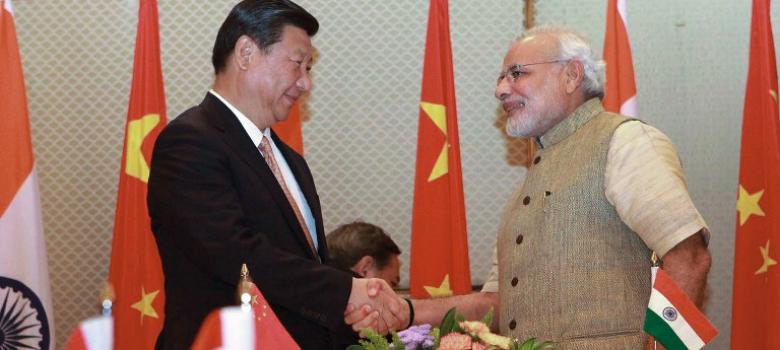
Prime Minister Narendra Modi’s meetings with Chinese President Xi Jinping this week once again showed that Mr. Modi is a master of media management.

The summit of the heads of the world’s two most-populous countries produced mixed results. A lot of agreements were signed, but the $100 billion in Chinese investment pledges that some local media had predicted did not materialize. And just as the leaders were shaking hands, there was an embarrassing faceoff between Chinese and Indian troops along the countries’ disputed boundary.

That didn’t stop India’s prime minister from again using photo opportunities and body language to broadcast his confidence, an impression that is likely to remain long after local media stop discussing the border tension and whether China had promised enough money.

Indians watching the visit wouldn’t have missed some of the symbolism. Mr. Xi flew into Mr. Modi’s home state, on the Indian prime minister’s birthday. Mr. Xi wore an  Indian vest that Mr. Modi gave him. Video of the two showed Mr. Modi walking in front of Mr. Xi at one event and swinging on a swing with him. At one point it even looked like Mr. Xi was carrying an umbrella for Mr. Modi.

Reuters Xi Jinping looked like he was carrying an umbrella for Narendra Modi during a recent visit to Gujarat.

The Indian prime minister has used the same charisma in photo ops during other international summits, most recently in Japan where he gave Prime Minister Shinzo Abe a big bear hug and later performed a solo on traditional Japanese drums.

All of this has been beamed into Indian homes and marks a major change from the demeanor of the country’s previous prime minister, Manmohan Singh, who was soft- spoken and slow-moving.

Mr. Modi’s multimedia skills are one of the things that made him prime minister.  Whether it is his controversial selfies, the sight of hundreds of supporters wearing Modi masks, campaign speeches delivered through hologram, his stylish outfits or his willingness to put on almost any kind of regional headwear, Mr. Modi knows how to make an impression.

via Modi Uses Another International Visit to Raise His Local Profile – India Real Time – WSJ.

18/09/2014

Trade, investment hopes as China’s Xi visits India – Businessweek

Chinese President Xi Jinping landed in the Indian prime minister‘s home state of Gujarat on Wednesday for a three-day visit expected to focus on India’s need to improve worn out infrastructure and reduce its trade deficit.

Xi was greeted on the tarmac by state officials carrying fringed umbrellas to guard him from the sun in Gujarat’s main financial city of Ahmedabad.

Prime Minister Narendra Modi is expected to court Chinese business and seek investment to upgrade creaky infrastructure, banking on China’s track record at building highways, railways, and industrial zones. India is also eager to address the imbalance in their annual trade, which now totals around $65 billion but is skewed toward imports of Chinese electrical equipment and parts.

Modi and the Gujarat government are staging a lavish welcome for Xi, with billboards across Ahmedabad showing a smiling Modi and Xi. A banquet dinner was being held Wednesday night on the banks of the Sabarmati River in Ahmedabad. Modi was also celebrating his 64th birthday.

Xi has been equally effusive in expressing excitement for the visit.

China-India relations have become one of the most dynamic and promising bilateral relations in the 21st century,” Xi wrote in an article published Wednesday in The Hindu newspaper.

via Trade, investment hopes as China’s Xi visits India – Businessweek.

18/09/2014

Chinese Views of India: Culturally Rich but Backward – China Real Time Report – WSJ

From China’s side of the Himalayas, the view of India isn’t always that great.

“This place is like China from 20 years ago. It’s much, much worse than I’d imagined,” said Tony Jiang, 29, an employee at an electronics-parts maker in Hangzhou visiting New Delhi this week.

Reshma Patil, an Indian journalist who spent more than three years based in Beijing reporting on China for the Hindustan Times newspaper, writes in a recently published book that Chinese she met tended to view India as poor and unsanitary.

In “Strangers Across the Border: Indian Encounters in Boomtown China,” Ms. Patil argues that ties between the two countries are hampered by their citizens’ mutual ignorance of each other.

A survey by the Pew Research Center published this year found that 30% of Chinese have a “favorable” view of India and 55% an “unfavorable” one. By contrast, 50% of Chinese have a favorable view of the U.S., according to Pew. Just 8% of Chinese hold a favorable view of Japan.

More Chinese are getting first-hand knowledge by visiting India as tourists or on business trips.

But the numbers are still small. India’s Ministry of Tourism says that about 175,000 Chinese tourists visited India in 2013, a 46% increase from around 120,000 in 2010. Tourism experts say China’s newly affluent prefer traveling to Europe, the U.S. and Southeast Asia.

India Real Time interviewed some Chinese visitors to India to get their impressions of the country as the two nations focus on bolstering ties that have long been strained by territorial disputes. Chinese President Xi Jinping arrived in India on Wednesday for a three-day trip aimed at deepening economic relations.

For some Chinese, the allure of India is its cultural heritage, especially its connection to Buddhism.

Mario Tang, a 26-year-old store manager from Shanghai who traveled across north India, said he came to see India’s centuries old history — against the advice of family and friends.

“My parents thought I was crazy. Most people I know think India is a poor, dirty, backward place,” Mr. Tang said.

He found it magical. “India is one of my favorite places on the planet,” he said. He visited Buddhist holy sites and even took a dip in the Ganges, India’s sacred river. He said Indians he spoke to seemed happy, something he attributed to “the power of belief and culture.”

Di Wenjie, a 32-year-old Chinese magazine editor who has visited India several times, said the country is “beyond imagination and full of color.” She says she studied meditation and yoga and plans to come again soon.

Others take a dimmer view.

“We didn’t have high hopes coming here,” said Mr. Jiang, the electronics-company employee, who was visiting Delhi for a trade fair. “Our impression was that Indian people are dirty and disorderly,” he said, while working on his laptop at a Starbucks in the center of the Indian capital this week.

Mr. Jiang also questioned Indians’ dedication to their jobs. “Indians are still eating breakfast at 10 a.m. Then they go home by 5 to 6 p.m.,” he said. “This is why this country is developing so, so slowly.”

His colleague, Ray Zhang, 28, said that his experience in New Delhi had been “terrible.” But he said he wouldn’t rule out returning to India to see the sights. “I’ve heard a lot about the Taj Mahal,” he said.

via Chinese Views of India: Culturally Rich but Backward – China Real Time Report – WSJ.

18/09/2014

India to hold talks with China on civil nuclear cooperation | Reuters

India will open talks on civil nuclear energy cooperation with China, Prime Minister Narendra Modi said on Thursday after summit talks with Chinese President Xi Jinping in New Delhi.

The announcement, part of the new government’s push to broaden its nuclear energy sector, comes on the heels of a deal India struck this month to buy uranium from Australia to increase its fuel supplies.

“We will begin the process of discussions on civil nuclear energy cooperation that will bolster our broader cooperation on energy security,” Modi said in a statement, with Xi beside him, at a news conference.

Ahead of Xi’s visit, Chinese Assistant Foreign Minister Liu Jianchao told reporters that China had a “positive attitude” towards nuclear cooperation with India, but offered no details.

Behind the scenes, China has been pressing India hard to begin talks on civil nuclear cooperation, said W.P.S. Sidhu, a senior fellow at Brookings India.

Any deal for India to buy civil nuclear reactors from China may take years, but both countries benefit by starting the conversation, said Sidhu.

“It’s a way for India to explore other options,” he said.

via India to hold talks with China on civil nuclear cooperation | Reuters.

18/09/2014

After Modi-Xi meeting, China agrees to quickly settle border dispute, demarcate LAC – Hindustan Times

Prime Minister Narendra Modi and Chinese President Xi Jinping on Thursday agreed to quickly resolve the border dispute and demarcate the Line of Actual Control to improve peace and cooperation between both countries.

Addressing the media after the conclusion of one-on-one meeting with visiting Chinese President Xi Jinping, Modi said India is concerned about the frequent incursions along the border. The Line of Actual Control should be demarcated soon to ensure peace and tranquility in the area, he said.

President Xi, in response, said that China will work to settle the border issue at the earliest date. Since the border is not demarcated there will be some incidents, but both countries are capable of settling it at various levels without causing a bigger impact, he said.

President Xi said both countries would be respectful and sensitive to each others concerns. “We also have the sincerity to work with India to maintain peace and tranquility in the border areas before we are finally able to settle the border question,”he said.

The latest incident India was referring to was the  fresh incursion by the Chinese army in Chumar area, even as talks were on between both the leaders.

via After Modi-Xi meeting, China agrees to quickly settle border dispute, demarcate LAC – Hindustan Times.

18/09/2014

Despite the Xi-Modi bromance, Indians and Chinese don’t actually like each other

One in two Indians thinks China is a major threat.

In the last two days alone, Chinese President Xi Jinping has called India an ancient, magic, enchanting, and beautiful land. And Indian Prime Minister Narendra Modi has reciprocated with syrupy adjectives, reminding visiting journalists how ancient Chinese technology was responsible for sugar being called cheeni in India.

The pictures of the two leaders’ bonhomie on Wednesday went even further. By the time you get to the sight of Modi and Xi sitting on a swing by the Sabarmati, most would imagine that India and China are steadfast allies who support each other through thick and thin.

Which is why it might be worth pointing out that we don’t actually like each other very much, and that Indians and Chinese people have very different intentions for the bilateral relationship. And it’s not just about the trade deficit and the border disputes. Ordinary Indians and Chinese people simply aren’t sure whether they like each other.

via Scroll.in – News. Politics. Culture..

17/09/2014

Could India Edge Out China? – Businessweek

China’s President Xi Jinping is due to arrive in India tomorrow, and for a change he’s the one with an economy heading in the wrong direction, not Indian Prime Minister Narendra Modi. After several dismal years, growth in India is rebounding, and the stock prices of companies selling to Indian consumers are benefiting from the surge in optimism that accompanied Modi’s landslide election victory in May. Britannia Industries (BRIT:IN), the Kolkata-based maker of cookies and other food products, is up 55 percent so far this year and today hit a 52-week high. “The Indian consumption story is back,” Credit Suisse analysts Neelkanth Mishra and Ravi Shankar wrote in a report published today.

Electronic ticker boards at the National Stock Exchange in Mumbai, India

Meanwhile, China is struggling as the troubled banking system and property markets put a damper on the economy. Hit by a slump in the property market, the Chinese economy expanded at an annual rate of 6.3 percent in August, a dramatic slowdown from the 7.4 percent growth in July and nowhere close to the government’s target of 7.5 percent. So far this year, the area of new property under development has declined 14.4 percent. The data from last month “made depressing reading,” Bloomberg economist Tom Orlik wrote in a report published yesterday.

The role reversal could lead to a world-turned-upside-down moment as early as 2016. That’s when India, always the laggard, may pull ahead of China and became the fastest-growing of Asia’s giants. India is likely to enjoy 7.2 percent growth in 2016, says Rajeev Malik, senior economist in Singapore with CLSA, compared with China’s 7.1 percent. Given the structural problems Xi faces and the slack Modi inherited, “China has to slow down, and India can do much better,” he says.

India has suffered from a chronically high inflation rate, but there are signs that pressure is easing, albeit slowly. Consumer prices last month rose 7.8 percent, a slight improvement from July’s 7.96 percent. Yesterday, the government reported wholesale prices rose 3.74 percent in August. That’s the best result in five years.

via Could India Edge Out China? – Businessweek.

17/09/2014

Is China Ready to Step Up and Invest in India? – India Real Time – WSJ

While Chinese companies have been great at peddling their products in India, they have been surprisingly reluctant to invest here. China has invested less in India than even Poland, Malaysia or Canada have.

President Xi Jinping’s three-day visit to India starting Wednesday is likely to include some massive pledges to try to remedy this imbalance.

When Prime Minister Narendra Modi visited Japan recently, Japan pledged to invest $35 billion in India. President Xi is expected to try to eclipse Japan’s promises, possibly pledging $100 billion in investment according to some local reports. His meetings with Mr. Modi are predicted to lay the groundwork for a wave of Chinese money to build industrial parks and bullet trains.

Annual trade between India and China has galloped to $66 billion from $3 billion 14 years ago, something that underscores the rise of Beijing as the global manufacturing hub and India’s growing appetite for everything from phones to machinery from China.

While the trade relationship between the two countries has bloomed, foreign direct investment from China has not. According to Indian government statistics, the country has received a total of around $400 million from China in investment in the last 14 years. Even if you add the $1.2 billion of direct investment India received from Hong Kong, China is still well behind the $22 billion in foreign direct investment from the United Kingdom, $17 billion from Japan, $13 billion from the Netherlands and $1.9 billion from Spain.

It’s not that China doesn’t invest abroad. According to data from United Nations Conference on Trade and Development, China was the third biggest source of foreign direct investment last year, having invested more than $100 billion in other countries. In the seven years to 2012, it invested more than $25 billion in the 10 members of the Association of Southeast Asian Nations alone.

Chinese investment has tended to focus on the resources sector to power its economy. Much of it has gone into getting control of oil, natural gas and coal in Africa, Australia, Indonesia and elsewhere. India has not attracted much of this investment as it is a net importer of resources and has a heavily regulated energy sector, said Rajiv Biswas, economist for IHS.

“China wants to increase investment in India and wants Chinese companies on the ground there,” Mr. Biswas said. “Most of it will be in manufacturing and infrastructure space.”

Chinese companies may also be looking to move some of their manufacturing to India as they struggle with rising wages at home, said Ajay Sahai, director general and chief executive at Federation of India Export Organization.

If India can’t find better ways to fix its trade imbalance with China, New Delhi may want to increase taxes on some imports such as auto-components and pharmaceuticals to encourage Chinese companies to set up factories in India, he said.

“This will not only raise Chinese investment in India but also help in fixing the trade imbalance,” said Mr. Sahai.

via Is China Ready to Step Up and Invest in India? – India Real Time – WSJ.

17/09/2014

5 Things to Look Out for During Xi Jinping’s Visit to India – WSJ

Manan Vatsyayana/Agence France-Presse/Getty Images

1 INFRASTRUCTURE

Prime Minister Narendra Modi is looking for foreign capital and expertise to build “smart cities”, high-speed trains and modern airports of the kind that China has built for itself in the past decade. The two leaders are expected to sign a deal to bring bullet trains to India and may also reach an agreement for the building of world-class railway stations and airports.

2 INDUSTRIAL PARKS

The two countries laid the groundwork for Chinese investment in industrial parks in India when Indian Vice-President Hamid Ansari visited Beijing in June. Indian officials say they expect to ink deals worth $5 billion for two parks – one in the western state of Gujarat, Mr. Modi’s home state, and the other in Maharashtra. The idea is to make it easier for Chinese companies to set up shop in India.

3 BORDER TROUBLES

Territorial disputes that have long dogged Sino-Indian ties aren’t the focus of this visit, but are sure to come up. Two reports this week – one about an alleged incursion by Chinese troops in Ladakh and another about protests by Chinese civilians and troops against the construction of an Indian canal along the disputed border – have highlighted the unresolved issues. Even after 17 rounds of talks, no solution has emerged – don’t expect one during this visit either.

4 COMPETITION WITH JAPAN

Indian newspapers have been filled with anticipation about whether China will outdo its Asian rival, Japan, in promising investments for India. Earlier this month, Japan pledged to pour $35 billion into India over five years; China is expected to go further. Expect reams of analysis of Mr. Xi’s rapport with Mr. Modi. When Japanese Premier Shinzo Abe met Mr. Modi, they bear hugged.

5 BREAKING OUT OF THE MOLD

Officials have raised hopes of a “directional change” and an “orbital jump” in Sino-Indian ties, which have long been bogged down by bureaucratic mistrust. Trade relations have flourished in the past decade, but are skewed in China’s favor– and investments have remained very low. Experts are hoping Mr. Modi – who worked with Chinese as chief minister of Gujarat – will adopt a pragmatic approach to push for Chinese money. If he succeeds, the visit may set the stage for an era of economic collaboration between the two Asian giants.

via 5 Things to Look Out for During Xi Jinping’s Visit to India – WSJ.

Law of Unintended Consequences

continuously updated blog about China & India

ChiaHou's Book Reviews

continuously updated blog about China & India

What's wrong with the world; and its economy

continuously updated blog about China & India