Posts tagged ‘Xi JinPing’

04/09/2016

China says should constructively handle disputes with India | Reuters

Chinese President Xi Jinping told Indian Prime Minister Narendra Modi on Sunday that the two countries should respect each other’s concerns and constructively handle their differences.

The two nuclear-armed neighbours have been moving to gradually ease long-existing tensions between them.

Leaders of Asia’s two giants pledged last year to cool a festering border dispute, which dates back to a brief border war in 1962, though the disagreement remains unresolved.

Meeting on the sidelines of the G20 summit in the eastern Chinese city of Hangzhou, Xi said relations had maintained a steady, healthy momentum, and should continue to increase mutual understanding and trust.

“We ought to respect and give consideration to each other’s concerns, and use constructive methods to appropriately handle questions on which there are disputes,” Xi said, in comments carried by China’s Foreign Ministry.

“China is willing to work hard with India the maintain the hard-won good position of Sino-India relations,” Xi added.

China’s Defence Ministry said last month that it hoped India could put more efforts into regional peace and stability rather than the opposite, in response to Indian plans to put advanced cruise missiles along the disputed border with China.

Indian military officials say the plan is to equip regiments deployed on the China border with the BrahMos missile, made by an Indo-Russian joint venture, as part of ongoing efforts to build up military and civilian infrastructure capabilities there.

China lays claim to more than 90,000 sq km (35,000 sq miles) ruled by New Delhi in the eastern sector of the Himalayas. India says China occupies 38,000 sq km (14,600 sq miles) of its territory on the Aksai Chin plateau in the west.

India is also suspicious of China’s support for its arch-rival, Pakistan.Modi arrived in China from Vietnam, which is involved in its own dispute with China over the South China Sea, where he offered Vietnam a credit line of half a billion dollars for defence cooperation.Modi’s government has ordered BrahMos Aerospace, which produces the BrahMos missiles, to accelerate sales to a list of five countries topped by Vietnam, according to a government note viewed by Reuters and previously unreported.

Source: China says should constructively handle disputes with India | Reuters

04/09/2016

UK’s May to review security risks of Chinese-funded nuclear deal | Reuters

Prime Minister Theresa May said on Sunday she wanted her security advisers to review a delayed nuclear power investment from China – a source of diplomatic tension – as she arrived in the country to attend a G20 summit.

May upset Chinese officials in July by delaying a $24 billion project that would see French firm EDF (EDF.PA) build Britain’s first new nuclear power plant in decades with the help of $8 billion from China.

Speaking during her first visit to China, May was asked whether she would ask the National Security Council, a team of ministers supported by intelligence officers, to look at the potential security implications of the Hinkley deal.

“I will be doing exactly as you’ve said,” May replied, saying it would be part of her decision-making process. The comment marked the first official acknowledgement that national security was a factor in her decision.

The initial delay caught investors by surprise and has cast doubt over whether May, who took office in July following Britain’s vote to leave the European Union, will continue to court China as a major source of infrastructure investment.

“This is the way I operate,” May earlier told reporters en route to the summit, which will include a one-to-one with Chinese President Xi Jinping.

“I look at the evidence, …take the advice and consider that and come to my decision.

“A final decision is expected later this month.

May, a former interior minister, is wary of the risks of allowing China to invest in nuclear projects, according to a former cabinet colleague. The EDF deal is viewed as a precursor to Chinese involvement in another two nuclear plants.

Asked whether she trusted China, May said: “Of course we have a relationship with them… What I want to do is build on that relationship.

“She also stressed a need to broaden the group of nations that Britain can trade with and tap for cash to help reinvigorate its power, transport and technology infrastructure.”This is the G20, this is about talking to a number of world leaders. I’m going to give the message that Britain is very much open for business… I want to be talking about the opportunities for free trade around the world.”

Source: UK’s May to review security risks of Chinese-funded nuclear deal | Reuters

25/08/2016

China and US to ratify landmark Paris climate deal ahead of G20 summit, sources reveal | South China Morning Post

China and the United States are set to jointly announce their ratification of a landmark climate change pact before the G20 summit early next month, the South China Morning Post has learned.

Senior climate officials from both countries worked late into the night in Beijing on Tuesday to finalise details, and a bilateral announcement is likely to be made on September 2, according to sources familiar with the issue.

President Xi Jinping will meet his US counterpart Barack Obama for the G20 summit in Hangzhou, Zhejiang province, two days later on September 4.

How China, the ‘world’s largest polluter’, is taking on climate change

“There are still some uncertainties from the US side due to the complicated US system in ratifying such a treaty, but the announcement is still quite likely to be ready by Sept 2,” said a source, who declined to be named.

If both sides announce the ratification on the day, it would be the last major joint statement between the two leaders before Obama leaves office.

China and the US account for about 38 per cent of global greenhouse gas emissions, according to the World Resources Institute.

By ratifying the Paris Agreement on climate change, Beijing and Washington could generate momentum for the accord to come into effect as a binding international treaty.

The pact agreed by representatives from 195 countries in Paris last December aims to keep the increase in the global average temperature to well below 2 degrees Celsius on pre-industrial levels.

Countries began the ratification process on April 22, Earth Day, and by Tuesday, 23 nations had joined, but they account for just 1 per cent of emissions.

China and the US create a new climate for international collaboration on the environment

The treaty will enter into force only after 55 countries representing at least 55 per cent of emissions ratify or join the deal in other ways.

China had said earlier it would ratify the accord before the G20 summit in September.

In June, the US said it would “work towards” approving the deal before end of the year, with the White House keen to seal a key part of Obama’s environmental protection legacy before he leaves office in January.

US law allows the nation to join international agreements in a number of ways, including through the authority of the president.

With China and US joining, some civil society trackers say they are confident the deal could hit the 55 per cent threshold before the end of the year.

On Wednesday, investors managing more than US$13 trillion of assets urged leaders of the Group of Twenty major economies to ratify the deal before the end of December.

The 130 investors also called for the G20 to double global investment in clean energy, develop carbon pricing and phase out fossil fuel subsidies.

How a little-known chapter in Sino-US cooperation may have helped save the planet

“Governments must ratify the Paris agreement swiftly and have a responsibility to implement policies that drive better disclosure of climate risk, curb fossil fuel subsidies and put in place strong pricing signals sufficient to catalyse the significant private sector investment in low carbon solutions,” said Stephanie Pfeifer, chief executive at Institutional Investors Group on Climate Change.

Ratification is expected to play out differently in the US compared with China.

While China has “few uncertainties” at home for passing the deal, it could cause controversy within the US, according to Liu Shuang, an officer with Energy Foundation’s low-carbon development programme.But the Obama administration’s commitment to international frameworks suggests the accord would be passed in a way that would make it difficult for his successors to undo, civil society trackers said.

‘I may do something else’: Donald Trump’s threat to renegotiate UN climate deal greeted with widespread dismay

The two countries started extensive cooperation at the leadership level in 2014. In a joint declaration that year, China promised its emissions would peak before 2030, while the US promised to cut emission by at least 26 per cent. That deal is widely regarded as paving the way for the Paris Agreement.

Source: China and US to ratify landmark Paris climate deal ahead of G20 summit, sources reveal | South China Morning Post

19/08/2016

The return of the Xia | The Economist

CHINA’S leaders are immensely proud of their country’s ancient origins. President Xi Jinping peppers his speeches with references to China’s “5,000 years of history”. The problem is that archaeological evidence of a political entity in China going back that far is scant.

There is some, including engravings on animal bones, that shows the second dynasty, the Shang, really did control an area in the Yellow river basin about 3,500 years ago. But no such confirmation exists for the legendary first ruling house, the Xia. Even inside China, some historians have long suspected that the country’s founding story—in which Emperor Yu tames flooding on the Yellow river (with the help of a magic black-shelled turtle, pictured), earns for himself the “mandate of heaven” and establishes the first dynasty—was either a Noah’s-Ark flood-myth or perhaps propaganda invented later to justify centralised state power. This month, however, state-controlled media have been crowing over newly published evidence in Science, an American journal, that at least the flooding was real. This, they say, has made it more credible that the Xia was, too. Not everyone is so convinced.

Catastrophic floods leave their mark on soil and rocks. Qinglong Wu of Peking University and others have examined the geology of the upper reaches of the Yellow river. In the journal, they conclude that a vast flood did take place in the right area and not long after the right time for the supposed founding of the Xia. Although their evidence does not prove the existence of an Emperor Yu or of the dynasty he founded, it does provide a historical context in which someone might have gained power with the help of flood-taming exploits.

According to Mr Wu, a vast landslide, probably caused by an earthquake, blocked the course of the Yellow river as it flowed through the Jishi gorge on the edge of the Tibetan plateau. For six to nine months as much as 16 cubic kilometres (3.8 cubic miles) of water built up behind the accidental dam, which, when it finally burst, produced one of the biggest floods ever. At its peak, the authors calculate, the flow was 500 times the normal discharge at Jishi Gorge. Mr Wu reckons the ancient flood could easily have been felt 2,000km downstream in the area of the Yellow river said by Chinese historians to have been the realm of the Xia.

At about this time, either coincidentally or (more probably) because of the flood, the river changed its course, carving out its vast loop across the north China plain. The significance is that, while the river was finding its new course, it would have flooded repeatedly. This is consistent with old folk tales about Emperor Yu taming the river not through one dramatic action, but by decades of dredging.

The ancient flood can be dated because the earthquake that set the catastrophic events in motion also destroyed a settlement in the Jishi gorge. Radiocarbon dating of inhabitants’ bones puts the earthquake at about 1920BC—not 5,000 years ago but close-ish. Xinhua, a state news agency, lauded the study as “important support” for the Xia’s existence. Xu Hong of the Chinese Academy of Social Sciences challenged this, saying the scholars’ findings had not proved their conclusions. The first dynasty has gone from myth to controversy.

Source: The return of the Xia | The Economist

04/08/2016

Poland in talks with Chinese buyers over LOT airline stake | Reuters

Poland is in talks with potential investors from China over selling a stake in the state airline LOT [LOT.UL], Deputy Prime Minister Mateusz Morawiecki said on Wednesday.

Poland’s euroskeptic, conservative government has been looking to tighten its relations with China since coming to power last year. The two countries pledged deeper co-operation during the visit of China’s leader Xi Jinping to Warsaw in June.”LOT is our national carrier, which we are trying to save no matter the cost. It is deeply in debt,” Morawiecki told state news agency PAP on Wednesday, adding that without a national carrier Poland would become a more peripheral country.

LOT, one of the world’s oldest airlines, has for years struggled to compete against low-cost competitors like Ryanair (RYA.I) and bigger rivals. The state-owned airline was saved from bankruptcy in 2012 thanks to public aid of more than 500 million zlotys ($130 million).

“The previous government has already granted public support for LOT, we cannot grant another and we are looking for an investor,” Morawiecki said.

“According to EU law a carrier from outside the EU cannot take over more than 49 percent of a carrier from the EU, hence we are in talks with potential investors, among others, from China,” he said.Morawiecki also said that usually it is a very long road to finalize such a transaction.

Earlier on Wednesday, a Polish local newspaper reported that Chinese carrier Air China (601111.SS) is interested in buying a 49-percent stake in LOT with a delegation from the Chinese firm expected to arrive in Warsaw over the coming days.

However, a LOT spokesman said he had no knowledge of any plans for a capital tie-up between LOT and Air China.

“I have no knowledge regarding any planned capital co-operation between LOT and Air China,” Adrian Kubicki, LOT spokesman said. “We have commercial co-operation with Air China, which we want to develop, regarding the Warsaw-Beijing route.”

Air China was not immediately available for comment.

Source: Poland in talks with Chinese buyers over LOT airline stake | Reuters

29/07/2016

China Steels Its Resolve, But ‘Zombies’ Abound – China Real Time Report – WSJ

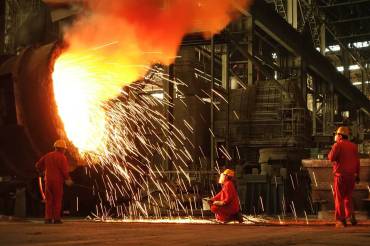
China’s steel industry is a test case for the nation’s ability to restructure overbuilt parts of the economy, and so far it’s not going very well.

Seven months into 2016, China has cut just 30% of the 45 million tons of steel capacity it has pledged to pare this year. And a Renmin University study found that more than half of China’s steel companies are “zombies.

”They define zombie firms as companies that have received below-market interest rates for two years running — a sign that they are being artificially propped up by their local governments or other government financing. Essentially, they are dependent on cheap financing to stay alive.Steel firms led the list, with 51.4% zombies in the sector, followed by the property sector, with 44.5% zombies and construction with 31.2%.

Renmin economists said local governments long nurtured sectors such as steel with the central government’s blessing. Now that the pressure is on to scale back, they tend to resist central government calls for cuts, given the impact on jobs, local economic growth and officials’ promotions, economists say.

An indication of that resistance is seen in recent data. Despite calls from Prime Minister Li Keqiang on down to turn off blast furnaces and shutter steel production lines, the industry posted record daily crude steel production in June, driven by easy money policies and a speculation-fueled upturn in the property market — which is itself suffering from overcapacity. Industry Vice Minister Fei Feng told reporters this week he didn’t expect a recent rebound in steel prices to last.

“For the purpose of political performance and maintaining stability, local governments continued to give blood to those zombie firms in various forms that were on the brink of bankruptcy,” the Renmin report said, adding that governments should interfere less in how companies operate and accelerate reform of state companies.

Officials have blamed this year’s slow progress on capacity trim on the lengthy negotiations required to allocate those cuts among China’s 28 provincial governments.

China, which accounts for half of global steel production, remains confident it will fulfill capacity cut targets for 2016, industry Vice Minister Feng told reporters, adding that the reductions so far this year are in line with expectations.

In all, China has vowed to cut up to 150 million tons of extraneous steel production over the next five years. Even that goal targets only 10% of the nation’s excess steel capacity, which is currently around 30%, according to industry analysts. This comes as rising exports fuel tension with overseas companies and labor groups alleging that China is selling steel at prices below its cost of production.

Beijing’s counter argument is a bit of a circular one: The problem isn’t that China is making too much steel, but that global demand is inadequate.

A disproportionate number of steelmakers are state-owned enterprises, a group that accounts for some 55% of China’s corporate debt but only produces 22% of economic output, according to International Monetary Fund data. China’s corporate debt hit approximately 145% of gross domestic product in 2015, up from less than 100% in 2007, according to the International Monetary Fund, a level it characterized as “high by any measure.

”Across all sectors, zombie firms make up 7.5% of the 800,000 industrial companies between 2005 and 2013 that Renmin studied, down from a peak of about 30% in 2000 shortly before China embarked on its last serious reform of the state sector. President Xi Jinping has called for state companies to remain a core part of China’s economy.

As companies age, they are increasingly likely to become zombies. About 30% of firms founded more than three decades ago qualify as zombie firms, according to Renmin’s research, compared with just 3% among firms with less than five years’ history.

Source: China Steels Its Resolve, But ‘Zombies’ Abound – China Real Time Report – WSJ

25/07/2016

ASEAN breaks deadlock on South China Sea, Beijing thanks Cambodia for support | Reuters

Southeast Asian nations overcame days of deadlock on Monday when the Philippines dropped a request for their joint statement to mention a landmark legal ruling on the South China Sea, officials said, after objections from Cambodia.

China publicly thanked Cambodia for supporting its stance on maritime disputes, a position which threw the regional block’s weekend meeting in the Laos capital of Vientiane into disarray.

Competing claims with China in the vital shipping lane are among the most contentious issues for the Association of Southeast Asian Nations, with its 10 members pulled between their desire to assert their sovereignty while finding common ground and fostering ties with Beijing.

In a ruling by the U.N.-backed Permanent Court of Arbitration on July 12, the Philippines won an emphatic legal victory over China on the dispute.

The Philippines and Vietnam both wanted the ruling, which denied China’s sweeping claims in the strategic seaway that channels more than $5 trillion in global trade each year, and a call to respect international maritime law to feature in the communique.

Backing China’s call for bilateral discussions, Cambodia opposed the wording on the ruling, diplomats said.

Manila agreed to drop the reference to the ruling in the communique, one ASEAN diplomat said on Monday, in an effort to prevent the disagreement leading to the group failing to issue a statement.

The communique referred instead to the need to find peaceful resolutions to disputes in the South China Sea in accordance with international law, including the United Nations’ law of the sea, to which the court ruling referred.

Source: ASEAN breaks deadlock on South China Sea, Beijing thanks Cambodia for support | Reuters

01/07/2016

Our bulldozers, our rules | The Economist

THE first revival of the Silk Road—a vast and ancient network of trade routes linking China’s merchants with those of Central Asia, the Middle East, Africa and Europe—took place in the seventh century, after war had made it unusable for hundreds of years. Xi Jinping, China’s president, looks back on that era as a golden age, a time of Pax Sinica, when Chinese luxuries were coveted across the globe and the Silk Road was a conduit for diplomacy and economic expansion. The term itself was coined by a German geographer in the 19th century, but China has adopted it with relish. Mr Xi wants a revival of the Silk Road and the glory that went with it.

This time cranes and construction crews are replacing caravans and camels. In April a Chinese shipping company, Cosco, took a 67% stake in Greece’s second-largest port, Piraeus, from which Chinese firms are building a high-speed rail network linking the city to Hungary and eventually Germany. In July work is due to start on the third stage of a Chinese-designed nuclear reactor in Pakistan, where China recently announced it would finance a big new highway and put $2 billion into a coal mine in the Thar desert. In the first five months of this year, more than half of China’s contracts overseas were signed with nations along the Silk Road—a first in the country’s modern history.

Politicians have been almost as busy in the builders’ wake. In June Mr Xi visited Serbia and Poland, scattering projects along the way, before heading to Uzbekistan. Last week Russia’s president, Vladimir Putin, made a brief visit to Beijing; he, Mr Xi and Mongolia’s leader promised to link their infrastructure plans with the new Silk Road. At the time, finance ministers from almost 60 countries were holding the first annual meeting in Beijing of an institution set up to finance some of these projects, the Asian Infrastructure Investment Bank (AIIB). Like a steam train pulling noisily out of a station, China’s biggest foreign-economic policy is slowly gathering speed.

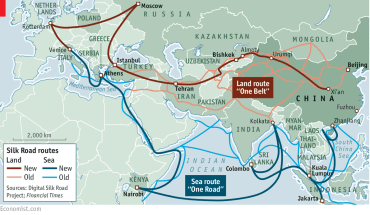
Chinese officials call that policy “One Belt, One Road”, though they often eviscerate its exotic appeal to foreigners by using the unlovely acronym OBOR. Confusingly, the road refers to ancient maritime routes between China and Europe, while the belt describes the Silk Road’s better-known trails overland (see map).

OBOR puzzles many Western policymakers because it is amorphous—it has no official list of member countries, though the rough count is 60—and because most of the projects that sport the label would probably have been built anyway. But OBOR matters for three big reasons.

First, the projects are vast. Official figures say there are 900 deals under way, worth $890 billion, such as a gas pipeline from the Bay of Bengal through Myanmar to south-west China and a rail link between Beijing and Duisburg, a transport hub in Germany. China says it will invest a cumulative $4 trillion in OBOR countries, though it does not say by when. Its officials tetchily reject comparison with the Marshall Plan which, they say, was a means of rewarding America’s friends and excluding its enemies after the second world war. OBOR, they boast, is open to all. But, for what it is worth, the Marshall Plan amounted to $130 billion in current dollars.

Next, OBOR matters because it is important to Mr Xi. In 2014 the foreign minister, Wang Yi, singled out OBOR as the most important feature of the president’s foreign policy. Mr Xi’s chief foreign adviser, Yang Jiechi, has tied OBOR to China’s much-touted aims of becoming a “moderately well-off society” by 2020 and a “strong, prosperous” one by mid-century.

Mr Xi seems to see the new Silk Road as a way of extending China’s commercial tentacles and soft power. It also plays a role in his broader foreign-policy thinking. The president has endorsed his predecessors’ view that China faces a “period of strategic opportunity” up to 2020, meaning it can take advantage of a mostly benign security environment to achieve its aim of strengthening its global power without causing conflict. OBOR, officials believe, is a good way of packaging such a strategy. It also fits with Mr Xi’s “Chinese dream” of recreating a great past. It is not too much to say that he expects to be judged as a leader partly on how well he fulfils OBOR’s goals.

Third, OBOR matters because it is a challenge to the United States and its traditional way of thinking about world trade. In that view, there are two main trading blocs, the trans-Atlantic one and the trans-Pacific one, with Europe in the first, Asia in the second and America the focal point of each. Two proposed regional trade deals, the Trans-Pacific Partnership and the Transatlantic Trade and Investment Partnership, embody this approach. But OBOR treats Asia and Europe as a single space, and China, not the United States, is its focal point.

Source: Our bulldozers, our rules | The Economist

24/06/2016

China rejects bending rule for India to join nuclear club | Reuters

China maintains its opposition to India joining a group of nations seeking to prevent the proliferation of nuclear weapons by controlling access to sensitive technology, said the head of the arms control department in China’s Foreign Ministry.

The Nuclear Suppliers Group (NSG) met this week in Seoul, but China said it would not bend the rules and allow India membership as it had not signed the nuclear Non-Proliferation Treaty (NPT), the main global arms control pact.

“Applicant countries must be signatories of the Treaty on the Non-Proliferation of nuclear weapons (NPT),” Wang Qun, the head of arms control department in China’s Foreign Ministry, was quoted as saying in Seoul on Thursday night.

“This is a pillar, not something that China set. It is universally recognized by the international community,” Wang said according to a statement released by the Chinese foreign ministry on Friday.China is leading opposition to a push by the United States to bring India into the NSG which aims to prevent nuclear weapons proliferation by stopping the sale of items that can be used to make nuclear arms.

The issue of India’s membership was not formally discussed at the NSG meeting this week, Wang said on Friday.

The United States, which has a nuclear cooperation deal with India, considers it a nuclear power that plays by the rules and is not a proliferator, and wants to bring Asia’s third largest economy into the 48-member group.

India already enjoys most of the benefits of membership under a 2008 exemption to NSG rules granted to support its nuclear cooperation deal with Washington.

On Friday, on the sidelines of the plenary meeting of the NSG, Wang stressed China considered it important to handle new memberships under a consensus and that there was no move yet to allow a non-NPT state to join.

“International rules will have to be respected, big or small,” Wang told Reuters. “Big like NPT. Small like the rules and procedures of this group.”   “The important question of which we are concerned, is how to deal with the question of participation of countries within the group of non-NPT states. It’s a formidable task.”Indian Prime Minister Narendra Modi raised the issue on Thursday at a meeting with Chinese President Xi Jinping at a regional summit in Tashkent, Uzbekistan, but there was no breakthrough.

One diplomat at the NSG plenary in Seoul said the group’s outgoing chairman, Argentinian diplomat Rafael Grossi, would act as a “facilitator” to continue to search for an accession deal.

Opponents argue that granting India membership would further undermine efforts to prevent proliferation. It would also infuriate India’s rival Pakistan, an ally of China’s, which has responded to India’s membership bid with one of its own.Pakistan joining would be unacceptable to many, given its track record. The father of its nuclear weapons program ran an illicit network for years that sold nuclear secrets to countries including North Korea and Iran.

Source: China rejects bending rule for India to join nuclear club | Reuters

18/06/2016

Study Finds China’s Ecosystems Have Become Healthier – China Real Time Report – WSJ

China’s skies may be toxic, and its rivers fetid and prone to sudden infestations of pig carcasses. But according to a new study, the country’s environmental battle has also been making quiet, measurable progress.

The paper, a collaboration between U.S. and Chinese researchers published in this week’s issue of Science, found that China’s ecosystems have become healthier and more resilient against such disasters as sandstorms and flooding. The authors partly credit what they describe as the world’s largest government-backed effort to restore natural habitats such as forests and grasslands, totaling some $150 billion in spending since 2000.

“In a more and more turbulent world, with climate change unfolding, it’s really crucial to measure these kinds of things,” says Gretchen Daily, a Stanford biology professor and a senior author on the paper.

The study didn’t examine air, water or soil quality, all deeply entrenched problems for the country.

Beijing’s investments in promoting better ecosystem protection were triggered after a spate of disasters in the 1990s. In particular, authors note, two decades after China started to liberalize its economy, rampant deforestation and soil erosion triggered devastating floods along the Yangtze River in 1998, killing thousands and causing some $36 billion in property damage.

The government subsequently embarked on an effort to try to forestall such environmental catastrophes. According to the study, in the decade following, carbon sequestration went up 23%, soil retention went up 13% and flood mitigation by 13%, with sandstorm prevention up by 6%.

The paper also involved authors from the Chinese Academy of Sciences and the University of Minnesota, among other institutions. Data was collected by remote sensing and a team of some 3,000 scientists across China, said Ms. Daily, who praised the “big-data” approach to tracking the quality of China’s ecosystems.

“The whole world is waking up to the need to invest in natural capital as the basis for green growth,” she said.

Reforestation was one particular bright spot, she said. Under the country’s founding father, Mao Zedong, China razed acres of forests to fuel steel-smelting furnaces. To reverse the trend–and combat creeping desertification in the country’s north — the country embarked on a project in 1978 to build a “Great Green Wall” of trees. Today, authorities say that 22% of the country is covered by forest, up 1.3 percentage points compared with 2008.

The authors note that the study has limits. While China has reported improving levels of air quality in the past year, urban residents still choke under regular “airpocalypses.” The majority of Chinese cities endure levels of smog that exceed both Chinese and World Health Organization health standards.

“You can plant trees till the end of time,” says Ms. Daily. “But they’ll never be enough to clean up the air.”

Source: Study Finds China’s Ecosystems Have Become Healthier – China Real Time Report – WSJ

Law of Unintended Consequences

continuously updated blog about China & India

ChiaHou's Book Reviews

continuously updated blog about China & India

What's wrong with the world; and its economy

continuously updated blog about China & India