Archive for August, 2014

04/08/2014

With court ban on illegal mosque loudspeakers, some Mumbai Muslims oppose street prayers too

The performance of religious practices in public spaces has occasionally caused friction in Indian cities. On July 30, the Bombay High Court addressed one particularly vexing source of strain when it asked the city police to take down all illegal loudspeakers attached to mosques in Mumbai and Navi Mumbai.
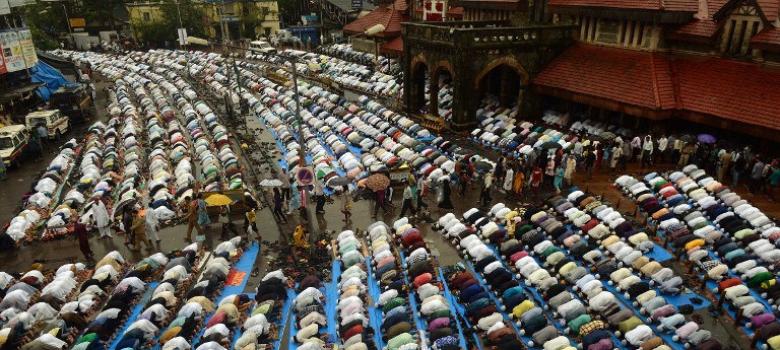
The court’s directive came in response to a public interest litigation filed by a Navi Mumbai resident against the unauthorised loudspeakers during prayer time at mosques. The court specified that all illegal loudspeakers, whether installed at mosques or at Ganesh or Navratri pandals, should be removed “irrespective of religion, caste or community”.

Even though the loudspeaker issue has been repeatedly politicised in Maharashtra (in 2010, the Shiv Sena had demanded a blanket ban on all mosque loudspeakers after the party was booked for violating noise norms at its Dussehra rally), several Muslim activists came out in support of the court directive.

But the call to prayer being announced on loudspeakers is not the only Muslim practice that some members of other communities complain about. In densely-populated cities like Mumbai, when large numbers of devotees gather to pray their Friday namaz, the congregation often spills out of the mosques and into the streets outside, hindering traffic and pedestrian movements for up to 30 minutes.

For many Muslim activists, this phenomenon is as much of an inconvenience to the public as the loudspeakers. But they believe the government has a greater role to play in helping to solve the problem.

“Nobody really likes to pray namaz outside on the streets, because it inconveniences so many people,” said Ghulam Arif, president of the Qartaba Wisdom Club, a Mumbai-based non-profit organisation that works on social issues. The only reason the practice continues, he said, is because the community is too large to fit into the existing mosques.

“The government could give Muslims the permission to organise Friday prayers in open grounds and maidans near mosques,” said Arif.

The community has been recommending a specific solution to the problem for nearly two decades: allowing mosques to expand by granting them additional floor space index. Increasing FSI  – the ratio of plot size to the height of a building that can be erected on it  –  would mean a greater number of floors to accommodate more worshippers.

via Scroll.in – News. Politics. Culture..

04/08/2014

For a country obsessed with fair skin, why are so many Indians buying self-tanners?

Market research firm Euromonitor has just released a study on the grooming habits of the world. It has one rather surprising finding – Indians are slathering on massive dollops of tanning lotions. Indians are apparently second only to Chinese in consuming what the researcher calls self-tanning products.

It doesn’t add up.

Indians are the highest consumers of whitening creams, the same survey shows, and that is unsurprising. The country’s problematic preference for fair skin is well known. Fairness cream ads featuring big Bollywood stars are ubiquitous. In 2010, AC Nielsen estimated the size of the market for skin whitening products at $432 million.

But there is not a single well-known brand of skin-tanning lotions in the country.

via Scroll.in – News. Politics. Culture..

02/08/2014

With End of China’s One-Child Policy, There Hasn’t Been a Baby Boom – Businessweek

Last November, China announced the loosening of its restrictive one-child population policy: Couples would soon be permitted to have two children so long as one parent was an only child. Government planners predicted that roughly half of China’s 11 million eligible couples would chose to have a second child within five years, and investors predicted a boom in sales of diapers, baby formula, and educational toys in China.

Why China's Second-Baby Boom Might Not Happen

The policy change has been rolled out in 29 of China’s 33 provinces and regions, yet by the end of May only 271,000 applications for permission to have a second child had been submitted. Many came from older mothers concerned not to lose their chance. At an agency in Beijing’s Tuanjiehu neighborhood that connects parents with maternity nannies, staff said that the majority of requests pertaining to second children came from women in their late 30s.

Six months into the new policy is still too early to judge the ultimate impact. But experts now express more modest expectations. “Every metric thus far indicates the loosening isn’t leading to a baby boom,” says Mei Fong, author of a forthcoming book on China’s population policies. With rising costs of urban living, Chinese couples are deliberately limiting family size for reasons similar to those depressing fertility in Taiwan, Japan, Korea, Singapore, and Western countries.

via With End of China’s One-Child Policy, There Hasn’t Been a Baby Boom – Businessweek.

01/08/2014

BBC News – ‘Suspects shot’ in Xinjiang imam killing

Police have shot dead two suspects in the killing of the imam of China’s largest mosque and captured another, state media say.

Jume Tahir speaks during an interview at Id Kah Mosque in Kashgar in this still image taken from video dated 3 August 2011

Jume Tahir was the imam in Kashgar, in China’s restive Xinjiang region.

He was found dead after morning prayers at the Id Kah mosque on Wednesday.

Police said the suspects, located shortly afterwards, “resisted arrest with knives and axes”. They were “influenced by religious extremism“, Xinhua news agency said.

Xinjiang, in China’s far west, is home to the Muslim Uighur minority.

Tensions have rumbled for years between Uighurs and Beijing over large-scale Han Chinese migration and tight Chinese control.

In recent months, however, there has been a marked increase in Xinjiang-linked violence, including a market attack in the regional capital Urumqi that left more than 30 people dead.

Beijing blames these attacks on extremists inspired by overseas terror groups. Uighur activists say heavy-handed restrictions on religious and cultural freedoms are fuelling local resentment.

via BBC News – ‘Suspects shot’ in Xinjiang imam killing.

01/08/2014

China’s Girl Births Ratio Improves as Country Gets More Educated – Businessweek

Priscilla Yang is standing outside Tuanjiehu Beijing Maternity Hospital, her husband dutifully holding aloft a purple umbrella to shield her from the blazing July sun. The 27-year-old is eight months pregnant and feeling relieved: Her latest rounds of prenatal tests came back normal.

Yang doesn’t know, but wonders about, the gender of her child. A college-educated public-relations executive, Yang says she hasn’t tried to wheedle illicit information from the maternity hospital staff. Boy or girl, “both are OK,” she says. “What I care most about is that the baby is healthy.”

Yang’s indifference about gender is becoming more common, though the struggle has been long. It has been illegal in China since 2001 for doctors to reveal the sex of the fetus to expectant parents. When ultrasound technology became widely available in the late 1980s, the number of sex-selective abortions shot up. Traditional Chinese culture prized sons, who performed heavy labor on farms and were expected to inherit land and stay home to care for elderly parents. Daughters left their parents’ household to join their husband’s after marriage. The one-child policy, announced in 1980 and enacted nationally within a few years, only intensified the desire for sons. Even after the 2001 law, many Chinese parents managed to bribe poorly paid doctors to see ultrasound results—then chose to abort female fetuses.

via China’s Girl Births Ratio Improves as Country Gets More Educated – Businessweek.

01/08/2014

PLA displays its softer side[1]- Chinadaily.com.cn

Armed police in Northwest China’s Jilin province joined the party by performing a “Little Apple” dance, featuring a hit song, and became an instant hit online.


The song, originally by China’s Chopstick Brothers, enjoyed great popularity around the nation for its melody and lyrics.

Previously, the Conscription Office in Xi’an, Northwest China’s Shaanxi province released its version of “Little Dance” to recruit young people.

It is the first time the People’s Liberation Army has used a popular song for promotion, showing a different side from the stern impression the military used to convey. Unlike previous conscription campaigns highlighting commitment and contribution, the innovation reflects the Chinese army’s attempt to create a more close-to-the-people image.

Many people have given credit to the army, saying the video is fascinating and humorous. “Those soldiers are so cute and I want to join the army after watching it”, one said online.

But for some, the video is not in accordance with Chinese soldiers’ serious image. “I’m really concerned about the Chinese army’s quality after seeing the video. It’s like a spoof. If those soldiers were on a battlefield, could they win the war?” one critic said.

via PLA displays its softer side[1]- Chinadaily.com.cn.

Law of Unintended Consequences

continuously updated blog about China & India

ChiaHou's Book Reviews

continuously updated blog about China & India

What's wrong with the world; and its economy

continuously updated blog about China & India