Archive for February, 2016

20/02/2016

Leaders of Nepal and India mend fences after friction | Reuters

The leaders of Nepal and India have overcome mutual misgivings, India’s foreign secretary said on Saturday, after talks to ease tensions over Nepal’s recently-adopted constitution.

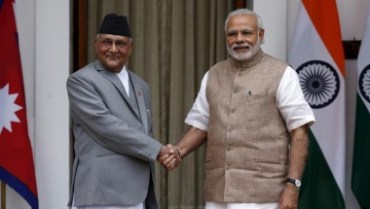
Nepal's Prime Minister Khadga Prasad Sharma Oli (L) shakes hands with his Indian counterpart Narendra Modi during a photo opportunity ahead of their meeting at Hyderabad House in New Delhi, India, February 20, 2016. REUTERS/Adnan Abidi

Prime Minister K.P. Oli visited New Delhi for talks with his Indian counterpart Narendra Modi after a months-long freeze in relations triggered by the grievances of plains dwellers in southern Nepal who have close historical ties to India.

Nepal, which moved from absolute to constitutional monarchy in 1990, made changes to its constitution to ensure greater participation of the Madhesi community in parliament.

But community leaders said the amendments failed to address their central fear that provincial borders would be redrawn in a way that would divide them.

“Our prime minister appreciated the progress made towards consolidation of constitutional democracy in Nepal,” Indian Foreign Secretary Subrahmanyan Jaishankar told a news briefing.

Source: Leaders of Nepal and India mend fences after friction | Reuters

20/02/2016

Pathankot Attack: Pakistan Begins Formal Police Investigation – India Real Time – WSJ

Pakistan has launched a formal police investigation into the alleged involvement of Pakistan-based militants in a deadly attack on an Indian air force base last month, senior government and police officials said Friday.

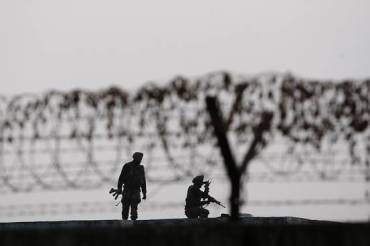
Six heavily-armed militants attacked the Pathankot air force base on Jan. 2, sparking a battle with Indian forces that lasted more than 40 hours, killed seven Indian security personnel and threatened to dismantle a tentative improvement in relations between Islamabad and New Delhi.

India suspected Pakistan-based Jaish-e-Mohammad, a U.S.-designated foreign terrorist group, was behind the Pathankot attack, and demanded Pakistan take action against the perpetrators.

Source: Pathankot Attack: Pakistan Begins Formal Police Investigation – India Real Time – WSJ

18/02/2016

Apple Pay takes on China’s internet kings in mobile payments | Reuters

Apple Inc launched its mobile payment system in China on Thursday in a bid to convince the hundreds of millions of users of the country’s entrenched, dominant services to switch.

Photo

“We think China could be our largest Apple Pay market,” Jennifer Bailey, vice president of Apple Pay, told Reuters in an interview in Beijing.

In an early boost, China’s biggest lender, Industrial and Commercial Bank of China Ltd (ICBC), was among the banks that said earlier this week that customers would be able to use Apple Pay from Thursday.

However, Apple Pay has not had an easy ride so far in China, the fifth country to get the service. Even in its U.S. home market, Apple has faced skeptical retailers in its effort to develop a new revenue stream.

China is not likely to prove any easier to crack.

“People switch applications for significantly better experiences, it (Apple) has to deliver not just a little bit more secure, or a little bit easier to use,” said Mark Natkin, founder of Marbridge Consulting.

Greater China is Apple’s second-largest market by revenue, and the world’s biggest smartphone market. By the end of 2015, 358 million people, more than the U.S. population, had already taken to buying goods and services by mobile phone, according to the China Internet Network Information Center.

The vast majority are using payment services from China’s two biggest Internet companies that have existed for years.

Social networking and gaming firm Tencent Holdings Ltd operates WeChat Payment, and e-commerce company Alibaba Group Holding Ltd, through its Internet finance affiliate Ant Financial Services Group, runs Alipay.

“With 100 percent saturation of local payment systems, no one in China is clamoring for Apple Pay,” said one retailer who declined to be named for fear of harming business prospects. “Today, everyone has a local payment option on their phone, so Apple Pay is a solution in need of a problem.”

Source: Apple Pay takes on China’s internet kings in mobile payments | Reuters

18/02/2016

Is India’s Freedom 251, a $4 Smartphone, Too Good to Be True? – India Real Time – WSJ

A little-known Indian company has announced grand plans to sell millions of made-in-India smartphones for less than $4 a piece, despite the fact that it has only been in the smartphone business for five months and has yet to build a factory.

Ringing Bells Pvt. started taking orders for its Freedom 251 phone on Thursday for 251 rupees ($3.67) each, or less than the price of a McDonald’s Big Mac in the U.S. The company has promised to deliver the phones by June 30–after it builds two manufacturing plants.

Social media lit up with discussion about the device–which the company says will have a four-inch display, 3.2-megapixel camera and 8 gigabytes of storage–after ads for the phone with the tagline “dreams will come true,” appeared in newspapers. Ringing Bells said its phones will have apps that help farmers check soil conditions and fishermen get weather reports.

The company’s website crashed Thursday and it stopped accepting orders for the device as it worked to upgrade its servers, the website said.

At a launch event in a public park Wednesday, thousands turned out to see company President Ashok Chadha unveil a poster-sized image of a phone under a shower of pyrotechnics and confetti. It was an impressive turnout considering only days earlier almost no one had even heard of him, his company or its phone.

Phones given to journalists to try looked as if the branding from another manufacturer had been covered up with white-out on the phone’s front. Indian flag stickers covered the rear. The phones used an Android operating system.

Mr. Chadha said the phone he was sharing was a “beta device.”

Ringing Bells said it would spend 5 billion rupees, or about $73 million, to build the factories. Mr. Chadha said the money will come from the family of Mohit Goel, one of the founders and directors of the company. Mr. Goel’s family owns a farming business, Mr. Chadha said. Attempts to reach Mr. Goel were unsuccessful.

Analysts said they couldn’t see how Ringing Bells could ever make money selling phones for $4.

If Ringing Bells follows through with its plans, the difficulties of setting up manufacturing operations in India could mean it runs into delays that could cause it to miss its June deadline, a spokeswoman for another Indian phone manufacturer said. She said setting up a new factory often takes up to a year.

The company aims produce hundreds of thousands of phones a month and take around 30% of the smartphone market within a year, Mr. Chadha said. Over 100 million smartphones were shipped by manufacturers to retailers in India last year, according to International Data Corp., a research company.

Despite the low price, Mr. Chadha said the company expects to make money on the phones. He said that making the phone using components imported from China would cost about 2,500 rupees per phone. India doesn’t make many components used in phones and other phone sellers in the country import their phones and components from elsewhere.

But Mr. Chadha said he expected to reduce costs through through “economies of scale,” tax breaks for local manufacturing, and other cost-cutting measures. “We are technocrats and have some understanding of international economics,” he said.

Ringing Bells says it will offer a smartphone with a 4-inch display, 3.2 megapixel camera and 8 gigabytes of memory for less than $4. The $33 smartphones powered by Mozilla Corp.’s Firefox operating system have a 3.5 inch display, 2 megapixel camera and 256 megabytes of storage.

Source: Is India’s Freedom 251, a $4 Smartphone, Too Good to Be True? – India Real Time – WSJ

17/02/2016

Free Speech in China Gets an Unlikely State-Media Backer – China Real Time Report – WSJ

China’s ruling Communist Party is cracking down on internal criticism, and the editor of one of the country’s most nationalist tabloids isn’t going to take it anymore.

In a post on his Weibo microblog over the weekend, Hu Xijin, editor in chief of the Global Times, called on Chinese authorities to show greater tolerance for dissenting opinions.

“China should open up more channels for criticism and suggestions and encourage constructive criticism,” Mr. Hu wrote on Sunday. “There also should be a certain amount of tolerance for unconstructive criticism.”

While allowing greater freedom of speech can lead to some problems, it brings greater benefits, he wrote, adding that recent Chinese history since the beginning of Communist rule in 1949 shows that freedom of speech “is inseparably linked to the vitality of society.”

“As for the problems it causes, the state has ample capacity to respond,” Mr. Hu wrote, without elaborating.

The message had received more than 2,000 comments and 1,500 “likes” as of Wednesday afternoon, on par with some of Mr. Hu’s other recent posts.

The posting comes as the Communist Party is doubling down on its efforts to stifle dissent among cadres. The sacking last November of Zhao Xinyu, an editor at a state-run newspaper, drew attention to a new tool in the party’s repertoire: the punishment of members for “groundlessly commenting” on official policies.

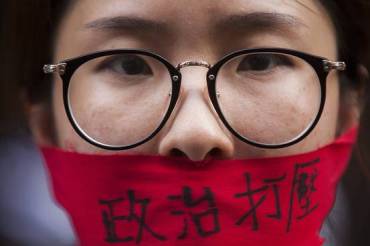
Introduced in a set of party rules last October, the prohibition against speaking out on national policies – known in Chinese as 妄议中央, wangyi zhongyang – is likely to have a chilling effect on political discussion within China, experts say.

It wasn’t clear whether Mr. Hu’s posting was in reaction to the new regulation – although some of the comments on his post indicated that the issue is on Chinese Internet users’ minds. “Aren’t you afraid of [being fired for] groundlessly commenting on official policies?” one user wrote.

Source: Free Speech in China Gets an Unlikely State-Media Backer – China Real Time Report – WSJ

16/02/2016

First train from China to Iran stimulates Silk Road revival – Xinhua | English.news.cn

First cargo train from China to Iran arrived in Tehran on Monday, indicating a milestone in reviving the “Silk Road,” which has opened a new chapter of win-win cooperation between China and Iran.

English: the Silk Road in Central Asia

English: the Silk Road in Central Asia (Photo credit: Wikipedia)

silk road

The train, also referred to as Silk Road train, has passed through Kazakhstan and Turkmenistan to Iran, travelling a distance of 10,399 kilometers. It had left Yiwu city in east China’s Zhejiang Province on January 28.

This train was carrying dozens of cargo containers, according to the deputy of Iran’s Road and Urbanism Minister, Mohsen Pour-Aqaei, who made a welcome speech after the arrival of the cargo train at Tehran Train Station on Monday.

As known to all, ancient Silk Road trade route had served as an important bridge for East-West trade and brought a close link between the Chinese and Persian civilizations.

The “Belt and Road” initiative was raised by Chinese President Xi Jinping in 2013, which refers to the New Silk Road Economic Belt, linking China with Europe through Central and Western Asia, and the 21st Century Maritime Silk Road, connecting China with Southeast Asian countries, Africa and Europe.

“To revive the Silk Road Economic Belt, the launch of the train is an important move, since about 700 kilometers of trip has been done per day,” said Pour-Aqaei, who was present at the welcome ceremony of the train in Tehran’s Railway Station.

“Compared to the sea voyage of the cargo ships from China’s Shanghai city to Iran’s Bandar Abbas port city, the travel time of the train was 30 days shorter,” he said.

Pour-Aqaei, also the Managing Director of Iran’s Railway Company, added that according to the plan, there would be one such a trip from China to Iran every month.

The travel of cargo train from China to Iran is part of a Chinese initiative to revive the ancient Silk Road used by the traders to commute between Europe and East Asia.

Tehran will not be the final destination of these kinds of trains from China, the Iranian deputy minister said, adding that in the future, the train will reach Europe.

This will benefit Iran as the transit course for the cargo trains from the east Asia to Europe, he said.

Chinese ambassador to Iran Pang Sen told Xinhua that as one of the cooperation projects after Chinese President Xi Jinping’s state visit to Iran, the cargo train is playing a important role to promote construction of the “Belt and Road” initiative.

Meanwhile, the railway line from Yiwu to Tehran provides the two countries an express and efficient cargo trade transportation method, Pang said, adding that the countries along the railway line will furthur upgrade rail technology with the aim to make its transportation ability faster and better.

Source: First train from China to Iran stimulates Silk Road revival – Xinhua | English.news.cn

16/02/2016

India and China Have Most Deaths From Pollution – China Real Time Report – WSJ

More than half of the 5.5 million deaths related to air pollution in 2013 happened in India and China, according to a new study.

About 1.4 million people in the South Asian nation and 1.6 million in its northern neighbor died of illnesses related to air pollution in 2013, researchers at the University of British Columbia in Canada said.

The Indian and Chinese fatalities accounted for 55% of such deaths worldwide, the study said.

Researchers studied risk factors for death and disease around the world and found that air pollution, both indoors and outdoors, was one of the leading contributors to global fatalities.

The inhalation of emissions from power plants, vehicles, the burning of crop stubble before replanting, and wood or open fires in homes are some of the leading causes of deaths from air pollution, the report said.

The number of premature deaths linked to air pollution worldwide will increase over the next two decades unless more aggressive targets are set to curb it, researchers studying India and China’s air said at a meeting Friday in Washington D.C.

A major contributor of poor air quality in India is linked to the burning of wood and cow dung for cooking and keeping warm, particularly in the winter months. These methods are popular among India’s rural and urban poor, who don’t have access to electricity or cleaner fuels.

Household air pollution from cooking with wood “is primarily a problem in rural areas of developing countries of the world,” said Michael Brauer, a professor at the University of British Columbia’s School of Population and Public Health, in Canada.

Over the past few months, levels of tiny insidious particles, known as PM 2.5, in the Indian capital New Delhi have often exceeded amounts deemed safe by the United Nations World Health Organization.

Taking their lead from Beijing, Indian authorities in January experimented with restricting cars on roads for two weeks in New Delhi to reduce emission levels. Delhi Chief Minister Arvind Kejriwal said Thursday the city would revive the restrictions for 15 days, starting April 15.

Scientists said vehicle emissions contribute only 20% to 40% of pollution in Delhi, saying other sources of the particulate matter include the burning of dung, rubbish and leaves and the use of diesel backup generators, which kick in when Delhi’s patchy electricity supply cuts out, as well as emissions from small-scale industries such as brick kilns.

A federal environmental court in New Delhi said Feb. 4 it wanted officials to improve air quality by asking authorities to reduce the number of traditional cremations that use wood to burn bodies, a widespread practice in majority Hindu India.

In China, outdoor air pollution from burning coal was found to be the biggest contributor to poor air quality, causing an estimated 366,000 deaths in the country in 2013. Scientists predict 1.3 million premature deaths will take place in China by 2030 if coal combustion remains unchecked.

“One of the unique things about air pollution is you cannot run, you cannot hide from it. We know that if you improve air quality everybody benefits, so from a health perspective reducing levels of air pollution is actually an incredibly efficient way to improve the health of the entire population,” Mr. Brauer said.

Source: India and China Have Most Deaths From Pollution – China Real Time Report – WSJ

15/02/2016

Home on the Range, Chinese Style – China Real Time Report – WSJ

It’s a small step in the right direction, driven more by necessity than enlightened policy.

That’s the view from economists on China’s move this year to put forward a range for its economic growth target rather than a single number. The head of the National Development and Reform Commission, China’s top economic planning agency, said early this month that the 2016 target is likely to be “6.5% to 7%,” the first time in recent memory that China has used such a band. The target is set to be officially released early next month when China’s parliament convenes.

For decades, Beijing beat its annual growth targets without breaking a sweat. More recently, as growth decelerated faster than expected, it has faced growing difficulty hitting its number, so a range provides more wiggle room.

This follows Beijing’s decision to add an “about” to both its 7.5% target in 2014 and its 7% target last year. The adjective proved handy when the actual growth figures wound up falling short both times.

The risk this year, economists say, is that even a 6.5% to 7% target may be too high, heaping pressure on local officials to artificially stimulate growth in ways that increase debt and blunt reform initiatives.

This is also the year that China sets a growth target for the coming five years that’s expected to be 6.5%, in line with a Communist Party goal of doubling per capita income by 2020 over 2010 levels. This benchmark also may be high, analysts said, given China’s many structural problems and so-far limited appetite for reform.

“If they really stick to the 6.5% target by adopting unsustainable policies, throwing up more credit, they face a bigger problem with debt down the road,” said Fitch Ratings Inc. analyst Andrew Colquhoun. “Many emerging market problems in the past have happened when countries veer off and start to believe their own hype on what growth is possible.”

Source: Home on the Range, Chinese Style – China Real Time Report – WSJ

12/02/2016

How India Helped Prove Einstein Right on Ripples and Gravity – India Real Time – WSJ

The discovery of gravitational waves announced Thursday has given momentum to Indian scientists hoping to be the first outside of the U.S. to host the device that detected the signals from the collision of two black holes.

Indian scientists contributed significantly to the decades long hunt for evidence of gravitational waves and in identifying that they were produced by the cosmic clash of black holes a billion light- years ago.

The discovery verifies an unproven portion of Albert Einstein’s Theory of General Relativity and, because the waves are largely unimpeded by matter, offers a new way for astronomers to probe formerly hidden corners of the universe. Einstein first suggestedthe existence of gravitational waves in 1916.

Around 30 Indians were part of a 1,000-strong team of researchers from 15 countries led by scientists at the California Institute of Technology and the Massachusetts Institute of Technology, that made the discovery using detectors at the Laser Interferometer Gravitational-Wave Observatory, or LIGO.

“I am so grateful for the major contributions, by Indian scientists working in India and abroad, that helped make this discovery and future discoveries possible,” said Kip Thorne, a Caltech theoretical physicist and co-founder of the LIGO project,  in a statement.

Indian data analysts developed and implemented techniques to find gravitational-wave signals amid noise and the country’s theorists computed the shapes of the signals, he added.

On Thursday, a tweet from the verified account of Indian Prime Minister Narendra Modi said he was “immensely proud that Indian scientists played an important role in this challenging quest.”

Source: How India Helped Prove Einstein Right on Ripples and Gravity – India Real Time – WSJ

10/02/2016

U.S. and India consider joint patrols in South China Sea – U.S. official | Reuters

The United States and India have held talks about conducting joint naval patrols that a U.S. defence official said could include the disputed South China Sea, a move that would likely anger Beijing, which claims most of the waterway.

An Indian Navy personnel gestures on the deck of the newly built INS Kochi, a guided missile destroyer, during a media tour at the naval dockyard in Mumbai, India September 28, 2015. REUTERS/Shailesh Andrade/Files

Washington wants its regional allies and other Asian nations to take a more united stance against China over the South China Sea, where tensions have spiked in the wake of Beijing’s construction of seven man-made islands in the Spratly archipelago.

India and the United States have ramped up military ties in recent years, holding naval exercises in the Indian Ocean that last year involved the Japanese navy.

But the Indian navy has never carried out joint patrols with another country and a naval spokesman told Reuters there was no change in the government’s policy of only joining an international military effort under the United Nations flag.

He pointed to India’s refusal to be part of anti-piracy missions involving dozens of countries in the Gulf of Aden and instead carrying out its own operations there since 2008.

The U.S. defence official said the two sides had discussed joint patrols, adding that both were hopeful of launching them within the year. The patrols would likely be in the Indian Ocean where the Indian navy is a major player as well as the South China Sea, the official told Reuters in New Delhi on condition of anonymity.

The official gave no details on the scale of the proposed patrols.

There was no immediate comment from China, which is on a week-long holiday for Chinese New Year.

China accused Washington this month of seeking maritime hegemony in the name of freedom of navigation after a U.S. Navy destroyer sailed within 12 nautical miles of a disputed island in the Paracel chain of the South China Sea in late January.

The U.S. Navy conducted a similar exercise in October near one of China’s artificial islands in the Spratlys.

Source: Exclusive: U.S. and India consider joint patrols in South China Sea – U.S. official | Reuters

Law of Unintended Consequences

continuously updated blog about China & India

ChiaHou's Book Reviews

continuously updated blog about China & India

What's wrong with the world; and its economy

continuously updated blog about China & India