Archive for June, 2016

07/06/2016

Is India the Most Attractive Place for Retailers? – India Real Time – WSJ

India has leapt into second place in a ranking of the most-attractive developing economies for retailers compiled by Chicago-based consulting company A.T. Kearney.

The company assessed 30 countries based on economic growth, urban population and ease of doing business, among other factors. China topped the list for the second consecutive year, followed by India, Malaysia, Kazakhstan and Indonesia.

A.T. Kearney said India’s high growth rate, vast pool of consumers and new rules for foreign investors lifted the country up 13 spots in this year’s Global Retail Development Index.“Retail demand is increasingly driven by urbanization, an expanding middle class, and more women entering the workforce,” the A.T. Kearney report said. But it noted that not everything was rosy, saying India remains a “challenging and complex market” with infrastructure bottlenecks.

Some retailers and analysts said they were surprised at India’s sharp move up in the A.T. Kearney ranking.

A rule that requires foreign retailers to source at least 30% of their merchandise locally, for example, has led companies to rethink their big plans for India.

Wal-Mart Stores has shelved plans to open supermarkets in India saying the requirement is near-impossible to meet. French hypermarket chain Carrefour has also shut shop.

Swedish retailer IKEA is struggling to source domestically, as The Wall Street Journal detailed in this front-page story. And government officials said recently they don’t plan to exempt Apple from local-sourcing requirements.

Meanwhile, consultants and retailers are growing increasingly skeptical about the size of India’s middle class. Most of India’s population still lives under $2 a day; only a fraction of its 1.2 billion people can afford a Zara dress or a Starbucks Frappuccino.

A change in A.T. Kearney’s methodology could have boosted India’s fortunes. The company said it tweaked the metrics it used to calculate this year’s index, which “had a substantial impact on the rankings.

”For example, it evaluated countries with a population of over 5 million this year, compared with 3 million last year. As a result, some countries that were ranked highly last year – such as Uruguay in 2nd place, Qatar in 4th place, and Mongolia in 5th  place, weren’t analyzed this year.

Source: Report: Is India the Most Attractive Place for Retailers? – India Real Time – WSJ

06/06/2016

Indian Firms Continue to Flounder in the Face of Fantastic Fundamentals – India Real Time – WSJ

India has the highest gross domestic product growth of any large economy; its chronic inflation problem seems under control and it has a relatively business-friendly prime minister. But its companies’ profits remain utterly unimpressive.

The latest round of quarterly results showed once again that whatever is happening with top-line GDP expansion isn’t trickling down to the bottom line.

The profit after tax at the 30 companies that make up the benchmark Sensex rose only 2.7% from a year earlier. That is better than the 9% decline a year ago but a slowdown compared  to the previous quarter.

For the full fiscal year ended March, Sensex company profit fell 1.6%–their worst performance in seven years. Official data showed last week that the economy grew 7.6% in the same period.

Profits were pummeled as Indian government-owned banks reported losses as they set aside huge amounts of money for bad loans.

Source: Indian Firms Continue to Flounder in the Face of Fantastic Fundamentals – India Real Time – WSJ

04/06/2016

Dam completion signifies growing Indian influence in Afghanistan | Reuters

Prime Minister Narendra Modi visited Afghanistan on Saturday to mark the completion of a nearly $300 million hydroelectric dam project, the latest symbol of Indian investment in its South Asian neighbour.

The dam, originally built in western Herat province in 1976 before being damaged during the civil wars of the 1990s, was rebuilt by some 1,500 Indian and Afghan engineers, according to the Indian Ministry of External Affairs.

“It is symbol of our friendship and would usher in hope, light up homes, nourish the fertile fields of Heart and bring prosperity to the people of the region,” Modi said in a social media post as he departed for Afghanistan, the first stop on a five-country trip.

Afghan President Ashraf Ghani has nurtured closer ties with India in the past year as relations with Pakistan have deteriorated in the face of continued insurgent attacks and border tensions.

Afghanistan has walked a fine line as it accepts Indian aid, with Pakistan historically wary of any Indian influence in Afghanistan.

Salma Dam is another big step in deepening and broadening the relationship between Afghanistan and India,” Ghani said in a post on Twitter.

At more than 100 metres (330 feet) high and 540 metres (1,770 feet) wide, the dam is designed to generate 42 megawatts of power and help irrigate 75,000 hectares of land, according to Modi.

India has poured more than $1 billion into Afghanistan reconstruction projects and humanitarian aid, making it one of the largest donors to the war-torn country.

A new national assembly building in Kabul and major power line and road construction have been among the main projects funded by India.

Source: Dam completion signifies growing Indian influence in Afghanistan | Reuters

04/06/2016

This Spanish Company Says It Holds the Key to Speed on India’s Crooked Railways – India Real Time – WSJ

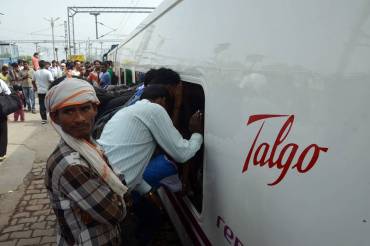
India’s trains are notoriously slow and outdated, but a Spanish train maker says it can change that with coaches that can squeeze much more speed out of the country’s crooked railways.

Talgo S.A. has been wooing India for years as the South Asian nation has one of the largest railway networks in the world and big plans to upgrade its rail infrastructure.

The Madrid-based company got its breakthrough this year when it got the go-ahead to test its coaches on few routes in India to prove its trains can slash travel times for the 13 million people who use the state-owned Indian Railways every day. Talgo claims its coaches can cut travel time by up to 30%.

The existing average maximum speed of Indian passenger trains is 110 kilometers per hour, according to Vijay Kumar, executive director for infrastructure and mechanical engineering at Indian Railways.

One of Indian Railways’ current fastest trains–the Rajdhani Express–travels between Delhi and Mumbai in around 16 hours. Talgo says the same journey with its coaches will take less than 11 hours.

India has traditionally built its own trains and Talgo is the first foreign train-manufacturer to be given permission to conduct trials, said Mr. Kumar.

The tests of the trains began last weekend between Bareilly and Moradabad in northern Indian state of Uttar Pradesh and will be expanded to two other routes.

The main selling point of the Talgo coaches is that India won’t need to change the tracks for them.

“For any conventional train you need a lot of investment in the existing infrastructure but with Talgo train you don’t need any investment in the infrastructure and it can start going at higher speed,” said Subrat Nath, director for India and Asia-Pacific region at Talgo.

Despite India’s dependence on its railways, the system has become outdated and overburdened.

“India is unique and alone among the major countries of the world in not having a single high-speed rail corridor,” said a document presented to the Indian Parliament in 2009 titled “Indian Railways Vision 2020.”

The Congress party-led government back then said it would upgrade the current tracks and build “state-of-the-art high-speed corridors” for the trains to run up to 350 kilometers, or 217 miles, per hour.

In the latest step in that direction, India launched its first “semi-high speed” train in April–the Gatimaan Express– between Delhi and Agra, home of the Taj Mahal. The train has a maximum speed of 160 kilometers, or 99 miles, per hour, cutting the fastest travel time between the capital and Agra by more than 15 minutes.

One of the biggest factors slowing down Indian Railways’ 7,000 passenger trains is the country’s long and winding railroads. There are 495 speed-killing curves in the tracks between Delhi and Mumbai alone, said Mr. Kumar at Indian Railways.

Straightening out existing tracks or building straight ones from scratch is too expensive, said Mr. Kumar, so the trains from Talgo and others which offer more speed on curvy lines could be the best option.

Talgo coaches use a “natural tilting mechanism” which allows them to go up to 20% faster on curves than conventional coaches, Mr. Kumar said.

He said the trials will test whether the trains perform as promised. India has not committed to ordering from Talgo yet.

Talgo’s Mr. Nath says the company is ready to build the coaches in India if it can get the orders.“India can be a key market for us,” he said.

Source: This Spanish Company Says It Holds the Key to Speed on India’s Crooked Railways – India Real Time – WSJ

03/06/2016

The class ceiling | The Economist

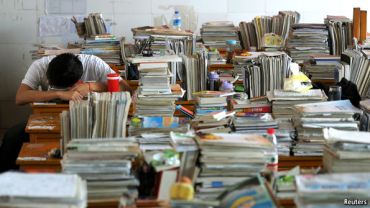
NO CAR may honk nor lorry rumble near secondary schools on the two days next week when students are taking their university entrance exams, known as gaokao. Teenagers have been cramming for years for these tests, which they believe (with justification) will determine their entire future. Yet it is at an earlier stage of education that an individual’s life chances in China are usually mapped out, often in ways that are deeply unfair.

To give more students access to higher education, the government has increased its investment in the sector fivefold since 1997. The number of universities has nearly doubled. In 1998 46% of secondary-school graduates went on to university. Now 88% of them do. About 7m people—roughly one-third of those aged between 18 and 22—now gain entry to some form of higher institution each year.

China’s universities offer more opportunity for social mobility than those in many other countries, says James Lee of Hong Kong University of Science and Technology. But the social backgrounds of those admitted have been changing. Until 1993, more than 40% of students were the children of farmers or factory workers. Now universities are crammed with people from wealthy, urban backgrounds. That is partly because a far bigger share of young people are middle-class. But it is also because rural Chinese face bigger hurdles getting into them than they used to.

The problem lies with inequality of access to senior high schools, which take students for the final three years of their secondary education. Students from rural backgrounds who go to such schools perform as well in the university entrance exams as those from urban areas. But most never get there. Less than 10% of young people in the countryside go to senior high schools compared with 70% of their urban counterparts. The result is that a third of urban youngsters complete tertiary education, compared with only 8% of young rural adults.

One reason is that junior high schools in the countryside are far weaker academically than urban ones. Local governments invest less in them per student than they do in cities. Urban parents tend to be better educated and thus better able to help children with their studies. Rural pupils often suffer from a “poverty of expectations”, says Jean Wei-Jun Yeung of the National University of Singapore: they are not encouraged to think they can succeed, so they do not try to.

Expense is a huge deterrent for many. Governments cover the costs of schooling for the nine years of compulsory education up to the age of around 15. But at senior high schools, families must pay tuition and other expenses; these outlays are among the highest in the world (measured by purchasing-power parity). Many students drop out of junior high school—which is free—because rising wages in low-skilled industrial work make the prospect of staying at school even less attractive. Millions enter the workforce every year who are barely literate or numerate. Poor nutrition is also a handicap. Stanford University’s Rural Education Action Programme has found that a high incidence of anaemia and intestinal worms in rural areas affects educational performance.

Since the 1990s more than 200m people have moved from the countryside to work in cities. Many have left their children behind because of the difficulty of getting them into urban schools: the country’s system of hukou, or household registration, makes it hard for migrant children to enjoy subsidised education in places other than their parents’ birthplace.

But migrant children who do attend schools in cities usually get a worse education than their city-born counterparts. State schools that accept migrant pupils often operate what Pei-chia Lan of National Taiwan University refers to as “apartheid school models”. In these, migrant children are taught separately from urban ones in the same school, and are even kept apart from them in the playground. Since they are forced to take senior high-school exams in the hometown of their hukou, many have little choice but to return to the countryside to attend junior high school.

Source: The class ceiling | The Economist

03/06/2016

India May Have Won the Battle With Food Inflation Before the First Drop of Monsoon Rain – India Real Time – WSJ

Around this time every year, farmers and economists look to India’s skies, hoping for the arrival of the monsoon rains.

Late and less rain hurts crops and triggers inflation, goes the traditional worry, so every day of delay or deficit in downpours threatens to derail the country’s fragile growth.

The problem with this annual, rational worry, however, is that it’s just, plain wrong.

Good and bad monsoons in recent years have had limited effect on growth or even on food inflation, according to a report this week from Nomura. What is much more important in determining how fast food prices rise, the report says, is the minimum support prices New Delhi sets for certain crucial commodities.

So instead of looking to the skies, central bankers and other inflation fighters should be looking to New Delhi.

This year the monsoon is predicted to be above normal but much more importantly, the weather over the capital is looking promising. On Thursday, India’s weather department upheld its monsoon forecast and said it expects rainfall to be 106% of the long-term average.

On Wednesday the government announced the minimum support prices for the most basic Indian staples–dal and rice—and capped the increases at less than 10%. In some years when the government looked to help farmers it has ratcheted up the prices more than 15%, triggering inflation.

Source: India May Have Won the Battle With Food Inflation Before the First Drop of Monsoon Rain – India Real Time – WSJ

02/06/2016

Bureaucrats at the till | The Economist

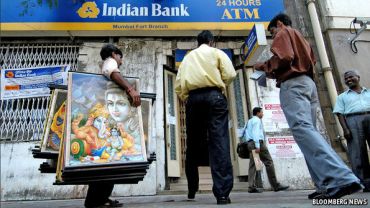
INDIA’S biggest banks tend to have official-sounding names, worthy of a central bank. There is State Bank of India, Union Bank of India, Bank of India and even Central Bank of India (the actual central bank is called the Reserve Bank of India, or RBI). That is because, starting in 1969, the entire financial system was nationalised. Although the government has grudgingly permitted private-sector banks over the past 20 years, the 27 public-sector banks (PSBs), which are listed but majority-owned by the government, still account for 70% of lending. That is a worry, because the PSBs are in terrible shape, having lent freely to companies that cannot pay them back. In response, both the government and the RBI are imposing various reforms—but not the most obvious one.

Indian banks dodged the global financial meltdown in 2008. But they promptly embarked on a frenzy of lending to big companies, sowing the seeds of a home-made crisis. The PSBs gleefully funded infrastructure projects that never got the required permits, mines with an output made much less valuable by slumping commodity prices, and tycoons whose main qualification was friendship with government ministers. PSBs have tried to gloss over the problem for years, but the RBI is now forcing them to admit the true extent of the damage.

The reckoning has been brutal: 3 trillion rupees ($44 billion) of loans have been recognised as “non-performing” by banks in the past two quarters, the vast bulk of them at PSBs; 17% of all loans there have either been written off, provisioned for or categorised as impaired, according to Credit Suisse, a bank. More losses are in the pipeline. The revelations have driven the combined market capitalisation of the 27 PSBs down to that of a single well-run private lender, HDFC Bank, founded in 1994.

Tidying up a mess on this scale is never easy, but it is proving particularly tricky in India. The absence of a bankruptcy law (one was enacted in May but it will take months, if not years, to become operational) leaves bankers powerless in the face of defaults. Indian lenders recover just 25% of their money from delinquent borrowers on average, and only after four years of haggling, compared with 80% in America in half the time. A creaky judicial system piles delays upon delays.

Worse, as quasi-bureaucrats, Indian bankers are loth to do the one thing that would help a recovery, which is to sell iffy loans to outside investors and move on. Such investors exist, albeit in limited numbers, but doing business with them can be treacherous: if the borrower’s fortunes recover after a sale and it pays back the new owner of the loans in full, bankers fear government auditors will accuse them of selling the distressed loans on the cheap. Best for the bankers to do nothing, and hope that the situation somehow improves.

The government wants to change this dynamic. A new “bank board bureau”, headed by an unimpeachable former government auditor, has been created to insulate bankers from government meddling, and so give them cover to sell assets at less than face value. Much of what it suggests is sensible: giving longer terms to PSBs’ bosses, for example, and ensuring they are not judged merely on how quickly they increase the bank’s loan book—part of the reason the PSBs ran into trouble before. The government also wants to halve the number of PSBs through mergers.

Source: Bureaucrats at the till | The Economist

Law of Unintended Consequences

continuously updated blog about China & India

ChiaHou's Book Reviews

continuously updated blog about China & India

What's wrong with the world; and its economy

continuously updated blog about China & India