Archive for December, 2016

15/12/2016

India court bans liquor shops on highways – BBC News

India’s top court has ordered all liquor shops to shut down along state and national highways in an attempt to reduce drink driving and road accidents.

The court told the government to stop issuing new licenses and not renew the existing ones after 31 March.More than 146,000 people died last year in traffic accidents in the country.

About 5% – or 6,755 – deaths were due to cases where the driver was either drunk or had taken drugs.

Can India really halve its road deaths?

India crashes kill 146,133 in 2015

What Al Capone can teach India about prohibition”

(There should be) no liquor vends on national and state highways,” news agency AFP quoted Chief Justice TS Thakur, who headed the three-judge bench, as saying in his order on Thursday.The court also said that all liquor advertisements should be removed from the highways and shops selling alcohol must be located at least 500 metres (1,640 feet) away from them.

Campaigners say the large number of liquor shops located along the highways are “a great temptation and a distraction for road users”.

Alcohol is banned in four Indian states (Gujarat, Bihar, Manipur, Nagaland) and the union territory of Lakshadweep. There’s a partial ban on sale of alcohol in the south Indian state of Kerala.

Source: India court bans liquor shops on highways – BBC News

15/12/2016

PepsiCo CEO Indra Nooyi Is Latest Indian American to Sign Up to Help Donald Trump – India Real Time – WSJ

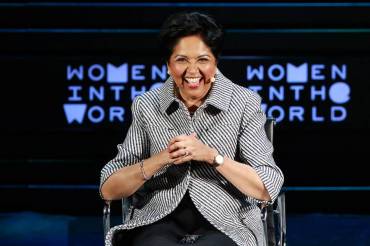
Chairman and CEO of PepsiCo. Indra Nooyi is the latest Indian American to be hand-picked by U.S. President-elect Donald Trump to advise him and help him run the country.

Ms. Nooyi’s appointment to his strategic and policy forum was announced Wednesday by Mr. Trump’s transition team as one of three new appointments to the 16-member group. SpaceX Corp’s Elon Musk and Uber Technologies Inc.’s Travis Kalanick were the other two appointments.

The forum will be called upon to meet frequently with Mr. Trump to discuss his economic agenda.“America has the most innovative and vibrant companies in the world, and the pioneering CEOs joining this Forum today are at the top of their fields,” Mr. Trump said in a news release. “My Administration is going to work together with the private sector to improve the business climate and make it attractive for firms to create new jobs across the United States from Silicon Valley to the heartland.”

Seema Verma, president and founder of SVC Inc. arriving at Trump Tower on November 22, 2016 in New York City.

Mr. Trump last month nominated Indian-American Seema Verma, CEO and founder of SVC Inc ., a U.S.-based health policy consulting company to serve as Administrator of the Centers for Medicare and Medicaid Services. “She has decades of experience advising on Medicare and Medicaid policy and helping states navigate our complicated systems,” he said.In November, Mr. Trump picked South Carolina Gov. Nikki Haley who is Indian in origin to serve as U.S. ambassador to the United Nations.

Ms. Nooyi, who was born in Chennai, India and later went to Yale University to study public policy and management, will have a direct line, along with others in the group, to Mr. Trump to advise him on economic policy, job creation and productivity, said the release.

Source: PepsiCo CEO Indra Nooyi Is Latest Indian American to Sign Up to Help Donald Trump – India Real Time – WSJ

15/12/2016

Trump and China: 5 Views From Beijing – China Real Time Report – WSJ

Stephen Sestanovich, a professor at Columbia University and senior fellow at the Council on Foreign Relations, is the author of “Maximalist: America in the World From Truman to Obama.” He is on Twitter: @SSestanovich.

When the Chinese Foreign Ministry expresses “serious concern” about things Donald Trump has said about Taiwan—and a party-controlled newspaper calls him “as ignorant as a child”—it’s clear that Beijing is alarmed. Yet after spending last week in China, I came away struck by the overall complacency of Chinese attitudes toward the president-elect. From officials (and former officials), entrepreneurs, journalists, NGO leaders, and think-tankers, I heard five different reasons for not worrying too much about how Mr. Trump could affect U.S.-China relations.

1. China is powerful.

Sure, a new administration might want to rethink the relationship between Beijing and Washington, but that can’t be the end of the story, I heard. China has so many ways to push back. Soon enough the Americans would come to their senses.

2. The U.S. is constrained.

Standing up to China is expensive, I was reminded. As one former trade official told me, “America may decide it wants to patrol the South China Sea more often, but that costs money.” (I pointed out to people I talked to that Mr. Trump was committed to a big increase in the Pentagon budget—but everyone knows there are a lot of claims on those dollars, and many would have no impact on China.)

3. Businessmen are practical people.

China’s economic surge, now more than three decades old, was premised on an abandonment of ideology. As a successful businessman, Mr. Trump—I was told—must be a pragmatist at heart. One journalist I talked to thought it might help the president-elect to cultivate a Nixon-style “mad man” reputation, but most of my interlocutors seemed confident this was all for show.

4. Bureaucratic and interest-group politics.

The Chinese have seen previous presidents campaign on anti-Chinese themes only to abandon them in office. Why, they ask, does this happen? Their answer: the institutions of the U.S. government know how to bury new ideas. Someone like Mr. Trump, with no prior experience in Washington, will find it difficult to ignore Congress and the federal bureaucracy.

5. Habit and mutual benefit.

Chinese of all outlooks believe that, in the 45 years since Henry Kissinger first visited Beijing, a relationship has been created from which both sides derive obvious benefits. “Win-win” seems to be a favorite buzz phrase in China, and the idea that it would be questioned evokes a certain incredulity.The status quo has a powerful hold on people’s imaginations everywhere. Still, the Chinese assumption of policy continuity—after everything that has happened this year!—was a surprise for me. I told the people I spoke to that Mr. Trump had convinced many voters that he is determined to scrap outmoded policies. One person, who knows the U.S. well, had an interesting response: “You mean ‘win-win’ could be one of them?”

Source: Trump and China: 5 Views From Beijing – China Real Time Report – WSJ

14/12/2016

Pop-Up Restaurant at Everest Base Camp Aims for Peak of Fine Dining – India Real Time – WSJ

Chefs are trekking thousands of feet to prepare fancy food in the cold

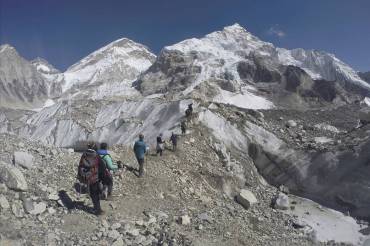
Trekkers pass through a glacier at the Mount Everest base camp, Nepal.

The peaks of fine dining just keep getting higher and higher.

A caravan of roving chefs and their 15 guests is currently making its way up the Himalayas toward the base camp at Mount Everest, where, 17,500 feet above sea level and amid the lashing winds and bone-penetrating chill of the Nepalese winter, food will be served.

The One Star House Party, as the project has been dubbed, is preparing 16 more such destination dining experiences, one a month, through 2018, though not all of the destinations are so extreme. Among the chefs involved is James Sharman, a onetime chef de partie at Noma, the influential, soon-to-close restaurant that put Copenhagen on the global culinary map.

The Nepal journey is costing its participants $1,050 each. Down jackets and sleeping bags are included. The group didn’t immediately respond to a request for the menu.

Everest Base Camp is, literally, a trek. Not a quick one, either. The group first flew from Nepal’s capital of Kathmandu to the tiny airstrip at Lukla, undertaking one of the most treacherous landings on the planet. From there they are walking, helped by porters, who are presumably carrying more than the usual amount of kitchen gear on their backs. Most travelers are advised to spend more than a week making their way up to base camp, to allow their bodies to adjust to the altitude.

On the way, the chefs have been collecting local flora for their mountaintop pantry.

Everest Base Camp is no stranger to haute cuisine. Adventurers scaling the great mountain with some of the more full-service expedition companies can enjoy sushi, pork chops and Peking duck alongside their protein bars and instant noodles. A few years ago Glenfiddich sponsored a whiskey tasting there, billed as the world’s highest, that was broadcast live online.

For more earthbound eaters in South Asia, there will be at least one more chance to join the One Star House Party. Their next destination, slated for January, is Mumbai. Reservations aren’t yet being taken.

Source: Pop-Up Restaurant at Everest Base Camp Aims for Peak of Fine Dining – India Real Time – WSJ

13/12/2016

Can jet engines clean up Delhi’s foul air? – BBC News

Sometime next year, if all goes well, a retired jet engine will be mounted on a flatbed trailer and taken to a coal-fired power plant in Delhi.

With the exhaust nozzle pointed at the sky, the engine will be placed near the smokestack and turned on.

As the engine roars to life, it will generate a nozzle speed of 400 metres per second (1,440km/h; 900mph), which is more or less the speed of sound.

The exhaust will create powerful updrafts that will, to put it simply, blast the emissions from the plant to higher altitudes, above a meteorological phenomenon called temperature inversion, where a layer of cold air is held in place by a warmer “lid” trapping smog.

The jet exhaust will act as a “virtual chimney”, drawing in and transporting the smog, which makes Delhi’s air some of the most toxic in the world. A single jet engine can deal with emissions from a 1,000 megawatt power plant.

Temperature inversion

Can Delhi ever clean up its foul air?

So can jet engines help clean up Delhi’s foul air? A team of researchers from the US, India and Singapore believes so.

“This could lead to a successful implementation of a new technology for smog mitigation all over the world,” the lead researcher, Moshe Alamaro, an aeronautical engineer and atmospheric scientist at the Massachusetts Institute of Technology, tells me.

“The programme could use retired and commercial engines and has the possibility of adding value to numerous retired propulsion systems available.”

Delhi is an ideal candidate for this experiment. The widespread use of festival fireworks, the burning of rubbish by the city’s poor, plus farm waste from around the city, vehicular emissions and construction dust, all contribute to the city’s thick “pea-soup” fogs.
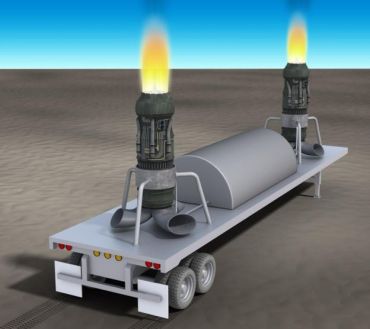
The jet engines will be mounted on a flatbed trailer

Things get worse in winter: last month, schools were shut, construction and demolition work suspended, people wore face masks and were asked to work from home.

The move came after levels of PM2.5 – tiny particles that can affect the lungs – soared to over 90 times the level considered safe by the World Health Organization and 15 times the federal government’s norms.

Carrying out the jet engine experiment outside a coal-fired electricity plant makes sense as coal accounts for more than 60% of India’s power generation. In two years, the country could surpass China as the biggest importer of thermal coal.

Coal-fired energy may be linked to more than 100,000 premature deaths and millions of cases of asthma and respiratory ailments. Also, emissions from a 1,000-megawatt coal-fired plant are equivalent to emissions from roughly 500,000 cars.

Scientists say that jet engines were used in the Soviet Union 45 years ago to enhance rainfall.

“They achieved some success,” says Dr Alamaro. “As far as I know nobody tried using jet engines for smog mitigation.”

Noise concerns

Farmers have also rented helicopters to hover over their fields to “agitate and disrupt the inversions” to protect their crops.

Next month, Dr Alamaro will join some of India’s top scientists and collaborators from government agencies at a workshop to plan the experiment.

There are concerns: noise from the jet engine, for example.”In the beginning,” he says, “the jet engine will be tested in remote location and not necessarily near a power plant, to observe the jet properties and for optimisation.”

The scientists say that fears about emissions from jet engines fouling the air are unfounded as their emissions “are much cleaner than that of the power plant per unit of power”.

There are reportedly offers of retired jet engines from air forces in India and the US for the experiment.

Scientists are talking to Tata Group, a private power producer, to use one of their plants for a site for the experiment.

Before the test, meteorological data on the area, along with information on frequency of smog will be essential. Drones will be used before and after the experiment.

Coal-powered thermal power plants meet most of India’s energy needs

Critics of the planned experiment doubt whether the jet exhausts will be powerful enough to create a virtual chimney and blow out the smog, and question whether expensive jet engines can be used on a large scale to control air pollution in a vast city such as Delhi.

But Dr Alamaro is optimistic.

“Each new technology should start with the least resistant path for success,” he says.”The concentration of emission from coal is very high near the power plant.”

So a jet engine that elevates this emission is more effective near the power plant than somewhere else in the city that is plagued by smog.

“That said, we also plan to try to elevate the less concentrated smog in and around the city by jet systems.”

For example, the jet system can be placed near highways where vehicle emission is high, so the jet is more effective than somewhere else in the city.

If successful, Dr Alamaro says, this method can be used “anywhere and anytime, away from a power plant and during normal atmospheric conditions” to control air pollution.

Fairly soon, we may know if jet engines can really help to clean Delhi’s foul air.

Source: Can jet engines clean up Delhi’s foul air? – BBC News

13/12/2016

A New Highway Links China’s Capital to a Hoped-For Future – China Real Time Report – WSJ

Beijing built it. Now will the traffic jams come?

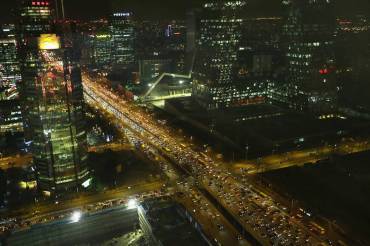
A new highway loop around China’s capital opened last week, ticking off another checkbox in a long-held state plan to tie the city and its surrounding suburbs into a massive megalopolis known as Jing-Jin-Ji.

Locally known as the Seventh Ring Road and officially as the G-95 national highway, the roadway spans nearly 1,000 kilometers (about 620 miles) and links a dozen existing highways in a chain that circles the far outskirts of Beijing. Five successively smaller coils of highways sit inside of it. The smallest, and nearest to the Forbidden City in the core of the capital, is the Second Ring Road.

If the seventh ring were unwound and moved to the U.S., it would stretch roughly a sixth of the way across the United States.

As it is, about 90% of the Seventh Ring Road snakes through 13 cities and largely undeveloped areas and farmland in nearby Hebei province. The name for the megalopolis, Jing-Jin-Ji, combines characters from Beijing and the port city of Tianjin and a name for Hebei.

Government planners hope that one day soon the less developed areas of this conurbation will be transformed into bedroom communities, office parks and industrial estates, giving impetus to new sources of economic growth and easing the pressure on Beijing’s clogged roadways and soaring property prices.

“Transportation is making a leading breakthrough, accelerating the integration of Jing-Jin-Ji,” the Ministry of Transport said in a statement last week.  The Communist Party’s newspaper, People’s Daily, said Monday that the new ring road “will effectively ease the pressure on vehicles in the capital region.”

Sanhe, a city in Hebei, is typical of the official plans for the region and was spotlighted by the government as an important link in the Seventh Ring Road. Sanhe borders the eastern Beijing suburb of Tongzhou district, where new Beijing city government offices are slated to open by the end of next year. Over the last year, the prospect of new business activity and services in Tongzhou spurred a mini home-buying frenzy.

Locals are anticipating that housing demand could someday spill into Sanhe. Wang Qiang, a 30-year-old installation engineer for a Chinese construction company, and his wife bought a one-bedroom apartment two years ago in Yanjiao, a town that is part of Sanhe and sits on the Tongzhou border. The value of his apartment has roughly doubled since then, a sign of rising demand for his neighborhood, he says. “Yanjiao prices closely follow Tongzhou prices,” Mr. Wang said.

During a recent drive to Sanhe, it took nearly an hour and half to escape the snarl of Beijing traffic. A few convenience stores dotted local roads. A sign for a “World Business Valley” housing development stretched over an archway in front of a land parcel overgrown with weeds.Three days after its official opening, the Sanhe stretch of the Seventh Ring Road was empty. The toll booths were staffed. The six-lane highway was smoothly paved. Half an hour went by, but there were no other cars on a sunny, blue-skied morning.

The taxi driver, Ms. Zhai, was asked if she’d consider buying a home someday in Sanhe, the site of possible future development.

“Here?” Ms. Zhai sighed. “I wouldn’t. I’m from Beijing, from Tongzhou. There are no businesses, no factories out here. I’d have to wait a few years, then maybe I’d buy. Maybe in 2020.”

Source: A New Highway Links China’s Capital to a Hoped-For Future – China Real Time Report – WSJ

Tags: , ,
09/12/2016

China has gained hugely from globalisation | The Economist

LI DONGSHENG, who is 35, says he is too old to learn new skills and too old to get married. Construction and factory work used to be plentiful, he says, as he eats his lunch from a yellow plastic container while sitting on a wall outside a job centre in Hangzhou, a city on China’s wealthy eastern seaboard. But these days he can rarely find even odd jobs. He sleeps rough and has not visited his parents, who live hundreds of kilometres inland, for two years.

Millions of people like Mr Li have powered China’s rise over the past three decades, working in the boom-towns that have prospered thanks to China’s enthusiastic embrace of globalisation. Yet many are anxious and angry.Factory workers in America and Europe often blame China for stealing their jobs. There is no doubt that China has benefited enormously from its vast pool of people, like Mr Li, who are willing to work for a fraction of what Western counterparts might earn. Since 1979 China’s transformation into the workshop of the world has helped lift hundreds of millions of Chinese out of poverty.

Yet many of the worries that have recently animated Western voters are common in China, too. Working-class Chinese, as well as members of the new middle class, fret about rising inequality, the impact of mass migration from the countryside into cities and job losses. “China will not shut the door to the outside world but open more,” said the president, Xi Jinping, in November. But even globalisation is occasionally attacked. On December 6th Global Times, a jingoistic newspaper published in Beijing, ran an opinion piece blaming globalisation for China’s income inequality, housing bubbles and the ravaging of its environment.

China’s own policy failures are much to blame, too. But the government has sensed the danger of rising public anger created by the divide between rich and poor (in the 1980s China was among the most equal societies in the world; now it is one of the least so). A decade ago it switched its “chief task” from “economic construction” to establishing a “harmonious society”—ie, one with a more even distribution of wealth (as well as a beefed-up police force to keep malcontents in check). China is now becoming slightly fairer overall: thanks to a dwindling supply of cheap labour and government efforts to boost the minimum wage, blue-collar salaries are rising faster than white-collar ones.But many people feel that inequality and social mobility are getting worse in other respects. For example, members of the fast-growing middle class complain about the emergence of a new plutocracy. They say that the wealthiest owe their fortunes to corruption and personal relationships, not hard work. Mr Xi’s waging of the longest and most intense campaign against graft since the party came to power in 1949 is partly (as he admits) a sign of fear that anger over widespread and egregious corruption might imperil the party’s rule.


Among blue-collar workers, a structural shift in China’s economy, from labour-intensive manufacturing to higher-tech industries and services, is fuelling job insecurity. In 2013, for the first time, the contribution to GDP from services, such as transport, shops, restaurants and finance, pulled ahead of industry, including manufacturing, mining and construction (see chart).

In the past couple of years, jobs in manufacturing have been declining, partly because globalisation is beginning to play the same sort of role in China as it does in developed countries. Some factories have been moving to cheaper locations abroad.The impact is pronounced in many of the hundreds of towns that specialise in making certain products. Datang, China’s “sock city” near Hangzhou, is a good example: in 2014 it made 26bn pairs of socks, some 70% of China’s production, but many factories are closing as garment-making moves to cheaper countries in Asia. As a local boss explains, “People simply won’t pay more for a pair of socks.”

Millions more jobs are threatened by efforts to reduce overcapacity in bloated and heavily indebted state-owned enterprises (SOEs), such as steelmakers and mining companies. Nervous officials often prefer to prop up such businesses rather than risk an explosion of unrest among laid-off urban-born workers. The government worries more about such people than it does about unemployed migrants from rural areas: they stay in the cities rather than return to the countryside.

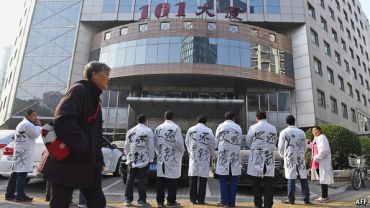
The official unemployment rate in urban areas has remained remarkably steady at around 4% for years, even during the worst of the global financial crisis. But those figures are highly misleading. For one thing they exclude migrants from the countryside, who often suffer the worst labour abuses, such as long periods of unpaid leave as well as of unpaid work: bosses often suffer the worst labour abuses, such as long periods of unpaid leave as well as of unpaid work: bosses often hold back wages for months. About 40 construction workers in Beijing protested last month to demand unpaid wages from a project three years ago (pictured above).

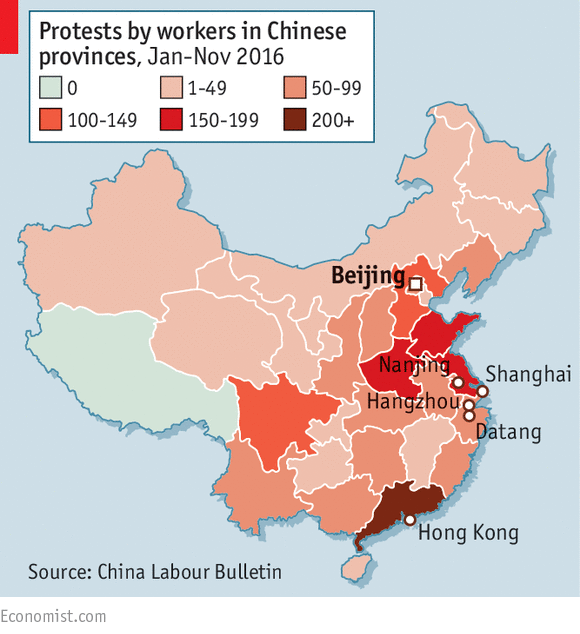
Many of those who used to work in factories, such as Mr Li in Hangzhou, are ill-equipped to find new jobs in service industries. Official data show that more than two-thirds of workers laid off in recent years were poorly educated and around half were aged 40 or older. Those are big handicaps. The government has assigned 100bn yuan ($14.5bn) to pay for the resettling and retraining of workers laid off in the steel and coal industries. But the scheme’s details are unclear. Migrants, usually first out of the door, often cannot afford to stay in a city without a job. Those who do find work in service industries are not necessarily happier. In the third quarter of 2016, for the first time, labour unrest in such firms was more common than in manufacturing, according to China Labour Bulletin. The Hong Kong-based NGO recorded 2,271 protests by workers in all industries between January and November (see map). That is more than 14 times as many as in the same period of 2011.

Drawbridge up

As anxieties grow, migrants are likely to suffer. Like those in the West who resent foreign immigrants, Chinese urbanites often blame their cities’ problems on outsiders, albeit on people from other parts of the country (who often speak very different dialects and lack “civilised” city ways). The 280m such migrants in urban China feel marginalised and resented. Weibo, a microblogging site, has accounts dedicated to subjects such as “Beijingers safeguarding the city of Beijing”. In May, 12 city and provincial governments tried to broaden their pool of university entrants by reducing quotas for local students. Parents in three cities staged demonstrations, worried their children would lose a precious advantage (pictured is one such protest in the eastern city of Nanjing).

More often, migrants are subjected to a kind of apartheid, in effect excluded from subsidised urban health care and other public services because they have no urban hukou, or residence permit. Urban schools commonly (and illegally) require that parents of migrant children pay extra fees and produce documents such as rental or job contracts that few of them can supply. Children who do get places are sometimes taught separately from those of urban-born parents. The central government is making it easier for migrants to obtain hukou in small towns and cities where apartment blocks often lie empty but jobs are scarce. But it is getting harder for people from the countryside to settle in megacities such as Beijing and Shanghai, owing to measures such as the demolition of ramshackle housing where many of them live and stricter qualifications for local hukou.

The Communist Party has treated the presidential election in America and Britain’s vote to leave the European Union as propaganda victories. People’s Daily, the party’s mouthpiece, gleefully reported on the “dark, chaotic and negative” election campaign that had revealed the “ill” state of America’s “so-called democracy”. China Daily called the Brexit vote a “political earthquake”. Its message was clear: giving people the freedom to make such momentous decisions can have dangerous consequences. With the West plunged into uncertainty, China has seized the chance to present itself as a beacon of stability.

Yet the party knows that in China, too, the rise of inequality and loss of manufacturing jobs present big challenges. Mr Xi may talk confidently of keeping China open, but the case for doing so is not clear to many of China’s citizens, nor even to the government (ask foreign businesses in China about the difficulties they face). Since the country first launched its “reform and opening” policy in the late 1970s, arguments have never ceased over how far to go. In the 1990s, when the party launched its first wave of SOE closures, resulting in millions of lay-offs, some angry workers even began to embrace a neo-Maoist movement that harked back to the days of guaranteed jobs (and far firmer controls on internal migration). As he prepared to take over in 2012, Mr Xi engaged in a fierce struggle with another leader, Bo Xilai, who had gained huge popularity partly thanks to his Maoist rhetoric. Mr Bo is now in jail, but Mr Xi has adopted his Mao-loving style and has lashed out at Mao’s critics.

Parents want to take back control

Anti-elite sentiment, such as Britain and America are experiencing, is the party’s worst fear. Mr Xi is a member of the party’s upper class: his father was Mao’s deputy prime minister until he was purged. Many of his closest allies are also “princelings”, as offspring of the party’s grandees are often called. That is why he has tried hard to portray himself as a “common man”, highlighting his experiences of living in a cave and working in the fields during Mao’s Cultural Revolution. He is appealing to popular nationalism, too, with talk of the country’s “great rejuvenation” and the “Chinese dream” (shades of Mr Trump’s “Make America Great Again”).

China does not have the complication of free elections, much less referendums. But the party feels that it needs to appear responsive to popular opinion in order to stay in power. That is becoming more difficult as economic growth slows and the main public demand—for greater wealth—becomes harder to satisfy. Even with strong institutions, rule of law and freedom of the press, Britain and America are struggling to contain popular rage. China is dealing with many of these same forces with fewer outlets for discontent. Mr Xi is trying to keep anger from spilling over by locking up dissidents with greater resolve than any Chinese leader has shown in years. He knows that global elites are under attack. That is making him all the more determined to protect China’s.

Source: China has gained hugely from globalisation | The Economist

09/12/2016

Mr Trump’s backing of an admirable but neglected country is worrisome | The Economist

WHEN President-elect Donald Trump tweeted last week that he had spoken to Taiwan’s leader, Tsai Ing-wen—“The President of Taiwan CALLED ME”—almost all of Washington’s Asia hands suffered palpitations.

It was the first presidential-level contact between America and Taiwan since “normalisation” in 1979, when Jimmy Carter broke off diplomatic relations with “Free China”, as Taiwan was then often known, and recognised the Communist government in Beijing instead.

At the time Congress tried to reassure Taiwan by making provisions for continued weapons sales and hinting that America would step in should the island be attacked. But, under immense Chinese pressure, America has always kept Taiwan at diplomatic arm’s length. China regards Taiwan as one of its provinces, and refuses even to honour Ms Tsai with her title of president. It has long been assumed in Washington that any American move to alter the status quo would so infuriate China that it might wage war on the island, probably dragging in America. Didn’t Mr Trump know he was playing with fire? To Washington’s Asia experts neither possible answer to that question seemed encouraging.

But then, something strange happened: nothing. No explosion of rage issued from Beijing, as many expected. The foreign minister, Wang Yi, dismissed Ms Tsai’s call as a “small step”, or “petty” as it might also be translated—a mild response by Chinese standards. In the lull, some Asia hands allowed themselves to breathe out. Perhaps, even, the breach was not wholly without precedent—Ronald Reagan had invited senior Taiwanese officials to his inauguration, after all, and got away with it.

Perhaps, even, Mr Trump gets grudging admiration for reminding the world that Taiwan deserves more recognition as a peaceful, prosperous democracy. For too long China has controlled the narrative over the island. Far from being a renegade part of China, it has in its entire history been ruled directly from the Chinese capital for not much more than a decade: briefly in the second half of the 19th century, and from 1945-49. Never have the Communists ruled Taiwan, so shouldn’t their bullying be decried more often? As for the “one China” idea that the Communist Party insists upon, America has never agreed to it; formally, it merely “acknowledges” that both China and Taiwan hold to the principle that there is but one China. That acknowledgment was made in the 1970s, with dictatorships in Beijing and Taipei both claiming to rule all of China. Today, a democratic Taiwan has no such pretensions. Why should American policy be set in stone?

For now, many Taiwanese are basking in Mr Trump’s attention. They hope for further gestures when he is president—a free-trade deal, perhaps, which Mr Trump’s advisers say they are keen on striking with Taiwan, and more American weapons. There have been rumours that Mr Trump is mulling another possible flourish before then: a meeting in New York in January with Ms Tsai, who will be travelling to Guatemala, one of a handful of countries that officially recognise Taiwan. Ms Tsai’s office dismisses talk of this as “excessive speculation”. But were such an encounter to happen, it would cause rapture in Taiwan. It would also trigger even greater palpitations in Washington.

China would still play things cool. For a country that craves predictability in its external environment, a Trumpian America has suddenly become the wild card. But, Chinese officials remind themselves, using an old saying, the way to deal with 10,000 changes is not yourself to change. Some Chinese policymakers are pessimistic about relations with America under Mr Trump, noting his staunchly protectionist views and his inclination to improve ties with Russia in ways that might leave China isolated. (Anti-China tweets from Mr Trump reinforce the downbeat view.) Others are more hopeful, seeing a transactional president minded to cut deals with China, America’s essential counterpart on everything from trade to security. The appointment of the China-friendly governor of Iowa, Terry Branstad, as ambassador to Beijing is a fillip. For now, the regime will bide its time.

Yet, far from diminishing, the risks will grow. One, in the near term, lies in the nature of Mr Trump’s team. Almost the entire Republican establishment of seasoned Asia experts has refused to serve under him. So those handling policy towards Asia are notable for their inexperience or for their ideological inclination to favour Taiwan over those once disparaged as “ChiComs”.

For all Taiwan’s virtues, this should be a worry. America’s relationship with China is broader, more complex and far, far more vital than its one with Taiwan. Making the running on Taiwan implies disregard for the bigger relationship. China’s help on many global issues, including counter-terrorism, is essential. And there is an urgent need for agreement over North Korea’s nuclear-weapons programme, which is developing dangerously fast. Only China can make North Korea change course. Finding the means to cajole or coerce China to act should be an American priority, from which much of the rest of Asia policy should flow. Yet Mr Trump’s team appears to be giving little thought to this.

Stop that tiger, I wanna get off

And then comes the risk of increased Chinese neuralgia over Taiwan during a Trump presidency. Years of propaganda and “patriotic education” have fuelled an irrational nationalism over Taiwan among ordinary Chinese. President Xi Jinping himself has said that the Taiwan “problem” can no longer be left to future generations. For now, the nationalism is in check. After all, officials claim that, for all the mischief by Taiwan’s splittist politicians, ordinary folk are true Chinese patriots. But should Mr Trump stir things up, it may dawn on the Chinese that the claim is not true, and that Taiwanese politicians promote de facto independence because that is what people want. If public anger grows, Mr Xi will be riding a tiger from which he will struggle to dismount. By then, it will no longer be possible to wait and see.

Source: Mr Trump’s backing of an admirable but neglected country is worrisome | The Economist

07/12/2016

The Great Wall: China takes on the world with new Matt Damon film – BBC News

Despite a long tradition of movie-making, and much critical acclaim for its directors overseas, China has never yet produced a truly global blockbuster.

But this is being billed as the moment when Chinese film finally takes on the world.

The Great Wall is one of the most lavish and expensive films ever shot in China.

Directed by the living-great of Chinese cinema, Zhang imou, it makes use of vast theatrical sets, elaborate costumes as well as great Chinese cultural icons like, er, Matt Damon.

Matt Damon?

The US superstar’s leading role in the swashbuckling Chinese showcase has already been the subject of much controversy.

“Well, ‘whitewashing’ you’ve got to define,” he tells me.”Whitewashing for me was always like Chuck Connors playing Geronimo, so I don’t know if that would even be the right term to accuse us of.

‘We never consider race first’

The accusation that a Caucasian male star has somehow been shoehorned into the piece to give the film a more direct appeal to American and European audiences is something that also rankles with Zhang Yimou.

“Matt Damon plays a foreign mercenary who comes to China to steal gun powder,” Mr Zhang tells me.

“Of course he is a foreigner. For the director, we never consider the race question first. We always think about the story first. If the story flows, if the story is good.”

Mr Damon joins the massed ranks of the Chinese army on top of perhaps the greatest cultural icon of them all, the Great Wall, built not to keep out men, according to the fantastical plot, but monsters.

The budget of at least $100m (£80m) underwrites a US-China collaboration of a kind that is becoming increasingly common nowadays.

And such collaborations align neatly with one of the political priorities of the Chinese government: to expand its international cultural influence.

The Great Wall’s director Zhang Yimou with actors Matt Damon, Pedro Pascal and Willem Dafoe

Rivalling Hollywood‘s soft power

As Hollywood comes to China in desperate search of new, lucrative audiences, China is desperate to harness something of the elusive magic.

If it can build its own film industry, the argument goes, it can use it to develop its so-called “soft power”, in the same way US movies have carried American values and norms around the world for a century or more.

And that appears, on some level at least, to be what The Great Wall is trying to do.It can appeal to Chinese and international audiences alike, hence the internationalised plot line, allowing the incorporation of a Hollywood star.

And it carries a central message about time-honoured Chinese ingenuity (the gunpowder), as well as lasting cultural power (the Great Wall).

Matt Damon though is having none of it.”No, I didn’t for a second think this film was a propaganda tool,” he says.

“I think our world is a much better place when we’re talking to each other and collaborating and making art together.”

Performers promoting The Great Wall film in Beijing

‘No director has 100% freedom’For Zhang Yimou, the experience of working on such a giant US-Chinese co-production has, he says, opened his eyes.

Not to the political sensitivities of communist China, of which he is already well aware of course, but of the restrictions that commercial pressures bring to bear.

“This time I discovered that Hollywood has lots of restrictions too,” he says.”It is a system based on producers and companies… As far as creativity is concerned, I think there is not 100% freedom for any directors around the world. The job of a director is to do his best under limited circumstances.

“Whatever the truth in that, it is surely the case that American films have been such powerful vehicles for the transportation of American values for the simple reason that those values have universal appeal.

So is the first all made-in-China blockbuster finally about to be released?Zhang Yimou thinks the time has come.”The world is following Hollywood. Everyone else is absent,” he tells me.

“This is not normal.”

Source: The Great Wall: China takes on the world with new Matt Damon film – BBC News

06/12/2016

Tsai says call with Trump does not reflect US policy change | South China Morning Post

Taiwanese President Tsai Ing-wen said on Tuesday her phone call with US president-elect Donald Trump should not be interpreted a significant shift in American policy, and stressed that both sides saw the value of maintaining regional stability.

“Of course I have to stress that one phone call does not mean a policy shift,” she told a small group of American reporters in Taipei. “The phone call was a way for us to express our respect for the US election as well as congratulate president-elect Trump on his win.”

Taiwan’s Tsai Ing-Wen initiated phone call with Donald Trump, says island’s presidential spokesmanTrump’s phone call with Tsai broke four decades of diplomatic protocol, alarming some commentators who feared it could spark a dangerous confrontation with Beijing.

Others though, especially US Republicans, have welcomed it as a sign Trump will not be bullied by Beijing, and believe the United States should offer more support to Taiwan’s democracy.

Sources in Trump’s team said the call was planned weeks in advance to establish the incoming president as a break from the past, although vice-president-elect Mike Pence described it as a “courtesy” call, not intended to show a shift in US policy on cross-strait ties.

Tsai echoed that line. “I do not foresee major policy shifts in the near future because we all see the value of stability in the region,” she said.Beijing has reacted with relative calm to the call, lodging what it called a “solemn protest” with the US government, but also underlining that its economic and diplomatic relationship with Washington depended on the US acceptance of the one-China principle, which recognises Beijing as the sole representative of the Chinese nation.

Beijing blocks Taiwan from taking part in almost all international bodies. Tsai’s office said she had told Trump during the phone call that she hoped the United States “would continue to support more opportunities for Taiwan to participate in international issues”.

Reacting to criticism of the call, Trump himself pointed out that the United States sold billions of dollars of arms to Taiwan.

Beijing has already increased the pressure on Taiwan since Tsai’s election, upset that she has not publicly endorsed the “one China” principle – although she consistently expresses the need for dialogue.

China’s Foreign Minister Wang Yi appeared to blame Taiwan for the phone call, calling it a “petty” move, and the nationalist Global Times tabloid initially recommended that Beijing should continue to talk to Trump but punish Taiwan.

Michael Cole, a Taipei-based senior non resident fellow at the China Policy Institute, University of Nottingham, wrote that this could include renewed efforts to deny Taiwan access at various multilateral organisations, the stealing of diplomatic allies, punitive economic measures and more intense or frequent military exercises aimed at Taiwan.

If that happens, the domestic support Tsai had received for her call could be countered by greater tensions with Beijing, he said, “What remains to be seen is what kind of ally Taiwan will have in Washington if and when such a shift occurs in the Taiwan Strait,” he wrote in The National Interest.

On Tuesday, there were also signs of growing concern in Beijing that Trump’s constant criticism of Beijing in his speeches and on Twitter might actually mean something. His latest salvo – complaining about China’s currency and trade policy, and its actions in the South China Sea – sparked a frustrated response in the Global Times.What does Donald Trump’s phone call with President Tsai mean for future US arms sales to Taiwan?

“Trump’s China-bashing tweet is just a cover for his real intent, which is to treat China as a fat lamb and cut a piece of meat off it,” it wrote. “China should brace itself for the possible fluctuations of the Sino-US relationship after Trump is sworn in. We must confront Trump’s provocations head-on, and make sure he won’t take advantage of China at the beginning of his tenure.

”The Communist Party mouthpiece People’s Daily took a more measured line, arguing that dialogue was vital to maintaining friendly relations and correct some of Trump’s “inaccurate” criticisms of Beijing.

“Trump’s recent demeanour has proved people’s doubts on his inexperience in diplomatic relations. In fact, Trump is not that ignorant on China and China-US relations, he has some sensible understandings and his own take on matters. But the problem is that Trump’s rhetoric shows that he only knows one side of China and China-US relations,” it wrote in a front-page editorial on its overseas edition.

“At the present, the peaceful transition of China-US relations is the key task that both countries face. It depends on joint efforts, not just good wishes from one side.”

Source: Tsai says call with Trump does not reflect US policy change | South China Morning Post

Law of Unintended Consequences

continuously updated blog about China & India

ChiaHou's Book Reviews

continuously updated blog about China & India

What's wrong with the world; and its economy

continuously updated blog about China & India