Archive for January, 2017

13/01/2017

India’s Massive Aadhaar Biometric Identification Program – The Numbers – Briefly – WSJ

The rollout of India’s new biometric identification system is not without problems as outlined in a story in The Wall Street Journal Friday.

One of the biggest reasons there are still issues with the biometric IDs–which are already being used widely to distribute subsidies for food and fuel–is the sheer scale of Aadhaar.

Here are a few of the numbers that point to the size of the program which is leading to the problems.

1.1 BILLION

The number of Aadhaar cards issued. Enrollment started in 2009, and now the system can process 1.5 million applications a day. That still leaves out about 150 million Indians without cards.

86%

The percentage of all Indians who hold Aadhaar cards. For those older than 18 the percentage is 99.5%. Most of those left out are infants, because fingerprint recognition isn’t reliable until a certain age. Still the government has already started to assigning numbers to newborns.

15 MILLION

The number of transactions per day involving Aadhaar. That is a five-fold rise from a year ago when there were 3 million a day.

4 BILLION

The total number of times the Aadhaar system has been used so far for authentication and identification.

377 MILLION

Number of Aadhaar number linked to bank accounts. Going forward, the connection to bank accounts will make transactions smoother and allow bank clients to move funds just by using their fingertips.

Source: India’s Massive Aadhaar Biometric Identification Program – The Numbers – Briefly – WSJ

Tags:
12/01/2017

Pen power: China closer to ballpoint success – BBC News

It has sent rockets into space, produced millions of the world’s smartphones and built high-speed trains. But until now, one bit of manufacturing had perhaps unexpectedly eluded China: the ballpoint pen.

A year ago Premier Li Keqiang went on national television and bemoaned the failure of his country to produce a good quality version of this seemingly-simple implement.

Locally-made versions felt “rough” compared to those from Germany, Switzerland and Japan, Mr Li complained.

High precisionThe problem was not the body of the pen, but the tip – the tiny ball that dispenses ink as you write.It might be something we take for granted, but making them requires high-precision machinery and very hard, ultra-thin steel plates.

Put simply, China’s steel has not been good enough. And it has struggled to shape its pen tips accurately.

Li Keqiang has held a few pens in his time as Chinese Premier

Without that ability, China’s 3,000 penmakers have had to import this crucial component from abroad, costing the industry a reported 120m yuan ($17.3m; £14.3m) a year.

But according to People’s Daily, the state-owned Taiyuan Iron and Steel Co thinks it has cracked the problem, after five years of research.

The first batch of 2.3-millimetre ballpoint pen tips has recently rolled off its production lines, the paper says.

And once lab tests are completed, it’s expected China could phase out pen tip imports completely within two years.

Symbolic

On one level, whether China can make a great pen is not hugely important in the scheme of things.

High-tech and innovative manufacturing lie at the heart of the central government’s Made in China 2025 programme – designed to help domestic growth.

Relatively low-value items, like ballpoint pens, have not been a priority.

But the pen-conundrum is a symbolic one.

European firms have dominated the ballpoint pen industry at both the top and lower ends of the market

Despite producing more than half of the world’s crude iron and steel, China has still heavily relied on imports for high-grade steel.

It was a failing that Mr Li said highlighted the need to upgrade China’s manufacturing capabilities.

Different culture

“Historically, China has never been able to do precision engineering very well and the ballpoint pen is an example of that,” says Professor George Huang, head of the University of Hong Kong’s department of industrial and mechanical engineering.

“Its parts are so small and very precise, and it’s not easy to solve this problem”

Precision engineering is thriving only in certain sectors such as aerospace and defence where the government has placed a high priority, says Prof Huang.

Even when it comes to smartphones and computers, the high end computer chips are usually imported from Japan and Taiwan.

Prof Huang says that China lacks a culture of excellence in precision engineering.

He uses the Mandarin term “fuzao” which describes something that is not 100% solid or reliable.

“The culture is different from the Japanese and Germans,” he says, who are known for innovation in engineering.”We Chinese are supposed to be craftsmen, but somehow the spirit is not as good.”

Source: Pen power: China closer to ballpoint success – BBC News

12/01/2017

Amazon Yanks Indian-Flag Doormats as New Delhi Threatens Punishment – India Real Time – WSJ

Amazon.com Inc. pulled doormats emblazoned with the Indian flag from its Canadian website after the South Asian nation’s foreign minister threatened to oust the Seattle company’s employees.

This is unacceptable,” Sushma Swaraj, India’s foreign minister, wrote on Twitter Wednesday in response to a posting from a user showing an image of the doormats for sale.

Ms. Swaraj, who has 7 million followers on the platform, called on Amazon to remove the “insulting” products and threatened to rescind visas for Amazon’s foreign staff in India if action wasn’t taken.Her three tweets on the issue garnered more than 19,000 retweets and more than 30,000 likes, with some users calling on “all angry Indians” to email Amazon founder Jeff Bezos directly.

Source: Amazon Yanks Indian-Flag Doormats as New Delhi Threatens Punishment – India Real Time – WSJ

12/01/2017

Service With a Smile in Xi’an – China Real Time Report – WSJ

In China’s ancient capital Xi’an, police are taking charm lessons from high-end innkeepers.

The Public Security Bureau in the city’s Chang’an district sent more than 20 officers to a nearby luxury hotel to study “Smiling Services” on Sunday, a few days after a local TV news program aired footage criticizing police and other local bureaucrats for poor customer service.

It’s a rare case of public agencies turning to private companies for working advice in a country where officialdom has long enjoyed the superior status.

The news report focused on difficulties people have in getting a Hukou, an essential local residence certificate in China, and the service they received from desk officers at the local police station.

The report came on the heels of a pledge by new Xi’an’s municipal party secretary, Wang Yongkang, that he would serve as a “five-star waiter” for local residents, and drew a sharp response from local Communist Party officials.

“We are all the waiters for the people. We should not only serve people well, but also should serve them better than five-star hotels and try to devote wholeheartedly to become people’s ‘Five-star Waiters,’” an article posted on the website of the Xi’an Communist Party’s municipal committee said.Chinese people have long complained about poor service from bureaucrats, with many saying their sole focus is on pleasing their superiors, not the people they are paid to help.

Mr. Wang’s “five-star pledge” has resonated throughout Xi’an and appears to have inspired the undercover news report on police services. The same news program aired a similar report targeting bureaucrats in the city’s business registration offices two days before it took on the police.In the wake of the latest news story, Public Security Bureau officials said they held emergency meetings to watch the program and criticize involved officials before coming up with a plan to seek advice from a local five-star hotel, which wasn’t identified.

The police officers received a PowerPoint presentation on the hotel staff’s serving standards and observed their work on site, according to sanqin.com, a local media site which was allowed to tag along at the sessions. Public Security Bureau officials declined to comment to The Wall Street Journal.

A photo posted on Chang’an Public Security’s social-media account showed police officers smiling behind the hotel desk counters, attending to “guests” played by hotel employees. Another photo showed police officers listening attentively to lectures and carefully taking notes.

The effort didn’t impress everyone, judging by responses in social and traditional media.“The timely response of local authorities toward local media exposure is worthy of praise,” Nanfang Daily commented, but it went on to question the value of the charm lessons. “Smiling shouldn’t be a fake smile. It’s better to come from the heart.”

One commentator on social media said people would simply be happy if bureaucrats did their jobs correctly.

“Citizens don’t ask you to extend warm welcome and farewell or deliver some star-level service,” this person said. “What we ask for is only that you answer questions and solve problems according to the rules.”

Source: Service With a Smile in Xi’an – China Real Time Report – WSJ

12/01/2017

Edifice Complex: China Is the World’s Largest Skyscraper Factory, Again – China Real Time Report – WSJ

China’s love for megatowers has hit another high.

For the ninth year running, China topped the world last year for the largest number of new skyscrapers 656 feet tall (200 meters) or taller.

A record 84 high-rises were completed in the country out of 128 globally, according to a report by the U.S.-based Council on Tall Buildings and Urban Habitat, which conferred the top ranking on China. Hundreds more are in China’s pipeline for the coming years, with the 1,965-foot Ping An Finance Centre in Shenzhen poised to become the second tallest in the country if finished as planned this year (Shanghai Tower in China’s business capital is the tallest.).

By comparison, seven skyscrapers of comparable height were built last year in the U.S.

Once seen as a sign of China’s progress, the soaring supply of skyscrapers is becoming a symbol of the slowing Chinese economy. Overall office vacancy rates are inching higher as demand wanes from domestic companies facing higher costs and multinational firms cutting back expansion plans.

In China, companies have generally been slow to lease, renting 25% less overall office space over the first three quarters of 2016 compared with a year earlier, due to worries about economic growth and the flight of peer-to-peer lending firms after a regulatory crackdown, according to real-estate broker CBRE Group. The 121-story Shanghai Tower is a prominent example of struggles with leasing.

So why hasn’t momentum slowed?

Partly, it is because local governments in China, hoping to meet economic-growth targets, have a strong incentive to sell long-term leases to developers, who in turn may seek quick returns by building as much rentable space as possible per land parcel, says Daniel Safarik, China director for the Council on Tall Buildings.

“There is also a strong incentive for leaders of large cities to show economic progress in even more tangible ways, such as building the skyline,” Mr. Safarik said.

Developers were particularly aggressive in Shenzhen, a tech hub where 11 high-rises 656 feet or taller were built last year, more than in any country besides China. Four towers of similar height were built in New York City last year.

Office-leasing troubles are starting to surface in the city, according to a third-quarter report from real estate broker Savills. The huge supply delayed some office-project launches, the broker said. Meanwhile, the overall amount of available space that was leased in the third quarter fell 35% from the previous quarter.

The city-wide vacancy rose to 9.9%, compared with the 9.2% average for China’s four first-tier cities, which include Shenzhen. CBRE said in a report that the rate may climb further with more buildings being completed over the next six months.

Office demand has been even more slack in second-tier cities, typically including provincial capitals and other large municipalities. The office vacancy rate for them collectively was 28.3% in the third quarter, CBRE said. In Chongqing, a fast-growing city in central China, the city-wide office vacancy rate was 43% at the end of the third quarter.

Source: Edifice Complex: China Is the World’s Largest Skyscraper Factory, Again – China Real Time Report – WSJ

Tags:
10/01/2017

Donald Trump has ‘great meeting’ with Alibaba boss Jack Ma – BBC News

US President-elect Donald Trump has held what he said was a “great meeting” in New York with Jack Ma, chairman of the e-commerce site Alibaba.

After the meeting Mr Ma said that both had agreed that US-China relations “should be strengthened, should be more friendly and do better”.

Mr Ma said he would help US businesses create a million new jobs by using his website to sell to China.

During his campaign Mr Trump threatened to place tariffs on Chinese imports.

“Jack and I are going to do some great things,” Mr Trump told reporters gathering in the Trump Tower lobby as the two emerged from the lift together.

What exactly does Alibaba do?

The man behind Alibaba: Jack MaUS vs China – Trump tools upTrump hints ‘One China’ policy could end

Calling the future US president “smart” and “open-minded”, Mr Ma described his company’s plan to attract one million small US businesses to its platform in order to sell goods to Chinese consumers.

The Alibaba Group tweeted about their job-creation plan after the meeting

Company spokesman Bob Christie said that one million new jobs will be created over the next five years as small American businesses hire new employees who will be tasked with interacting with Alibaba.

Mr Ma, who is one of the richest people in China, specifically said that farmers and small clothing makers in the US Midwest should use the Alibaba online marketplace to reach Chinese consumers.

It is estimated that up to 80% of Chinese online purchases are made on the Alibaba platform.

The New York real estate mogul has said that 45% import taxes could be placed on Chinese goods and would come in response to currency manipulation and illegal subsidies by the world’s second largest economy.

He has been highly critical of Chinese trade practices, and has appointed noted China critics to key economic cabinet positions in the White House.

Market researchers fear that punitive tariffs would lead to a retaliatory response from China, triggering a trade war.

Source: Donald Trump has ‘great meeting’ with Alibaba boss Jack Ma – BBC News

10/01/2017

Will India Get Rid of Plastic Money by 2020? – India Real Time – WSJ

After India’s government took 86% of currency out of circulation a couple of months ago, its main policy think-tank has a new plan for the country: rendering plastic money “irrelevant” by 2020.Amitabh Kant, Chief Executive Officer of NITI Aayog, which helps the government formulate long-term policies, said Sunday that India was in the midst of a “huge disruption” in financial technology and innovation, which will enable the country to transition from using plastic money to mobile transactions.

“By 2020, India will make all debit cards, all credit cards, all ATM machines, all [point-of-sale] machines totally irrelevant,” Mr. Kant said at the Pravasi Bharatiya Divas event inaugurated by Prime Minister Narendra Modi in Bangalore.

“In 30 seconds flat, we’ll all be doing our transactions by using our thumb.”

The annual event is aimed at increasing engagement between the government and Indians living overseas.

Mr. Kant was referring to a new mobile app launched by Mr. Modi last week as the 50-day deadline for depositing invalidated 500- and 1000-rupee bank notes came to an end.

Prime Minister Narendra Modi speaks at the Pravasi Bharatiya Divas event in Bangalore, India on Sunday.

Mr. Modi had on Nov. 8 announced the withdrawal of the country’s largest bank notes to crackdown on corruption and counterfeiting. The move caused a severe cash shortage in the economy, although Mr. Modi said later that the problems would abate in 50 days once new bills were back in circulation.

“Give me time until Dec. 30. After that, if any fault is found in my intentions or my actions, I am willing to suffer any punishment given by the country,” he had said.

After 50 days, queues were still forming outside ATMs to withdraw cash, despite the work to recalibrate almost all of the country’s 215,000 ATM machines to issue the new, slimmer notes being completed.

“Bhim,” the new digital payments app currently allows users of Google’s Android platform to transfer money directly from one bank account to another. The government plans to link the app to “Aadhar,” India’s unique identification program. Once that is done, consumers will be able to transact by using their thumbprints to authorize transactions.

“In the next two years, the power of ‘Bhim’ will be such that you wouldn’t need a smartphone, feature phone or even Internet. Your thumb would be enough,” Mr. Modi said at the unveiling of the app on Dec. 30.

The app has already been downloaded by more than 10 million users, Mr. Modi said in a tweet on Monday.

He also took to twitter to tell Indians how the app was a “fine example” of the government’s ‘Make in India’ plan aimed at encouraging local manufacturing, and also the use of technology to end corruption and black money.

On Sunday, Mr. Modi thanked 30 million Indians living abroad for contributing about $69 billion to India’s economy through remittances and hit back at the critics of his government’s currency move.

“It is unfortunate that some worshipers of black money are calling our move anti-people,” he said.

Source: Will India Get Rid of Plastic Money by 2020? – India Real Time – WSJ

06/01/2017

The high economic costs of India’s demonetisation | The Economist

MOST economists might hazard a guess that voiding the bulk of a country’s currency overnight would dent its immediate growth prospects. On November 8th India took this abstruse thought experiment into the real world, scrapping two banknotes which made up 86% of all rupees in circulation. Predictably, the economy appears indeed to have been hobbled by the sudden “demonetisation”. Evidence of the measure’s costs is mounting, while the benefits look ever more uncertain.

At least the new year has brought a semblance of monetary normality. For seven weeks queues had snaked around banks, the main way for Indians to exchange their old notes for new ones or deposit them in their accounts. That is over, largely because the window to exchange money closed on December 30th. The number of fresh notes that can be withdrawn from ATMs or bank counters is still curtailed, but the acute cash shortage is abating, at least in big cities.

As data trickle through, so is evidence of the economic price paid for demonetisation. Consumers, companies and investors all wobbled in late 2016. Fast-moving consumer goods, usually a reliable growth sector, retrenched by 1-1.5% in November, according to Nielsen, a research group. Bigger-ticket items seem to have been hit harder. Year-on-year sales at Hero Motocorp, the biggest purveyor of two-wheelers, slid by more than a third in December.AdvertisementA survey of purchasing managers in manufacturing plunged from relative optimism throughout 2016 to the expectation of mild contraction. Firms’ investment proposals fell from an average of 2.4trn rupees ($35bn) a quarter to just 1.25trn rupees in the one just ended, according to Centre for Monitoring Indian Economy, a data provider. As a result, corporate-credit growth, already anaemic, has reached its lowest rate in at least 30 years (see chart).

All this amounts to “a significant but not catastrophic” impact, says Shilan Shah of Capital Economics, a consultancy. Annual GDP growth forecasts for the fiscal year ending in March have slipped by around half a percentage point, to under 7%, from an actual rate of 7.3% in the last full quarter before demonetisation. Other factors, such as the rise in the oil price and the surge in the value of the dollar after the election of Donald Trump, are also at play.

Whether the costs of the exercise justify the benefits depends, of course, on what those benefits are. In his speech announcing the measure, Narendra Modi, the prime minister, highlighted combating corruption and untaxed wealth. Gangsters and profiteers with suitcases full of money would be left stranded. But reports suggest that nearly 15trn rupees of the 15.4trn rupees taken out of circulation are now accounted for. So either the rich weren’t hoarding as much “black money” as was supposed, or they have proved adept at laundering it. The Indian press is full of tales of household staff paid months in advance in old notes, or of bankers agreeing to exchange vast sums illegally.

Fans of demonetisation point to three beneficial outcomes.

First, banks, laden with fresh deposits, will lend this money out and so boost the economy. Big banks cut lending rates this week (quite possibly nudged by government, the largest shareholder of most of them). But their lending recently has not been constrained by a lack of deposits, so much as by insufficient shareholder capital to absorb potential losses, and by the over-borrowed balance-sheets of many industrial customers.

Second, Indians will move from living cash in hand into the taxed formal economy. Mr Modi has recently promoted the idea of a cashless, or “less-cash”, India (not something mentioned at the outset), as one reason for demonetisation. Progress towards getting Indians to pay for things electronically is indeed being made, but from an abysmally low base.

The third upshot is the most controversial. Now that the demonetised bank notes are worthless, the government is intent on in effect appropriating the proceeds. The procedure requires trampling on the credibility of the Reserve Bank of India (RBI), the central bank, which must first agree to dishonour the promise, on all banknotes, to “pay the bearer” the value. If it does so, “extinguishing” the notes and its liability for them, it can transfer an equivalent amount to the government budget.

With so much cash handed in at banks, the amount remitted to government by the RBI might amount to perhaps 0.2-0.3% of GDP. Proceeds from a tax-amnesty scheme for cash-hoarders may swell the figure. Even so, it will not be enough to justify the costs of demonetisation—or even, perhaps, the damage to the reputation of the RBI, which is already facing questions about its independence. But having imposed the costs, Mr Modi will be keen to trumpet whatever benefits he can find.

Source: The high economic costs of India’s demonetisation | The Economist

06/01/2017

Xi Jinping is busy arranging a huge reshuffle | The Economist

EVERY four years the United States holds an election that can change national policy and unseat many decision-makers. Every five years China holds a selection process that can do the same thing. Communist Party officials tout it as evidence of a well-ordered rhythm in their country’s politics. This year it may turn out as unpredictable as America’s election in 2016.
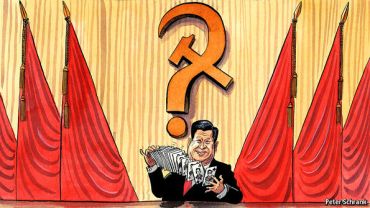
The people up for re-selection are the 350-odd members of the party’s Central Committee, the political elite, along with its decision-taking subsets: the Politburo, the Politburo’s Standing Committee (a sort of inner cabinet) and the army’s ruling council. The choice of new leaders will be made at a party congress—the 19th since the founding one in 1921—which is expected to be held in Beijing in October or November, and at a meeting of the newly selected Central Committee which will be held directly afterwards.

Party congresses, which are attended by more than 2,000 hand-picked delegates, and the Central Committee meetings that follow them, are little more than rubber-stamp affairs. But they are of huge symbolic importance to Chinese leaders. They matter for three reasons.

First, they endorse a sweeping reshuffle of the leadership that is decided in advance during secretive horsetrading among the elite. The coming congress will be Mr Xi’s first opportunity to pack the Central Committee with his own allies; the outgoing one was picked in 2012, when he took over, not by him but by the people then running the country, including his two predecessors. After previous congresses held five years into a leader’s normally ten-year term—that is, those convened in 2007 and 1997—it became clear who that leader’s successor was likely to be. If the coming meetings are like those earlier ones—a big if—they will give a strong clue to Mr Xi’s choice of successor and start the transition from one generation of leaders to another.

Second, congresses can amend the party’s constitution. China’s leaders like the document to give credit to their favourite ideological themes (and Mr Xi is particularly keen on ideology). When Jiang Zemin stepped down as party chief in 2002 his buzzwords were duly incorporated; so too were those of his successor, Hu Jintao, five years later. Mr Xi’s contribution to party-thought—such as on the need to purge it of corruption while strengthening its grip—is likely to gain similar recognition.

Third, congresses are the setting for a kind of state-of-the-union speech by the party leader, reflecting an elite consensus hammered out during the circulation of numerous drafts. In the coming months, Mr Xi will be devoting most of his political energy to ensuring that his will prevails in all three of these aspects. His authority in the coming years will hugely depend on the degree to which he succeeds. Preparations for the gatherings are under way. They involve a massive operation for the selection of congress delegates. On paper, this is a bottom-up exercise. Party committees down to village level are choosing people who will then choose other representatives who, by mid-summer, will make the final pick. Thousands of party members are also scrutinising the party’s charter, looking for bits that might need changing.It may sound like a vast exercise in democratic consultation, but Mr Xi is leaving little to chance. Provincial party bosses are required to make sure that all goes to (his) plan. Over the past year, Mr Xi has appointed several new provincial leaders, all allies, who will doubtless comply.

Hands up who likes XiT

hose chosen to attend the congress will follow orders, too, especially when it comes to casting their votes for members of the new Central Committee. And the newly selected committee will stick even closer to script. The processes that lead to its selection of the party’s and army’s most senior leaders are obscure—a bit like the picking of cardinals in the Vatican. But an account in the official media of what happened in 2007 suggests that at some point in the summer, Mr Xi will convene a secret meeting of the current Central Committee and other grandees for a straw poll to rank about 200 potential members of the new Politburo (which now has 25 members). This is called “democratic recommendation”, although those taking part will be mindful of who Mr Xi’s favourites are.

Candidates for the Politburo must fulfil certain criteria, such as holding ministerial rank. For the coming reshuffle, Mr Xi has added a new stipulation: faithful implementation of his policies. For all his power, Mr Xi has struggled with widespread passive resistance to his economic reforms. To ram home the importance of obedience, Mr Xi recently held what he called a “democratic life session” at which Politburo members read out Mao-era-style self-criticisms as well as professions of loyalty to Mr Xi as the “core” leader (as the party decided last October to call him).

By August, when Mr Xi and his colleagues hold an annual retreat at a beach resort near Beijing, the initial lists of leaders will be ready. Probably in October, the Central Committee will hold its last meeting before the congress to approve its documents. The “19th Big” will start soon after, and will last for about a week. The first meeting of the new Central Committee will take place the next day, followed immediately by the unveiling before the press of Mr Xi’s new lineup (no questions allowed, if officials stick to precedent).

The process is cumbersome and elaborate, but over the past 20 years it has produced remarkably stable transfers of power for a party previously prone to turbulent ones. This has been helped by the introduction of unwritten rules: a limit of two terms for the post of general secretary, and compulsory retirement for Politburo members if they are 68 or over at the time of a congress. Mr Xi, however, is widely believed to be impatient with these restrictions. He has ignored the party’s hallowed notion of “collective leadership”, by accruing more power to himself than his post-Mao predecessors did.

If precedent is adhered to, five of the seven members of the Politburo’s Standing Committee, six of its other members and four of the 11 members of the party’s Central Military Commission (as the army council is known) will all start drawing their pensions. In addition, roughly half the 200-odd full members of the Central Committee (its other members, known as alternates, do not have voting rights) will retire, or will have been arrested during Mr Xi’s anti-corruption campaign. This would make the political turnover at this year’s gatherings the biggest for decades, akin to changing half the members of the House of Representatives and three-quarters of the cabinet.

Until late in 2016 there was little to suggest any deviation from the informal rules. But in October Deng Maosheng, a director of the party’s Central Policy Research Office, dropped a bombshell by calling the party’s system of retirement ages “folklore”—a custom, not a regulation.

The deliberate raising of doubts about retirement ages has triggered a round of rumour and concern in Beijing that Mr Xi may be considering going further. The main focus is his own role. Mr Xi is in the middle of his assumed-to-be ten-year term. By institutional tradition, any party leader must have served at least five years in the Standing Committee before getting the top job. So if Mr Xi is to abide by the ten-year rule, his successor will be someone who joins the Standing Committee right after the coming congress.

But there is widespread speculation that Mr Xi might seek to stay on in some capacity when his term ends in 2022. He might, for instance, retire as state president (for which post there is a clear two-term limit) but continue as party general-secretary. He faces a trade-off. The more he breaks with precedent, the longer he will retain power—but the more personalised and therefore more unstable the political system itself may become. Trying to square that circle will be Mr Xi’s biggest challenge in the politicking of the year ahead.

Source: Xi Jinping is busy arranging a huge reshuffle | The Economist

06/01/2017

How China uses Shakespeare to promote its own bard | The Economist

LIKE many countries, China had a busy schedule of Shakespeare-themed celebrations in 2016, 400 years after his death. There were plays, lectures and even plans announced for the rebuilding of his hometown, Stratford-upon-Avon, at Sanweng-upon-Min in Jiangxi province. But as many organisers saw it, Shakespeare was just an excuse.

Their main aim was to use the English bard to promote one of their own: Tang Xianzu. Whatever the West can do, their message was, China can do at least as well.Tang is well known in China, though even in his home country he does not enjoy anything like the literary status of his English counterpart—he wrote far fewer works (four plays, compared with Shakespeare’s 37), and is not as quotable. But no matter. The timing was perfect. Tang died in 1616, the same year as Shashibiya, as Shakespeare is called in Chinese. President Xi Jinping described Tang as the “Shakespeare of the East” during a state visit to Britain in 2015. The Ministry of Culture later organised a Tang-themed exhibition, comparing his life and works to those of Shakespeare. It has shown this in more than 20 countries, from Mexico to France.

The two playwrights would not have heard of each other: contacts between China and Europe were rare at the time. But that has not deterred China’s cultural commissars from trying to weave a common narrative. A Chinese opera company created “Coriolanus and Du Liniang”, in which Shakespeare’s Roman general encounters an aristocratic lady from Tang’s best-known play, “The Peony Pavilion”. The musical debuted in London, then travelled to Paris and Frankfurt. Last month Xinhua, an official news agency, released an animated music-video, “When Shakespeare meets Tang Xianzu”. Its lines, set bizarrely to a rap tune, include: “You tell love with English letters, I use Chinese ink to depict Eastern romance.”

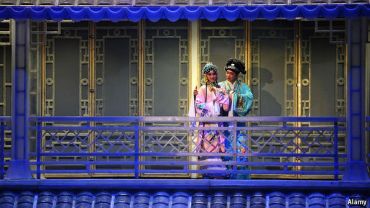
The anniversary of Shakespeare’s death is now over, but officially inspired adulation of Tang carries on (a musical about him premiered in September in Fuzhou, his birthplace—see picture). Chinese media say that a recent hit song, “The New Peony Pavilion”, is likely to be performed at the end of this month on state television’s annual gala which is broadcast on the eve of the lunar new year. It is often described as the world’s most-watched television programme. Officials want to cultivate pride in Chinese literature, and boost foreign awareness of it. It is part of what they like to call China’s “soft power”.

Shakespeare’s works only began to take root in China after Britain defeated the Qing empire in the first Opium War of 1839-42. They were slow to spread. After the dynasty’s collapse in the early 20th century, Chinese reformers viewed the lack of a complete translation of his works as humiliating. Mao was less keen on him. During his rule, Shakespeare’s works were banned as “capitalist poisonous weeds”. Since then, however, his popularity has surged in tandem with the country’s growing engagement with the West.

Cong Cong, co-director of a recently opened Shakespeare Centre at Nanjing University, worries that without a push by the government, Tang might slip back into relative obscurity. But Ms Cong says the “Shakespeare of the East” label does Tang a disservice by implying that Shakespeare is the gold standard for literature. Tang worked in a very different cultural environment. That makes it difficult to compare the two directly, she says. Officials, however, will surely keep trying.

Source: How China uses Shakespeare to promote its own bard | The Economist

Tags:
Law of Unintended Consequences

continuously updated blog about China & India

ChiaHou's Book Reviews

continuously updated blog about China & India

What's wrong with the world; and its economy

continuously updated blog about China & India