Archive for January, 2017

06/01/2017

‘Yeti’ Prints Suggest Humans Settled in Tibet More Than 7,000 Years Ago – China Real Time Report – WSJ

A cluster of ghostly hand- and footprints on a mountain north of Lhasa offers evidence that humans scratched out a permanent existence in the thin air of Tibet much earlier than commonly thought, according to a new study.
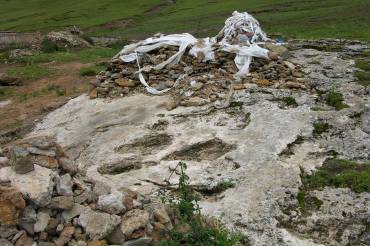
Some locals believe the prints, pressed into an ancient slab of limestone located 14,000 feet above sea level near the present-day village of Chusang, were left behind by mythical beasts. A team of researchers say that the impressions were left by people and that they offer intriguing clues to the puzzle of Tibetans’ ethnic origins.The researchers, whose latest findings are published in the latest issue of Science, say they’ve now developed a clearer picture of the site’s significance. According to their calculations, Chusang was very likely used by inhabitants of a nearby year-round settlement between 7,400 and 12,700 years ago — at least 2,200 years before permanent villages are believed to have been established elsewhere on the Tibetan Plateau.The researchers used radiocarbon dating and other, more advanced tests to determine the age of rock and dirt samples taken near the prints, according to the report.

There are no other reliably dated sites on the central, high-elevation part of the plateau,” said Mark Aldenderfer, a University of California, Merced who lead the study along with geologist Michael Meyer, from the University of Innsbruck.

By positing an earlier date of settlement on the Tibetan plateau, the study is likely to be controversial in Chinese archaeological circles. It could also irk Communist Party officials, for whom the question of where Tibetans came from is freighted with political significance.

Pushing back against advocates for Tibetan independence, the Chinese government recently began arguing that Tibet has been a part of China, not just during the imperial era, but “since ancient times.” The effort to prove that claim has led state-affiliated scholars to reach past China’s first, and some say largely mythical, dynasty, the 4,000-year-old Xia, to a neolithic culture called the Yangshao that existed in China’s Yellow River basin between 7,000 and 5,000 years ago.

Some pottery shards and other artefacts found on the Tibetan Plateau appear similar to remnants of the late Yangshao — proof, these government-backed scholars say, that China and Tibet are branches of the same civilization.“Early history has abruptly become of far greater importance to the issue, and specifically to the Chinese side,” said Robert Barnett, director of the modern Tibet studies program at Columbia University. Previously, Mr. Barnett said, the government had dated its claims over Tibet to the Yuan Dynasty, established by Mongolian leader Kublai Khan in 1271.

A 2015 paper on human settlement of the Tibetan Plateau written by Chinese archaeologists, also published in Science, supports the Yangshao timeline. It says that people didn’t start living in year-round settlements on the plateau until the development of agriculture and herding in what is now Qinghai province around 3,000 B.C.The new paper, however, suggests that migrants bearing pottery and other elements of Yangshao culture into the Tibetan regions would have encountered indigenous inhabitants, according to Mr. Aldenderfer.

“Our argument is fairly simple: There were people on the Tibetan Plateau before these ceramics and other influences came in from lower elevation locations,” he said.

There are 19 handprints and footprints of various sizes pressed into the Chusang limestone, which is believed to have formed by deposits from a now extinguished hot spring. The site was discovered in 1996 by University of Hong Kong geographer David Zhang, who was not part of the Aldenderfer team.

An image of one of the hand prints, taken in 2006. PHOTO: MARK ALDENDERFER“

Locals took me there and said [the prints] were left by a yeti,” Mr. Zhang told China Real Time, referring to the mythical creature better known in the west as the Abominable Snowman.

Mr. Zhang, who said he had seen a copy of the report but not its supplementary material,  disagreed with the conclusions of the new study. He cited tests he conducted that measured when quartz crystals from an ancient hearth found near the prints were last exposed to light. From that, he concluded that the evidence of settlement is closer to 20,000 years old.

Chusang was most likely one of several seasonal sites that people traveled to from primary settlements at lower elevations, he said.

Mr. Aldenderfer said Mr. Zhang’s measurements, taken in 2002, came from a different part of the Chusang site and that his testing methods were outdated. He said it would have taken an improbably long time to travel on foot from Chusang to a base camp at a low elevation.

The existence of smaller handprints suggests children also spent time at the site, he said.

Life would have been hard, with people forced to survive by hunting and foraging wild barley in temperatures only slightly warmer than they are now, but the area also would have had its advantages, Mr. Aldenderfer said.

A view to the north of the valley below the hot springs.
A view to the north of the valley below the hot springs. PHOTO: MARK ALDENDERFER

“It’s a really cool place. It’s perched on a mountainside, and when you’re sitting at the hot spring that has the hand- and footprints, it has an absolutely fabulous view of the valley below,” he said. The hot spring would have offered warmth, and possibly even a chance to bathe, he said.
Source: ‘Yeti’ Prints Suggest Humans Settled in Tibet More Than 7,000 Years Ago – China Real Time Report – WSJ

Tags: ,
04/01/2017

India’s double first in climate battle – BBC News

Two world-leading clean energy projects have opened in the south Indian state of Tamil Nadu.

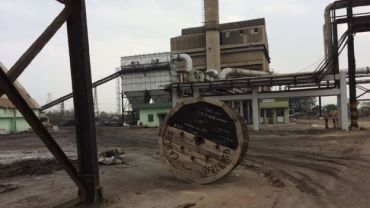
A £3m industrial plant is capturing the CO2 emissions from a coal boiler and using the CO2 to make valuable chemicals. It is a world first.

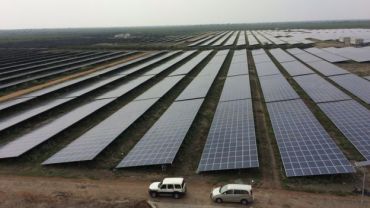
And just 100km away is the world’s biggest solar farm, making power for 150,000 homes on a 10 sq km site.

The industrial plant appears especially significant as it offers a breakthrough by capturing CO2 without subsidy.

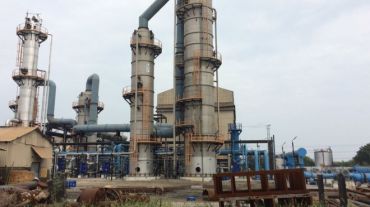
Built at a chemical plant in the port city of Tuticorin, it is projected to save 60,000 tonnes of CO2 emissions a year by incorporating them into the recipes for baking soda and other chemicals.

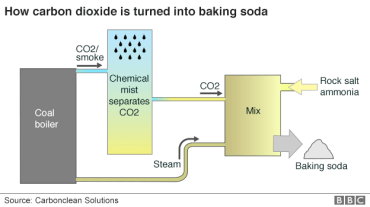
Here’s how it works:

The plant operates a coal-fired boiler to make steam for its chemical operations.CO2 emissions from the boiler’s chimney are stripped out by a fine mist of a new patented chemical.

A stream of CO2 is fed into the chemicals plant as an ingredient for baking soda and other compounds with many uses, including the manufacturing of glass, detergents and sweeteners.

Zero emissions

The owner of the chemicals plant, Ramachadran Gopalan, told a BBC Radio 4 documentary: “I am a businessman. I never thought about saving the planet. I needed a reliable stream of CO2, and this was the best way of getting it.”

He says his operation has now almost zero emissions. He hopes soon to install a second coal boiler to make more CO2 to synthesise fertiliser.

The chemical used in stripping the CO2 from the flue gas was invented by two young Indian chemists. They failed to raise Indian finance to develop it, but their firm, Carbonclean Solutions, working with the Institute of Chemical Technology at Mumbai and Imperial College in London, got backing from the UK’s entrepreneur support scheme.

Their technique uses a form of salt to bond with CO2 molecules in the boiler chimney. The firm says it is more efficient than typical amine compounds used for the purpose.

The plant is projected to save 60,000 tonnes of CO2 emissions a year

They say it also needs less energy, produces less alkaline waste and allows the use of a cheaper form of steel – all radically reducing the cost of the whole operation.

The firm admits its technology of Carbon Capture and Utilisation won’t cure climate change, but says it may provide a useful contribution by gobbling up perhaps 5-10% of the world’s emissions from coal.

Lord Oxburgh, former chairman of Shell, and now director and head of the UK government’s carbon capture advisory group, told the BBC: “We have to do everything we can to reduce the harmful effects of burning fossil fuels and it is great news that more ways are being found of turning at least some of the CO2 into useful products.”

Solar farm

Meanwhile, the nearby giant Kamuthi solar plant offers a marker for India’s ambition for a rapid expansion in renewables.

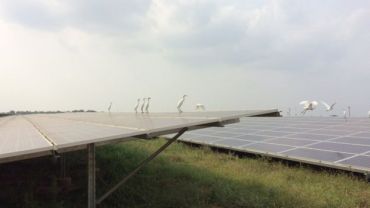
The world’s largest solar farm at Kamuthi in southern IndiaIt is truly enormous; from the tall observation tower, the ranks of black panels stretch almost to the horizon.Prime Minister Modi is offering subsidies for a plan to power 60 million homes with solar by 2022 and aims for 40% of its energy from renewables by 2030.

For large-scale projects, the cost of new solar power in India is now cheaper than coal. But solar doesn’t generate 24/7 on an industrial scale, so India has adopted a “more of everything” approach to energy.

The firm behind the solar plant, Adani, is also looking to create Australia’s biggest coal mine, which it says will provide power for up to 100 million people in India. Renewables, it says, can’t answer India’s vast appetite for power to lift people out of poverty.

Will India stick to its renewables promises with Donald Trump as US president?And questions have been raised recently as to whether India will stick to its renewables promises now President-elect Donald Trump may be about to scrap climate targets for the US.

At the recent Marrakech climate conference, China, the EU and many developing countries pledged to forge ahead with emissions-cutting plans regardless of US involvement. But India offered no such guarantee.

Some environmentalists are not too worried: they think economics may drive India’s clean energy revolution.

Source: India’s double first in climate battle – BBC News

04/01/2017

‘China freight train’ in first trip to Barking – BBC News

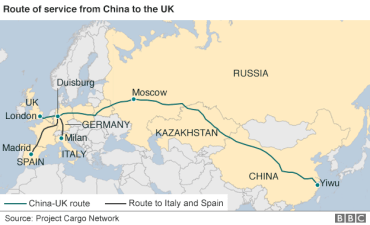
China has launched a direct rail freight service to London, as part of its drive to develop trade and investment ties with Europe.China Railway already runs services between China and other European cities, including Madrid and Hamburg.

The train will take about two weeks to cover the 12,000 mile journey and is carrying a cargo of clothes, bags and other household items.

It has the advantage of being cheaper than air freight and faster than sea.

The first China-Europe Block Train for Madrid left Yiwu Railway Freight Station in November 2014The proliferation of routes linking China and Europe is part of a strategy launched in 2013 aimed at boosting infrastructure links with Europe along the former Silk Road trading routes.London will become the 15th European city to join what the Chinese government calls the New Silk Route.

The service will pass through Kazakhstan, Russia, Belarus, Poland, Germany Belgium and France before arriving at Barking Rail Freight Terminal in East London, which is directly connected to the High Speed 1 rail line to the European mainland.

Because of the different railway gauges involved, a single train cannot travel the whole route and the containers need to be reloaded at various points.

The Chinese government is keen to boost its economy in the face of slowing export and economic growth.

Source: ‘China freight train’ in first trip to Barking – BBC News

04/01/2017

What can we expect in China in 2017? | McKinsey & Company

Provided geopolitical movement doesn’t derail his best laid predictions, Gordon Orr sees a year of slowing economic growth, headaches for multinationals, demographic anxiety, and buyer’s remorse for soccer tycoons.

My base case for China’s outlook this year assumes increased trade friction with the United States, with tariffs raised on specific product categories (such as steel and some agricultural goods), and, while I don’t expect across-the-board disruptions, a few high-profile companies will be forced to choose between accommodating the demands of the Chinese or US government.

Of course, if recent statements from US politicians translate into sweeping action on trade, 2017 could develop very differently. Tit-for-tat moves on specific companies and sectors could easily escalate, with many multinationals’ global supply chains caught in the middle and consumers around the world facing product shortages and, when products are available, material price increases. China’s government could implement sweeping actions to sustain employment, restrict further capital outflows, and stimulate the domestic economy. Market-oriented restructuring and reform would be off the table. Economic nationalism, food and energy security, and social stability would be paramount.

But if globally we continue with something recognizably close to current trade arrangements, how will China fare this year? And, most important for a country that regards economic growth as of paramount importance (the centerpiece of China’s 13th five-year plan remains to double GDP and household income in the decade to 2020), can 2016’s GDP growth in the ballpark of 6.5 percent be replicated?

Matching 2016’s economic growth will be a struggle

Where will China’s growth come from this year? It is unlikely to come from exports—even ignoring potential protectionist moves in major export markets, there’s nothing that would significantly increase the world’s demand for Chinese goods. What about currency depreciation to make exports more competitive? That will be quickly offset by rising wages. Could growth come from consumers? Will they feel good enough to increase spending another 8 to 10 percent this year? They will likely spend a lot less on buying property and fitting it out (because of government action to restrain prices and restrict access to mortgage financing) and less on cars if the current tax break expires. Moreover, real salary increases are likely to be the lowest since the Lehman crisis, and with house prices expected to be flat, there won’t be a repeat of last year’s wealth effect. The stimulation of e-commerce making goods available in smaller cities for the first time may help, but technology displacing jobs in services, not just manufacturing, certainly won’t. In fact, its impact is becoming more and more visible, leading more and more consumers to not only worry about losing their jobs but also actually see them eliminated. The impact of technology on creating jobs in fields such as medical and education services will benefit the privileged few with the skills to take advantage, but it will not offset the near-term job losses.

Source: What can we expect in China in 2017? | McKinsey & Company

Tags: ,
Law of Unintended Consequences

continuously updated blog about China & India

ChiaHou's Book Reviews

continuously updated blog about China & India

What's wrong with the world; and its economy

continuously updated blog about China & India