Archive for December, 2018

18/12/2018

Premier Li meets delegates attending Understanding China Conference

CHINA-BEIJING-LI KEQIANG-DELEGATES-MEETING (CN)

Chinese Premier Li Keqiang meets with delegates attending the third Understanding China Conference at the Great Hall of the People in Beijing, capital of China, on Dec. 17, 2018. (Xinhua/Liu Weibing)

BEIJING, Dec. 17 (Xinhua) — Chinese Premier Li Keqiang on Monday met with delegates attending the third Understanding China Conference, pledging to press ahead with reform and opening up.

After listening to the speeches of former Mexican President Ernesto Zedillo, former British Prime Minister Gordon Brown, former Prime Minister of Denmark Helle Thorning-Schmidt, former Greek Prime Minister George Papandreou and former Director-General of the World Trade Organization Pascal Lamy, Li answered their questions and gave his opinions.

Li said he appreciated the delegates’ efforts to promote China’s exchanges with the world.

He said this year coincided with the 40th anniversary of China’s reform and opening up. Over the past 40 years, China has achieved remarkable development progress, which was underscored by the Chinese people’s hard work.

“China’s past achievements were realized by the reform and opening up, and future progress can only be made by further reform and opening up,” he said.

China will continue to deepen reforms, further press ahead the opening up, and commit itself to developing an open economy at higher level, he said, reiterating China’s stance to create a fair business environment for domestic and foreign companies, and strictly protect intellectual property rights.

“China has the conditions and ability to cope with various risks and challenges, and promote its economy to achieve high-quality development,” Li said.

The Chinese premier said that under the complex international situation, people should adhere to multilateralism and free trade, while treating problems in globalization and world trade from a development perspective.

China supports the reform and improvement of the WTO rules, Li said, urging for relevant reforms to be conducted while making rules that “stick to the general direction of trade liberalization, accommodate all parties’ concerns and interests, safeguard the development rights of developing members, and facilitate the narrowing of the North-South gap.”

Stressing that China would be a developing country for a long period, Li called on the world to understand more about a true China, hoping the delegates could be a bridge of communication and cooperation between China and the world, and make greater contributions to the common development of China and the world.

The delegates congratulated China on its achievements in various fields such as economic development, poverty relief and education, saying all countries should work together to promote the reform and improvement of global rules, safeguard multilateralism and free trade.

The three-day conference, which kicked off on Dec. 16, gathered nearly 600 people, including 40 global politicians, strategists and entrepreneurs.

18/12/2018

Xi Jinping: The man who leads China’s reform into a new era

BEIJING, Dec. 17 (Xinhua) — Wang Jun is a deputy editor and main author of the book “A Study of Xi Jinping Thought on Reform and Opening-Up.”

Paper and documents pile up in his office. These are what his team has collected for research in writing the book.

“Xi Jinping is a man whole-heartedly devoted to reform and opening-up,” said Wang, president of the Guangdong Academy of Social Sciences.

In 2018, China celebrates the 40th anniversary of the reform and opening-up, a cause started by Deng Xiaoping and is now being carried forward by Xi.

In late October, Xi came to Guangdong Province. He visited a reform-themed exhibition at the foot of the Lotus Mountain in Shenzhen, spending more than an hour inside the museum halls.

Xi paused in front of a large painting.

It was a morning rush hour scene of the city in the 1980s. A giant poster stood tall before the Shekou industrial zone to constantly remind the city’s early builders to seize the moment and strive for economic miracles.

It was not the first time Xi visited Shenzhen, a prominent test-bed of China’s reform and opening-up.

“Coming to Shenzhen, Guangdong again (because) we want to declare to the world that China will never drag its feet on reform and opening-up! China is certain to show the world impressive new achievements in the next 40 years!” Xi said.

Six years ago, when Xi was elected general secretary of the Communist Party of China (CPC) Central Committee, reform entered what many people call a “deep-water” zone. The CPC faced arduous challenges in reform, some foreign media claimed.

Xi has withstood the pressure and led China to achieve so much, Wang said.

The Chinese economy is being transformed from fast growth to high-quality development. In 2017, the growth picked up for the first time in six years, reaching 6.9 percent, way above the 3.7-percent global economic growth.

Over the past six years, more than 70 million new jobs have been created, more than the population of Britain. The size of the Chinese middle-income group has swelled to 400 million, constituting a huge consumer market in the world.

Overseas media called Xi “a far-sighted reformer” and “a serious reformer who built a unique path for China’s future” whose clear vision for reform “has inspired the nation.”

DETERMINED TO REFORM

When China began the reform and opening-up in 1978, Xi was studying chemical engineering at Tsinghua University. His father, Xi Zhongxun, was then the Party chief of Guangdong Province.

The elder Xi had high hopes for reform. He sought Deng’s permission for “taking the first step” to set up a special economic zone that would break the new ground for reform.

The father’s courage and sense of mission left a deep impression on the son.

In the early 1980s, as Xi senior was promoted to Beijing, Xi Jinping was sent down to work in the county of Zhengding, Hebei Province. He began his reform experiments there, starting with the rural land contract trial, being the first in Hebei to adopt this practice already tested in southern provinces.

As the county Party chief, Xi already knew how hard it was to press ahead with reforms. He was critical of the “middle-level obstruction” issue and solved it by appointing willing and competent cadres to push forward reforms.

Xi’s reputation as a reformer was reinforced as he advanced his political career. In Ningde, Xiamen and Fuzhou of Fujian Province, Zhejiang Province and Shanghai Municipality, he kick-started innovative reform strategies to tackle different sorts of challenges.

“In a real sense, Xi comes from a reformer family. More important, Xi is deeply committed to reform,” said Robert Kuhn, a leading U.S. expert on China and chairman of the Kuhn Foundation, adding that when they met in 2005 and 2006, Xi spoke a lot on the importance of “reform in all facets.”

“Xi’s reform is derived from his experience,” said Shi Zhihong, a former deputy director of the Policy Research Office of the CPC Central Committee. “He knew that the rigid old paths would lead nowhere, and reform was a must.”

In 2012, reflecting on China’s reform cause, Xi spoke highly of Deng. “If there were no Deng who guided our Party to make the historic decision to reform and open up, we couldn’t have achieved this much,” Xi said.

“The reform and opening-up is a great awakening of our Party, and it gave rise to great theoretical and practical innovations,” he added.

Xi’s thinking and practices of reform in provinces have been compiled into books, from which observers say one can trace the roots of China’s comprehensive deepening reform that is being rolled out in the new era.

“FIFTH MODERNIZATION”

On Nov. 15, 2012, Xi met the press right after being elected general secretary of the CPC Central Committee. He spoke of the need to adhere to reform and opening-up to continue liberating social productive forces, resolve people’s difficulties in life and work and stay committed to the path of common prosperity.

At the moment, Xi’s resolve to carry on the reform could not be more obvious. But Xi knew how hard it would be. All low-lying fruits have been picked, what is left are hard bones, he said.

People following Xi in his reforms need to be brave enough to cross hurdles in thinking and break through the blockade of vested interest.

Xi came to Guangdong in his first domestic inspection tour after assuming the Party’s top post. It was not by coincidence that in 1992 Deng visited Guangdong in his now well-known “southern tour.” Deng’s talks during the tour were instrumental in advancing the reform and opening-up.

In his 2012 visit, Xi paid tribute to Deng’s bronze statue. “Reform and opening-up is a make-or-break move that decides China’s destiny,” Xi said. “There is no pause or backtrack.”

The Financial Times said, “Mr. Xi is hardly the first Chinese leader to talk about the need for reform. But the tone of the pronouncements emerging from his weekend trip has been more forceful than those employed by past leaders.”

For Xi, reform must be carried on along the path of socialism with Chinese characteristics. Neither the old path nor the detour could work.

Xi insisted that reform shall suit China’s own needs for change, and China would not reform to make others happy. “Only the wearer knows whether the shoes fit or not,” he said.

The overall goal of deepening reform is to improve and develop the system of socialism with Chinese characteristics and modernize China’s system and capacity for governance.

This overarching objective is described by observers as China’s “Fifth Modernization” drive.

According to Xi, the reform must balance several pairs of relations: between mind emancipation and truth-seeking; overall advancement and breakthroughs in key areas; top-level design and crossing the river by feeling the stones.

He Yiting, vice president of the Party School of the CPC Central Committee, said Xi’s thought on reform has enriched and developed the theory of socialism with Chinese characteristics.

Zheng Yongnian, director of the East Asian Institute at the National University of Singapore, said Xi answered the questions related to what to change, how to change in the new round of reform and who will implement it.

In November 2013, Xi presided over the third plenary session of the 18th CPC Central Committee that issued an extensive reform plan and a seven-year implementation timetable.

China’s deepening reform in all areas has caught the world’s attention. Some overseas media said the reform gave a big impetus to China’s lasting and inspiring rise.

Since then, the succeeding Party plenums have all stressed deepening reform, which constitutes a prominent fixture in Xi Jinping Thought on Socialism with Chinese Characteristics for a New Era.

Xi has become the leader in China’s new round of reform and opening-up.

LEAD BY ACTION

After the third plenary session of the 18th CPC Central Committee, Xi served as the head of a leading group on deepening overall reform. When it was changed to a committee, he remained as the chair.

In the meantime, he also chairs a number of high-level committees and commissions on areas such as law-based governance, foreign affairs, cyber-security and informatization.

By heading these groups, Xi can have face-to-face discussions with people working in different areas and better learn about actual situations.

Xi went through each version of major reform documents, added his personal insights and pushed for major progress.

Take the market’s role as an example. In 2013, the Party decided to let the market play a “decisive” role in allocating resources. It sent a strong signal of policy adjustment as the original wording — “basic” — had remained unchanged since 1992.

When drafting the change, some people said it was still too early to make such a big leap. It was Xi who decided to make the change.

“Many of the major reforms would not have been possible if it weren’t Xi,” said an academic who was involved in drafting the document.

Xi led reform on multiple fronts to achieve breakthroughs: the gaps between urban and rural populations have been narrowed, the two-child policy initiated and pushed to yield results, splurge on government bills curbed, and vested interests broken up.

He constantly called on officials to have the perseverance to hammer away at obstacles until a task is done and make concrete, meticulous and effective efforts in reform.

Between late 2012 and late 2017, Xi took 50 domestic inspection tours, in which he researched and pushed for reform.

The reform progress encompasses an expansive scope of fields.

In the economy, he made the judgment of new normal, initiated the supply-side structural reform and drew a clear line between the government and the market.

In science, he set the goal of turning China into one of the world’s science centers and an innovation high ground.

He led the anti-corruption fight to form a crushing tide and has won a sweeping victory.

He launched a major institutional reform to reshape Party and state organs, including the establishment of the National Supervisory Commission and the Commission for Law-based Governance of the CPC Central Committee.

Reform progress is reported on other fronts: people have stronger cultural confidence and sense of fulfillment; environmental protection systems are improved; and the armed forces have been reshaped.

In the five years since late 2012, more than 1,500 reform measures were issued. Reform picked up pace after the 19th CPC National Congress in late 2017.

In his 2018 New Year speech, Xi called on the Chinese people to “cut paths through mountains and build bridges across rivers” to advance reform.

Wang, the book author, said Xi has made breakthroughs in a number of tough and stalemated issues.

“Xi has been and is a remarkably comprehensive reformer, whose reforms are broader in scope than those of prior generations,” Kuhn said.

FOR THE PEOPLE

In April, Xi told visiting UN Secretary-General Antonio Guterres that “everything we do is for people’s happiness and national rejuvenation and to seek common ground for the world.”

Xi has been stressing that reform should focus on what the people care about and expect the most. The aim, he says, is to give the people a stronger sense of fulfillment.

That may be felt more directly from the rise of earnings. The average income of Chinese grew by 7.4 percent annually over the past six years, eclipsing the GDP growth.

In October, wage-earners hailed a personal income tax reform which exempts those who earn less than 5,000 yuan (725 U.S. dollars) a month.

Many migrant workers also made it to the country’s expanding middle-income group.

Zou Bin is one of them who benefit from the reform. He rose from laying bricks at construction sites to heading a team in the Fortune 500 firm China Construction Group as a project manager.

This year, Zou started serving as a deputy to the National People’s Congress, the top legislature. His first legislative proposal was, not surprisingly, about deepening construction labor reforms.

Poverty reduction is another milestone. In the past six years, about 70 million rural people had been lifted over the poverty line.

William Jones, Washington bureau chief of the Executive Intelligence Review news magazine, said ending poverty had long been regarded a major task for humanity but until recently, was seen as a Utopian dream.

“With China, that dream is now becoming a reality,” he said.

Under Xi’s lead, China’s social security network has expanded, with the basic medical insurance covering 1.3 billion people and the social old-age insurance covering more than 900 million.

This summer, a domestic film shot up to box office stardom. “Dying to Survive” tells a fictional story of a shopkeeper who illegally imports cheap Indian drugs and sells them to cancer patients in China.

The blockbuster touched a public sore point of costly drugs. But fortunately, the issue is being addressed.

Policies have been introduced to exempt import tariffs on many cancer drugs, and efforts are on-going to bring more life-saving medicines into the medical insurance program.

Xi’s reform also aims to nurture a great environment to conduct business.

The World Bank Group said in its annual “Doing Business Report” that China advanced to a global ranking of the 46th this year, up from the 78th last year, as the country implemented the largest number of reforms in the East Asia and Pacific region.

The “2018 China Business Report” by the American Chamber of Commerce in Shanghai also found that 83 percent of respondents in manufacturing sector and 81 percent in retail achieved profit, while 61.6 percent of companies expected to increase their China investment in 2018.

Private sectors in China have entered a new phase of development.

In 2018, a total of 28 Chinese private companies were enlisted in the Fortune 500, compared with a lone company in 2010.

CONNECTING THE WORLD

China’s reform has benefited the world. China contributed to global growth by an annual average of 18.4 percent in the past 40 years, second only to the United States, according to the National Bureau of Statistics.

In 2017, China accounted for 27.8 percent of global economic growth, more than that of the United States and Japan combined.

CRRC Corporation Limited (CRRC), the world’s leading supplier of rail transit equipment, has improved infrastructure and brought jobs to more than 100 countries and regions since it was founded three years ago.

“President Xi visited our workshop in 2015, asking us to speed up innovation and create a brand for ‘made-in-China’ products, which has promoted our modern enterprise system reform and CRRC’s integration with the global economy,” said a CRRC executive.

Facing mounting protectionism and a stagnant world economy, Xi proposed to foster a new type of international relations featuring win-win cooperation and follow the principle of achieving shared growth through discussion and collaboration in engaging in global governance.

An important feature of Xi’s reform is the integration of promoting domestic reform with the participation of global governance reform, said Shi.

Xi’s proposition of building a community with a shared future for humanity reflects the pursuit of common values, Shi added.

When Xi was governor of east China’s Fujian Province 18 years ago, he pushed for a demonstration project to help the Eastern Highland Province of Papua New Guinea with Juncao and dry-land rice planting.

The Juncao technology cultivates edible and medicinal mushroom from special wild grass so that trees do not need to be cut for mushroom growing. The technology has brought the hope of poverty eradication across the globe.

The success of Juncao is an epitome of the advancement of the Belt and Road Initiative, proposed by Xi to promote a shared prosperity of humanity by cooperation on trade and infrastructure. So far, more than 140 countries and international organizations have signed agreements with China to jointly build the Belt and Road.

Ecological degradation is a key global challenge. Xi attended the UN Climate Change Conference in Paris in November 2015. China is one of the first countries to sign the Paris Agreement on climate change. Xi personally handed over China’s instruments of joining the Paris Agreement to then UN Secretary-General Ban Ki-moon in September 2016.

In the past six years, China has kept its promise to protect the Earth through deepening domestic reforms, including the implementation of 10 air pollution prevention and control measures, the promotion of a river chief system and introduction of a national park mechanism. Many of the reforms were initiated by Xi.

Xi brought China’s opening up to a new level. He designed and pushed forward the opening of the world’s first import-themed national-level expo. At the China International Import Expo, he reiterated opposition to trade protectionism and commitment to an open world economy.

The expo, held in Shanghai in November this year, was attended by over 3,600 companies, including nearly 180 American companies. Agreements on intended one-year purchases of goods and services were valued at 57.83 billion U.S. dollars.

China announced a series of measures to further open up its economy, including broadening market access, easing foreign equity restrictions, lowering automobile import tariffs and increasing imports. The number of free trade zones has risen to 12 in five years.

“Openness brings progress while seclusion leads to backwardness,” Xi said.

Xi led China to be more involved in international economic cooperation, turning the country into a more mature modern market economy, said Wang.

ON THE WAY

“Xi has transformed China at an astonishing pace,” Geoff Raby said in his column in the Australian Financial Review. “At over 8,000 U.S. dollars per capita, China is now at the higher end of the World Bank’s middle-income economy range, and some 40 percent of that was added during Xi’s tenure.”

“This is the new order in Asia. It is no longer emerging, it has arrived,” he said.

The People’s Republic of China will celebrate its 70th anniversary next year. The Chinese nation with a history of humiliation has stood up, grown rich and is becoming strong.

Xi’s reform has laid a firm foundation for the Chinese nation’s rejuvenation. It will be the first time in human history that a country of more than 1 billion people march into modernization as a whole.

China’s reform has inspired the world: developing countries can walk a new path to modernization that is different from the West. It breaks the “end of history” and “Western-centered” mentalities.

The year 2018 also marks the 200th anniversary of Karl Marx’s birth. China’s successful practice has injected new vitality into the classic theory named after him.

What Xi aims to develop is a model of how a rising country can avoid confrontation with an established one. It will show that different civilizations can enrich exchanges and co-exist peacefully.

The reform is still on the way. It is no easy task to change the world’s biggest developing country. China’s per capita GDP has surpassed 8,000 U.S. dollars, yet far from 57,000 dollars of the United States.

China is still facing an unbalanced industrial structure, weak innovation and financial risks.

Xi has many challenges ahead. With great courage, he is ready to lead the Party and the country to forge ahead with the reform.

“A lot of progress has been made over the past few years,” Xi said. “But much can still be achieved as we embark on the new journey.”

17/12/2018

Three-year-old assaulted on Delhi bus rape anniversary

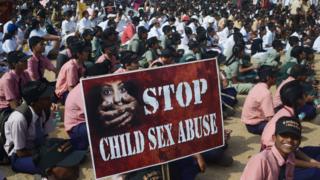
A protest in India against child sex abuseImage copyrightAFP

A three-year-old Indian girl is in critical condition after she was allegedly raped by her neighbour in the capital Delhi.

The accused, a 40-year-old security guard who worked in the building the child lived in, has been arrested.

Police found the girl unconscious and rushed her to hospital where she is undergoing surgery.

The incident occurred on Sunday, which was the sixth anniversary of the brutal gang rape of a student on a Delhi bus.

Delhi Women’s Commissioner Swati Maliwal said the incident “let down” the bus rape victim, whose attack saw country-wide protests and a tightening of rape laws.

There is still no clarity on the condition of the girl or whether she will survive the attack, which local media have described as “brutal”.

Locals in the area found the accused and attacked him after the incident came to light, the Times of India newspaper said. It also quoted police as saying that the accused was treated for injuries before they arrested him.

The girl’s parents, who are daily wage labourers, were away when the incident occurred. The accused allegedly lured the girl with sweets and picked her up from outside her house.

Police have registered a case for rape under the Protection of Children from Sexual Offences (POSCO) Act, which could see the death penalty handed out to the accused.

The incident, which has prompted a fresh wave of anger and outrage in India, comes after a series of high-profile cases against children this year. In April, the brutal gang-rape and murder of an eight-year-old in Indian-administered Kashmir dominated headlines. In June, hundreds took to the streets in the central state of Madhya Pradesh over the rape of a seven-year-old girl.


The scale of abuse in India

  • A child under 16 is raped every 155 minutes, a child under 10 every 13 hours
  • The number of reported rapes of children increased from 8,541 in 2012 to 19,765 in 2016
  • More than 10,000 children were raped in 2015
  • 240 million women living in India were married before they turned 18
  • 53.22% of children who participated in a government study reported some form of sexual abuse
  • 50% of abusers are known to the child or are “persons in trust and care-givers”
17/12/2018

Narendra Modi: Is hardline Hindu politics failing India’s PM?

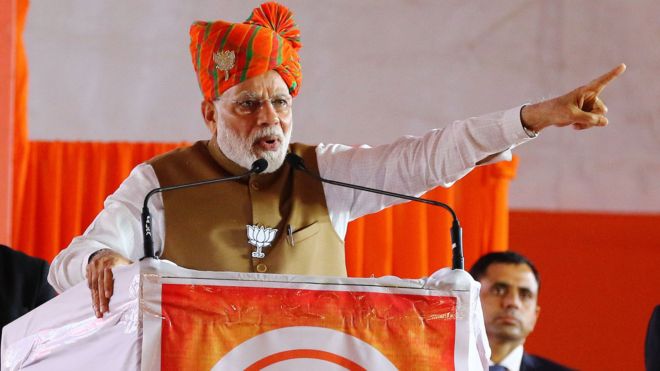
Prime Minister Narendra Modi addressing the election campaign rally ahead the state assembly polls , in Jaipur , Rajasthan, India , Dec 04,2018.Image copyrightGETTY IMAGES

Last week’s electoral losses in five states for India’s ruling party has led to speculation that its agenda of promoting hardline Hindu politics has backfired. The BBC’s Priyanka Pathak reports.

Prime Minister Narendra Modi’s Bharatiya Janata Party (BJP) lost to the main opposition Congress party in the Hindi-speaking heartland states of Madhya Pradesh, Rajasthan and Chhattisgarh, all of which they previously governed. Local parties swept up the other two states – Telangana and Mizoram – putting the BJP in a tough place ahead of general elections next year.

It appears that after winning no less than 13 state elections since coming to power in 2014, the BJP’s seemingly invincible electoral juggernaut is losing steam.

There is a great deal of introspection within and outside the party. And the main question is: has the BJP’s recent pursuit of a hardline Hindu agenda – known locally as Hindutva – backfired? Will a departure from an inclusive, development agenda to a polarising, communal one cost the BJP general election too?

These are legitimate questions because the party deployed the chief minister of the northern state of Uttar Pradesh, Yogi Adityanath, as its star campaigner in the five states that went to polls.

Mr Adityanath is widely considered a controversial figure because of his well-publicised anti-Muslim comments.

He addressed 74 election rallies while Mr Modi, who is usually his party’s star campaigner, addressed just 31.

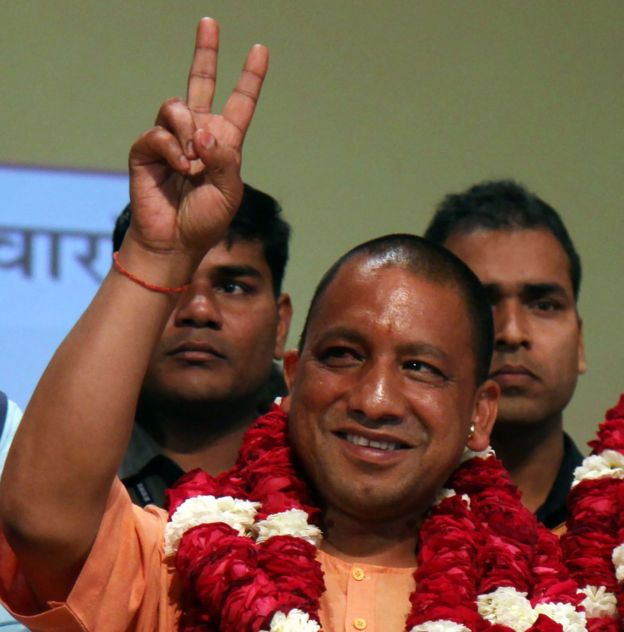
Adityanath victoryImage copyrightAFP
Image captionYogi Adityanath is seen as a “poster child” for a hardline Hindu agenda

Mr Adityanath also spent the past few months courting the Sangh Parivar – a “family” of Hindu nationalist organisations including the Rashtriya Swayamsevak Sangh (RSS), a hardline Hindu organisation with umbilical ties to the BJP.

The Sangh Parivar also includes the Vishwa Hindu Parishad (VHP), which has been at the forefront of a movement demanding the construction of a Hindu temple on the site of a 16th Century mosque that was torn down by Hindu mobs in 1992, provoking widespread riots that left thousands dead.

Hindus believe Ayodhya, situated in Mr Adityanath’s Uttar Pradesh state, is the birthplace of their revered deity Lord Ram, and say an older temple existed at the site before the mosque was constructed.

Mr Adityanath has announced the construction of a giant statue of Ram in the state, and changed the name of the historical city of Allahabad to the more “Hindu” sounding Prayagraj ahead of the forthcoming Ardh Kumbh Mela, one of the world’s largest religious gatherings.

But if Mr Adityanath was hoping to prove to the VHP leadership that he is a more willing pursuer of the Hindutva agenda and, therefore, a potential alternative to Mr Modi, the recent electoral defeats do not advance his case.

Many observers believe that the BJP’s defeats are because the party deviated from the development agenda that swept them to power in 2014. The pursuit of Hindutva has backfired, they say.

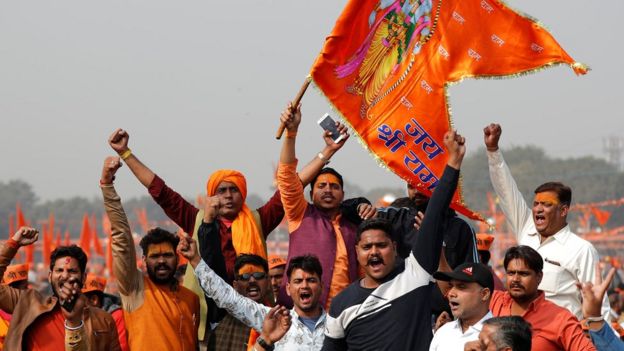
Supporters of the Vishva Hindu Parishad (VHP), a Hindu nationalist organisation, shout religious slogansImage copyrightREUTERS
Image captionHindus believe the disputed religious site of Ayodhya is the birthplace of one of their most revered deities

But some in the Sangh Parivar disagree, insisting that it is actually the opposite that is true. “Just the way people feel disenchanted with the economic policies of the government, the people have also lost faith in this government’s commitment to build the Ram temple. If the VHP and RSS have to come to the street to warn the government about it, what does it tell you? What does it tell the electorate?” one of them said.

Last week, tens of thousands of Hindus gathered in the capital, Delhi, to demand the expedited construction of the temple and criticised the government for failing to do so.

They chanted a striking slogan directly targeting Mr Modi’s stated development-first agenda: “Pehle Ram ko aasan do, phir humko sushasan do (First give Ram a throne, then give us good governance)”.

But it must be noted that while Mr Modi has never openly supported these hardline elements, his silence on issues such as an increasing number of attacks on Muslims over various issues like eating beef – cows are considered sacred in Hinduism and their slaughter is banned in many Indian states – is interpreted as a tacit approval for muscular Hindu politics.

But he now faces pressure to do more.

His government already leads a lacklustre economy. And this renewed pressure to recommit to Hindutva, despite its apparent failure as an electoral agenda, puts Mr Modi’s government in a difficult place.

There is also the fact that the RSS played a vital role in the BJP’s 2014 election victory by mobilising and galvanising voters. They are also credited for Mr Modi’s rise from state chief minister to a national figure. Apart from spearheading a sophisticated online and digital campaign in his favour, cadres also held 600 district-level meetings across the country to make Mr Modi a familiar name among the rural population.

Clearly, they cannot be ignored or offended.

So even as the liberals suggest that Hindutva has backfired and demand that the government refocus on the economy, there are voices within the BJP which are demanding a more strident return to the party’s “core” agenda – including the construction of the Ram temple and renewed focus on efforts to protect cows – to reassure their base that the BJP has not abandoned them.

The less-than-satisfactory economic performance will also make the Hindutva agenda more important, they say.

17/12/2018

Indian forces lock down Kashmir city, hold leaders to stifle protests

SRINAGAR, India (Reuters) – Indian police detained separatist leaders in the disputed Kashmir region on Monday and sealed off roads in an effort to stifle protests against the killing of civilians on the weekend.

An Indian policeman stands guard behind concertina wire laid across a road leading to the Indian army headquarters in Srinagar December 17, 2018. REUTERS/Danish Ismail

Unrest has intensified over recent weeks in the Muslim-majority region at the heart of decades of hostility between India and Pakistan, and seven civilians were killed on Saturday when security forces opened fire at a protest over the killing of three militants.

Separatists leaders Mohammad Yasin Malik and Mirwaiz Umar Farooq said they were detained as they marched towards an army headquarters in Kashmir’s main city of Srinagar. Another leader, Syed Ali Shah Geelani, was under house arrest, police said.

“Indian troops are killing Kashmiris,” Malik told reporters as police in riot gear took him away in a white vehicle. “For the last many years they are on a killing spree.”

A senior police official, who declined to be identified, said Malik and Farooq would be released “once the situation stabilises”.

A spokesman for India’s Ministry of Home Affairs in New Delhi said he had no comment.

Police and para-military forces put up barricades in various parts of Srinagar, including on roads leading to the army headquarters, and were patrolling in force.

The army warned the population against being used to make trouble.

“Army advises people not to fall prey to such designs of anti-national forces,” the army said in a statement late on Sunday.

“It’s an attempt to pit the civilian population against the security forces”.

One soldier was killed in the Saturday violence.

‘DIALOGUE, NOT VIOLENCE’

Shops, government offices and banks were closed in Srinagar and a nearby district and traffic was off the roads. Authorities have also shut down mobile internet and train services.

Slideshow (3 Images)

Pakistan, which like India, claims Kashmir in full but rules it in part, condemned the Saturday killings.

“Only dialogue and not violence and killings will resolve this conflict,” Pakistan Prime Minister Imran Khan said, adding that his country would raise India’s “human rights violations” at the United Nations.

Hindu-majority India accuses Pakistan of training and arming separatist militants operating in Kashmir.

Pakistan denies that saying it only offers political support to the people of the Muslim region who are being denied their rights by India’s security forces.

Indian forces say they have killed 242 militants this year in the region, while 101 civilians and 82 members of the security forces have been killed, making it the bloodiest year in more than a decade.

Meenakshi Ganguly, South Asia director at Human Rights Watch, said Indian authorities should investigate and prosecute those responsible for “indiscriminate use of force”.

“Security forces are aware that villagers gather, protest during gunfights with Kashmir militants and have responsibility to ensure civilians are not at risk,” she said in a tweet.

17/12/2018

‘Carnage of unbelievable proportions’: Delhi High Court convicts Sajjan Kumar for 1984 riots

Sajjan Kumar,anti-Sikh riots case,1984 anti-sikh riots case
Congress’ Sajjan Kumar was convicted today by Delhi High Court in 1984 riots case(PTI)

The Delhi High Court on Monday called the anti-Sikh riots case of 1984 “communal frenzy” after the then prime minister Indira Gandhi was assassinated by her bodyguards as it sentenced Congress leader Sajjan Kumar to life imprisonment in one of the cases.

As it reversed the trial court’s order acquitting Kumar, the court also directed him to surrender by December 31, 2018, and slapped a fine of Rs 5 lakh on him and Rs 1 lakh on all other accused in the case.

The case relates to the murder of five members of a family during the anti-Sikh riots in the Raj Nagar area in the Delhi Cantonment on November 1, 1984.

“What happened in the aftermath of the assassination of the then Prime Minister was carnage of unbelievable proportions in which over 2,700 Sikhs were murdered in Delhi alone. The law and order machinery clearly broke down and it was literally a ‘free for all’ situation which persisted. The aftershocks of those atrocities are still being felt,” justice S Muralidhar and justice Vinod Goel said while handing the 203-page judgement.

Also watch | Congress’ Sajjan Kumar convicted in 1984 Sikh riots case, gets life term 

The judges also quoted a poem by Amrita Pritam on the violence after the Partition in 1947 in India and Pakistan. She escaped to India with her two children from Pakistan’s Lahore.

“She was moved to pen an “Ode to Waris Shah” in which she spoke of the fertile land of Punjab having “sprouted poisonous weeds far and near” and where “Seeds of hatred have grown high, bloodshed is everywhere/Poisoned breeze in forest turned bamboo flutes into snakes/Their venom has turned the bright and rosy Punjab all blue,” they said.

Also read | Congress’ Sajjan Kumar convicted in 1984 Sikh riots, gets life term

“The killings would continue in the streets of Delhi. Thirty-seven years later, the country was again witness to another enormous human tragedy. Following the assassination of Smt. Indira Gandhi, the then Prime Minister of India, on the morning of 31st October 1984 by two of her Sikh bodyguards, a communal frenzy was unleashed.”

‘Political patronage’

The judges recalled the violence in which thousands of Sikhs were killed, some burnt alive, as their houses were destroyed in Delhi and across the country.

“A majority of the perpetrators of these horrific mass crimes, enjoyed political patronage and were aided by an indifferent law enforcement agency … The criminals escaped prosecution and punishment for over two decades.”

“There was an abject failure by the police to investigate the violence which broke out in the aftermath of the assassination of the then Prime Minister Smt. Indira Gandhi is apparent from the several circumstances highlighted hereinabove.”

There was an “utter failure” to register separate first report information in the case of five deaths in which Congress leader Kumar and others were sentenced.

“The failure to record any incident whatsoever in the DDR and the lack of mention of PW-1’s statement therein, amongst other circumstances, established the apathy of the Delhi Police and their active connivance in the brutal murders being perpetrated.

Here is what they also said in the summary of their judgement:

1. This was an extraordinary case where it was going to be impossible to proceed against A-1 in the normal scheme of things because there appeared to be ongoing large-scale efforts to suppress the cases against him by not even recording or registering them. Even if they were registered they were not investigated properly and even the investigations which saw any progress were not carried to the logical end of a charge sheet actually being filed. Even the defence does not dispute that as far as FIR No.416/1984 is concerned, a closure report had been prepared and filed but was yet to be considered by the learned MM.

2. The trial Court completely omitted to address the charge of conspiracy despite detailed arguments submitted by the CBI in that regard. There was a two-pronged strategy adopted by the attackers. First was to liquidate all Sikh males and the other was to destroy their Crl.A. 1099/2013 & Connected Matters Page 200 of 203 residential houses leaving the women and children utterly destitute. The attack on the Raj Nagar Gurudwara was clearly a part of the communal agenda of the perpetrators.

Read | ‘Will pay for sins’: Arun Jaitley targets Congress after Sajjan Kumar conviction

3. The mass killings of Sikhs between 1st and 4th November 1984 in Delhi and the rest of the country, engineered by political actors with the assistance of the law enforcement agencies, answer the description of “crimes against humanity”. Cases like the present are to be viewed in the larger context of mass crimes that require a different approach and much can be learnt from similar experiences elsewhere.

4. Common to the instances of mass crimes are the targeting of minorities and the attacks spearheaded by the dominant political actors facilitated by the law enforcement agencies. The criminals responsible for the mass crimes have enjoyed political patronage and managed to evade prosecution and punishment. Bringing such criminals to justice poses a serious challenge to our legal system. Decades pass by before they can be made answerable. This calls for strengthening the legal system. Neither “crimes against humanity‟ nor genocide‟ is part of our domestic law of crime. This loophole needs to be addressed urgently.

5. The acquittal of A-1 by the trial Court is set aside. He is convicted of the offence of criminal conspiracy punishable under Section 120B read with Sections 302, 436, 295, and 153A (1) (a) and (b) IPC; for the offence punishable under Section 109 IPC of abetting the commission of the aforementioned offences; and for the offence of delivering provocative speeches instigating violence against Sikhs Crl.A. 1099/2013 & Connected Matters Page 201 of 203 punishable under Section 153A (1) (a) and (b) IPC.

17/12/2018

Drones called in to save the Great Wall of China

Drones called in to save the Great Wall

A very 21st Century piece of tech is being called in to save the crumbling Great Wall of China.


Large sections of the Great Wall of China are in urgent need of preservation work, but hard to reach.


So drones are coming to the rescue.

17/12/2018

Four Chinese activists shave heads to protest ‘persecution’ of husbands

BEIJING (Reuters) – The wives of four of China’s most prominent rights lawyers and activists shaved their heads on Monday in protest over what they called the “persecution” of their husbands by the government.

Liu Ermin, wive of a prominent Chinese rights lawyer, has her head shaved in protest over the government’s treatment of her husband in Beijing, China, December 17, 2018. REUTERS/Thomas Peter

Since taking office in 2012, Chinese President Xi Jinping has overseen a crackdown on dissent, with hundreds of rights lawyers and activists being detained, arrested and jailed.

Four wives of lawyers detained during a July 2015 sweep known as the 709 crackdown gathered in the central park of a sleepy Beijing apartment complex and cut off their hair in front of neighbours and a small group of invited foreign journalists.

The women took turns shaving each other’s heads, placing the hair in see-through plastic boxes alongside pictures of them with their husbands, before heading to China’s Supreme People’s Court to petition over their husbands’ treatment.

Li Wenzu, who says she has been unable to visit her husband, rights lawyer Wang Quanzhang, since he went missing in the 2015 crackdown, told reporters that the act was to protest against the way her husband’s case was being handled.

Li said judges in Wang’s trial had unlawfully delayed proceedings and prevented her from appointing a lawyer of her choosing.

Wang is being held in Tianjin on suspicion of subverting state power, but both Li and seven lawyers she has appointed to try and represent Wang have been unable to visit him, she said.

“We can go hairless, but you cannot be lawless,” they announced at the end of the ceremony, a pun in Chinese, as the words for “hair” and “law” sound similar.

Requests for comment faxed to China’s Supreme People’s Court and the Tianjin Number 2 Intermediate People’s Court, where Wang’s case is set to be heard at an unknown date, went unanswered.

Li, Wang and other family members of rights lawyers and activists who have been detained or jailed have in recent years taken up their loved ones’ causes and attempting to keep pressuring the government into allowing their release.

The authorities have responded using “soft” detention measures, such as house arrest, to keep family members from getting their message out, rights activists have said.

17/12/2018

China tightens control of local economic data ahead of expected weak growth next year

  • Authorities in Guangdong, nation’s manufacturing powerhouse, told all future purchasing managers’ indexes will be produced by National Bureau of Statistics
  • Ruling comes ahead of what is likely to be tough start to 2019 for China’s economy as trade war bites
PUBLISHED : Monday, 17 December, 2018, 2:26pm
UPDATED : Monday, 17 December, 2018, 3:05pm

China’s central government has ordered authorities in the country’s export hub, Guangdong province, to stop producing a regional purchasing managers’ index for the manufacturing sector as it seeks to control the flow of sensitive economic data.

The order by the National Bureau of Statistics (NBS) means the province will now not release purchasing managers’ index (PMI) data for either October or November.

The move comes as Beijing looks to tighten its grip on the dissemination of economic news amid the trade war with the United States. Industry insiders and analysts raised concerns about what the move means for disclosure of the real impact of the conflict on local businesses.

The demise of Guangdong’s PMI came unannounced as the Guangdong government just stopped releasing the data.

When an individual inquired as to why Guangdong had stopped releasing its own PMI, the Guangdong Industry and Information Technology Department issued a brief statement on December 10, buried deep in the website, saying that it had received a notice from the NBS at the end of October and was told that all PMI compilations must be conducted by the NBS. Given this directive, it decided to stop compiling and releasing the provincial PMI from November 1 on.

Phone calls to the NBS information office went unanswered on Monday and the bureau has not replied to faxed questions from the South China Morning Post.

The Guangdong provincial PMI, complied by the Guangdong’s Industry and Information Technology Department, has been released on a monthly basis since November 2011.

When the Guangdong government decided to produce its own PMI that year, it said in a statement that Guangdong, which is a global manufacturing hub, was in need of its own PMI to help inform economic policymakers, enterprises and analysts so that they could accurately predict economic performance of the province and even the whole country.

“For instance, Chicago used to be the heartland of US manufacturing, and the Chicago PMI is often regarded one of the most significant [US] economic indicators by economists,” the Guangdong government said then. The Guangdong PMI is calculated based on a survey of 1,000 key enterprises in the province.

Peng Peng, vice-president of the South Nongovernmental Think Tank in Guangdong, said the demise of the provincial PMI would be a loss to the local business community.

“Guangdong’s monthly PMI was an important lead indicator showing China’s real economic situation,” he said.

Without it, local companies would have to rely on official statistics reported by the central government – via the NBS – or on official views of how manufacturing companies were doing in China, he said.

The owner of an export-oriented manufacturing business in Guangzhou, the capital of Guangdong, said he was concerned by the central government’s move as it suggested the economy might be in even worse shape than he thought.

“Timely and transparent PMI data is not only important for Guangdong companies but for all businesses nationwide, because Guangdong is China’s main economic engine,” said the person, who asked not to be identified.

“I’m actually worried about the official move. I think the situation in the manufacturing sector will be really bad in the coming year, and that might be why Guangdong’s provincial monthly PMI needed to be shut down.”

The Guangdong PMI for the manufacturing sector actually rose in September to 50.2, from 49.3 a month earlier. Readings above 50 points indicate the sector is expanding.

It is not the first time China’s statistics bureau has tightened control over PMIs not produced in house. The bureau in 2015 ordered a private compiler of a Chinese PMI to stop releasing preliminary readings that came out a week before the official release.

The tightened control by NBS over Guangdong’s PMI comes at the same time as the statistics bureau reduces the autonomy of local governments to produce their own gross domestic product data.

According to a notice issued by NBS in October 2017, the NBS will compile provincial GDP figures directly from 2019 onwards, taking over the work of local provincial statistics bureaus, so that the gaps between provincial and nationwide GDP data would be smaller. The NBS notice at that time only mentioned GDP data and did not touch on other indicators such as PMI.

17/12/2018

China’s foreign trade to remain steady in 2018: report

#CHINA-FOREIGN TRADE-REPORT (CN)

Aerial photo taken on Nov. 8, 2018 shows the container terminal of Port of Qingdao, east China’s Shandong Province. China’s foreign trade will maintain steady growth in 2018, as the country’s economy posted stable performance amid mounting external uncertainties, according to a report released by the Ministry of Commerce. China’s foreign trade saw fast growth in the first three quarters, the report said. The country’s goods trade rose 11.1 percent year-on-year to 27.88 trillion yuan (about 4 trillion U.S. dollars) in the first 11 months this year, customs data showed. The report also said that the Chinese economy currently showed many favorable conditions to sustain medium-high growth and move toward a medium- to high-end level, laying a solid foundation for the development of foreign trade. (Xinhua/Yu Fangping)

BEIJING, Dec. 16 (Xinhua) — China’s foreign trade will maintain steady growth in 2018, as the country’s economy posted stable performance amid mounting external uncertainties, according to a report released by the Ministry of Commerce.

China’s foreign trade saw fast growth in the first three quarters, the report said.

The country’s goods trade rose 11.1 percent year-on-year to 27.88 trillion yuan (about 4 trillion U.S. dollars) in the first 11 months this year, customs data showed.

Exports rose 8.2 percent year-on-year to 14.92 trillion yuan in the January-November period while imports grew 14.6 percent to 12.96 trillion yuan, resulting in a trade surplus of 1.96 trillion yuan, which narrowed by 21.1 percent.

However, the growth of foreign trade might be pulled back because of a high comparative base during the same period last year, the ministry added.

The report also said that the Chinese economy currently showed many favorable conditions to sustain medium-high growth and move toward a medium- to high-end level, laying a solid foundation for the development of foreign trade.

The fundamentals of China’s economic development have remained steady and positive over the past 11 months. China’s gross domestic product posted an increase of 6.7 percent year-on-year in the first three quarters, above the government’s target of 6.5-percent.

Law of Unintended Consequences

continuously updated blog about China & India

ChiaHou's Book Reviews

continuously updated blog about China & India

What's wrong with the world; and its economy

continuously updated blog about China & India