Chindia Alert: You’ll be Living in their World Very Soon
aims to alert you to the threats and opportunities that China and India present. China and India require serious attention; case of ‘hidden dragon and crouching tiger’.
Without this attention, governments, businesses and, indeed, individuals may find themselves at a great disadvantage sooner rather than later.
The POSTs (front webpages) are mainly 'cuttings' from reliable sources, updated continuously.
The PAGEs (see Tabs, above) attempt to make the information more meaningful by putting some structure to the information we have researched and assembled since 2006.
Investors are seen at a stock exchange in Hangzhou, east China’s Zhejiang Province, Feb. 11, 2019, the first trading day of the Year of the Pig. China’s major stock indices ended notably higher Monday as investors greeted the Year of the Pig in China’s lunar calendar with bullish sentiment. The benchmark Shanghai Composite Index closed 1.36 percent higher at 2,653.9 points while the Shenzhen Component Index surged by 3.06 percent to close at 7,919.05 points. (Xinhua/Long Wei)
BEIJING, Feb. 11 (Xinhua) — China’s major stock indices ended notably higher Monday as investors greeted the Year of the Pig in China’s lunar calendar with bullish sentiment.
The benchmark Shanghai Composite Index closed 1.36 percent higher at 2,653.9 points while the Shenzhen Component Index surged by 3.06 percent to close at 7,919.05 points.
Companies in the agricultural sector were among the biggest winners, with Jiangxi Zhengbang Technology, a Shenzhen-listed agro-processing firm, jumping by the daily limit of 10 percent.
Liquor makers saw a strong performance, with the share price of top liquor brand Kweichow Moutai jumping 4.71 percent, bringing the company’s market capitalization to over 911 billion yuan (135 billion U.S. dollars).
Beijing Jingxi Culture & Tourism Co., Ltd, an investor of Chinese sci-fi blockbuster “The Wandering Earth”, surged by the daily limit after the film claimed the winner of the Chinese box office during the week-long Spring Festival holiday.
The film had earned over 1.94 billion yuan (about 288 million U.S. dollars) since its release on Tuesday as of 7:00 p.m. Sunday, according to Maoyan, a professional box office tracker.
The ChiNext Index, China’s NASDAQ-style board of growth enterprises, gained 3.53 percent to close at 1,316.1 points.
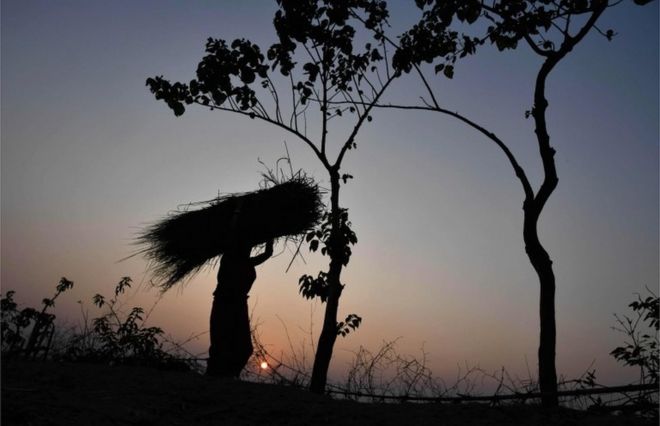
Image copyrightAFPImage captionThe sun rises nearly two hours earlier in the east of India than in the far west
India’s single time zone is a legacy of British rule, and is thought of as a symbol of unity. But not everyone thinks the Indian Standard Time (IST) is a good idea.
Here’s why.
India stretches 3,000km (1,864 miles) from east to west, spanning roughly 30 degrees longitude. This corresponds with a two-hour difference in mean solar times – the passage of time based on the position of the sun in the sky.
The US equivalent would be New York and Utah sharing one time zone. Except that in this case, it also affects more than a billion people – hundreds of millions of whom live in poverty.
The sun rises nearly two hours earlier in the east of India than in the far west. Critics of the single time zone have argued that India should move to two different standard times to make the best use of daylight in eastern India, where the sun rises and sets much earlier than the west. People in the east need to start using their lights earlier in the day and hence use more electricity.
The rising and setting of the sun impacts our body clocks or circadian rhythm. As it gets darker in the evening, the body starts to produce the sleep hormone melatonin – which helps people nod off.
This is how it happens. The school day starts at more or less the same time everywhere in India but children go to bed later and have reduced sleep in areas where the sun sets later. An hour’s delay in sunset time reduces children’s sleep by 30 minutes.
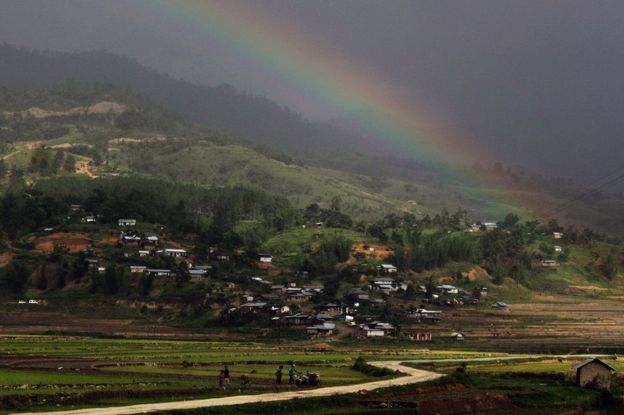
Image copyrightAFPImage captionScientists suggest Manipur, a hilly north-eastern state, should have a different time zone
Using data from the India Time Survey and the national Demographic and Health Survey, Mr Jagnani found that school-going children exposed to later sunsets get fewer years of education, and are less likely to complete primary and middle school.
He found evidence that suggested that sunset-induced sleep deprivation is more pronounced among the poor, especially in periods when households face severe financial constraints.
“This might be because sleep environments among poor households are associated with noise, heat, mosquitoes, overcrowding, and overall uncomfortable physical conditions. The poor may lack the financial resources to invest in sleep-inducing goods like window shades, separate rooms, indoor beds and adjust their sleep schedules,” he told me.
“In addition, poverty may have psychological consequences like stress, negative affective states, and an increase in cognitive load that can affect decision-making.”
Mr Jagnani also found that children’s education outcomes vary with the annual average sunset time across eastern and western locations even within a single district. An hour’s delay in annual average sunset time reduces education by 0.8 years, and children living in locations with later sunsets are less likely to complete primary and middle school, the research showed.
Mr Jagnani says that back of the envelope estimates suggested that India would accrue annual human capital gains of over $4.2bn (0.2% of GDP) if the country switched from the existing single time zone to the proposed two time zone policy: UTC+5 hours for western India and UTC+6 hours for eastern India. (UTC is essentially the same as Greenwich Mean Time or GMT but is measured by an atomic clock and is thus more accurate.)
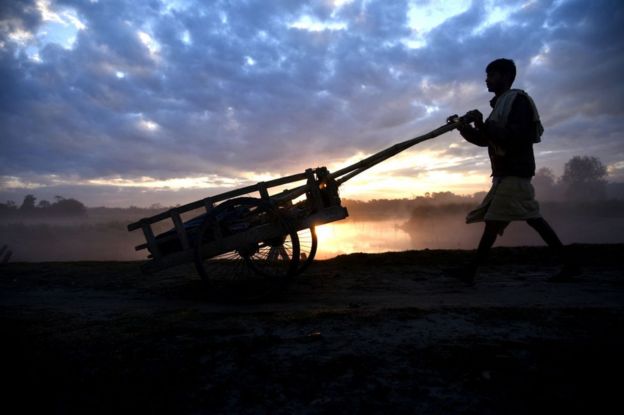
Image copyrightAFPImage captionThe sun can rise nearly two hours earlier in the east of India than in the far west
India has long debated whether it should move to two time zones. (In fact tea gardens in the north-eastern state of Assam have long set their clocks one hour ahead of IST in what functions as an informal time zone of their own.)
During the late 1980s, a team of researchers at a leading energy institute suggested a system of time zones to save electricity. In 2002, a government panel shot down a similar proposal, citing complexities. There was the risk, some experts felt, of railway accidents as there would be a need to reset times at every crossing from one time zone to another.
Researchers at the National Physical Laboratory said the single time zone was “badly affecting lives” as the sun rises and sets much earlier than official working hours allow for.
Early sunrise, they said, was leading to the loss of many daylight hours as offices, schools and colleges opened too “late” to take full advantage of the sunlight. In winters, the problem was said to be worse as the sun set so early that more electricity was consumed “to keep life active”.
Moral of the story: Sleep is linked to productivity, and a messy time zone can play havoc with the lives of people, especially poor children.
NEW DELHI (Reuters) – Thousands of candidates, hundreds of parties, endless combinations of possible coalitions – spare a thought for India’s pollsters, tasked with making sense of the country’s fiendishly complicated politics ahead of a general election due by May.
The ruling Bharatiya Janata Party led by Prime Minister Narendra Modi won a surprise majority in 2014. Until last year, many predicted a similar result. But amid rising anger over unemployment and a fall in rural incomes, the BJP lost key state elections in December, making this contest more closely fought than first expected.
That means surveys conducted on behalf of newspapers and TV channels will be closely scrutinised. Some of India’s top pollsters however, told Reuters current surveys could be wide of the mark until the parties finalise alliances, which could be as late as April – and even then, there are challenges.
“In India there are certain relationships between caste, religion and allegiance,” said VK Bajaj, chief executive of Today’s Chanakya, the only polling firm to predict the BJP would win an outright majority in 2014. “We have to do checks and counter-checks when collecting our samples.”
CHEQUERED PAST
Opinion polls grew in popularity in India in the 1990s, after economic liberalisation saw a boom in privately-owned newspapers and TV channels, all demanding their own surveys.
In 1998 and 1999, the polls closely predicted the share of seats for the winning BJP-led coalition, according to data collected by Praveen Rai, an analyst who has tracked opinion polls in India for more than 15 years at the Centre for the Study of Developing Societies, which also runs its own surveys.
But in the last three elections, polls have been significantly wide of the mark. In 2004 and 2009 the victorious Congress alliance was completely underestimated, while in 2014 only Bajaj’s firm predicted the BJP would win an outright majority.
Elections in India have become “increasingly multi-varied”, Rai said, with the emergence of regional parties complicating pollsters’ efforts.
REALITY ON THE GROUND
Many polls are conducted face-to-face, and collecting representative samples can be hard in a country that still has several armed separatist movements and tribal communities unused to opinion polling.
When CNX, one of India’s largest polling companies, conducts fieldwork in rural Chhattisgarh and Jharkhand – two states with large tribal populations – it often finds many are unfamiliar with the concept of opinion polls.
“In areas where people are not so educated it is difficult for them to understand,” said Bhawesh Jha, CNX’s founder.
Elsewhere, a lack of trust in why polls are conducted and how the data is used means respondents are also less truthful than other countries, pollsters said.
“Dubious opinion polls conducted by some media houses to sway the elections for political parties … has definitely created a bad name for the polling industry in India,” Rai said.
India lacks strong data protections laws like those in North America and Europe, and many people still believe their details will be passed on to political parties, Rai and Jha said, meaning answers were often those they think the pollster wants to hear.
“We have to convince people we are not going to reveal their identity,” Jha said.
COMPLEX ARITHMETIC
Current polls are making large assumptions, no more so than in Uttar Pradesh, India’s largest state with a population of more than 200 million that accounts for nearly a fifth of the seats in India’s lower house.
Results there have been so difficult to predict that the state has earned the nickname “Ulta Pradesh” – a play on the Hindi word meaning “reverse” – for its ability to confound experts.
A recent poll there found that if two regional parties already in alliance joined forced with the main opposition Congress, the BJP would be wiped out in the state, almost certainly losing power nationally.
But like other states in India, much depends on who contests from where – and to what extent Congress stands its candidates down to allow regional parties a run.
Until the final seats sharing agreements and candidate lists are announced – which may not be until April – current polls are little more than guesswork, said Today’s Chanakya chief Bajaj.
“We have to wait until the final alliances come out,” he said. “It is not possible to do anything until that.”
The Congress has been repeatedly alleging a scam in the multi-crore Rafale fighter jet deal with France.
SNS Web | New Delhi | February 12, 2019 1:33 pm
Congress president Rahul Gandhi on Tuesday accused Prime Minister Narendra Modi of compromising on national security and called him a “middleman for Anil Ambani”.
Addressing a press conference on Tuesday in New Delhi, Gandhi, whose party has been repeatedly alleging a scam in the multi-crore Rafale fighter jet deal with France, cited a media report which said that Ambani met the French Defence Minister just days before the inking of the fighter jet deal.
“An email has come into light that states ‘A. Ambani visited the Minister’s office… Mentioned MoU in preparation and intention to sign during PM visit’. How is Anil Ambani meeting the French Defence Minister prior to PM’s visit?” Gandhi said while showing the email to media persons.
“Modi is under oath to protect secrets. He has given these secrets to Anil Ambani, who knew about the biggest defence deal in the world 10 days before. This in itself is criminal. This in itself will put the Prime Minister in jail,” Gandhi said.
Alleging that the PM has compromised with national security, Gandhi said, “Defence Minister says he doesn’t know about the new deal, whereas Anil Ambani is sitting in the French Defence Minister’s office saying PM will sign an MoU with him involved.”
“This is the breach of the Official Secrets Act. PM was working as the middleman for Anil Ambani,” he added.
“First, it (the deal) was a matter of corruption, now it is a matter of official secrets act. Investigation should begin immediately,” Gandhi demanded, reiterating that the new development is serious.
Rejecting the Comptroller and Auditor General (CAG) report on the Rafale deal, Gandhi even went on raising a finger at the Supreme Court’s judgement based on that report.
“Supreme Court judgement is open to question. It does not have jurisdiction and has quoted the CAG report which does not exist,” he said.
A three-Judge bench headed by Chief Justice Ranjan Gogoi had dismissed all the petitions calling for a probe in the procurement of 36 Rafale fighter jets from France.
According to a report published by The Indian Express on Tuesday, Anil Ambani visited then French Defence Minister Jean-Yves Le Drian’s office in Paris and had a meeting with his top advisers in March 2015. NDTV reported that Anil Ambani’s Reliance Defence stated that the visit had nothing to do with Rafale but to discuss a Naval Utility Helicopter deal for which the government of India had issued a Request for Information in 2015.
Gandhi had on Monday slammed the PM for “facilitating loot” in the deal by removing the anti-corruption clause, as was reported by a daily.
“Every defence deal has an anti-corruption clause. The Hindu has reported that the PM removed the anti-corruption clause. It is clear that the PM facilitated loot,” Gandhi told reporters outside the Andhra Bhawan in New Delhi where he came to support Andhra Pradesh Chief Minister N Chandrababu Naidu’s protest against the Centre.
“NoMo anti corruption clause. The Chowkidar himself opened the door to allow Anil Ambani to steal 30,000 crore from the IAF,” Gandhi tweeted from his official handle using his “chowkidaar chor hai” jibe at the PM.
Congress members have been raising the matter since the start of the Winter Session of Parliament on 11 December, demanding a Joint Parliamentary Committee (JPC) probe into the Rafale deal.
BEIJING (Reuters) – China struck an upbeat note on Monday as trade talks resumed with the United States, but also expressed anger at a U.S. Navy mission through the disputed South China Sea, casting a shadow over the prospect for improved Beijing-Washington ties.
White House senior counsellor Kellyanne Conway on Monday also expressed confidence in a possible deal. Asked if the two countries were getting close to a trade agreement, she told Fox News in an interview, “It looks that way, absolutely.”
RELATED COVERAGE
The United States is expected to keep pressing China on longstanding demands that it reform how it treats American companies’ intellectual property in order to seal a trade deal that could prevent tariffs from rising on Chinese imports.
The latest talks kick off with working level discussions on Monday before high-level discussions later in the week. Negotiations in Washington last month ended without a deal and with the top U.S. negotiator declaring work was needed.
“We, of course, hope, and the people of the world want to see, a good result,” Chinese Foreign Ministry spokeswoman Hua Chunying said at a news briefing in Beijing.
The two sides are trying to hammer out a deal before the March 1 deadline when U.S. tariffs on $200 billion (£155 billion) worth of Chinese imports are scheduled to increase to 25 percent from 10 percent.
Trump said last week he did not plan to meet with Chinese President Xi Jinping before that deadline, dampening hopes that a trade pact could be reached quickly. But the White House’s Conway said a meeting was still possible soon.
Escalating tensions between the United States and China have cost both countries billions of dollars and disrupted global trade and business flows, roiling financial markets.
The same day the latest talks began, two U.S. warships sailed near islands claimed by China in the disputed South China Sea, a U.S. official told Reuters.
Asked if the ships’ passage would impact trade talks, Hua said that “a series of U.S. tricks” showed what Washington was thinking. But Hua added that China believed resolving trade frictions through dialogue was in the interests of both countries’ people, and of global economic growth.
China claims a large part of the South China Sea, and has built artificial islands and air bases there, prompting concern around the region and in Washington.
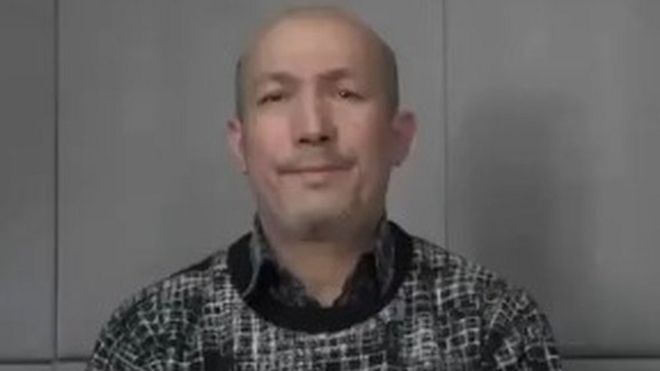
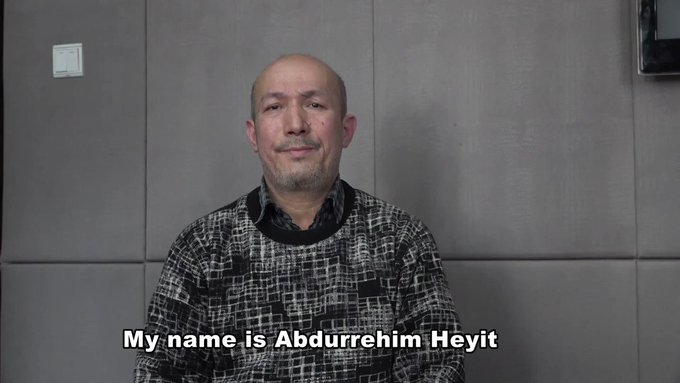
Image copyrightCRIImage captionA screenshot of the footage appearing to show Mr Heyit
China has railed at Turkish claims it is mistreating its Uighur minority, after a dispute about the fate of a prominent musician.
Turkey cited reports Abdurehim Heyit had died in a detention camp, and called China’s treatment of the Uighurs a “great embarrassment for humanity”.
China then released a video allegedly showing Mr Heyit alive.
The Uighurs are a Muslim minority in north-western China who speak a language closely related to Turkish.
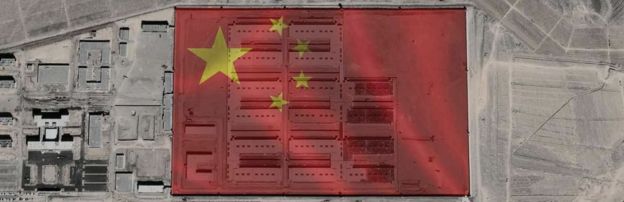
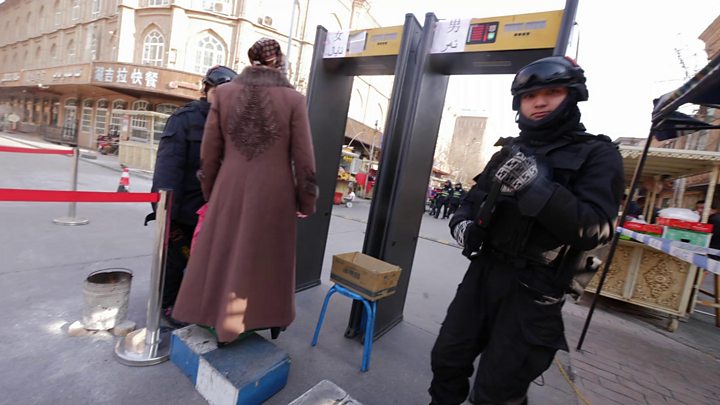
They have come under intense surveillance by the authorities and up to a million Uighurs are reportedly being detained. A significant number of Uighurs have fled to Turkey from China in recent years.
China has asked Turkey to revoke its “false” claims. A Chinese foreign ministry spokeswoman said the musician was “very healthy”.
“We hope the relevant Turkish persons can distinguish between right and wrong and correct their mistakes,” spokeswoman Hua Chunying told reporters.
What is in the video?
The video was released by China Radio International’s Turkish-language service, which said Turkey’s criticism of China was unfounded.
Dated 10 February, the video features a man said to be Mr Heyit stating that he is in “good health”.
So far, few Muslim-majority countries have joined in public international condemnation of the allegations.
Analysts say many fear political and economic retaliation from China.
Turkey’s strategic blunder?
By John Sudworth, BBC News, Beijing
Critics have long seen Turkey’s silence over the plight of China’s Uighurs as a strategic blunder, undermining President Recep Tayyip Erdogan’s lofty claim to moral leadership of the Muslim world.
But belatedly basing its condemnation of China’s system of internment camps on a wrongful claim of a death in custody might be seen as an even bigger blunder.
That is certainly the view of China’s foreign ministry. “The video clip has provided very good evidence for the truth,” the ministry’s spokeswoman said.
In reality, it’s impossible to verify anything about the status of Abdurehim Heyit. Before the claims of the musician’s death, and China’s quick rebuttal, there had been no official word about his detention at all.
Like hundreds of thousands of Uighurs, he had simply disappeared into a legal black hole.
And the video bears all the hallmarks of the forced, televised confessions regularly produced by the combined efforts of China’s Communist Party-controlled courts, police investigators and state-run media.
China has been quick to claim that the reports of Mr Heyit’s death prove that much of the criticism of the situation in Xinjiang is based on falsehoods.
But critics will continue to argue that the confusion – stemming from the lack of any independent scrutiny – shows precisely why there’s such growing concern, even, finally, in Turkey.
Heyit was a celebrated player of the dutar, a two-stringed instrument that is notoriously hard to master. At one time, he was venerated across China. He studied music in Beijing and later performed with national arts troupes.
Mr Heyit’s detention reportedly stemmed from a song he had performed, titled Fathers. It takes its lyrics from a Uighur poem calling on younger generations to respect the sacrifices of those before them.
But three words in the lyrics – “martyrs of war” – apparently led Chinese authorities to conclude that Mr Heyit presented a terrorist threat.
Who are the Uighurs?
The Uighurs make up about 45% of the population in Xinjiang.
Media captionJohn Sudworth reports from Xinjiang, where one million Uighurs have reportedly been detained
They see themselves as culturally and ethnically close to Central Asian nations.
In recent decades, large numbers of Han Chinese (China’s ethnic majority) have migrated to Xinjiang, and the Uighurs feel their culture and livelihoods are under threat.
Xinjiang is officially designated as an autonomous region within China, like Tibet to its south.
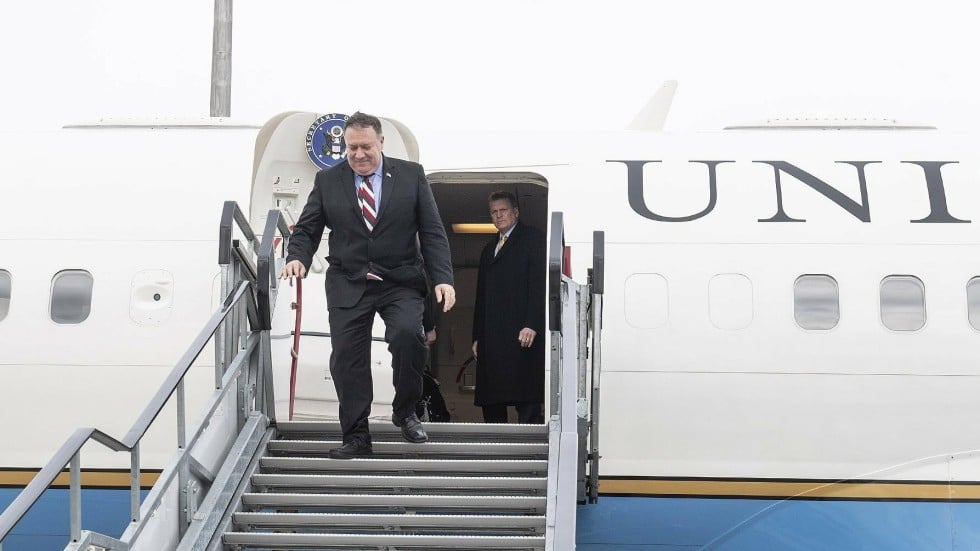
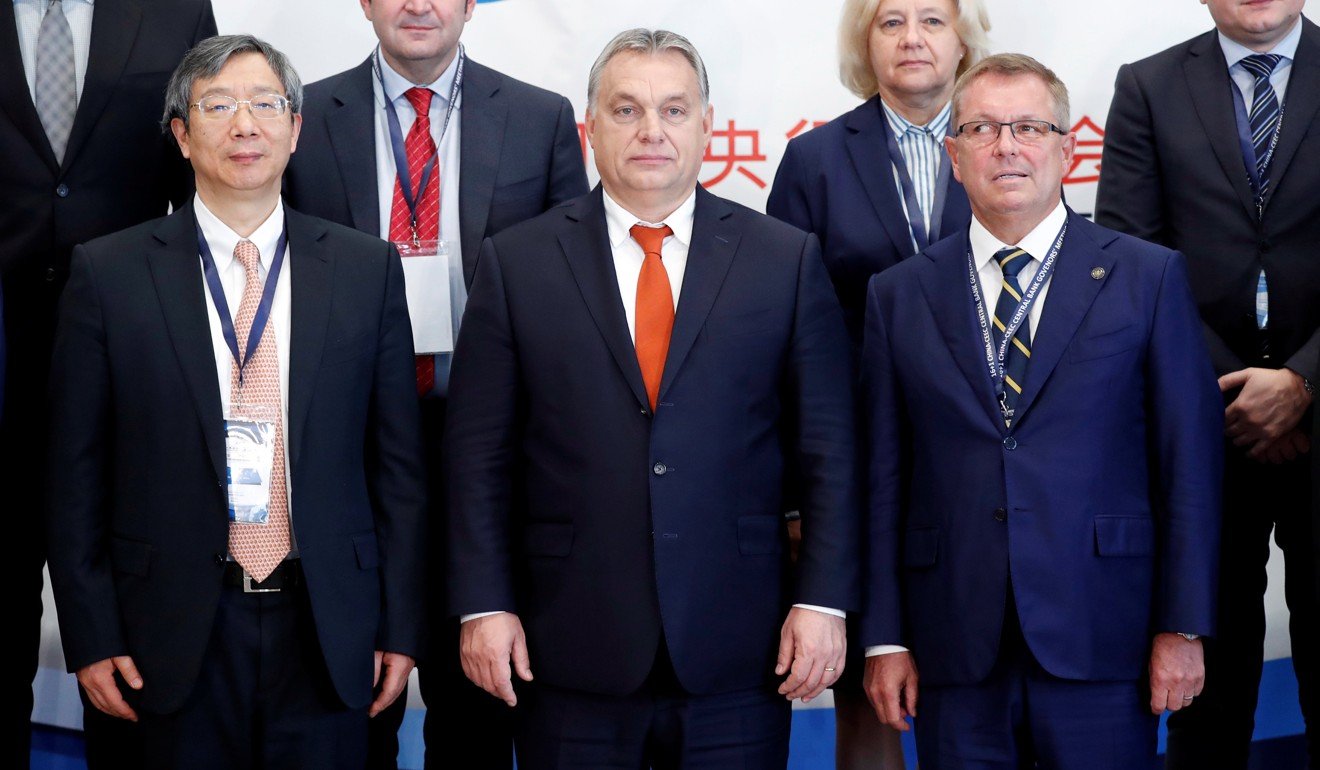
US Secretary of State Mike Pompeo is in Hungary on the first leg of a five-nation European tour during which he will raise concerns about China and Russia’s growing influence in Central Europe.
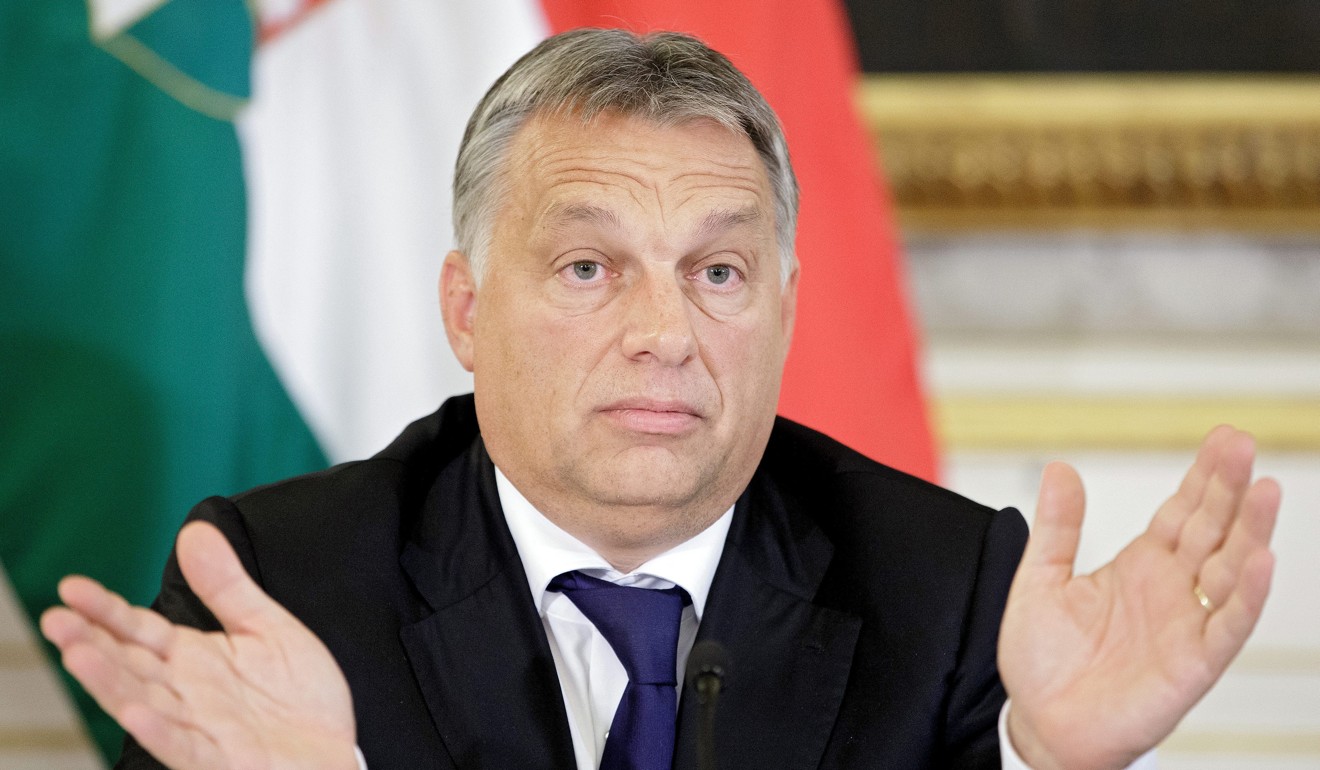
Pompeo was meeting in Budapest on Monday Hungary’s nationalist Prime Minister Viktor Orban and other senior officials to stress the importance of promoting democracy and the rule of law. The US sees those as key to countering Russian and Chinese efforts to pull Hungary and other countries in the region away from the West and sow division in the European Union and Nato, officials said.
Pompeo will specifically point to Central Europe’s reliance on Russian energy and the presence of the Chinese hi-tech telecoms firm Huawei, particularly in Hungary, according to the officials, who were not authorised to publicly discuss Pompeo’s travel and spoke on the condition of anonymity.
US officials are deeply troubled by Huawei’s expansion in Europe, especially in Nato member states where they believe it poses significant information security threats.
We have to show up [in Hungary] or expect to lose
U.S. OFFICIAL
Pompeo will take the same message to his next stop, Slovakia, on Tuesday, before heading to Poland, where he will participate in a conference on the future of the Middle East expected to focus on Iran. He will wrap up the tour with brief stops in Belgium and Iceland.
Before his visits to Budapest and Bratislava, US officials said Pompeo hoped to reverse what they called a decade of US disengagement in Central Europe that created a vacuum Russia and China have exploited. Over the past 10 years, the officials said, Russian President Vladimir Putin and Chinese leaders have become much more aggressive in the region and made inroads.
One official said Pompeo’s aim is to “wrong-foot the West’s rivals in places where they have gained bridgeheads”.
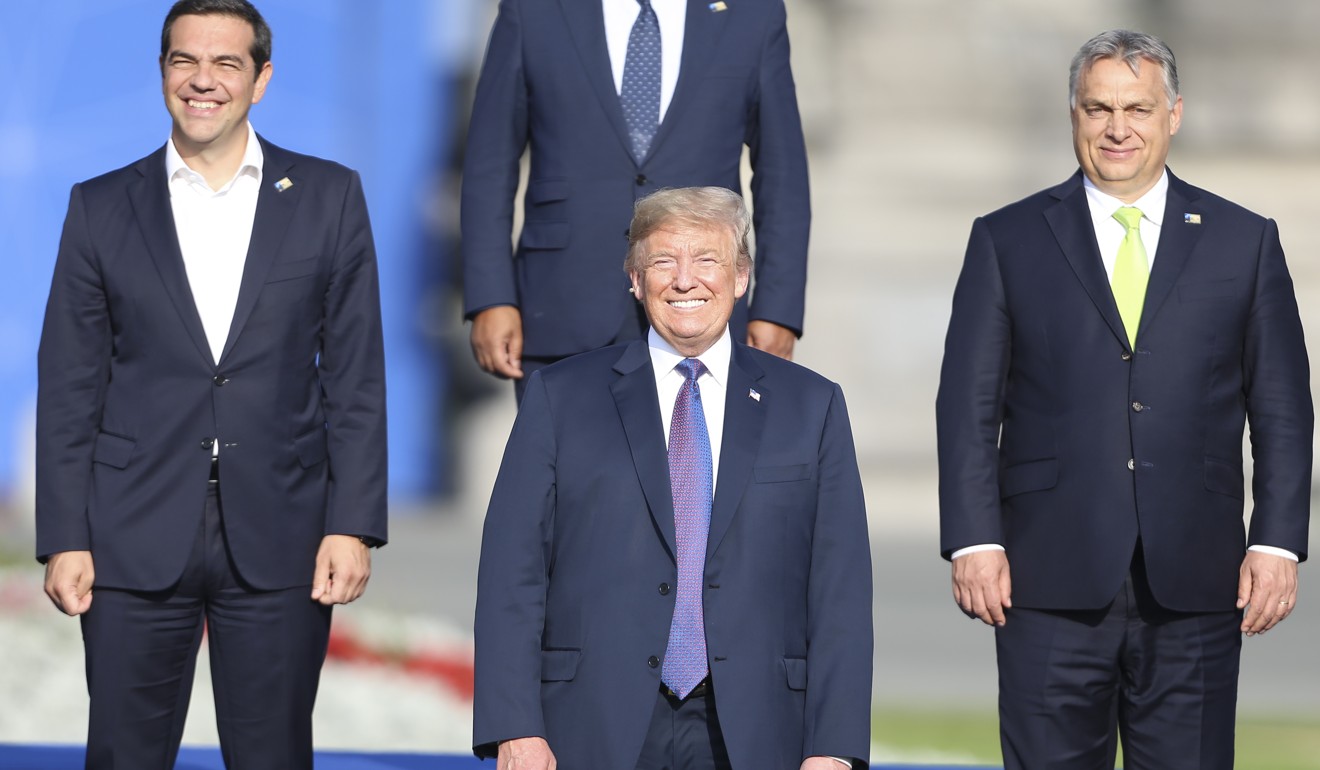
President Donald Trump’s administration has made a point of reaching out to Orban, who shares Trump’s strong stance on limiting immigration and has adopted increasingly authoritarian measures, including cracking down on the opposition, trade unions, independent media and academia.
Former US president Barack Obama’s administration largely steered clear of Orban, who won a third consecutive term last year in a campaign based on anti-immigration policies which have been met with concern by some EU members.
Orban on Sunday announced a programme to encourage women to have more children and reverse Hungary’s population decline. He said the initiative is meant to “ensure the survival of the Hungarian nation”.
“This is the Hungarians’ answer, not immigration,” he said.
Last month, Orban said he wanted “anti-immigration forces” to become a majority in all EU institutions, including its parliament and the European Commission, and predicted there would soon be two civilisations in Europe – one “that builds its future on a mixed Islamic and Christian coexistence” and another in Central Europe that would be only Christian.
Orban’s fiery rhetoric against immigrants and refusal to join a new European Union public prosecutor’s office focusing on fraud and corruption also have raised concerns.
Human rights groups and others have lamented Pompeo’s plans to meet Orban and urged him to take a strong stance against his policies, which they consider worrisome.
The US officials defended the Budapest stop, saying it is impossible to promote US positions and interests in Hungary effectively without meeting Orban.
“We have to show up or expect to lose,” one official said.
BEIJING, Feb. 11 (Xinhua) — China announced Monday that it is developing the modified version of the Long March-6 rocket with four additional solid boosters to increase its carrying capacity.
The improved medium-left carrier rocket will be sent into space by 2020, according to the Shanghai Academy of Spaceflight Technology under the China Aerospace Science and Technology Corporation (CASTC), which designed the rocket.
With a short launch preparation cycle, the Long March-6 has been mainly used for the academy’s commercial launches. The rocket completed two space tests in September 2015 and November 2017, carrying 20 satellites and three satellites, respectively.
The three-stage rocket is 29.3 meters long, with a launch weight of 103 tonnes. It has a carrying capacity of one tonne for sun-synchronous orbit.
Fueled by a liquid propellant made of liquid oxygen and kerosene, the Long March-6 is China’s first carrier rocket that uses non-toxic and non-polluting fuel.
Ding Xiufeng, executive manager of the Long March-6 project, said in response to the growing demand for commercial launches, they will have the rockets’ market competitiveness enhanced through technical improvements, so that they can provide easier, faster and more comprehensive services to users at home and abroad.
In January, the China Great Wall Industry Corporation, affiliated with the CASTC, signed a multiple launch services agreement with Satellogic to use the Long March-6 and the Long March-2 rockets to launch 90 satellites for a private Argentine company in the coming years.
The first 13 satellites will be delivered later this year. It will be the first time for the Long March-6 to provide launch services for an international user.
BEIJING, Feb. 11 (Xinhua) — Yang Jiechi, a member of the Political Bureau of the Communist Party of China (CPC) Central Committee, will travel to Germany to attend the 55th Munich Security Conference (MSC) from Friday to Sunday, Foreign Ministry spokeswoman Hua Chunying announced Monday.
Yang, also director of the Office of the Foreign Affairs Commission of the CPC Central Committee, will attend the conference at the invitation of the MSC Chairman Wolfgang Ischinger, Hua said in the announcement.
Passengers are seen at the station hall of Nanchangxi Railway Station in east China’s Jiangxi Province, Feb. 10, 2019. Railway trips in China reached 60.3 million during the week-long Spring Festival holiday from Feb. 4 to Feb. 10, data from the national railway operator showed Monday. (Xinhua/Peng Zhaozhi)
BEIJING, Feb. 11 (Xinhua) — Railway trips in China reached 60.3 million during the week-long Spring Festival holiday from Feb. 4 to Feb. 10, data from the national railway operator showed Monday.
On Feb. 10, some 12.6 million passenger trips were made by rail, up 4.4 percent year on year, according to the China Railway Corporation (CRC).
Hundreds of millions of Chinese went back to their hometowns to celebrate the Chinese Lunar New Year with their families. The annual travel rush around the festival, known as “chunyun,” often puts the country’s transportation system to the test.
This year’s Spring Festival travel rush started from Jan. 21 and will last till March 1, with railway trips expected to hit 413 million in total, up 8.3 percent.





 CHINDIA ALERT: You'll be living in their world, very soon
COMMENTS: