Chindia Alert: You’ll be Living in their World Very Soon
aims to alert you to the threats and opportunities that China and India present. China and India require serious attention; case of ‘hidden dragon and crouching tiger’.
Without this attention, governments, businesses and, indeed, individuals may find themselves at a great disadvantage sooner rather than later.
The POSTs (front webpages) are mainly 'cuttings' from reliable sources, updated continuously.
The PAGEs (see Tabs, above) attempt to make the information more meaningful by putting some structure to the information we have researched and assembled since 2006.
UNITED NATIONS, March 15 (Xinhua) — A Chinese envoy said Friday that China is ready to continue to play a constructive role in South Sudan.
“China is ready to continue to play a constructive role in achieving peace, stability and development in South Sudan,” Wu Haitao, the charge d’affaires of China’s Permanent Mission to the United Nations, told the Security Council after it adopted Resolution 2459 to extend the mandate of the UN Mission in South Sudan (UNMISS).
“Since its deployment, UNMISS has played an important role in maintaining peace and stability in South Sudan,” he said.
“The international community should continue to support the mission in carrying out its mandate,” Wu added.
He also noted that the international community, especially the Security Council, should fully acknowledge the importance of the Revitalized Agreement on the Resolution of the Conflict in South Sudan signed between the government and major oppositions last September.
“UNMISS should focus on facilitating the implementation of the agreement in order to help sustain the current positive momentum in South Sudan,” he added.
The Security Council on Friday extended the mandate of UNMISS for an additional year till March 15, 2020.
The resolution, drafted by the United States, received 14 votes in favor from the 15-member Security Council and one abstention from Russia.
BEIJING, March 15 (Xinhua) — The People’s Liberation Army (PLA) and armed police force have been urged to study the spirit of the second session of the 13th National People’s Congress (NPC) and the spirit of the remarks made by President Xi Jinping during the session.
This is an important political task for the whole military, said a circular released Friday by the General Office of the Central Military Commission.
Xi, also general secretary of the Communist Party of China Central Committee and chairman of the Central Military Commission, stressed fulfilling the set targets and tasks of national defense and military development as scheduled, in the remarks he made while attending a plenary meeting of the PLA and armed police force delegation.
The circular called on the PLA and armed police force to have a clear understanding of new circumstances, new tasks and new demands in strengthening national defense and the armed forces, and intensify the sense of mission to achieve new progress in making the military strong.
The circular stressed studying the spirit of Xi’s remarks, and urged the PLA and armed police force to clearly understand the importance and urgency of implementing the 13th Five-Year Plan for military development, and go all out to carry out the plan so as to ensure that the set targets and tasks are fulfilled as scheduled.
The PLA and armed police force should have a deep understanding of the severe situation facing China’s security and development, improve military preparedness, actively support local economic and social development as well as ecological conservation and resolutely safeguard national sovereignty, security and development interests, the circular stressed.
A worker onloads cargo to the 2,000th China-Europe freight train heading to Krasnodar of Russia at the freight logistics center in Urumqi, capital of northwest China’s Xinjiang Uygur Autonomous Region, on March 15, 2019. Since its operation in 2016, trains running from the freight train logistics center in the regional capital reached 2,000. (Xinhua/Fu Xiaobo)
BEIJING, March 15 (Xinhua) — Chinese President Xi Jinping sent a message of condolence to New Zealand Governor-General Patsy Reddy on Friday over the deadly shooting incidents earlier Friday in New Zealand’s Christchurch City.
In his message, Xi said he was shocked to learn about the serious shooting incidents which have caused heavy casualties.
On behalf of the Chinese government, the Chinese people and in his own name, Xi expressed deep sympathy with and sincere condolences to the New Zealand government and the New Zealand people, while expressing grief for the victims and wishing the injured an early recovery.
Also on Friday, Chinese Premier Li Keqiang sent a message of condolence to New Zealand Prime Minister Jacinda Ardern, expressing grief for the victims while extending sincere sympathies to the injured and the bereaved families.
Technical team expected to go to Latin American country to discuss project reportedly worth up to US$8 billion
Argentina had hoped to announce an agreement on China-financed construction of Atucha III during a state visit by Chinese President Xi Jinping after November’s G20 summit in Buenos Aires. Image: Handout
A delegation from China will visit Argentina this month to discuss the construction of a nuclear power plant, signalling possible progress in a deal that could increase Beijing’s deepening influence in the South American nation.
An Argentinian government source told Reuters this week the “technical team” from China would meet local suppliers about the long-stalled nuclear power plant project, reportedly worth up to US$8 billion.
Argentina had hoped to announce an agreement on China-financed construction of Atucha III, as it has been referred to in the past, during a state visit by Chinese President Xi Jinping after November’s G20 summit in Buenos Aires.
But the deal failed to emerge then, and in January Argentina’s nuclear energy undersecretary, Julian Gadano, and the ambassador to China, Diego Guelar, met officials in Beijing for talks about the project, the government source said.
Argentina seeks new currency swap deal with China as Beijing pursues closer ties in Latin America
A second government source, in the foreign ministry, said talks about the nuclear plant with China were ongoing but added that there had been no “concrete progress” towards signing a deal.
If finalised, the nuclear plant would be one of the biggest projects financed in Argentina by China, which has become a key trading partner for the South American country and its biggest non-institutional lender.
SHANGHAI (Reuters) – BMW AG (BMWG.DE) and Mercedes-Benz said on Saturday they will lower their prices in China, after the government announced it will reduce the country’s value-added tax (VAT) starting on April 1.
The German automobile companies each published posts on Chinese social media announcing immediate price cuts for several models. The discounts come as China endures a shrinking market for automobiles as the economy slows.
BMW said it would reduce prices for both domestically produced and imported models, including the locally-made BMW 3 series and BMW 5 series, along with the BMW X5 and BMW 7 import models. The BMW 320Li M model will sell for a suggested retail price of 339,800 yuan ($50,620), a drop of 10,000 yuan from its original price.
The reductions mark the company’s “active response to the national VAT adjustment notice,” BMW said in a post on WeChat, China’s popular messaging app.
Daimler AG-owned (DAIGn.DE) Mercedes-Benz announced similar price cuts on a range of its cars, also effective immediately, in advance of the upcoming VAT drop. The cuts shown on its social media page range from 10,000 yuan to 40,000 yuan on select models.
On March 5, Chinese Premier Li Keqiang announced that China will cut VAT across a range of industries, with the tax set to drop in the manufacturing sector from 16 percent to 13 percent and in the transport sector from 10 percent to 9 percent.
The carmakers’ cuts come as China’s automobile industry faces a major slowdown. In 2018, China’s car market shrank 5.8 percent, marking its first contraction in over two decades.
Policymakers have introduced a range of policies to stimulate demand for cars. In January, China’s National Development and Reform Commission (NDRC) said it would loosen restrictions on the second-hand car market and provide subsidies to boost purchases in rural areas.
Image copyrightAFPImage captionMore than half of India’s “missing” women voters are from three northern states
Indian women got the right to vote the year their country was born. It was, as a historian said, a “staggering achievement for a post-colonial nation”. But more than 70 years later, why are 21 million women in India apparently being denied the right to vote?
It is one of India’s many social riddles.
Women have been enthusiastic voters in India: voter turnout among women will be higher in this year’s general election than that of men. Most women say they are voting independently, without consulting their spouses and families.
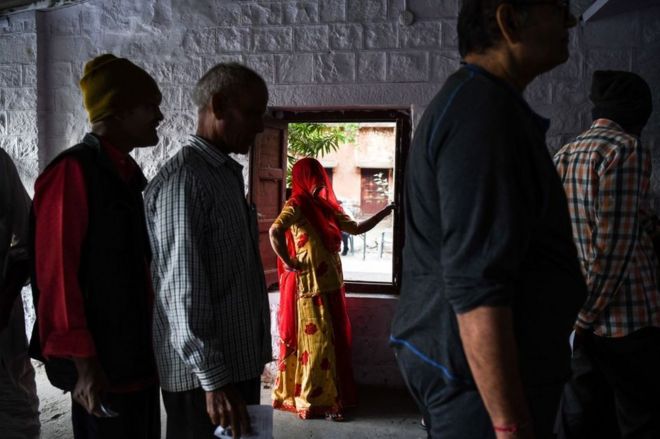
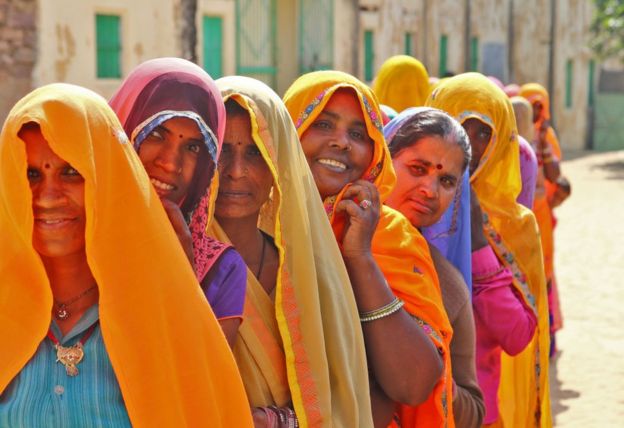
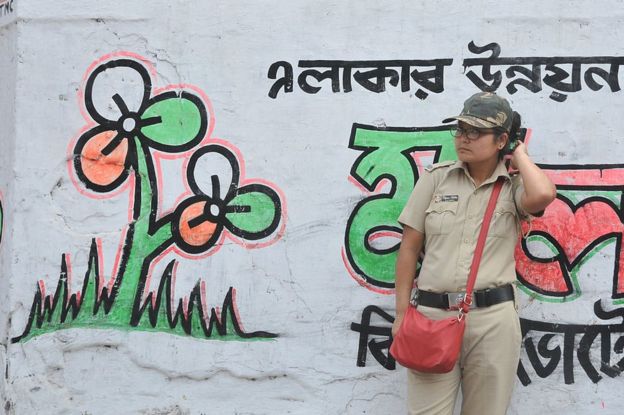
To make them secure, there are separate queues for women at polling stations and female police officers guarding them. Polling stations contain at least one female officer.
More than 660 women candidates contested the 2014 elections, up from 24 in the first election in 1951. And political parties now target women as a separate constituency, offering them cheap cooking gas, scholarships for studies and bicycles to go to college.
‘Major problem’
Yet, a truly astonishing number of women – equal to the population of Sri Lanka – appear to be “missing” from India’s voters lists.
In their upcoming book, The Verdict: Decoding India’s Elections, poll experts Prannoy Roy and Dorab Sopariwala find that the available data on women points to this.
They looked at the number of women above the age of 18 in the census, extrapolated it, and compared it to the number of women in the latest list of voters. And they found a sizeable “shortfall” – 21 million to be exact – in the number of female voters.
Three states – Uttar Pradesh, Maharashtra and Rajasthan – accounted for more than half of the missing female voters. Southern states such as Andhra Pradesh and Tamil Nadu fare better.
Image copyrightAFPImage captionMore women are expected to vote than men in the 2019 elections
What does this mean?
More than 20 million missing women, analysts say, translates into 38,000 missing women voters on average in every constituency in India. In places like Uttar Pradesh, India’s most populous and a key bellwether state, the figure swells to 80,000 missing women in every seat.
Given that more than one in every five seats are won or lost by a margin of fewer than 38,000 votes, the missing women could swing the results in many seats. The absence of a large number of women also means that India’s electorate would be higher than the 900 million people who are eligible to vote in the summer elections. If the sex ratio in a constituency is skewed against women and the average voter is male, the preferences of female voters are likely to be ignored.
“Women want to vote, but they are not allowed to vote. This is deeply worrying. It also raises a lot of questions. We know that there are some social reasons behind this problem. But we also know that by controlling turnouts you can control results. Is that one of the reasons? We really need to investigate further to get to the truth,” Prannoy Roy told me.
With a sex ratio that is skewed in favour of men, India has had a problem of missing women for a long time.
Last year, a government report found that 63 million women were “missing” from India’s population because the preference for sons led to sex-selective abortions and more care was given to boys. Separately, economists Shamika Ravi and Mudit Kapoor estimated that more than 65 million women – some 20% of the female electorate – were missing. This included women who were not registered to vote and women “who were not in the population because of gross neglect” (worsening sex ratio, which reflected the gross neglect). So elections, they said, were “revealing the preferences or the will of a population that is artificially skewed against women”.
It’s not that election authorities haven’t worked hard to get more women to vote.
The Election Commission adopts a rigorous statistical method – gender ratios, elector-population ratios and ages of voters – to make sure that eligible voters are not left out. There is doorstep verification of voters and a substantial number of officials involved in this exercise are women. In villages, child welfare workers and women’s self-help groups are roped in. State-run TV and radio programmes motivate women to register. There are even polling stations dedicated exclusively to women.
Image copyrightAFPImage captionPolicewomen are deployed at polling stations during elections
So why are so many women still missing from the rolls? Is it because many women shift residence after marriage and fail to register anew? (Less than 3% of Indian women aged 30-34 are single.) Is it because families still refuse to provide photographs of women to officials to publish in voters lists? Or does this exclusion have something to do with the “dark arts of voter suppression”?
“There is some social resistance, but it doesn’t explain such large scale exclusion,” says Dr Roy.
People who have helped organise elections in India say there is no reason to panic. Former election commissioner SY Quraishi told me that the enrolment of women had gone up steadily over the years. “There is social resistance to enrolling women still,” he says.
“I have heard of parents not registering their daughter because they don’t want to reveal her age, because they feel it will end up hurting their prospects for marriage. We have also been sometimes indifferent in our outreach to rope in more women voters,” he said.
With the 2019 elections barely a month away, there’s no time to fix this problem. Dr Roy believes there’s only one way out – to let women vote even if they are not registered.
“Any woman who comes to a polling station and wants to cast her vote, and can prove she is 18 years old, must be allowed to vote,” he says.
BEIJING (Reuters) – China said on Friday it was willing to have more discussions with all parties concerned including India on blacklisting the head of Pakistan-based militant group Jaish-e-Mohammed (JeM), which claimed responsibility for the attack on an Indian paramilitary convoy in disputed Kashmir in February.
China prevented a U.N. Security Council committee on Wednesday from blacklisting JeM founder Masood Azhar.
India said it was disappointed at the block, which sparked calls for boycotts of Chinese products on domestic social media, while the United States said it was counter to a goal it shared with China of achieving regional peace and stability.
In a statement faxed to Reuters late on Friday, China’s Foreign Ministry reiterated that the “technical hold” on the blacklisting was to give more time for the committee to have further consultations and study on the issue.
China hopes the committee’s actions can “benefit reducing the tense situation and protect regional stability”, the ministry said, responding to a Reuters question on the boycott calls in India.
“China is willing to strengthen communication with all parties, including India, to appropriately handle this issue,” it added, without elaborating.
The United States, Britain and France had asked the Security Council’s Islamic State and al Qaeda sanctions committee to subject Azhar to an arms embargo, travel ban and asset freeze. The 15-member committee operates by consensus.
China had previously prevented the sanctions committee from sanctioning Azhar in 2016 and 2017.
The Feb. 14 attack that killed at least 40 paramilitary police was the deadliest in Kashmir’s 30-year-long insurgency, escalating tension between the nuclear-armed neighbours, which said they shot down each other’s fighter jets late last month.
Western powers could also blacklist Azhar by adopting a Security Council resolution, which needs nine votes in favour and no vetoes by Russia, China, the United States, Britain or France.
Blacklisted by the U.N. Security Council in 2001, JeM is a primarily anti-India group that forged ties with al Qaeda.
A special police officer has been shot dead by unknown gunmen outside her house in Jammu and Kashmir’s Shopian.
INDIAUpdated: Mar 16, 2019 16:27 IST
Indo Asian News Service
Shopian
A special police officer has been shot dead by unknown gunmen outside her house in Jammu and Kashmir’s Shopian.(ANI)
Militants killed a woman Special Police Officer (SPO) on Saturday in Jammu and Kashmir’s Shopian district, police said.
The terrorists shot dead Khushboo Jan from close range while she was on her home village, Vehil.
“She suffered critical bullet injuries around 2.40 p.m. and was rushed to a hospital where she succumbed,” the police added.
A cordon and search operation was underway to trace the assailants.
SPOs are engaged by the state police on fixed monthly remuneration to fight militancy in the state. They are neither imparted training to handle firearms nor are weapons issued to them.
The SPOs represent the lowest rung of police officials below the state constabulary that is adequately trained to handle weapons and are also issued service weapons.
India is optimistic that Azhar will be listed under the UN 1267 Sanctions Committee as New Delhi has the “strong support” of 14 members.
SNS Web | New Delhi | March 16, 2019 12:57 pm
Expressing disappointment with China blocking a bid to label Maulana Masood Azhar a global terrorist, India said on Saturday that it is continuing its work with the UN Security Council sanctions committee to get the Jaish-e-Mohammad (JeM) chief in the list.
“India continues to work with the UNSC’s sanction committee on listing of JeM chief Masood Azhar as a global terrorist,” PTI reported on Saturday quoting official sources.
India is optimistic that Azhar will be listed under the UN 1267 Sanctions Committee as New Delhi has the “strong support” of 14 members.
“Hold is not a block. We are optimistic (that Azhar will be listed). India will show patience as long as it takes. India has strong support of 14 members,” news agency ANI cited sources as saying.
The sources also said that China will have to resolve issues with Pakistan as Beijing is well aware that terrorism emanates and operates from Pakistan.
“China also knows terrorism is a challenge; they know it operates from Pakistan. Pakistan is spending diplomatic capital in defending indefensible,” the sources said.
China has adequate information that there are groups in Pakistan working against China, they said.
Calling Pakistan’s so-called actions against terrorism “cosmetic”, New Delhi said that US is supportive of India and has assured that Pakistan will take action.
The sources said that Washington has also taken note of New Delhi’s concerns over arms used.
“There are no takers in US to take Pak’s narrative that India is posing threat,” ANI reported quoting sources.
India also demanded that Pakistan can hand over Indians who are in India’s wanted list as well as international terror list such as Dawood Ibrahim and Sayeed Salahudeen.
China on Wednesday blocked the bid in the UN Security Council to designate Azhar a “global terrorist”. This was the fourth time Beijing placed a technical hold on the proposal.
The hold was placed for three months and China might put the issue on hold for another six months.






 CHINDIA ALERT: You'll be living in their world, very soon