Chindia Alert: You’ll be Living in their World Very Soon
aims to alert you to the threats and opportunities that China and India present. China and India require serious attention; case of ‘hidden dragon and crouching tiger’.
Without this attention, governments, businesses and, indeed, individuals may find themselves at a great disadvantage sooner rather than later.
The POSTs (front webpages) are mainly 'cuttings' from reliable sources, updated continuously.
The PAGEs (see Tabs, above) attempt to make the information more meaningful by putting some structure to the information we have researched and assembled since 2006.
Police investigation finds nearly 40 people received the shots since January last year – before the drug was approved by the Chinese regulator
Hainan hospital had rented out its medical cosmetics department to a beauty parlour, which authorities suspect administered the vaccinations
The Gardasil HPV vaccine has been in short supply in China since it was approved by the regulator last year. Photo: Shutterstock
A private hospital on Hainan Island has been closed down after it gave fake HPV vaccines to dozens of patients, including at least one who was pregnant, the local health authority said.
Police found 38 people had been given the fake shots at Boao Yinfeng Healthcare International Hospital, in the city of Boao, since January last year, the Health Commission of Hainan said in a statement on Sunday.
Some of the vaccines were found to have been smuggled in from overseas before the drug was approved in China, while others were illegally made in Jilin province.
The case is the latest in a series of scandals in recent years – including drug makers
and people including children being given fake, faulty or expired vaccines – that have rocked public confidence in the industry.
The hospital began administering the fake HPV shots three months before Merck’s Gardasil vaccine against human papillomavirus, which causes cervical cancer, was approved by the Chinese regulator in April last year. There has been a constant shortage of the vaccine since it was approved and a ballot system is used at some hospitals due to the huge demand and limited supply.
All of the Boao patients given fake shots had paid 9,000 yuan (US$1,300) to be immunised except for a hospital employee, who was vaccinated for free, the statement said.
The health commission said the hospital did not have approval to administer HPV vaccines and some of the shots were given before it officially opened in March last year.
Are Philippine children’s deaths linked to dengue vaccine?
It was also in breach of the hospital management regulation because it had rented out its medical cosmetics department to a beauty parlour from Qingdao, which authorities suspect administered the fake vaccinations.
Its medical institution business licence was revoked and the hospital was fined 8,000 yuan, while authorities have confiscated the illegal proceeds of the fake vaccinations. It was not known whether any arrests had been made in the case, and the investigation was continuing.
The scandal came to light in March when a man posted on the People’s Daily website his complaint to the health authority about his pregnant wife being told by police she was given a fake HPV shot.
Another patient, who identified herself as Wang Xi, wrote on microblog site Weibo last week that she was told the hospital could receive the vaccine before it was officially approved because it was located in a medical tourism pilot zone, giving it preferential access to treatments.
“As a victim, I’m constantly worried – what have they injected into my body?” Wang wrote.
HONG KONG (Reuters) – Thousands of people marched on Hong Kong’s parliament on Sunday to demand the scrapping of proposed extradition rules that would allow people to be sent to mainland China for trial – a move which some fear puts the city’s core freedoms at risk.
Opponents of the proposal fear further erosion of rights and legal protections in the free-wheeling financial hub – freedoms which were guaranteed under the city’s handover from British colonial rule to Chinese sovereignty in 1997.
Early estimates suggested several thousand people had joined the march along Hong Kong Island from Causeway Bay to the council in the Admiralty business district.
Veteran Hong Kong activist and former legislator Leung Kwok-hung said the government’s move risked removing Hong Kongers’ “freedom from fear”.
“Hong Kong people and visitors passing by Hong Kong will lose their right not to be extradited into mainland China,” he said. “They would need to face an unjust legal system on the mainland.”
Some younger marchers said they were worried about travelling to China after the move, which comes just as the government encourages young people to deepen ties with the mainland and promotes Hong Kong’s links with southern China.
The peaceful marchers chanted demands for Hong Kong’s Executive Carrie Lam to step down, saying she had “betrayed” Hong Kong. Some sported yellow umbrellas – the symbol of the Occupy civil disobedience movement that paralysed parts of Hong Kong for 11 weeks in 2014.
The proposed changes have sparked an unusually broad chorus of concern from international business elites to lawyers and rights’ groups and even some pro-establishment figures.
Chris Patten, the last British governor of Hong Kong who handed the city back to Chinese rule in 1997, on Saturday described the move “as an assault on Hong Kong’s values, stability and security”, government-funded broadcaster RTHK reported.
Chief Executive Lam and other government officials are standing fast by their proposals, saying they are vital to plug long-standing loopholes.
Under the changes, the Hong Kong leader would have the right to order the extradition of wanted offenders to China, Macau and Taiwan as well as other countries not covered by Hong Kong’s existing extradition treaties.
As a safeguard such orders, to be issued case-by-case, could be challenged and appealed through the city’s vaunted legal system.
Government officials have said no-one at risk of the death penalty or torture or facing a political charge could be sent from Hong Kong. Under pressure from local business groups, they earlier exempted nine commercial crimes from the new provisions.
The proposals could be passed into law later in the year, with the city’s pro-democratic camp no longer holding enough seats to block the move.
The government has justified the swift introduction of the changes by saying they are needed so a young Hong Kong man suspected of murdering his girlfriend in Taiwan can be extradited to face charges there.
The government’s assurances are not enough for Lam Wing-kee, a former Hong Kong political bookseller who said in 2016 he was abducted by mainland agents in the city.
Lam left Hong Kong for Taiwan last week, saying he feared being sent back to the mainland under the new laws and his experienced showed he could have no trust in China’s legal system.
A group of 33 followers of Falun Gong, a religious sect banned in China, flew from Taiwan to Hong Kong on Saturday to join the march but were refused entry to Hong Kong, RTHK reported.
Sunday’s march comes amid renewed calls for deeper electoral reforms stalled five years ago after Occupy protests.
Four leaders of the movement were last week sentenced to jail terms ranging from eight to 16 months, part of a group of nine activists found guilty after a near month-long trial.
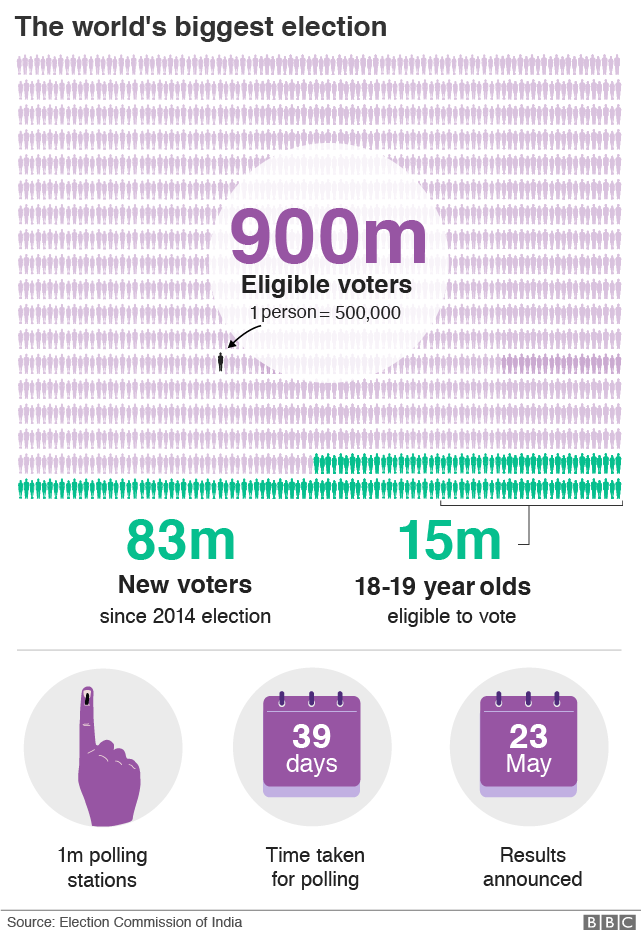
It is an election like no other. Those eligible to vote in India’s upcoming polls represent more than 10% of the world’s population and they will take part in the largest democratic exercise in history.
Voters will choose representatives for the Indian parliament, and in turn decide if Hindu nationalist Prime Minister Narendra Modi will run the country for another five years.
What is at stake?
Whoever wins these elections and forms a government will control the destiny of the world’s largest democracy.
While they are in charge, India’s economy is likely to overtake the UK’s and become the world’s fifth-largest.
Its population meanwhile – at more than 1.34bn people – is predicted to soon surpass China’s 1.39bn.
Hundreds of millions of Indians have escaped poverty since the turn of the millennium but huge challenges remain.
Unemployment is a major concern and is especially high among young people.
Millions of farmers are angry about low crop prices.
How the nuclear-armed country engages with the outside world – and manages a tricky relationship with its neighbour Pakistan – is also of immense importance to international security.
Who is being elected?
Indians are voting for members of parliament and the job of prime minister tends to go to the leader of the party or coalition with most seats. The current PM is Narendra Modi.
His main rival is opposition leader Rahul Gandhi.
Parliament has two houses: the Lok Sabha and the Rajya Sabha.
The lower house – Lok Sabha – is the one to watch.
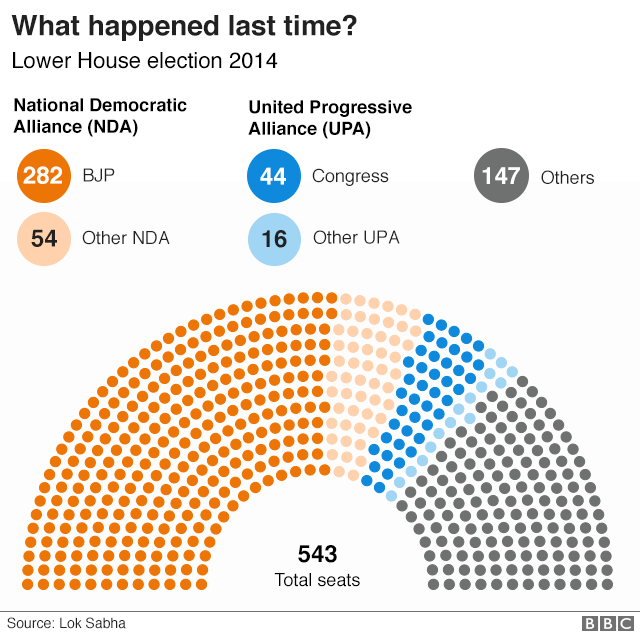
It has 543 elected seats and any party or coalition needs a minimum of 272 MPs to form a government.
At the last election in 2014, Mr Modi’s BJP won 282 seats.
Mr Gandhi’s Congress Party only took 44 seats in 2014 – down from 206 in 2009.
Why does voting take so long?
Because of the enormous number of election officials and security personnel involved, voting will take place in seven stages between 11 April and 19 May.
Different states will vote at different times.
Votes will be counted on 23 May and results are expected on the same day.
Who will win?
This election is being seen as a referendum on Mr Modi, a polarising figure adored by many but also accused of stoking divisions between India’s Hindu majority and the country’s 200 million Muslims.
Until a few months ago, Mr Modi and his BJP party were seen as the overwhelming favourites. But the loss of key states in December’s regional elections injected a sense of serious competition into the national vote.
Analysts are divided on whether Mr Modi will be able to win a simple majority again.
A recent escalation of tensions with Pakistan has given the BJP a new and popular issue to campaign on.
It will be hoping that a focus on patriotism will help the party to get past the serious challenge mounted by powerful regional parties and Congress.
The train driver, whose name was not known, reversed the train for about a kilometre so that the injured passenger, who had fallen from the train, could be taken to a nearby hospital for treatment.
INDIAUpdated: Apr 28, 2019 12:24 IST
HT Correspondent
Hindustan Times, Jaipur
Quick thinking and prompt action by a train driver saved the life of a man on the Kota-bina stretch of Atru-salpura railway line.
The train driver, whose name was not known, reversed the train for about a kilometre so that the injured passenger, who had fallen from the train, could be taken to a nearby hospital for treatment.
The incident took place on the Kota-bina stretch around 4pm on Friday when a 32-year-old man, Rajendra, who was mentally ill, jumped from the train and in order to save Verma, his brother Vinod also jumped from the train.
Giving information about the incident their cousin, Suresh Verma, who was also travelling with them in the train at the time of the incident, said, “My paternal cousin Rajendra Verma works with me in Satna district of Madhya Pradesh (mp) as a labourer. For last five days, his mental condition was not well. On April 24 night, Rajendra was going to Sikar district via Katni town of MP where his health condition deteriorated. So instead of going to Sikar, we (Suresh and his cousins) took train for Jaipur.”
On April 25, around 3am, when the train passed through Ashok Nagar railway station, Rajendra jumped off the train. “I had to pull the chain in order to catch him. I was also fined for this by police. Again, we took a train and left for Jaipur,” Suresh added.
“Next day around 4pm, when train passed Salpura area of Baran district, Rajendra was sleeping on the upper berth of the train. Suddenly, Rajendra got down from the berth and ran towards the gate and jumped from the gate. In order to catch him, his brother Vinod also went behind him and lost balance and fell from the train,” Suresh said.
Senior divisional commercial manager (DCM) of Kota region Vijay Prakash said, “As soon as Rajendra jumped off the train, somebody pulled the chain and the train stopped after crawling a few kilometres. Relatives of Rajendra called for ambulance.”
He added, “As there was no path for ambulance to enter the point where the train had stopped.
“The loco-pilot reversed the train for about one kilometre so that the injured passenger, who fell from the train, could be taken to a nearby hospital for treatment.”
Both the men were taken to Baran hospital where they were given treatment. Both of them are stable, Prakash said.
AHMEDABAD/NEW DELHI (Reuters) – PepsiCo Inc has sued four Indian farmers for cultivating a potato variety that the snack food and drinks maker claims infringes its patent, the company and the growers said on Friday.
Pepsi has sued the farmers for cultivating the FC5 potato variety, grown exclusively for its popular Lay’s potato chips. The FC5 variety has a lower moisture content required to make snacks such as potato chips.
The company is seeking more than 10 million rupees (£110,669) each for alleged patent infringement.
The farmers grow potatoes in the western state of Gujarat, a leading producer of India’s most consumed vegetable.
“We have been growing potatoes for a long time and we didn’t face this problem ever, as we’ve mostly been using the seeds saved from one harvest to plant the next year’s crop,” said Bipin Patel, one of the four farmers sued by Pepsi.
Patel did not say how he came by the PepsiCo variety.
A court in Ahmedabad, the business hub of Gujarat, on Friday agreed to hear the case on June 12, said Anand Yagnik, the farmers’ lawyer.
“In this instance, we took judicial recourse against people who were illegally dealing in our registered variety,” a PepsiCo India spokesman said.
“This was done to protect our rights and safeguard the larger interest of farmers that are engaged with us and who are using and benefiting from seeds of our registered variety.”
PepsiCo, which set up its first potato chips plant in India in 1989, supplies the FC5 potato variety to a group of farmers who in turn sell their produce to the company at a fixed price.
The company said the four farmers could join the group of growers who exclusively grow the FC5 variety for its Lay’s potato chips.
“PepsiCo India has proposed to amicably settle with the people who were unlawfully using the seeds of its registered variety. PepsiCo has also proposed that they may become part of its collaborative potato farming programme,” the company spokesman said in a statement.
If the farmers do not wish to grow the FC5 potato variety for PepsiCo, they can simply sign an agreement with the company to cultivate other available varieties, he added.
The All India Kisan Sabha, or All India Farmers’ Forum, has asked the Indian government to protect the farmers.
The forum has also called for a boycott of Lay’s chips and PepsiCo’s other products.
The Ministry of Agriculture & Farmers’ Welfare did not immediately respond to an email seeking comment.
PepsiCo is the second large U.S. company to face patent infringement issues in India.
Stung by a long-standing intellectual property dispute, seed maker Monsanto, now owned by German drugmaker Bayer AG, withdrew from some businesses in India over a cotton-seed dispute with farmers, Reuters reported in 2017. (reut.rs/2ncBknn)
BEIJING, April 26 (Xinhua) — The Belt and Road Initiative (BRI) is growing up and gaining global traction, said Klaus Schwab, founder and executive chairman of the World Economic Forum (WEF), here on Friday.
In an interview with Xinhua on the sidelines of the second Belt and Road Forum for International Cooperation (BRF), he said that when he attended the first BRF in 2017, the BRI “was still a child growing up and you don’t know what the end of it will be.”
“Now the BRI has become an adult, which means that it has become an important factor in the global economy. It has grown up,” he told Xinhua.
Illustrating his understanding of the BRI in a speech at the ongoing second BRF, the professor said that through the BRI and institutions like the Asian Infrastructure Investment Bank, China can demonstrate to the world that “the philosophy and concept of the Belt and Road is more than an important initiative.”
The WEF founder, an advocate of “Globalization 4.0,” said that if people want globalization to continue as a positive force, a higher level of globalization is needed to respond to the needs and realities of a transforming world.
The BRI, he added, can be “a building block and a role model of” an advanced pattern of global cooperation that should be more sustainable, more inclusive and more collaborative.
Over the years, Schwab has articulated on many occasions his views of the BRI. At the 2015 Summer Davos Forum in northeast China’s port city of Dalian, he said he was happy to see that China proposed the BRI.
There was a huge infrastructure demand in Asia and Europe, and it was a good thing for China to play a leading role in building infrastructure in the region, he noted.
Partly thanks to the fact that it met the development needs of many countries, the BRI continued with rapid progress, promoting common development in participating countries and bringing Asia and Europe ever closer.
On May 13, 2017, the 1,000th China-Europe freight train that year departed from China’s eastern city of Yiwu to Europe, fully loaded with commodities like smallware and clothes.
The next day, Schwab reaffirmed his full support for the BRI in an address at the first BRF. Not hiding his enthusiasm about the BRI, he said the initiative “takes a long-term and holistic view, and makes a unique contribution to international cooperation and economic development.”
He pointed out that connectivity, a primary focus of the BRI, “is the new meta-pattern of our era and a key driver of our future economy.”
Citing a Chinese saying that “if you want to get rich, build a road,” he said, “I would update this to say: ‘If you seek prosperity, build connectivity.'”
One month later, in an interview with Xinhua ahead of the 2017 Summer Davos Forum, also held in Dalian, Schwab pointed to the BRI’s paradigm-shifting significance.
“The Belt and Road Initiative has great significance because it is a new approach to reach a new and open cooperation … and everybody can participate in a win-win situation as an equal partner,” he said.
Since Chinese President Xi Jinping proposed the initiative six years ago, 126 countries and 29 international organizations have signed BRI cooperation documents with China. The initiative has become the world’s largest platform for international cooperation and the most welcomed global public good.
The BRI “is now growing up into a mature initiative that can have even more impact,” Schwab told Xinhua.
Li Zhanshu (R), a member of the Standing Committee of the Political Bureau of the Communist Party of China Central Committee and chairman of the Standing Committee of the National People’s Congress, meets with General Secretary of the Lao People’s Revolutionary Party Central Committee and Lao President Bounnhang Vorachit, who is attending the Second Belt and Road Forum for International Cooperation, in Beijing, capital of China, April 26, 2019. (Xinhua/Yin Bogu)
BEIJING, April 26 (Xinhua) — Li Zhanshu, chairman of the Standing Committee of the National People’s Congress (NPC), on Friday met with Lao President Bounnhang Vorachit, who is attending the Second Belt and Road Forum for International Cooperation in Beijing.
Li, also a member of the Standing Committee of the Political Bureau of the Communist Party of China Central Committee, said that China is willing to strengthen high-level contacts between the two countries and push forward the bilateral relations.
Li said that the NPC is willing to enhance exchanges and cooperation with the Lao National Assembly.
Bounnhang, also general secretary of the Lao People’s Revolutionary Party Central Committee, said Laos is ready to work closely with China to make new progress in building a community with a shared future for the two countries.
Chinese Premier Li Keqiang (R) meets with Vietnamese Prime Minister Nguyen Xuan Phuc, who is here attending the Second Belt and Road Forum for International Cooperation, in Beijing, capital of China, April 26, 2019. (Xinhua/Liu Weibing)
BEIJING, April 26 (Xinhua) — Chinese Premier Li Keqiang on Friday met with Vietnamese Prime Minister Nguyen Xuan Phuc, who is here attending the Second Belt and Road Forum for International Cooperation.
Li said China is willing to enhance high-level contacts with Vietnam, deepen pragmatic cooperation, and better align the Belt and Road Initiative (BRI) with Vietnam’s “Two Corridors and One Economic Circle” plan.
China is willing to expand bilateral trade and achieve balanced and sustainable development in trade with Vietnam, and welcomes the entry of quality Vietnamese products into the Chinese market, Li said.
China supports Vietnam in assuming its role as the rotating chair of the Association of Southeast Asian Nations in 2020, and is willing to work with Vietnam and other parties to steadily advance the consultations on the Code of Conduct in the South China Sea, the premier said.
Nguyen Xuan Phuc said Vietnam actively supports the BRI and is willing to build greater synergy of the two countries’ development strategies.
Vietnam is willing to work with China in implementing the high-level consensus and safeguarding the long-term stability in the South China Sea, he said.
Chinese President Xi Jinping (R) meets with United Nations (UN) Secretary-General Antonio Guterres, who is attending the Second Belt and Road Forum for International Cooperation, in Beijing, capital of China, April 26, 2019. (Xinhua/Ding Haitao)
BEIJING, April 26 (Xinhua) — Chinese President Xi Jinping on Friday met with United Nations (UN) Secretary-General Antonio Guterres, who is attending the Second Belt and Road Forum for International Cooperation in Beijing.
China firmly upholds multilateralism, the international system with the UN at its core, and the international order based on international law, and promotes the building of a community with a shared future for humanity, Xi said.
The more complex and grim the situation is, the more important it is to manifest the authority and role of the UN, Xi said, adding that China will continue to support the UN.
Noting that the Chinese people not only pursue a good life for themselves, but also work for common interest and harmony of the world, Xi said the Belt and Road Initiative (BRI) embodies the idea of mutual benefit, and is in line with the UN’s sustainable development concept.
Describing the UN as an important partner in promoting the BRI, Xi said that China is ready to work with the UN to advance the initiative in an all-round way while following the principle of delivering shared benefits through extensive consultation and joint contribution.
Guterres said President Xi’s speech delivered at the forum on Friday morning is very important, as it elaborates the interrelationship between the BRI and global development agenda.
He spoke highly of China’s major measures for further reform and opening up.
China firmly upholds multilateralism, and safeguards equity and justice, as well as the purposes and principles of the UN Charter, the UN chief said, adding that China has played an important role in stabilizing, and brought certainty, confidence and hope to the world.
Calling on countries around the world to seize the opportunities brought about by the BRI cooperation and achieve win-win outcomes, Guterres said history will prove that China’s development is not only an irresistible historical trend, but also a major contribution to human progress.
Chinese President Xi Jinping addresses a banquet hosted by him and his wife Peng Liyuan in honor of guests attending the Second Belt and Road Forum for International Cooperation in Beijing, capital of China, April 26, 2019. (Xinhua/Huang Jingwen)
BEIJING, April 26 (Xinhua) — Chinese President Xi Jinping and his wife Peng Liyuan hosted a banquet Friday evening in honor of guests attending the Second Belt and Road Forum for International Cooperation in Beijing.
“On behalf of the Chinese government and Chinese people, my wife and also in my own name, let me extend warm welcome to all guests,” Xi said while proposing a toast at the banquet.
“Today’s gathering makes us recall the beautiful memories in our hearts,” Xi said, adding that “no matter how the international environment changes, the sincere friendship will last forever and the mutually beneficial cooperation will be the eternal melody in our hearts.”
The occasion inspires the participants via exchanges of ideas and insights, he said, calling for fostering global partnerships and creating a bright future of common development.
“Today’s gathering reminds us of the heavy responsibilities on our shoulders,” Xi told the guests that as the world is now undergoing profound changes unseen in a century, “may we all live up to our missions and the times.”
“We should all have faith that people of all countries deserve a better future, and the joint building of the Belt and Road will surely bring about a better world,” he said.
Li Keqiang, Li Zhanshu, Wang Yang, Wang Huning, Zhao Leji, Han Zheng and Wang Qishan also attended the banquet.
After the banquet, Xi and his wife accompanied the guests in watching a gala.





 CHINDIA ALERT: You'll be living in their world, very soon