Chindia Alert: You’ll be Living in their World Very Soon
aims to alert you to the threats and opportunities that China and India present. China and India require serious attention; case of ‘hidden dragon and crouching tiger’.
Without this attention, governments, businesses and, indeed, individuals may find themselves at a great disadvantage sooner rather than later.
The POSTs (front webpages) are mainly 'cuttings' from reliable sources, updated continuously.
The PAGEs (see Tabs, above) attempt to make the information more meaningful by putting some structure to the information we have researched and assembled since 2006.
Police and e-commerce giant JD.com launch joint investigation
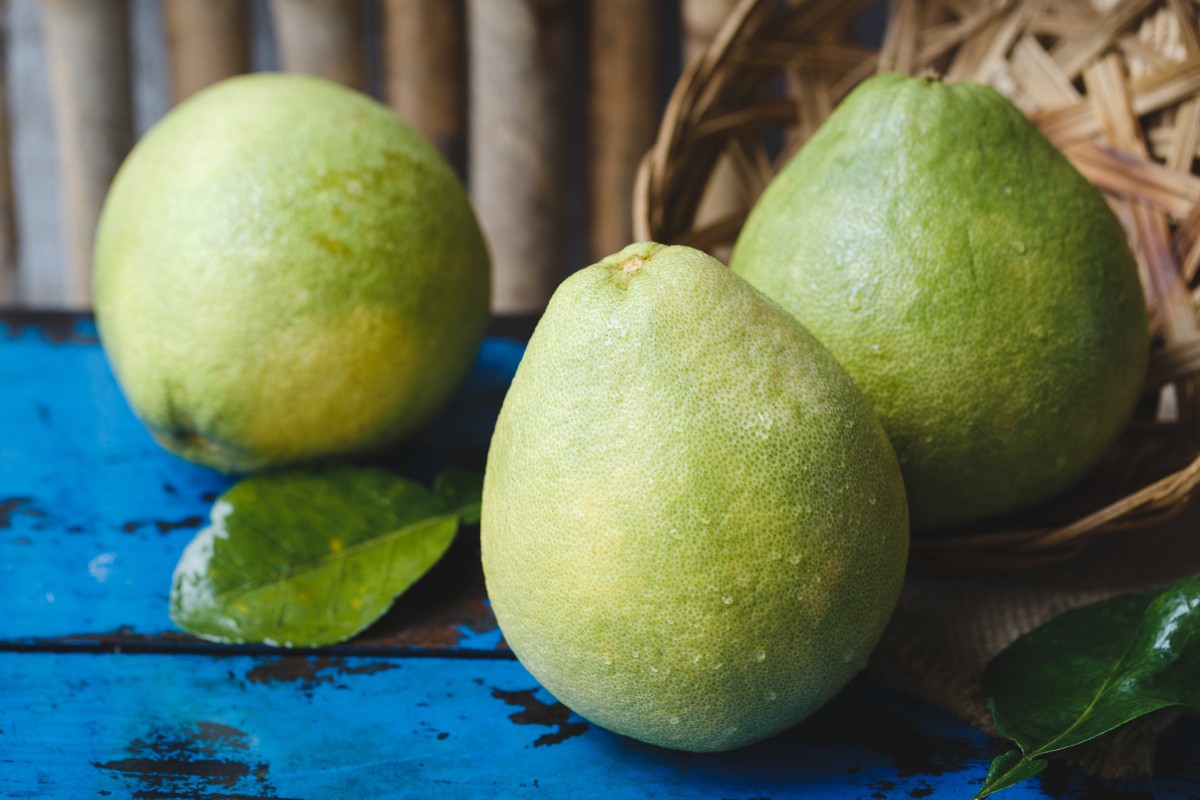
A woman in China was subjected to nuisance and calls texts after leaving a negative review about some fruit which she bought online. Photo: Shutterstock
A woman in southwest China was inundated with nuisance calls and texts after leaving a bad review with an online fruit seller.
Chinese e-commerce platform JD.com has launched a joint investigation with the police to determine whether the woman’s personal details were leaked online, according to online news portal The Paper on Thursday.
The woman, surnamed Pang, from Kunming in Yunnan province, said she started receiving the harassing phone calls and texts soon after writing a negative review for two boxes of pomelos – an Asian citrus – she ordered from a JD.com vendor last week.
Pang wrote the negative review when the number of pomelos delivered to her on Monday was fewer than the description in the online listing. After checking with her that the fruit was not damaged, the seller wrote: “Then you can’t leave a negative comment.
Why are you not responding? What the?”
Twelve minutes after she reported this interaction to JD.com customer services, the nuisance calls began. Pang told The Paper she suspected her personal information had been leaked.
JD.com said on Tuesday that the customer had been fully refunded for the price of the item, and that the mismatch between the description and the delivery was due to an omission by the seller. The e-commerce platform said it would deal with the merchant in accordance with its guidelines.
Pang said the vendor had contacted her on Wednesday to apologise for the poor customer service but had denied any involvement with the nuisance calls and texts. The seller also denied sharing her personal information with third parties.
Pang said she would seek legal advice to protect her consumer rights.
Parents in Jiangsu province were shocked by a form that said a kindergarten class had been investigated and ‘no pupils were found to be involved in organised crime’
Officials fired or disciplined for ‘causing serious negative publicity’
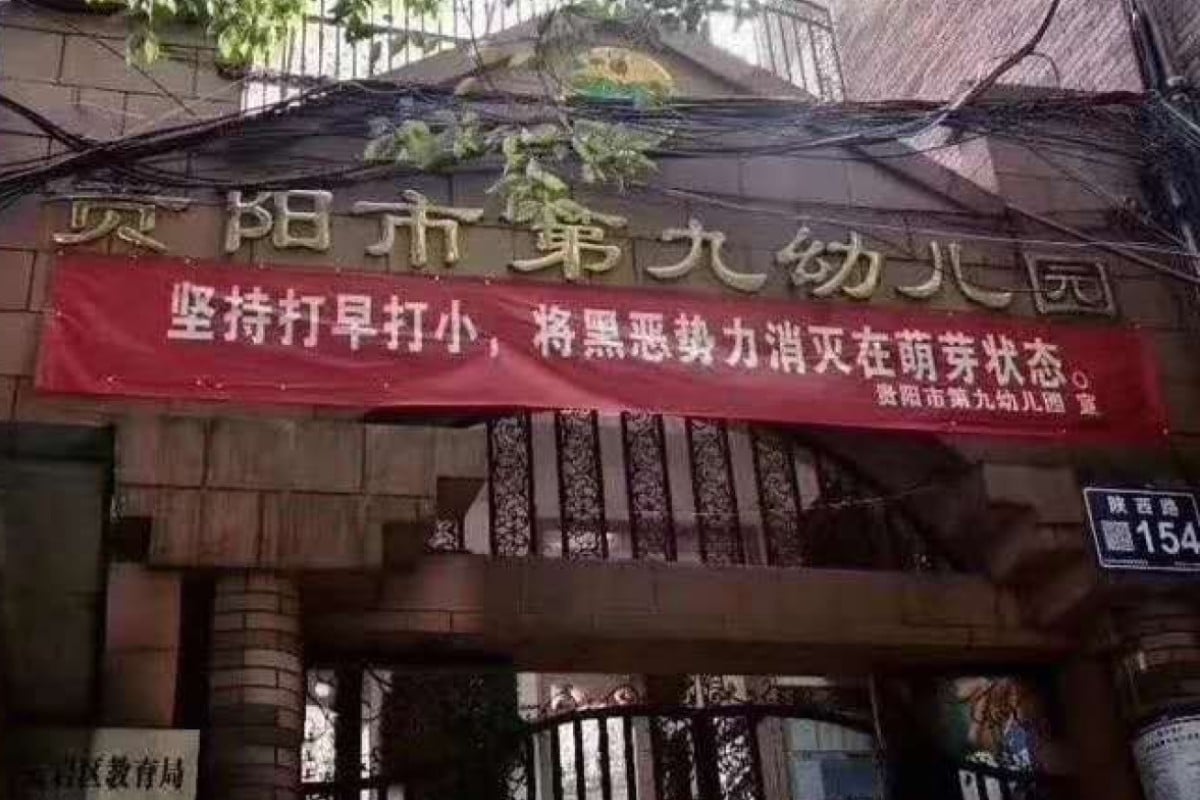
A kindergarten in Guiyang put up a banner on its entrance that read: “Crack down early and crack down young. Eliminate the dark and evil forces when they are still budding”. It was later removed. Photo: Weibo
Education officials in eastern China have been sacked or disciplined after targeting kindergarten pupils in a crackdown on organised crime.
Residents in Wuxi, a city in Jiangsu province, were shocked when a note saying that 35 pupils aged four and five at Xinguang Kindergarten had been investigated as part of the wider crackdown on mafia-style gangs was leaked online.
The form, signed by two teachers, concluded: “No pupils were found to be involved in organised crime”.
Copies of the document started circulating on social media, triggering a widespread backlash and ridicule.
Some social media users accused the kindergarten of box-ticking and questioned whether staff would have been capable of discovering whether any parents were involved in organised crime.
China’s war on organised crime, corrupt officials sees 79,000 people detained
One said that if officials really wanted to nip criminal tendencies in the bud, they were starting too late, adding: “Why not start when they are in the womb and crack down in the maternity hospital?”
But on Thursday the Wuxi government backed down and criticised education officials in Xishan district for misinterpreting the crackdown on organised crime and “putting on an unrealistic show”.
Three senior officials from the Xishan district authority were disciplined for their roles in “causing serious negative publicity”.
China’s fentanyl firms back crackdown on opioid
Feng Dongyan, the chief and party secretary of Xishan district education bureau, was given a party warning.
Wang Zhaoyu, director of the bureau’s general office, and Lu Zhongxian, the director in charge of education inspection of the bureau, lost their jobs and were given a serious party disciplinary warning.
Beijing started the campaign targeting grass-roots criminal organisations and their “protective umbrellas” last year.
More than 3,000 people have been punished so far, but the campaign has also been ridiculed for taking aim at the wrong targets.
Last month a kindergarten in Guiyang in Guizhou province put up a banner at its entrance reading: “Crack down early and crack down young. Eliminate the dark and evil forces when they are still budding”.
The kindergarten said the banner was “meant for the public” but took it down after an online backlash.
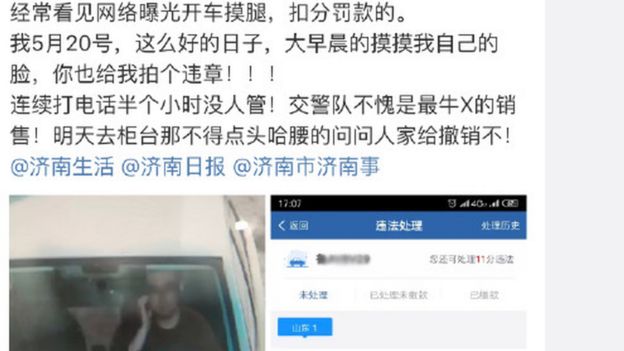
The next thing he knew, he’d received a notification instructing him that he had violated the laws of the road for “driving while holding a phone”. A surveillance picture of his “offence” was attached.
He was told that he would receive two points on his licence and was also ordered to pay a 50 yuan (£5.70; $7.25) fine.
“I often see people online exposed for driving and touching [others’] legs,” he said on the popular Sina Weibo microblog,” “but this morning, for touching my face, I was also snapped ‘breaking the rules’!”
He shared the surveillance picture of himself that he had been sent, and said that he was going to go the authorities to try to sort the situation, after “no one would help him” over the phone.
Image copyright SINA WEIBOImage caption Mr Liu shared his surveillance photograph on social media
The Global Times newspaper says that the city’s traffic authority have now cancelled his ticket, and told him that “the traffic surveillance system automatically identifies a driver’s motion and then takes a photo”, which is why his face-scratching had been mistaken for him taking a phone call.
While many online are amused by his case joking that the positioning of his hand signalled he certainly appeared to be on an “invisible” phone, some are also voicing their concerns about the level of surveillance placed on them.
“This is quite embarrassing,” says one, “that monitored people have no privacy.”
“Chinese people’s privacy – is that not an important issue?” another asks.
Many are fitted with artificial intelligence including facial recognition technology, and whereas some can read simple faces, others can estimate age, ethnicity and gender.
Image copyright GETTY IMAGESImage caption Critics say many participants in this year’s beauty pageant look similar
It is the contest that kick-started Bollywood superstar Priyanka Chopra’s career, so it is unsurprising that this year’s Miss India finalists have such wide smiles in their publicity shots.
After all, this is a competition with the power to change lives.
But instead of being able to enjoy their success, they have found themselves at the centre of a storm over a photo collage which, critics say, suggests the organisers are obsessed with fair skin.
The collage published in the Times of India newspaper – which belongs to the group that organises the annual beauty pageant – depicts 30 headshots of beautiful women.
But when a Twitter user shared it and posed a question: “What is wrong with this picture?” it began to gain traction.
With their tame, glossy, shoulder-length hair and a skin tone that is virtually identical, some quipped that they all looked the same. Others wondered out loud – albeit as a joke – if in fact they were all the same person.
As the picture gained traction on Twitter, critics made the point that while there was nothing wrong with the image of the women themselves, the lack of diversity in skin colour has once again highlighted India’s obsession with being fair and lovely.
As social media chatter grew, we tried to get in touch with the organisers but there has been no response so far.
Beauty pageants have been serious business in India since the mid-1990s. The country has produced several famous Miss Indias, like Aishwarya Rai, Sushmita Sen and Ms Chopra, who also won global titles. Many pageant winners have also gone on to have lucrative Bollywood careers.
Over the years, institutions that train young women aspiring to participate in beauty pageants have mushroomed across the country.
But again, many of their biggest successes have been women who are light-skinned.
Image copyright GETTY IMAGESImage caption Aishwarya Rai soon after she was crowned Miss World 1994
This is hardly surprising.
India’s obsession with fairness, especially when it comes to women, is well known and many regard fair skin as being superior to darker tones.
It has always been accepted for instance, that fairer is better in the marriage market.
And ever since the 1970s, when Fair and Lovely – India’s first fairness cream – was introduced, skin whitening cosmetics have been among the highest selling in the country and, over the years, top Bollywood actors and actresses have appeared in advertisements to endorse them.
Commercials for such creams and gels promised not just fair skin but also peddled them as means to get a glamorous job, find love, or get married.
And pageants like this, which favour a particular type of skin tone, only serve to perpetuate that stereotype.
In 2005, some bright spark decided that it was not just women who needed fairer skin, so along came India’s first fairness cream for men – Fair and Handsome.
Endorsed by Bollywood superstar Shah Rukh Khan no less, it soon became a huge success.
But this has not stopped the flood of new creams and gels that claim to lighten everything from armpit hair to – hold your breath – female genitalia.
Their popularity in India can be gauged from the fact that fairness creams and bleaches sell for hundreds of millions of dollars every year and, according to one estimate, the market for women’s fairness products is expected to be 50bn rupees ($716m; £566m) by 2023.
The defenders of skin whitening products say it’s a matter of personal choice, that if women can use lipstick to make their lips redder, then what’s the big deal about using creams or gels to appear fairer?
It may sound logical, but campaigners point out that this obsession with fair skin is grossly unfair – the “superiority” of light skin is subtly, but constantly, reinforced and that perpetuates societal prejudice and hurts people with darker complexions who grow up with low self-confidence. It also impacts their personal and professional success, they say.
We’ve heard models with darker skin colours say how they were overlooked for assignments and I can remember only a few darker-skinned Bollywood actresses in leading roles.
Image copyrightGETTY IMAGESImage captionBeauty pageants have been accused of favouring a particular skin tone
In 2014, the Advertising Standards Council of India (ASCI), a self-regulatory body of advertisers, issued a set of guidelines barring commercials from depicting people with darker skin colour as “unattractive, unhappy, depressed or concerned” and said that they should not be shown as being at a disadvantage when it came to “prospects of matrimony, jobs or promotions”.
The ads, however, continue to be made, even though they are a bit more discreet now compared to the earlier in-your-face sort of campaigns. Popular film actors and actresses also continue to endorse them.
But as I write this piece, a heart-warming piece of news is just being reported: South Indian actress Sai Pallavi has confirmed that she rejected a 20m rupee deal to appear in a fairness cream advertisement earlier this year.
“What am I going to do with the money I get from such an ad? I don’t have… big needs.
“I can say that the standards we have are wrong. This is the Indian colour. We can’t go to foreigners and ask them why they’re white.
“That’s their skin colour and this is ours,” she was quoted as saying.
Pallavi’s comments are being hailed as a breath of fresh air by commentators, especially as they are seen in context to the Miss India collage where all contestants look the same – whitewashed.
Donald Trump has welcomed Tokyo’s order for the stealth fighter, but it is likely to trigger a response from Beijing
Deal to buy 105 of the advanced fighters will greatly expand Japan’s capabilities in the South China Sea
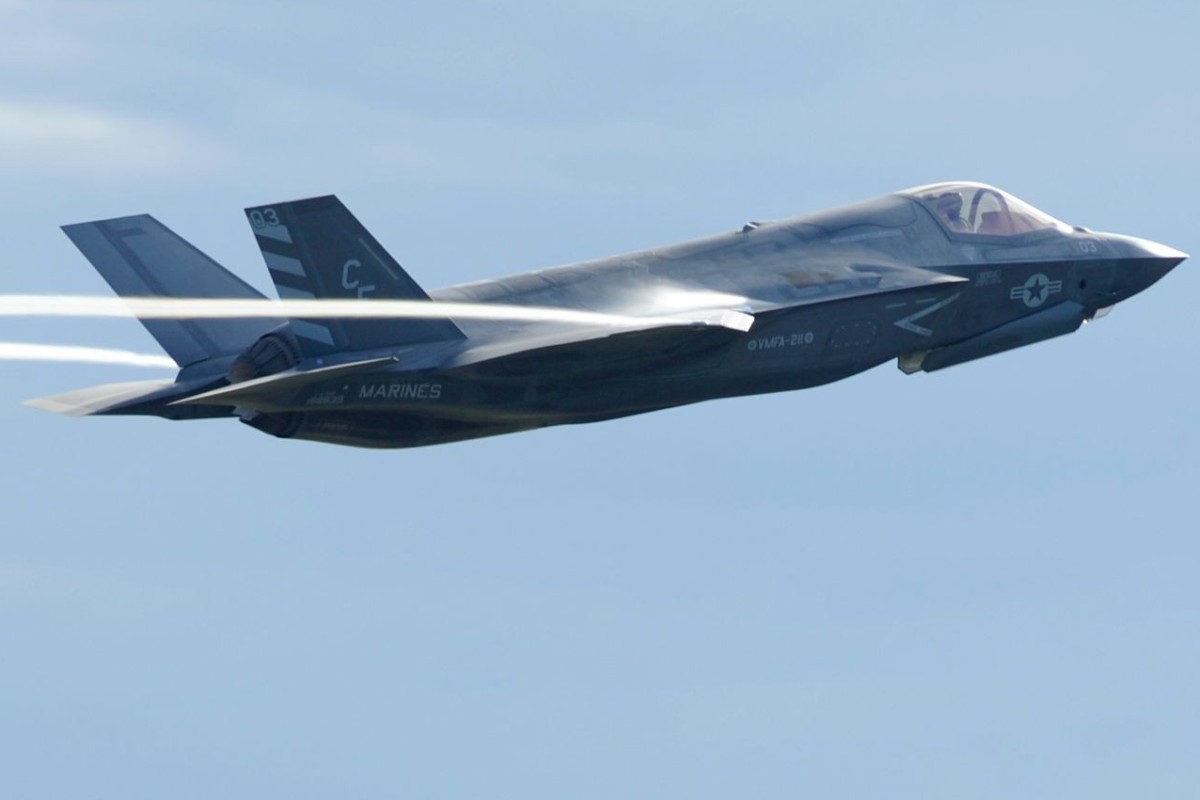
Japan’s F-35 fleet will be the largest of any US ally. Photo: AFP
Japan’s decision to buy 105 F-35 Lightning jet fighters from the United States may further fuel the arms race in Asia, analysts have warned.
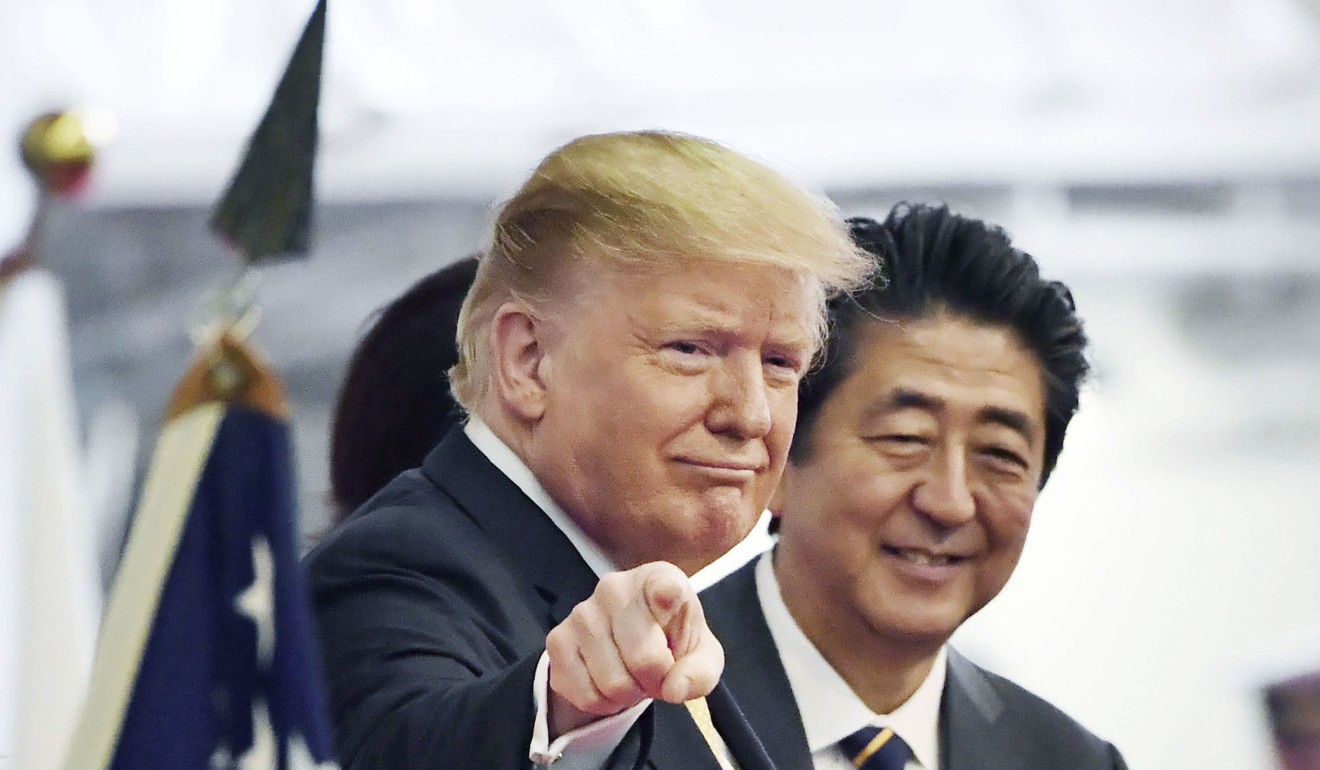
The deal, first announced in December, was confirmed on Monday during US President Donald Trump’s four-day state visit to Japan.
Japan “has just announced its intent to purchase 105 brand new F-35 stealth aircraft. Stealth, because, the fact is you can’t see them”, Trump said at Japan’s Akasaka Palace. “This purchase would give Japan the largest F-35 fleet of any US ally.”
The F-35 deal is likely to help Japan reassert its role as a leading security player, but also present a new challenge to China’s People’s Liberation Army, which has extended its clout in the Indo-Pacific region in recent years.
So far about a dozen US allies have placed orders for the F-35.
The Australian government has budgeted US$17 billion for 72 of the jets and South Korea has ordered 40 F-35As. Lockheed Martin, which makes the F-35, also hopes Seoul will buy another 20 of the fighters.
Washington and Tokyo have long been wary of Beijing’s military expansion, with Japan announcing a new foreign policy strategy of a “Free and Open Indo-Pacific” three years ago to further promote the “rule of law, freedom of navigation and free trade”.
Washington’s concerns are reflected in this year’s version of an annual congressional report that warned: “Over the coming decades, [Chinese leaders] are focused on realising a powerful and prosperous China that is equipped with a ‘world-class’ military, securing China’s status as a great power with the aim of emerging as the pre-eminent power in the Indo-Pacific region.”
In Japan, a parade of pomp for Trump, but Rodrigo Duterte and other world leaders will have to wait
Military observers said that the F-35 deal, together with Tokyo’s plans to modernise its fleet of Izumo-class helicopter carriers to accommodate jets, pose a threat to Beijing’s game plan in the South China Sea by increasing the operational reach of its air force.
Japan does not face the South China Sea but views it as strategically important due to its role as a vital shipping lane.
Zhou Chenming, a Beijing-based military expert, said: “The [F-35 deal] can help Japan counterbalance threats from China … and it can be seen as a vital part of the worldwide coercion strategy of the US.
“This is bound to upset the balance of power in the Asia-Pacific region, given the large quantity of warplanes ordered by Japan.”
Analysts also pointed out that although China’s fifth-generation J-20 fighter has given the PLA a lead in the stealth fighter race, the Chinese aircraft was known to have suffered from engine problems even after its deployment in 2017.
The latest F-35 deal will also put further pressure on China to accelerate and improve its J-20 development programme.
Zhang Baohui, director of the Centre for Asia-Pacific Studies at Lingnan University in Hong Kong, said: “If Japan buys the F-35B, which is carrier-based, then it will upset the South China Sea dynamic. Japan does have plans to deploy F-35B to its aircraft carriers.”
US President Donald Trump and Japanese prime Minister Shinzo Abe on a Japanese helicopter carrier on Tuesday. Photo: Kyodo
Ryo Hinata-Yamaguchi, a visiting professor at Pusan National University in South Korea, said: “As Japan moves to configure the Izumo class with the ability to launch short take-off and vertical landing features, the F-35B is essentially the only choice.”
The F-35 deal is about “enhancing Japan’s ability to achieve air and naval superiority, which is vital to the defence of the Japanese archipelago”, he added, noting that the further strengthening of military ties between Washington and Tokyo would improve their joint operational capabilities.
President Donald Trump boasts ‘fearsome’ US military in the Pacific during final Japan speech aimed at rivals China, North Korea
Song Zhongping, a Hong Kong-based military analyst and formerly an instructor with the PLA Artillery Corps, said: “The purchase will definitely trigger a regional arms race, prompting China to do the same by developing and deploying more of its own advanced stealth fighter jets in the region to counter the military presence of the US and its allies.
“Japan needs to update its old air force fleet, with its 200 F-15 fighters approaching the end of their service life,” he explained.
“It also wants to catch up with the pace of generational advancement of fighter jets in many countries – entering a new age of stealth fighters.”
Japan is planning to adapt its helicopter carriers to carry fighter jets. Photo: Kyodo
Collin Koh, a maritime security expert at Nanyang Technological University in Singapore, said the F-35s would give Japan a significant boost in the stealth fighter race.
“Japan would retain its position as one of the best-equipped air forces in the region and worldwide,” he said.
Koh suggested that while China was a key concern for Tokyo, North Korea was also a consideration.
“This move could be seen as a response to what Japan has in recent times mentioned to be an increasingly severe security environment it faces: not just China and its rapid military build-up including, of course, the induction of new-generation fighters such as J-20, but also the threat posed by North Korea,” Koh said.
President Xi Jinping will meet Russian counterpart Vladimir Putin next month and address economic summit in St Petersburg
Diplomatic flurry will also include regional security forums in Kyrgyzstan and Tajikistan
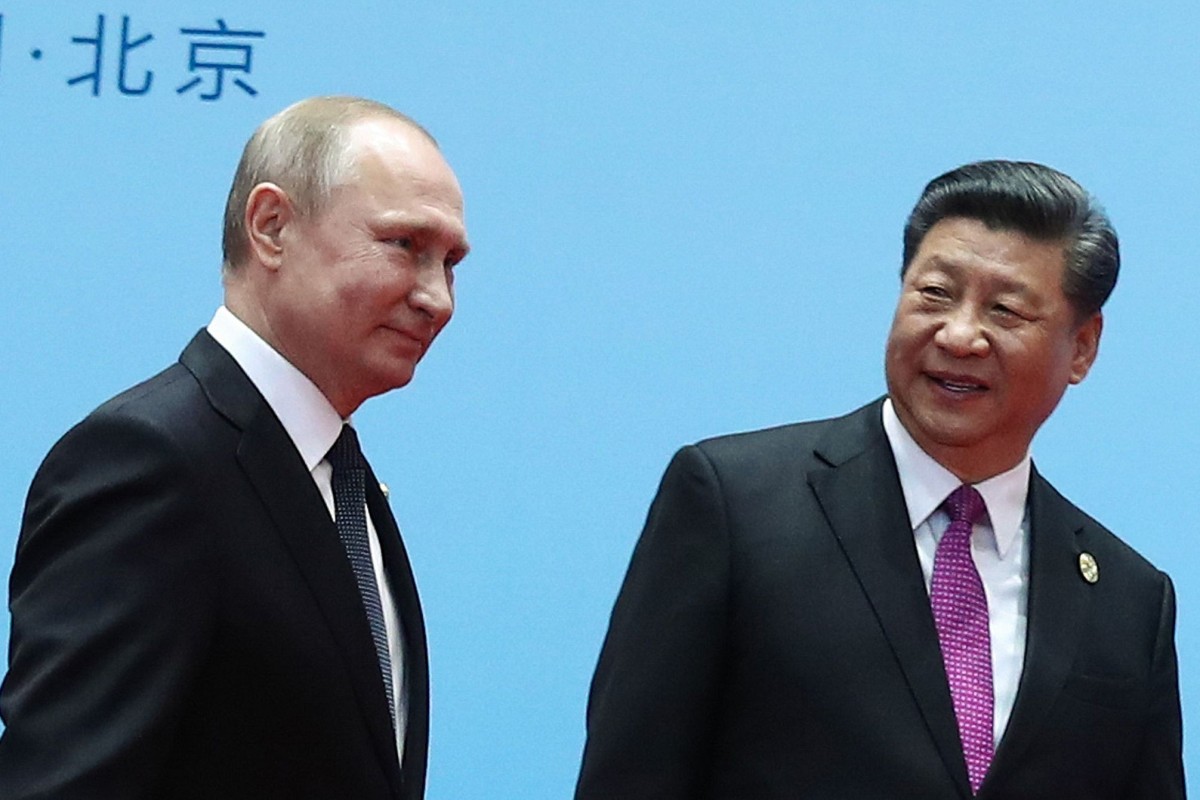
Xi Jinping has met Vladimir Putin more times than any other foreign leader since he took power in 2013. Photo: AFP
Beijing is stepping up efforts to seek support from regional and global players such as Russia and Central Asian nations as its geostrategic rivalry with Washington heats up.
President Xi Jinping is expected to meet his Russian counterpart Vladimir Putin next month, when he will also address the St Petersburg International Economic Summit,
The Chinese president will also visit the Kyrgyzstan capital Bishkek for the Shanghai Cooperation Organisation (SCO) summit in June, as well as another regional security forum in Dushanbe, Tajikistan.
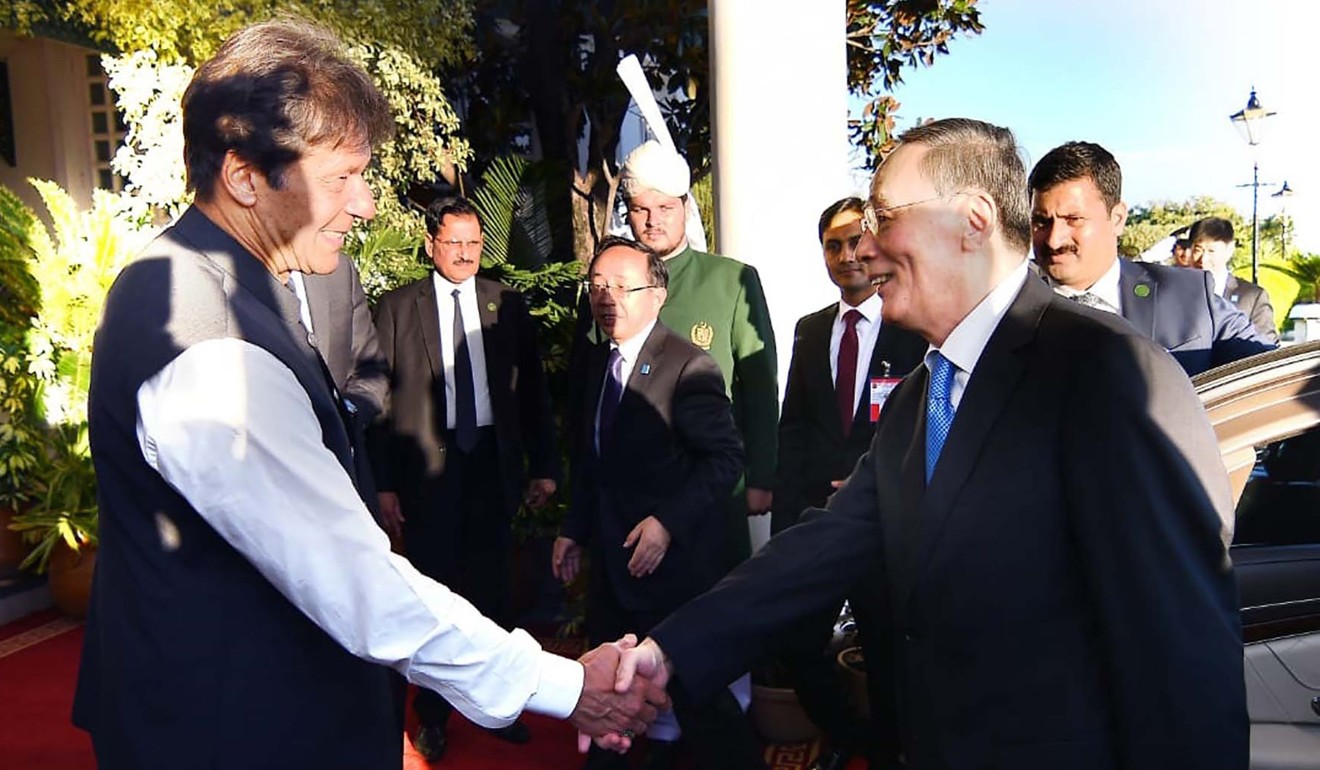
Meanwhile, Vice-PresidentWang Qishan is visiting Pakistan before he heads to the Netherlands and Germany, according to the Chinese foreign ministry.
Pakistani Prime Minister Imran Khan meets Chinese Vice-President Wang Qishan in Islamabad on Sunday. Photo: AFP
The latest flurry of diplomatic activity comes as competition between China and the US intensifies on several fronts including trade and technology, the South China Sea and the Arctic, where Beijing’s partnership with Moscow –
It will be Xi’s second time at the St Petersburg forum, and observers expect the Chinese leader will reaffirm Beijing’s commitment to multilateralism and promote the nation as a champion of openness and cooperation.
China-Russia ties unrivalled, Beijing warns before Pompeo meets Putin
It will also be his second meeting with Putin in two months, after talks on the sidelines of the Belt and Road Forum in Beijing in late April, when the Russian president
for the controversial China-led infrastructure and investment initiative.
With China and Russia edging closer, the latest meeting is likely to see efforts to coordinate their strategies on a range of issues – including Venezuela, North Korea, nuclear weapons and arms control, according to observers. Xi has met Putin more times than any other foreign leader since he took power in 2013.
“This time it is very likely that the latest anti-China moves by the US, such as new tariffs and the Huawei ban, will feature prominently in their conversations,” said Artyom Lukin, an associate professor at Far Eastern Federal University in Vladivostok.
Lukin said Russia’s stagnating economy and sanctions imposed by the West limited its role as a substitute for the foreign markets and technologies China could lose access to because of the US crusade. But he said Putin would “provide political and moral support to Xi”.
“That is also significant as Russia has been withstanding intense US-led sanctions pressure for more than five years already,” Lukin said, referring to sanctions imposed after Russia’s annexation of Crimea in 2014.
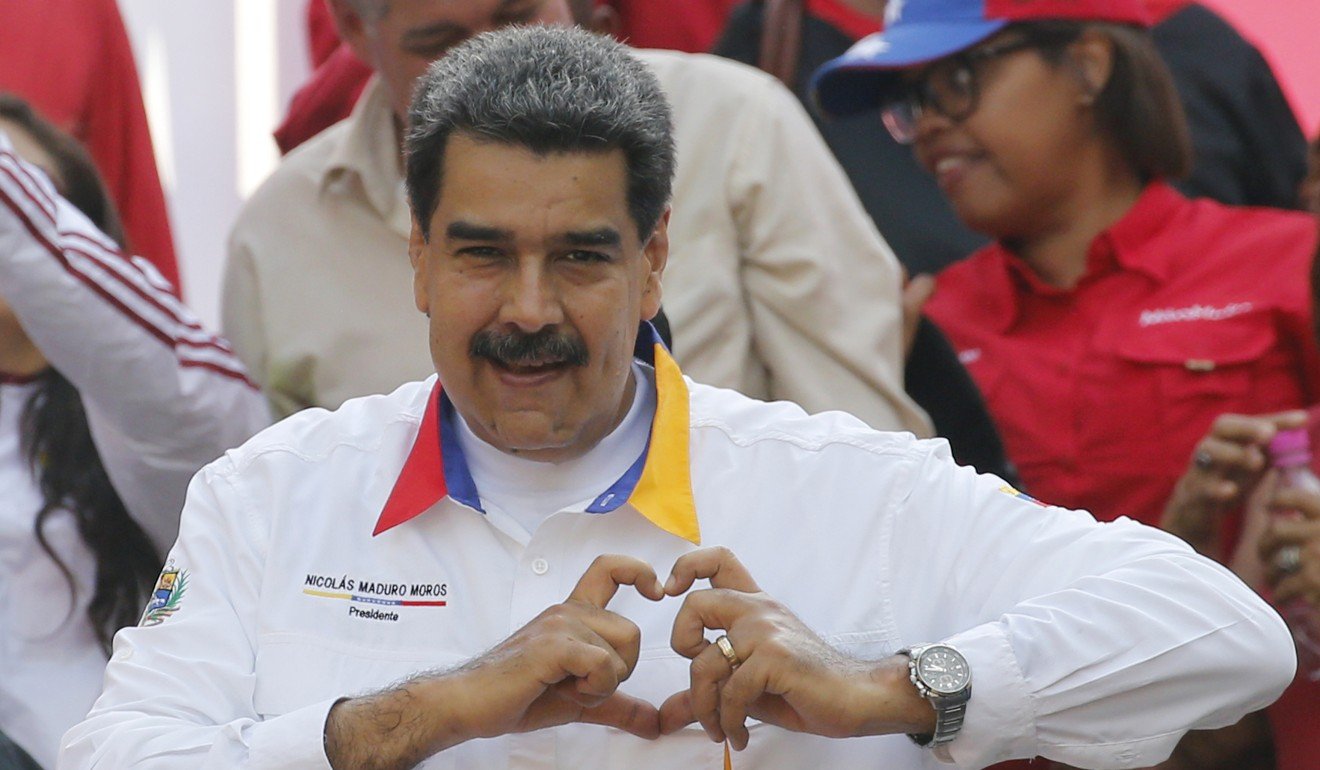
Xi and Putin are also expected to talk about Venezuela, where US-backed opposition leader Juan Guaido is attempting to oust socialist President Nicolas Maduro, who has the support of China and Russia.
Venezuelan President Nicolas Maduro has the backing of China and Russia. Photo: AP
“Moscow and Beijing are not able to seriously hurt Washington by raising tariffs or denying access to high technology. However, there are plenty of areas where coordinated Sino-Russian policies can damage US interests in the short term or in the long run,” Lukin said. “For example, Moscow and Beijing could intensify their joint support for the Venezuelan government of Nicolas Maduro, frustrating Washington’s efforts to dislodge him.”
China and Russia would also be seeking to boost economic ties. Bilateral trade, dominated by Chinese imports of gas and oil, reached US$108 billion last year – falling far short of the target set in 2011 by Xi’s predecessor, Hu Jintao, of US$200 billion by 2020.
China and Russia to forge stronger Eurasian economic ties
Li Lifan, an associate research professor at the Shanghai Academy of Social Sciences, said bilateral trade was a sticking point. “This is one of the potential hindrances in China-Russia relations and Beijing is hoping to [address this] … in the face of a possible global economic slowdown,” Li said.
Given the escalating trade war with Washington, he said China would seek to diversify its investments and markets to other parts of the world, particularly Russia and Europe.
“China will step up its investment cooperation with Europe and Russia and focus more on multilateral investment,” Li said.
But Beijing was not expected to do anything to worsen tensions with Washington.
“China is currently taking a very cautious approach towards the US, trying to avoid heating up the confrontation and further aggravation of the situation,” said Danil Bochkov, a contributing author with the Russian International Affairs Council. “For China it is important to demonstrate that it has a reliable friend – Russia – but that should not be done in an openly provocative manner.”
Stephen Blank, a senior fellow at the American Foreign Policy Council in Washington, said Beijing and Moscow would also seek to contain US influence “as far as possible” from Central Asia, where China has increased its engagement through infrastructure building under the “Belt and Road Initiative”.
Leaders from the region will gather in Bishkek next month for the SCO summit, a security bloc set up in 2001 that now comprises China, Russia, Kazakhstan, Kyrgyzstan, Tajikistan, Uzbekistan, India and Pakistan. Those members account for about 23 per cent of the world’s land mass, 45 per cent of its population, and 25 per cent of global GDP.
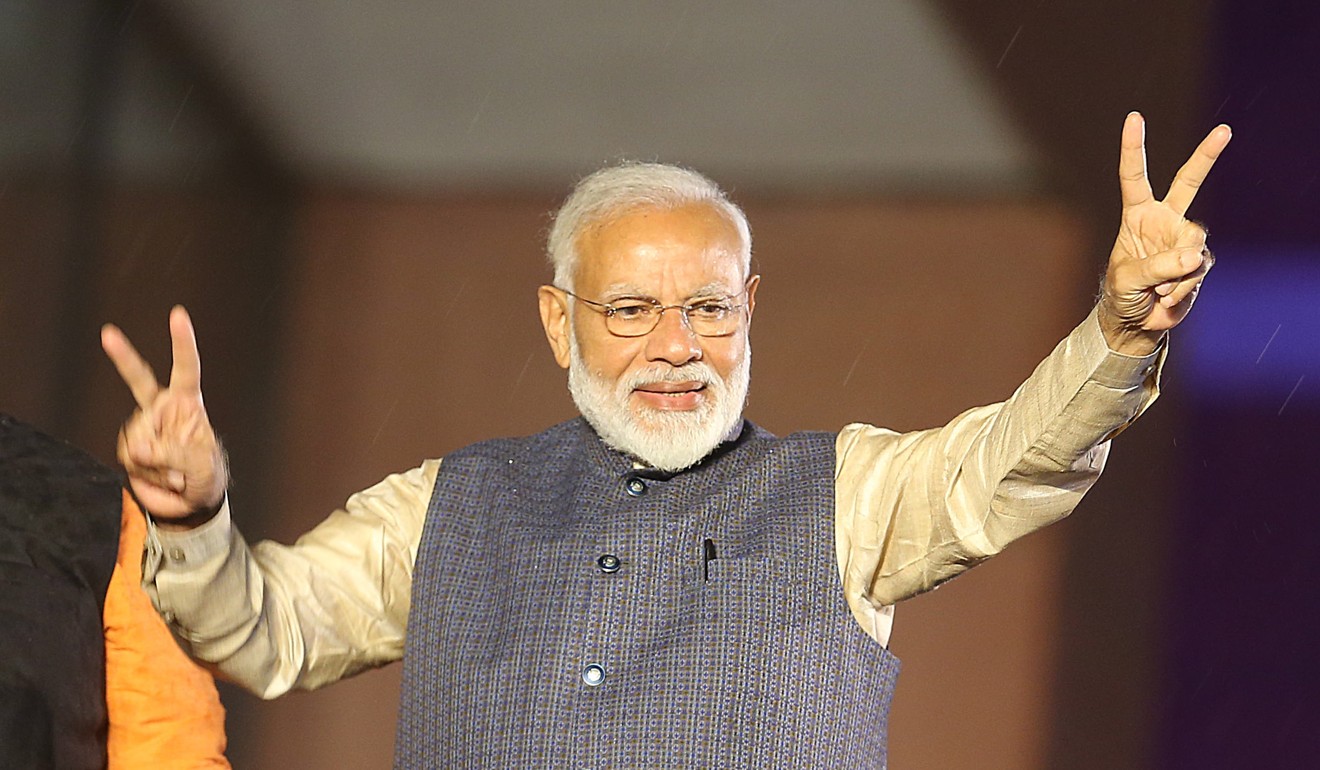
Newly re-elected Indian Prime Minister Narendra Modi could meet the Chinese president for talks in Bishkek next month. Photo: EPA-EFE
There is growing speculation that Xi will meet newly re-elected Indian Prime Minister Narendra Modi on the sidelines of that summit.
Independent analyst and author Namrata Goswami said India would be seeking a commitment to a WTO-led and rules-based multilateral trading system during the SCO talks.
“This is interesting and significant given the current US tendencies under President Donald Trump focused on ‘America first’ and the US-China trade war,” Goswami said.
Counterterrorism will again be a top priority at the SCO summit, amid concerns among member states about the rising number of Islamic State fighters returning from Syria and Iraq. Chinese scholars estimated last year that around 30,000 jihadists who had fought in Syria had gone back to their home countries, including China.
Alexander Bortnikov, chief of the main Russian intelligence agency FSB, said earlier that 5,000 fighters from a group affiliated with Isis had gathered in areas bordering former Soviet states in Central Asia, saying most of them had fought alongside Isis in Syria.
War-torn Afghanistan, which shares a border with four SCO member states – China, Pakistan, Tajikistan and Uzbekistan – is also likely to be high on the agenda at the Bishkek summit.
“With the Trump administration drafting plans to withdraw troops from Afghanistan, the SCO will assess the security situation there and decide whether to provide training for Afghan troops,” Li said.
Eva Seiwert, a doctoral candidate at the Free University of Berlin, expected the security bloc would also discuss Iran after the US withdrew from the 2015 nuclear deal and ordered new sanctions against the country.
Iran, which has observer status with the SCO, was blocked from becoming a full member in 2008 because it was subject to UN sanctions at the time. But its membership application could again be up for discussion.
Iran presses China and Russia to save nuclear deal
“The Trump administration’s unilateral withdrawal from the Iran nuclear deal in 2018 made it easy for China and Russia to present themselves as the proponents of peaceful settlement of conflicts,” Seiwert said. “Discussing the possibility of admitting Iran as a full member state would help the SCO members demonstrate their support of multilateral and peaceful cooperation.
“This would be a strong signal to the US and enhance the SCO’s standing in the international community,” she said.
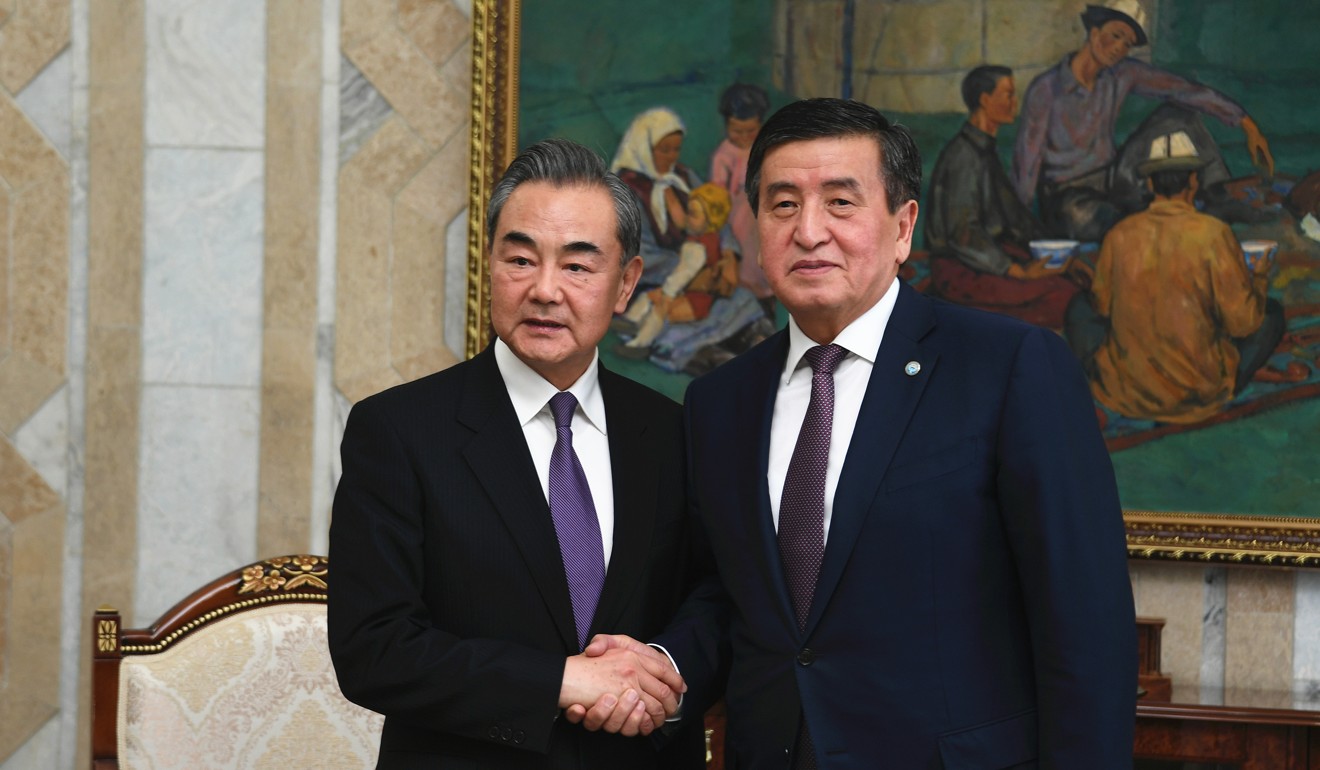
Kyrgyz President Sooronbay Jeenbekov (right) meets Chinese Foreign Minister Wang Yi in Bishkek on Tuesday last week. Photo: Xinhua
As well as security, Xi’s visit to Central Asia is also likely to focus on economic ties. Meeting Kyrgyz President Sooronbay Jeenbekov in Bishkek last week, Chinese Foreign Minister Wang Yi said Beijing would continue to “provide support and help national development and construction in Kyrgyzstan”.
Li said China may increase investment in the Central Asian region, especially in greenfield projects.
“China will continue to buy agriculture products from Central Asia, such as cherries from Uzbekistan, and build hydropower projects to meet local energy demand,” Li said. “Investment in solar and wind energy projects is also expected to increase too.”
Academic on-board the HMAS Canberra says pilots were struck by lasers on a voyage from Vietnam to Singapore, during which they were being tailed by a Chinese warship
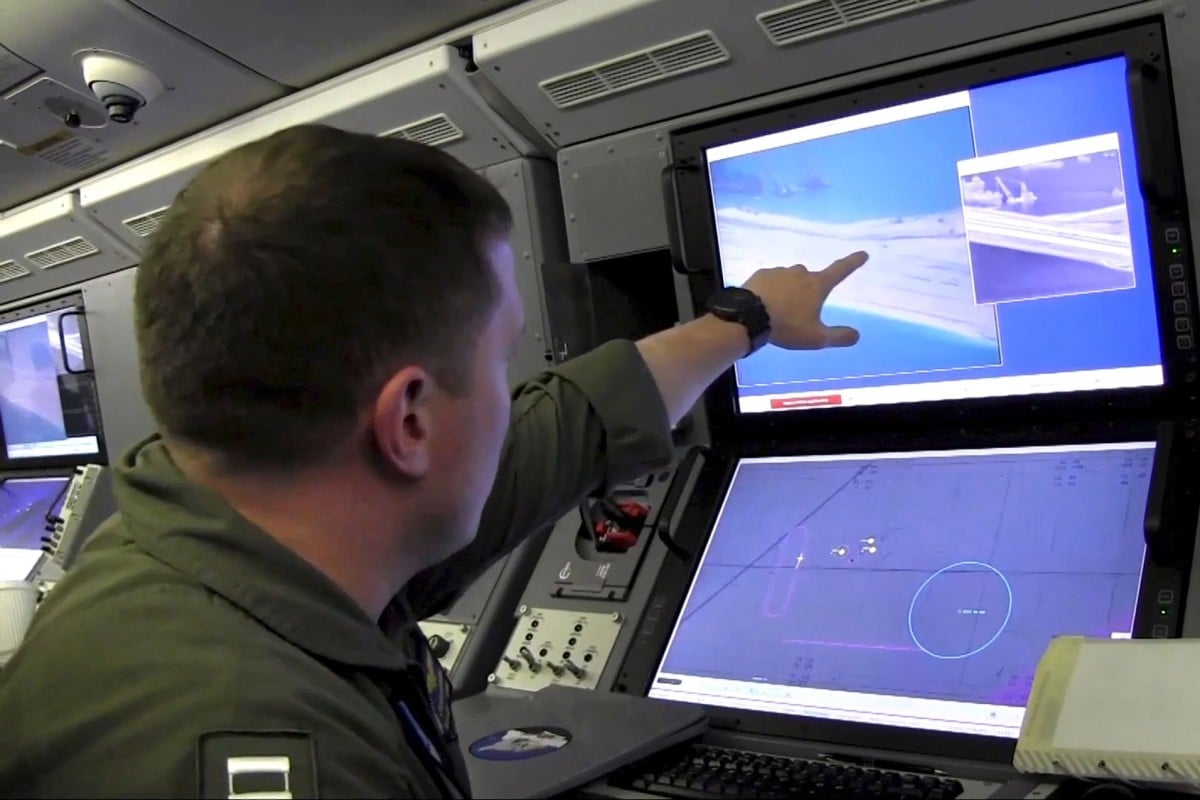
US Navy personnel point at a computer screen showing Chinese activity on the Fiery Cross Reef in the Spratly Islands in the South China Sea. An Australian scholar said
Chinese ships pointed lasers at them during a flight over the disputed sea. Photo: Reuters
Australian navy helicopter pilots were hit by lasers and forced to land during exercises in
flagship HMAS Canberra during a voyage from Vietnam to Singapore, said the lasers had been pointed from passing fishing vessels while the Canberra was being
“Was this startled fishermen reacting to the unexpected? Or was it the sort of coordinated harassment more suggestive of China’s maritime militia? It’s hard to say for sure, but similar incidents have occurred in the western Pacific,” he wrote on the website The Strategist run by the Australian Strategic Policy Institute, an independent, non-partisan think tank based in Canberra.
His account of the incident appeared on Tuesday.
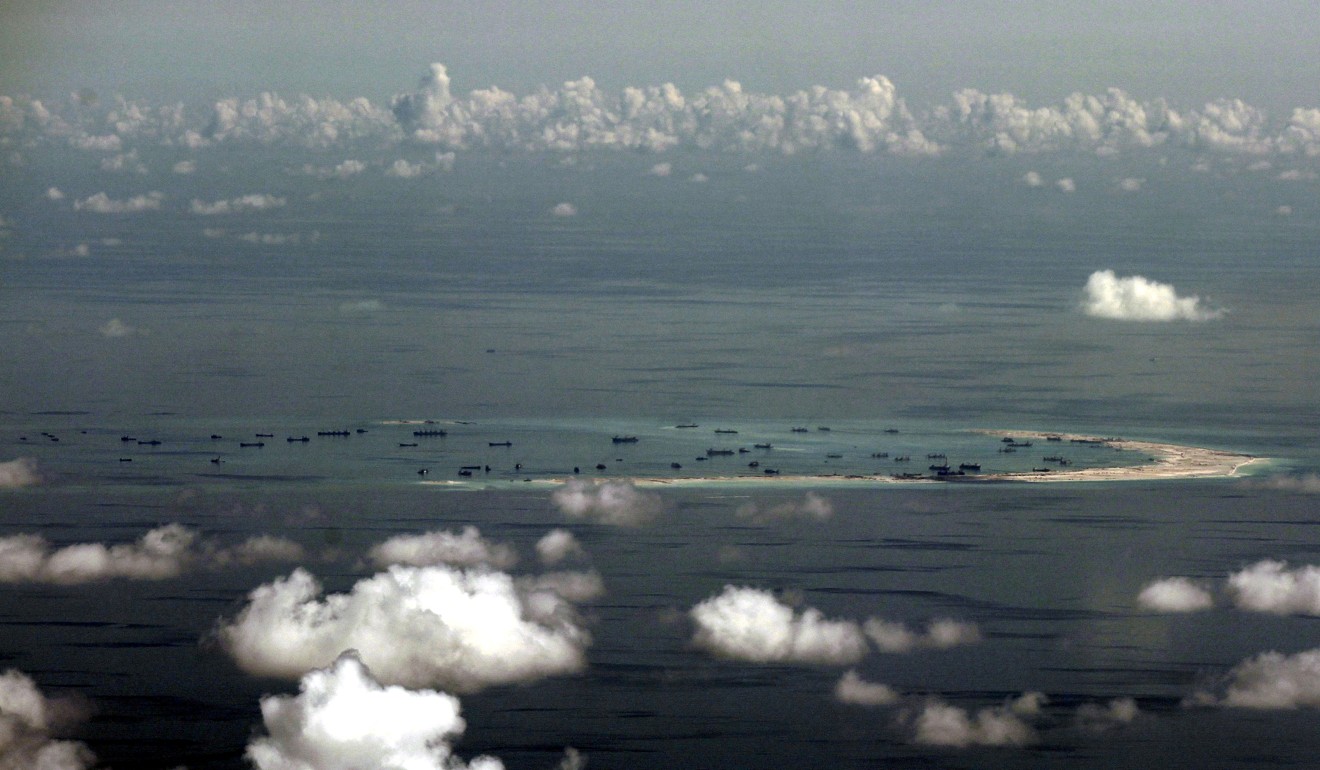
The Mischief Reef in the Spratly Islands in the South China Sea, where China is said to be increasing its military presence. Photo: Reuters
China maintains a robust maritime militia in the South China Sea, composed of fishing vessels equipped to carry out missions just short of combat. China claims the strategic waterway virtually in its entirety and is sensitive to all foreign naval action in the area, especially by
Similar incidents involving lasers and the Chinese military have been reported as far away as Djibouti, where the US and China have bases. Last year, the US complained to China after lasers were directed at aircraft in the Horn of Africa nation, causing minor injuries to two American pilots.
China denied that its forces targeted the US military aircraft.
Graham said that while bridge-to-bridge communications with the Chinese during the voyage were courteous, the Chinese requested the Australian warships notify them in advance of any corrections to their course.
That was something the Australian navy was “not about to concede while exercising its high-seas freedoms”, Graham wrote.
In South China Sea, Asean has a choice: ‘Asian values’ or rule of law?
He wrote that the constant presence of Chinese vessels shadowing foreign ships appeared to indicate that the Chinese fleet had grown large enough to allow it to have vessels lying in wait for just such orders.
He said their trailing actions also appeared to show that China’s over-the-horizon surveillance capability was also maturing, supported by technology based at points such as Fiery Cross Reef in the contested Spratly island group where China has built military installations and an airstrip atop coral reefs.
Five other governments have claims in the South China Sea that overlap with China’s, and the US and its allies insist on the right to sail and fly anywhere in the area is permitted under international law, despite China’s differing interpretation of such guidelines.
Graham, who is executive director of La Trobe Asia at La Trobe University in Australia, was one of several academics invited to observe Australia’s engagement exercise Indo-Pacific Endeavour 2019.
China’s housing market showing signs of bubble similar to that seen in Japan in 1980s, says Asian Development Bank Institute dean and CEO Naoyuki Yoshino
China’s loose policy following 2008 global financial crisis laid foundations for current housing bubble, with US-China trade war adding to concerns
The average price of a home in Beijing has soared from around 380 yuan (US$55) per square feet in the early 2000s to the current level of well above 5,610 yuan (US$813) per square foot, according to property data provider creprice.cn. Photo: Bloomberg
China must exercise extreme caution in handling its housing sector because it is showing signs similar to those witnessed during Japan’s bubble period of the 1980s that contributed to the collapse of Japanese asset prices and its subsequent “lost decades” of weak economic growth and deflation, a Japanese financial system expert warned.
The parallels between China’s current landscape and Japan’s three decades ago are readily apparent, stemming from a loose monetary policy that laid the foundation for the expansion of a housing bubble, said Naoyuki Yoshino, dean and CEO of the Asian Development Bank Institute.
China flooded its economy with credit in response to the 2008 global financial crisis, fuelling rapid growth in mortgages, real estate borrowings and investments over the past decade.
In the same vein, the Japanese government’s relaxed monetary policy in the 1980s triggered an economic bubble that eventually burst and sank the economy into a recession that
with the Bank of Japan continuing to still keep interest rates at or below zero per cent to this day in an attempt to spur inflation.
The Japanese government’s relaxed monetary policy in the 1980s triggered an economic bubble that eventually burst and sank the economy into a recession that lasted almost 25 years. Photo: Bloomberg
Japan’s experience could serve as a lesson on how to avoid a housing market collapse that would be especially detrimental to China’s financial sector and real economy, according to Yoshino.
“I’m very much concerned that if land prices keep on rising and if the population starts to shrink along with aggregate demand, then China will experience a similar situation to that of Japan,” Yoshino said.
There are already several strong signs of a housing bubble in China, according to Yoshino, firstly the astronomical surge in property prices in recent years.
I’m very much concerned that if land prices keep on rising and if the population starts to shrink along with aggregate demand, then China will experience a similar situation to that of Japan Naoyuki Yoshino
Home ownership is one of the few ways for Chinese families to generate wealth because of limited investment opportunities. The average price of a home in Beijing has soared from around 4,000 yuan (US$578) per square metre, or 380 yuan (US$55) per square feet, in the early 2000s to the current level of well above 60,000 yuan (US$8,677) per square metre, or 5,610 yuan (US$813) per square foot, according to property data provider creprice.cn.
The increase has also lifted the housing price to income ratio sharply from 5.6 in 1996 to 7.6 in 2013, well above the Japanese rate of 3.0 at its peak in 1988. The price to income ratio is the basic affordability measure for housing.
According to the Global Times, a reasonable home price should be three to six times the median household income. That means a family with an average income can buy a house with three to six years’ annual income. The house price to income ratio in China is above 50 in the first-tier cities and 30 to 40 in the third- and fourth-tier cities, the newspaper said in October. There are four levels of cities in China, defined by a number of factors including gross domestic product (GDP) and population, with Beijing, Shanghai and Shenzhen considered tier-one cities.
Another worrying sign, according to Yoshino, is that China’s financial sector has lent more heavily to the real estate sector than did Japanese banks during their bubble period.
Thirdly, the ratio of Chinese housing loans to the nation’s GDP has consistently been higher than Japan’s by about three times more.
Ever since US President Donald Trump started imposing tariffs on Chinese imports in July, worries have been mounting that China’s property bubble and its record debt level would make the economy vulnerable to the impact of rising trade tensions, leading to a sharper-than-expected economic slowdown.
Despite a government crackdown on debt and risky lending over the last several years, housing prices and bank lending to the sector have continued to rise, pushing homes beyond what the vast majority of people can afford, as well as putting many property developers deeply into debt.
The Chinese Academy of Social Sciences, a top government think tank, said in a report last week that the growth in housing prices in China’s bigger cities, caused by a relatively short supply of new homes, is likely to push up costs across the country.
“The government should closely monitor these cities to avoid overheating,” said Wang Yeqiang, a researcher at the Chinese Academy of Social Sciences who co-authored the report.
Property developers have begun a debt-fuelled land-buying spree just as urban housing demand is entering a long-running structural decline, said Julian Evans-Pritchard, senior China economist at Capital Economics. The potential supply of property that could be built on developers’ land reserves jumped last year to a record high, meaning the risk of a glut of new housing is real, Evans-Pritchard added, if developers were to convert all their land reserves into housing tracts.
“Since real estate drives around a fifth of GDP, a sharp downturn in this sector would be contagious, resulting in a jump in defaults across a wide swathe of the economy that could quickly erode bank capital buffers,” he warned.
China’s corporate debt stood at 155 per cent of GDP in the second quarter of 2018, much higher than other major economies, according to data from the Organisation for Economic Cooperation and Development. In comparison, Japan’s corporate debt level is 100 per cent of GDP and is 74 per cent in the US. China’s corporate debt includes issuances by its
vehicles which by extension is mostly credit with an implicit guarantee from the central government.
Since real estate drives around a fifth of GDP, a sharp downturn in this sector would be contagious, resulting in a jump in defaults across a wide swathe of the economy that could quickly erode bank capital buffersJulian Evans-Pritchard
China’s imbalance between housing supply and demand may worsen because it faces a similar economic transition that is already well underway in Japan – a
that led to Japan’s long-term deflation problem, said Yoshino, who is also the chief adviser to the Japan Financial Services Agency’s Financial Research Centre.
Even if rising housing demand due to urbanisation were to push China’s housing prices higher over the near term, the country faces risks from an oversupply of housing in the longer term due to its increasingly unbalanced demographic structure, he said.
The government has proposed that China’s retirement ages of 45 to 50 years for females and 55 to 60 years for males introduced in the 1980s be gradually increased to 65 years for both by 2045 due to a rapidly ageing population.
The rising population of retirees will consume fewer goods and services compared to younger families with children, and in turn, could dampen business investment given lower expected rates of return.
At the same time, more retirees means a bigger burden on the younger generation of taxpayers, which would reduce their wealth and change patterns of consumption. This is especially worrying on the back of China’s high debt level and pension funding gap, similar to the situation in Japan, Yoshino said.
In Japan, benefits from government pension schemes account for an increasing share of the country’s accumulated debt as spending on social protection programmes now represents more than a third of the government’s total budget.
China’s national pension fund is forecast to peak at 6.99 trillion yuan (US$1 trillion) in 2027 before it gradually runs out by 2035, according to the Chinese Academy of Social Sciences. Photo: AFP
forecast to peak at 6.99 trillion yuan (US$1 trillion) in 2027 before it gradually runs out by 2035, according to the Chinese Academy of Social Sciences, forcing the government to start to transfer assets from state-owned companies to fill the funding gap.
Against the broader economic slowdown, compounded by the trade war with the US, policymakers are also expected to carve out a highly expansionary fiscal budget for this year, with the broad deficit surging to 6.6 per cent of China’s GDP, up from 4.7 per cent last year, according to Larry Hu, head of China economics at Macquarie Capital.
Alicia Garcia Herrero, Asia-Pacific chief economist at Natixis, noted that the US criticisms of China’s unfair trade practises and currency manipulation were reminiscent of the US-Japan disputes in the 1980s and 1990s.
Because Japan was politically and economically dependent on the US at that time, it inevitably implemented economic policies to reduce its current account surplus. Subsequently, Japan suffered from the bursting of its asset price bubble, which led to deflation and the lost decades.
However, Herrero said that the modern China is less dependent on the US and so is in a better position to resist pressure to adjust its economic policies to create demand for American products.
Wang Yang, one of the seven members of China’s elite Politburo Standing Committee, said the US-China trade war could slash one percentage point off Beijing’s economic growth this year. Last year, growth expanded at its slowest pace since 1990, while corporate bond defaults hit a record high and banks’ non-performing loan ratio hit a 10-year high.
“I believe my father would have been thrilled to know this,” Li’s dad Lee Hsien Yang said
Sex between men remains illegal in Singapore but the city state’s first PM had been known to express a different opinion from the government in his later years
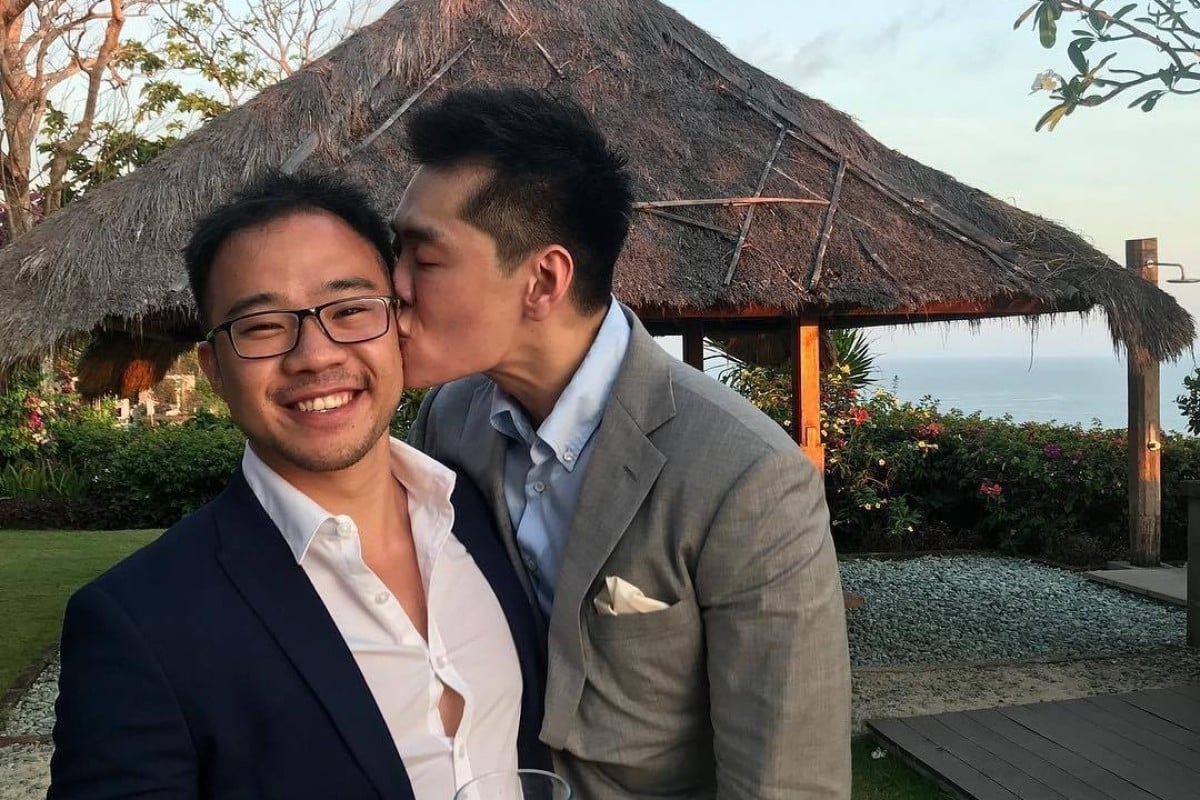
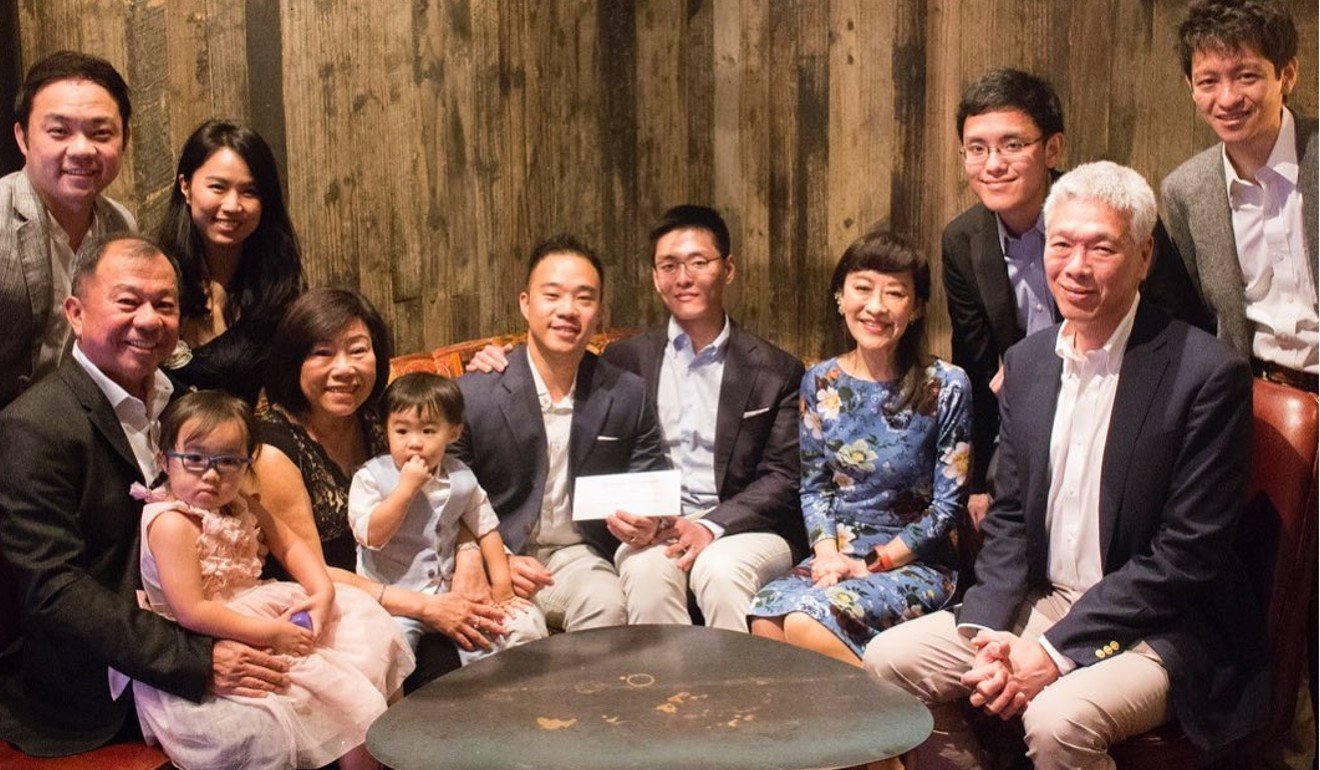
Li Huanwu (R) with his boyfriend Heng Yirui. Photo: Facebook
revealed on Friday he had married his boyfriend in South Africa, prompting a flurry of mostly positive reactions in his country, where male homosexuality is banned, and around the region.
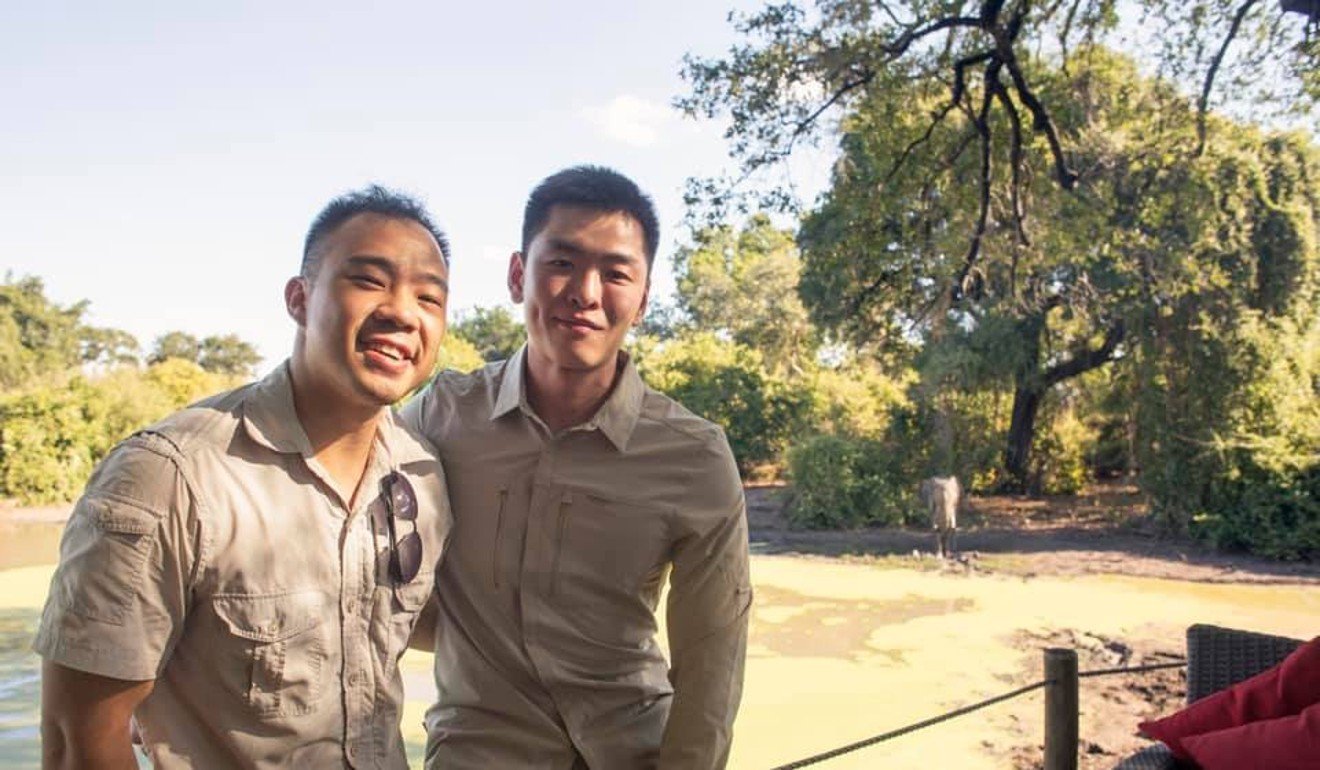
Li Huanwu, the second son of Lee Hsien Yang, was seen with his partner Heng Yirui in an Instagram post the latter shared online on Friday with a caption that read: “Today I marry my soulmate. Looking forward to a lifetime of moments like this with [Huanwu].”
The picture showed both in matching white shirts and khaki trousers at a game reserve in Cape Town.
“I’ll echo my comment I made to Pink Dot – today would have been unimaginable to us growing up. We are overjoyed to share this occasion in the glowing company of friends and family,” Li told the South China Morning Post.
The happy couple with their families. Photo: Facebook
Li’s father, Lee Hsien Yang, is himself the second and youngest son of the elder Lee, who died in March 2015.
Asked about his son’s nuptials, Lee told the Post : “I believe my father would have been thrilled to know this.”
under Section 377A of the Penal Code but Lee Kuan Yew, who was Prime Minister for 31 years until 1990, had been known to express a different opinion from the government in his later years.
Li’s wedding was held in South Africa, where same-sex marriages were legalised in 2006. It also came amid celebrations lauding
, including Mothership.sg and The Independent, were quick to pick up on the announcement while mainstream media outlets steered clear of reporting it.
Mothership’s Facebook post by Saturday had attracted 1,700 likes and 400 comments, mostly positive and congratulating the pair. One user, Donna Lim, commented: “Congrats! Love has no boundaries.”
In mainland China, multiple posts of Li’s wedding surfaced on social media app WeChat, which have garnered hundreds of likes and comments as of Saturday afternoon.
A few reacted with disdain but many of the Chinese commentators also congratulated the couple, with some hoping that Li would front the fight for gay rights in Singapore.
Why some members of Singapore’s LGBT community prefer life in the shadows
“…Homosexuality is illegal in Singapore, and now, Lee Kuan Yew’s grandson is taking the lead,” said a netizen with the username Tired and Humorous.
Another netizen added: “Gay love is still love, homophobia is a disease.”
Comments on the WeChat posts also noted how the lesbian, gay, bisexual and transgender (
) community in Singapore were subject to a law that criminalises sex between gay men.
“It turns out that Singapore is so traditional, it can lead to a conviction,” said one user named Facecover.
The Drum Tower, another user, added: “Singapore’s anti-same sex law was set by the British colony, but now the UK has legalised same-sex marriage.”
Li Huanwu had gone public about his partner more than a year before the wedding. In 2018, he and Heng appeared in a lesbian, gay, bisexual and transgender campaign titled Out in Singapore. Both had also attended
, an annual celebration to support the LGBT community in Singapore that year.
‘Worse than the Kardashians’: family feud turns ugly as siblings target PM’s wife
Li Huanwu’s father, Hsien Yang and his sister Lee Wei Ling are estranged from their eldest brother and current Singapore Prime Minister Lee Hsien Loong because of a dispute over their father’s wishes to have their
In his book Hard Truths to Keep Singapore Going published in 2011, the elder Lee, who retired from government that same year, said that homosexuality was “not a lifestyle”.
Li Huanwu (R) and Heng Yirui. Photo: Facebook
“You can read the books you want, all the articles. You know that there’s a genetic difference,” Lee said.
“They are born that way and that’s that. So if two men or two women are that way, just leave them alone.”
Earlier, in a book The Wit & Wisdom of Lee Kuan Yew, published in 2007, Lee was quoted as saying: “If in fact it is true, and I have asked doctors this, that you are genetically born a homosexual – because that’s the nature of the genetic random transmission of genes – you can’t help it. So why should we criminalise it?”
may be a dominant military force in Asia for now but short of going to war, it will be unable to stop its economic and diplomatic clout from declining relative to China’s power.
That’s the view of Australian think tank the Lowy Institute, which on Tuesday evening released its 2019 index on the distribution of power in Asia.
However, the institute also said China faced its own obstacles in the region, and that its ambitions would be constrained by a lack of trust from its neighbours.
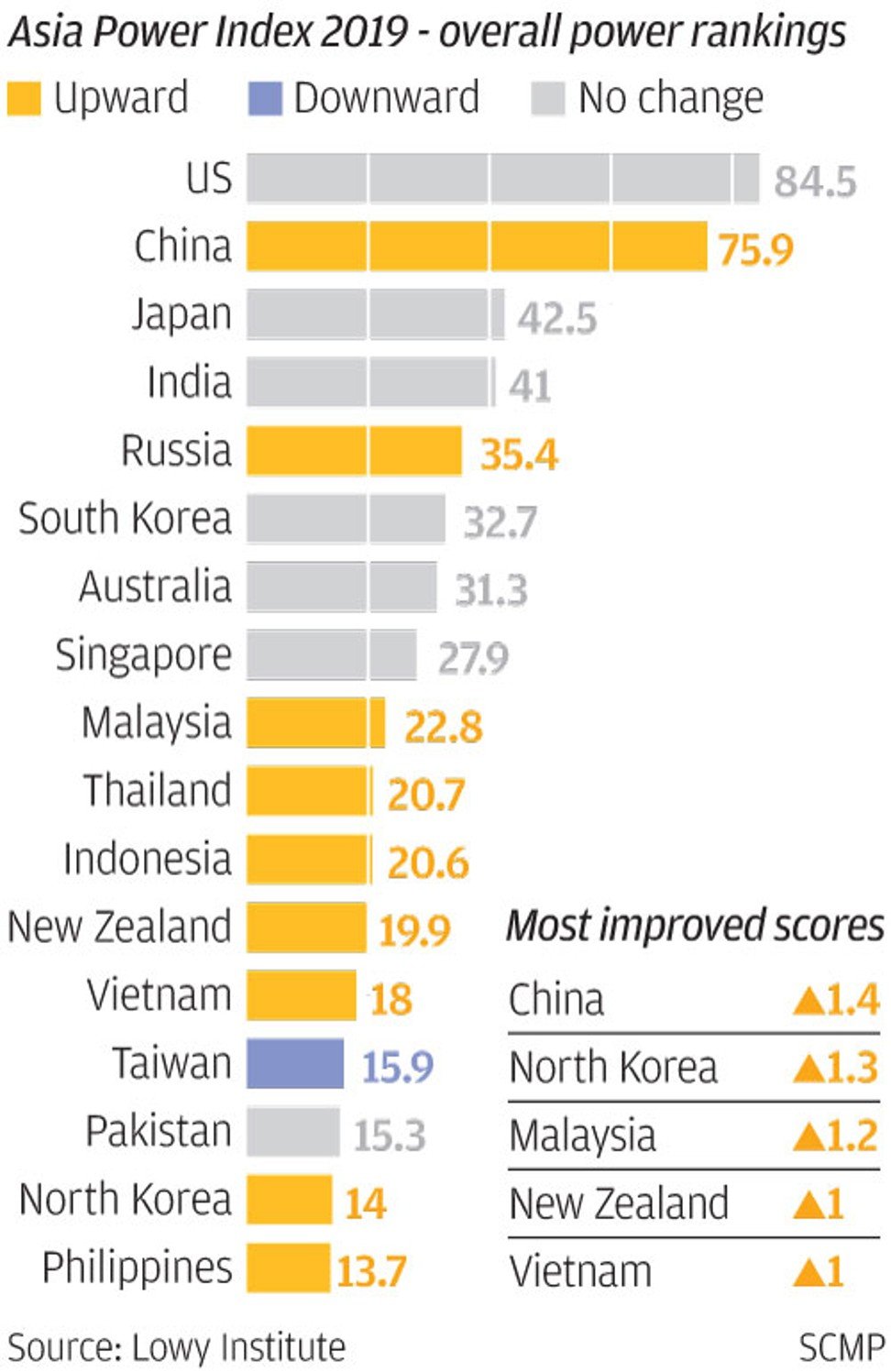
The index scored China 75.9 out of 100, just behind the US, on 84.5. The gap was less than America’s 10 point lead last year, when the index was released for the first time.
“Current US foreign policy may be accelerating this trend,” said the institute, which contended that “under most scenarios, short of war, the United States is unlikely to halt the narrowing power differential between itself and China”.
The Lowy Institute’s Asia Power Index. Click to enlarge.
. He most recently hiked a 10 per cent levy on US$200 billion worth of Chinese goods to 25 per cent and has also threatened to impose tariffs on other trading partners such as the European Union and Japan.
Herve Lemahieu, the director of the Lowy Institute’s Asian Power and Diplomacy programme, said: “The Trump administration’s focus on trade wars and balancing trade flows one country at a time has done little to reverse the relative decline of the United States, and carries significant collateral risk for third countries, including key allies of the United States.”
The index rates a nation’s power – which it defines as the ability to direct or influence choices of both state and non-state actors – using eight criteria. These include a country’s defence networks, economic relationships, future resources and military capability.
It ranked Washington behind both Beijing and Tokyo in terms of diplomatic influence in Asia, due in part to “contradictions” between its recent economic agenda and its traditional role of offering consensus-based leadership.
The spoils of trade war: Asia’s winners and losers in US-China clash
Toshihiro Nakayama, a fellow at the Wilson Centre in Washington, said the US had become its own enemy in terms of influence.
“I don’t see the US being overwhelmed by China in terms of sheer power,” said Nakayama. “It’s whether America is willing to maintain its internationalist outlook.”
But John Lee, a senior fellow at the Hudson Institute, said the Trump administration’s willingness to challenge the status quo on issues like trade could ultimately boost US standing in Asia.
“The current administration is disruptive but has earned respect for taking on difficult challenges which are of high regional concern but were largely ignored by the Obama administration –
illegal weapons and China’s predatory economic policies to name two,” said Lee.
“One’s diplomatic standing is not just about being ‘liked’ or ‘uncontroversial’ but being seen as a constructive presence.”
CHINA’S RISE
China’s move up the index overall – from 74.5 last year to 75.9 this year – was partly due to it overtaking the US on the criteria of “economic resources”, which encompasses GDP size, international leverage and technology.
China’s economy grew by more than the size of Australia’s GDP in 2018, the report noted, arguing that its growing base of upper-middle class consumers would blunt the impact of US efforts to restrict Chinese tech firms in Western markets.
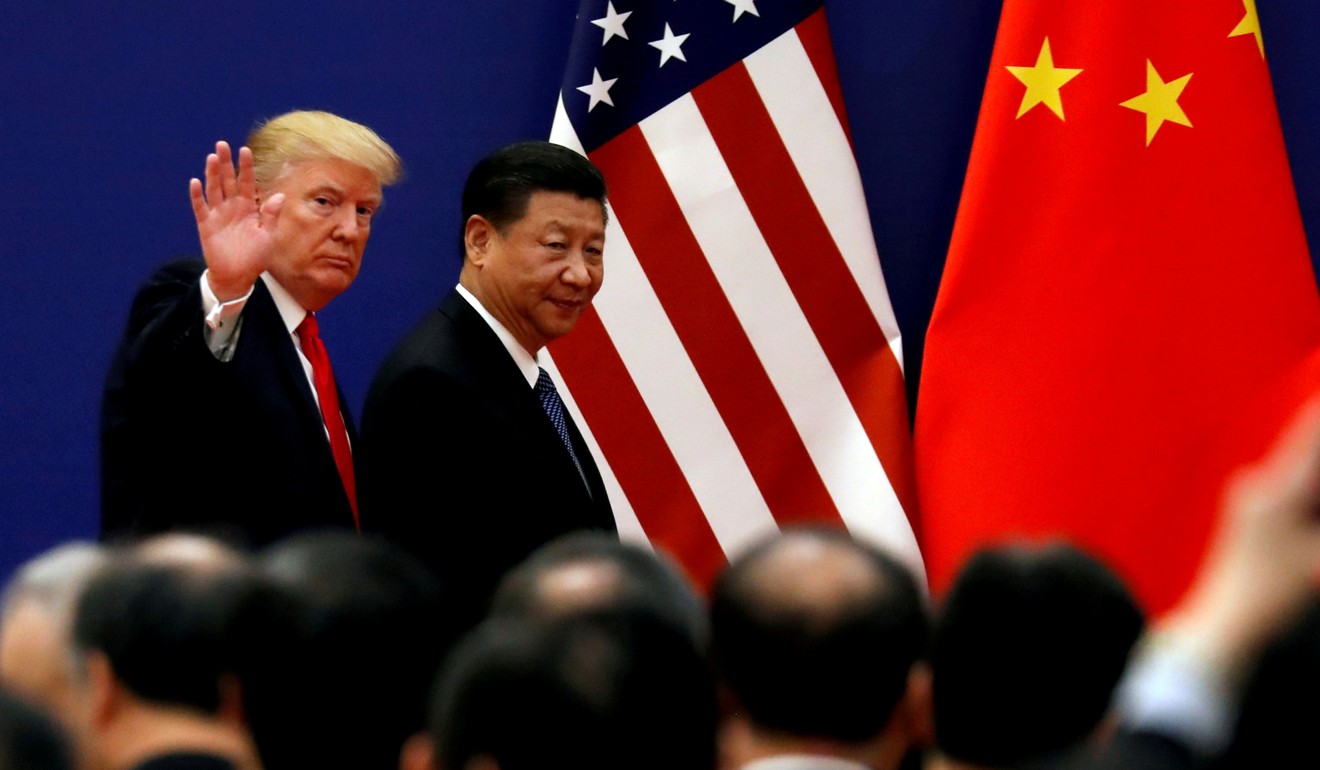
US President Donald Trump with Chinese counterpart Xi Jinping. Photo: Reuters
“In midstream products such as smartphones and with regard to developing country markets, Chinese tech companies can still be competitive and profitable due to their economies of scale and price competitiveness,” said Jingdong Yuan, an associate professor at the China Studies Centre at the University of Sydney.
“However, to become a true superpower in the tech sector and dominate the global market remains a steep climb for China, and the Trump administration is making it all the more difficult.”
The future competitiveness of Beijing’s military, currently a distant second to Washington’s, will depend on long-term political will, according to the report, which noted that China already spends over 50 per cent more on defence than the 10
stands in the way of its primacy in Asia, according to the index, which noted Beijing’s unresolved territorial and historical disputes with 11 neighbouring countries and “growing degrees of opposition” to its signature
and Myanmar due to concerns over feasibility and cost.
If Trump kills off Huawei, do Asia’s 5G dreams die?
Xin Qiang, a professor at the Centre for American Studies at Fudan University in Shanghai, said Beijing still needed to persuade its neighbours it could be a “constructive, instead of a detrimental, force for the region”.
“There are still many challenges for [China to increase its] power and influence in the Asia-Pacific,” Xin said.
Wu Xinbo, also at Fudan University’s Centre for American Studies, said Beijing was having mixed success in terms of winning regional friends and allies.
“For China, the key challenge is how to manage the maritime disputes with its neighbours,” said Wu. “I don’t think there is growing opposition to the Belt and Road Initiative from the region, actually more and more countries are jumping aboard. It is the US that is intensifying its opposition to the project as Washington worries it may promote China’s geopolitical influence.”
would persist and shape the global order into the distant future.
“They can still and do wish to cooperate where both find it mutually beneficial, but I think the more important task for now and for some time to come, is to manage their disputes in ways that do not escalate to a dangerous level,” Yuan said. “These differences probably cannot be resolved given their divergent interests, perspectives, etc, but they can and should be managed, simply because their issues are not confined to the bilateral [relationship] but have enormous regional and global implications.”
Elsewhere in Asia, the report spotlighted Japan, ranked third in the index, as the leader of the liberal order in Asia, and fourth-placed India as an “underachiever relative to both its size and potential”.
China’s wrong, the US can kill off Huawei. But here’s why it won’t
Lee said the index supported a growing perception that Tokyo had emerged as a “political and strategic leader among democracies in Asia” under
“This is important because Prime Minister Abe wants Japan to emerge as a constructive strategic player in the Indo-Pacific and high diplomatic standing is important to that end,” Lee said.
, Malaysia and Thailand rounded out the top-10 most powerful countries, in that order. Among the pack, Russia, Malaysia and Thailand stood out as nations that improved their standing from the previous year.











 CHINDIA ALERT: You'll be living in their world, very soon