Archive for June, 2019

17/06/2019

China rockets to forefront of global space race with sea launch success

  • China has become the first nation to fully own and operate a floating launch platform for its space missions
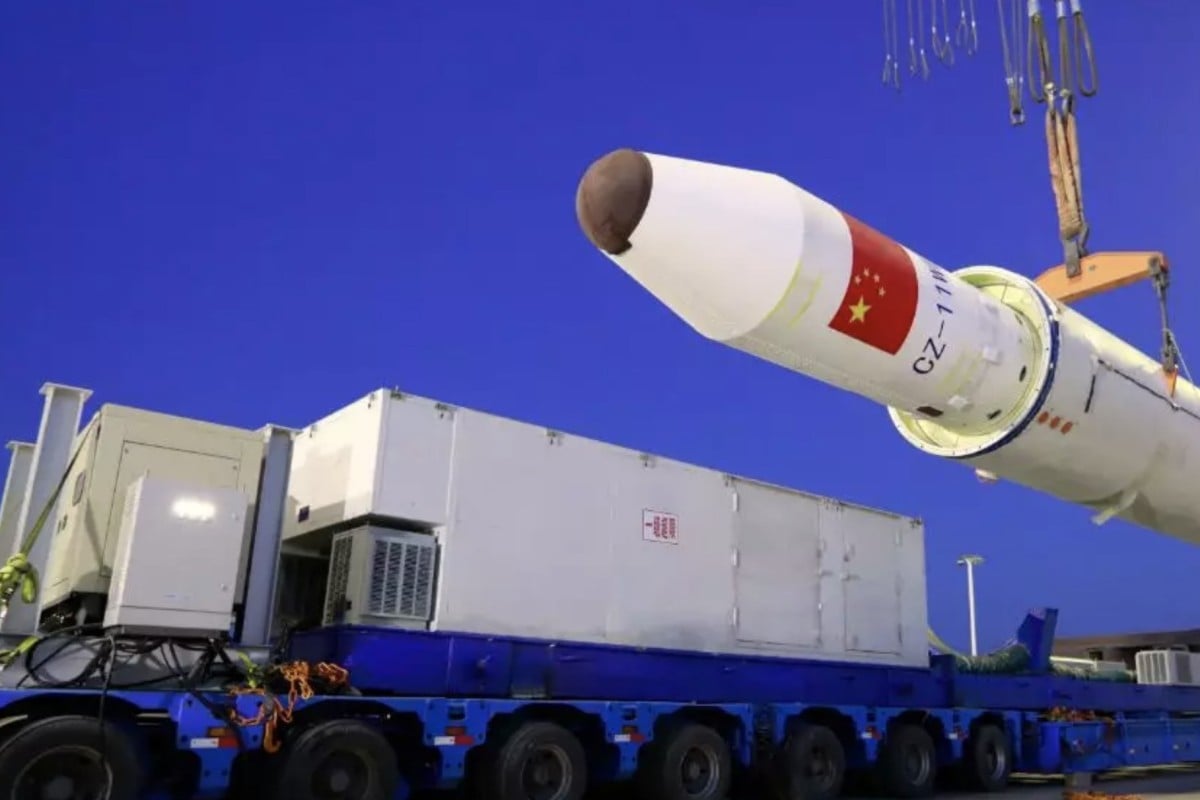
China has successfully launched a rocket into space from the Yellow Sea, making it the first nation to fully own and operate a floating sea launch platform. Photo: China National Space Administration
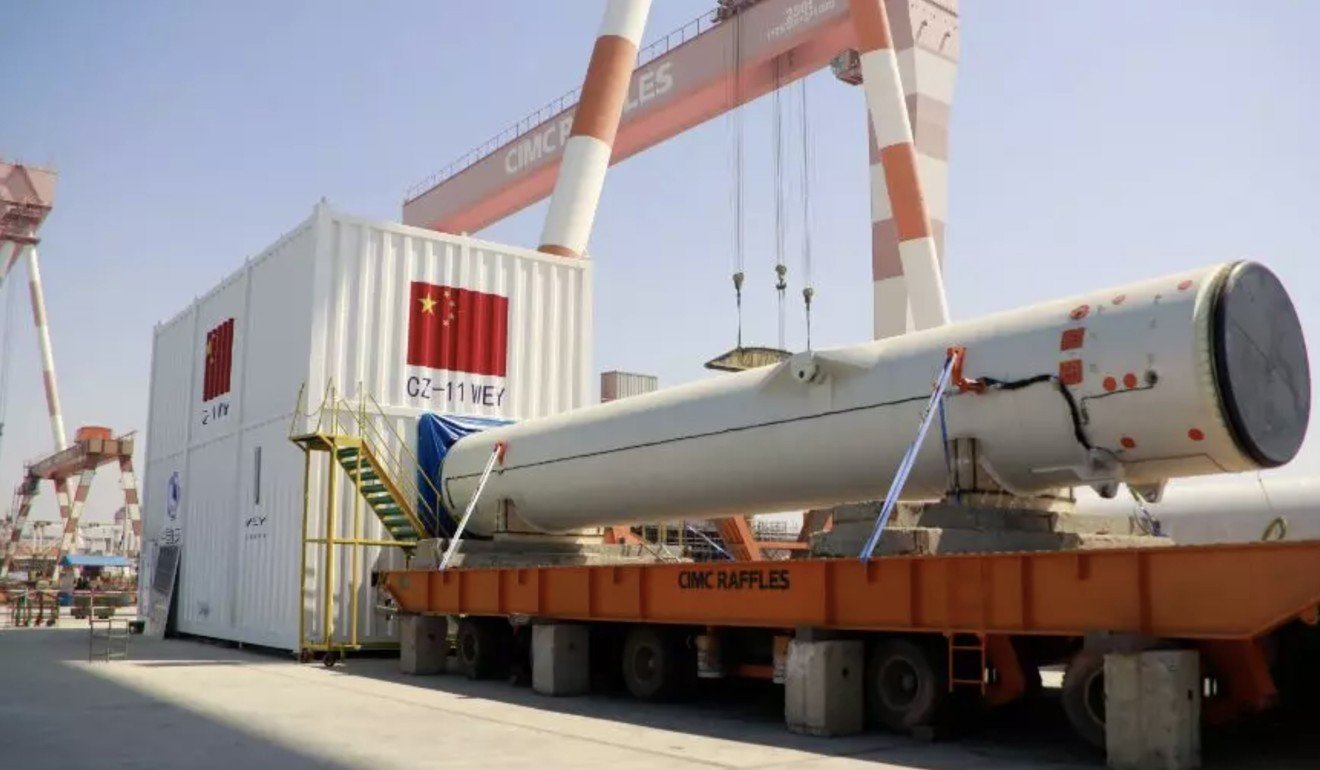
China successfully launched a rocket into space from a civilian cargo ship at sea on Wednesday, becoming the first nation to fully own and operate a floating sea launch platform, a technology expected to significantly reduce the cost and risk of space missions.
A Long March 11WEY rocket blasted off from the ship in the Yellow Sea at noon Beijing time, according to the China National Space Administration.
About six minutes later, five commercial satellites and a pair of “technical experiment” probes – called Bufeng, or Wind Catchers – reached their designated orbits.

The Wind Catchers will work together to detect winds on the surface of the world’s oceans. They will boost China’s ability to monitor and forecast typhoons and other extreme weather events, according to the administration.

“Launching a rocket from the sea has the advantages of high flexibility, good adaptability for specific tasks, and excellent launch economy,” said a statement on the administration’s website.

“It can flexibly select the launch point and touchdown area to meet the needs of various payloads for different orbits, and provide better aerospace commercial launch services for countries along the belt and road,” it added, referring to the Belt and Road Initiative, China’s plan to grow global trade.

The Long March 11 is a four-stage, solid fuel rocket with a design similar to a ballistic missile. It can carry a payload of about 700kg to the Earth’s lower orbit.

The first two stages of the rocket dropped in open waters in the northern Pacific Ocean, according to the administration. The rocket was equipped with a flight suspension system in case of any abnormal situation, but none occurred.

“The rocket debris will not cause damage to surrounding waters,” the administration said.

The world’s first ocean rocket launch platform, the Sea Launch, was jointly built by companies from Russia, the United States, Norway and Ukraine in the late 1990s. Its operation was halted in 2014 after military conflicts broke out between Russia and Ukraine.

Li Hong, president of the China Academy of Launch Vehicle Technology, told state media in March that the Chinese rocket and launch platform were designed and owned entirely by China, so it would not have similar problems caused by international disputes as the Sea Launch.

The launch was expected to encounter many technical and engineering challenges, including simplified procedures for pre-launch testing, the rocking motion of the ship and heat dissipation in a confined space.

But Chinese space authorities have argued the inconvenience would be offset by numerous advantages. For instance, the technology would allow China to move its launch site to as far away as Hawaii for quicker, cheaper satellite insertion to certain orbits, according to Xinhua.

Preparations get under way for Wednesday’s successful Chinese space launch from the northern Pacific ocean. Photo: China National Space Administration

A maritime launch is also expected to reduce the risk of rocket debris falling into densely populated areas.

Chinese space launch sites are typically located inland for defence purposes.

China has built its sea launch capability mainly to bolster the commercial space sector, according to Chinese space authorities.

In this mission, the rocket was sponsored and named after WEY, a young luxury car brand by Chinese sports utility vehicle manufacturer Great Wall Motor.

Chang’e 4 landing marks start of new China-US space race
Some cutting-edge car technology, such as new paint materials, will go into space for testing in the most extreme environments, according to state media reports.
The payloads include the Jilin 03A, the latest addition to a high-definition Earth observation satellite network, according to Changguang Satellite Technology Corporation, the satellite’s owner.
The company said the constellation, which will eventually comprise more than 20 satellites, would achieve global coverage for commercial applications.
One of the satellites launched on Wednesday belongs to Shanghai-based LinkSure Network, which has ambitious plans to provide free Wi-fi to everyone on the planet. The company has said it plans to eventually launch more than 200 satellites as part of the project.
Source: SCMP
17/06/2019

China rolls out rules to guide development of SpaceX-style commercial rocket research in the country

  • Chinese President Xi Jinping has made becoming a “space flight superpower” a priority for his government
Chinese space authorities prepare to launch a rocket from a commercial cargo ship at sea. Photo: Handout
China has rolled out its first rules to regulate the manufacture of commercial space rockets and test flights in a move to guide healthy development of the commercial space sector, mirroring similar moves by the US in recent years.
As a rising number of start-ups set out to be China’s version of Elon Musk’s SpaceX, the guidelines are the first since China’s space industry was opened to the private sector in 2014. They require companies to obtain official permission before carrying out rocket research and development as well as production, according to a notice published on the web site of the State Administration of Science, Technology and Industry for National Defense on Monday.
The new rules also require a confidentiality system to be established among commercial rocket companies and asks them to follow state export control regulations when in doubt about whether they can provide overseas services and products.
The detailed regulations come as the number of private companies engaged in the commercialisation of China’s space industry increased to almost 100 in 2018 from 30 a year earlier, and as Beijing puts more emphasis on private sector involvement to boost its space ambitions.
China rockets to forefront of global space race with sea launch success

“The specifics give clear direction for China’s commercial space industry, clarifying the qualifications, operational boundaries and national guarantees, which will be conducive to the sector’s healthy and orderly development,” Shu Chang, CEO of Beijing-based commercial rocket pioneer OneSpace Technology, was quoted as saying to state media Global Times on Tuesday

Since coming to power in 2012, Chinese President Xi Jinping has made becoming a “space flight superpower” a priority for his government. Since 2014, Beijing has encouraged more private investors to participate in its space push to bolster commercial space technology development, including policies directed at investment and providing land for launches.

The guidelines issued on Monday said commercial rocket development had the potential to lower the cost of space sector development, improving China’s space power and competitiveness globally. It also encourages private companies to partner with state-backed organisations to take full advantage of the latter’s resources in research development, production and launch facilities.

Trump criticises Nasa moon mission after previously promoting it
The move by China mirrors similar efforts by the US in recent years to shift the burden of space exploration and technology development away from the state and into the private sector, leading to space rocket development by the likes of Elon Musk, Jeff Bezos and Richard Branson.

Military interests still weigh though. President Donald Trump has championed a return to the moon, calling for a lunar gateway that would allow a continuous stream of spacecraft and people to visit the moon, and serve as a leaping off point for Mars. Trump has also called for the creation of a “Space Force”, a sixth branch of the military that would be focused on defending US interests.

China accounts for roughly 3 per cent of the US$16.1 billion invested in private space companies and partnerships since 2009 in the world. But investments have increased rapidly since 2016, and the country led the world in the third quarter of 2018, according to Space Angels, a US investment firm that specialises in private space ventures.

Source: SCMP

17/06/2019

Are China and US racing towards inevitable military confrontation in outer space?

  • Beijing is still behind in terms of its space-based military capabilities, but the gap is closing fast, experts say
  • US law now prohibits Nasa from communicating with China’s space agency
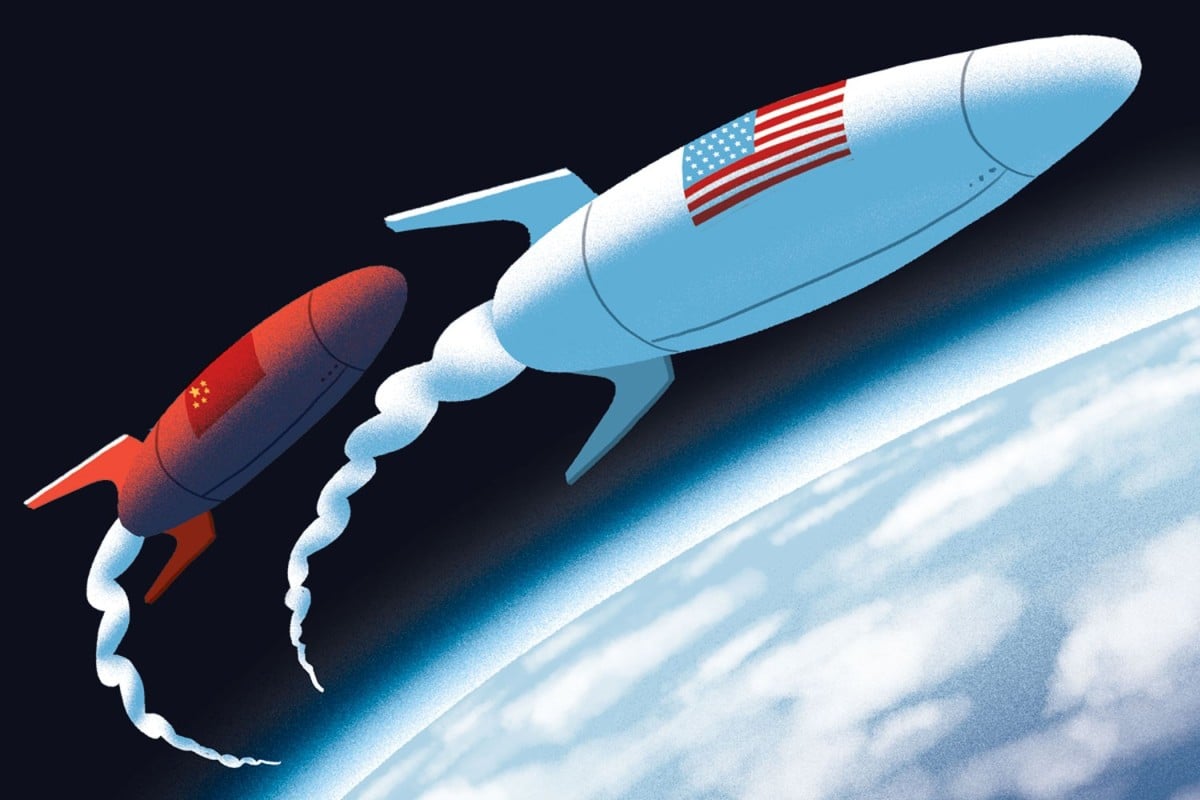
Illustration: Kaliz Lee

This story is part of an ongoing series on US-China relations produced jointly by the South China Morning Post and POLITICO, with reporting from Asia and the United States.

A top Chinese general has a warning for any US leaders planning an arms race in space: be prepared to lose.

Outspending a rival power into economic exhaustion might have helped the US win the cold war, said Qiao Liang, a major general in the Chinese air force who co-wrote the book Unrestricted Warfare: China’s Master Plan to Destroy America. But he said it would not work against a wealthy manufacturing powerhouse like China.

“China is not the Soviet Union,” Qiao said in an interview with the South China Morning Post, a news partner of POLITICO. “If the United States thinks it can also drag China into an arms race and take down China as it did with the Soviets … in the end, probably it would not be China who is down on the ground.”
Qiao’s words come as both Washington and Beijing are pouring money and resources into an increasingly militarised space race that some security specialists and former US officials fear is heightening the risk of war. The aggressive manoeuvres include US President Donald Trump’s proposal for a stand-alone 
Space Force

– which Qiao dismissed as “an unwise move” – and efforts by both countries to develop laser and cyber weapons that could take out each other’s satellites.

The rivalry is plainly on the minds of leaders at the Pentagon, which cites “space” 86 times in a new threat assessment of China’s military. It also warns that the People’s Liberation Army (PLA) is working on “enabling long-range precision strikes” and developing directed-energy weapons for use in orbit.
Sea launch rockets China to forefront of global space race

Trump, Vice-President Mike Pence and a slew of US military leaders have cited China’s military space programmes as a key rationale for proposing the Space Force, which would gather nearly all the defence department’s space-related programmes into a new military branch – similar to the one China created four years ago. Congress is considering the administration’s plan, although some defence hawks are sceptical.

Pence has also expressed alarm at China’s success in

landing uncrewed probes on the moon

, a place US astronauts last visited in 1972.

“Last December, China became the first nation to land on the far side of the moon and revealed their ambition to seize the lunar strategic high ground and become the world’s pre-eminent spacefaring nation,” Pence said at a meeting of the National Space Council in March.

China and the US are pouring money into an increasingly militarised space race that some observers fear is heightening the risk of war. Photo: Shutterstock

Even more worrying, neither country seems interested in placing the issue on the diplomatic agenda to lower the tensions, some security advocates say. That is in contrast to the decades of space cooperation that have existed between the US and Russia.

“One of my biggest concerns is that for all the talk about how horrible an armed conflict with China would be for everyone, all the current US policies and actions seem to be preparing for armed conflict instead of avoiding it,” said Brian Weeden, director of programme planning at the Secure World Foundation, which advocates for using space in a peaceful and sustainable way.

“There is not a lot of dialogue between the US and China,” he said.

But other space experts say China is a greater threat to the United States than most people realise – and even an “imminent threat”, according to independent analyst Namrata Goswami.

“If anything, it [the threat from China] is underappreciated and underplayed in the US,” she said. “I suspect that is because the US military might not want to call attention to its own vulnerabilities regarding its space assets.”

Chang’e 4 lunar probe sends first photo of far side of the moon

Qiao said China was not seeking a space war but was preparing to counter any nation, including the US, that sought to pose a threat to its national security.

China’s economic prowess left it well positioned to prevail in an expensive contest with the US, he said.

“When the United States and the Soviet Union engaged in the cold war and the arms race, the United States was the largest manufacturing country, and the Soviet Union was not even the second,” he said. “But today it is China who is the world’s top manufacturer.”

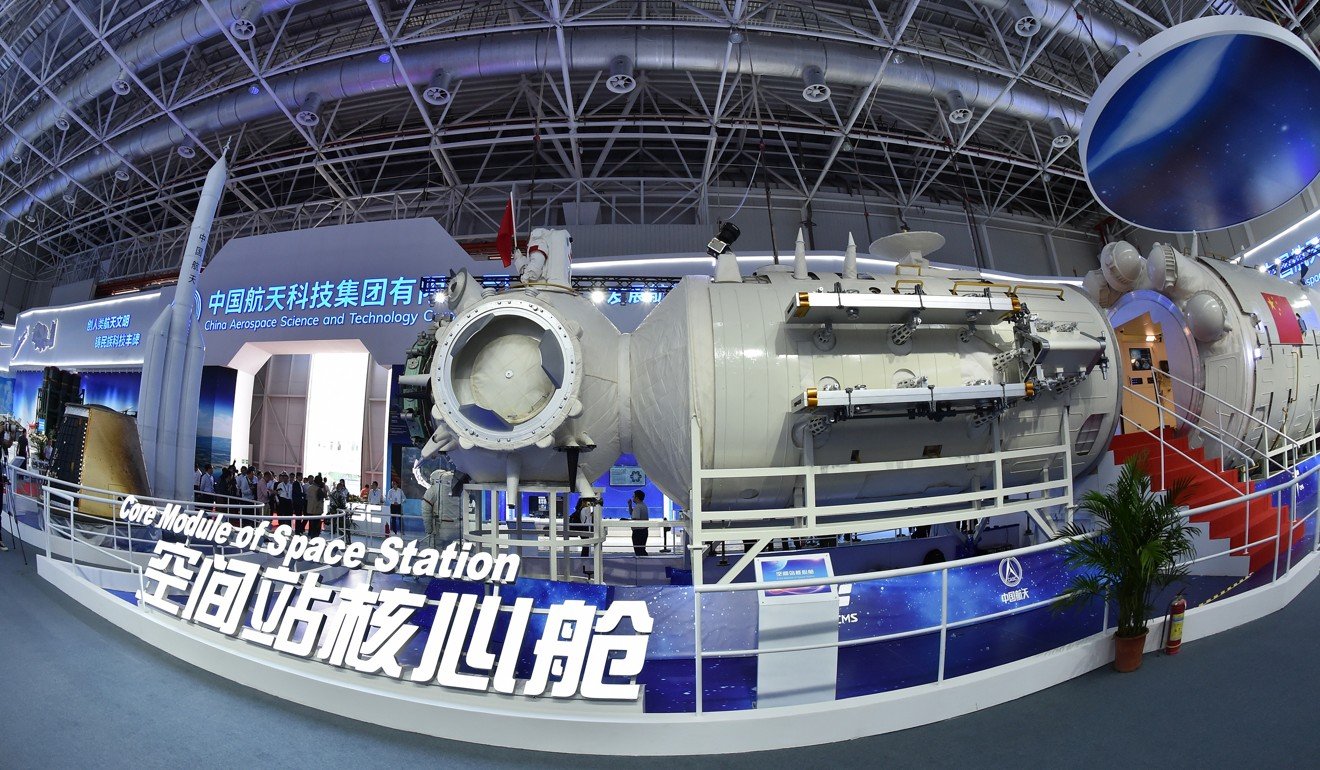
A full-size model of the core module of China’s space station goes on show at Airshow China in November. Photo: Xinhua

Recent reports from US spy agencies and think tanks indicate that China’s efforts are advancing quickly. Those include estimates that China will soon be able to field high-powered lasers designed to attack objects in low-Earth orbit – and evidence that its weapons can already attack targets much further from the Earth than the United States can.

China’s reliance on space assets is also expanding: it has more than 120 intelligence, surveillance and reconnaissance satellites of its own – second only to the United States.

About half of them are owned and operated by the military and could be used to track and target US forces around the world, the report warns.

Will China’s new laser satellite be ‘Death Star’ for submarines?

The threat getting the most attention is the danger China’s orbiting weapons might pose to the satellites the United States relies on for communications, navigation and surveillance – for both military operations and economic well-being.

China is heavily investing in so-called counterspace technology, including the development of at least three antisatellite missile systems, according to an April report from the Centre for Strategic and International Studies. It is also developing satellites that can make physical contact with other satellites in orbit, the report said.

While that technology can be used for repairs in orbit, it can also be used to disable a satellite or tear off a solar array to impact a satellite’s power source.

China is developing satellites that can make physical contact with other satellites in orbit. Photo: Xinhua

The Pentagon’s “China Military Power” report found that China is also pursuing new jamming and “directed energy” weapons that can interfere with satellites. In a conflict, that technology would probably be used to “blind and deafen the enemy”, the report said.

China also reorganised the PLA in 2015 to create a Strategic Support Force, a military branch dedicated entirely to space, electronic and cyberwarfare. The new branch was designed to bring space assets from across the military under one organisation, similar to the goal of the US Space Force.

The space-centric branch, which reports directly to the Central Military Commission, is focused primarily on satellite launches and intelligence, navigation and communication operations, but also conducts research and development on new counterspace capabilities, according to the US Defence Intelligence Agency report published in February.

China ‘has overtaken Russia’ as a maritime power

Chinese military units are also training with missiles that could damage or destroy satellites, the agency also reported in February, adding that China will probably have a ground-based laser that can blind optical sensors on satellites in low-Earth orbit by 2020.

Unlike the United States or Russia, China is also believed to have the capacity to use missiles to attack satellites in the more distant geosynchronous orbit, or 35,000km (22,000 miles) above Earth.

If any country were to launch a physical strike in geosynchronous orbit (GEO), the debris field would make the area, which is today used for critical missions like early missile warning and weather observations, unusable.

“We have much more to lose in GEO than any other country,” said Kaitlyn Johnson, an associate fellow who specialises in space security at the Centre for Strategic and International Studies. “We wouldn’t want to have a first strike capability.”

Chinese military units are training with missiles that could destroy satellites. Photo: Reuters

Military experts also worry that China could try to seize areas of the moon that contain strategic resources including ice that could be used for rocket fuel or life support.

But they say it is much more likely China will want to use dominance in space to influence conflicts on Earth. For instance, being able to threaten the military’s GPS or communications satellites might deter the US from getting involved in a conflict in the South China Sea, Weeden said.

The US Space Force is intended to close some of those gaps by grouping space assets together to build expertise and giving the new service autonomy over its budget requests. One of the biggest goals of the new branch is to speed up space acquisitions, allowing new technology to be fielded faster, and to develop a space “doctrine” that would oversee how the US fights conflicts when space platforms are at stake.

China adds new satellite to rival US global positioning system

The Chinese government insists that it is merely responding to aggressive US moves to dominate space militarily. Qiao called it “bullying and hegemonic” for the United States to insist that other countries cannot follow suit.

“The US space troops have long existed,” he said. “They just did not become an independent force … moreover, the US possessed anti-satellite capabilities as early as the 1970s and 1980s. China only developed anti-satellite capabilities at the end of the 1990s and even in the first decade of this century.”

China had little choice but to enhance its capabilities, he said.

“China’s purpose to develop space capabilities, firstly, is we do not want to be blackmailed by others,” Qiao said in the interview. “Second, we hope to use space peacefully. But if others want to oppress us by occupying the heights of space and opening up a ‘fourth battlefield’, China will certainly not accept it.”

Qiao Liang, a major general in the Chinese air force, says it is “bullying and hegemonic” for the United States to insist other countries cannot develop a space force. Photo: Handout

Still, China remained far from surpassing US dominance, he said. “We cannot overtake the US in the next decade or two, but we will narrow the gap in a comprehensive way. And it is possible we may take the lead in some individual areas.”

Weeden agreed.

“China is developing many of the same space capabilities the US did decades ago, while the US is focused on sustaining its capabilities and making them more resilient,” he said.

“On the whole, the US is still far more capable than China is but the relative advantage is narrowing.”

What is space junk and why is it a problem?

The two nations have some diplomatic channels through which they could cooperate in space, including the United Nations’ Committee on the Peaceful Uses of Outer Space, of which both are members. In 2015, the Obama administration established a dialogue with China on space safety, which is quietly continuing under Trump, although Weeden said the meetings were mostly high-level talks.

But the Wolf Amendment, which was first passed in a Congressional appropriations bill in 2011, forbids the US government from working with China and prohibits any bilateral cooperation between the China National Space Administration and the US National Aeronautics and Space Administration on national security grounds. And there is virtually no collaboration between the militaries of the two nations today.

To open the door for conversations that could ease tensions and avoid miscommunication, the US and China must “crawl before we walk”, Audrey Schaffer, the director of space strategy and plans at the defence department, said at a March event on US-China space relations hosted by the Secure World Foundation.

Some potential first steps include the two countries sharing information like their national defence strategies, providing launch notifications of space vehicles or opening routine, secure communications channels between diplomats. Each step would help build trust and transparency, Schaffer said, pointing to the strong relationship between the US and Russia in space as evidence that it could be done.

“Even then when the relationship was just as strained, if not more so, we did manage to work bilaterally and multilaterally with the Soviets to really create mechanisms that would help reduce the risks of conflict and enhance stability,” Schaffer said.

Source: SCMP

17/06/2019

India magician disappears in river after Houdini trick

Chanchal LahiriImage copyright EI SAMAY
Image caption Chanchal Lahiri went by the stage name Mandrake

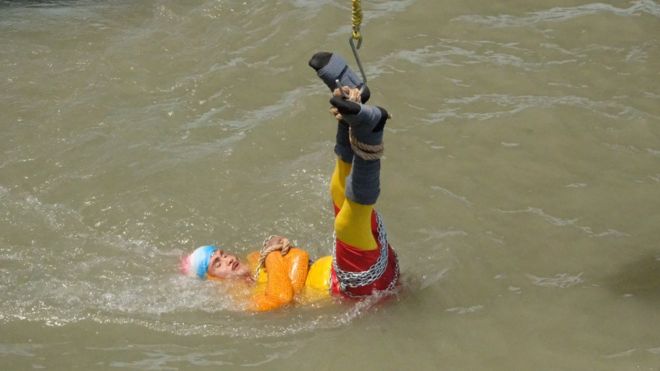
An Indian magician, who attempted to recreate Harry Houdini’s famed trick by jumping shackled into a river, is feared dead.

Chanchal Lahiri was meant to escape and swim to safety but did not emerge from the Hooghly river in West Bengal state.

Spectators who had gathered to watch him take the plunge on Sunday informed the police, who say they are searching for him.

Mr Lahiri, also known as Mandrake, was lowered into the river from a boat.

He was shackled with six locks and a chain as spectators on two boats watched him. Several people had also gathered by the shore and some stood on the landmark Howrah Bridge in Kolkata (formerly Calcutta).

Police and a team of divers canvassed the area but as of Sunday evening local time, they had been unable to find the magician. One officer told the Hindustan Times newspaper that Mr Lahiri could not be declared dead until the body was found.

Jayant Shaw, a photographer with a local newspaper, witnessed Mr Lahiri attempting the trick. He told the BBC that he spoke to him before the magician started his act.

“I asked him why he risked his life for magic,” Mr Shaw said. “He [Mr Lahiri] smiled and said, ‘If I do it right, it’s magic. If I make a mistake, it becomes tragic.'”

The magician told him that he wanted to do this trick in order “to revive interest in magic”.

This is not the first time that Mr Lahiri had attempted a risky underwater trick.

He was lowered into the same river inside a glass box more than 20 years ago but had managed to escape to safety.

Mr Shaw had also witnessed Mr Lahiri’s previous underwater trick.

“I never thought he would not come out of the water this time,” he said.

Source: The BBC

16/06/2019

Beijing new airport subway line starts test run

BEIJING, June 15 (Xinhua) — Self-driving trains for the subway line connecting downtown Beijing with its new international airport started trial run Saturday, according to local authorities.

Stretching 41.4 kilometers, the new line supports autopilot system and can run at a speed of 160 km per hour, with as many as 448 passengers, according to Beijing Major Projects Construction Headquarters Office.

It runs through Daxing and Fentai, two districts in the southern part of Beijing, and will take only 19 minutes to get from the Caoqiao station in Beijing’s south third ring road to the new airport after it starts operation by the end of September.

The line is part of an integrated transport network that will combine subways, expressways, intercity rail and high-speed rail with the airport at the center.

Beijing Daxing International Airport, located 46 kilometers south of downtown Beijing, is designed to take pressure off overcrowded Beijing Capital International Airport in the northeastern suburbs. It sits at the junction of Beijing’s Daxing District and Langfang, a city in neighboring Hebei Province.

Source: Xinhua

16/06/2019

Commissioner’s office of China’s foreign ministry in HK voices support for HK’s decision to suspend fugitive law amendments

HONG KONG, June 15 (Xinhua) — An official in charge of the Office of the Commissioner of the Chinese Foreign Ministry in Hong Kong Special Administrative Region (HKSAR) on Saturday expressed understanding, respect and support for the decision by the HKSAR chief executive to suspend the exercise to amend the HKSAR’s Fugitive Offenders Ordinance and the Mutual Legal Assistance in Criminal Matters Ordinance.

The official also voiced continuous staunch support for HKSAR Chief Executive Carrie Lam and the SAR government in governing Hong Kong in accordance with law, safeguarding the country’s sovereignty, security and development interests, and upholding Hong Kong’s enduring prosperity and stability.

“We firmly support the SAR government’s efforts to amend the ordinances,” he said, adding that the amendments to the two ordinances aim to plug a legal loophole in the existing legal framework, demonstrate social justice and improve Hong kong’s rule of law, which is necessary, legitimate and reasonable.

The contents of the amendments conform to the international law and the common practices of the international community, and help fight crimes, he said.

The official strongly condemned the violent acts by some people, and voiced firm support for the Hong Kong police force to mete out punishment in accordance with law, uphold Hong Kong’s rule of law and protect Hong Kong’s social stability.

Since Hong Kong’s return to the motherland, Hong Kong people have been enjoying unprecedented and extensive rights and freedoms, including the freedoms of speech and assembly, he said.

However, freedom is by no means without boundaries, and rights must be exercised within the framework of the rule of law. Any civilized society ruled by law will not tolerate unlawful acts which impact peace and security, he said.

He stressed that Hong Kong is China’s Hong Kong and its affairs are purely China’s internal affairs. “We resolutely oppose any external forces interfering in its affairs with any excuse or in any form. Any attempts to create chaos in Hong Kong and jeopardize its prosperity and stability are doomed to fail,” he said.

“Again, we urge relevant countries to comply with the international law and the basic norms governing international relations, fully respect China’s sovereignty and the SAR government in exercising governance in accordance with law and immediately stop the wrong words and deeds that undermine Hong Kong’s prosperity and stability,” the official said.

Source: Xinhua

16/06/2019

Xi receives Crown Order from Tajik President Rahmon

TAJIKISTAN-DUSHANBE-XI JINPING-ORDER OF THE CROWN

Chinese President Xi Jinping (L) receives the Order of the Crown, Tajikistan’s highest decoration, from Tajik President Emomali Rahmon during a ceremony in Dushanbe, Tajikistan, June 15, 2019. (Xinhua/Sadat)

DUSHANBE, June 15 (Xinhua) — Chinese President Xi Jinping received the Order of the Crown, Tajikistan’s highest decoration, from Tajik President Emomali Rahmon here on Saturday.

During the ceremony held at the presidential palace, Rahmon spoke highly of Xi’s positive contributions to the development of Tajikistan-China relations, saying he is ready to work together with Xi to guide bilateral relations toward greater achievements.

Noting that the Order of the Crown embodies the profound friendship the people of Tajikistan have kept with the people of China, Xi said he attaches great significance to the decoration.

“I am willing to join hands with President Rahmon in lifting China-Tajikistan comprehensive strategic partnership to higher levels and better serving the two peoples,” Xi said.

Xi arrived here Friday for the fifth summit of the Conference on Interaction and Confidence Building Measures in Asia and a state visit to Tajikistan.

Tajikistan is the second leg of Xi’s two-country Central Asia trip, which also took him to Kyrgyzstan for a state visit and the 19th Shanghai Cooperation Organization summit.

Source: Xinhua

16/06/2019

Beijing sees ‘broad consensus’ with UN on Xinjiang as human rights groups blast envoy’s visit

  • UN counterterrorism chief Vladimir Voronkov not expected to make statement after visiting region last week
  • Trip prompts calls for independent observation in Muslim-majority area where an estimated 1 million people are held in detention facilities
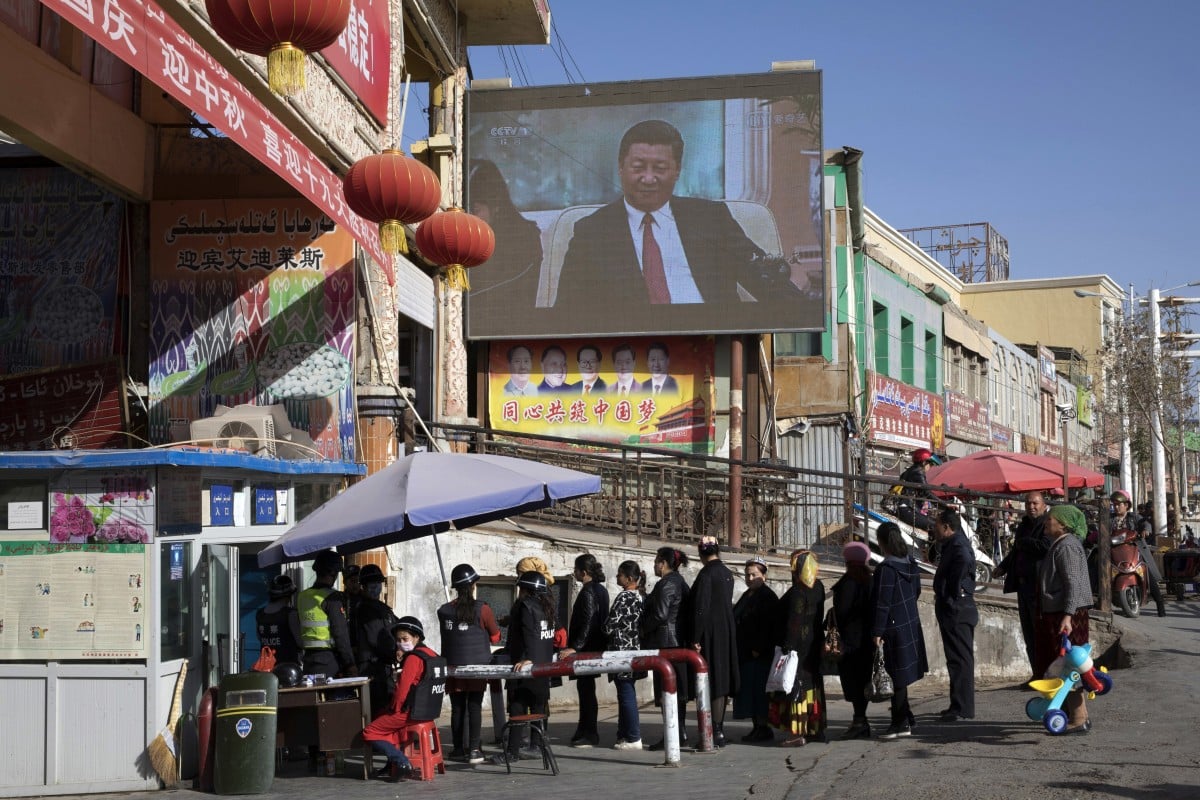
Residents go through a security checkpoint at the entrance to a bazaar in Hotan, Xinjiang. The UN’s counterterrorism chief visited the far western region last week. Photo: AP
Human rights group Amnesty International has joined growing criticism of a top UN official’s visit to China’s 
Xinjiang region

, echoing calls for more independent investigations of detention facilities for ethnic Uygurs.

The invitation to the United Nations envoy to visit was Beijing’s latest attempt to show it has nothing to hide in what it calls “re-education facilities” that hold an estimated 1 million people in the Muslim-majority area in western China.
But critics have warned that state-led media tours and diplomatic visits lack the unfettered access needed to make a proper assessment of alleged rights abuses in the region.
UN counterterrorism chief Vladimir Voronkov 
visited Beijing and Xinjiang

from Thursday to Saturday and met Le Yucheng, the vice foreign minister, according to a statement from the foreign ministry on Sunday. The statement said the two sides had reached a “broad consensus”.

UN human rights chief ‘is welcome to visit Xinjiang’

Voronkov’s visit follows months of pressure to allow the UN to investigate alleged human rights abuses in Xinjiang. China has so far only allowed guided tours of the region for foreign journalists and diplomatic envoys.

Reuters reported on Saturday that Voronkov’s itinerary was planned by China and that his UN office did not expect to make any public statement about the trip, according to an email from Voronkov’s office seen by the news agency.

The United Nations said in August last year it had credible reports that detention facilities in Xinjiang held 1 million Uygurs and other Muslims. Beijing says the facilities are for “vocational training” and tied to deradicalisation and anti-terrorism efforts.

Patrick Poon, a Hong Kong-based researcher with Amnesty International, said he was “very much concerned” about how the UN envoy’s visit had been arranged.

“From what we saw in the previous visits orchestrated by the Chinese government for diplomats, it’s very difficult for anyone to believe how this visit will be able to show any authentic situation on the ground,” Poon said.

“If the Chinese government is sincere, let independent UN experts, such as the special rapporteurs, have independent observation of what’s happening in Xinjiang.”

Xinjiang’s vanishing mosques highlight pressure on China’s Muslims
His remarks followed criticism of the trip from Human Rights Watch on Friday.
“The UN allowing its counterterrorism chief to go to Xinjiang risks confirming China’s false narrative that this is a counterterrorism issue, not a question of massive human rights abuses,” Human Rights Watch UN director Louis Charbonneau told Agence France-Presse.
Also on Friday, US Deputy Secretary of State John Sullivan called UN Secretary General Antonio Guterres to express “deep concerns” about Voronkov’s visit, according to the State Department website. Sullivan called for “unmonitored and unhindered access to all camps and detainees in Xinjiang by UN human rights officials”.
The United States has been increasingly vocal about China’s human rights abuses. Vice-President Mike Pence is due to give a speech on China’s “control and oppression” of citizens on June 24, but according to Bloomberg it could be postponed to avoid inflaming tensions with Beijing ahead of a possible meeting between US President Donald Trump and his Chinese counterpart Xi Jinping at the Group of 20 leaders summit in Japan on June 28-29. The speech was originally scheduled for June 4 but was delayed by Trump, Bloomberg reported, citing sources familiar with the matter.
Source: SCMP
16/06/2019

Maoist rebels kill five policemen in eastern India

BHUBANESWAR, India (Reuters) – Maoist rebels killed five policemen in the eastern Indian state of Jharkhand on Friday, a senior police official said, the latest in a series of attacks on security forces.

The policemen were patrolling a weekly market, M. L. Meena, additional director general of police in Jharkhand, told Reuters by telephone from Ranchi, the state capital.

The attack took place near the state border with West Bengal, Meena added.

Last month, suspected leftist insurgents killed at least 15 police and a civilian in a landmine attack on two security vehicles in the western Indian state of Maharashtra.

The Maoist insurgents, also known as Naxals, have battled a number of state governments for decades. They say they are fighting on behalf of people who have not benefited from a long economic boom in India, Asia’s third largest economy.

Source: Reuters

15/06/2019

Chinese president arrives in Tajikistan for CICA summit, state visit

TAJIKISTAN-DUSHANBE-XI JINPING-CICA SUMMIT AND STATE VISIT-ARRIVAL

Chinese President Xi Jinping (L) is warmly received by Tajik President Emomali Rahmon upon his arrival at the airport in Dushanbe, Tajikistan, June 14, 2019. Xi arrived here Friday for the fifth summit of the Conference on Interaction and Confidence Building Measures in Asia (CICA) and a state visit to Tajikistan. (Xinhua/Xie Huanchi)

DUSHANBE, June 14 (Xinhua) — Chinese President Xi Jinping arrived here Friday for the fifth summit of the Conference on Interaction and Confidence Building Measures in Asia (CICA) and a state visit to Tajikistan.

Xi was warmly received by Tajik President Emomali Rahmon at the airport.

The two heads of state had a cordial talk. Xi thanked Rahmon for meeting him in person at the airport and conveyed to the Tajik government and people sincere greetings on behalf of the Chinese government and people.

As good neighbours, friends and brothers, China and Tajikistan have maintained sound and steady development in relations ever since they forged diplomatic ties 27 years ago, he said.

Xi said he and Rahmon decided to establish the China-Tajikistan comprehensive strategic partnership in 2017, which has ushered bilateral relations into a new phase of rapid development.

“My visit this time aims to push bilateral ties to an even higher level,” he said. “I look forward to having in-depth communication with my old friend President Rahmon, and jointly outlining the beautiful blueprint of China-Tajikistan relations.”

He pledged China’s willingness to work with Tajikistan to further promote bilateral ties and cooperation in various fields to bring more benefits to both peoples.

The Dushanbe summit bears great significance to the development of the CICA, where all sides will discuss the mechanism’s future development and decide on priorities for cooperation, Xi said, praising Tajikistan’s efforts in preparing for the event and expressing belief in its success.

Recalling Xi’s visit to Tajikistan five years ago, Rahmon extended a warm welcome to the Chinese leader for the state visit and his participation in the CICA summit.

Rahmon wished the visit a complete success and better and faster development of bilateral ties.

Tajikistan is the second leg of Xi’s two-country Central Asia trip, which also took him to Kyrgyzstan for a state visit and the 19th Shanghai Cooperation Organization summit.

Source: Xinhua

Law of Unintended Consequences

continuously updated blog about China & India

ChiaHou's Book Reviews

continuously updated blog about China & India

What's wrong with the world; and its economy

continuously updated blog about China & India