Archive for July, 2019

29/07/2019

Protests over worker deaths paralyse production at some Coal India mines

BHUBANESWAR (Reuters) – Members of Indian Prime Minister Narendra Modi’s Bharatiya Janata Party (BJP) have mounted protests that have paralysed production at one of India’s biggest coalfields following a deadly accident last week.

The BJP workers have been staging sit-down protests and waving flags at state-run Coal India Ltd’s mines in the eastern state of Odisha, demanding a safety audit of all mines in the region.

Rescue officials said they have recovered the bodies of three workers who were trapped inside the mine in Odisha’s Angul district after a landslide on Tuesday, and are trying to recover another body from inside the mine.

Kalandi Samal, a local BJP leader who is leading the protests, said the demonstrations will continue until authorities ensure safety measures to prevent such tragedies and ensure adequate compensation to the victims.

“We demand specific guidelines on safety audits of mines,” Samal said.

Production at Odisha state’s Talcher coalfields, which account for at least an eighth of Coal India’s annual production, has not resumed after the accident, said Dikken Mehra, a spokesman for Mahanadi Coalfields Ltd, a unit of Coal India.

State-run Coal India has a near monopoly on the coal industry in India, producing more than four-fifths of the country’s coal output.

“The forced stoppage of all the mines at Talcher has resulted in a cumulative loss of 842,000 tonnes of coal production,” Mehra told Reuters, adding that the company has suffered a loss of about 856.8 million rupees (£10 million).

Srinivas Khuntia, a senior leader at BJP-affiliated trade union Bharatiya Mazdoor Sangh, called the protests “unjustified, especially when its own government is in power”.


“There is no justification why you would stop all the mining operations,” Khuntia told Reuters.

Though deaths at coal mines in India have come down over time, it remains one of the most dangerous countries to be a coal miner, with one worker dying every seven days on average in state-run mines in 2018.

In addition, thousands of workers, including children, have been killed in illegal rat-hole mines that are notorious for their poor safety record, with many accidents going unreported.

“We are in talks with all the stakeholders to resolve the issues as soon as possible,” Mehra said, without divulging details on the timeframe for resumption of production.

Coal India is trying to divert supplies from elsewhere to ensure coal availability at utilities and companies that normally rely on the Odisha coalfields.


Those entities include state-owned NTPC Ltd, India’s biggest electricity generator, as well as the state-owned National Aluminium Company Ltd (NALCO).

“Production will be affected if the mines remain shut for more days,” said Tapan Kumar Chand, chairman of NALCO.

Source: Reuters

28/07/2019

Senior official underlines drinking water safety in poor areas

YINCHUAN, July 27 (Xinhua) — Hu Chunhua, a member of the Political Bureau of the Communist Party of China Central Committee, has urged more efforts to address weak links in the country’s poverty alleviation campaign, including drinking water safety in the impoverished areas.

Hu, also chief of the State Council’s leading group of poverty alleviation and development, made the remarks during an inspection tour from Friday to Saturday in the city of Guyuan in northwest China’s Ningxia Hui Autonomous Region.

After visits to some impoverished villages, Hu said efforts should be made to ensure compulsory education, basic medical care, and housing for the rural poor, while drinking water safety should be guaranteed.

The country’s central authorities should speed up the implementation of poverty relief policies, while local governments should increase fund use efficiency, he said.

Source: Xinhua

28/07/2019

Chinese FM says BRICS cooperation a strategic choice, urges bigger BRICS role in world affairs

BRAZIL-RIO DE JANEIRO-CHINA-WANG YI-BRICS-MEETING

Chinese State Councilor and Foreign Minister Wang Yi (2nd L) poses for a group photo with Brazilian Foreign Minister Ernesto Araujo (3rd L), Russian Foreign Minister Sergey Lavrov (1st L), South African Foreign Minister Naledi Pandor (2nd R) and India’s Minister of State for External Affairs Vijay Kumar Singh in Rio de Janeiro, Brazil, July 26, 2019. Wang Yi attended the Formal Meeting of the BRICS Ministers of Foreign Affairs in Rio de Janeiro. (Xinhua/Xin Yuewei)

RIO DE JANEIRO, July 27 (Xinhua) — The rise of emerging markets and developing countries, represented by the BRICS countries, has bolstered a more multi-polar world, Chinese State Councilor and Foreign Minister Wang Yi said here on Friday.

At the Formal Meeting of the BRICS Ministers of Foreign Affairs, Wang also said BRICS cooperation is not a band-aid solution for the five countries but a strategic choice that focuses on common and long-term development and harbors bright prospects.

The five countries are Brazil, Russia, India, China and South Africa.

Wang said no matter how the international landscape changes, the direction of the BRICS cooperation must not change. Faced with new challenges, the five countries should let their voices be heard, offer more solutions to pressing global issues and play a greater role in world affairs.

Wang pointed out that unilateralism undermines international rules and challenges the international rule of law, which exacerbates the instability and uncertainty of the world.

The BRICS countries must take the lead in maintaining multilateralism and safeguarding the global governance system with the UN as its core and under international law.

Furthermore, the bloc should safeguard the multilateral trading system represented by the WTO and protect the common interests and development space of emerging market and developing countries, he said.

The five countries together must continue to integrate the interests of other emerging market countries and developing countries through flexible and diverse platforms such as “BRICS Plus.”

At the meeting, the five foreign ministers all agreed to safeguard the purposes and principles of the UN Charter, defend multilateralism and free trade, oppose unilateralism and protectionism, strengthen global governance, and build a community with a shared future for humankind.

They agreed that regional hotspot issues should be resolved through dialogue and consultation and that BRICS cooperation should work to benefit the peoples of the five countries.

The foreign ministers also agreed to maintain vigilance on cybersecurity issues and expressed opposition to the use of cybersecurity to suppress the development of science and technology in other countries. They agreed to strive toward an open and non-discriminatory environment for the application of information technology.

The foreign ministers were tasked with preparing for the BRICS summit to be held in Brasilia in November.

Source: Xinhua

28/07/2019

7th Kubuqi Int’l Desert Forum opens in China’s Inner Mongolia

CHINA-INNER MONGOLIA-KUBUQI INT'L DESERT FORUM (CN)

Photo taken on July 27, 2019 shows the venue of the 7th Kubuqi International Desert Forum in Ordos, north China’s Inner Mongolia Autonomous Region. The 7th Kubuqi International Desert Forum with the theme of “Greening the Belt and Road, Building the Ecological Civilization” opened here on Saturday. (Xinhua/Li Zhipeng)

Source: Xinhua

28/07/2019

Vietnam renews demand for ‘immediate withdrawal’ of Chinese ship in disputed South China Sea

  • Hanoi says it has sent several messages to Beijing that a Chinese survey ship vacate the waters located in its exclusive economic zone
  • ‘Vietnam resolutely and persistently protects our sovereign rights … by peaceful means on the basis of international laws,’ a foreign ministry spokesperson said
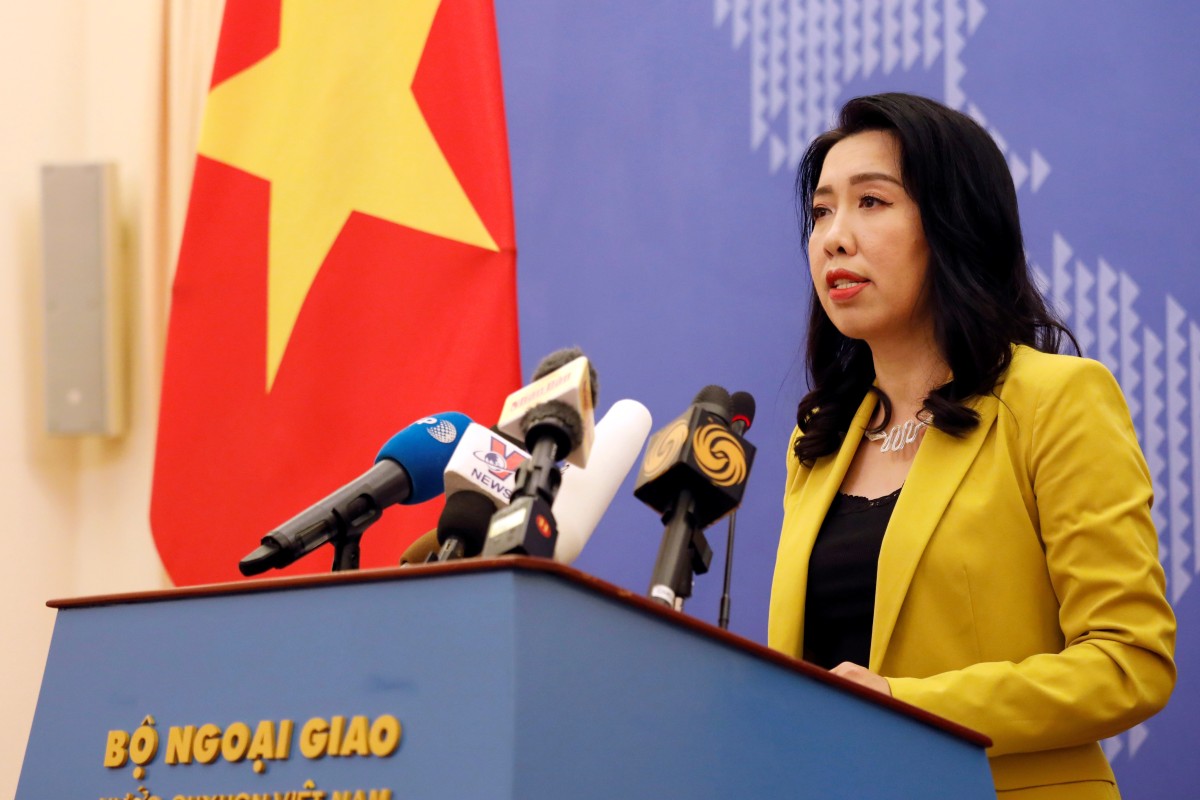
Vietnamese foreign ministry spokeswoman Le Thi Thu Hang. Photo: Reuters
Vietnam on Thursday called for the “immediate withdrawal” of a Chinese ship in the 
South China Sea

, as the stand-off over the disputed waters intensified.

Beijing last week issued a new call for Hanoi to respect its claims to the resource-rich region – which has historically been contested by Vietnam, as well as Taiwan, the Philippines, Malaysia and Brunei.
Hanoi responded by saying it had sent several messages to Beijing insisting that a Chinese survey ship vacate its waters, and doubled down on Thursday with new demands for the vessel’s removal.
“Vietnam has had several appropriate diplomatic exchanges … requesting immediate withdrawal from Vietnam’s exclusive economic zone,” a foreign ministry spokesperson told reporters, while refusing to disclose the ship’s precise location.
“Vietnam resolutely and persistently protects our sovereign rights … by peaceful means on the basis of international laws,” Le Thi Thu Hang added.
The ship, owned by the government-run China Geological Survey, begun research around the contested Spratly Islands on July 3, according to the US-based Center for Strategic and International Studies (CSIS).

Before it was spotted, a Chinese coastguard vessel also patrolled near Vietnamese supply ships in a “threatening manner”, CSIS said.

China has not confirmed the presence of its ships in the area.

China’s neighbours boost coastguards as tensions rise in South China Sea

Beijing invokes its so-called nine-dash line to justify its claim to historic rights to the waterway, and has previously built up artificial islands as well as installed airstrips and military equipment in the region.

The line runs as far as 2,000km (1,240 miles) from the Chinese mainland to within a few hundred kilometres of the Philippines, Malaysia and Vietnam.

In 2014 Beijing moved an oil rig into waters claimed by Hanoi, sparking deadly anti-China protests across Vietnam.

The latest stand-off in the sea prompted a swift rebuke from the United States over the weekend, calling for an end to China’s “bullying behaviour”.

US accuses China of acting like a bully in the South China Sea

“China’s repeated provocative actions aimed at the offshore oil and gas development of other claimant states threaten regional energy security,” the US State Department said Saturday.

The US has long called for freedom of navigation in the South China Sea, and on Thursday said it sailed a warship through the Taiwan Strait

.
Source: SCMP
28/07/2019

Latin America trade grows as China and US tussle for influence

  • Chinese Foreign Minister Wang Yi wraps up tour of Brazil and Chile, as Colombian president heads for Beijing
  • Ecuador president tells US Secretary of State Mike Pompeo ‘smaller countries pay when the big ones fight’
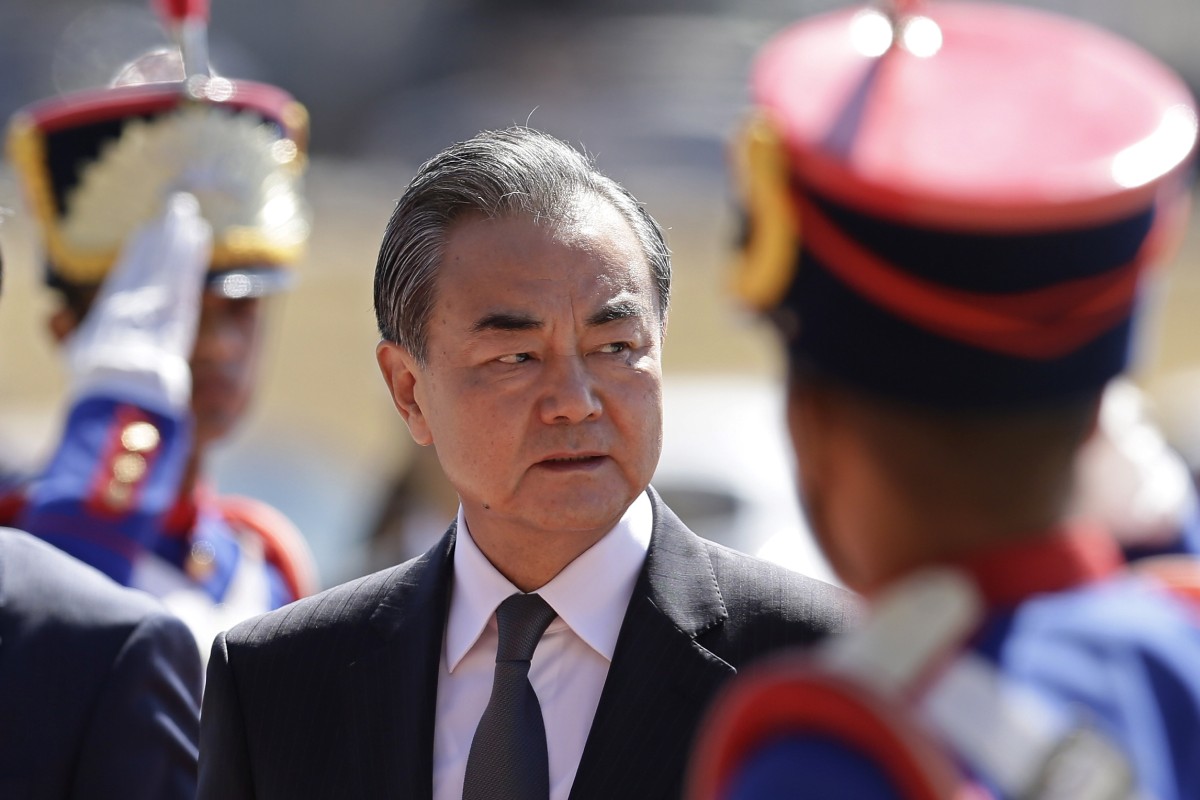
Chinese Foreign Minister Wang Yi is greeted by an honour guard as he arrives at the Itamaraty Palace for a meeting with his Brazilian counterpart Ernesto Araujo on Thursday. Photo: AP
Latin American countries are caught in the middle of a geopolitical tug of war between Beijing and Washington as China boosts its ties in the region in a bid to counterbalance the effects of its trade war with the US.
China’s Foreign Minister Wang Yi wraps up a tour of Latin America on Sunday which began last week in Brazil and ended with an official visit to Chile. He returns to Beijing on the same day Colombia’s President Ivan Duque Marquez arrives for a three-day state visit to China which will include a meeting with Chinese President Xi Jinping.
Wang was in Brazil for the latest summit of foreign ministers from the BRICS countries – an association of emerging countries made up of Brazil, Russia, India, China and South Africa – as well as the third China-Brazil foreign ministers’ comprehensive strategic dialogue with Brazilian Foreign Minister Ernesto Araujo.
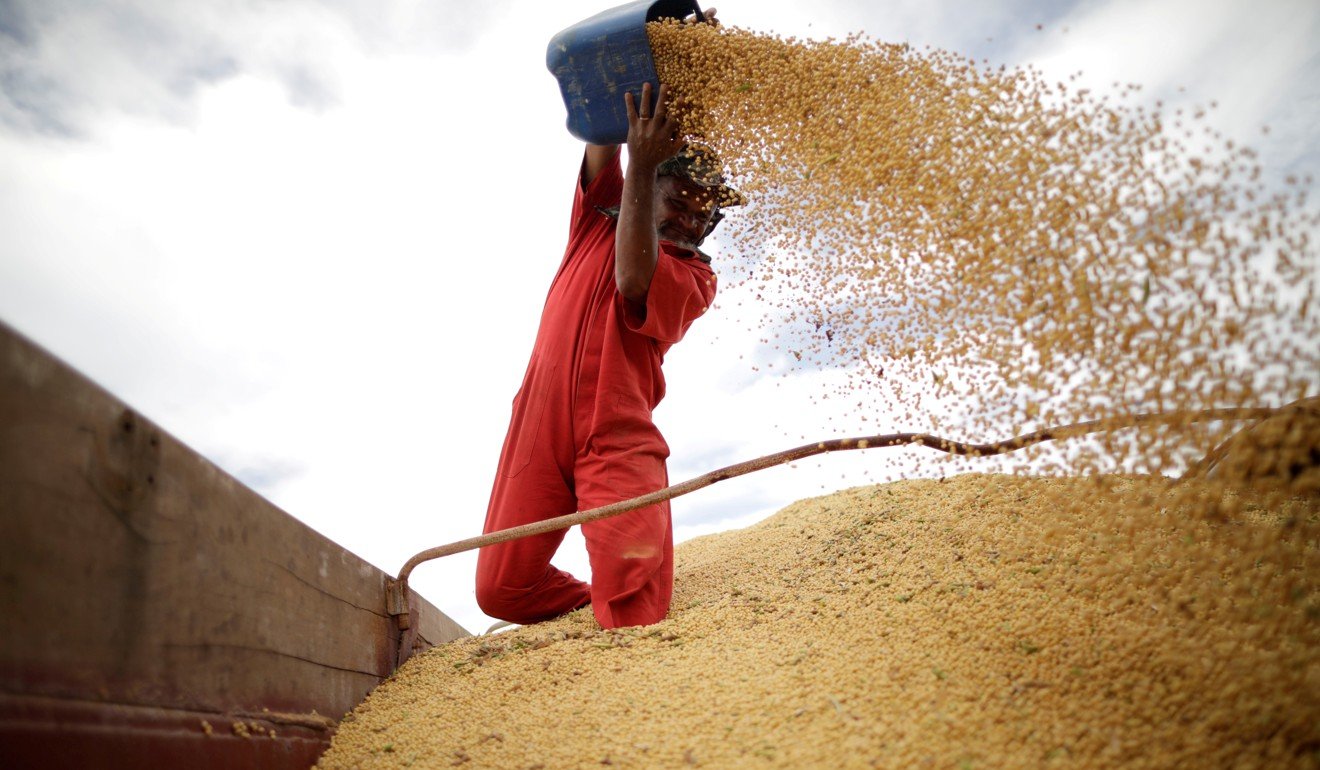
China has overtaken the US as Brazil’s largest trading partner, with Brazilian soybeans – one of the country’s biggest exports – and other agricultural products replacing American imports since the start of the US-China trade war a year ago.
Brazilian soybeans – one of the country’s biggest exports – and other farm products are being sold to China as a result of the trade war. Photo: Reuters

The growing importance of China to Brazil’s economy has created a difficult position for President Jair Bolsonaro, who accused Beijing of trying to buy Brazil during his election campaign, but changed tack on assuming office in January.

In March, Bolsonaro called China his country’s “main partner, politically as well as economically and commercially” and announced plans to travel to Beijing this year, a visit which was confirmed on Tuesday for late October.

China is now Latin America’s second largest trading partner with bilateral trade at US$307.4 billion, growing 18.9 per cent over the previous year, according to China’s ministry of commerce, in a relationship focused on commodity imports, including mining products like copper and energy, as well as soybeans and other agricultural goods.

While the US and China have tentatively agreed to resume talks in Shanghai next week, China and Latin American countries are likely to continue deepening their trade relations as production chains realign as a result of the trade war, according to Gustavo Oliveira, assistant professor of global and international studies at the University of California, Irvine.

“This means Chinese imports of Latin American agricultural and mineral commodities, and Latin American imports of Chinese manufactured products and hi-tech, might contribute to China’s ability to stand its ground against US pressure,” he said.

China in Latin America: partner or predator?
Oliveira said domestic contradictions in most Latin American countries complicated relations with China, as few leaders had the capacity to press or leverage China for much. “Unfortunately, therefore, most in this crop of Latin American leaders are basically placing themselves as junior partners or pawns in the geopolitical tug of war between the US and China.”
US Secretary of State Mike Pompeo put the pressure on Latin American countries over their relationship with China during his four-day tour of the region last weekend, when he visited Argentina, Ecuador, Mexico, and El Salvador.
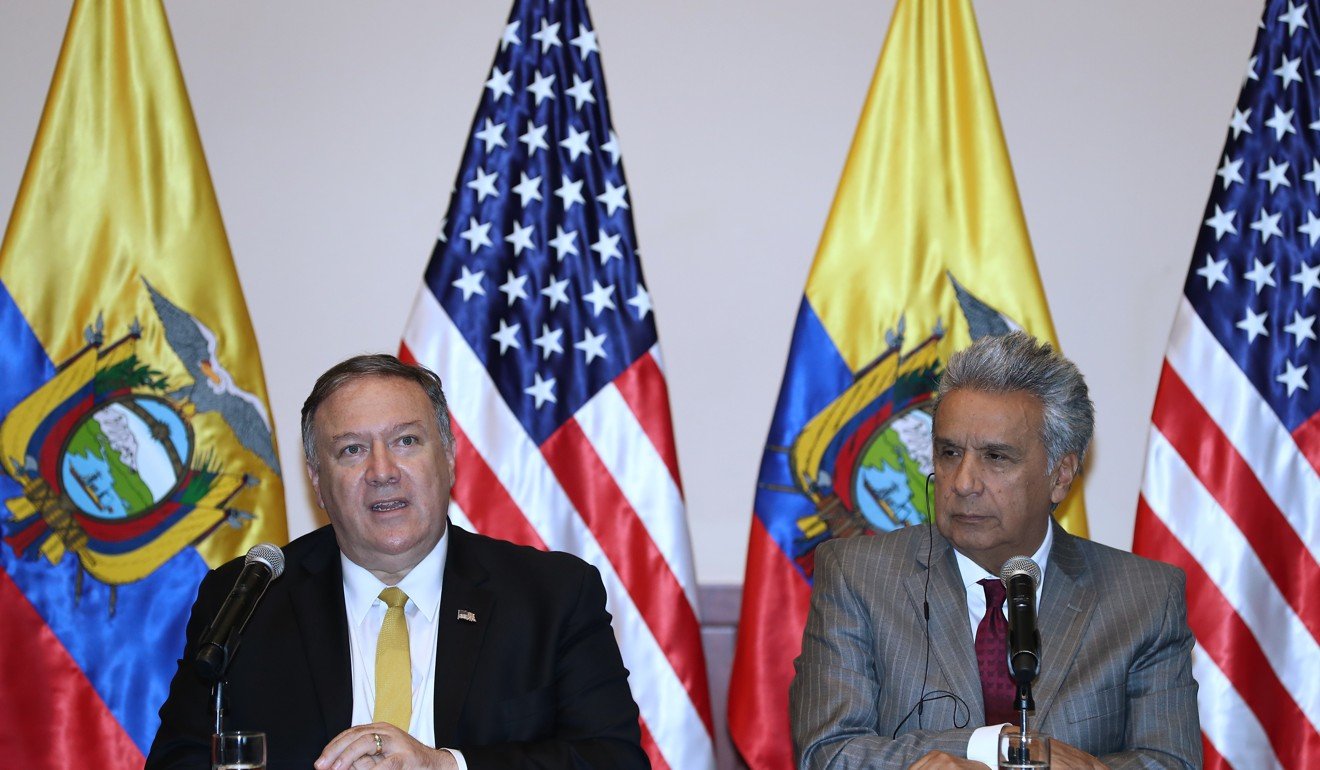
In a joint interview with Pompeo during the visit, Ecuador’s new President Lenin Moreno defended the country’s China ties, and urged Washington and Beijing to resolve their conflicts for the benefit of other nations in the region.
“We hope that the US and China, the greatest powers in the world now, will find agreement easily because, unfortunately, when the big ones are discussing or fighting and have conflicts, the ones that are paying for all of that are the smaller countries,” he said.
“Now, when two elephants fight, the ones who lose are the insects who are of course being crushed by the elephants in the attempt to evade them.”
US Secretary of State Mike Pompeo (left) and Ecuadorian President Lenin Moreno hold a joint press conference during Pompeo’s tour of Latin America on July 20. Photo: EPA-EFE

Pompeo blasted China’s role in the region during a previous tour of South America in April, when he singled out Beijing’s support for President Nicolas Maduro of Venezuela. Maduro is backed by Beijing, Russia and other allies, while the US and many European countries have supported opposition leader Juan Guaido as legitimate president since elections in January.

Speaking from Chile on that tour, Pompeo said Beijing’s calls for non-intervention in Venezuela were “hypocritical” and aimed at protecting Beijing’s investments in the country, as well as debts owed to China by Venezuela.

Pompeo also accused Beijing of “sowing discord” in the region through debt traps. “When China does business in places like Latin America, it often injects corrosive capital into the economic bloodstream, giving life to corruption and eroding good governance,” he said.

Professor Cui Shoujun of Renmin University in Beijing said Washington’s concerns about “debt trap diplomacy” in Latin America reflected concerns that China’s growing involvement in financing infrastructure and development projects would make the region more pro-China.

“China’s interests in Latin America go beyond raw materials extraction,” he said. “The biggest point of tension between the US and China in the region is perhaps that China presents an alternative model for development that is very different from the Western model.”

‘Mr Pompeo, you can stop’: China hits back over Latin America criticism

While the US was drumming up tensions about China across the world, Beijing was not openly retaliating but responding with investment and trade for global partners, said Kevin Gallagher, researcher on China-Latin America ties, and professor at Boston University.

“The US points fingers and makes angry speeches in the region as China cuts investment deals and helps address infrastructure needs,” he said.

“Latin American countries’ governments are rightly keeping their heads down on the broader geopolitical winds, and are getting down to business with their largest trading partner.”

Source: SCMP

28/07/2019

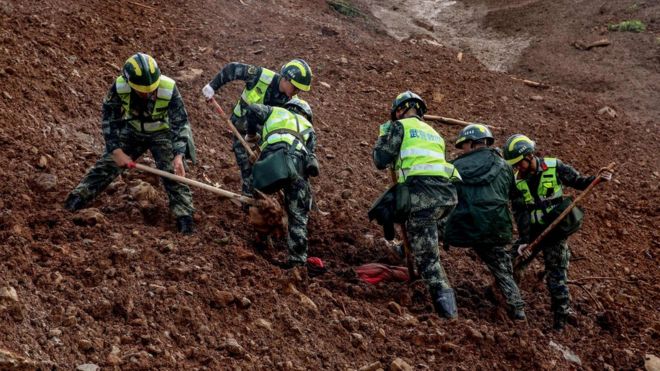
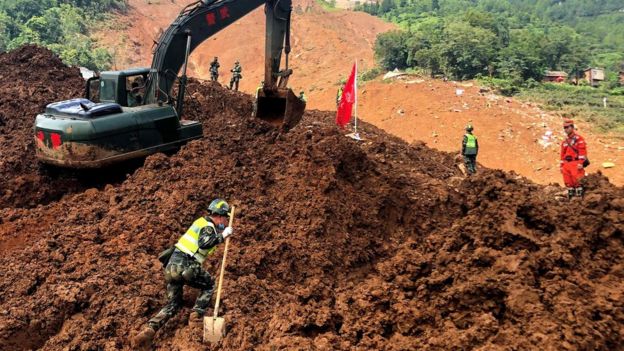
At least 30 killed and 15 missing after China landslide

Rescuers search for survivors at the site of a landslide in Liupanshui in China"s southwestern Guizhou provinceImage copyright AFP
Image caption The landslide was caused by heavy rains that have struck China this summer

At least 36 people are now known to have died in a landslide that struck a village in southern China on Tuesday.

State-run local media also report that 15 people have been missing since a wave of mud buried more than 20 houses in the province of Guizhou.

Chinese authorities told Xinhua news agency that another 40 people had been rescued from the landslide in Shuicheng county.

It comes as heavy rains continue to batter parts of the country.

Two children and a mother with a baby are reportedly among the dead, but details are still unclear.

Footage from state broadcaster CCTV show rescue workers using diggers to unearth survivors from a huge mound in the village.

Rescuers search for survivors at the site of a landslide in Liupanshui in China"s southwestern Guizhou provinceImage copyright AFP
Image caption  The government has reportedly earmarked 30 million yuan ($4.4m; £3.5m) for rescue efforts

A local school has also been commandeered as a emergency medical and rescue centre for victims.

According to Xinhua, the government has reportedly set aside 30 million yuan ($4.4m; £3.5m) for rescue efforts and the relocation of victims.

Landslides are common in rural and mountainous areas of China, especially after heavy rain.

Last month, footage emerged of a landslide in Fujian province in the country’s southeast.

Several other people have also been killed and thousands have been evacuated from their homes this year as a result of rain and flooding.


Source: The BBC
28/07/2019

India floods: Over 1,000 train passengers rescued near Mumbai

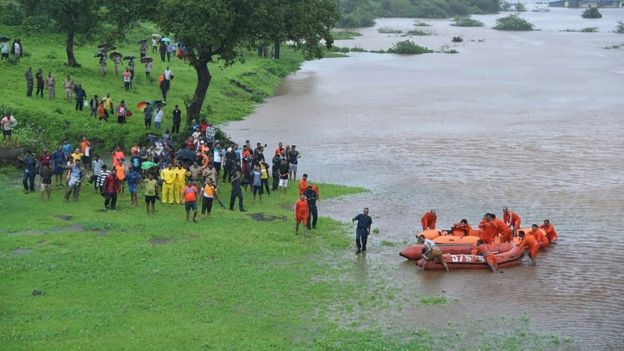
Indian authorities have rescued 1,050 people from a train after it became trapped by flooding near Mumbai.

Helicopters, boats and diving teams were deployed by the Indian authorities after the Mahalaxmi Express was stranded on Friday night close to the town of Vangani.

Passengers told news agency IANS they were ordered to stay onboard but had had no food or water for 15 hours.

Weeks of monsoon flooding in south Asia has killed over 600 people.

Images released by the NDRF show passengers being rescued in rubber boats.

Members of the National Disaster Resoponse Force (NDRF) rescue stranded passengersImage copyright AFP
Image caption Nine pregnant women are reportedly among those who have been rescued

Train operator Central Railway said all passengers – including nine pregnant women – had been recovered and taken to safety.

A temporary camp has been set up nearby with food and medical supplies.

A spokesperson for the train operator also said alternative travel arrangements had been arranged for passengers affected.

Most areas in the nearby towns of Badlapur, Ulhasnagar, Vangani have been submerged as heavy rains battered the region this week, swelling local rivers.

Other transport has also been hit by flooding in Mumbai, with 11 flights cancelled and several others diverted by from the city’s airport.


Source: The BBC
28/07/2019

India boosts Hindu pilgrimage to holy cave in conflict-torn Kashmir

PAHALGAM, India (Reuters) – India is hailing a Hindu pilgrimage to a holy cave high in the snow-capped mountains of contested Kashmir as an example of communal harmony, in a region where the Muslim-majority population is overwhelmingly hostile to its rule.

India and arch-rival Pakistan have fought two wars over Kashmir, and came close to a third in February after a suicide-bomb attack by Pakistan-based militants on Indian paramilitary police near the pilgrimage route.

India’s Hindu-nationalist government led by Prime Minister Narendra Modi has made “pilgrimage tourism” a focus, spending huge sums on January’s Kumbh Mela festival, where more than a hundred million Indians came to bathe in the holy Ganges river.

For the Amarnath Yatra pilgrimage in the Pahalgam area, the Jammu and Kashmir state government has spent a record $72 million on preparations for the six-week event that began on July 1.

“It is a perfect example of religious harmony,” said Anup Kumar Soni, additional chief executive of the Amarnath Ji Shrine Board, which organises the pilgrimage.

Saffron-clad Hindu ascetics, some barefoot and with photos of the cave around their necks, trudge the 46 km (28 mile) route to the cave across glaciers and waterlogged trails.
Muslim Kashmiri villagers in long woollen coats clear the way of snow and ice, and thousands of Indian troops are deployed to guard against attacks by Muslim militant groups.
The route is arduous. One in four of the 300,000 pilgrims who have visited this year have required medical treatment, and 24 have died, mainly from heart attacks and hypertension, according to government statistics.
‘ALWAYS FRIENDLY’

While thousands of Kashmiris work to clear the path, thousands more rent ponies and palanquins to the pilgrims, and tents for them to sleep in.

“Everyone is always friendly, there is no hostility here,” said a Hindu pilgrim who give his name as Abhhinav, hiking up a steep track in driving rain to one of the passes on the route that reaches nearly 4,500 metres (15,000 feet) in places.

The pilgrimage has been attacked repeatedly by militant groups – the last time in 2017 when eight pilgrims were killed in an ambush.

This year, the government has set up a bar-coding system, allowing only registered people onto the trail.

Separatists in Muslim-majority Kashmir have been campaigning against the government of Hindu-majority India for years, including a campaign of violence by militants, and an Indian security force response that Kashmiris often condemn as heavy handed.

The trouble has badly affected the region’s farming and tourism industries.

In Pahalgam, the pilgrimage offers a lifeline for many families.

“There is no private sector here, and so educated youth and many other Kashmiris are depending on the Yatra,” said Firoz Ahmed Wani, a history graduate and part-time tutor renting out two tents to pilgrims paying 200 rupees ($2.90) a night, at a camp along the route.

“We’re ordinary people. The conflict is something for the politicians to decide.”

Source: Reuters

27/07/2019

Ambassadors from 50 countries voice support for China’s position on issues related to Xinjiang


GENEVA, July 27 (Xinhua) — Ambassadors from 50 countries to the United Nations Office at Geneva (UNOG) have co-signed a letter to the President of the UN Human Rights Council (HRC) and the High Commissioner for Human Rights to voice their support for China’s position on issues related to its Xinjiang Uygur Autonomous Region.

Earlier on July 12, a number of ambassadors in Geneva sent the joint letter to show their support for China, and as of Friday evening, more ambassadors had joined, the Chinese Mission to the UNOG revealed.

In a statement issued on Friday night, the Chinese mission said that some other countries had also expressed their support in separate letters or press statements.

In the joint letter, the ambassadors commend China for its economic and social progress, effective counter-terrorism and de-radicalization measures, and strong guarantee of human rights.

They appreciate the opportunities provided by China for diplomatic envoys, officials of international organizations, and media professionals to visit Xinjiang, and point to the contrast between Xinjiang in the eyes of those who have visited it and the one portrayed by some western media.

The ambassadors also urge a certain group of countries to stop using uncorroborated information to make unfounded accusations against China.

“I was surprised that some people call these vocational training and education centers concentration or internment camps,” Vadim Pisarevich, deputy permanent representative of Belarus to the UNOG, told Xinhua.

“They’re nothing of the kind. They look like ordinary educational facilities and even I said that they are more than this because they provide life skills training to the students,” Pisarevich said.

They are “very useful institutions for addressing the problems of terrorism, extremism and separatism,” he said.

“Terrorism and extremism are an intractable challenge across the world. In the face of its grave threat, Xinjiang Uygur Autonomous Region responded with a number of lawful steps, including setting up vocational education and training centers, to prevent and combat terrorism and extremism,” the Chinese Mission to the UNOG said in its statement.

“Facts speak louder than words, and justice cannot be overshadowed. The great diversity of countries co-signing the letter — from Asia, Africa, Latin America, and Europe, especially the OIC (Organization of Islamic Cooperation) — makes it clear that the international community has drawn a fair conclusion about Xinjiang’s human rights achievement and counter-terrorism and de-radicalization outcome,” the statement said.

“Those that seek to use human rights as an excuse to slander and pressure China have only themselves to deceive,” it added.

“We oppose any attempt to use human rights issues as a cover for interference in a country’s internal affairs. We urge those who are doing so to change course, refrain from politicization and double standards, and stop interfering in the internal affairs of other countries under the pretext of human rights,” it said.

At a press conference on Friday, China’s Ambassador to the UNOG Chen Xu also rebuked some Western nations for slandering China over Xinjiang, noting that China doesn’t accept these “groundless accusations.”

Jamshed Khamidov, head of Tajikistan’s mission in Geneva, said his government opposes any attempts to use the Human Rights Council for particular political purposes, and efforts should be made to avoid any politicization of the Human Rights Council.

“We know the situation in the Xinjiang region. We know how much the government of China is doing … and what kind of measures were implemented in this region to support its peace, security and development,” he said.

In visits to the vocational training and education centers in Xinjiang’s Urumqi and Kashi, Zenon Mukongo Ngay, head of the Democratic Republic of Congo’s mission in Geneva, said he was impressed with the “level of development” in Xinjiang and how the people in the centers receive education for getting a job.

The Chinese mission also said that together with all parties, China is committed to promoting the healthy development of the international human rights cause by encouraging multilateral human rights institutions to stick to the purpose and principles of the UN Charter, handle human rights issues in an objective, impartial and non-selective manner, and engage in constructive dialogues and cooperation.

Source: Xinhua

Law of Unintended Consequences

continuously updated blog about China & India

ChiaHou's Book Reviews

continuously updated blog about China & India

What's wrong with the world; and its economy

continuously updated blog about China & India