Archive for July, 2019

10/07/2019

China’s producer prices stall in June, fuel deflation worries

The producer price index (PPI) showed no growth in June from a year earlier, the National Bureau of Statistics (NBS) said on Wednesday. That compared with a 0.6% rise in May and a gain of 0.3% forecast by economists in a Reuters poll.

The June PPI reading was the lowest since August 2016 when the index last fell year-on-year. Factory gate prices slowed from May as well, falling 0.3%.

On the other hand, June consumer price growth in annual terms matched a 15-month high seen in May as supply shortages triggered by the African swine fever outbreak and extreme weather conditions continued to push up pork and fruit prices.

A cooling in producer prices, seen as a gauge of industrial demand that gives momentum to investment and profits in the Chinese economy, may rekindle worries about deflation and prompt the authorities to launch more aggressive stimulus.

“The bigger picture is inflation, apart from food inflation, is actually pretty weak and with the economy continuing to cool, I think the return to factory-gate deflation is very likely,” said Julian Evans-Pritchard, senior China economist at Capital Economics.

Tommy Xie, China economist at OCBC Bank in Singapore, also said he saw the risk of produce prices contracting in annual terms as early as next month.

Upstream sectors were particularly weak, with prices for oil and natural gas extraction down 1.8% from a year earlier, the NBS data showed. Price gains in the coal mining sector also eased.

Although Beijing and Washington reached another truce in their trade war last month, economists expect continuing pressure on the Chinese economy as manufacturers shift more production abroad to avoid U.S. tariffs on China-made goods.

China’s factory activity shrank more than expected in June as tariffs and weaker domestic demand hit new orders for goods.

Beijing is fast-tracking more infrastructure projects but prices for some construction materials remain lacklustre.

Spot prices for steel rebar in June lingered below the levels of a year earlier and may worsen due to seasonal slackening of construction activity amid high temperatures and rainfall in summer.

Premier Li Keqiang pledged earlier this month to implement financing tools including reserve requirement ratio (RRR) cuts to support small and private firms, adding to expectations for further stimulus measures.

At the same time, however, he and other top policymakers have reiterated that China will not resort to large-scale stimulus.

Evans-Pritchard from Capital Economics said the government could adopt more monetary easing and off-budget fiscal support to bolster the economy.

“But I think the days of big drastic stimulus are probably over. The most we can hope for is really it (more government support) helps to dampen the headwinds and prevent the economy from slowing too sharply.”

CPI STILL ELEVATED

The consumer price index (CPI) in June rose 2.7% in annual terms, driven by higher food prices. Fruit prices surged 42.7% from a year earlier while pork prices rose 21.1%.

Analysts polled by Reuters expected consumer prices to rise 2.7%, matching the pace seen in May.

Some economists said consumer inflation may accelerate due to dwindling pig stocks, but others contended price rises will cool.

“CPI may have peaked in June and could come off steadily in the second half,” said Wang Jun, Beijing-based chief economist at Zhongyuan Bank. “There are deflationary risks but the overall pressure is not big, because deflationary risk is only restricted to manufacturing products.”

Core inflation that strips out volatile food and energy prices was at 1.6% in June from a year earlier, the same annual pace as in May.

On a month-on-month basis, CPI fell 0.1% in June after no change in May.

Source: Reuters
10/07/2019

Jai Shri Ram: The Hindu chant that became a murder cry

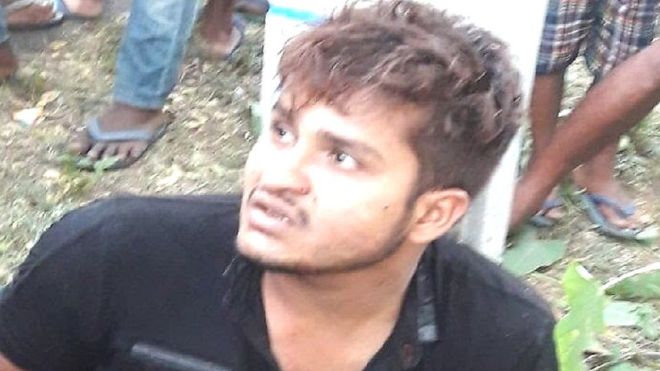
Tabrez AnsariImage copyright BBC HINDI
Image caption A video showing Tabrez Ansari pleading for his life was widely circulated on social media

In many parts of India, Hindus often invoke the popular god Ram’s name as a greeting. But in recent years, Hindu lynch mobs have turned Ram’s name into a murder cry, writes the BBC’s Geeta Pandey in Delhi.

Last month, a video that went viral on social media showed a terrified Muslim man tied to a pole being assaulted by a lynch mob made up of Hindu men in the eastern state of Jharkhand.

In the video, 24-year old Tabrez Ansari is seen pleading for his life, blood and tears streaming down his face.

His attackers force him to repeatedly chant “Jai Shri Ram”, which translates from Hindi to “hail Lord Ram” or “victory to Lord Ram”.

Mr Ansari does as told, and when the mob is finished with him, he is handed over to the police.

The police lock him up and his family is not allowed to see him. He dies four days later from injuries sustained during the attack.

Mr Ansari is not the only one to have been singled out in this manner. June was a particularly bloody month for Indian Muslims, who were targeted in several such attacks.

In Barpeta district in the north-eastern state of Assam, a group of young Muslim men were assaulted and then made to chant slogans like “Jai Shri Ram”, “Bharat Mata ki Jai” (long live Mother India) and “Pakistan murdabad” (death to Pakistan).

In the commercial capital Mumbai, a 25-year-old Muslim taxi driver was abused, beaten up and told to chant “Jai Shri Ram” by a group of men. Faizal Usman Khan said he was attacked when his taxi broke down and he was trying to fix it. His attackers fled after a passenger called the police.

And in the eastern city of Kolkata, Hafeez Mohd Sahrukh Haldar, a 26-year-old Muslim teacher at a madrassa (religious seminary), was heckled while travelling on a train by a group of men chanting “Jai Shri Ram”.

He told reporters that they made fun of his clothes and beard, and then insisted that he also chant the slogans. When he refused, they pushed him out of the moving train. Mr Haldar was injured, but lived to tell the tale.

The slogan-shouting and heckling is no longer restricted to the mob and the streets. Worryingly, it has also entered parliament.

When the newly-elected lower house convened for the first time on 17 June, Muslim and opposition MPs were heckled by members of Prime Minister Narendra Modi’s Bharatiya Janata Party (BJP) when they stood up to take the oath.

The attacks on the minorities have been condemned by opposition politicians. Rahul Gandhi, before he resigned as leader of the main opposition Congress party, described the mob lynching of Tabrez Ansari as a “blot on humanity”.

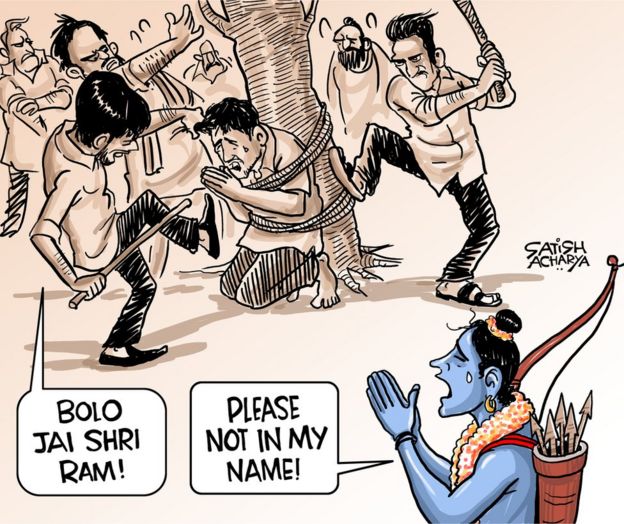
Many critics, including cartoonist Satish Acharya, have also expressed alarm over the rising number of such incidents.

CartoonImage copyright COURTESY: SATISH ACHARYA
Image caption Cartoonist Satish Acharya says using Ram’s name to unleash violence risks widening India’s religious divide

In villages across north India, devout Hindus have traditionally used “Ram Ram”, “Jai Siya Ram” (goddess Siya or Sita is Ram’s consort) or “Jai Ram Ji Ki” as a greeting.

And many feel a sense of unease that these attacks and killings are being carried out in the name of a god revered by millions for his sense of justice and benevolence.

But “Jai Shri Ram” has now been turned into a cry of attack, meant to intimidate and threaten those who worship differently.

The invocation was first used as a political chant in the late 1980s by the BJP to mobilise the Hindu masses during the movement to construct a Ram temple at a disputed siteat Ayodhya.

The party’s then president LK Advani launched a march supporting the construction of the temple and in December 1992 mobs chanting “Jai Shri Ram” marched upon the northern town and tore down the 16th Century Babri mosque.

The BJP believes the mosque was built after the destruction of a temple to Ram that once stood there.

The campaign galvanised Hindu voters in favour of the BJP and helped turn Ram from personal to political. Since then, the party has consistently invoked the deity during elections and the 2019 polls were no exception.

Critics say those who heckle minorities, inside parliament and outside it, see the BJP’s sweeping victory in the April/May elections as sanctioning their behaviour. The party won more than 300 seats in the 543-member lower house, propelling Mr Modi to a second term.

Mr Modi’s first term in power was marked by violence against minorities. There were numerous incidents of Muslims being attacked by so-called “cow vigilantes” over rumours that they had eaten beef, or that they were trying to smuggle cows – an animal many Hindus consider holy – for slaughter.

The prime minister did not condone such attacks, but was criticised for not condemning them either.

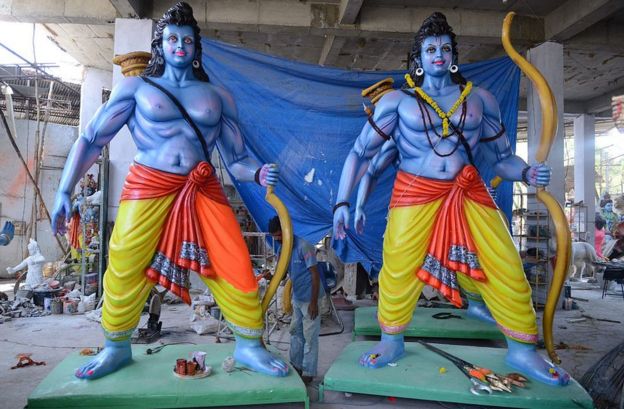
An Indian artist puts final touches to statues of the Hindu God Lord Ram in Hyderabad on April 13, 2016Image copyright GETTY IMAGES
Image caption Millions of Hindus revere the god Ram for his sense of justice and benevolence

But right after the BJP’s stunning victory in May, Mr Modi expanded his earlier slogan of “sabka saath, sabka vikas” (development for all) to include “sabka vishwas” (to win the trust of everyone), giving rise to hopes that this term would be different.

A few days after Tabrez Ansari’s death, he told parliament that he was “pained” by the incident and that “the guilty must be severely punished”.

But many Indians doubt that any serious action will be taken against those who carry out such attacks.

Several dozen people have been killed and hundreds injured since 2014 in mob attacks, but there have been convictions in only a handful of cases.

In others, the accused remain free, often due to a lack of evidence, and some have been seen being feted by Mr Modi’s party’s colleagues.

BJP leaders often downplay such incidents, calling them “minor” and accusing the press of “maligning the image of the government”.

One BJP MP recently told a news website that the popularity of the slogan “Jai Shri Ram” was a sort of protest by Hindus “against a certain bias and tilt of the polity towards minorities”.

“They are also asserting that we are Hindus and we count as Hindus,” he said.

But critics say that there are other – better – ways of doing that.

Source: The BBC

09/07/2019

China’s high-speed rail offers model for other countries: World Bank

BEIJING, July 8 (Xinhua) — China’s high-speed railway (HSR) has registered rapid growth and offered many viable practices for other countries considering HSR investment, according to a World Bank report released Monday.

Key factors enabling the growth include the development of a comprehensive long-term plan and the standardization of designs and procedures, said the report, which summarizes China’s HSR development.

China’s Medium- and Long-Term Railway Plan, which looks up to 15 years ahead, provides a clear framework for the development of the system, according to the World Bank.

Meanwhile, the construction cost of the Chinese HSR network stood at about two-thirds of the cost in other countries, the report said, citing an average of 17 million U. S. dollars to 21 million U. S. dollars per km.

“China has built the largest high-speed rail network in the world. The impacts go well beyond the railway sector and include changed patterns of urban development, increases in tourism, and promotion of regional economic growth,” said Martin Raiser, World Bank director of China.

By the end of 2018, the total railway operation mileage reached 131,000 km, five times higher than 1949, while the high-speed railway exceeded 29,000 km, accounting for more than 60 percent of the world’s total, according to a recent report by the National Bureau of Statistics.

In China, high-speed rail service is competitive with road and air transport for distances of up to about 1,200 km, while fares are about one-fourth the base fares in other countries, which allows HSR trains to attract passengers from all income groups, the report said.

“Large numbers of people are now able to travel more easily and reliably than ever before, and the network has laid the groundwork for future reductions in greenhouse gas emissions,” Raiser said.

Source: Xinhua

09/07/2019

Chinese FM calls for deepening comprehensive strategic partnership with Poland

POLAND-WARSAW-CHINA-WANG YI-VISIT

Chinese State Councilor and Foreign Minister Wang Yi (L) and Polish Foreign Minister Jacek Czaputowicz attend a press conference after holding talks and attending the opening ceremony of the second plenary session of China-Poland Intergovernmental Cooperation Committee in Warsaw, Poland, on July 8, 2019. (Xinhua/Chen Xu)

WARSAW, July 8 (Xinhua) — Chinese State Councilor and Foreign Minister Wang Yi held talks with Polish Foreign Minister Jacek Czaputowicz here on Monday, calling for deepening comprehensive strategic partnership with Poland.

Noting this year marks the 70th anniversary of the establishment of diplomatic relations between China and Poland, Wang said bilateral relations have withstood the tests of changing international situations and maintained good momentum. During Chinese leader’s visit to Poland in 2016, the leaders of the two countries agreed to elevate the bilateral ties to comprehensive strategic partnership, indicating the direction for future development of the bilateral ties.

China attaches great importance to the key role Poland plays as a major country among Central and Eastern European Countries (CEEC) as well as in the European Union (EU), Wang said, adding China stands ready to work with the Polish side to extend traditional friendship, build cooperation consensus, inject new impetus into bilateral relations, and push for the comprehensive strategic partnership between the two nations to run at the forefront of China-CEEC ties.

The Chinese foreign minister called on the two countries to strengthen strategic communication, maintain high-level exchanges in various fields, cement political mutual trust, and respect and give consideration to each other’s core interests and major concerns.

The two sides should seize the cooperation opportunities of jointly building the Belt and Road Initiative (BRI) to boost infrastructural construction, production capacity, and Eurasian transport corridor so as to contribute to the global interconnectivity partnership, Wang said.

The two sides should also cultivate new growth points in areas like nuclear power, environmental protection and technological innovation, he added.

The Chinese market is open to Poland, and China is willing to import more Polish products to mitigate trade imbalance, Wang said, noting that China encourages its enterprises to invest and operate in Poland and hopes the Polish side will offer them fair, open and non-discriminatory business environment.

The Chinese foreign minister also called on the two sides to uphold multilateralism, safeguard the rules-based multilateral trading system, and join hand in hand to tackle global challenges like climate change.

The two sides should also strengthen communication and coordination on international and regional affairs so as to boost stability and prosperity in Eurasia, he said. The Chinese official also hopes Poland can serve as a bridge linking China and Western countries as well as Asia and Europe.

On his part, Czaputowicz said Poland, located in the heartland of the Europe, is willing to actively take part in the joint construction of the BRI, strengthen bilateral exchanges, and play an active role in promoting China-CEEC cooperation and EU-China ties.

Poland welcomes Chinese investments, and will treat foreign enterprises according to international laws and business principles. Poland will not exclude Chinese enterprises or adopt any discriminatory measures against them, said Czaputowicz.

The two officials also on Monday attended the opening ceremony of the second plenary session of China-Poland Intergovernmental Cooperation Committee.

Source: Xinhua

09/07/2019

China and India eye joint military drills as sides seek thaw after face-off on Himalayan border

  • Relations between the Asian giants had been strained after a 73-day military stand-off at their disputed border last year
The Chinese People’s Liberation Army in Beijing. Photo: EPA
China and India aim to hold joint army drills in China before the end of this year, China’s Defence Ministry said on Thursday, as the two countries continue a rapid rapprochement.
Relations between the Asian giants were strained last year over a 73-day military face-off in a remote, high-altitude stretch of their disputed Himalayan border.
Chinese ‘tourists’ face 7 years in Indian jail over shahtoosh shawls made from endangered antelope
But the neighbours have over recent months been working on mending ties and Chinese Defence Minister Wei Fenghe met Indian Prime Minister Narendra Modi in New Delhi in August.
Speaking at a regular monthly news briefing, Chinese Defence Ministry spokesman Wu Qian said that the joint exercise was planned for before the end of this year.
China and India are aiming to hold joint army drills this year as part of an ongoing rapprochement. Photo: EPA

The two countries would meet in the southwestern Chinese city of Chengdu next month to discuss the arrangements, he added, without giving other details.

India and China fought a war in 1962 and the unresolved dispute over stretches of their 3,500km (2,200 miles) border has clouded relations ever since.

But the two big Asian economies share similar positions on a host of issues including concern about US tariffs and Chinese President Xi Jinping and Modi agreed in April to improve relations.

Source: SCMP

09/07/2019

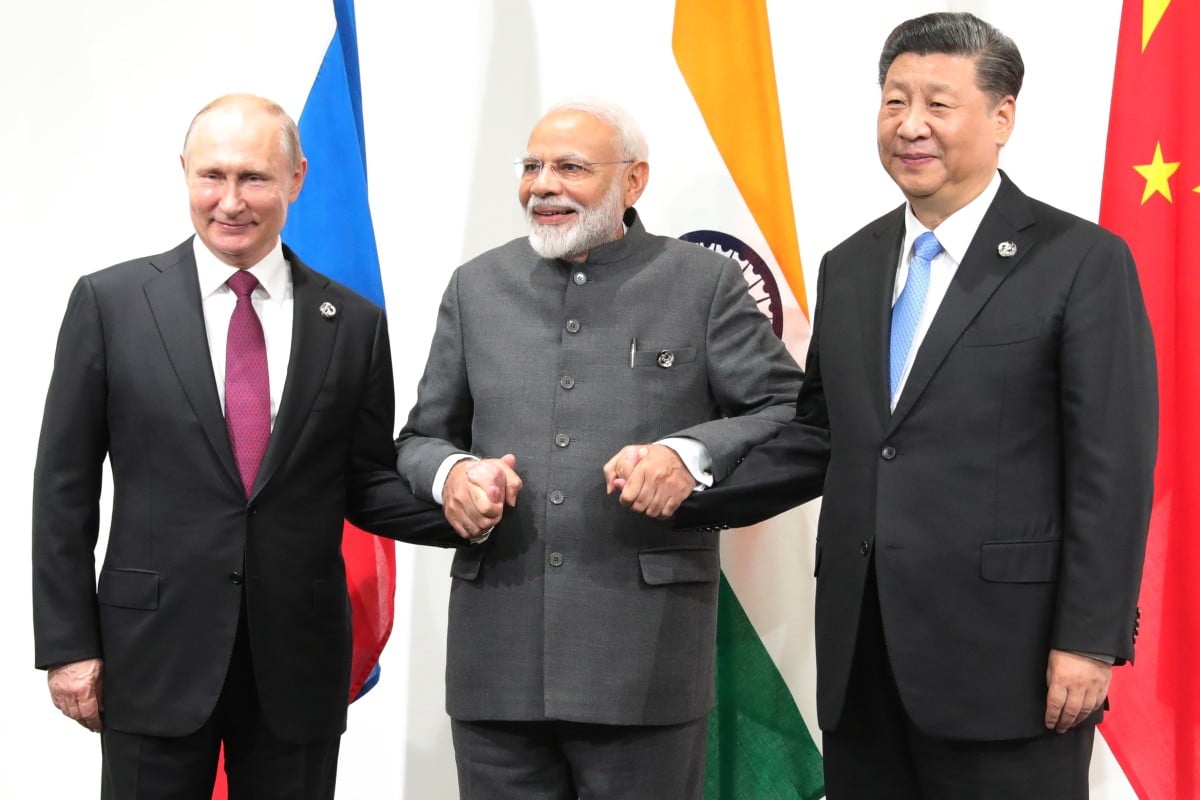
Xi Jinping says China, Russia and India should take ‘global responsibility’ to protect interests

  • Chinese president also called for the three nations to uphold multilateralism in talks with Vladimir Putin and Narendra Modi in Osaka
  • In a separate meeting with other BRICS leaders, he said Beijing opposed ‘illegal and unilateral sanctions’ and ‘long-arm jurisdiction’
(From left) Russian President Vladimir Putin, Indian Prime Minister Narendra Modi and Chinese leader Xi Jinping meet on the sidelines of the G20 summit in Osaka, Japan, on Friday. Photo: EPA-EFE
Chinese President Xi Jinping on Friday called on the leaders of Russia and India to take “global responsibility” to safeguard the three countries’ interests and uphold multilateralism, as Beijing seeks to rally support amid its protracted trade war with Washington.
Xi made the remarks during a trilateral meeting with Vladimir Putin and Narendra Modi on the sidelines of the annual 
Group of 20

summit of world leaders in Osaka, Japan.

The trilateral meeting was part of the Chinese leader’s efforts to marshal international support ahead of his 
high-stakes meeting

with US President Donald Trump, seeking to reach a truce on the year-long trade conflict between the world’s two biggest economies.

“The rise of protectionism and unilateralism has severely affected global stability and economic growth, as well as the existing international order which emerging economies and developing countries have relied on,” Xi was quoted as saying by state broadcaster CCTV.

“China, Russia and India should take on global responsibility to safeguard the fundamental and long-term interests of these three countries and the world,” he said.

Xi also called for the nations to promote “a more multipolar world and the democratisation of international relations” – meaning with less reliance on a US-led world order.

During a meeting with leaders of the other BRICS countries – major emerging economies Brazil, Russia, India, China and South Africa – Xi also said Beijing opposed what it saw as “illegal and unilateral sanctions” and “long-arm jurisdiction”.

The efforts to forge closer ties among China, Russia and India come as all three nations are locked in disputes with the United States.

New Delhi, a key strategic ally in Washington’s Indo-Pacific policy to contain China’s rise, has been upset over tariffs imposed on Indian goods by the Trump administration. Meanwhile, geopolitical rivalry and the Kremlin’s alleged meddling in US elections has strained relations between Moscow and Washington.

Beneath the smiles and handshakes, tensions simmer as world leaders meet for G20

Wu Jianghao, director general of the Chinese foreign ministry’s Asian affairs department, said the trilateral meeting laid out a framework for future cooperation.

“The three countries have spoken with one voice on some major global issues, helping stability and injecting positive energy to the current international situation – which is filled with instability and uncertainties,” Wu said at a briefing on Friday.

Wu said that the leaders did not talk about Huawei Technologies or 5G networks, but that the three countries had maintained good communication on telecoms issues and would continue to cooperate.

Washington has banned US companies from selling American technology to Huawei and put pressure on its allies to block the Chinese tech firm over security concerns.

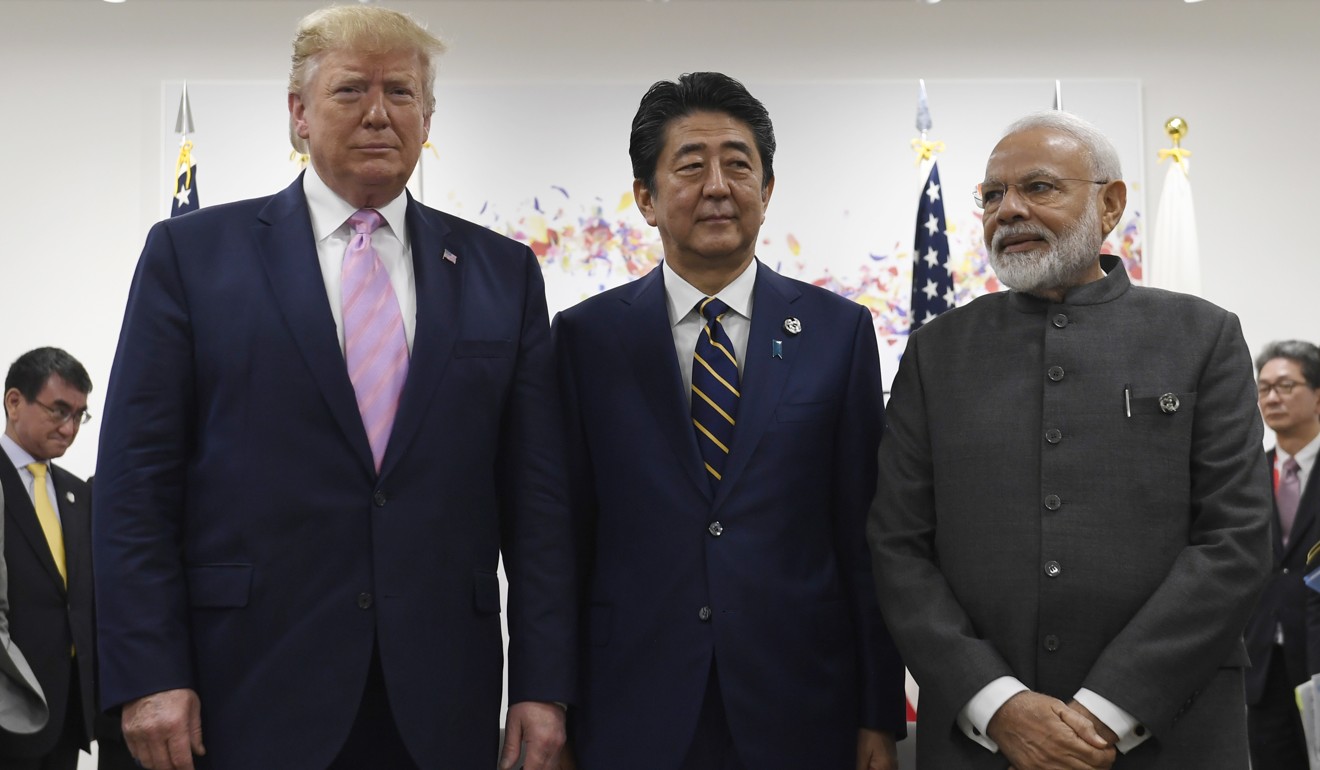
(From left) US President Donald Trump, Japanese Prime Minister Shinzo Abe and Indian Prime Minister Narendra Modi pose for a photo before their meeting. Photo: AP

Meanwhile, the United States is also seeking to build ties with India, with Trump holding trilateral talks with Modi and Japanese Prime Minister Shinzo Abe on Friday.

Indian Foreign Secretary Vijay Gokhale described that trilateral meeting as “very good”, saying it was “short but very productive”.

“The main topic of discussion was the Indo-Pacific, about how the three countries could work together in terms of connectivity, infrastructure and ensuring that peace and stability is maintained, and working together to build upon this new concept so that it would benefit the region as a whole and the three countries,” Gokhale said.

On the Modi-Trump bilateral meeting, he said the two leaders had “a very warm discussion”. They also briefly discussed 5G, with the focus on business cooperation between the two countries to leverage their technology and the potential of the Indian market, according to Gokhale.

He said the discussion of how to develop 5G networks was “in terms of business, not in terms of governments”. “It’s an exciting new area that India and the US can work together [on],” he said.

Source: SCMP

09/07/2019

‘We need to talk’: call for Chinese and Indian navies to communicate

  • Ambassador to China Vikram Misri says they will be ‘meeting more and more in common waters’, and more exchanges are needed
  • He also says preparations are under way for President Xi Jinping to visit India
The INS Kolkata arrives in Qingdao for PLA Navy 70th anniversary celebrations in April. The Indian ambassador called for more communication between the two navies. Photo: Reuters
The INS Kolkata arrives in Qingdao for PLA Navy 70th anniversary celebrations in April.
The Indian ambassador called for more communication between the two navies. Photo: Reuters
The Chinese and Indian navies should establish communication because they are increasingly operating within close proximity, according to India’s ambassador to China.

While the two nations’ militaries communicated extensively, it was mainly between their land forces, and that should be extended to the navies and air forces, Vikram Misri said.

“We need to talk about the two air forces and the two navies – especially the two navies – because we are operating in the same waters and increasingly in the coming years, we will be meeting more and more in common waters,” Misri said.

“I think it is important for us to develop those levels of understanding and communication,” he said. “There are some [navy and air force] exchanges now, but not as well developed as in the case of the land force.”
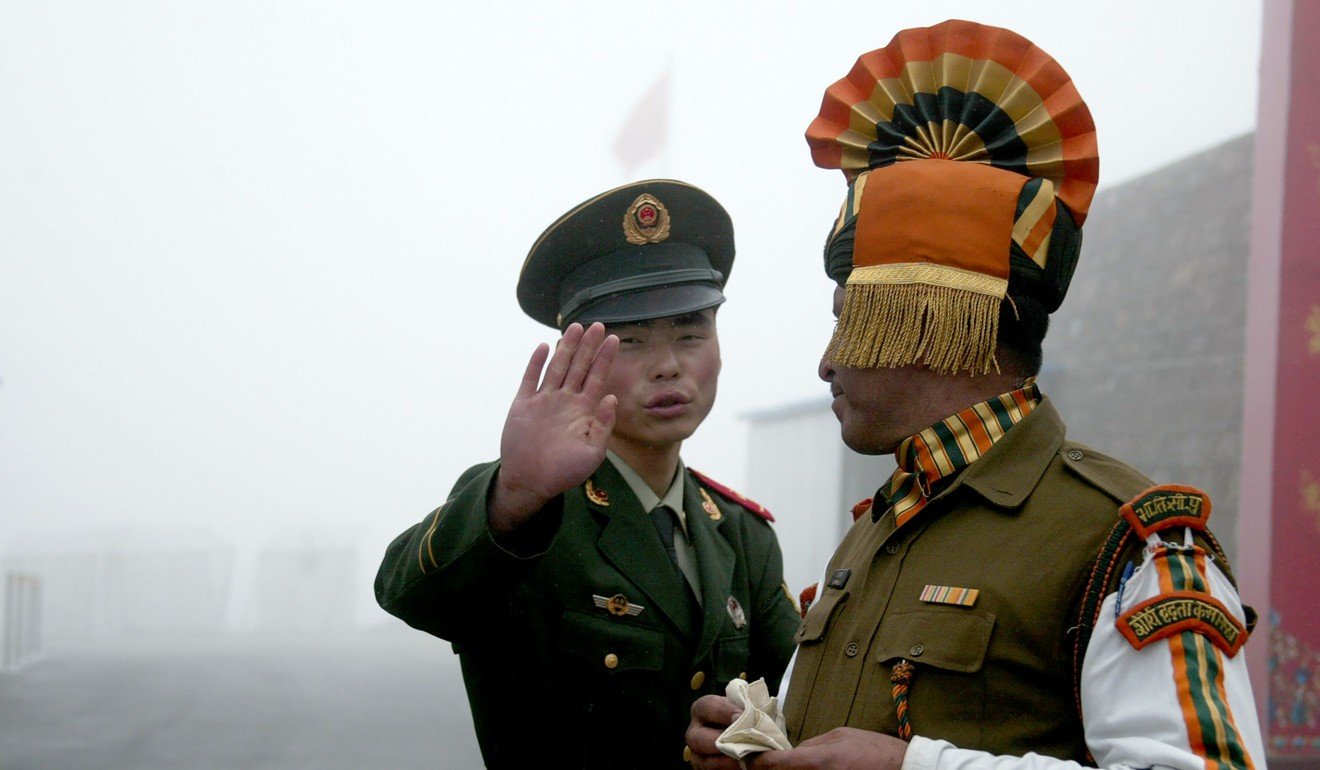
China and India have made efforts to repair their relations since a tense stand-off at the Doklam plateau two years ago, when communications between their forces along the border were seen as inadequate to contain the tension.
China and India have sought to repair relations after a tense stand-off at Doklam. Photo: AFP

Misri said the two nations had made incremental progress, and opened new points where “border personnel can meet and exchange information, or exchange views about any particular situation”.

The ambassador was visiting the Indian consulate in Hong Kong over the weekend, six months after taking up the post and six weeks after Prime Minister Narendra Modi was re-elected.

He said preparations were under way for Chinese President Xi Jinping to visit India, which was expected to happen in the fourth quarter, after they pledged earlier to strengthen cooperation.

Tensions between 

China and India

have periodically flared along their 4,000km (2,485-mile) border, resulting in a brief war in 1962. Relations have also been strained by China’s ties with Pakistan, and India’s concern over China’s growing presence in the Indian Ocean.

India has also not signed on to China’s global trade and infrastructure strategy, the

Belt and Road Initiative

, which has projects that run through the disputed Kashmir region.

“Our concerns with regards to this particular initiative are very clear, and we have continued to share them very, very frankly with our Chinese partners,” Misri said. “I think there is understanding on the part of our Chinese partners with regard to this.”
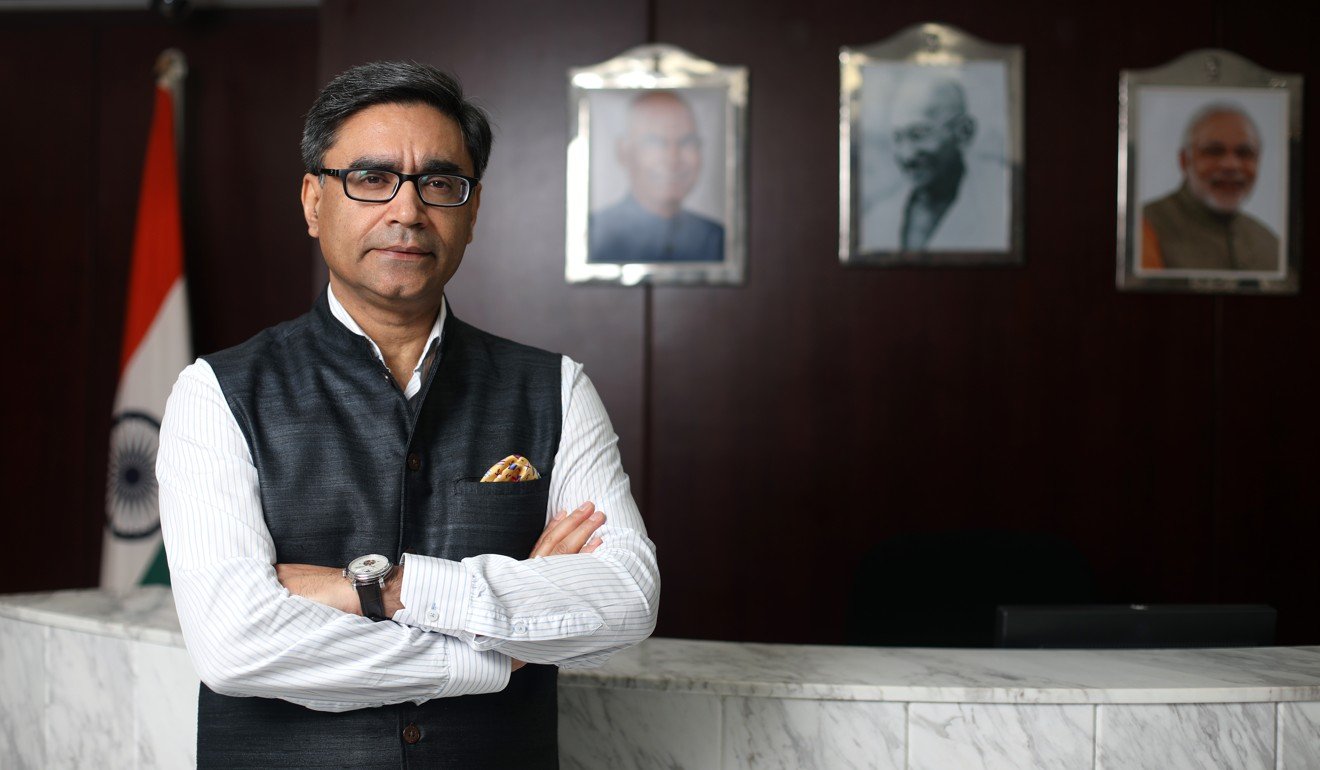
Indian ambassador to China Vikram Misri said New Delhi’s concerns on the Belt and Road Initiative were clear. Photo: Xiaomei Chen

But he said the two nations should not let their differences evolve into disputes, and they should focus on areas where they can cooperate.

One such area was maritime and investment cooperation in the Indo-Pacific region, including infrastructure and disaster response. The US in recent years has focused on the Indo-Pacific region, and has asked its allies to send naval vessels to the area as a counterbalance to Beijing.

“We have made the point that our vision of the Indo-Pacific is not a strategy, which sometimes is a concern on the part of some partners, aimed against any particular country,” Misri said. “It is definitely not a military alliance in any format.

“It is on the other hand a vision that aims at economic and development cooperation with our partners in the Indo-Pacific space,” he said, adding that India was discussing such cooperation with China.

He also said trilateral meetings between China, India and Russia would become more regular after their three leaders met on the sidelines of the 

Group of 20

summit in Osaka, Japan last month, when they vowed to uphold multilateralism.

Those meetings would allow the nations to address challenges facing the international trading system and pushback against globalisation, but Misri said they should not be seen as a bid to counter the US, which is also involved in a trade battle with India.

India also had a trilateral meeting with Japan and the United States during the G20 summit.

“The fact that these countries seek us out also shows that they see value in engaging with India, and we have important issues to discuss in each of these settings,” he said. “None of our individual relationships is going to come at the cost of a relationship with any other partner.”

The ambassador said there could be a broader consensus on counterterrorism. Photo: AP

Misri also said there could be a broader consensus between China and India on counterterrorism. The two nations have clashed over Indian efforts to blacklist Masood Azhar, leader of the Pakistan-based terror group Jaish-e-Mohammed (JeM), at the United Nations, which China objected to for years – a move seen in India as being done at the behest of Islamabad.

Azhar was finally listed as a global terrorist by the UN in May, after JeM claimed responsibility for a deadly terror attack on Indian security forces in Pulwama in February, although the listing did not directly reference the attack.

“It could have happened earlier … but I’m glad that it did happen, and we hope to build on that – that should be taken as progress, and we hope to build on that in the coming years,” Misri said.

“Everybody is aware of the context in which the listing happened, and therefore, I don’t think it’s hidden from anybody as to what this was aimed at or who this was aimed at, or what the motivation for the action might have been.”

As for the tensions between India and Pakistan following the terror strike in Indian-controlled Kashmir, Misri said progress would be “largely dependent on Pakistan” and the actions it needed to take to address the “ecosystem of terror that prevails in different parts of that country”.

Source: SCMP

09/07/2019

Wuhan protests: Incinerator plan sparks mass unrest

Protest in Wuhan
Image caption Local people say having an incinerator near their homes will be dangerous

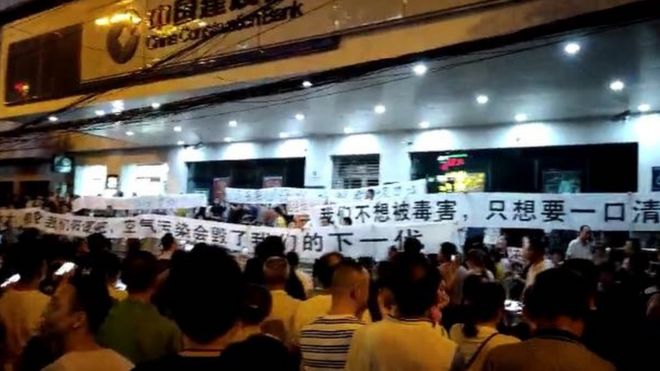
While the world’s attention has been focused on the protests in Hong Kong, another Chinese city has been witnessing unrest on a scale rarely seen on the mainland.

Thousands of citizens in Wuhan, the capital city of central Hubei province, took to the streets last week for several days.

They were angry about a planned waste incineration plant they say will bring dangerous levels of pollution to their town.

But as the protests steadily grew over the week, a censorship and public security operation kicked in to try to keep a lid on the unrest.

Why are they so angry?

Wuhan desperately needs to find ways to handle the waste generated by its 10 million residents. So it has drawn up plans for a huge incinerator, to be based in the Yangluo zone of Xinzhou district, where about 300,000 people live.

According to a city government document published in February, the incinerator would possess a daily capacity of 2,000 tonnes of rubbish.

Xinzhou district also already hosts a waste landfill, the strong smells of which, according to some locals, can be caught even when one passes the area on a bus.

But there has been public concern that badly-made incinerators can emit dioxins that are highly toxic and can damage the immune system, interfere with hormones and cause cancer. In 2013, five such plants in Wuhan city were found to be sub-standard and emitting dangerous pollutants, according to China’s state broadcaster CCTV.

Social media footage of police in WuhanImage copyright OTHER
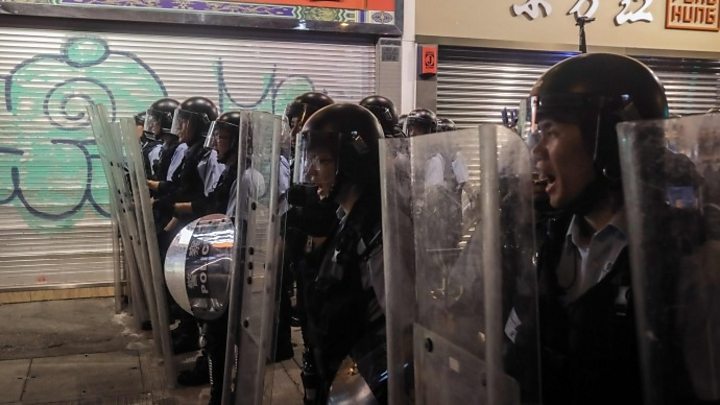
Image caption Grainy social media footage showed huge numbers of police moving into the town

In late June, rumours began spreading that work had already started on the new plant, on a patch of land in Yangluo designated as an industrial park, close to residences and two schools.

Local people took to the streets for several days, demanding that the location be re-thought. They held banners with slogans like “air pollution will damage the next generation” and “we don’t want to be poisoned, we just need a breath of fresh air”. They weren’t demanding it be scrapped completely, just that it be moved further away.

The protests grew over several days and, according to some locals, the night with the biggest crowds saw up to 10,000 people taking part.

How has the government responded?

At first the Xinzhou district government attempted to calm the unrest. It issued a statement last Wednesday denying that work had started on the incinerator. It said the project hadn’t even been registered, nor had it gone through any environmental assessment.

They said the local government would attach “great importance to the voices of the people” in its decision-making, but warned that public security authorities would crack down on any “illegal criminal acts such as malicious incitement and provocation”.

Several locals said people were detained but the exact number couldn’t be confirmed.

Over the weekend, the authorities appear to have successfully quashed the protests. Some locals said riot police were on the streets and shops around the protest sites had been ordered to shut by 6pm.

Meanwhile, China’s censors have been at work. Local voices on social media have been vanishing fast. Videos and photos of the crowded streets and clashes between the protesters and the police can be censored within hours. While there were a few reports in domestic media about the incinerator, none of them covered the protests.

Local people have said they’re not satisfied with the district government’s reassurances, because it’s the municipal authorities who have the final say.

But the municipality has kept quiet so far.

How unusual is this for China?

China often sees public protests like this, but mostly on a much smaller scale.

While the Chinese public have largely avoided protests about political reforms since the Tiananmen movement was crushed in 1989, “not in my back yard” protests related to environmental problems have become more common.

Civil movements against high-polluting projects date back to at least 2007 when a significant protest broke out in Xiamen city of Fujian province against an industrial chemical plant.

The incident became well-known at a time of lighter censorship, and the local government ended up moving the location of the project out of the city.

Media caption Hong Kong police and protesters clash

In 2015 there were protests in both Shanghai and northern Tianjin over planned manufacturing plants which locals felt put them in danger.

And in 2017, Qingyuan city in Guangdong province also saw protests over an incinerator.

During the Qingyuan protests nearly 10,000 locals took to the streets and police reportedly fired tear gas at the height of the unrest. Three days later the government cancelled the planned incinerator.

Might the Wuhan authorities learn from Qingyuan?

So far there’s no sign of that.

Even after a week of protests the city government seems deaf to public opinion.

Source: The BBC

09/07/2019

Rights violations in contested Kashmir continue unchecked, U.N. report says

SRINAGAR, India (Reuters) – Tensions in disputed Kashmir after a deadly suicide bombing earlier this year are having a severe impact on human rights in the region, a United Nations report released on Monday said.

Muslim-majority Kashmir is claimed in full by India and Pakistan, who both rule it in part and have fought two wars over the territory. They came close to a third in February after the suicide bombing of a convoy claimed by a Pakistan-based militant group killed 40 paramilitary police.

India accuses Pakistan of funding these groups, who want independence for Indian-administered Kashmir, a claim Islamabad denies.

The report, by the U.N. Human Rights Council, says that arbitrary detentions during search operations by Indian troops are leading to a range of human rights violations.

Despite the high numbers of civilians killed in the vicinity of gun battles between security forces and militants, “there is no information about any new investigation into excessive use of force leading to casualties”, it said.

The report was also critical of special legal regimes used by India in Kashmir, saying accountability for violations committed by troops remains virtually non-existent.

The report says that in nearly three decades that emergency laws have been in force in Jammu and Kashmir, there has not been a single prosecution of armed forces personnel granted by the central government in a civilian court.

It called for the repeal of special powers protecting troops from prosecution.

The United Nations also flagged a spike in hate crimes against Kashmiris in the rest of India following the February attacks, calling on India to do more to prevent the violence.

In response, India’s Foreign Ministry spokesman Raveesh Kumar said the report presented a “false and motivated narrative” on the state of the region.

“Its assertions are in violation of India’s sovereignty and territorial integrity and ignore the core issue of cross-border terrorism,” Kumar added in a statement.

Though the majority of the allegations in the report pertain to Indian-administered Kashmir, it was also critical of Pakistan for detentions of separatists in its portion of the region.

A spokesman for the Pakistan embassy in New Delhi did not immediately respond to a request for comment.

Source: Reuters

08/07/2019

Ministry dispatches work teams to assist with local flood control

BEIJING, July 7 (Xinhua) — Four work teams have been dispatched to four provincial-level regions in southern China, including Jiangxi, Hunan, Guangxi and Guizhou, to assist with local flood control efforts, according to the Ministry of Water Resources Sunday.

The National Meteorological Center earlier issued a yellow alert for heavy rains in the country’s southern regions. Characterized by wide coverage and long duration, the rainstorm would hit the regions with precipitation up to 180 mm in some areas.

Water levels of major rivers in southern China would be above the warning line, according to the weather forecast.

The ministry stresses that local governments should take targeted measures to prevent mountain torrents, ensure dam safety during floods and strengthen patrols on the levee system.

The ministry also asks local water resources departments to pay close attention to the weather conditions and raining and flood situation, issue alerts timely and move the people out of the dangerous areas in time.

China has a four-tier color-coded weather warning system, with red representing the most severe, followed by orange, yellow and blue.

The China Meteorological Administration on Sunday also issued a grade-IV response for the upcoming rains. The grade-IV response, the lowest in China’s emergency response system, means a 24-hour alert, daily damage reports, and the allocation of money and relief materials within 48 hours.

Source: Xinhua

Law of Unintended Consequences

continuously updated blog about China & India

ChiaHou's Book Reviews

continuously updated blog about China & India

What's wrong with the world; and its economy

continuously updated blog about China & India