Chindia Alert: You’ll be Living in their World Very Soon
aims to alert you to the threats and opportunities that China and India present. China and India require serious attention; case of ‘hidden dragon and crouching tiger’.
Without this attention, governments, businesses and, indeed, individuals may find themselves at a great disadvantage sooner rather than later.
The POSTs (front webpages) are mainly 'cuttings' from reliable sources, updated continuously.
The PAGEs (see Tabs, above) attempt to make the information more meaningful by putting some structure to the information we have researched and assembled since 2006.
Chinese State Councilor and Foreign Minister Wang Yi delivers a keynote speech at a dinner co-hosted by the National Committee on U.S.-China Relations, the U.S.-China Business Council, the U.S. Chamber of Commerce, and Council on Foreign Relations in New York, the United States, Sept. 24, 2019. (Xinhua/Liu Jie)
NEW YORK, Sept. 24 (Xinhua) — The development goals of China and the United States are not mutually exclusive, and the two sides may work with each other well to attain their respective goals, said Chinese State Councilor and Foreign Minister Wang Yi here on Tuesday.
China and the United States both have their own development goals, which are not mutually exclusive or a zero-sum equation, Wang said in a keynote speech at a dinner co-hosted by the National Committee on U.S.-China Relations, the U.S.-China Business Council, the U.S. Chamber of Commerce and the Council on Foreign Relations.
China’s renewal will provide the United States with a stable and sustainable market for the long run and a vibrant United States will provide China’s development with a better external environment, the state councilor said, when expounding on how the world’s two largest economies can benefit from each other’s prosperity.
The key is to be open-minded and respect each other’s right to development and appreciate each other’s accomplishments, he said.
For the sake of the two countries and the world, China and the United States must find a way for major countries with different social systems and cultural backgrounds to co-exist on this planet in peace and cooperate with each other for win-win results, Wang added.
The top diplomat said since China and the United States differ from each other in history, culture, social system, development path and national conditions, it is inevitable for them to have disagreements and even frictions.
However, real harmony is based upon the recognition of and respect for differences, Wang said, adding that differences should not be a chasm that prevents people from engaging with each other, but an impetus to mutual learning and shared progress.
The ups and downs in China-U.S. relations provide ample evidence that confrontation and conflict are not in the fundamental interests of both sides, and dialogue and cooperation are the only way to go, he said.
The Chinese state councilor denounced the claim by some Americans that the decades-long U.S. engagement policy has failed in its original purpose of changing China and that it is time to revert to a containment policy.
“Such an idea of modeling others according to one’s own wish is wrong from the very starting point, and cannot possibly work,” he said.
Seventy years on, it is important for the United States to avoid picking another misguided fight with the wrong country, he said.
BEIJING, Sept. 25 (Xinhua) — Achieving the country’s greatness, national rejuvenation and cross-Strait reunification is the trend of history, which can never be blocked by anyone or any force, said a Chinese mainland spokesperson Wednesday.
“The past 70 years of relations across the Taiwan Strait have witnessed compatriots on both sides of the Strait breaking down their isolation and engaging in increasingly extensive exchanges and cooperation,” said Ma Xiaoguang, a spokesperson with the State Council Taiwan Affairs Office, at a press conference.
By the end of 2018, 135 million cross-Strait visits were logged, including more than 100 million made by people from Taiwan; two-way trade reached 226 billion U.S. dollars in 2018; and by July 2019, the mainland had approved over 110,000 investment projects by businessmen from Taiwan, with the actual investment exceeding 69 billion U.S. dollars.
Over the past 70 years, the two sides across the Strait have conducted equal consultation, sought common ground while shelving differences, and improved and developed cross-Strait relations on the basis of the 1992 Consensus, Ma noted.
“The past 70 years are also a history of opposing and deterring separatist elements advocating ‘Taiwan independence,’ resolutely safeguarding China’s sovereignty and territorial integrity, promoting the peaceful development of cross-Strait relations, and advancing the peaceful reunification of the motherland,” he added.
NANNING, Sept. 23 (Xinhua) — The Belt and Road Initiative (BRI) provides momentum for regional economic integration and connectivity, helping China and ASEAN forge a closer community of shared future, said Cambodian Deputy Prime Minister Hor Nam Hong.
Hor made the remarks Saturday at the opening ceremony of the 16th China-ASEAN Expo themed “Building the Belt & Road, Realizing Our Vision for a Community of Shared Future.”
The deputy vice prime minister envisioned that the China-ASEAN strategic partnership and the BRI will further deepen the cooperation between the two sides in the joint pursuit of shared prosperity.
Statistics show that China has signed cooperation agreements with more than 130 countries across the globe and 30 international organizations on jointly building the Belt and Road, benefiting people of the involved nations.
Highlighting regional economic cooperation, this year’s China-ASEAN expo is expected to lift the practical and comprehensive cooperation between China, ASEAN and other countries participating in the BRI to new heights.
The expo has served as a crucial platform for promoting investment and trade in Asia over the past 16 years, setting an example of friendly cooperation between China and ASEAN, said Luhut Binsar Pandjaitan, special envoy of the Indonesian president and coordinating minister for maritime affairs.
As the Country of Honor for this year’s expo, Indonesia will showcase its high-quality products from more than 100 Indonesian enterprises.
Speaking highly of the BRI, Luhut said cooperation under the China-proposed initiative will boost infrastructure construction and trade among members of ASEAN to facilitate the building of the ASEAN Community.
To push China-ASEAN ties to new heights, both sides are making joint efforts in constructing the Belt and Road and implementing the Master Plan on ASEAN Connectivity 2025 under the guidance of the China-ASEAN Strategic Partnership Vision 2030.
The BRI accelerates regional connectivity and improves people’s livelihoods, said Thai Deputy Prime Minister and Minister of Commerce Jurin Laksanawisit, adding that Thailand had formulated plans to contribute to the completion of the Regional Comprehensive Economic Partnership, alleviate volatility of the global economy and trade, and inject momentum into sustainable development.
Two-way investment between China and ASEAN countries grew robustly to reach 230 billion U.S. dollars in the first eight months of this year, with the establishment of 25 economic and trade cooperation zones creating over 100,000 jobs.
Meanwhile, the cooperation between China and ASEAN in fields including international production capacity, the digital economy and e-commerce is also leaping forward.
Hailing the achievements of cooperation under the BRI, Lao Deputy Prime Minister Sonexay Siphandone said Laos will take an active role in building the Belt and Road.
Citing the China-Laos railway, the largest cooperation project between the two sides so far, Sonexay said it will promote regional peace, prosperity and sustainable development.
Apart from prospering bilateral trade and investment, recent years have seen the deepening of China-ASEAN cooperation in various other fields. ASEAN has become the largest destination for Chinese tourists, with the number of personal exchanges hitting 57 million in 2018 and nearly 4,000 flights traveling between both sides every week.
Holding similar viewpoints, Myanmar’s Vice President U Myint Swe said the BRI provides opportunities for developing trade and cross-border exchanges and bridging infrastructure gaps.
Looking forward to shared prosperity, Jurin said Thailand, as well as ASEAN, will collaborate with China to strive for sustainable development.
MANILA, Sept. 24 (Xinhua) — China has proven to be an important partner of the Philippines in economic development, a senior aide of Philippine President Rodrigo Duterte has said.
The Philippine Presidential Adviser for Flagship Programs and Projects Vivencio Dizon told Xinhua on Monday that China is now “an integral partner” in the Philippines’ infrastructure build-up.
Indeed, Dizon said that President Duterte was correct in espousing “a foreign policy that we are friends to all, enemies to none.” By embracing partners like China other than its traditional partners, Dizon said the Duterte administration has gained a lot especially from building warm relations with China.
“China is an integral partner in our infrastructure build-up,” said Dizon, also the president of the Bases Conversion Development Authority (BCDA).
Already, Dizon said, China has become the country’s largest trading partner. “I think this is a testament to the success of this strategy,” he added, referring to Duterte’s decision to pursue an independent foreign policy.
For example, Dizon said the number of Chinese tourists has “increased exponentially over the last couple of years, bringing in a lot of foreign expenditures from Chinese tourists to the Philippines, boosting our economy.”
BCDA, a Philippine government-owned and controlled corporation, has partnered with Chinese companies on infrastructure projects and business investments.
BCDA and China Gezhouba Group Corporation signed a framework of cooperation in November 2018 to develop a 500-hectare mixed-use industrial park in New Clark City in the northern Philippines.
“We believe that bringing in more investments from countries like China will not only provide more employment opportunities, but also provide a lot of opportunities for technology transfer in the country and in particular the New Clark City,” Dizon added.
Dizon said China’s Belt and Road Initiative complements with the Duterte administration’s “Build, Build, Build” infrastructure program that aims to improve the connectivity of this archipelagic country.
He said infrastructure requires the Philippines to partner and work with countries throughout the world who have been successful in building infrastructure.
“China is obviously one of those countries,” Dizon said. “That’s the reason why we have identified several projects under the Build, Build, Build program wherein China can help and participate in allowing the Philippines not only to raise the needed resources, the needed capital to build these large-scale infrastructure projects but also learn from the experiences of China in building up its infrastructure.”
The “Build, Build, Build” program, rolled out by the Philippine government in 2017, intends to spend 8 to 9 trillion pesos (roughly 160 to 180 billion U.S. dollars) in the medium-term on building roads, bridges, airports, seaports and railways in the Philippines.
“It’s very important for the Philippines to partner with these countries, like China, in order to not only raise the needed resources but also to build the right infrastructure for the country and our people to move forward,” Dizon said.
Chinese State Councilor and Foreign Minister Wang Yi (R) meets with Pakistani Prime Minister Imran Khan on the sidelines of the United Nations General Assembly high-level week, at the UN headquarters in New York, on Sept. 23, 2019. (Xinhua/Han Fang)
UNITED NATIONS, Sept. 23 (Xinhua) — Chinese State Councilor and Foreign Minister Wang Yi on Monday said China and Pakistan hold all-weather strategic cooperative partnership and the friendship between the two countries is unbreakable.
Meeting with Pakistani Prime Minister Imran Khan on the sidelines of the UN General Assembly high-level week, Wang said the two countries have always enjoyed mutual trust, mutual understanding and mutual support.
He said China will continue to support Pakistan’s efforts to uphold its territorial sovereignty and national dignity. China-Pakistan cooperation has contributed significantly to Pakistan’s national development and improvement of its people’s livelihood.
Wang added that the two sides should work together to build the China-Pakistan Economic Corridor (CPEC) into a model for high-quality development projects under the Belt and Road Initiative.
Khan, for his part, said Pakistan will firmly push forward the transformation and upgrading of the CPEC and continue to make every effort to ensure the safety of Chinese projects, enterprises and personnel in Pakistan.
He said that Pakistan and China are close friends, and Pakistan thanks the Chinese government and people for standing firmly with the Pakistani people in the most difficult time.
He added that China’s support and assistance are of great significance to Pakistan’s national security and development.
Pakistan will spare no effort in maintaining bilateral friendship and will not allow any external forces to interfere in or sabotage the development of bilateral relations.
Khan introduced Pakistan’s views on the current situation in Kashmir. Wang reiterated China’s principled position on the issue.
The two sides also exchanged views on Afghanistan, Iran and other issues.
Chinese Premier Li Keqiang, also a member of the Standing Committee of the Political Bureau of the Communist Party of China (CPC) Central Committee, delivers a speech during the opening ceremony of a grand exhibition of achievements in commemoration of the 70th anniversary of the founding of the People’s Republic of China (PRC) at the Beijing Exhibition Center in Beijing, capital of China, Sept. 23, 2019. (Xinhua/Rao Aimin)
BEIJING, Sept. 23 (Xinhua) — A grand exhibition of achievements in commemoration of the 70th anniversary of the founding of the People’s Republic of China (PRC) opened Monday at the Beijing Exhibition Center.
Premier Li Keqiang, also a member of the Standing Committee of the Political Bureau of the Communist Party of China (CPC) Central Committee, attended the opening ceremony and delivered a speech.
The exhibition comprehensively reflects the practices, achievements and experience of the past 70 years, which witnessed great improvements in the country’s economy and people’s living conditions, said Li.
It also records the continuous rise of China’s international status and influence, as well as China’s contribution to the cause of world peace and development, according to Li.
Noting that China remains the largest developing country in the world, Li called for more efforts to secure even greater victories in the future.
The country should work for high-quality development, comprehensively deepen reform, and build a market-oriented international business environment based on the rule of law, said Li, adding that it will implement a proactive policy of opening up to the outside world and promote economic globalization.
The opening ceremony was presided over by Wang Huning, a member of the Standing Committee of the Political Bureau of the CPC Central Committee and a member of the Secretariat of the CPC Central Committee.
Chinese Premier Li Keqiang holds talks with visiting Iraqi Prime Minister Adel Abdul Mahdi at the Great Hall of the People in Beijing, capital of China, Sept. 23, 2019. (Xinhua/Wang Ye)
BEIJING, Sept. 23 (Xinhua) — Chinese Premier Li Keqiang held talks with Iraqi Prime Minister Adel Abdul Mahdi at the Great Hall of the People in Beijing, voicing support for Iraq’s reconstruction and encouraging more practical cooperation.
Li said China and Iraq are two ancient civilizations and have a long history of friendly exchanges.
He commended the bilateral ties between the two countries since they established diplomatic relations and voiced support for Iraq’s efforts to restore security and stability, promote economic and social reconstruction, and improve people’s livelihood.
China is ready to work with Iraq to deepen mutual political trust, expand practical cooperation across the board, and enhance people-to-people exchanges to promote the China-Iraq strategic partnership for greater development, Li said.
Li pointed out that China is willing to participate in Iraq’s reconstruction, maintain a long-term and stable energy partnership with Iraq, and expand cooperation in capacity, manufacturing and agriculture to fuel the diversified development of the Iraqi economy and achieve win-win results.
The Chinese Premier said his country stands ready to work with Iraq to dovetail the Belt and Road Initiative with Iraq’s reconstruction plan, supports Chinese enterprises to positively take part in Iraq’s infrastructure construction and hopes that Iraq will take forceful measures to guarantee the safety of Chinese institutions and individuals in the country.
Abdul Mahdi said Iraq and China are enjoying the best bilateral relations in their history and his country has experienced war and is rebuilding its homeland.
He said China is a country that loves peace and advocates cooperation, adding that Iraq is willing to work with China to enhance cooperation in the fields of trade, the economy, infrastructure construction, energy and culture to realize greater development of bilateral relations.
After the talks, Li and Abdul Mahdi witnessed the signature of a series of bilateral cooperation documents on the economy and technology, finance and culture.
Prior to the talks, Li held a welcoming ceremony for his Iraqi counterpart in the North Hall of the Great Hall of the People.
Observers say domestic issues prompted Kremlin to tighten environmental protection around the lake in Siberia, but Chinese activities also played a part
Businesses catering to growing number of visitors from China may be easy scapegoats as they are ‘among the most visible because they are foreign’
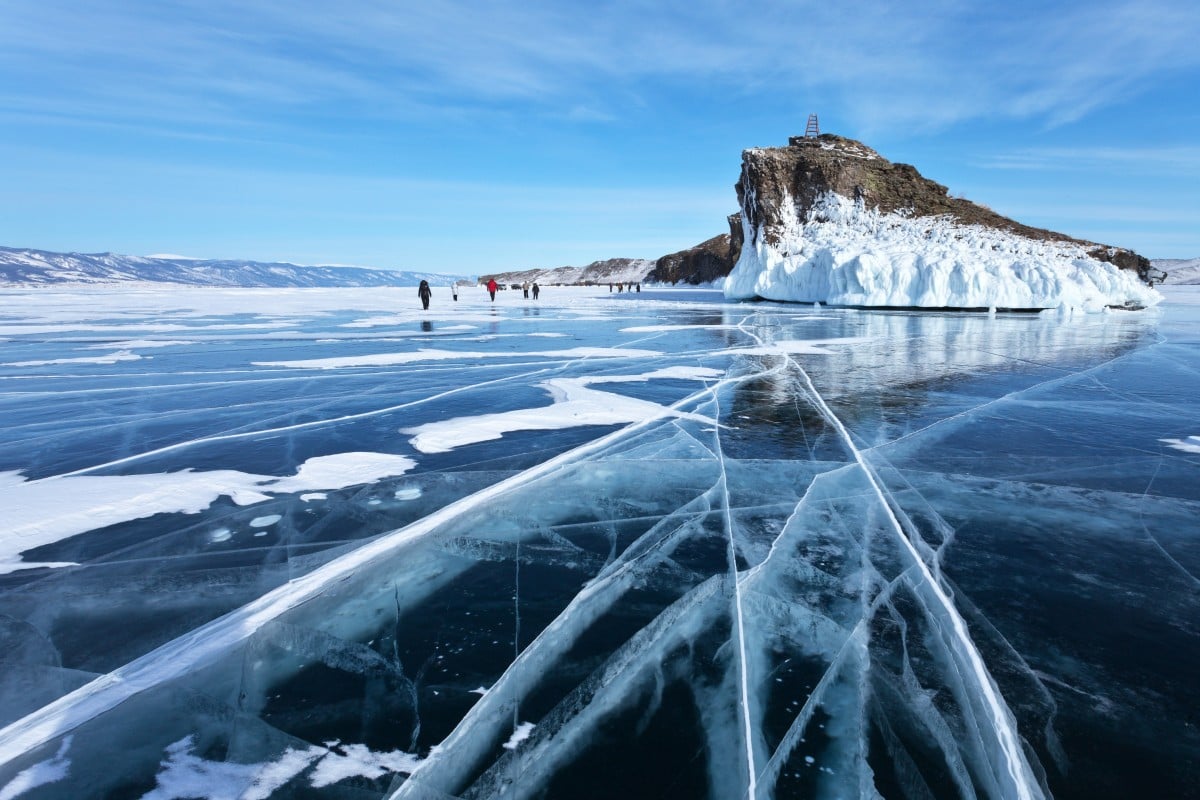
A growing number of Chinese tourists are visiting Lake Baikal in Siberia. Photo: Shutterstock
Russia has tightened environmental protection around Lake Baikal amid growing concerns over degradation, with Chinese development and tourism at the heart of recent debates on the nationally treasured Siberian lake.
New protocols signed by President Vladimir Putin on September 12 clarify how authorities will monitor “compliance with the law on Lake Baikal’s conservation and environmental rehabilitation”.
They also call for improved state environmental monitoring of the lake’s unique ecosystem, aquatic animal and plant life; prevention of and response to risks; analysis of the pressure from fishing on its biological resources; as well as measures to conserve those unique aquatic resources.
Observers say domestic issues – including a backlash over the government’s hand in accelerating environmental damage – prompted the Kremlin to act, but concerns over Chinese activities in the area also played a part.
Eugene Simonov, coordinator of the Rivers Without Boundaries International Coalition, said the protocols were a bid by Moscow to show it was concerned about the lake, where mismanagement and relaxed standards had damaged water quality and the ecosystem – drawing concern from Unesco, which has designated it a World Heritage Site.
But it was also related to local concerns that an influx of Chinese money and tourists in the region was making matters worse.
“One of the leading causes of problems on Lake Baikal is the development of the lake shore for tourism these days, which, at least in the Irkutsk region, is greatly driven by Chinese business,” said Simonov, who has worked extensively on the area’s environmental issues.
He pointed to the “not legal” hotels opened by local and Chinese businesses that cater to the increasing number of tourists from China, saying they stood out as easy scapegoats.
“The real driving force is the desire of locals to privatise the lake shore, illegally, but the Chinese demand is one of the reasons they want to privatise it, while Chinese businesses are among the most visible because they are foreign,” he said.
Public opposition to a water bottling plant being built by a Chinese-owned company pushed local authorities to halt the project in March. Photo: Weibo
Some 186,000 Chinese tourists visited the region last year, up 37 per cent from 2017, according to official Irkutsk figures. But while they accounted for about two-thirds of foreign visitors to the Irkutsk region, they made up only about 10 per cent of the 1.7 million tourists who visited last year.
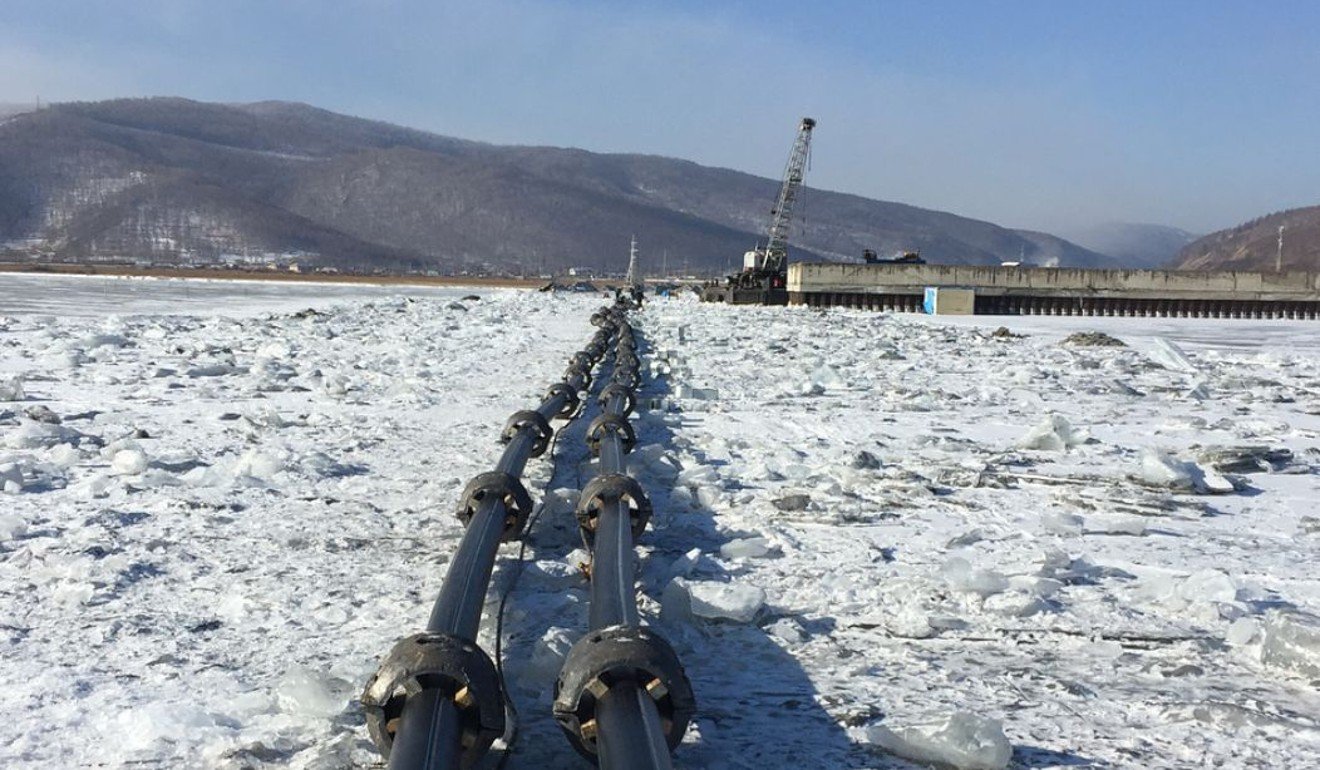
Concern about Chinese investment and development in the region reached a crescendo in March, when public opposition pushed local authorities to halt the construction of a water bottling plant operated by AquaSib, a Russian firm owned by a Chinese company called Lake Baikal Water Industry, based in China’s Heilongjiang province.
The Irkutsk government acted after more than a million people – more than the city’s population – signed a petition calling for the “Chinese plant” to be halted.
Adventures in the frozen wilderness: a Hong Kong man’s trek across icy Lake Baikal
“There were at least 10 problems [around Lake Baikal] that were much more important at that moment, but it was the Chinese plan that was the focus,” Simonov said, noting the nationalism surrounding the lake as a Russian point of pride.
Paul Goble, a Eurasia specialist who has been tracking the issues at Lake Baikal, said stirring up resentment over Chinese encroachment in Siberia and the country’s Far East had long been a government tactic to quell dissent and unite popular opinion.
But he said the new protocols showed Moscow realised that locals – facing the effects of a deteriorating environment including deforestation driven by China’s domestic market demand – may not be satisfied with that explanation.
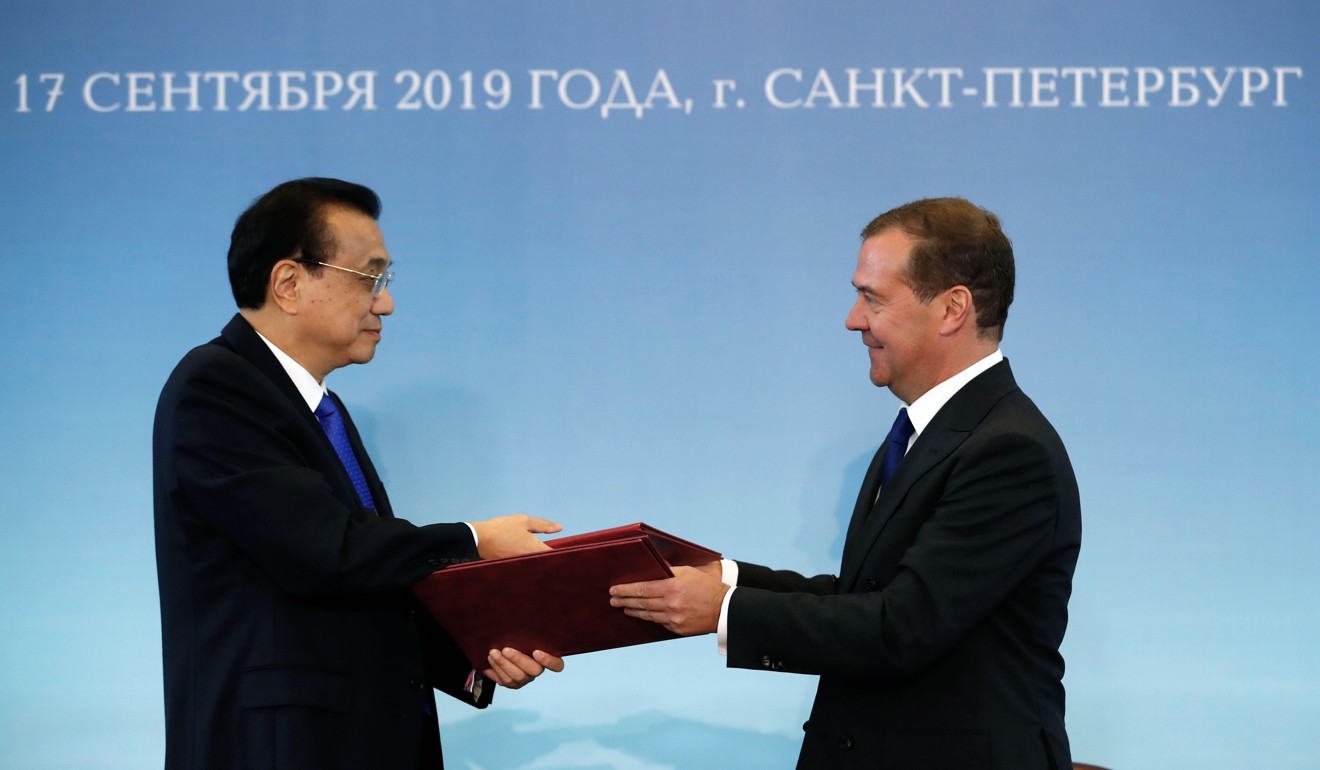
Chinese Premier Li Keqiang and Russian Prime Minister Dmitry Medvedev exchange documents after talks in St Petersburg on Tuesday. Photo: AFP
“People are angry not at China, as might have been the case a year ago or more, but they are angry at Moscow for not standing up to China and what it’s doing,” he said, pointing to this as the reason the Kremlin tightened environmental controls on the lake.
Concerns about the impact of Chinese activities on Russia’s environment come as the two neighbours are playing up closer diplomatic and economic ties. One of the outcomes of a
between Chinese Premier Li Keqiang and Russian heads of state last week was an agreement to increase bilateral trade to more than US$200 billion over the next five years.
But how that investment could be sustainable for Russia – a key supplier of raw materials needed by China such as oil, gas and timber – remained to be seen, observers said.
Are Chinese tourists the greatest threat to Lake Baikal?
“Our great relationship is going well, but we have not seen the accompanying rise in Chinese foreign direct investment into Russia – that remains very small, despite all the talk,” said Artyom Lukin, an associate professor with the School of Regional and International Studies at Far Eastern Federal University in Vladivostok.
“Russia is not satisfied with that, they would like to see more Chinese money, more Chinese greenfield investment coming into Russia, into more productive areas of the Russian economy, not just into the extraction sector like oil, timber or coal,” he said.
Lake Baikal has been seen as an area that could draw a lot of Chinese investment. Back in 2016 there were reports of a tourism development deal, worth up to US$11 billion, between Russian operator Grand Baikal and a consortium of Chinese firms, according to Russian state media reports.
But so far most development from Chinese businesses has remained at the small and medium scale.
The reasons for that, according to experts, range from the difficulty of competing with powerful local rivals and the need to tread carefully around anti-China sentiment.
However, the burden and liability of complying with environmental standards also kept operations at a smaller scale.
China and Russia: a fool’s errand for Trump to try to come between them
“It’s simpler and easier to operate smaller businesses and facilities, and it’s easier to monitor and manage them,” said Vitaly Mozharowski, a partner at Bryan Cave Leighton Paisner in Moscow, who specialises in environmental law, noting that concerns included management of waste water and garbage.
Meanwhile, big complexes were obvious targets for scrutiny, and that would only increase with the new protocols in place, Mozharowski said. “Any large-scale initiatives would be considered from the very top of the Russian establishment,” he said.
Shanghai’s authorities have doubled the free-trade zone to 240 square kilometres by including part of Lingang, a previously untapped area linked to the Yangshan deep water port
The expansion reflected the city’s renewed efforts to build a free marketplace that can rival regional business hubs such as Hong Kong and Singapore
Aerial photo taken on March 9, 2017 shows the Shanghai free trade zone (FTZ). Photo: Xinhua
Shanghai’s ambitious plan to turn Lingang into a Hong Kong-style free-trade port has yet to impress European companies due to a slow pace of enforcement with a series of liberalisations subject to Beijing’s approval.
The European Union Chamber of Commerce in Shanghai said on Tuesday that the business lobby group was expecting concrete measures to be implemented at the 119.5-square kilometre newly expanded free-trade zone (FTZ), which would whet European companies’ investment appetite, but it also vented dismay towards the slow progress.
It was advisable for the government to carry out planned reforms sooner to convince foreign investors of the golden opportunities inside the zone, said Carlo Diego D’Andrea, the chamber’s Shanghai chairman, who is also vice-president of the EU business chamber in China.
“After so many years [of waiting], we would like to see reform happen soon, not just the talks,” he said in an interview with South China Morning Post.
Shanghai doubled the size of the free-trade zone last month to about 240 sq km by including part of Lingang, a previously untapped area that is linked to the Yangshan deep water port.
The expansion reflected the city’s renewed efforts to build a free marketplace that can rival regional business hubs such as Hong Kong and Singapore.
Shanghai plans to impose zero tariffs on imported goods inside the Lingang FTZ, but the reform measures cannot be implemented unless the General Administration of Customs gives a green light.
Shanghai’s city government had proposed a series of incentives aimed at building Lingang into a world-class investment magnet, the free-trade zone’s deputy director Wu Wei said at a Friday press conference, without elaborating on when the policies might be endorsed by the relevant ministry-level authorities.
Professor Zhou Zhenhua, president of Shanghai Academy of Global Cities, said the central government was still cautious of taking drastic steps in quickly liberalising the Lingang FTZ amid worries of rampant capital and cargo flows.
US bestselling electric vehicle maker Tesla has built its Gigafactory 3 at the Lingang FTZ after it secured an approval from Beijing to establish a wholly owned assembly plant late last year.
The approval for the first wholly-owned foreign car factory on mainland China coincided with a sales drop in the country’s automobile market, the first contraction in nearly three decades.
“Why could not you have opened the market before when the market was booming,” said D’Andrea.
He said that the timing of scrapping the foreign ownership cap amid the first negative growth of the domestic car market in three decades was not enough to show Beijing’s determinations in drawing overseas funds.
Beijing has been harping on its resolution in further opening up the markets to foreign businesses as a way of amid the US-China trade war that began in 2018.
Image copyright EPAImage caption China is getting dressed up for its big birthday party
One week from now, the People’s Republic of China will mark its 70th anniversary with celebrations on a scale not seen in China in decades.
Beijing is pulling out all stops and 1 October will be flush with fireworks, fanfare and a huge military parade.
To ensure it goes smoothly, authorities have been ramping up security in the capital – and online – for weeks.
But with yet more protests expected in Hong Kong, the territory might just rain on China’s parade.
What is it all about?
The birth of modern China was declared on 1 October 1949, after the communists under Mao Zedong won the civil war that followed World War Two.
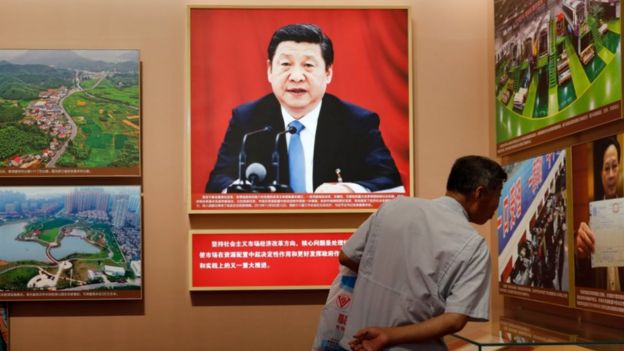
Image copyright EPAImage caption Exhibitions are highlighting the achievements of the Communist Party
The date is marked every year, but celebrations for this 70th anniversary are expected to eclipse previous events.
It’s the first big anniversary since China has emerged as a global power. While 10 years ago China was a superpower in the making, it is now the world’s second largest economy, almost eye-to-eye with the United States.
What to expect?
The main celebrations will take place in the capital, Beijing, where there will be a grand military parade with “advanced weapons” on display, followed by a “mass pageant”.
President Xi Jinping – considered the most powerful Chinese leader since Mao – will address the Chinese people. His speech is expected to celebrate China’s rapid growth and which will be closely watched for any indication of the country’s direction in the coming years.
The president will also hand out honours for contributions to the country and in the evening there will be a grand gala and fireworks show.
All official Chinese celebrations are carefully choreographed and the success of this one is particularly important to the government.
The Dos and Don’ts
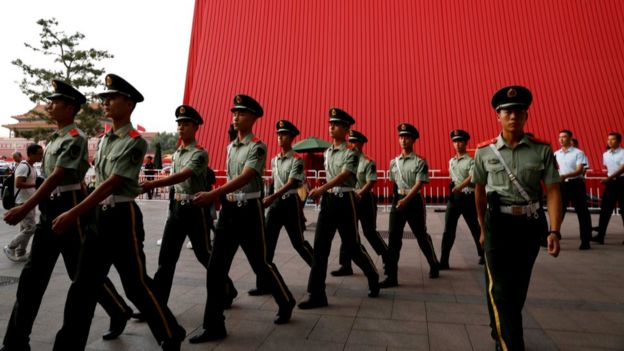
The parade – open to invited guests only – will take place around Tiananmen Square in central Beijing. The surrounding area will be practically under lockdown, and in fact has been so several times already.
During rehearsals leading up to the big day, hotels near Tiananmen Square told guests that for several hours each day, no-one would be able to leave the hotel or return to it should they be out, leading to much travel chaos and rebookings.
Many shops and restaurants in the centre are also closed or have shortened hours and some subway stations are temporarily shut.
Image copyright EPAImage caption Security is tight ensure the party goes to plan
Trains to Beijing are running numerous safety checks on their passengers and vehicles going into the city are also being tightly watched.
On the big day itself, areas around Tiananmen Square will be blocked and guarded. Local residents will need to identify themselves if they want to pass.
To ensure the sun will shine brightly on the celebration in notoriously polluted Beijing, several coal plants and construction sites in and around the city have been ordered to stop work for the duration.
There’s also a ban on any low-flying aerial vehicles in place. That means anything from light aircraft to drones, balloons and even racing pigeons.
Censorship galore
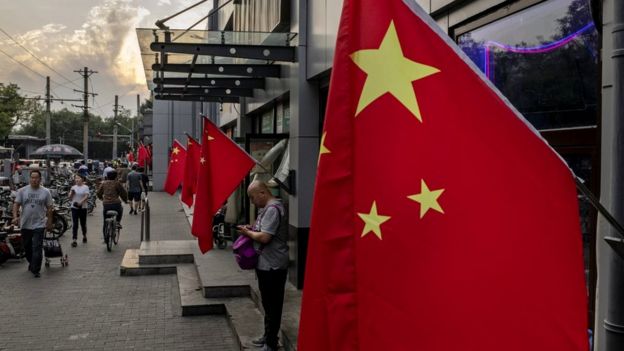
Across much of the city centre, there are national flags set up at every door. Voluntary inspectors are monitoring the streets and locals have told the BBC they’re being questioned after having even brief conversations with foreigners
One person said she was asked by an inspector: “Who were those foreigners? Why were they here?”
The tight control naturally extends online as well. Popular social media platform Weibo said it was deleting content that “distorts” or “insults” the country’s history ahead of the anniversary.
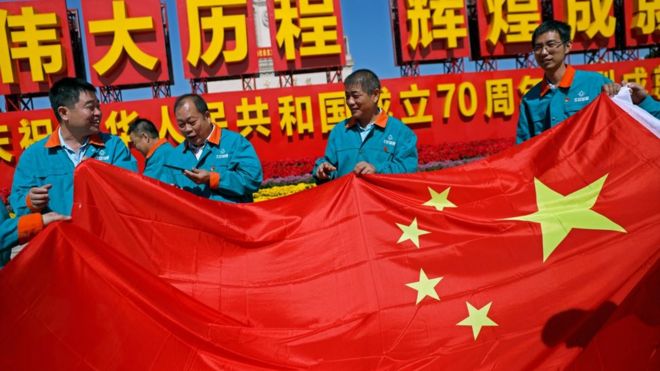
Image copyright GETTY IMAGESImage caption Every house and every shop is sporting a national flag
Chinese journalists are always expected to toe the party line anyway, but starting in October they will have to pass an extra test to prove they are versed particularly in Xi Jinping’s teachings, officially called Xi Jinping Thought on Socialism with Chinese Characteristics, which has been written into the constitution.
Whether or not they pass the exam will then determine whether they’ll be accredited as journalists.
“The fundamental point with this ‘training’ and indoctrination process isn’t so much about the content,” David Bandurski of China Media Watch told the BBC.
“It is about reinforcing the message and understanding among journalists that they work, first and foremost, for the Chinese Communist Party, and serve its agenda.”
So not only will the events be choreographed – the domestic coverage of them will also be tightly guarded.
What about Hong Kong?
Despite Beijing’s determination to let its achievements shine on 1 October, there’s a good chance Hong Kong will pull focus.
Anti-Beijing protests always take place in Hong Kong on China’s National Day, but this time, the activists know that the world is watching.
Anti-government protests have rocked the city for months and the situation shows no sign of dying down.
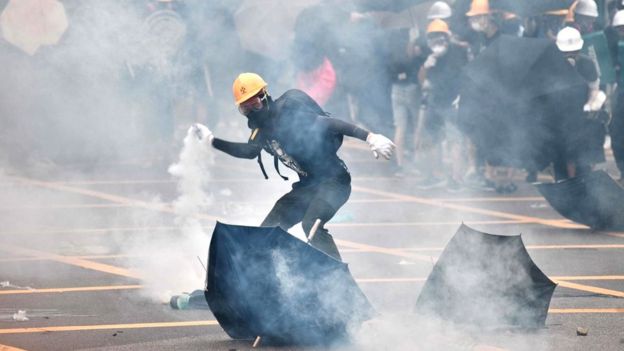
Clashes between police and activists have been becoming increasingly violent, with police using tear gas and activists storming parliament.
Image copyright AFPImage caption The protests have often escalated into violent clashes
That means two things for 1 October: official celebrations in the territory are being toned down to avoid clashes – the annual fireworks display has been cancelled – while at the same time, activists are planning to step up their protests.
On Sunday 29 September, a “Global Anti Totalitarianism March” is scheduled to take place at various locations around the world in support of Hong Kong.
On 1 October itself, a march in central Hong Kong is planned with everyone asked to wear black.
If the past weeks’ demonstrations are anything to go by, the smiles and celebrations in Beijing will be competing for media space with pictures of tear gas and angry young protesters in Hong Kong.





 CHINDIA ALERT: You'll be living in their world, very soon