Archive for October, 2019

27/10/2019

India yoga: Inspirational teacher V Nanammal dies at 99

India’s oldest exponent and teacher of yoga, V Nanammal, has died at her home near Coimbatore, in the southern state of Tamil Nadu.

She was 99 and still teaching a hundred students a day until a few months ago.

Born into an agricultural family, she was taught yoga by her father.

She went on to master more than 50 postures or asanas, and trained more than a million students – hundreds of them now yoga instructors themselves around the world.

V Nanammal in Bangalore, 2017Image copyright GETTY IMAGES
Image caption V Nanammal (right) was known for her trademark pink sari

Known affectionately as “Yoga Grandma”, Nanammal received the Padma Shri – one of India’s highest civilian honours.

She became a popular figure on YouTube in her later years, still performing some of the most formidable yoga positions in her trademark pink sari.

Media caption The inspiration behind eight famous yoga poses

A week ago, she fell from her bed and had been unwell since then, family sources were quoted as saying by India’s PTI news agency.

Speaking to BBC News in 2017, Nanammal attributed her good health to her daily yoga routine.

“Health becomes your priority and everything is achievable,” she said.

Source: The BBC

26/10/2019

Merger of China’s shipbuilding giants gets the green light

  • After nearly 10 years of planning, the country’s two shipbuilders will be reunited with a combined revenue of US$141.5 billion
China’s two shipbuilding giants have built hundreds of military vessels over the past few years as the country’s navy seeks to modernise rapidly. Photo: Xinhua

China on Friday announced the merger of the country’s two largest state-owned shipbuilding giants, a step Beijing has been preparing for nearly a decade to strengthen the competitiveness of its shipbuilding industry.

The intention to merge the Shanghai-based China State Shipbuilding Corp (CSSC) and the China Shipbuilding Industry Co (CSIC), based in Dalian, Northern Liaoning province, was announced in a statement on the website of the state-owned Assets Supervision and Administration Commission of the State Council, China’s cabinet.

The merger would enable China to establish a shipbuilding giant with a combined revenue up to 1 trillion yuan (US$141.5 billion), capable of building vessels ranging from warships, like aircraft carriers, to civilian ships such as container ships and oil tankers, said a source familiar with the merger plan.

“This merger has been in the making since Hu Wenming, a former party leader of the state-owned aviation industry, was assigned to CSSC as party secretary in 2010,” the source said, requesting anonymity because of the sensitivity of the issue.

“The merger plan was put on the drawing board at a time when the world shipping industry had entered a golden period in 2009, and the business of CSSC and CSIC was at its peak, but [China’s] analysis indicated a decline was on the horizon, as has actually happened in recent years.”
Chinese shipbuilder touts warships in push to expand arms sales in region

CSIC and CSSC were part of the same group until 1999 when they were split into two separate entities. Since then, China has overtaken South Korea and Japan to become the world’s largest builder of merchant ships, a rise spurred by the boom in world trade and the country’s accession to the World Trade Organisation in 2001.

CSSC manages shipbuilding business in the east and south of China, while CSIC oversees activities in the northern and western parts of the country. Both are also primary contractors for PLA naval ships.

Commercial shipbuilding was the major source of revenue for both enterprises, given they were generally less technologically challenging and of lower cost to build, the source said.

“Developing and building warships for the PLA needs more manpower and more advanced technologies because naval ships, which are built for sea battles, take longer to build and require cutting-edge technologies, hence the higher costs,” the source said.

China tests new warships in live-fire drills near Vietnam
CSSC and CSIC have built hundreds of military vessels over the past few years as the Chinese navy seeks to modernise rapidly. These have included aircraft carriers, Type 055 destroyers, Type 075 amphibious assault ships and Type 094A nuclear submarines.
But, the source said, the two giants’ naval warship building mission would be cut back next year, as Beijing expected greater financial pressure as a result of slower economic growth. The merger would allow the two companies to pool their resources and enhance their competitiveness, especially in the development of mega vessels.
But the source said the two giants’ naval warships building missions would be cut back beginning next year as Beijing foresees greater financial pressure as a result of slower economic growth. The merger will allow the two companies to pool their resources and enhance their competitiveness, especially in areas of mega vessels.
“The merger is also part of China’s long-term maritime energy development plan to meet President Xi Jinping’s sustainable and clean energy goal, because China needs more giant vessels to help ship oil and gas from other countries,” the source said.
Source: SCMP
25/10/2019

China seeks to enhance ties with Kenya on development of digital economy

NAIROBI, Oct.25 (Xinhua) — China is seeking to promote cooperation with Kenya in the development of the technology arena and digital economy.

Guo Ce, economic and commercial counselor of the Chinese embassy in Kenya, said on Thursday that China which is Kenya’s largest trading partner is also seeking cooperation with Kenya in terms of capacity building by outcome-sharing in the technological arena for mutual benefit.

“For instance, China has such wonderful information technology (IT) companies as TECNO and Huawei in Kenya, providing local users with easy access to the Internet and thus increasing the welfare of its people,” Guo said during the symposium on China-Kenya cooperation and development of digital economy on Thursday.

By the end of 2018, the number of Chinese netizens has reached 829 million, and the number of mobile Internet users has reached 871 million, with the e-commerce transaction volume amounting to 4.4 trillion US dollars.

In Kenya, the value of the ICT sector, driven by growth in the digital economy, expanded by 12.9% in 2018. And as of December 2018, the total number of active data/Internet subscriptions in Kenya stood at 45.7 million of which 47.9 percent were on broadband. The number of Internet users in Kenya accounts for 83.0% of its population.

Zhao Hui, secretary general of China Federation of Internet Societies (CFIS), said during the symposium that China has always attached great importance to the extensive and friendly cooperation in cyberspace with Kenya and other African countries.

Zhao said that Kenya, as the largest economy in east Africa, has achieved remarkable results in the development of the digital economy.

“It is undoubted that there will be great opportunities for China and Kenya to carry out in-depth cooperation in the digital economy,” she added.

CFIS expects to build up a communicating platform for companies from China and Kenya to promote the continuous improvement of China-Kenya digital industrialization through the symposium, Zhao said.

Peng Lihui, secretary general of China Electronics Chamber of Commerce (CECC), invited Kenyan organizations to join the Global Digital Economy Alliance (D50), which was initiated by CECC and 50 national industrial organizations and leading enterprises.

In the symposium, Jacqueline Sigu, manager of county programme and small and medium enterprises development at Kenya National Chamber of Commerce and Industry , said that the Kenyan government has already developed a blueprint for the digital economy, which will accelerate Kenya’s ambition to automate government and private sector business operations, while noting that the high cost of infrastructure remains a big challenge.

She said that China is an ideal partner for Kenya in the ICT sector because it is a world leader in digital innovations. “Kenya’s business community could borrow lessons from China that can adapt to meet local conditions,” she said.

She revealed that Kenya will leverage on close ties with China to solidify its status as eastern Africa’s regional ICT hub.

Liz Kisyanga, digital marketing manager of StarTimes Kenya, said that Chinese firms can play a big role in the provision of affordable internet and smart-phones in Kenya.

“More players in the digital economy space will result in more innovation and the ultimate beneficiary will be the Kenyan consumer,” Kisyanga said Kenya can partner with Chinese firms to rollout Internet services in the rural and remote areas that are typical underserved by technological service providers.

Source: Xinhua

25/10/2019

Chinese premier to visit Uzbekistan, Thailand

BEIJING, Oct. 25 (Xinhua) — Chinese Premier Li Keqiang will pay official visits to Uzbekistan and Thailand, at the invitation of Uzbek Prime Minister Abdulla Aripov and Thai Prime Minister Prayut Chan-o-cha, and attend a series of meetings in the two countries from Nov. 1 to 5, Foreign Ministry Spokesperson Hua Chunying announced Friday.

Li will attend the 18th meeting of the Council of Heads of Government (Prime Ministers) of the Shanghai Cooperation Organization (SCO) in the Uzbek capital Tashkent, and attend the 22nd China-ASEAN (10+1) leaders’ meeting, the 22nd ASEAN-China, Japan and Republic of Korea (10+3) leaders’ meeting and the 14th East Asia Summit (EAS) in the Thai capital Bangkok during the visits, the spokesperson added.

Source: Xinhua

25/10/2019

China, ASEAN trade to continue expanding, driving global growth amidst uncertainties: Malaysian official

KUALA LUMPUR, Oct. 25 (Xinhua) — Trade between China and the Association of Southeast Asian Nations (ASEAN) will continue to expand, serving as an engine for global economic growth, Malaysian International Trade and Industry Deputy Minister Ong Kian Ming said on Friday.

Speaking at the 2019 China Macroeconomic Roundtable “Economic Forecast, High Quality Development, and Policy Implications” hosted in Xiamen University Malaysia, Ong said despite downward forecasts, strong economic activity between China and the ASEAN would help both weather the storm.

As the economic growth in China and Southeast Asia would continue to outstrip the economic growth of the United States as well as Europe, the greater cooperation between China and the ASEAN will have a bigger impact to the wider world, Ong said.

“We definitely can see Asia not only as an engine of services and manufacture and production but also later on as the engine of growth for the global economy. So there are many opportunities for China and Southeast Asia to work together in order to improve the economic outlook for our respective countries, as well as globally,” he said.

Jointly organized by the Center for Macroeconomics Research at Xiamen University and Xiamen University Malaysia, this year’s overseas forecast conference is the first time that the event was held in Malaysia.

At the conference, the team from the Center for Macroeconomics Research at Xiamen University released China’s main macroeconomic indicators for 2019-2020 and reported its policy implications based on simulation analysis.

Also released was the findings of this year’s “Economists Questionnaire Survey on China’s Macroeconomic Outlook,” which was co-organized by Xiamen University and Economic Information Daily newspaper.

Since 2006, Xiamen University has been holding China’s macroeconomic forecast conference twice a year.

Source: Xinhua

25/10/2019

Chinese top legislator meets Brazilian president

BEIJING, Oct. 25 (Xinhua) — Chinese top legislator Li Zhanshu on Friday met with Brazilian President Jair Messias Bolsonaro in Beijing.

Li, chairman of the Standing Committee of the National People’s Congress (NPC), said both China and Brazil are major developing countries and emerging markets with important influence, and relations between the two countries, featured with more strategic and comprehensive significance, have far transcended the bilateral scope.

Given the complex international situation, strengthening all-round cooperation between the two countries will be conducive to promoting the construction of a new type of international relations and building of a community with a shared future for humanity, Li said.

Both sides should continue their mutual support of issues regarding each other’s core interests and major concerns to push their comprehensive strategic partnership to constantly reach new heights, he suggested.

“The National People’s Congress of China stands ready to further enhance exchange and cooperation with the National Congress of Brazil to provide legal guarantee and support for smooth pragmatic cooperation between China and Brazil,” Li said.

China is a great country, said Bolsonaro, who noted Brazil’s new government attaches great importance to relations with China and considers China as Brazil’s important partner. He said his government is ready to enhance cooperation with China, deepen friendship between the two countries and advance bilateral ties to a new high.

Source: Xinhua

25/10/2019

Chinese vice president visits Japan to promote ties

Chinese Vice President Wang Qishan (L) attends a banquet held by Japanese Emperor Naruhito and Empress Masako in Tokyo, Japan, Oct. 22, 2019. Chinese Vice President Wang Qishan on Friday rounded off a fruitful friendly visit to Japan. During the five-day visit as Chinese President Xi Jinping’s special envoy, Wang attended the enthronement ceremony of Japanese Emperor Naruhito. (Xinhua)

SAPPORO, Japan, Oct. 25 (Xinhua) — Chinese Vice President Wang Qishan on Friday rounded off a fruitful friendly visit to Japan, with the two neighbors pledging continued efforts to foster a relationship that fits the needs of the new era.

During the five-day visit as Chinese President Xi Jinping’s special envoy, Wang attended the enthronement ceremony of Emperor Naruhito, and met separately with Prime Minister Shinzo Abe and Deputy Prime Minister and Finance Minister Taro Aso.

On Tuesday, when Emperor Naruhito officially proclaimed his enthronement, Wang conveyed to him and Empress Masako the sincere congratulations of Xi and his wife, Peng Liyuan, and asked the emperor and empress to pass on Xi and Peng’s cordial greetings to Emperor Emeritus Akihito and Empress Emerita Michiko.

Emperor Naruhito, for his part, asked Wang to communicate to the Chinese president and his wife the genuine gratitude and best wishes of the imperial couple as well as of the emperor emeritus and empress emerita.

In his meeting with Abe, Wang conveyed to him the cordial greetings of Xi and Chinese Premier Li Keqiang, and expressed sympathies over the serious casualties and losses caused by Typhoon Hagibis, an unusually monstrous tropical cyclone that recently wreaked havoc in Japan.

The vice president recalled that Xi and Abe met in the Japanese city of Osaka in June and reached a series of important consensus on pushing for a China-Japan relationship that fits the needs of the new era, creating new opportunities for the development of bilateral ties.

The two sides, he added, should abide by the principles set forth in the four political documents between China and Japan, properly address such issues as history and Taiwan, and ensure that their relations will move forward along the right track of peace, friendship and cooperation.

China stands ready to work with Japan to continuously cement political mutual trust, deepen practical cooperation, expand people-to-people exchanges and build a constructive security relationship, said Wang.

He also called on the two countries to join hands to act as defenders of multilateralism, promoters of open cooperation, and practitioners of cross-civilization dialogue, and make positive contributions to advancing global and regional peace, stability and development.

Noting that Xi has accepted in principle Abe’s invitation for a state visit to Japan next spring, Wang said he hopes that the two sides will maintain close contact and coordination, so as to create a favorable environment and a conducive atmosphere and ensure that the visit will materialize smoothly and achieve complete success.

The Japanese prime minister once again extended congratulations on the 70th anniversary of the founding of the People’s Republic of China (PRC), and thanked Xi for sending Wang as his special envoy to attend Emperor Naruhito’s enthronement ceremony and pay a friendly visit to Japan.

Japan and China have a long history of exchanges and boast a solid traditional friendship, Abe said, adding that today the two countries enjoy steadily deepening cooperation on economy and trade, deal with international affairs side by side, and shoulder great responsibility for peace and prosperity in Asia as well as the whole world.

As both countries are entering a new era, and the Osaka meeting has facilitated a full return of Japan-China relations to normal development, the two sides have huge potential in future cooperation, added the Japanese prime minister.

The Japanese side, he said, earnestly looks forward to Xi’s state visit to Japan in the coming spring, and is willing to properly handle the Taiwan question and other sensitive issues.

He added that his country stands ready to make concerted efforts with China to enhance top-level planning for bilateral relations, maintain the momentum of high-level exchanges, and build a Japan-China relationship that is beautiful, harmonious, future-oriented and vigorous.

In his meeting with Aso, Wang said China and Japan, as important countries in Asia and major economies in the world, should more consciously perceive and handle their relationship against the backdrop of the world and the times, and manage and plan it from long-term, strategic perspectives.

In the new era, the two countries have broader common interests and more common concerns, and the strategic value of their relationship is growing ever more prominent, noted the Chinese vice president.

China, he said, stands ready to work with Japan to effectively seize the opportunities and, with their eyes set on the future and the big picture, comprehensively strengthen coordination and communication in various areas including financial cooperation, so as to lift bilateral ties to a higher level.

Aso said that boosting candid, open and constructive exchanges between the two countries is conducive to bilateral relations, and that Japan supports open market and free trade, and is willing to step up communication and cooperation with China in the financial realm.

The Japanese side, added the deputy prime minister, is actively making preparations in order to foster a conducive atmosphere for Xi’s planned visit next year.

Also during his stay in Japan, Wang held separate meetings with Chief Cabinet Secretary Yoshihide Suga, former Prime Minister Yasuo Fukuda, Secretary General Toshihiro Nikai of the ruling Liberal Democratic Party, and Governor Naomichi Suzuki of the Hokkaido prefecture.

In addition, he met with Pakistani President Arif Alvi in Tokyo.

Source: Xinhua

25/10/2019

Xi stresses role of traditional Chinese medicine for “Healthy China”

BEIJING, Oct. 25 (Xinhua) — Chinese President Xi Jinping has underlined the important role of traditional Chinese medicine (TCM) in building “Healthy China.”

The country should carry on fine elements in TCM and innovate them, Xi said in a recent instruction, stressing that traditional medicine is a treasure of Chinese civilization embodying the wisdom of the nation and its people.

Xi’s instruction was delivered at a national conference of TCM held Friday in Beijing.

Xi said that equal importance should be placed on traditional Chinese and Western medicines and efforts be made to enable them to supplement each other and prosper together.

He also underlined the efforts to promote TCM internationally and fully develop its unique strength in preventing and treating diseases.

In an instruction also delivered at the conference, Premier Li Keqiang called TCM a great creation of the Chinese nation.

Li stressed promoting talent training, scientific and technological innovation, and research and development of medicines.

He required efforts to promote preservation, innovation and high-quality development of TCM so that it will contribute to the improvement of people’s health and wellbeing.

Addressing the event, Vice Premier Sun Chunlan pledged to thoroughly implement the leaders’ instructions.

People who made outstanding contribution to TCM development were awarded at the conference.

Source: Xinhua

25/10/2019

Chinese survey ship involved in South China Sea stand-off with Vietnam back home, tracker says

  • Haiyang Dizhi 8 in waters close to Macau as of 4pm Friday, MarineTraffic reports
  • Vessel’s work in disputed waters ‘now complete’, foreign ministry says
The Haiyang Dizhi 8 was close to Macau as of Friday afternoon, according to the MarineTraffic maritime information service. Photo: Weibo
The Chinese survey ship that has been at the centre of a stand-off with Vietnam in the

South China Sea

was back in waters close to home on Friday afternoon, according to an online platform that provides information about maritime activity.

As of 4pm, the Haiyang Dizhi 8 (Marine Geology 8), which had been operating close to Vanguard Bank – a disputed reef in the Spratly Island chain claimed by both Beijing and Hanoi – was located just off Macau, the MarineTraffic service said.
China’s foreign ministry said on Thursday that the vessel had finished the work it had started “in Chinese-controlled waters in early July”.
“According to our understanding the work is now complete,” spokeswoman Hua Chunying told a regular press briefing, without elaborating.
The Japanese oil rig, Hakuryu 5, is reported to have completed its drilling mission near Vanguard Bank earlier this week. Photo: Japan Drilling Co
While in the Vanguard Reef area, the Haiyang Dizhi 8, escorted by heavily armed coastguard vessels, made multiple passes by an oil block operated by Russian energy company Rosneft.

Observers say the presence of the Chinese vessels in the region is part of Beijing’s efforts to prevent Hanoi from partnering with international energy firms to explore energy reserves in the disputed waterway. The latest activity triggered a months-long stand-off between the two countries.

The departure of the Haiyang Dizhi 8 came amid reports that the Japanese oil rig, Hakuryu 5, owned by Tokyo-based Japan Drilling Company and employed by Rosneft, had earlier this week completed a drilling mission it started in May near Vanguard Bank.

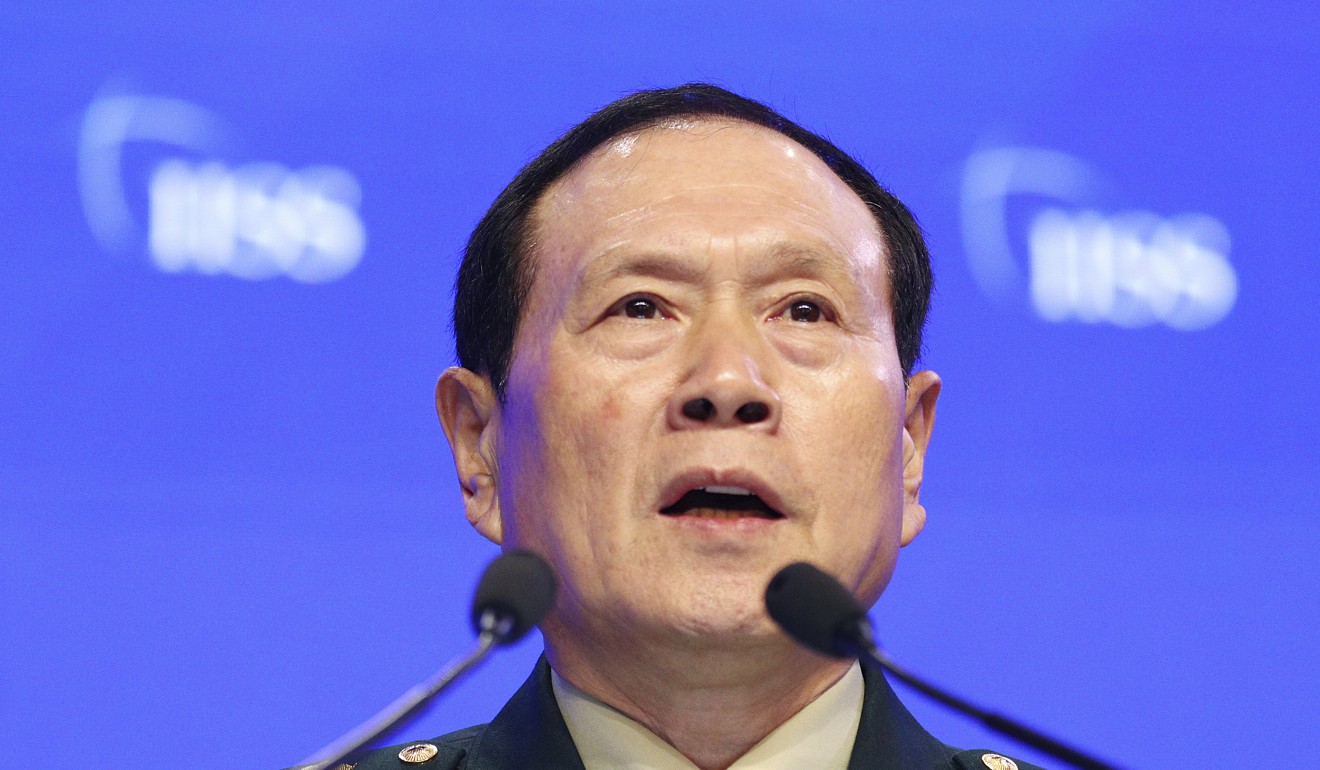
China’s Defence Minister Wei Fenghe told a regional security conference that the South China Sea was an inalienable part of China’s territory. Photo: AP

Although China and Vietnam have said they are looking for a diplomatic solution to prevent confrontations, neither has shown any signs of backing down and tensions have continued to rise.

On Monday, China’s Defence Minister Wei Fenghe told military and defence officials attending a regional security conference in Beijing that the South China Sea was an inalienable part of China’s territory.

“We will not allow even an inch of territory that our ancestors have left to us to be taken away,” he said in his opening speech at the Xiangshan Forum.

Also on Monday, Vietnamese Prime Minister Nguyen Xuan Phuc told lawmakers at the National Assembly that Hanoi would never give any territorial concessions.

“The situation in the South China Sea has become increasingly complicated,” he said. “Our party and state have consistently stated that what belongs to our independence, sovereignty and territorial integrity, we will never give up.”

Last week, Hanoi pulled DreamWorks’ animated film Abominable from theatres over a scene featuring a map that shows Beijing’s self-declared “nine-dash line” in the South China Sea. China uses the U-shaped line to claim sovereignty over more than 80 per cent of the resource-rich waterway, parts of which are also claimed by Vietnam, Malaysia, the Philippines and Brunei.

Ian Storey, a senior fellow at the ISEAS-Yusof Ishak Institute in Singapore, said that the withdrawal of the Haiyang Dizhi might only be “temporary”.

“China has made its point about drilling activities within the nine-dash line and expects Vietnam to suspend further exploration and production activities,” he said. “[But] of course Vietnam won’t.”

China, Malaysia seek to resolve South China Sea disputes with dialogue mechanism

Zhang Mingliang, a specialist in Southeast Asian affairs at Jinan University in the south China city of Guangzhou, said that the Chinese ship’s withdrawal was unlikely to have had anything to do with the comments made by Vietnam.

“I think the main reason is that it had finished its work,” he said. “But the withdrawal could also be seen as an attempt to ease the [China’s] tensions with the US.”

The significance for relations between Beijing and Hanoi was minimal, he said, as the two nations were engaged in one of the world’s most complicated territorial disputes.

“The impact on Sino-Vietnam relations will be limited because there have been too many disputes like this one,” he said.

Source: SCMP

25/10/2019

Mahjong: Police clamp down on China’s most loved game

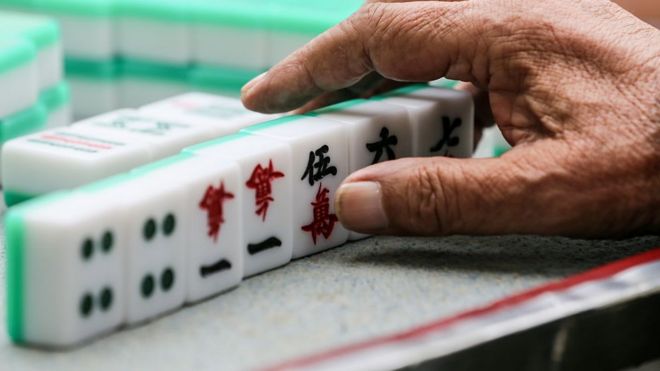
MahjongImage copyright GETTY IMAGES
Image caption Mahjong has been referred to as the “quintessence of Chinese culture”

An apparent police ban on all mahjong parlours in a Chinese city led to panic among aficionados of China’s national pastime.

Police in Yushan in southeast China first announced the ban at the weekend, saying it was to curb illegal gambling and “purify social conduct”.

This led to shock and outrage with many calling the strategic, tile-based game the “quintessence of Chinese culture”.

Police then clarified that only unlicensed parlours would be shut.

It comes after several other cities also announced parlours encouraging gambling would be shut.

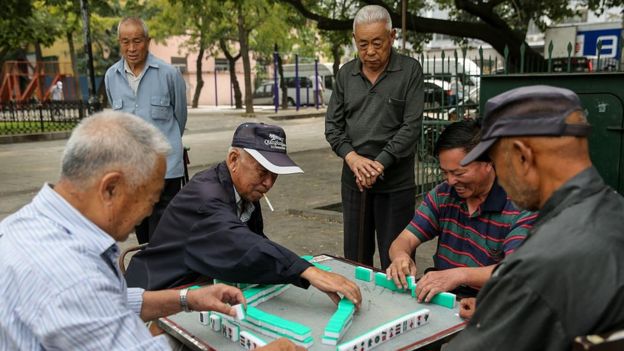
Mahjong is one of the most popular games in China, especially with older people.

While it does not have to be played with money, it is common for players to gamble with small amounts. A typical mahjong game could see players bet anywhere from $1 to $15.

‘People can gamble with anything’

On 20 October, police in Yushan, a small county in China’s southeast Jiangxi province, issued a statement announcing that all mahjong parlours in the county would be “closed” by 22 October.

Authorities said the ban would be enacted in an effort to “push forward the campaign against crimes and gangs… [to] solve the gambling and noise problem [and] purify social conduct”.

Gambling is illegal in China but under Jiangxi province law, those who engage in “win-loss entertainments such as mahjong and poker involving a small amount of money… shall not be punished”.

However, the law adds that people who “[gamble] money of more than 200 yuan ($28; £21)” could be subject to punishment.

Men play mah-jong in a streetImage copyright GETTY IMAGES
Image caption It’s a familiar sight to see retirees gather in parks to play mahjong

It wasn’t long before the backlash kicked in.

Some people pointed out that while China does face a widespread problem of illegal gambling dens, many mahjong parlours are in fact, legally operated with licenses.

Another commenter on social media site Weibo said: “Not all people play mahjong for gambling,” according to state media ECNS.

“My grandparents play mahjong as part of their daily entertainment”.

Others said it was a “lazy” solution by the government in an attempt to curtail illegal gambling.

“Mahjong [itself] is not a problem. People can gamble with anything,” said one comment on Weibo.

But one social media user saw the positive side of the ban, saying: “Finally! I have been woken up numerous times [by] mahjong players.”

Mahjong is known to be quite a noisy game, as the heavy tiles often make clacking sounds as they are shuffled around.

But their joy was short lived. Just one day after they made the announcement, Yushan authorities revised their statement, saying licensed mahjong parlours would not be affected.

They also clarified that the ban was meant to target places that encouraged “illegal gambling”.

Despite this, some licensed parlour owners told local news outlets that they were also not operating amid the clampdown, but it was unclear whether that was voluntary or enforced by officials.

Several other cities in Jiangxi have also banned mahjong in recent days, but had made it clear in their announcements that registered mahjong parlours would not be affected.

line

What is mahjong?

line

The game has also gone on to gain popularity in the West – and has recently made several appearances in mainstream pop culture.

It was featured as part of a pivotal moment in the Hollywood blockbuster Crazy Rich Asians, where two main characters met for a showdown of a game at a mahjong parlour.

Source: The BBC

Law of Unintended Consequences

continuously updated blog about China & India

ChiaHou's Book Reviews

continuously updated blog about China & India

What's wrong with the world; and its economy

continuously updated blog about China & India