Archive for November, 2019

15/11/2019

Xi’s remarks point way to stabilizing Hong Kong situation: spokesperson

BEIJING, Nov. 15 (Xinhua) — President Xi Jinping’s latest remarks on the Hong Kong situation are the strongest voice from the central government on the work of ending violence and chaos in Hong Kong, a spokesperson said Friday.

Xi’s remarks on Thursday in Brazil have pointed the way to stabilizing the situation in the Hong Kong Special Administrative Region (SAR), said Yang Guang, a spokesperson for the Hong Kong and Macao Affairs Office of the State Council.

The president’s words came as the disturbances in Hong Kong have lasted more than five months and radical violent crimes have been escalating recently, the spokesperson said.

His remarks are a strong support to the Hong Kong SAR government led by Chief Executive Carrie Lam, a great inspiration to Hong Kong residents, and a stern warning to the rioters and their backroom supporting forces, Yang said.

The office will work with resolve to implement the president’s requirements to firmly support the chief executive in leading the SAR government to govern in accordance with the law, firmly support the Hong Kong police in strictly enforcing the law, and firmly support the Hong Kong judicial bodies in severely punishing the violent criminals in accordance with the law, Yang said.

The spokesperson pledged various means of supporting and encouraging the Hong Kong people from all walks of life to build up “overwhelming positive energy” in countering violence and safeguarding rule of law, for the end of chaos and the restoration of social stability in Hong Kong as soon as possible.

“The central government and 1.4 billion people of China will always be the strongest backing for Hong Kong to overcome any challenges and risks,” he said.

Source: Xinhua

15/11/2019

Hong Kong in first recession for a decade amid protests

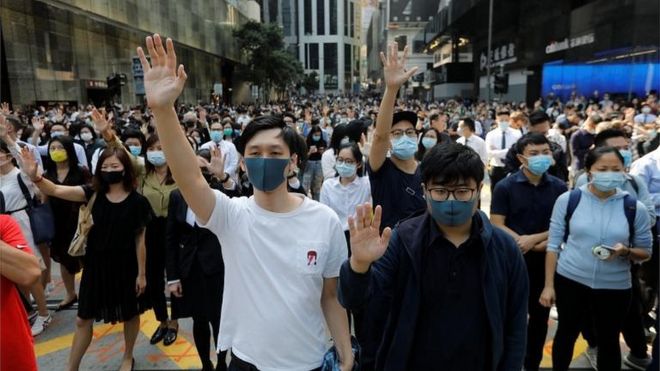
Protesters in Hong KongImage copyright REUTERS
Image caption Anti-government protests in Hong Kong started five months ago

Hong Kong has confirmed it has entered its first recession for a decade as it continues to be gripped by protests.

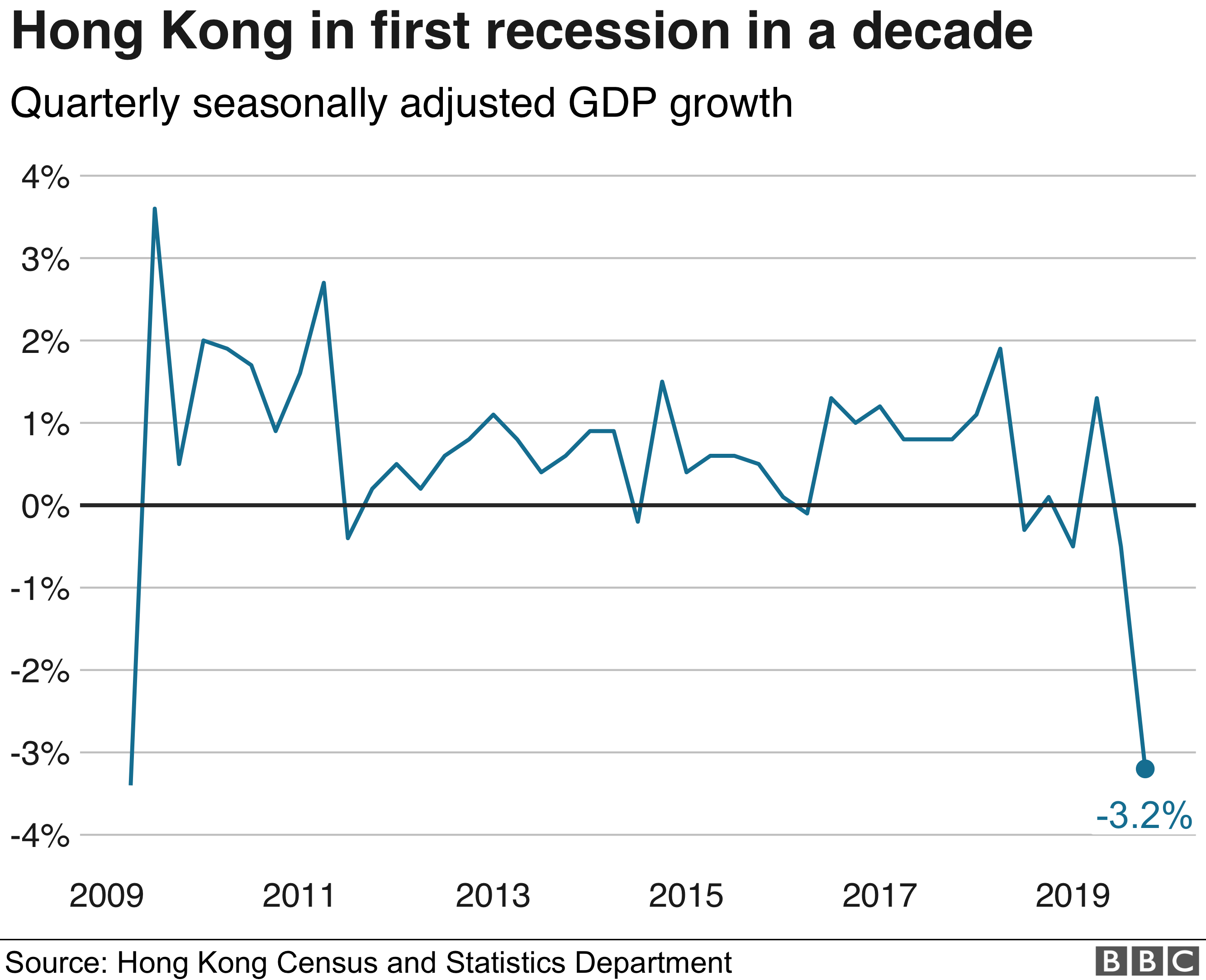
Its economy shrank 3.2% in the July-to-September period compared with the prior quarter, figures showed, confirming earlier preliminary data.

It means the economy has contracted for two quarters in a row, which is the usual definition of a recession.

Tourists are staying away and shops are suffering amid battles between anti-government protesters and police.

“Domestic demand worsened significantly in the third quarter, as the local social incidents took a heavy toll on consumption-related activities and subdued economic prospects weighed on consumption and investment sentiment,” the government said in a statement.

It now expects the economy to shrink 1.3% for the full year.

Hong Kong GDP graph

“Ending violence and restoring calm are pivotal to the recovery of the economy. The government will continue to closely monitor the situation and introduce measures as necessary to support enterprises and safeguard,” the government added.

Why are there protests in Hong Kong?

Hong Kong – a British colony until 1997 – is part of China under a model known as “one country, two systems”.

Under this model, Hong Kong has a high degree of autonomy and people have freedoms unseen in mainland China.

The protests started in June after the government planned to pass a bill that would allow suspects to be extradited to mainland China.

Many feared this bill would undermine the city’s freedoms and judicial independence.

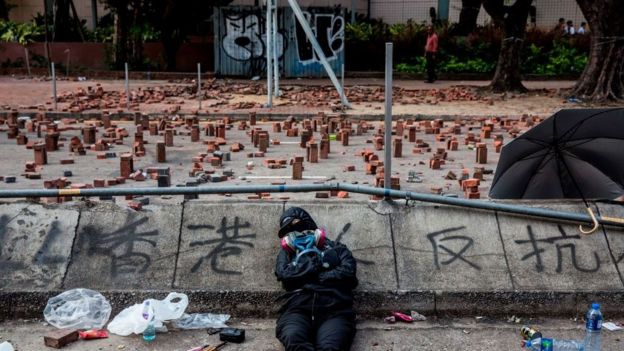
ProtesterImage copyrightGETTY IMAGES

The bill was eventually withdrawn but the protests continued, having evolved into a broader revolt against the police, and the way Hong Kong is administered by Beijing.

Protests have taken place every weekend over the past few months, causing widespread disruption and a number of deaths.

On Thursday, a 70-year-old cleaner died after he was hit in the head during a protest in the Hong Kong border town of Sheung Shui.

Video purported to be of the incident shows two groups throwing bricks at each other before the man falls to the ground after being struck on the head.

Hong Kong protestors outside a Burberry storeImage copyright GETTY IMAGES
Image caption Burberry says it has seen a “double digit” percentage decline in sales in Hong Kong

Dramatic scenes such as these have kept tourists away. In August, arrivals to the city – a popular travel destination and transit hub – hit their worst level since the SARS crisis of 2003.

Some hotels have slashed prices as they struggle to fill their rooms.

On Thursday, two companies with major operations in Hong Kong revealed the financial impact of the protests.

Luxury fashion house Burberry said its sales in Hong Kong had fallen by more than 10% and would “remain under pressure”.

Airline Cathay Pacific cut its profit guidance and said the civil unrest had “been exceptionally challenging, severely impacting demand and operations of the business”.

Why the spike in anger?

This week has seen a marked escalation in violence with intense street battles, violent clashes at universities and lunchtime protests in the financial heart of Hong Kong.

It is the first time in weeks that protests have taken place during weekdays.

Media caption Hong Kong Justice Secretary Teresa Cheng is jostled by protesters in London

Monday’s protests followed a weekend of vigils and demonstrations after a 22-year-old student protester died last week.

Alex Chow had been in hospital since he fell from the ledge of a car park during a police operation a week ago.

Later on Monday, violence escalated further when a police officer shot an activist in the torso with a live bullet and a pro-government supporter was set on fire by protesters.

In London, Hong Kong’s Justice Secretary Teresa Cheng was hurt after being jostled by anti-government protesters, the Chinese embassy said.

Ms Cheng is seen as having played a key role in promoting the unpopular extradition bill that triggered the protests. China strongly condemned the incident and called for a thorough investigation.

Source: The BBC

14/11/2019

China ready to achieve common prosperity with Brazil: Xi

BRAZIL-BRASILIA-XI JINPING-BRAZILIAN PRESIDENT-TALKS

Chinese President Xi Jinping holds talks with Brazilian President Jair Bolsonaro in Brasilia, Brazil, Nov. 13, 2019. (Xinhua/Ding Haitao)

BRASILIA, Nov. 13 (Xinhua) — Chinese President Xi Jinping said on Wednesday China is fully confident in China-Brazil cooperation and stands ready to achieve common prosperity with Brazil.

Xi made the remarks when meeting here with Brazilian President Jair Bolsonaro.

Noting that Bolsonaro paid a successful state visit to China in October, Xi said the consensus reached by the two sides is being actively implemented.

At the recently concluded second China International Import Expo (CIIE), the transaction volume of Brazilian businesses grew 3.6 times compared with that at the first CIIE last year, Xi said, calling the results gratifying.

As the largest emerging-market country in the eastern and western hemispheres, respectively, Xi said, China and Brazil share broad common interests.

China is optimistic about Brazil’s development prospects and fully confident in bilateral cooperation, Xi said, adding that China stands ready to share development experience and gains with Brazil, so as to achieve common prosperity.

Xi expressed willingness to work with Bolsonaro to properly grasp and guide the direction of the development of China-Brazil relations.

China and Brazil are both major countries and the two sides should maintain strategic focus, adhere to mutual respect, treat each other as equals, strengthen exchanges and cement mutual trust, Xi stressed.

He urged both sides to open markets to each other and explore ways to establish long-term, stable and direct supply channels for basic products, including agricultural products, iron ore and crude oil.

China supports its enterprises to actively participate in Brazil’s infrastructure construction to promote connectivity, Xi said.

Xi called on both sides to advance cooperation in areas such as digital economy, next-generation communications, material science and biotechnology, wishing another successful launch of the China-Brazil Earth Resources Satellite in the near future, and urging the two sides to jointly promote the follow-up cooperation.

Xi also urged both sides to expand cultural and people-to-people exchanges and facilitate personnel exchanges.

China supports the Brazilian government’s efforts to combat the disaster in the Amazon rainforest and believes that Brazil is capable of overcoming the disaster, Xi said.

Both sides should work together to promote all-round exchanges and cooperation between China and Latin American countries, uphold multilateralism, build an open world economy, and safeguard the legitimate development rights and interests of emerging markets, Xi said.

The Chinese president added that China supports Brazil in hosting the upcoming BRICS summit and stands ready to work with all parties to make the summitry a success.

For his part, Bolsonaro said he has instructed relevant government departments to implement as soon as possible the consensus reached during his state visit to China, calling that visit a success.

Noting that China is a significant major country and Brazil’s largest trading partner, Bolsonaro said the Brazilian people hold admiration, respect and friendly feelings toward the Chinese people, and Brazil-China cooperation boasts increasing significance to Brazil’s future development.

Economies of Brazil and China are highly complementary and the areas of cooperation continue to expand, Bolsonaro said, adding that his country welcomes Chinese investment to Brazil and stronger cooperation in infrastructure construction, iron ore, and the energy sector, including oil and gas.

The Brazilian side values the important opportunities brought about by China’s opening-up of its market, he said, expressing the hope to expand bilateral trade and promote export of more Brazilian agricultural products to China.

His country is also willing to offer favorable conditions for Chinese enterprises and products to enter Brazil, he said, adding that Brazil stands ready to facilitate personnel exchanges and cultural and people-to-people exchanges.

Bolsonaro thanked China for supporting Brazil’s sovereignty over the Amazon rainforest issue and expressed his willingness to cooperate with China on biodiversity conservation.

He also thanked China for supporting Brazil in hosting the BRICS summit, adding that Brazil is ready to strengthen coordination and cooperation with other parties for a summit that produces positive outcomes.

Brazil is grateful for China’s trust and friendship, said Bolsonaro, adding that from a long-term perspective, Brazil attaches importance to strengthening cooperation with China in a wide range of areas, so as to deepen their traditional friendship and benefit the two peoples.

After the meeting, the two heads of state jointly met the press and witnessed the exchange of a number of documents on bilateral cooperation.

Source: Xinhua

14/11/2019

China’s top political advisor visits Egypt to enhance bilateral cooperation, boost ties

EGYPT-CHINA-WANG YANG-VISIT

Wang Yang, chairman of the National Committee of the Chinese People’s Political Consultative Conference (CPPCC), meets with Egyptian President Abdel-Fattah al-Sisi in Egypt, Nov. 11, 2019. Invited by Speaker Ali Abdel-Aal of the Egyptian Parliament, Wang paid an official visit to Egypt from Nov. 10 to 13. (Xinhua/Yan Yan)

CAIRO, Nov. 13 (Xinhua) — China and Egypt agreed to enhance cooperation and further promote bilateral ties as China’s top political advisor Wang Yang visited the North African country from Nov. 10 to 13.

During his meeting with Egyptian President Abdel-Fattah al-Sisi, Wang, chairman of the National Committee of the Chinese People’s Political Consultative Conference (CPPCC), hailed the robust development of bilateral ties.

Wang conveyed Chinese President Xi Jinping’s cordial greetings and best wishes to Sisi, noting that, under the guidance of the two heads of state, Sino-Egyptian relations have achieved historical development.

He said China stands ready to work with Egypt to increase high-level exchanges, deepen political mutual trust, actively promote practical cooperation under the framework of the Belt and Road Initiative (BRI), enhance coordination over regional and global affairs, strengthen anti-terrorism cooperation, and push the Sino-Egyptian comprehensive strategic partnership for greater development.

Wang said that the just-concluded fourth plenary session of the 19th Communist Party of China Central Committee has constructed a reliable mechanism for the modernization of China’s national governance system and capacity, as well as realization of national rejuvenation, which also provides Chinese wisdom and solutions to the institutional civilization of humanity.

Wang said China is ready to work with Egypt to strengthen exchanges of experience on governance and support Egypt’s choice of a development path that suits its own national conditions.

For his part, Sisi asked Wang to convey his cordial greetings to Xi, while expressing his heartfelt congratulations to China on its great achievements made in the past 70 years.

Applauding the unprecedented level and depth of Sino-Egyptian relations, Sisi said Egypt supports the BRI and welcomes Chinese enterprises to increase investment in Egypt.

The Egyptian leader also expressed the hope that China will give full play to its influence to promote peace and stability in the Middle East.

Egypt is willing to enhance exchanges and mutual learning on de-radicalization, he added.

At his meeting with Egyptian Parliament Speaker Ali Abdel-Aal, Wang said that political mutual trust is the foundation of Sino-Egyptian relations and the BRI has become the new focus of cooperation between the two countries.

Wang appreciated Egypt’s firm support on the issues concerning China’s core interests, adding that China is ready to work with Egypt to enhance coordination on development strategies, implement major cooperation projects, and boost cooperation in tourism and people-to-people exchanges.

He said that the CPPCC is willing to increase exchanges with Egyptian parliament at all levels, with an aim to increase each other’s capabilities of fulfilling own duties.

Abdel-Aal expressed his country’s firm support for the one-China principle and the measures adopted by China to safeguard its territorial and sovereign integrity and national stability.

He said Egypt supports the two sides to enhance friendly exchanges between legislative and consultative bodies.

Abdel-Aal hoped that more Egyptian agricultural products will enter China’s market, while pledging to offer convenience for Chinese enterprises to expand investment in Egypt.

When meeting with Egyptian Prime Minister Mostafa Madbouly, Wang said that Egypt, which boasts huge market potential and demographic dividend at a crucial stage of industrialization and urbanization, is China’s natural partner in BRI development.

Wang said China is willing to positively participate in Egypt’s strategic planning including the Suez Canal Corridor development, encourage competitive Chinese enterprises to invest in Egypt, explore conducting Africa-oriented tripartite cooperation, and facilitate the access to China’s market by high-quality Egyptian agricultural products.

Madbouly said China has become Egypt’s largest trading partner and the Sino-Egyptian ties are taking a leap forward.

He said that Egypt is willing to learn from China’s advanced experience in technological innovation, and enhance mutually beneficial cooperation and mutual support on cyber security and anti-terrorism.

Egypt also looks forward to working with China to jointly promote the interconnection and intercommunication between China and Africa, Madbouly added.

During his stay in Egypt, Wang also had in-depth exchanges with Grand Imam of al-Azhar Ahmed el-Tayeb and Governor of Luxor Moustafa Mohamed Alham Khaled, inspected Chinese telecom company Huawei’s innovation exhibition center in North Africa, and attended the inauguration ceremony of Luxor University’s Confucius classroom.

Source: Xinhua

14/11/2019

Sabarimala temple: India court to review ruling on women’s entry

Devotees inside the Sabarimala templeImage copyright KAVIYOOR SANTHOSH
Image caption Sabarimala is one of the most prominent Hindu temples in the country

India’s Supreme Court has agreed to review its landmark judgement allowing women of menstruating age to enter a controversial Hindu shrine.

A five-judge bench last year ruled that keeping women out of the Sabarimala shrine in the southern state of Kerala was discriminatory.

The verdict led to massive protests in the state.

Women who tried to enter the shrine were either sent back or, in some cases, even assaulted.

The move is likely to anger women who fought hard to win the right to enter the temple.

Hinduism regards menstruating women as unclean and bars them from participating in religious rituals.

Many temples bar women during their periods and many devout women voluntarily stay away, but Sabarimala had a blanket ban on all women between the ages of 10 and 50.

What did the court say?

On Thursday the five-judge bench, responding to dozens of review petitions challenging the court’s landmark judgement last year, said that the matter would now be heard by a larger bench.

In doing so, however, it did not stay its earlier order. This means women can still legally enter the temple.

But it’s not going to be easy for them.

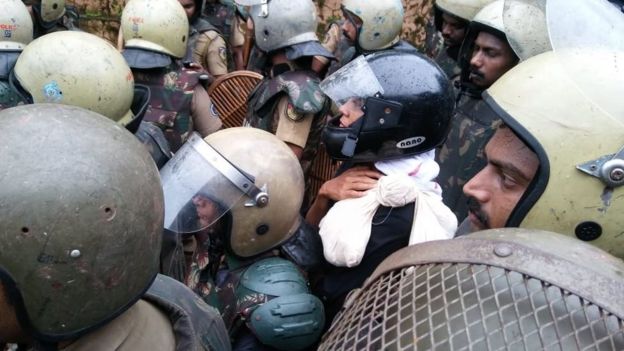
Two women trying to enter the temple in full riot gear
Image caption Some women tried to enter the temple last year

A temple official welcomed the ruling and appealed to women to stay away.

Women trying to enter the temple after the verdict last year were attacked by mobs blocking the way.

Many checked vehicles heading towards the temple to see if any women of a “menstruating age” – deemed to be those aged between 10 and 50 years – were trying to enter.

Following Thursday’s verdict, police in Kerala have appealed for calm, saying that action will be taken “against those who take the law into their own hands”. They added that social media accounts would be under surveillance and those stoking religious tensions online would be arrested.line

‘One step forward, two steps back’

Geeta Pandey, BBC News, Delhi

Today’s verdict will come as a massive disappointment to women’s rights campaigners. It’s a case of one step forward, two steps back.

In 2018, while lifting the ban on women’s entry into the shrine, the Supreme Court had said that everyone had the right to practice religion and that the ban was a form of “untouchability”.

It was seen as a hugely progressive ruling and had given hope to women that they were equal before the law and could now claim equality before the gods too. What happened in court today has taken that sense away.

The Supreme Court has not put its earlier order on hold, but with the ambiguity over women’s entry continuing, it’s very likely they could be kept out in the name of keeping peace.

With the case now to be reopened by a larger seven-judge bench, the fight will have to be fought all over again.line

Why is the temple so controversial?

Part of the violent opposition to the Supreme Court order to reverse the temple’s historical ban on women was because protesters felt the ruling goes against the wishes of the deity, Lord Ayappa, himself.

While most Hindu temples allow women to enter as long as they are not menstruating, the Sabarimala temple is unusual in that it was one of the few that did not allow women in a broad age group to enter at all.

Hindu devotees say that the ban on women entering Sabarimala is not about menstruation alone – it is also in keeping with the wish of the deity who is believed to have laid down clear rules about the pilgrimage to seek his blessings.

Indian Police patrol during clashes between Communist Party of India (Marxist) (CPM) and Bhartiya Janta Party (BJP) in front of the Kerala Government Secretariat in Thiruvnanthapuram on January 02, 2019Image copyright GETTY IMAGES
Image caption The entry of women into the Sabarimala temple sparked angry scenes

Every year, millions of male devotees trek up a steep hill, often barefoot, to visit the shrine. They also undertake a rigorous 41-day fast, abstaining from smoking, alcohol, meat, sex and contact with menstruating women before they begin the journey.

Women’s rights campaigners who appealed to the Supreme Court to lift the ban said that this custom violated equality guaranteed under India’s constitution. They added that it was prejudiced against women and their right to worship.

Supporters of the ban argued that the practice had been in effect for centuries, and there was no need to change it now.

So, were any women able to enter last year?

In January, two women defied protesters and entered the shrine.

Kanakadurga, 39, and Bindu Ammini, 40, made history when they entered the Sabarimala shrine – but they had to do so under heavy police protection and were also met with massive protests after.

Right-wing groups, supported by India’s ruling Hindu nationalist Bharatiya Janata Party (BJP), demanded a state-wide shutdown after, and businesses and transportation became paralysed.

Across the state hundreds were arrested, and at least one person was killed in clashes.

In an interview with the BBC, the women said they felt it necessary to uphold women’s rights and they weren’t afraid of mobs “enraged” by their actions.

Media caption One of the women who defied protesters to enter the Sabarimala temple says she has ‘no fear’

“I am not afraid. But every time women make any progress, society has always made a lot of noise,” Ms Kanakadurga told the BBC in January.

But their decision to enter the temple also came at heavy personal cost.

She alleged that she had been beaten by her mother-in-law and abandoned. She has since filed for divorce.

Source: The BBC

13/11/2019

China sends five satellites into orbit via single rocket

CHINA-TAIYUAN-SATELLITE LAUNCH-NINGXIA-1 (CN)

The five new remote-sensing Ningxia-1 satellites are launched by a Long March-6 carrier rocket from the Taiyuan Satellite Launch Center in north China’s Shanxi Province on Nov. 13, 2019. The five Ningxia-1 satellites were sent into planned orbit here on Wednesday. The satellites are part of a commercial satellite project invested by the Ningxia Jingui Information Technology Co., Ltd. and will be mainly used for remote sensing detection. (Photo by Zheng Taotao/Xinhua)

TAIYUAN, Nov. 13 (Xinhua) — Five new remote-sensing satellites were sent into planned orbit from the Taiyuan Satellite Launch Center in north China’s Shanxi Province Wednesday.

The five Ningxia-1 satellites were launched by a Long March-6 carrier rocket at 2:35 p.m. (Beijing Time).

The satellites are part of a commercial satellite project invested by the Ningxia Jingui Information Technology Co., Ltd. and will be mainly used for remote sensing detection.

The satellites and carrier rocket were developed by the DFH Satellite Co., Ltd. and the Shanghai Academy of Spaceflight Technology.

Wednesday’s launch was the 318th mission for the Long March series carrier rockets.

Source: Xinhua

13/11/2019

Two endangered Chinese finless porpoises found dead in Yangtze River as species struggles for survival

  • Remains of two of river’s estimated 1,012 porpoises found in less than a week
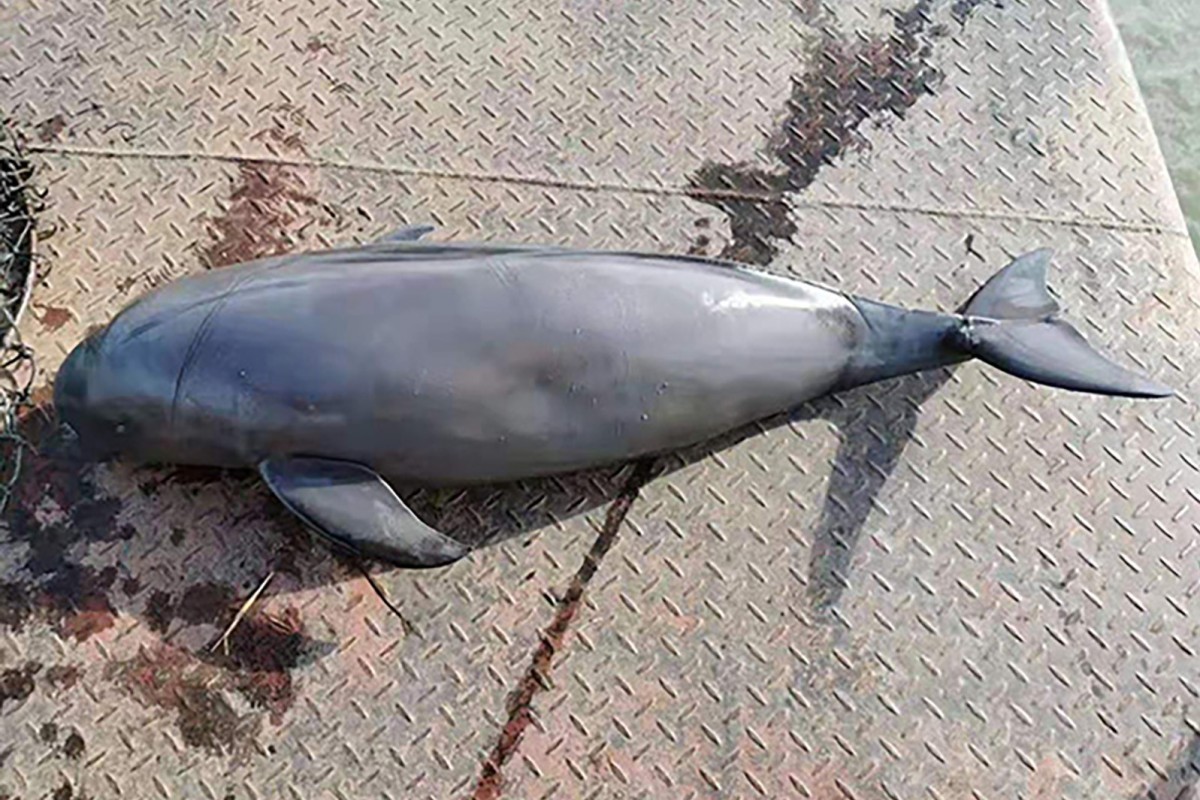
The finless porpoise found dead in the Yangtze River in Hubei on Monday was the second fatality in a week. Photo: 163.com

Two endangered finless porpoises have been found dead in the Yangtze River in the space of a week, according to mainland Chinese media reports.

One was found on Monday in Jiayu county, central Hubei province, four days after the remains of another were recovered from Dongting Lake, a tributary of the Yangtze in central Hunan province, news website Thepaper.cn reported.

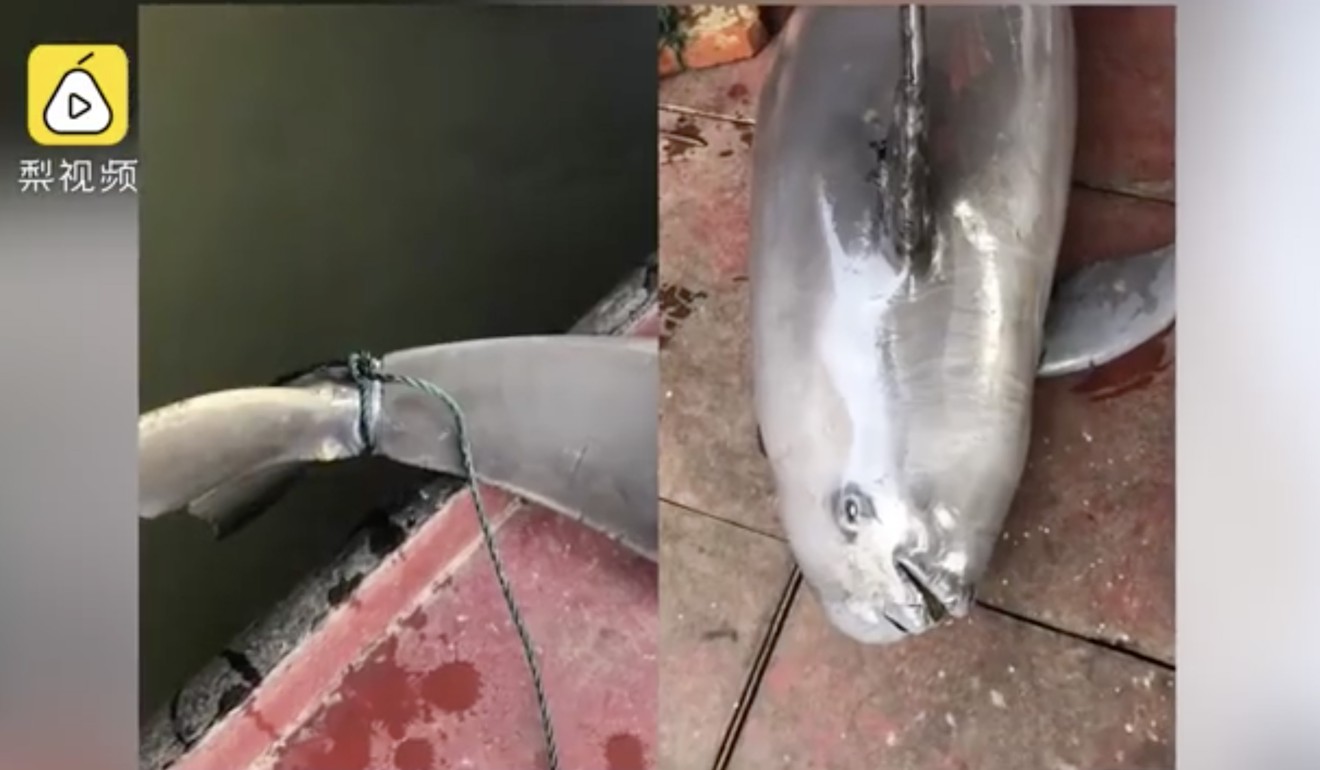
The Dongting Lake carcass was tied with a rope and weighted with bricks, and authorities in Hunan said the creature became tangled in a fishing net. The Hubei death is under investigation.

The Yangtze’s finless porpoises are “extremely endangered”, the Ministry of Agriculture and Rural Affairs said in a 2016 action plan to protect the species. Last year, vice-minister Yu Kangzhen said surveys showed there were about 1,012 of the animals in the river.

The tail of a dead finless porpoise pulled from Dongting Lake in Hunan appears to have been tied to weights. Photo: Pear Video

In 2017, China raised its protection for the mammals to its highest level because of the critical dangers they faced. Experts said that as the river’s “flagship” species, the porpoise was an indicator for the Yangtze’s ecology.

The porpoise discovered in Hubei was small and it had suffered superficial wounds, investigators were quoted as saying. They estimated that it was found soon after its death.

Xiaoxiang Morning Post quoted fisheries authorities in Yueyang, near Dongting Lake, as saying the porpoise in Hunan was found with weights around its tail.

Two porpoise carcasses found on separate Hong Kong shores
Officials said the fishermen who set the net feared they would be blamed for the creature’s death and tied bricks to its tail to sink it.

Other fishermen who witnessed the incident told the authority, leading to the discovery of the body, the report said. The investigation is ongoing and the suspects are still at large.

A fishing authority spokesman told the newspaper that the porpoise’s death showed the difficulty of balancing conservation with the livelihoods of fishermen.

“It’s difficult to figure out a good model to protect the porpoises without affecting fishermen’s business,” he said.

In mainland China, finless porpoises are referred to as “giant pandas in water” because of their endangered status. Their numbers fell from 2,700 in 1991 to 1,800 in 2006, and there were 1,045 finless porpoises in 2012, according to agriculture ministry data.

Source: SCMP

13/11/2019

Xinjiang cotton sparks concern over ‘forced labour’ claims

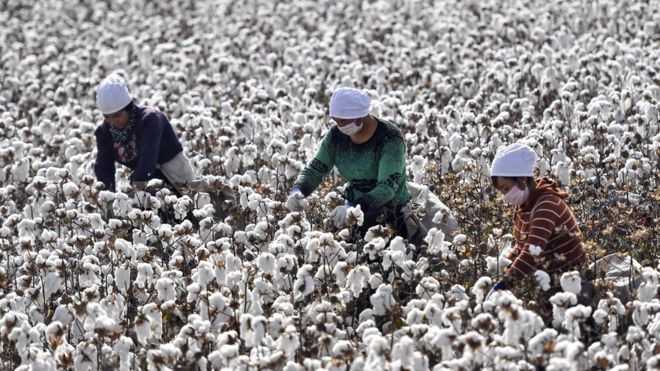
Farmers pick cotton during the harvest on October 21, 2019 in Shaya County, Xinjiang Uygur Autonomous Region of China.Image copyright GETTY IMAGES

Global retailers are facing scrutiny over cotton supplies sourced from Xinjiang, a Chinese region plagued by allegations of human rights abuses.

China is one of the world’s top cotton producers and most of its crop is grown in Xinjiang.

Rights groups say Xinjiang’s Uighur minority are being persecuted and recruited for forced labour.

Many brands are thought to indirectly source cotton products from the Xinjiang region in China’s far west.

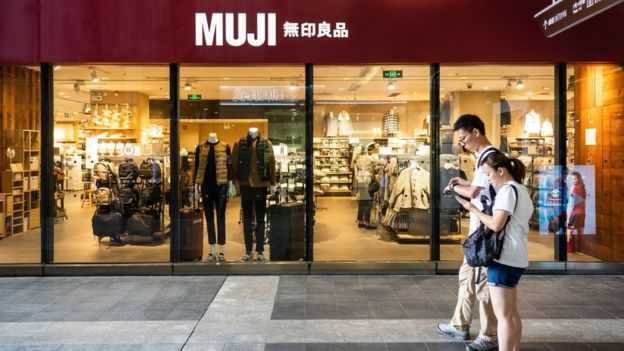
Japanese retailers Muji and Uniqlo attracted attention recently after a report highlighted the brands used the Xinjiang-origin of their cotton as a selling point in advertisements.

H&M, Esprit and Adidas are among the firms said to be at the end of supply chains involving cotton products from Xinjiang, according to a Wall Street Journal investigation.

“You can’t be sure that you don’t have coerced labour in your supply chain if you do cotton business in China,” said Nathan Ruser, researcher at the Australian Strategic Policy Institute.

“Xinjiang labour and what is almost certainly coerced labour is very deeply entrenched into the supply chain that exists in Xinjiang.”

What is happening in Xinjiang?

UN experts and human rights groups say China is holding more than a million Uighurs and other ethnic minorities in vast detention camps.

Rights groups also say people in camps are made to learn Mandarin Chinese, swear loyalty to President Xi Jinping, and criticise or renounce their faith.

China says those people are attending “vocational training centres” which are giving them jobs and helping them integrate into Chinese society, in the name of preventing terrorism.

What is produced in Xinjiang?

The Xinjiang region is a key hub of Chinese cotton production.

China produces about 22% of global cotton supplies, according to a report by the Center for Strategic and International Studies (CSIS).

Last year, 84% of Chinese cotton came from Xinjiang, the report said.

That has raised concerns over whether forced labour has been used in the production of cotton from the region.

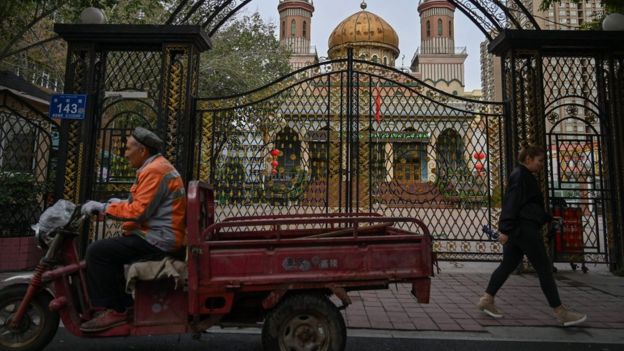
This photo taken on September 11, 2019 shows people walking past a mosque in Urumqi, the regional capital of Xinjiang.Image copyright GETTY IMAGES
Image caption The Uighurs are mostly Muslims, and number about 11 million in China’s Xinjiang region

Nury Turkel, chairman of the Uighur Human Rights Project in Washington, said the Uighurs were being “detained and tormented” and “swept into a vast system of forced labor” in Xinjiang.

In testimony to US congress, he said it was becoming “increasingly hard to ignore the fact” that the goods manufactured in the region have “a high likelihood” of being produced with forced labour.

Which brands use Xinjiang cotton?

Amy Lehr, director of CSIS Human Rights Initiative, said in many cases Western companies aren’t buying directly from factories in Xinjiang.

“Rather, the products may go through several stages of transformation after leaving Xinjiang before they are sent to large Western brands,” she said.

Some, like Muji, are very open about sourcing material from Xinjiang.

The Japanese retail chain launched a new Xinjiang Cotton collection earlier this year.

One of its advertisements boasts “soft and breathable” men’s shirts made from organic cotton “delicately and wholly handpicked in Xinjiang”.

Another Japanese fashion brand Uniqlo had also touted the Xinjiang region in an advertisement advertisment for men’s shirts.

In the fine print of the shirt description, the advert said the shirts were made from Xinjiang cotton, “famous for its superb quality”.

That reference was later removed from the advertisement “given the complexity of this issue”, according to a spokesperson for Uniqlo.

“Uniqlo does not have any production partners located in the Xinjiang region. Moreover, Uniqlo production partners must commit to our strict company code of conduct.

“To the best of our knowledge, this means our cotton comes only from ethical sources,” the spokesperson told the BBC.

Pedestrians walk past a Japanese household and consumer goods retailer, Muji store in ShenzhenImage copyright GETTY IMAGES

According to the Wall Street Journal report which focused on workers at a mill operated by Huafu Fashion in Aksu, Xinjiang, yarn made in the region was present in the supply chains of several international retailers including H&M, Esprit and Adidas.

Many of the companies looked into the allegations, including those without clear links to the Huafu mill.

In a statement to the BBC, Adidas said: “While we do not have a contractual relationship with Huafu Fashion Co., or any direct leverage with this business entity or its subsidiary, we are currently investigating these claims.”

“We advised our material suppliers to place no orders with Huafu until we have completed those investigations,” the Adidas spokesperson said.

Esprit, which also does not source cotton directly from Xinjiang, said it had made several inquiries earlier this year.

“We concluded that a very small amount of cotton from a Huafu factory in Xinjiang was used in a limited number of Esprit garments,” the firm said in a statement.

The company has instructed all suppliers to not source Huafu yarn from Aksu, the statement said.

H&M said it does not have “a direct or indirect business relationship” with any garment manufacturer in the Xinjiang region.

“We have an indirect business relationship with Huafu’s spinning unit in Shanyu, which is not located in the Xinjiang region, and according to our data, the vast majority of the yarn used for our garment manufacturing comes from this spinning unit,” a spokesperson for H&M said.

“Since we have an indirect business relationship with the yarn supplier Huafu, we also asked for access to their spinning facilities in Aksu. Our investigations showed no evidence of forced labor.”

Source: The BBC

13/11/2019

India train collision: Lucky escape for passengers in Hyderabad

Hundreds of passengers had a lucky escape after two trains collided head-on in the southern Indian city of Hyderabad.

Twelve passengers suffered minor injuries and are being treated at a local hospital.

An inquiry has been ordered into the incident.

India has one of the largest train networks in the world but accidents are fairly common because much of the railway equipment is out of date.

The government has promised to modernise the network but the pace of the change has been slow.

source: The BBC

12/11/2019

Feature: Xi spearheads closer China-LatAm cooperation for common prosperity

MEXICO CITY, Nov. 12 (Xinhua) — China and Latin America sit on the opposite sides of the globe, but the formidably vast Pacific Ocean that separates them did not stop them from sharing a long history of exchanges.

Today, the major developing country in the East is forging an increasingly close partnership with the dynamic region in the Western Hemisphere, especially since Chinese President Xi Jinping took office in 2013, and set into motion what is now known as Xiplomacy.

In the past six years, Xi has visited 11 Latin American and the Caribbean (LAC) countries. On Tuesday, he is setting foot on the region for the fifth time as president, as he arrives in Brazil for the upcoming 11th BRICS summit.

Thanks in no small part to Xi’s push, the time-honored, distance-defying China-Latin America relationship is flourishing with new vitality. China has become the second largest trading partner of Latin America, while the latter is one of the fastest growing sources of exports to China. Two-way trade rose 18.9 percent year on year to 307.4 billion U.S. dollars in 2018.

GRAND VISION

Every time Xi visited Latin America, he reaffirmed China’s commitment to cementing bilateral friendship and expanding win-win cooperation.

His first trip to the region as head of state, in 2013, took him to Trinidad and Tobago, Costa Rica and Mexico. The following year saw him travel to Brazil, Argentina, Venezuela and Cuba.

It was in Brazil that Xi met with leaders from 11 LAC countries, and for the first time laid out his grand vision for building a China-Latin American community with a shared future.

“Let us seize the opportunities presented to us and work together to blaze new trails in building a community of shared destiny for common progress and usher in a bright future for the relations between China and Latin America and the Caribbean,” Xi said in a keynote speech at the first ever China-Latin American and Carribean Countries Leaders’ Meeting in 2014.

He then proposed a “1+3+6” cooperation framework to “promote faster, broader and deeper cooperation between the two sides for real results.”

The “1” refers to “one plan,” the Chinese-Latin American and Caribbean Cooperation Plan (2015-2019), formulated to promote inclusive growth and sustainable development.

The “3” alludes to “three engines” for driving practical cooperation for comprehensive development, namely trade, investment and financial cooperation.

The “6” means the six priority cooperation fields of energy and resources, infrastructure building, agriculture, manufacturing, scientific and technological innovation, and information technologies.

In 2016, Xi visited Ecuador, Peru and Chile. Two years later, he traveled to Argentina for the Group of 20 summit as well as Panama, a Central American country which established diplomatic ties with China in June 2017.

In a landmark speech at the Peruvian Congress in Lima in 2016, Xi expounded the significance of strengthening China-Latin America cooperation.

“With one fifth of the world’s total area and nearly one third of the world’s population, China and Latin America and the Caribbean are crucial forces for world peace and stability,” he said.

China, he added, “will increase sharing of governance experience and improve planning and coordination of macro policies with Latin American and Caribbean states to better synergize our development plans and strategies.”

Besides top-level engagement, Xi also reaches out to local people from all walks of life, in order to keep cementing the China-Latin America friendship and the public support for bilateral cooperation.

While in Costa Rica, Xi visited a family-run coffee plantation and tried some local brew. “I think some more coffee can well be exported to China,” Xi told his hosts with a smile.

Today, Costa Rica exports coffee to the Asian market, along with pork, dairy, pineapples and other high-quality agricultural goods, especially after the inauguration of the China International Import Expo in 2018.

NEW OPPORTUNITIES

With international cooperation within the framework of the Belt and Road Initiative (BRI) gaining steam worldwide, the Xi-proposed vision is creating new opportunities for China-Latin America cooperation.

The BRI, designed to promote common development along and beyond the ancient Silk Road trade routes, comprises the Silk Road Economic Belt and the 21st Century Maritime Silk Road, and the latter is closely connected to Latin America.

For two and a half centuries, from the mid-1500s to the early 1800s, galleons laden with Chinese silk, spices, porcelain and other goods sailed across the ocean to today’s port city of Acapulco on the Mexican Pacific coast.

Latin America is the natural extension of the 21st Century Maritime Silk Road, Xi said in a meeting with visiting Argentine President Mauricio Macri in May 2017.

In a congratulatory message to the second Ministerial Meeting of the China-Community of Latin American and Caribbean States (CELAC) Forum held in Chile on Jan. 22, 2018, Xi stressed that China and LAC countries “need to draw a new blueprint for our joint effort under the Belt and Road Initiative and open a path of cooperation across the Pacific Ocean that will better connect the richly endowed lands of China and Latin America and usher in a new era of China-LAC relations.”

During Xi’s visits, the Chinese president is always dedicated to better aligning the BRI — an open platform for cooperation — with the development plans of LAC countries.

In his meeting with Macri, Xi called for dovetailing the BRI with Argentina’s development strategy, expanding cooperation in such sectors as infrastructure, energy, agriculture, mining and manufacturing, and implementing existing major cooperation projects in hydro-power, railway and other fields.

Similarly, during the state visit to Panama in December 2018, Xi said the National Logistics Strategy of Panama 2030 and the BRI are highly compatible, calling on the two sides to synergize their respective development strategies, boost cooperation and promote connectivity.

So far, 19 LAC countries have signed BRI cooperation agreements with China. China-Latin America cooperation in various areas has effectively promoted local economic and social development, bringing visible and tangible benefits to the Latin American people.

Just as Xi said in his speech at the Peruvian Congress in 2016, “China will share its development experience and opportunities with the rest of the world and welcome other countries to board the express train of its development, so that we can all develop together.”

SOurce: Xinhua

Law of Unintended Consequences

continuously updated blog about China & India

ChiaHou's Book Reviews

continuously updated blog about China & India

What's wrong with the world; and its economy

continuously updated blog about China & India