Archive for February, 2020

13/02/2020

Why do many India MPs have criminal records?

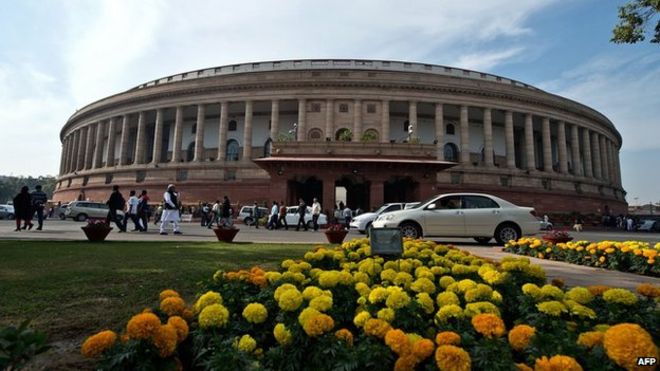
Indian parliamentImage copyright AFP
Image caption A third of the current members of parliament have criminal cases pending against them

“We need to build a consensus on how to prevent individuals with a criminal record from contesting elections.”

A necessary, even obvious fundamental you would think of building the world’s largest democracy.

And when Sonia Gandhi, India’s most powerful politician, uttered those words three years ago, even her main opponent, the leader of the BJP agreed.

Yet since then, things have gone in the opposite direction – with more alleged lawbreakers among India’s lawmakers than ever, a third of the current parliament according to a watchdog called the Association for Democratic Reforms.

By some calculations, politicians with a criminal record are more likely to be elected than those with a clean slate – because, says the ADR, they have more illicit funds with which to buy votes.

And on Tuesday night, India’s cabinet sought to ensure there was even less chance of criminal politicians facing their own laws.

It issued an order overturning a Supreme Court ruling demanding the disqualification of any politician convicted for crimes punishable with more than two years in jail.

This was “to ensure that governance is not adversely impacted“, the government had argued, with no apparent irony intended.

Unusual speed

Arguably, of course, the government is right. Losing tainted local or national politicians – among them many accused murderers, rapists and fraudsters – could upset delicate political alliances and make it even harder to get laws passed.

So often derided for doing nothing, this time round the cabinet acted with unusual speed.

The urgency it appears is the impending conclusion of two cases involving key politicians, due before Prime Minister Manmohan Singh gets back to India from a trip to the US.
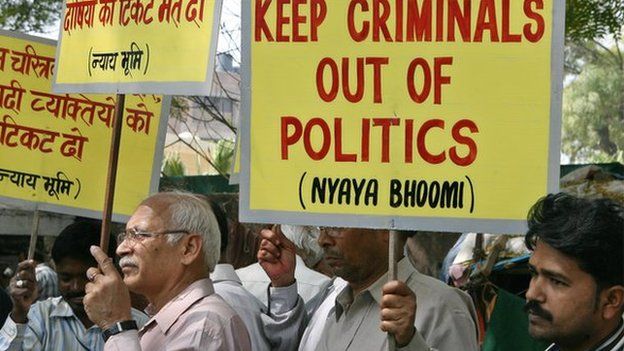
Protest against criminals contesting the parliamentary elections in Delhi on March 14, 2009Image copyright AFP
Image caption There’s been some criticism of criminal politicians

One concerns Lalu Prasad Yadav, a former railways minister and Congress party ally, charged with pocketing millions of dollars in subsidies for non-existent livestock.

Another concerns Congress MP Rashid Masood, already convicted of corruption and due to be sentenced next week. When the BBC asked his office for a comment, his assistant told us “he is unwell”.

“Don’t know whether to laugh or cry” tweeted MP Baijayant Panda in response to the government’s protective move.

He is a rare voice though inside the chamber campaigning against criminals sitting alongside him.

There’s been some other criticism outside, but not much. Indians have become very used to these kinds of shenanigans.

Almost forgotten already are calls in the Verma commission report into the December 16 Delhi gang rape case for all politicians accused of sexual crimes to be barred from office. Instead, six politicians charged with rape remain in office.

The opposition BJP has said it will oppose the cabinet order. But its record is just as murky, with even more accused criminals among its elected members in parliament and state assemblies than the Congress.

And with elections round the corner, none of the parties want to risk real reform right now, whatever they have signed up to in the past.

The world’s largest democracy is not alone in allowing so many questionable people to run it. Fellow Brics member Brazil has similar numbers of alleged criminals running the country.

The difference though is that in Brazil, brazen political abuses have provoked major protest.

But, says Indian MP Baijayant Panda: “This is a phase all democracies have gone through – look at the US.”

Voters will start to demand change, he predicts: “This is the last era of brazenness.”

Source: The BBC

13/02/2020

Another wall goes up for Trump, this time in India

AHMEDABAD, India (Reuters) – U.S. President Donald Trump will be shielded from the sight of slums by a newly built wall when he visits the city of Ahmedabad during a visit to India this month.

A senior government said the wall was being built for security reasons, not to conceal the slum district.

But the contractor building it told Reuters the government “did not want the slum to be seen” when Trump passes by on the ride in from Ahmedabad’s airport.

“I’ve been ordered to build a wall as soon as possible, over 150 masons are working round-the-clock to finish the project,” the contractor said, speaking on condition of anonymity.

The government official conceded that the wall was part of a “beautification and cleanliness” drive.

Whatever the reason, the 400-meter-long and seven-feet-high wall will prevent the U.S. leader from getting a glimpse of a slum district that houses an estimated 800 families.

Trump, who has made his pledge to build a wall along the United States’ border with Mexico a feature of his presidency, will visit India on Feb. 24-25 to reaffirm strategic ties that have been buffeted by trade disputes.

He is expected to attend an event dubbed “Kem Chho Trump” (“How are you, Trump”) at a stadium in Ahmedabad along the lines of the “Howdy Modi” extravaganza he hosted for Indian Prime Minister Narendra Modi in Houston last September.

Speaking at the White House on Tuesday, Trump quoted Modi as saying “millions and millions of people” would attend the rally.

The event provides Trump, who was impeached in December, with the opportunity to woo the support of hundreds of thousands of Indian-American voters ahead of the U.S. presidential election in November.

But some slum dwellers whose homes will be cordoned off by the wall in Ahmedabad – the largest city in Modi’s home state of Gujarat – said the government was wasting tax-payer money to hide the poor.

“Poverty and slums are the reality of our life, but Modi’s government wants to hide the poor,” said Parvatbhai Mafabhai, a day worker who has lived there with his family for more than three decades.

Source: Reuters

13/02/2020

Economists eye silver lining in India’s rising rural inflation numbers

MUMBAI (Reuters) – India’s rural inflation rate surged faster than urban inflation for the first time in 19 months in January, and economists are optimistic that signals something the country desperately needs – a revival in demand in the rural economy.

Around two-thirds of India’s population depends on the rural sector with agriculture accounting for near 15% of India’s $2.8 trillion economy, and rising inflation suggests pricing power is returning to the hands of the farmers, say economists.

“This augurs well for farmers’ cash flows in the coming months. I expect early signs of demand revival to emerge from the rural belts, going ahead,” said Rupa Rege Nitsure, chief economist at L&T Financial Holdings.

Rural inflation rose to 7.73% in January, higher than the urban inflation rate – which was 7.39% – for the first time since June 2018. The latest data, released on Wednesday, also showed that overall inflation was 7.59% – its highest level in more than six years.

While the higher inflation readout, which comes at a time when India’s growth has likely slumped to 11-year lows, has fanned some concerns around stagflation, economists say the inflation numbers could also signal some momentum returning to rural growth.

The central bank is mandated to keep the retail inflation rate between 2-6% and it targets a medium-term inflation rate of 4%.

Rural inflation has been falling over the last year and half as a lack of proper infrastructure for storage and transport had left rural India with a glut of grains and the floods in several states in 2019 made matters worse for goods transportation.

“Better returns on food prices could improve the prolonged period of unfavourable terms of trade faced by the rural sector,” said Radhika Rao, economist with DBS Bank.

This could bring a glimmer of good news for the government, which has been trying to revive growth and boost consumption.

In its budget earlier this month, the government allocated 5.6% higher spends on agriculture and allied activities for the fiscal year 2020/21, as it seeks to kick-start demand.

While higher rural inflation could help kickstart economic growth, economists caution that urban demand revival remains a concern.

“To that extent that high inflation hurts urban spending, the overall demand dynamics stay unchanged,” Rao said.

Source: Reuters

12/02/2020

China says epidemic control goes beyond borders, calling for stronger communication

BEIJING, Feb. 12 (Xinhua) — A Chinese Foreign Ministry spokesperson on Wednesday said epidemic prevention and control goes beyond borders and stronger communication, coordination and cooperation is needed to win the fight against the novel coronavirus outbreak.

Spokesperson Geng Shuang made the remarks when commenting on reports that health ministers of the 27 European Union (EU) member states will hold a special meeting on the epidemic on Feb. 13 to coordinate action, and the EU will continue to offer assistance to China in combating the epidemic.

“We have noted relevant reports. The EU crisis management commissioner also stressed the importance for the entire international community to maintain solidarity and jointly respond to the virus,” said Geng.

He thanked the international community including the EU for their support and assistance to China in combating the epidemic.

Geng also stressed that China hoped relevant countries would remain cool-headed, make science-based assessments and rational responses, and heed recommendations of the World Health Organization (WHO).

“To defeat the virus as early as possible, China will continue to enhance communication and cooperation with the WHO and the world in an open, transparent and responsible manner,” he added.

on Wednesday said epidemic prevention and control goes beyond borders and stronger communication, coordination and cooperation is needed to win the fight against the novel coronavirus outbreak.

Spokesperson Geng Shuang made the remarks when commenting on reports that health ministers of the 27 European Union (EU) member states will hold a special meeting on the epidemic on Feb. 13 to coordinate action, and the EU will continue to offer assistance to China in combating the epidemic.

“We have noted relevant reports. The EU crisis management commissioner also stressed the importance for the entire international community to maintain solidarity and jointly respond to the virus,” said Geng.

He thanked the international community including the EU for their support and assistance to China in combating the epidemic.

Geng also stressed that China hoped relevant countries would remain cool-headed, make science-based assessments and rational responses, and heed recommendations of the World Health Organization (WHO).

“To defeat the virus as early as possible, China will continue to enhance communication and cooperation with the WHO and the world in an open, transparent and responsible manner,” he added.

Source: Xinhua

12/02/2020

China appreciates BRICS statement supporting epidemic fight: FM spokesperson

BEIJING, Feb. 12 (Xinhua) — China highly appreciates a BRICS chairmanship statement in support of China’s fight against the novel coronavirus epidemic, Foreign Ministry Spokesperson Geng Shuang said Wednesday at an online press briefing.

Russia, holding this year’s chairmanship of the emerging-market bloc that groups Brazil, Russia, India, China and South Africa, on Tuesday issued the statement representing the BRICS countries to support the “firm commitment and decisive efforts of the Chinese government” to combat the epidemic.

The statement also called for international cooperation and coordination within the World Health Organization framework to protect regional and global public health security, and underlined the importance of avoiding discrimination, stigmatization and overreaction while responding to the outbreak.

Calling other BRICS countries as important partners for China, Geng said this statement delivered positive and constructive messages, voiced support for China’s efforts and called for greater international cooperation in safeguarding public health security.

“This demonstrates the BRICS spirit of helping each other during difficult times. It also epitomizes the support China has received from the international community. We highly appreciate it,” he said.

“We will continue to work with the international community including the BRICS countries to combat the epidemic and safeguard regional and global public health security,” said the spokesperson.

Source: Xinhua

12/02/2020

New confirmed coronavirus infections drop by nearly half in China: spokesperson

BEIJING, Feb. 12 (Xinhua) — The number of daily new confirmed cases of the novel coronavirus infection fell from a peak of 3,887 on Feb. 4 to 2,015 on Tuesday, with a decrease of 48.2 percent, according to the National Health Commission (NHC).

Noting that the epidemic situation remains grave at the moment, NHC spokesperson Mi Feng identified some positive changes in the statistics as a result of a series of effective measures.

For example, the number of newly reported suspected cases dropped by 37.3 percent from 5,328 on Feb. 5 to Tuesday’s 3,342.

He also highlighted the rapid increase in the number of people cured and discharged from hospitals, bringing the recovery rate to 10.6 percent by Tuesday from the lowest level of 1.3 percent on Jan. 27.

The overall confirmed cases on the Chinese mainland reached 44,653 by the end of Tuesday, and 16,067 people remain suspected of being infected with the virus.

A total of 4,740 people had been discharged from hospitals after recovery.

Source: Xinhua

12/02/2020

WHO’s professional advice should be respected: FM spokesperson

BEIJING, Feb. 12 (Xinhua) — World Health Organization’s professional advice should be respected and overreactions will only make things worse, Chinese Foreign Ministry Spokesperson Geng Shuang said Wednesday.

He made the remarks while commending the Canadian foreign ministry’s recent comment in support of China’s efforts in fighting the coronavirus epidemic. Canada’s health minister had also reportedly said that the country will not impose travel restrictions on Chinese nationals.

“Our heartfelt thanks go to Canada for its support and assistance in China’s fight against the epidemic,” Geng said, adding that the Canadian health minister’s statement reflected science-based and rational judgment.

“I’d like to reiterate that countries need to respect the WHO’s professional advice. Overreactions will only make things worse,” he said.

Source: Xinhua

12/02/2020

Int’l community sees Xi’s inspection tour a boost in anti-epidemic confidence

Chinese President Xi Jinping, also general secretary of the Communist Party of China (CPC) Central Committee and chairman of the Central Military Commission, inspects the center for disease control and prevention of Chaoyang District in Beijing, capital of China, on Feb. 10, 2020. (Xinhua/Liu Bin)

WHO Spokesperson Fadela Chaib said that the visit has sent a very important signal to both China and the international community.

BEIJING, Feb. 12 (Xinhua) — The international community have spoke highly of Chinese President Xi Jinping’s inspection tour of the epidemic prevention and control work in Beijing, saying it has injected enormous confidence into the battle against the novel coronavirus pneumonia (NCP).

Xi, also general secretary of the Communist Party of China Central Committee and chairman of the Central Military Commission, visited a residential community, a hospital and a district center for disease control and prevention in Beijing on Monday.

The World Health Organization (WHO) has expressed firm support for China’s fight against the NCP and spoken highly of Xi’s field visit. WHO Spokesperson Fadela Chaib said that the visit has sent a very important signal to both China and the international community.

Chinese President Xi Jinping, also general secretary of the Communist Party of China (CPC) Central Committee and chairman of the Central Military Commission, inspects the novel coronavirus pneumonia prevention and control work in Beijing, capital of China, on Feb. 10, 2020. (Xinhua/Ju Peng)

Stephen Perry, chairman of Britain’s 48 Group Club, told Xinhua that through his inspection visit, Xi has shown his concern for the people and strong determination to fight against the epidemic.

The government has carried out anti-epidemic steps with great accuracy, and the whole population of China has united behind the government to carry out the steps necessary in different areas, Perry said.

Subhomoy Bhattacharjee, a consultant at India’s Research and Information System for Developing Countries based in India, said that Xi’s inspection visit has greatly encouraged the medical staff there and sent a positive signal to citizens and investors about the health of the society and economy.

Thai former Deputy Prime Minister Pinij Charusombat said that Xi’s field visit at this crucial moment has shown that the government truly put the people’s lives on top priority, sending out a message to the international community that the Chinese people united as one will get through the difficulties with joint efforts.

Chinese President Xi Jinping, also general secretary of the Communist Party of China (CPC) Central Committee and chairman of the Central Military Commission, checks the treatment of hospitalized patients at the monitoring center and talks to medical staff on duty via a video link at Beijing Ditan Hospital in Beijing, capital of China, on Feb. 10, 2020. (Xinhua/Ju Peng)

Oh Ei Sun, principal advisor for Malaysia’s Pacific Research Center, said Xi’s visit to the residential community has shown the Chinese government’s concern for the people, focus on the people’s voice and understanding of the people’s needs in the fight against epidemic.

Xi’s remarks during the inspection sent out a positive signal that scientific prevention and control measures and targeted policies are needed in the fight against the epidemic, Oh Ei Sun said.

Abdalmuhdi Abumotawi, director of Egypt’s Middle East Forum for Strategic Studies & National Security, said that as China has now entered a critical stage in the fight against the NCP epidemic, President Xi gave everyone more confidence by inspecting the relevant sites in Beijing.

The measures taken by the Chinese government and the response and interaction of the Chinese people confirm once again that China has the ability to eliminate the virus, the Egyptian expert added.

Source: Xinhua

12/02/2020

Chinese FM to travel to Germany to attend Munich Security Conference

BEIJING, Feb. 12 (Xinhua) — Chinese State Councilor and Foreign Minister Wang Yi will travel to Germany to attend the 56th Munich Security Conference (MSC) and co-chair the 5th round of China-Germany strategic dialogue on diplomacy and security with German Foreign Minister Heiko Maas from Feb. 13 to 15.

Foreign Ministry spokesperson Geng Shuang made the announcement on Wednesday.

Wang was invited by the German foreign minister and the MSC Chairman Wolfgang Ischinger.

Source: Xinhua

12/02/2020

Taiwan says it does not need Beijing’s permission to take part in WHO’s online coronavirus meeting

  • Excluded from the World Health Organisation on mainland China’s objections, Taipei said it dealt directly with organisation on outbreak
  • Beijing and the WHO say they ensured Taiwan was kept up to date with virus developments
Taiwan says it dealt directly with the WHO over the virus outbreak and did not need mainland China’s permission to do so. Photo: Getty Images
Taiwan’s presence at a World Health Organisation (WHO) meeting this week on the coronavirus outbreak that started in mainland China was the result of direct talks between the island and the body, and did not require Beijing’s permission, Taipei
said on Wednesday.
Its exclusion from WHO membership because of Chinese objections has been an increasingly sore point for Taiwan during the outbreak. It complained that it was unable to get timely information from the WHO and accused Beijing of passing incorrect information about Taiwan’s total virus case numbers, which stand at 18. 

But in a small diplomatic breakthrough for the island – which mainland China regards as a wayward province – its health experts were this week allowed to attend an online technical meeting on the virus.

The Chinese foreign ministry said that was because Beijing gave approval for Taiwan’s participation. Taiwan foreign ministry spokeswoman Joanne Ou said China was trying to take credit for something it did not deserve.

Coronavirus: Taiwan restricts travellers from Hong Kong and Macau amid outbreak crisis
“The participation of our experts at this WHO forum was an arrangement made by our government and the WHO directly. It did not need China’s approval,” Ou said.
Taiwan’s experts took part in a personal capacity to avoid political disputes, and did not give their nationality when joining the online forum, she said.

Coronavirus: Everything you need to know in a visual explainer

Taiwan’s WHO exclusion became another point of contention between China and the United States last week, after the US ambassador to the UN in Geneva told the WHO’s executive board that the agency should deal directly with Taipei.

Mainland China, which said Beijing adequately represents Taiwan at the WHO, accused the US of a political “hype-up” about the issue.

Beijing and the WHO said they had ensured Taiwan was kept up to date with virus developments and that communication with the island was smooth.

Beijing insists that Taiwan cannot be part of the World Health Organisation as the island is part of “one China”. Photo: AFP
Taipei said that it alone had the right to represent the island’s 23 million people, that it has never been a part of the People’s Republic of China, and that it has no need to be represented by it.
Source: SCMP
Law of Unintended Consequences

continuously updated blog about China & India

ChiaHou's Book Reviews

continuously updated blog about China & India

What's wrong with the world; and its economy

continuously updated blog about China & India