Chindia Alert: You’ll be Living in their World Very Soon
aims to alert you to the threats and opportunities that China and India present. China and India require serious attention; case of ‘hidden dragon and crouching tiger’.
Without this attention, governments, businesses and, indeed, individuals may find themselves at a great disadvantage sooner rather than later.
The POSTs (front webpages) are mainly 'cuttings' from reliable sources, updated continuously.
The PAGEs (see Tabs, above) attempt to make the information more meaningful by putting some structure to the information we have researched and assembled since 2006.
NEW DELHI (Reuters) – U.S. President Donald Trump will meet executives of large Indian companies with interests in the United States as he looks to drum up investments during his visit to New Delhi this month.
Executives of some of the companies expected to attend the meeting include Indian oil & gas company Reliance Industries (RELI.NS), diversified group Tata Sons and auto sector companies such as Bharat Forge (BFRG.NS), Mahindra and Mahindra (MAHM.NS) and Motherson, industry and business sources told Reuters.
Trump is scheduled to make his first visit as president to India on Feb. 24-25 during which he will travel to Prime Minister Narendra Modi’s home state of Gujarat followed by talks in New Delhi. The two countries are trying to sign a trade deal during his visit.
On Feb. 25, a meeting is being planned between Trump and Indian executives, especially those focussing on job creation and manufacturing in the United States, the sources said.
The meeting, which will be held in New Delhi, was unlikely to include executives of U.S. companies, they said.
Creating new jobs and boosting manufacturing is critical for Trump in his re-election bid later this year. U.S. factory activity rebounded in January but only after it contracted for five straight months.
“President (Trump) is keen on acknowledging Indian companies which are focussing on manufacturing in the United States,” said a Washington-based source aware of the plans.
United States is a key market for several Indian firms.
Mahindra last year said it will invest another $1 billion (£767.64 million) in the United States and was committed to creating American jobs, while Bharat Forge has announced plans to invest $56 million to set up a new plant in North Carolina.
The $100-billion Tata Group says it is one of the largest Indian-headquartered multinationals in North America, with 13 companies and more than 35,000 employees.
The Confederation of Indian Industries and U.S.-India trade groups have suggested several Indian executives for the Trump meeting and the U.S. Embassy in New Delhi was reviewing that, one source said, adding the final list was yet to be finalised.
The U.S. Embassy in New Delhi declined to comment.
Other than his meeting with Indian business leaders and Modi, Trump is expected to attend an event at a stadium in Gujarat along the lines of the “Howdy Modi” extravaganza held in Houston last September during which the two leaders made a joint appearance.
Authorities say a foreigner tested positive without any symptoms and has been isolated in hospital in stable condition
WHO is racing to equip laboratories so they can test for the virus and avert an outbreak on the continent, which has close ties with China
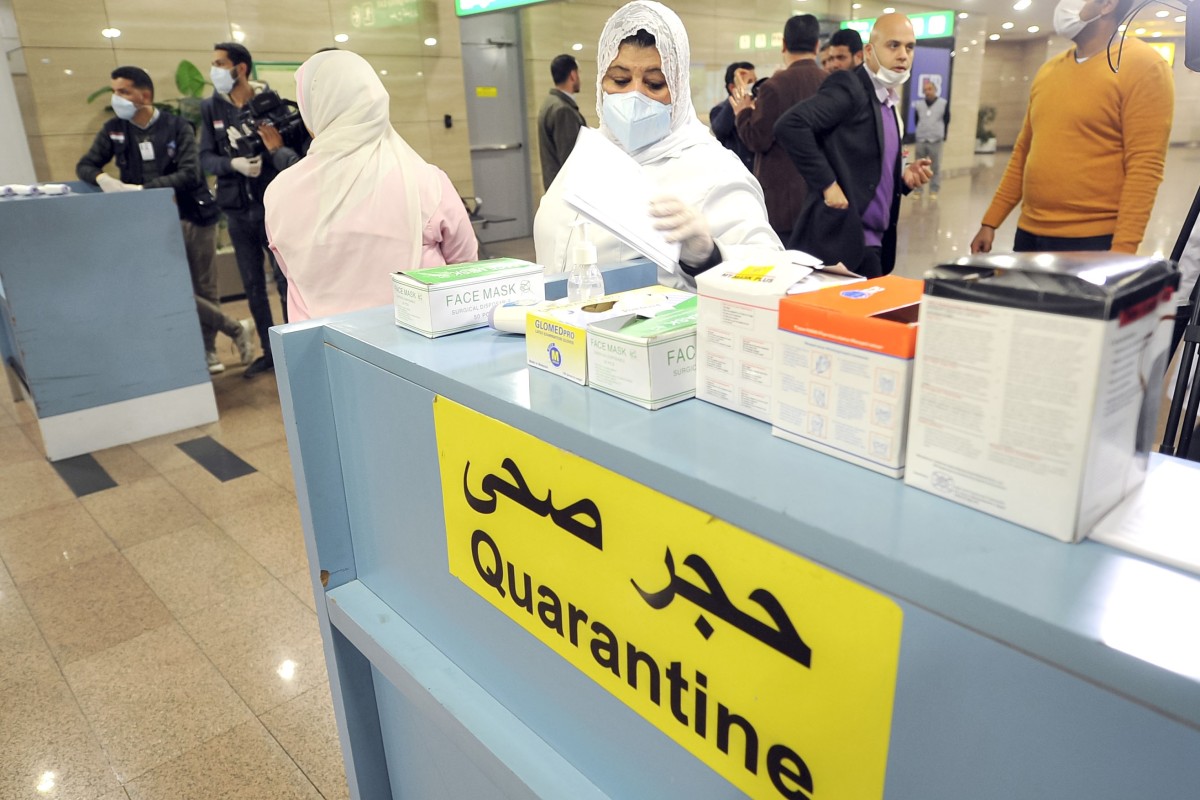
Egyptian quarantine officers prepare to screen travellers arriving at Cairo’s airport. The country has reported its first coronavirus case. Photo: AFP
Africa has reported its first case of the new coronavirus that has so far claimed more than 1,600 lives, with Egypt’s health ministry confirming that a foreigner had tested positive there.
Health experts and African leaders have expressed concern that poorer countries may struggle to cope if the virus spread to the continent. Fears for nations with weaker health systems prompted the World Health Organisation to declare the outbreak of the virus – which originated in China – a global public health emergency in January.
Its director general Tedros Adhanom Ghebreyesus last week said the WHO was racing to equip laboratories in vulnerable African countries with the “capacity to rapidly diagnose cases” to avert an outbreak.
The WHO and Egypt’s health ministry on Friday confirmed the country’s first case was a foreign national who had been isolated in hospital and was in stable condition. Health ministry spokesman Khaled Megahed said the patient had tested positive for the virus without any symptoms, and the WHO had been informed and measures taken to limit its spread.
The WHO said its Egypt office was working closely with health officials in the North African nation, taking “outbreak investigation and response actions”.
The country’s Eastern Mediterranean neighbour, the United Arab Emirates, had reported eight cases, the WHO said.
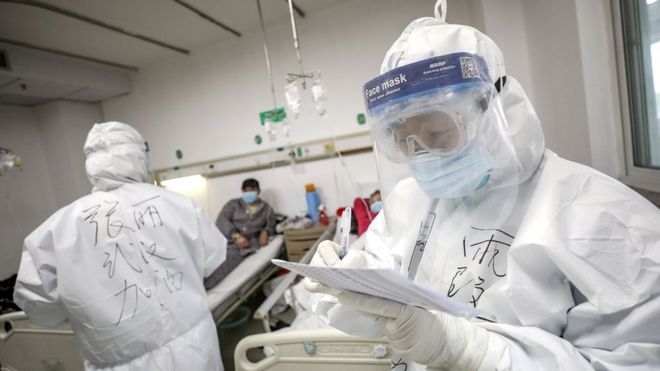
The Chinese medical workers on the front line of the coronavirus fight in Wuhan
The virus, which causes a disease known as Covid-19, has infected more than 68,000 people since the outbreak began in the Chinese city of Wuhan in December, and it has spread to more than 20 countries.
The first case in Africa comes as countries on the continent have stepped up screening at border checkpoints to prevent the spread of the pneumonia-like illness. Many countries have imposed restrictions on travel to and from mainland China, while six out of eight African airlines with Chinese routes have halted flights until the virus is contained, including EgyptAir.
Egypt has suspended all flights to and from China until the end of the month and has evacuated more than 300 Egyptians from Wuhan.
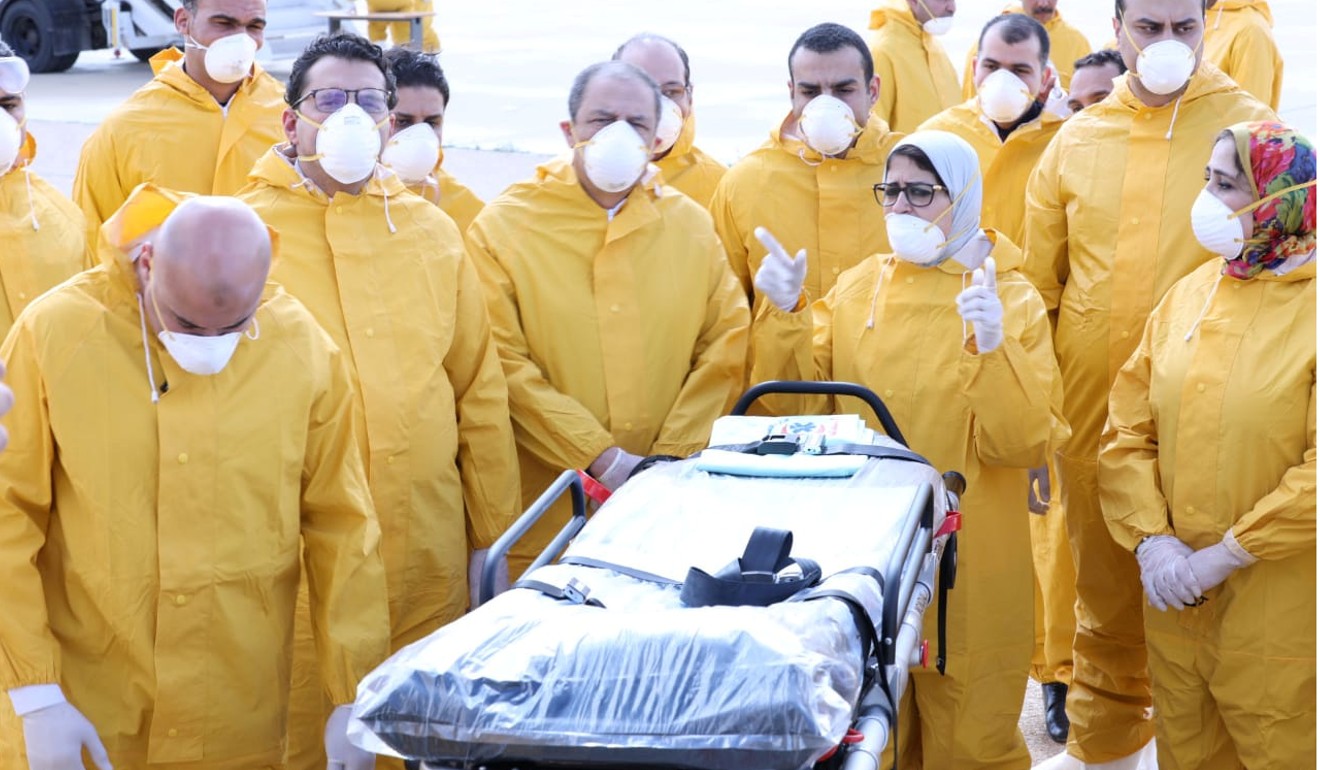
Egyptian Health Minister Hala Zayed waits with a medical team at Alexandria’s airport to meet passengers evacuated from Wuhan on February 3. Photo: Reuters
John Nkengasong, director of the Africa Centres for Disease Control and Prevention (Africa CDC), said the Addis Ababa-based organisation was “on standby to work closely with the government of Egypt to rapidly contain the spread of the virus”.
How to lower the risk of catching a virus while on a flight
15 Feb 2020
African nations are also equipping laboratories so that they can test for the virus, with the help of the WHO and others.
Until about two weeks ago, there were only two laboratories in the continent of 54 countries – in Senegal and South Africa – with the reagents needed to test for the coronavirus.
That meant dozens of countries that had quarantined suspected patients were sending samples to South Africa or Senegal to be tested. Since then, four more labs have been equipped – in Ghana, Nigeria, Madagascar and Sierra Leone – to test for the virus, according to the WHO.
The global health body has also sent testing kits to Cameroon, Ivory Coast, the Democratic Republic of Congo, Egypt, Ethiopia, Gabon, Ghana, Kenya, Morocco, Nigeria, Tunisia, Uganda and Zambia.
Tedros on Monday said the WHO’s immediate “objective remains containment. We call on all countries to use the window of opportunity we have to prevent a bigger fire”.
The Africa CDC has trained health workers from 12 countries in early detection and prevention in Senegal, using testing kits sent by the WHO. Further training would take place in South Africa next week, Tedros said.
“Without vital diagnostic capacity, countries are in the dark as to how far and wide the virus has spread – and who has coronavirus or another disease with similar symptoms,” Tedros said.
Coronavirus: desperate times drive some Chinese to take desperate measures
15 Feb 2020
Many countries in Africa are still reeling from the 2014-16 outbreak of Ebola, which killed 11,325 people and infected 28,600. The deadly virus is yet to be contained, with new cases reported in the Democratic Republic of Congo last week.
China disinfects entire cities to fight coronavirus outbreak, some twice a day
There are concerns that Africa’s close links with China put it at high risk for the spread of the new coronavirus. Africa has become home to millions of Chinese since Beijing started looking to the continent for raw materials for its industries and markets for its products, and China has been Africa’s largest trading partner since 2009, after it overtook the United States.
Ethiopian Airlines refuses to bow to pressure to halt flights to China
14 Feb 2020
China is also a major trading partner of Egypt, with two-way trade standing at US$13.8 billion in 2018, according to the China Africa Research Initiative at the Johns Hopkins University School of Advanced International Studies. Beijing is pouring billions of dollars into infrastructure projects in the country, including building a business district in its new administrative capital, 50km east of Cairo. Chinese firms are also investing billions of dollars in the Egyptian Suez Canal Economic Zone, a project under Beijing’s sprawling trade and infrastructure scheme the Belt and Road Initiative.
The measures China has taken to stop the spread of the coronavirus are starting to have an impact, Mi Feng, a spokesman at the National Health Commission, said on Sunday.
In other developments:
The number of people who have tested positive on the Diamond Princess cruise ship, which is being held in quarantine in Japan, has risen to 355. The US and Canada are sending planes to evacuate their citizens
A Chinese tourist has died in France – the first fatality outside Asia
An 83-year-old American woman has tested positive after disembarking another cruise ship that was turned away by a number of countries before being allowed to dock in Cambodia
In the UK, all but one of nine people being treated have been discharged from hospital
On Saturday, World Health Organization (WHO) head Tedros Adhanom Ghebreyesus praised Beijing’s response to the outbreak.
“China has bought the world time. We don’t know how much time,” he said. “We’re encouraged that outside China, we have not yet seen widespread community transmission.”
How is China coping?
Tens of millions of Chinese still face heavy restrictions on their day-to-day life as part of the government’s efforts to halt the spread of the disease, which causes a disease named Covid-19.
Much of the response has focused on the hard-hit province of Hubei and its capital Wuhan, where the outbreak began. The city is all but sealed off from the rest of the country.
Foreign Minister Wang Yi said that along with a drop in infections within Hubei there had also been a rapid increase in the number of people who had recovered.
China’s central bank will also disinfect and store used banknotes before recirculating them in a bid to stop the virus spreading.
Media caption Medics in Wuhan resort to shaving their heads in a bid to prevent cross-infection of the coronavirus
In another development Chinese state media published a speech from earlier this month in which Chinese President Xi Jinping said he said he had given instructions on 7 January on containing the outbreak.
At the time, local officials in the city of Wuhan were downplaying the severity of the epidemic.
This would suggest senior leaders were aware of the potential dangers of the virus before the information was made public.
With the government facing criticism for its handling of the outbreak, analysts suggest the disclosure is an attempt to show the party leadership acted decisively from the start.
LONDON (Reuters) – The British government has not talked to China about helping build High Speed 2, the major rail project given the green light last week despite being billions of pounds over budget, Transport Secretary Grant Shapps said on Sunday.
A report in the Financial Times said China had offered to build the rail line, known as HS2, in five years and for less money.
“I’ve certainly had no advice on the subject, obviously I will be asking to see what the communication has been,” Shapps told the BBC’s Andrew Marr on Sunday.
“This has not been a discussion with the department, it’s been a discussion with HS2 as I understand it.”
Shapps said he wanted to push ahead with major projects more quickly.
“There are things we can do to speed this up and I want to learn from everyone but I also want to make sure the British ingenuity and skills and apprentices and all the rest of it come through on this massive project,” he said.
Shapps also told Marr the resignation of finance minister, or chancellor, Sajid Javid on Thursday could result in a delay to the budget planned for March 11.
“This is a matter for the new chancellor Rishi (Sunak),” he said.
“I don’t think we’ve said it will definitely go ahead on the same date that was mentioned before in March, that will be a matter for the chancellor.”
Image copyright GETTY IMAGESImage caption Discrimination against women on account of menstruation is widespread in India
India’s uncomfortable relationship with periods is back in the headlines.
College students living in a hostel in the western Indian state of Gujarat have complained that they were made to strip and show their underwear to female teachers to prove that they were not menstruating.
The 68 young women were pulled out of classrooms and taken to the toilet, where they were asked to individually remove their knickers for inspection.
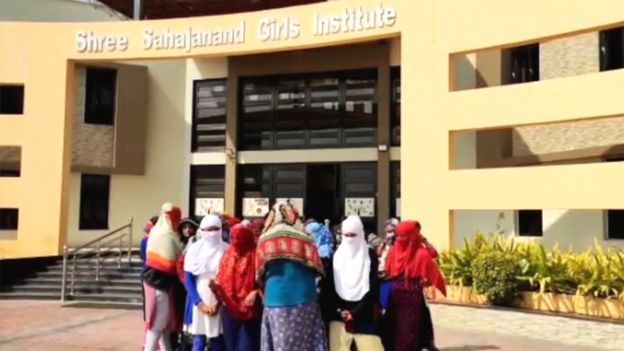
The incident took place in the city of Bhuj on Tuesday. The young women are undergraduate students at Shree Sahajanand Girls Institute (SSGI), which is run by Swaminarayan sect, a wealthy and conservative Hindu religious group.
They said a hostel official had complained to the college principal on Monday that some of the students were breaking rules menstruating women are supposed to follow.
According to these rules, women are barred from entering the temple and the kitchen and are not allowed to touch other students during their periods.
At meal times, they have to sit away from others, they have to clean their own dishes, and in the classroom, they are expected to sit on the last bench.
Image copyright BBC GUJARATIImage caption Female students gather outside the Shree Sahajanand Girls Institute (SSGI)
One of the students told BBC Gujarati’s Prashant Gupta that the hostel maintains a register where they are expected to enter their names when they get their periods, which helps the authorities to identify them.
But for the past two months, not one student had entered her name in the register – perhaps not surprising considering the restrictions they have to put up with if they do.
So on Monday, the hostel official complained to the principal that menstruating students were entering the kitchen, going near the temple, and mingling with other hostellers.
The students allege that, the next day, they were abused by the hostel official and the principal before they were forced to strip.
They described what happened to them as a “very painful experience” that had left them “traumatised” and amounted to “mental torture”.
One student’s father said that when he arrived at the college, his daughter and several other students came to him and started crying. “They are in shock,” he said.
On Thursday, a group of students held a protest on the campus, demanding action against the college officials who had “humiliated” them.
The college trustee Pravin Pindoria said the incident was “unfortunate”, adding that an investigation had been ordered and action would be taken against anyone found guilty of wrongdoing.
But Darshana Dholakia, the vice-chancellor of the university which the college is affiliated with, put the blame on the students. She said that they had broken rules and added that some of them had apologised.
However, some of the students told BBC Gujarati that they are now under pressure from the school authorities to play down the incident and not to speak of their ordeal.
On Friday, the Gujarat State Women’s Commission ordered an investigation into this “shameful exercise” and asked the students to “come forward and speak without fear about their grievances”. The police have lodged a complaint.
Media caption Using comics to combat India’s menstruation taboos
This is not the first time that female students have been humiliated on account of periods.
Discrimination against women on account of menstruation is widespread in India, where periods have long been a taboo and menstruating women are considered impure. They are often excluded from social and religious events, denied entry into temples and shrines and kept out of kitchens.
Increasingly, urban educated women have been challenging these regressive ideas. In the past few years, attempts have been made to see periods for just what they are – a natural biological function.
But success has been patchy.
In 2018, the top court in a landmark order threw open the doors of the Sabarimala shrine to women of all ages, saying that keeping women out of the temple in the southern state of Kerala was discriminatory.
SIHANOUKVILLE, Cambodia (Reuters) – U.S. President Donald Trump has thanked Cambodia for taking in the castaway cruise ship MS Westerdam in a rare message to a country that is one of China’s closest allies and has often been at odds with Washington.
Five countries turned away the Westerdam, worried its passengers could be carrying the coronavirus despite it having no known cases before Cambodia’s authoritarian prime minister, Hun Sen, agreed the passengers could disembark there.
“Thank you to the beautiful country of Cambodia for accepting the @CarnivalCruise ship Westerdam into your port. The United States will remember your courtesy,” Trump said in a post on Twitter late on Friday.
The Westerdam, operated by Carnival Corp (CCL.N) unit Holland America Inc, docked in the port of Sihanoukville on Thursday after being shunned for two weeks.
Its 1,455 passengers began to disembark on Friday.
The passengers were tested regularly on the cruise ship and Cambodia also tested 20 once it docked. None were found to have the new coronavirus that has killed more than 1,500 people, the vast majority in China.
Cambodia’s Hun Sen has often sparred with the United States over its accusations of human rights abuses and its condemnation of a crackdown on the opposition since 2017.
He has brought Cambodia much closer to China, which has provided billions of dollars in aid for infrastructure projects and stood by Cambodia in the face of Western criticism.
“We are very grateful that Cambodia opened its port … We hope that other countries can be equally as helpful to people in need,” U.S. Ambassador to Cambodia W. Patrick Murphy told reporters at the Westerdam.
MOUNTING SCRUTINY
The cruise line industry has come under mounting scrutiny amid the virus outbreak after more than 200 people tested positive for the infection onboard a ship quarantined in Japan.
Two ships, German-owned AIDAvita and the Norwegian Jade, were denied entry by Vietnam amid the worries. [L4N2AF052]
These two have, however, docked at Thai ports.
AIDAvita docked at Laem Chabang port on Friday, a Thai Marine Department official told Reuters.
“The ship will leave the port tomorrow.”
The Jade, operated by Norwegian Cruise Line Holdings Ltd (NCLH.N), docked at Ko Samui on Saturday morning, another Thai Marine Department official said.
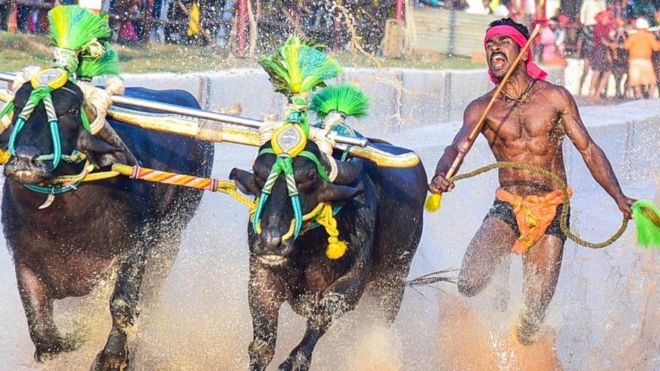
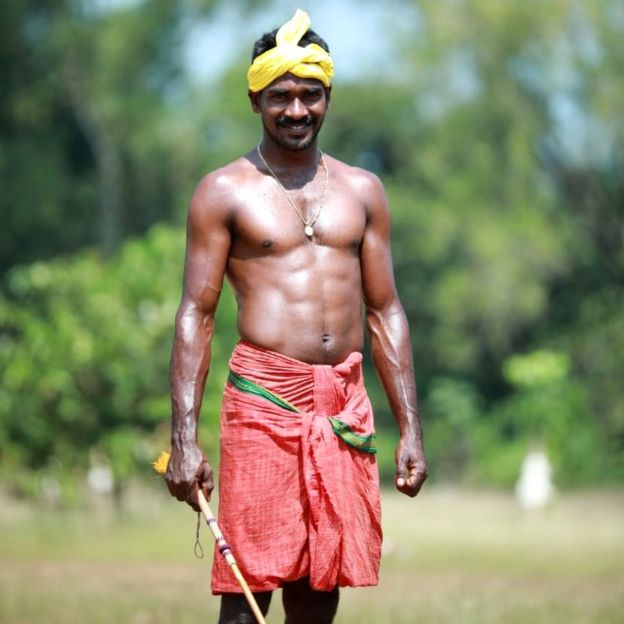
Image copyright ANNU PAIImage caption Srinivas Gowda also praised the efforts of his teammates, the two buffalo
A construction worker in south India is being compared to the Olympic gold medallist sprinter Usain Bolt after a record-breaking win in a buffalo race.
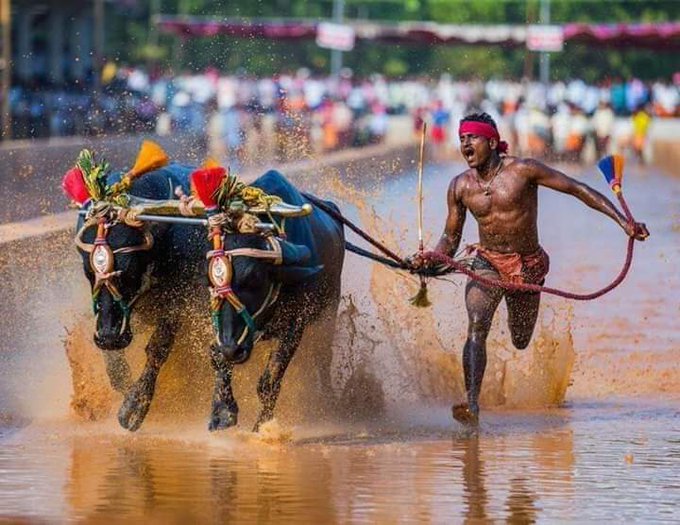
Srinivas Gowda, 28, was competing in Kambala, a sport from the southern state of Karnataka where people sprint 142m through paddy fields with buffalo.
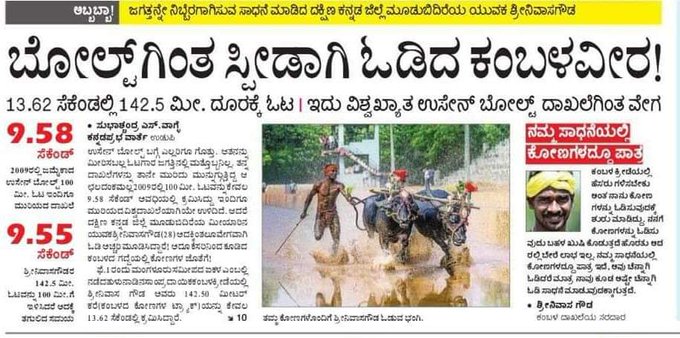
Mr Gowda is said to have finished in 13.42 seconds. Bolt holds the world 100m record of 9.58 seconds.
But the governing body for Kambala has warned against comparing him to Bolt.
“We would not like to indulge in any comparison with others,” Prof K Gunapala Kadamba, president of the Kambala Academy, told BBC Hindi.
“They [Olympic event monitors] have more scientific methods and better electronic equipment to measure speed.”
Prof Kadamba’s response came after several local newspapers and journalists made the comparison between Mr Gowda’s performance and the Jamaican sprinter’s world record time.
He is Srinivasa Gowda (28) from Moodabidri in Dakshina Kannada district. Ran 142.5 meters in just 13.62 seconds at a “Kambala” or Buffalo race in a slushy paddy field. 100 meters in JUST 9.55 seconds! @usainbolt took 9.58 seconds to cover 100 meters. #Karnataka
But Mr Gowda, from Moodabidri in Karnataka’s coastal district of Dakshina Kannada, was excited about his record-breaking win and praised his teammates – the two buffalo he ran alongside – for doing so well.Image copyright ANNU PAIImage caption Srinivas Gowda, 28, has been taking part in Kambala for seven years
He told BBC Hindi he had taken part in Kambala for seven years, adding: “I got interested in it because I used to watch Kambala during my school days.”
What is Kambala?
Kambala, which roughly translates to “paddy-growing mud field” in the local language Tulu, is a traditional sport originating from part of Karnataka’s coast.
Participants sprint through a field, which is normally either 132m or 142m, with two buffalo that are tethered together.
It is controversial, and in the past the sport has attracted strong criticism from international animal rights groups.
In 2014, India’s Supreme Court issued a ban on races with bulls, prompted primarily by campaigns against the practice of Jallikattu, a form of bull-fighting from the neighbouring state of Tamil Nadu.
Two years later, Karnataka’s state court issued an interim order stopping all Kambala events.
Prof Kadamba said that the organising body had responded to this, updating the sport in order to make it more humane.
He said their current and former students – including Mr Gowda – are now taught how to deal with buffalo “in a humane manner without unnecessarily hurting the animal”.
In 2018, the state started allowing Kambala races to take part again, but issued several conditions – including a ban on the use of whips.
But the practice is still under threat. International animal rights group Peta has a petition pending in the Supreme Court, arguing that Karnataka’s reinstatement of Kambala was illegal.
“This Kambala is quite different from the traditional Kambala that used to be practised some decades ago,” Prof Kadamba added.
MUNICH (Reuters) – U.S. Secretary of State Mike Pompeo defended on Saturday his nation’s global role despite misgivings in Europe, vowing that Western values would prevail over China’s desire for “empire”.
Pompeo was seeking to reassure Europeans troubled by U.S. President Donald Trump’s “America first” rhetoric, ambivalence over the transatlantic NATO military alliance and tariffs on European goods.
“I’m happy to report that the death of the transatlantic alliance is grossly exaggerated. The West is winning, and we’re winning together,” he said in a speech at the Munich Security Conference, listing U.S. steps to protect liberal democracies.
RELATED COVERAGE
U.S., allied firms testing alternatives to Chinese 5G technology – Esper
Pompeo was, in part, responding to German President Frank-Walter Steinmeier, who on Friday accused the United States, Russia and China of stoking global mistrust.
Trump’s decision to pull out of the 2015 Iran nuclear deal, as well as the Paris climate accord, have undermined European priorities, while moves such as recognition of Jerusalem as Israel’s capital have weakened European diplomacy, envoys say.
Pompeo defended the U.S. strategy, saying Europe, Japan and other American allies were united on China, Iran and Russia, despite “tactical differences.”
He reiterated Washington’s opposition to the Nord Stream 2 gas pipeline under construction between Russia and Germany under the Baltic Sea, a project backed by the government of German Chancellor Angela Merkel.
Citing Russia’s 2014 annexation of Crimea, cyber threats in Iran and economic coercion by China, Pompeo said those countries were still “desiring empires” and destabilising the rules-based international system.
U.S. Secretary of Defense Mark Esper, speaking immediately after Pompeo, focused his remarks solely on China, accusing Beijing of a “nefarious strategy” through telecommunications firm Huawei [HWT.UL].
“It is essential that we as an international community wake up to the challenges presented by Chinese manipulation of the long-standing international rules-based order,” Esper said.
He said it was not too late for Britain, which last month said it would allow Huawei a limited role in building its 5G networks, to take “two steps back,” but added he still needed to asses London’s decision.
“We could have a win-win strategy if we just abide by the international rules that have been set in place for decades … that respect human rights, that respect sovereignty,” he said.
Those accused Huawei of violating US sanctions and stealing technology from T-Mobile. Huawei has denied the claims.
The firm, one of the world’s biggest smartphone makers, said the US is targeting it because its expansion is a threat to American business interests.
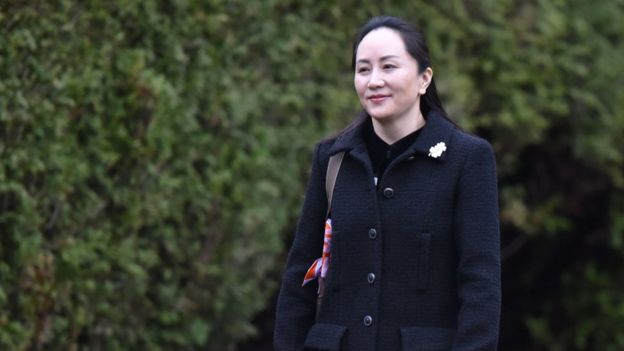
Meng Wanzhou, its chief financial officer and the daughter of the company’s founder, is still being held in Canada where she is fighting extradition to the US.
She is wanted there on charges of fraud and sanctions violations – claims she denies.
Image copyright AFPImage caption Meng Wanzhou was arrested during a layover in Vancouver in 2018
“This new indictment is part of the Justice Department’s attempt to irrevocably damage Huawei’s reputation and its business for reasons related to competition rather than law enforcement,” the company said.
In the updated indictment, the US accuses Huawei of racketeering and trade secret theft, and gives more detail about the firm’s efforts to evade US rules on doing business with Iran and North Korea.
Prosecutors also said Huawei offered bonuses to staff who obtained “confidential information” from its competitors.
“As a consequence of its campaign to steal this technology and intellectual property, Huawei was able to drastically cut its research and development costs and associated delays, giving the company a significant and unfair competitive advantage,” prosecutors said.
Huawei said the new charges are a “contrived repackaging” of claims that have already been litigated in civil court.
“The government will not prevail on these charges which we will prove to be both unfounded and unfair,” the company said.
The new charges, filed in federal court in Brooklyn on Thursday, suggest the US is not backing away from its fight over Huawei, which has added to tensions between the US and China, and complicated American relationships with allies.
The US has pushed partners such as the UK to ban Huawei technology from their networks, maintaining the company’s equipment could be used for spying by China.
NEW DELHI/MUMBAI (Reuters) – The Indian government ordered mobile carriers on Friday to immediately pay billions of dollars in dues after the Supreme Court threatened the companies and officials with contempt proceedings for failing to implement an earlier ruling.
The court, which had ordered companies including Vodafone Idea (VODA.NS) and Bharti Airtel (BRTI.NS) to pay 920 billion Indian rupees ($13 billion) in overdue levies and interest by Jan. 23, last month rejected petitions seeking a review of the order it issued back in October.
“This is pure contempt, 100% contempt,” Justice Arun Mishra told lawyers for the companies and the government on Friday.
Later in the day, the Department of Telecommunications called for “immediate payments” from the telcos. A second order instructed relevant offices to stay open on Saturday to “facilitate the Telecom Licensees to make payments or contact them with respect to any matter related to that.”
The companies had contested the government’s definition of revenues subject to tax and Vodafone Idea and Bharti Airtel both flagged risks to their ability to continue as ongoing concerns following the October order. They did not immediately respond to calls seeking comment on the new ruling.
The companies, along with Reliance Jio, which is backed by Asia’s richest man, Mukesh Ambani, control more than 90% of India’s mobile market.
Jio, a relatively new entrant which has disrupted the market with its cut-price offerings, has paid its dues.
Shares in Vodafone Idea, in which Britain’s Vodafone Group (VOD.L) owns a sizable stake, closed down 24.4% after the order. The company’s future is in doubt, with Vodafone Group having said it has no plans to commit any more equity into India.
Shares in Bharti Airtel rose 4.64%, as many investors expect it will be able to survive the payment, leaving it and Jio with a potential opportunity to win market share and enjoy an effective duopoly in the sector. In a letter to the government, Bharti Airtel said it would deposit 100 billion rupees by Thursday and pay the balance “well before” the next hearing on March 17.
Justice Mishra rebuked the government for having failed to implement the court order on collecting the dues. “A desk officer in the government stays a Supreme Court order … Is there any law left in the country?,” he said.
“We will draw up contempt against everyone,” he added, implying that both company and government officials could be fined or jailed if the dues are not paid by March 17.
Analysts said the court’s move could harm the government more broadly, as well as the companies.
“It can’t be in anybody’s interest if a company as high profile as Vodafone Idea shuts shop. Also, the government’s own dues from the sector are at risk,” said Mahesh Uppal, director at ComFirst, a telecom consultancy firm.
BANKS BURDENED
Indian banks are burdened with nearly $140 billion of bad loans and face another huge hit if Vodafone Idea is forced into bankruptcy.
Banks in India are owed roughly 300 billion rupees by Vodafone Idea, according to a Macquarie report from last year.
“Banks were yet to make additional provisioning for these loans as they were expecting some sort of a relief from the court,” said Siddharth Purohit, an analyst at SMC Institutional Equities.
Banks that have the highest exposure to Vodafone Idea include State Bank of India (SBI.NS), Punjab National Bank (PNBK.NS), Canara Bank (CNBK.NS) and Bank of India (BOI.NS), among others, the Macquarie report said.
Vodafone Idea, which owes the government about $4 billion in dues related to the ruling, has seen its shares slide more than 40% since the court ruling in October.
The broader Indian stock market also reversed early gains to trade lower after the ruling as investors worried about the fallout.
Still, some analysts remained hopeful the government could appeal to the court to review its decision.
“Let’s see how the government reacts and what they do. If the government appeals to the court they could still settle it out, and we may see some positives emerge for everyone,” said a senior industry analyst, who asked not to be named.












 CHINDIA ALERT: You'll be living in their world, very soon