Chindia Alert: You’ll be Living in their World Very Soon
aims to alert you to the threats and opportunities that China and India present. China and India require serious attention; case of ‘hidden dragon and crouching tiger’.
Without this attention, governments, businesses and, indeed, individuals may find themselves at a great disadvantage sooner rather than later.
The POSTs (front webpages) are mainly 'cuttings' from reliable sources, updated continuously.
The PAGEs (see Tabs, above) attempt to make the information more meaningful by putting some structure to the information we have researched and assembled since 2006.
BEIJING, March 12 (Xinhua) — China’s determination to achieve the goal of poverty elimination remains unwavering despite the impact from the novel coronavirus disease (COVID-19), according to Liu Yongfu, director of the State Council Leading Group Office of Poverty Alleviation and Development.
About 3 million more migrant workers from the poverty-stricken areas have returned to their jobs last week, said Liu. He added that one-third of the poverty-relief projects had resumed operation as of March 6, and resumption will be accelerated.
The country’s poverty alleviation tasks are near completion, as the number of impoverished people fell to 5.51 million at the end of 2019 from 98.99 million at the end of 2012, and the number of poverty-stricken counties fell to 52 in 2020.
Guidance on establishing the poverty-relief supervision and aid mechanism will be released soon to prevent people from returning to poverty after being lifted out of it, according to Liu.
Measures should be taken to ensure the quality of compulsory education as well as develop vocational, higher and pre-school education in impoverished areas to eliminate poverty from the roots, he said.
Efforts to relieve poverty will not be stopped, even after absolute poverty is eradicated, said Liu, stressing that the country would then bridge the development gap and realize common prosperity.
Liu also noted that a census targeting poor people will be launched this year to ensure the data authenticity and accuracy of the achievements of the poverty alleviation tasks.
He also praised the help from Hong Kong in the fight against poverty. Nanjiang county in southwestern China’s Sichuan province has lifted all of the poor populations out of poverty last year, with parts of the contributions made by the government of Hong Kong Special Administrative Region and all walks of life in Hong Kong.
China is now making more than 100 million masks a day, up from 20 million before the coronavirus outbreak, and may start to export more to other countries
Mask shortages elsewhere once more raise the debate about an over-reliance on China, with critics pointing to a lack of US industrial policy
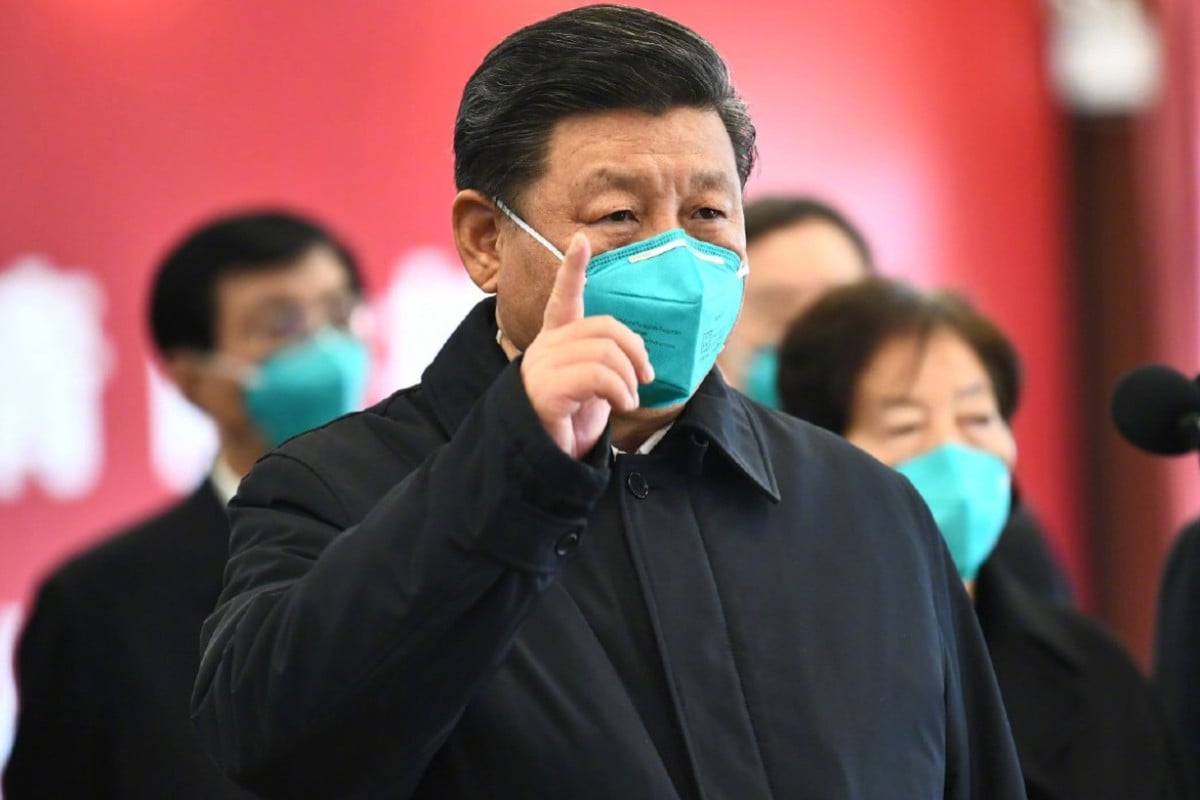
China was producing 116 million masks per day of February 29, including a mix of disposable and high-end masks like the American-designed N95 model worn by President Xi Jinping on his trip on Tuesday to Wuhan. Photo: Xinhua
The Liu family factory has been making diapers and baby products in the Chinese city of Quanzhou for over 10 years, but in February, for the first time, it started making face masks, as demand soared spectacularly due to the coronavirus outbreak.
The business – which employs 100 people in the Southeastern Fujian province – has added two production lines to make up to 200,000 masks a day.
And while the decision was primarily commercial, “encouragement” from the Chinese government – in the form of subsidies, lower taxes, interest-free loans, fast-track approvals for expansion and help alleviating labour shortages – made the decision an obvious one, said Mr Liu who preferred only to give his family name.
“The government is advocating an expansion in production,” Liu said. “With faster approvals, producers need to prioritise the government’s needs over exports.”
WHO declares coronavirus crisis a pandemic
The factory is one of thousands of refitted pop-ups around China making masks and other protective equipment for the first time, part of a massive industrial drive to respond to the spread of the coronavirus.
Before the outbreak, China already made about half the world’s supply of masks, at a rate of 20 million units a day. That rose to 116 million as of February 29, according to China’s state planning agency, a mix of disposable and high-end masks like the American-designed N95 model worn by President Xi Jinping on his trip on Tuesday to Wuhan, the epicentre of the outbreak.
This exponential jump is the result of a wartime-like shift in industrial policy, with Beijing directing its powerful state-owned enterprises to lead the nationwide mask-making effort, and the country’s sprawling manufacturing engine following their lead.
For me, this is the big advantage of China, the speed Thomas Schmitz
“For me, this is the big advantage of China, the speed,” said Thomas Schmitz, president of the China branch of Austrian engineering giant Andritz, which has seen a big uptick in demand for its wet wipe-making machines in recent weeks, also due to the virus. “When you need to run, people know how to run, and this is something which has been lost in other countries since their industrial heydays.”
Chinese oil and gas major Sinopec upped production of mask raw materials such as polypropylene and polyvinyl chloride in January. This week, it set up two production lines in Beijing to produce melt-blown non-woven fabric, intended to make four tonnes of the fabric each day, which can then be used to produce 1.2 million N95 respirators or six million surgical masks a day.
The maker of China’s new J-20 stealth fighter jet, Chengdu Aircraft Industry Group, repurposed part of its factory to design a mask production line, according to local media reports. The SichuanDaily said 258 of the company’s engineers spent three days fast-tracking development of an assembly line with more than 1,200 components.
Coronavirus: From mysterious origins to a global threat
More than 2,500 companies in China have reportedly started making masks, among them 700 technology companies including iPhone assembler Foxconn and smartphone makers Xiaomi and Oppo, in an extraordinary mobilisation of resources.
The result resembles “the war effort” in the middle of the last century in the United States and western Europe, but arguably no other nation could undergo such a transformation so quickly today.
It is a reminder of what can happen in a centrally-planned economy with a strong manufacturing base, but also brings into sharp focus some of the geopolitical issues which have characterised China’s at-times difficult relationship with the rest of the world, particularly the European Union and US, over the past couple of years.
China’s dominance in manufacturing has become all the more evident as the rest of the world scrambles to shore up their own dwindling medical supplies, leading many to wonder why the world is so dependent on it for vital supplies.
The lesson for Washington is not that we need to emulate the Chinese economic model, but rather that we need to better steward the industrial base in key sectors Rush Doshi
The Italian government, which is dealing with the highest number of coronavirus cases and deaths after China, is to take shipment of 1,000 ventilators, 2 million masks, 100,000 respirators, 200,000 protective suits and 50,000 testing kits from China.
Italian foreign minister Luigi Di Maio said after a phone call with Chinese counterpart Wang Yi, they had agreed the export deal in the same week that European neighbours France and Germany banned masks from being exported because of low domestic supplies.
The Italy export deal showed that “China is emerging as a global public goods provider as the US proves unable and unwilling to lead,” said Rush Doshi, the director of the China Strategy Initiative at the Washington-based Brookings Institute think tank.
“China’s ability to produce what is needed to fight coronavirus is not simply a product of its economic model – it’s also a product of its industrial capacity,” Doshi said. “The US once had this capacity too, but it has lost important parts of it. The lesson for Washington is not that we need to emulate the Chinese economic model, but rather that we need to better steward the industrial base in key sectors.”
The frustration is felt acutely by Michael Einhorn, president of medical equipment distributor Dealmed-Park Surgical in New York, who has been trying to source stock from China for weeks, “but cannot get straight answers” from vendors.
Einhorn said he placed an order with a private seller in China’s virus-stricken city last week, but that the goods had not been shipped.
“Everyone is running out here, people are panicking in hospitals and we want to be able to help our most important customers,” Einhorn said. “We are dealing with hospitals that do not have products, how in the United States of America in 2020 did this happen?”
With the number of confirmed coronavirus cases in China falling daily, it is not inconceivable that the sort of export deal struck with Italian leaders becomes commonplace, although for now, it deal can be chalked up as a significant public relations coup for Beijing.
The World Medical Association is unable to specify how many masks are required to supply frontline medical staff in virus-hit areas, but said that “this crisis should be a wake up call for politicians and societies to make the necessary investment in emergency preparedness and to look into the vulnerability of our supply chains”.
Australian-listed manufacturer Eagle Health announced on Friday that it had installed production lines at its Xiamen factory in southern China to make 300 million masks a year and said it had already received orders from China and would be securing further larger orders internationally.
The group, which normally makes products including amino acids, protein supplements and lozenges in China, said it would prioritise meeting the large domestic demand, but was aware of an impending global shortage.
Eagle Health has already commenced production of its first order of 3.2 million medical masks for the Yiling Hospital Management Group in China, a process which will take 10 days. It has other smaller orders from Chinese government agencies and expects to receive more orders outside China.
The decision to make more masks came from increased demand. These are opportunities. The global demand for high quality masks will be significant Xu Gang
“The decision to make more masks came from increased demand. These are opportunities,” said chief executive Xu Gang. “The global demand for high quality masks will be significant. Imagine when the schools open. The situation will take some time to peak.”
Last week, the Australian Dental Association said supplies of masks at many practices were expected to run out within four weeks. The Australian government has since arranged a supply of 54 million masks for both the dental and medical industries.
At the same time, the US only has 1 per cent of the 3.5 billion masks it would need to counter a serious outbreak, Bloomberg reported.
While China has no quota on the volume of masks that had to be hived off for local consumption, the government has said domestic demand needs to be prioritised.
Businesses are free to export but overseas demand has yet to explode like it has in China, said Fujian factory owner Liu.
Wendy Min, sales director of Pluscare, a manufacturer based near the virus’ epicentre in Hubei province, said her company is making 200,000 masks per day, much of which are sold to the government, with exports still restricted by partial lockdown of workers and cargo transport.
“We previously exported to Europe, South America and other parts of Asia,” Min said. “But at the moment we can’t export. We are trying to discuss this with the government, but we cannot wait any more – we have to export soon.”
Min said that while she was receiving countless cold calls up until last week from people in China looking for masks, these have stopped, perhaps unsurprising given the abundance in supplies becoming available.
An influx of Chinese-made masks, though, is likely to be welcomed in other virus-stricken parts of the world.
Self-quarantine of all international travellers to Beijing as China fights import of coronavirus
Miguel Luiz Gricheno, CEO of Brazilian mask manufacturer Destra, said that his company is making 30,000 masks a day, but cannot meet local demand due to a lack of supplies, including the non-woven fabric from which masks are made.
“In disposable masks, most Brazilian companies are paralysed due to the lack of raw materials,” Gricheno said. “With the arrival of the coronavirus in Brazil, the demand has increased a lot but the main raw material comes from abroad.”
However, a short-term supply fix will not answer underlying questions about how so many countries found themselves in such dire straits,meaning the geopolitical fallout of the coronavirus will be extensive.
Decades of weak industrial policy helped elect US President Donald Trump, who said he would bring manufacturing jobs back to America at China’s expense. While he has waged a bruising two-year trade war with China in response, the current situation shows just how difficult it will be to change the global manufacturing processes, which are so heavily controlled by China.
One of the great flaws of globalisation is that everyone wanted things cheaper, but did you compromise your health care infrastructure in the process? Stephen Roach
“In the guise of trying to improve efficiency and create value for price-sensitive consumers, we’ve created a global production network that is very difficult to unwind,” said Stephen Roach, a professor of economics at Yale University and a veteran China watcher. “One of the great flaws of globalisation is that everyone wanted things cheaper, but did you compromise your health care infrastructure in the process.
Reuters reported that Trump is considering invoking the emergency provisions of the Defence Production Act, which would allow the government to instruct companies to alter production to help address the domestic shortage of medical supplies like masks. If a company is producing 20 per cent N95 masks and 80 per cent standard masks, the White House could order them to rejig the ratio, an unnamed official said.
The New York Times reported on Wednesday that the White House is preparing an executive order that would allow the government to buy medical supplies from overseas in the hope that it will incentivise companies to make them within the US.
But these changes still do not give Trump the sort of sweeping powers enjoyed by Chinese counterpart Xi.
“When you have a pluralistic, democratic situation that Trump is overseeing, it becomes more unwieldy” to take the steps necessary to address a crisis situation, said Harry Broadman, chair of the emerging markets practise at the Berkeley Research Group and a senior US government official in the 1980s and 1990s.
“That is why I think Trump looks at Xi with envy, because he doesn’t have to deal with a disparity of views or democratic interests,” Broadman said. “I think Trump is at heart a bilateral guy, as you saw with the phase one [US-China] trade deal and the state-to-state purchases. That is why he likes dealing with [Russian President Vladimir] Putin and Xi, because each of them can move mountains. I think Trump is very envious of that ability.”
In response to the 2008 global financial crisis, China pumped a 4 trillion yuan (US$575 billion) into its economy but it led to a mountain of local government debt
Various early indicators suggest China’s economy will slow in the first quarter of 2020, with some suggestions it will suffer a first contraction since 1976
President Xi Jinping said China must accelerate construction of “new infrastructures such as 5G networks and data centres” on top of speeding up “key projects and major infrastructure construction” in response to the economic impact caused by the coronavirus outbreak. Photo: Xinhua
China should not try to bolster its coronavirus-hit economy by again resorting to a massive debt-fuelled fiscal and monetary stimulus programme, according to a group of government advisers.
Various early indicators suggest China’s economy will slow in the first quarter of 2020, with some even suggesting it will suffer a first contraction since the end of the Cultural Revolution in 1976.
This raises the question if China will miss its key 2020 growth target, with voices on both sides of the debate discussing what stimulus policies are needed to offset the deep impact of the coronavirus.
China is already leaning towards some additional stimulus, with Premier Li Keqiang ordering the central bank pump additional money into the banking system, while President Xi Jinping has announced the need for more spending on “new infrastructure”.
Are there other ways out for China except stimulus policies?Liu Shijin
“Are there other ways out for China except stimulus policies?” rhetorically asked Liu Shijin, who previously worked closely with Vice-Premier Liu He, the top economic aide to Xi, at the Development Research Centre, the think tank attached to the State Council.
“If it really works, why can’t Japan and the United States reach a 5 per cent growth rate?”
It is believed China will need to achieve an average 5.6 per cent growth in 2020 to achieve its goal of doubling the size of its economy from 2010, which is a key goal for
China’s economy grew by 6.1 per cent in 2019, and while it was the slowest in 29 years, the US economy only grew 2.3 per cent, with Japan’s estimated to grow by 0.9 per cent.
What is gross domestic product (GDP)?
Liu Shijin, who is now a deputy head of the China Development Research Foundation and a policy adviser to the People’s Bank of China, argued that a growth rate averaging 5 per cent over the next decade is sufficient for China to meet its development goals.
Growth in 2020, though, may well be below 5 per cent given that the impact of the coronavirus is “unprecedented” and larger than both severe acute respiratory syndrome (Sars) in 2003 and the 2008 global financial crisis.
Xi said earlier this month that China must accelerate construction of “new infrastructures such as 5G networks and data centres” on top of speeding up “key projects and major infrastructure construction already included in state plans” like additional high-speed railway lines in response to the economic impact caused by the coronavirus outbreak.
But as this will mainly rely on corporate and private investment, Liu Shijin feels it will be too small to engineer a major rebound in the growth rate.
When encountering challenges, we should first push forward new reform measures to unleash growth potential. Now is the right timeLiu Shijin
“It’s a different thing compared to real [government-led] economic stabilisation,” Liu Shijin told a web seminar hosted by Peking University’s National School of Development on Wednesday.
“When encountering challenges, we should first push forward new reform measures to unleash growth potential. Now is the right time.”
Instead, to support longer-term growth, China should put its efforts into the development of its “city clusters”, which could lead to higher spending on housing construction, urban infrastructure and manufacturing, added Liu Shijin, which would increase the growth rate by up to an additional percentage point over the next decade.
China has so far refrained from the massive stimulus programme it adopted in 2008 in response to the global financial crisis, which included a 4 trillion yuan (US$575 billion) plan that pumped cheap money into government-backed projects but also created a mountain of local government debt.
Trump bans travel from Europe to the US as coronavirus pandemic hits actor Tom Hanks and the NBA
Zhang Bin, a senior researcher at the Chinese Academy of Social Sciences, said infrastructure construction will remain an important part of any plan to support growth.
“If the funding [for the 4 trillion yuan stimulus] had come solely from treasury bonds or local government bonds [rather than risky lending], there wouldn’t be so much shadow banking, unmanageable credit expansion, high leverage, implicit liabilities or financial risks,” he said.
“If the balance sheets of corporations, households and local governments can’t be repaired, it might lead to insufficient demand and a decline into a vicious [downward] cycle.”
Zhang, like Liu Shijin, is a key member of the China Finance 40 Forum, a group of state economists who advocate more structural reforms to support the Chinese economy. In particular, Zhang has set sights on reforms that would boost consumption, which accounted for 58 per cent of Chinese growth last year.
“The biggest weak link of the Chinese economy is that 200 to 300 million migrant workers can’t [legally] settle in big cities,” he said. “Only if they are able to settle in the city that China can be called a real well-off society. It will also boost the economy, lift demand for manufactured goods and unleashed consumption potential.”
Currently, most large Chinese cities only provide social services including health care and schooling to residents who have a legal permit, or hukou. Most migrant workers who come to the big cities for jobs are blocked from obtaining a hukou, meaning they have to travel back to their rural hometowns to have access to basic social services, so often do not settle in their adopted city.
In response to this idea, Xu Yuan, a professor at Peking University, called for the government to build 10 million affordable housing units annually to accommodate new urban citizens, which would address short-term economic pain and serve the nation’s long-term development.
China will release its annual growth target as well as other key goals, including the fiscal deficit ratio and local bond quota, at the National People’s Congress, although the annual parliamentary convention, previously scheduled for March 5, has been postponed, with a new date yet to be announced.
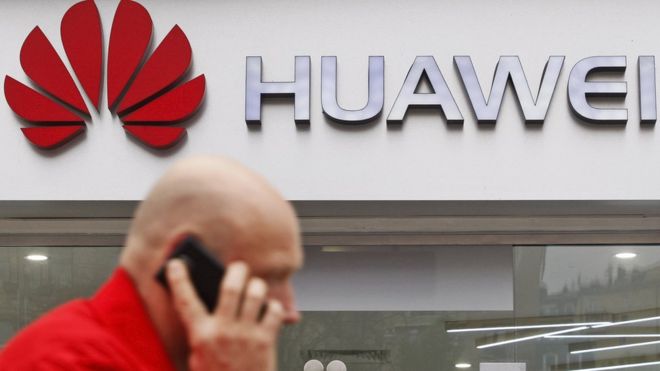
The government has defeated the first rebellion from its own MPs over plans to allow Huawei to be used in the UK’s 5G mobile network.
Thirty-eight Conservative rebels backed an amendment to end the Chinese firm’s participation in the project by the start of 2023.
Despite promises from the government of a new bill to address their concerns, rebel MPs pushed their plan to a vote.
But with a large Commons majority, the government defeated it by 24 votes.
Culture Minister Matt Warman said the government had heard the points “loud and clear”.
He added: “We will now engage intensively with colleagues across the House to make sure that we will make our case at every possible level…and we will underline that we will always put national security at the very top of our agenda.”
The use of Huawei technology in the 5G network was signed off by No 10 and security experts earlier this year, with the caveats of keeping the kit out of the most sensitive areas and capping its market share at 35%.
But Tory critics say the firm is an arm of the Chinese state and a risk to UK security – claims the firm rejects.
Other countries, including the US and Australia, have banned Huawei from their own networks and criticised the UK’s decision.
After the Commons vote, Huawei vice president Victor Zhang, said: “An evidence-based approach is needed, so we were disappointed to hear some groundless accusations asserted.
“The industry and experts agree that banning Huawei equipment would leave Britain less secure, less productive and less innovative.”
Today’s revolt on Huawei leaves Boris Johnson with one king-sized political headache.
It will likely prompt a bout of teeth gnashing in Downing Street that so many Tories should be ready to defy the PM so soon after he delivered them a whopping election victory.
But it will also sting that their ranks were made up of some of the most senior Tory MPs, including a solid block of former cabinet ministers.
In other words, these are not the sort of MPs who No 10 might expect to be able to bully back into line.
And this matters because the rebellion could pave the way for an even bigger one in the summer that could yet overturn the Huawei decision, with several Tory MPs making clear they are ready to join the rebels once the key 5G legislation comes back to the Commons.
A defeat for Mr Johnson over such a high profile issue would be a deeply wounding blow – all the more so since he went out on a limb to give his personal go-ahead to Huawei despite the fury of the White House and other allies.
Time perhaps for the PM to root out the paracetamol.
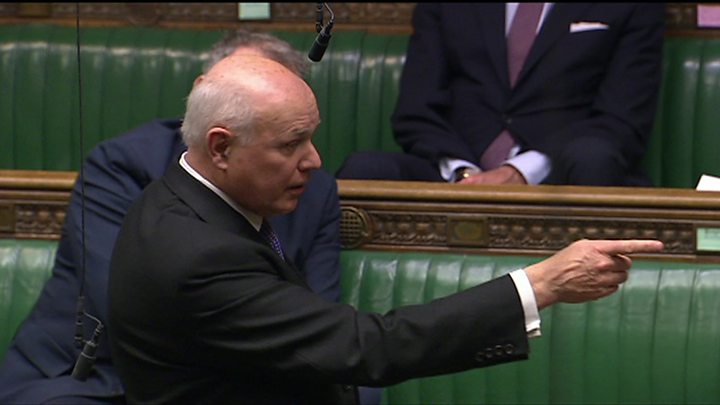
A group of Tory MPs, led by the party’s former leader Sir Iain Duncan Smith, put forward an amendment to the Telecommunications Infrastructure Bill to try and stop Huawei’s involvement.
The amendment would have seen firms classified as “high-risk vendors” by the National Cyber Security Centre be banned entirely from the UK’s 5G project by 31 December 2022.
Sir Iain said he and his colleagues were “genuinely concerned that this country has got itself far too bound in to a process in which we are reliant on untrusted vendors”.
Speaking in the Commons, the backbencher accused the Chinese government of spending 20 years “underbidding” other technology firms until Huawei dominated the market, and the outcome was a risk to the UK’s security.
He said using Huawei’s technology was a “statement of absence of thought by any government”, adding: “If defence of the realm is our number one priority, then this becomes demi-defence of the realm, and I am simply not prepared to put up with that.”
Media caption IDS warns UK “in thrall” to untrusted telecoms providers
Culture Secretary Oliver Dowden tried to reassure the group of backbenchers with the promise of bringing forward a Telecoms Security Bill before the summer recess “so all honourable members will be able to debate these points extensively”.
He also said the government wanted to work with its Five Eyes security partners – including the US – on alternative solutions so the UK could “get to a position where we do not have to use high-risk vendors at all”.
But Mr Dowden could not give a timetable for the exclusion of such companies, except to say it would be “in this Parliament” – meaning within the next five years.
As a result, Sir Iain pushed his amendment to a vote, marking the first Tory rebellion against the government since Boris Johnson won the election in December.
However, while 282 MPs from across the House voted in favour of the amendment, 306 MPs voted against, defeating it.
There were 38 Conservative MPs who rebelled against their government by voting for the amendment – including former international trade secretary Liam Fox, ex-Brexit secretary David Davis and former housing minister Esther McVey.
Conservative MP and Foreign Affairs Committee chairman, Tom Tugendhat, also voted in favour of the amendment, saying he did “not get the commitments” he wanted from the government.
“I am sorry that I could not support the government. I hope the policy will change before we come to the main Telecoms Security Bill before the summer.”
The Telecommunications Infrastructure Bill later passed without needing a vote.
BEIJING, March 11 (Xinhua) — China will take new measures to keep the foreign trade and investment stable, and help the enterprises tide over difficulties to mitigate the impact of the coronavirus outbreak.
Further steps will be taken to smooth the industrial and capital chain, and promote work and production resumption in coordination, according to a State Council executive meeting chaired by Premier Li Keqiang Tuesday.
Li urged continued efforts to give better play to the role of reloan and rediscount to ensure supply of materials for epidemic prevention and control and support firms in difficulty.
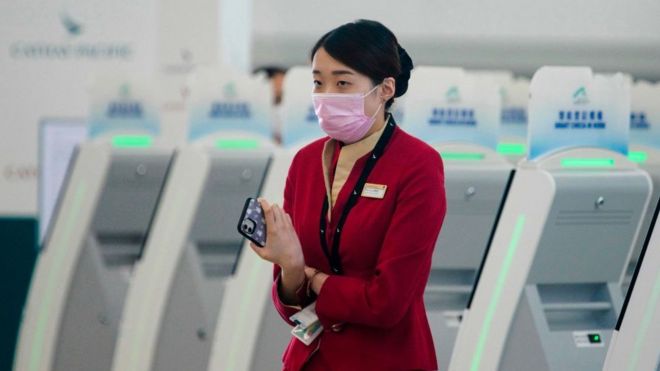
Cathay Pacific has said it expects a “substantial” loss in the first half of this year as the impact of the coronavirus outbreak takes it toll.
The Hong Kong carrier also saw a 28% drop in 2019 profits as it struggled during the city’s political protests.
The airline is now battling with the fallout of the virus as passenger numbers plummet.
Chairman Patrick Healy said the first half of 2020 was expected to be “extremely challenging financially”.
The development comes with thousands of flights already cancelled worldwide, as airlines struggle to cope with a slump in demand caused by the coronavirus outbreak.
British Airways, Ryanair and EasyJet have all cancelled flights to and from Italy until April, while Norwegian Air and American Airlines have also announced significant cuts to services.
Calling 2019 a “turbulent year”, Mr Healy said he expected “our passenger business to be under severe pressure this year and that our cargo business will continue to face headwinds”.
While Cathay Pacific has reduced flights to help save costs, “we expect to incur a substantial loss for the first half of 2020,” he added.
The airline reported a net profit of HK$1.69bn (£170m) for last year, down from a HK$2.35bn profit in 2018.
In other developments:
Dutch airline KLM is cancelling all its flights to and from Milan, Venice and Naples until 3 April
Austrian rail operator OBB has announced it is suspending all trains in and out of Italy – which has more than 10,000 confirmed cases of the virus – until further notice
Seat, the Spanish unit of car-maker Volkswagen, is considering temporary lay-offs at its Barcelona plant
Ride-hailing app Uber says it plans to offer an as-yet unspecified amount of financial assistance to its drivers who have to self-isolate for up to 14 days
Embattled sector
The airline industry faces a loss of revenue of up to $113bn this year, according to aviation trade body IATA, as thousands of planes are grounded amid travel restrictions across the globe.
After UK-based airline Flybe went into administration last week, analysts are warning of more failures to come for the embattled airline industry.
Earlier this week, Korean Air warned the coronavirus outbreak could threaten its survival, in a memo sent to employees.
The global spread of the coronavirus has hit both holidaymakers and business travellers. The Global Business Travel Association said on Wednesday that 43% of its member companies have cancelled business trips booked for this month.
BANGKOK (Reuters) – Thailand will temporarily suspend issuing visas on arrival to visitors from 19 countries and territories, including China, to contain the spread of the coronavirus, its interior minister said on Wednesday.
The suspensions were the latest measures imposed in the tourism-reliant Southeast Asian country, which has reported 59 cases of the virus and one death so far. Globally, over 113,000 people have been infected in over 100 countries.
“People from any country who want to come will need to apply for a visa with our embassies,” Minister of Interior Anupong Paochinda told reporters.
“Thai embassies everywhere will ensure that no sick people will travel to Thailand.”
Visa on Arrival (VoA) will be suspended for nationals of all 19 countries and territories previously eligible, including Bulgaria, Bhutan, China, Cyprus, Ethiopia, Fiji, Georgia, India, Kazakhstan, Malta, Mexico, Nauru, Papua New Guinea, Romania, Russia, Saudi Arabia, Taiwan, Uzbekistan, and Vanuatu, according to a list provided to reporters by the Ministry of Foreign Affairs.
However, Russian passport holders will not be affected by the suspension of the visa on arrival from Russia, as they can still travel to Thailand and stay for 30 days under a visa waiver agreement, an official at the ministry told Reuters.
Visa exemptions will be cancelled for South Korea, Italy and Hong Kong, Anupong said.
“These measures will solve the problem of foreigners arriving from risky zones,” he said.
Anupong said he would start the process immediately but it was not immediately clear when they will be effective.
Chatree Atchananant, director-general of the foreign ministry’s Consular Affairs Department, said visa applicants will need to present medical certificates and insurance as part of the screening at Thai embassies.
Last week, Thailand designated South Korea, China, Macao, Hong Kong, Italy and Iran as “dangerous communicable disease areas.”
Thai authorities urged people arriving from the six places to self-quarantine for 14 days.
GENEVA, March 10 (Xinhua) — China urges relevant parties to immediately lift unilateral sanctions against Iran to prevent further harm to the human rights of the Iranian people, a senior Chinese diplomat has said.
Liu Hua, Special Representative for Human Rights of the Chinese Foreign Ministry, told the on-going 43rd session of the UN Human Rights Council on Monday that imposing external mechanisms without the consent of the countries concerned is not conducive to dialogue and cooperation, and does not play a role in promoting and protecting human rights.
Liu said that the international community should treat the human rights situation of Iran in an objective and fair manner, understand the challenges Iran faces as a developing country in promoting and protecting human rights, and listen more to the Iranian government and the demands of its people.
The unilateral sanctions imposed by relevant countries on Iran have had a significant negative impact on the human rights of the Iranian people, and have also restricted the United Nations and other organizations from providing humanitarian assistance to Iran, she said.
The Chinese diplomat highlighted that it is crucial time at this moment for the Iranian government and its people to fight the COVID-19 epidemic.
“China is providing support to the Iranian side within its capacity, including providing testing kits and other anti-epidemic materials, and sending a team of volunteer experts to help Iran fight the epidemic. China also calls on all parties to strengthen cooperation with Iran on epidemic prevention,” Liu said.
She also highlighted that China has always advocated that all countries should address human rights issues through constructive dialogue and cooperation, oppose politicization, selectivity, double standards, and confrontational practices, and does not support the practice of “naming and shaming” and publicly pressuring.
GENEVA, March 10 (Xinhua) — A senior Chinese diplomat said here that China advocates that Myanmar and Bangladesh properly resolve the Rakhine State issue through dialogue and consultation and start the process of repatriating people at an early date.
Liu Hua, Special Representative for Human Rights of the Ministry of Foreign Affairs of China, told the on-going 43rd session of the UN Human Rights Council on Monday that the international community should provide more constructive help to Myanmar and Bangladesh to create a favorable external environment for the two sides to implement bilateral repatriation agreements.
Liu pointed out that the international community should respect Myanmar’s sovereignty and treat Myanmar’s human rights progress in a comprehensive, impartial and objective manner.
On the issue of Myanmar, she said, the United Nations should take a fair and objective position, and related work should help promote the solution to the Rakhine state issue, not the contrary.
The Chinese diplomat also highlighted that China has always advocated that all countries should address human rights issues through constructive dialogue and cooperation, oppose politicization, selectivity, double standards, and confrontational practices, and does not support the practice of “naming and shaming” and publicly pressuring.







 CHINDIA ALERT: You'll be living in their world, very soon