Archive for June, 2020

01/06/2020

Border skirmish becomes battle of spin as Indian and Chinese soldiers turn to social media

  • Photos showing Indian soldiers purportedly brought down by PLA soldiers at a fist and stick fight circulated among Chinese military websites
  • WeChat and YouTube become new fighting arenas for soldiers but their governments are playing down Himalayan clashes
A photo showing PLA troops after purportedly bringing down several Indian soldiers at a close-quarters fight at Pangong Lake border area with India, was circulated among Chinese military websites on Sunday. Photo: Handout
People’s Liberation Army soldiers and their Indian counterparts have moved

their physical brawl

over border disputes in the Himalayas to social media platforms as both their governments try to play down the fights.

A post with photos showing several Indian soldiers purportedly brought down by PLA soldiers in a fist and stick fight at the Pangong Lake border area with India was circulated among Chinese military websites on Sunday.
On the Chinese social media site WeChat, a Chinese soldier posted photos showing a number of Indian soldiers lying on the ground with a group of PLA soldiers standing nearby with sticks in their hands. The photos were accompanied by a Chinese caption saying the Chinese side “had just one injury but dozens of Indian soldiers were wounded”.
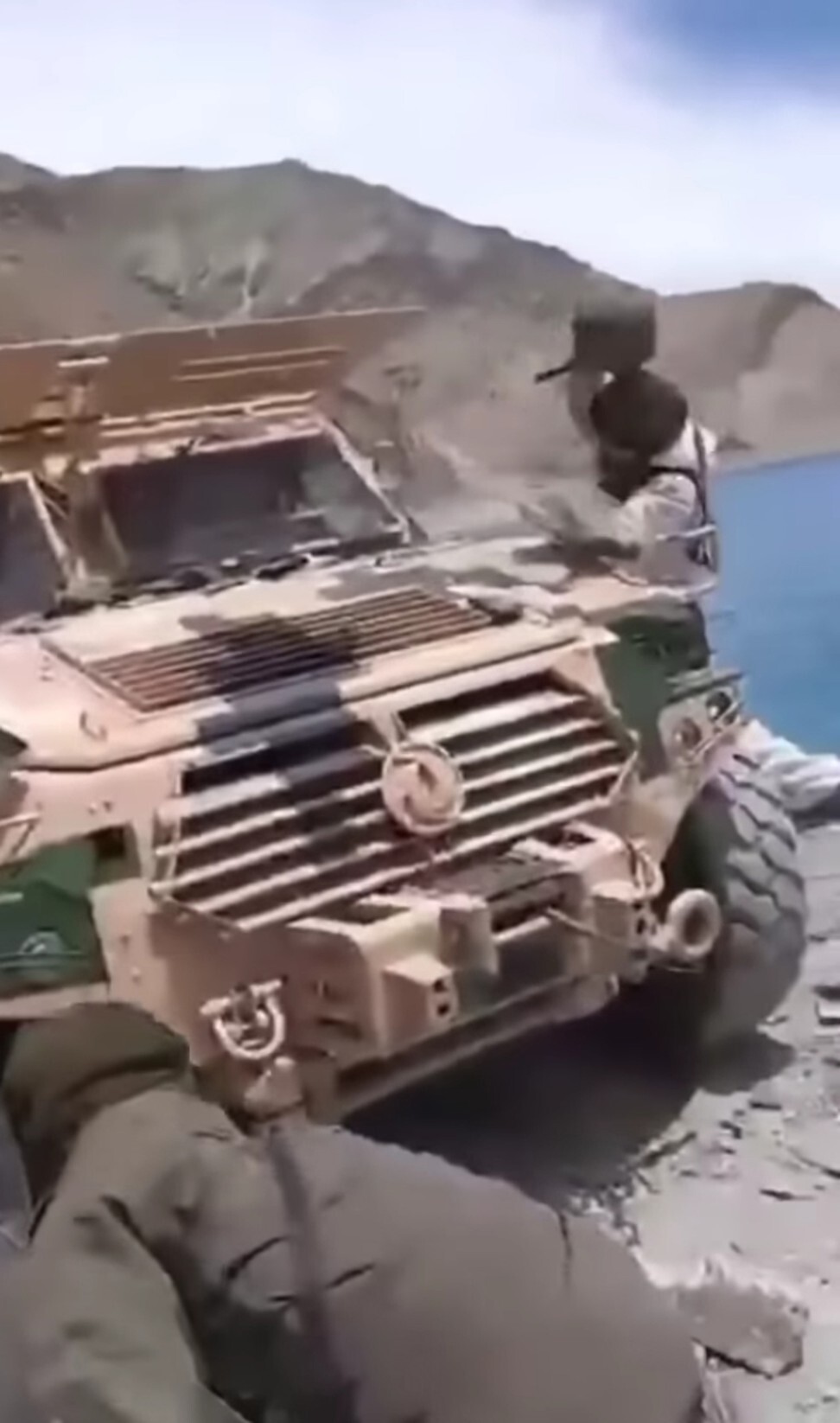
A screen grab of YouTube video in which Indian troops claimed to have captured a Chinese officer, who appeared hurt after a brawl at Pangong Lake in the Himalayas. Photo: Handout
The report was published one day after the Indian side posted a video on YouTube showing that Indian troops had captured a Chinese officer, who appeared badly roughed up during the brawl at Pangong Lake, about 4,350 metres (14,300 feet) above sea level in the Himalayas.
The YouTube video posted by someone on the Indian side did not state the time or date of the incident. Photo: Handout
The crudely made video, which did not include the date of the incident, also showed a damaged PLA military vehicle amid cheering Indian troops.

Two independent sources close to the PLA said “the wounded Chinese officer was an interpreter who was taken in by the Indian troops but was later released with minor injuries after the Chinese side called for reinforcements”.

The sources said soldiers from both sides had turned to social media to give a positive spin to their “acts of bravery” while their commanders wanted to play down the disputes. One source pointed out that the pictures of injured Indian soldiers were posted by a Chinese soldier on his personal social media account and not on official channels.

“Beijing didn’t want its people to think that Chinese soldiers lost in the fight but at the same time it is mindful of not escalating the matter,” said the source, who requested anonymity because of sensitivity of the situation.

India denies that Trump spoke to Modi about border tensions with China

29 May 2020

Beijing-based military expert Zhou Chenming said the Chinese border troops had been told to be “restrained”.

“In border disputes, China always wants to keep the status quo, especially now when both sides should do all they can to avoid fighting,” Zhou said. “China is busy dealing with the Covid-19 pandemic and other issues like Taiwan and Hong Kong, and India also faces a serious Covid-19 situation.”

Rajeev Ranjan Chaturvedy, an international relations expert based in New Delhi, agreed with Zhou’s analysis, saying both China and India understood the seriousness and sensitivity of their border disputes.

“Civilian and military officials of both countries are already in discussion under existing mechanisms,” he said. “The stakes are too high for both countries and the probability of a war [between India and China] is low, in my view.

“Though, the situation is very serious and India is closely monitoring Chinese activities.”

Military and diplomacy analysts believe border skirmishes between China and India will not escalate to war because of a range of factors, including the coronavirus pandemic. Photo: AP
Overseas media reported that both Chinese and Indian militaries had increased deployment to the border, with the PLA moving 5,000 personnel to the area.

Speaking last Wednesday, Chinese foreign ministry spokesman Zhao Lijian did not deny the troop deployment reports but said the overall situation in the China-India border area remained “stable and under control, and the two countries were capable of resolving border issues through dialogue and negotiations”.

Border conflicts between China and India have escalated since 2017, with Indian troops and the PLA staging the most serious confrontation in Doklam near a tri-junction border area – known as Donglang or Donglang Caochang, in Chinese – a territory which is claimed by both China and Bhutan, an ally of India.
Source: SCMP
01/06/2020

Hong Kong: Boris Johnson urged to form alliance over China security law

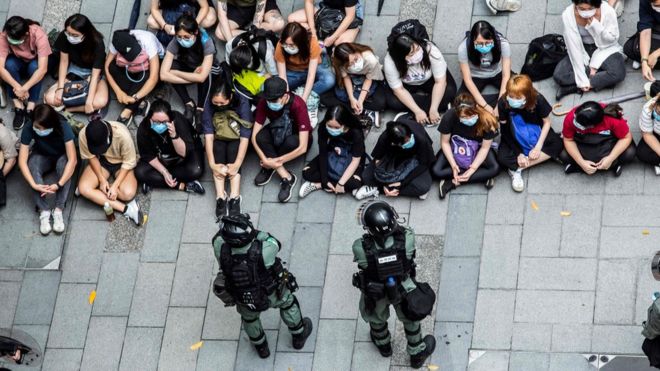
Riot police detain a group of people during a protest in the Causeway Bay district of Hong KongImage copyright AFP
Image caption Beijing’s proposed security law has sparked protests in Hong Kong

Seven former UK foreign secretaries have urged Boris Johnson to form a global alliance to coordinate the response to the China-Hong Kong crisis.

China is facing mounting criticism over a planned security law for Hong Kong which would make it a crime to undermine Beijing’s authority.

Foreign Secretary Dominic Raab said the UK would not turn a blind eye.

Hong Kong was handed back to China from British control in 1997 but under a unique agreement.

The former British colony enjoys some freedoms not seen in mainland China – and these are set out in a mini-constitution called the Basic Law.

But there are fears the proposed law, which has sparked a mass of anti-mainland protests in Hong Kong, could compromise some of the freedoms guaranteed by the Basic Law.

In their letter to the prime minister, the cross-party group of former cabinet ministers says the UK government must be seen to lead the international response, as many countries take their cue from Britain over its former colony.

Jeremy Hunt, David Miliband, Jack Straw, William Hague, Malcolm Rifkind, David Owen and Margaret Beckett all expressed their concern at what they call China’s “flagrant breach” of Sino-British agreements by imposing tough national security laws on Hong Kong.

They urged Mr Johnson to set up an “international contact group” of allies to coordinate any joint action, similar to that set up in 1994 to try to end the conflict in the former Yugoslavia.

A Downing Street spokesman insisted the government was already playing a leading role with international partners in urging China to think again.

Mr Raab said the new security legislation “very clearly violates” the autonomy that is guaranteed under Chinese law as well as that in the 1997 agreement.

He confirmed the UK will allow those who hold British National (Overseas) passports to come to the UK and apply to study and work for an extendable 12-month period.

This will in turn “provide a path to citizenship”, he told the BBC’s Andrew Marr Show on Sunday.

Mr Raab said up to three million people registered as a British national (overseas) in Hong Kong could be eligible for UK citizenship if China presses ahead with the law.

Meanwhile, the chairman of Commons foreign affairs committee, Tom Tugendhat, said the government must realise that China has a “very, very authoritarian system of government” and should rethink the partnership between the two.

Source: The BBC

01/06/2020

India coronavirus: Huge crowds as some train services resume

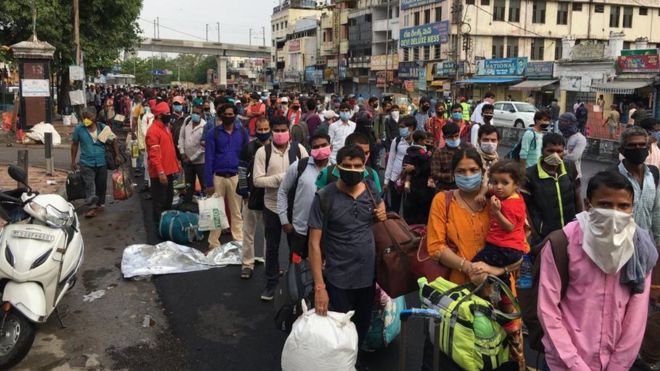
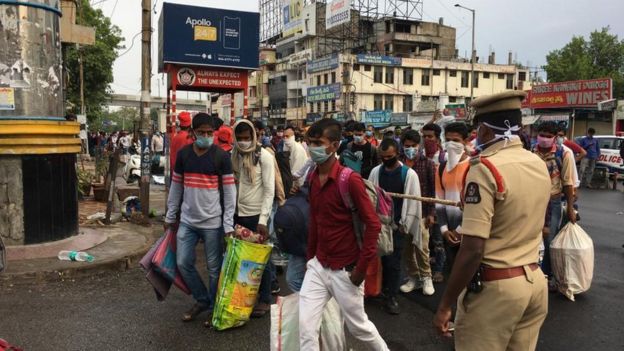
Passengers gathered outside Secundarabad station in Andhra Pradesh state
Image caption Passengers gathered outside Secundarabad station in Andhra Pradesh state

India has partially restored train services amid reports of chaos and overcrowding at some stations.

At least 145,000 people will travel in trains on Monday as the country starts to reopen after a prolonged lockdown.

Two hundred trains will now start operations – up from the existing 30 that are currently running.

But maintaining social distancing and cleanliness is proving to be a difficult task as huge crowds gathered outside some stations.

India’s mammoth railway network usually carries 25 million passengers every day.

The ministry of home affairs has issued specific guidelines for the smooth operation of train services. They say that all passengers will have to be screened, social distancing must be followed at the station and in trains and only passengers who have confirmed tickets will be allowed to travel.

Police struggles to enforce social distancing due to large crowds
Image caption Police struggled to enforce social distancing due to large crowds

But some stations reported chaotic scenes as officials struggled to enforce these guidelines. BBC Telugu reported that people were standing much too close to each other at Secunderabad railway station in the southern state of Telangana.

“Railway staff and police didn’t allow passengers to go inside the station until at least one hour before the scheduled departure, citing physical distancing measures. This led to some chaos outside the railway station as a large number of passengers had gathered and there was no physical distance maintained. Police later arrived and organised the queues,” BBC Telugu’s Sharath Behara says.

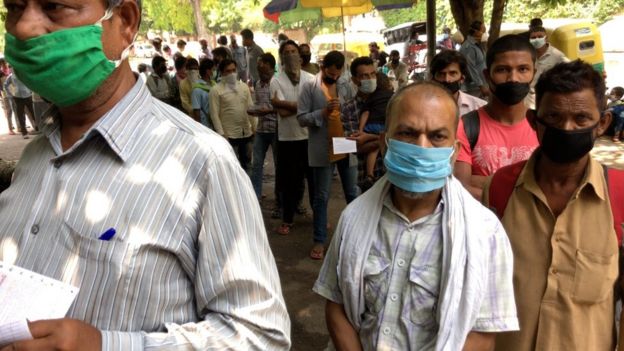
Reporting from Delhi, BBC Hindi’s Salman Ravi said strict social distancing was being followed when passengers boarded trains, and all of them wore masks.

Passengers waiting outside the train station in Delhi
Image caption Passengers waiting outside the train station in Delhi

“But the same was not observed at ticket booking counters. Many people who did not have tickets also turned up at the station and that caused crowding,” he added.

Train services came to a grinding halt when Prime Minister Narendra Modi announced the lockdown on 24 March to stop the spread of coronavirus.

This left millions of daily-wage workers stranded as they desperately tried to go back to their villages from cities. Many of them decided to walk long distances – in some cases more than 1,000 kilometres.

As pressure and criticism mounted, the government started running special trains to ferry migrants. Some 30 trains restarted on 12 May, since then there has been a consistent demand to reopen more routes.

Getting the train network going again is part of the government’s wider strategy to slowly reopen the economy. Millions have lost jobs and factories are struggling to reopen as demand is likely to be sluggish in the coming weeks.

But serious questions have been raised over the strategy as India’s coronavirus caseload is consistently increasing. Experts say if safety norms are not followed, the situation could quickly become worse.

Source: The BBC

01/06/2020

‘Lemon’ or not, Trump is stuck with Phase 1 China trade deal

WASHINGTON (Reuters) – U.S. President Donald Trump has little choice but to stick with his Phase 1 China trade deal despite his anger at Beijing over the coronavirus pandemic, new Hong Kong security rules, and dwindling hopes China can meet U.S. goods purchase targets, people familiar with his administration’s deliberations say.

The U.S.-China trade negotiations took more than two years, heaped tariffs on $370 billion of Chinese products, whipsawed financial markets and dimmed global growth prospects well before the coronavirus outbreak crushed them.

In recent weeks, suggestions that Trump may cancel the deal have emanated from the White House almost daily, and businesses, investors, and China trade watchers are hanging on to every word and tweet.

But on Friday, when Trump said the United States would start dismantling trade and travel privileges for Hong Kong, he did not mention the deal. Stock markets heaved a sigh of relief, with the S&P 500 .SPX reversing losses.

Talking tough on China and criticizing the Obama administration’s more measured approach is a key part of Trump’s re-election strategy. Sticking with the pact may mean accepting that China is likely to fall short of purchase commitments for U.S. agricultural goods, manufactured products, energy and services – goals that many said were unrealistic here even before the pandemic.

Canceling the deal, though, would reignite the nearly two-year U.S.-China trade war at a time U.S. unemployment is at its worst since the 1930s Great Depression.

The next U.S. step would likely be reviving previously planned but canceled tariffs on some $165 billion worth of Chinese consumer goods, including Apple (AAPL.O) cellphones and computers, toys and clothing – all ultimately paid by U.S. companies and passed on to consumers. Beijing would retaliate with tariffs on U.S. goods, fueling more market turmoil and delaying recovery.

“He’s stuck with a lemon. He gets an empty agreement if he sticks with it, and he gets more actions that create an economic drag and more volatility if he abandons it,” said one person briefed on the administration’s trade deliberations.

U.S. goods exports here to China in the first quarter were down $4 billion from the trade war-damaged levels a year earlier, according to U.S. Census Bureau data.

The Peterson Institute of International Economics estimates here that during the first quarter, China made only about 40% of the purchases it needed to stay on target for a first-year increase of $77 billion over 2017 levels, implying an extremely steep climb in the second half.

Leaving the deal now would not buy a lasting political bounce for Trump in manufacturing-heavy swing states with five months to go before the presidential election, analysts say.

COMPLEX RELATIONSHIP

Trump blames China for failing to contain the coronavirus and has repeatedly said the deal, including its pledges to boost U.S. exports to China by $200 billion over two years, no longer means as much to him with U.S. coronavirus deaths now over 100,000 and job losses piling up.

Trump said on Friday that China was “absolutely smothering Hong Kong’s freedom,” but refrained from harsh sanctions that could put the trade deal in jeopardy, taking milder steps to revoke the territory’s separate travel and customs benefits from China.

Claire Reade, a former U.S. trade negotiator, said Trump’s “peripheral steps” would not deter Beijing from proceeding with the security law, as it regards Hong Kong as a core national security issue.

“Probably the most significant thing from the trade perspective is that the Phase 1 trade deal is – for now anyway – unaffected,” said Reade, senior counsel with Arnold and Porter law firm in Washington.

White House Economic Adviser Larry Kudlow criticized Beijing last week, but on trade told CNBC: “It’s a complex relationship. The China Phase 1 trade deal does continue to go on for the moment and we may be making progress there.”

U.S. Trade Representative Robert Lighthizer has recently cited here “continuing progress” in the deal, after China welcomed U.S. blueberries, barley, beef and dairy products. He has touted the deal’s dispute settlement mechanism, which provides for regular consultations on compliance with Beijing’s commitments on intellectual property protections, financial services, agriculture standards and purchases.

U.S.-China flashpoints on Hong Kong, Taiwan and other issues did not derail negotiations that resulted in new concessions from China, said Jamieson Greer, who served as Lighthizer’s chief of staff until April.

“Some of these security and human rights challenges have certainly complicated the atmosphere, but the trade agreement can still provide a set of rules governing important aspects of the trade relationship,” said Greer, now an international trade partner at the King and Spalding law firm.

Another person familiar with USTR thinking said the agency “needs to make Phase 1 look good. They want to show that progress is being made. The president looks at the China relationship much more broadly.”

Source: Reuters

01/06/2020

India’s monsoon rains seen at 102% of average in 2020: weather office

MUMBAI/NEW DELHI (Reuters) – India is likely to receive 102% rainfall of a long-term average this year, the state-run weather office said on Monday, raising expectations for higher farm output in Asia’s third-biggest economy, which is reeling from the new coronavirus pandemic.

In July India could receive 103% rainfall of its long-term average and 97% in August, M. Rajeevan, secretary at the Ministry of Earth Sciences, told a news conference.

The IMD defines average, or normal, rainfall as between 96%and 104% of a 50-year average of 88 centimetres for the entire four-month season beginning in June.

Source: Reuters

Law of Unintended Consequences

continuously updated blog about China & India

ChiaHou's Book Reviews

continuously updated blog about China & India

What's wrong with the world; and its economy

continuously updated blog about China & India