03/09/2019
Li Zhanshu, chairman of the National People’s Congress (NPC) Standing Committee, meets with a delegation led by U.S. Senator Steve Daines, also co-chair of the U.S. House of Senate U.S.-China Working Group, and U.S. Senator David Perdue in Beijing, capital of China, Sept. 2, 2019. (Xinhua/Ding Haitao)
BEIJING, Sept. 2 (Xinhua) — Top legislator Li Zhanshu met with a delegation led by U.S. Senator Steve Daines and Senator David Perdue here on Monday.
Commending their long-term efforts to promote the development of bilateral relations and exchanges between the legislative bodies, Li, chairman of the Standing Committee of the National People’s Congress (NPC), said this year marks the 70th anniversary of the founding of the People’s Republic of China and the 40th anniversary of the establishment of diplomatic relations between China and the United States.
He said history has proven that China and the United States stand to gain from cooperation and lose from confrontation and a healthy China-U.S. relationship meets the common interests of both countries and the world.
China is committed to the road of peaceful development and upholds an opening strategy featuring mutual benefit and win-win results, said Li, adding that the NPC is ready to work with the U.S. Congress to enhance cooperation and to properly handle differences and sensitive issues through dialogue and constructive means.
Daines, also co-chair of the U.S. House of Senate U.S.-China Working Group, and Perdue said U.S.-China relations are one of the most important bilateral relations in the world and members from the working group are ready to make efforts to promote mutual understanding between the two governments and the two peoples.
Wang Chen, vice chairperson of the Standing Committee of the National People’s Congress, met with Daines and Perdue earlier in the day.
Source: Xinhua
Posted in 40th anniversary, 70th anniversary, Beijing, chairman of the Standing Committee of the National People's Congress (NPC), China alert, China-U.S. relationship, diplomatic relations, founding, founding of the People's Republic of China (PRC), Senator David Perdue, Senator Steve Daines, Top legislator Li Zhanshu, U.S. House of Senate, U.S.-China Working Group, Uncategorized, United States, vice chairperson of the Standing Committee of the National People's Congress, Wang Cheng |
Leave a Comment »
24/08/2019
Chinese President Xi Jinping, also general secretary of the Communist Party of China Central Committee and chairman of the Central Military Commission, inspects an air force base in northwest China’s Gansu Province, Aug. 22. 2019. (Xinhua/Li Gang)
LANZHOU, Aug. 23 (Xinhua) — Chinese President Xi Jinping has called on the air force to enhance its capability to win and greet the 70th anniversary of the founding of the People’s Republic of China (PRC) with great achievements.
Xi, also general secretary of the Communist Party of China Central Committee and chairman of the Central Military Commission, made the remarks Thursday when inspecting an air force base in northwest China’s Gansu Province.
At the combat command center, Xi used a tele-conferencing facility to inspect the troops including personnel at a radar station on a plateau over 3,600 meters above sea level and a transport and rescue regiment.
After listening to the work report of the base, Xi stressed the great significance of carrying out the Party education campaign themed “staying true to our founding mission” as the nation marks the 70th anniversary of the founding of the PRC.
Demanding a stronger sense of responsibility, Xi asked for persistent efforts in improving military preparedness to ensure that the air force can fight and emerge victorious when called upon.
The combat forces and support forces should be developed through military training under real combat conditions and joint operations, Xi said.
He also stressed the need to govern the military with strict discipline in every respect and make sure that the armed forces are highly centralized, unified, pure and solid, and that they stay secure and stable.
Source: Xinhua
Posted in 70th anniversary, air force, air force base, Chairman of the Central Military Commission, Chinese President Xi Jinping, founding of the People's Republic of China (PRC), Gansu Province, general secretary of the Communist Party of China Central Committee, Party education campaign, radar station, tele-conferencing facility, transport and rescue regiment, Uncategorized |
Leave a Comment »
22/08/2019
- State media says presence is part of preparations for major drill, but analyst calls it a ‘psychological warfare tactic’
- Fears that the armed presence was a show of power to Hong Kong
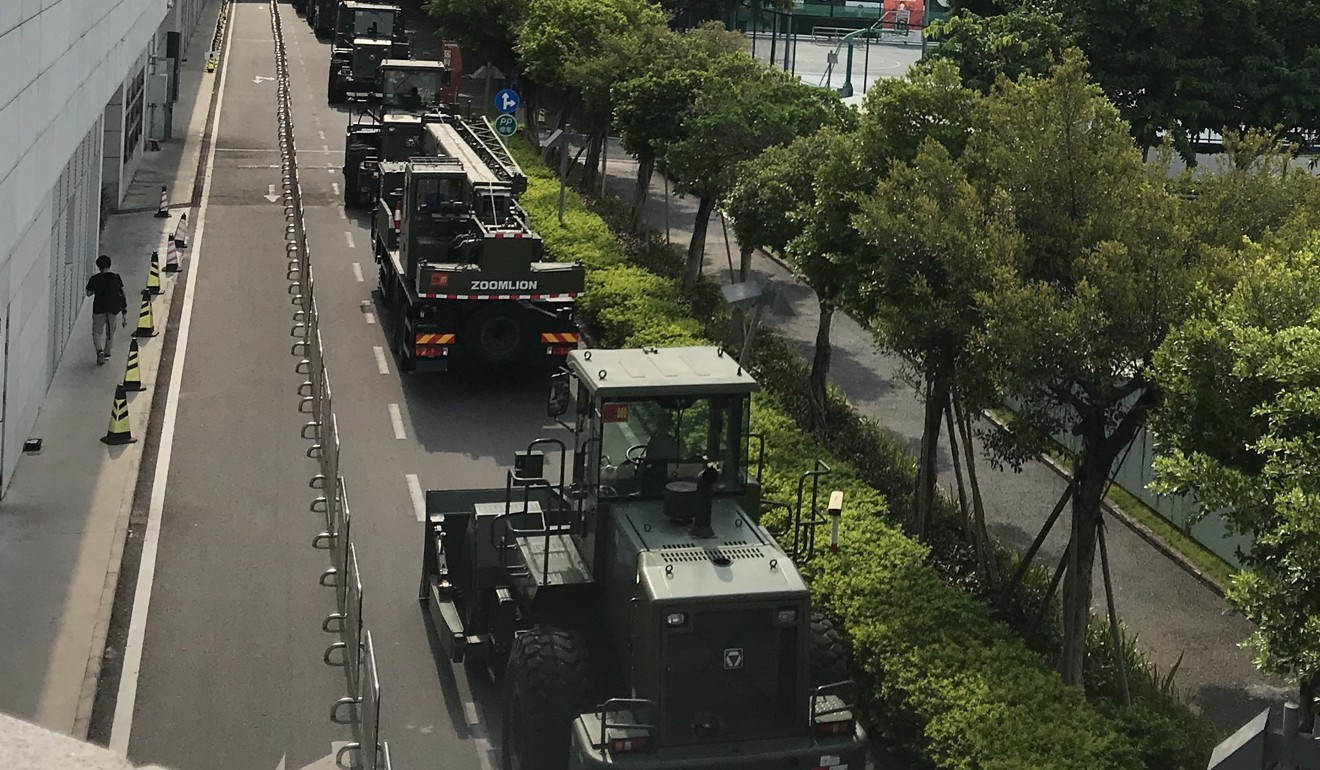
Dozens of trucks line a street next to the entrance of the Shenzhen Bay Sports Centre in Shenzhen on Monday. Photo: SCMP
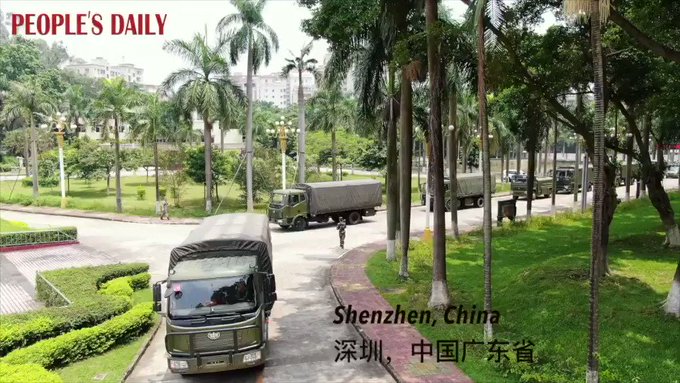
A convoy of armed police trucks has been stationed at a sports centre in a mainland Chinese city bordering Hong Kong, adding to speculation online that Beijing could be preparing to intervene directly in the protests roiling the special administrative region.
But a Beijing-based military expert said the movements were part of regular exercises and not cause for concern.
Footage of the trucks rolling into Shenzhen in the southern province of Guangdong began circulating online on Saturday.
On Monday, Communist Party mouthpiece People’s Daily and Global Times posted videos of the convoy in the city, saying the police were there to prepare for large-scale drills.
Dozens of the trucks as well as excavators lined a pavement next to the entrance of the Shenzhen Bay Sports Centre in Nanshan district on Monday, across the harbour from Hong Kong.
Personnel in camouflage uniforms stood at the entrances of the sports centre, but did not block access to civilians.
Asked whether they were in Shenzhen for a drill and what time they had arrived, the personnel shook their heads and said nothing.
Also on Monday, the Hong Kong and Macau Affairs Office released a stern statement, calling attacks on police “signs of terrorism”.
Online, internet users speculated that the armed presence was a show of power to Hong Kong.
Excavators are among the heavy equipment stationed near the entrance of the Shenzhen Bay Sports Centre on Monday. Photo: SCMP
“They are just waiting for an order before they’ll drive to Hong Kong to calm the riots. We hope the armed forces can enter Hong Kong and beat the hell out of these idiotic youth,” one commenter said on Weibo, China’s Twitter-like social media platform.
Beijing-based military specialist Zhou Chenming said that the armed police were taking part in regular drills and that people should not feel nervous.
“The central government has repeatedly stated it will only interfere if there are large-scale riots and the Hong Kong government has applied voluntarily for support,” Zhou said.
Hong Kong policeman filmed aiming gun at protesters hailed as a hero by Chinese state media
“If the situation does not reach that point, then this is only a deterrence measure, to deter these [small group of people] from stepping over the line.”
Dixon Sing Ming, a political-science professor at the Hong Kong University of Science and Technology, said the move was a “psychological warfare tactic”.
“The drill is part and parcel of a well-coordinated attempt by Beijing to pressure the protesters and the general public to give up their five demands, including the one for universal suffrage immediately,” Sing said.
Hong Kong has been engulfed in protests since early June, at first to oppose the now-shelved extradition bill that would have allowed Hong Kong to send suspects to other jurisdictions, including mainland China.
Chinese police mass 12,000 anti-riot officers in Shenzhen for drill
But protesters now have five demands, including a complete withdrawal of the extradition bill and an independent investigation into the police’s use of force in handling the protests.
As the confrontations have escalated, public opinion in the mainland has grown steadily tougher, with many calling for more stern measures to restore order.
On August 6, 12,000 police officers gathered in Shenzhen for a drill, which included anti-riot measures similar to those seen on the streets of Hong Kong.
Although the police said the drill was part of security preparations for the 70th anniversary of the People’s Republic on October 1, internet users saw it as a show of power and warning to Hong Kong.
Source: SCMP
Posted in 70th anniversary, anti-riot officers, armed police, Beijing, camouflage uniforms, Central government, Chinese armed police, excavators, Global Times, guangdong province, harbour, Hong Kong, Hong Kong and Macau Affairs Office, Hong Kong University of Science and Technology, large-scale drills, mainland Chinese city, Nanshan district, October 1 1949, People’s Daily, People’s Republic, Police, protests, psychological warfare tactic, regular drills, Shenzhen, Shenzhen Bay Sports Centre, signs of terrorism, Special administrative region, truck convoy, Uncategorized, videos, Weibo |
Leave a Comment »
17/08/2019
- Chinese government advisers say Beijing has not reached direct intervention point but that could change if the violence continues
- Military action would trigger international backlash, observers say, as US expresses concern over reported paramilitary movements and ‘erosion of Hong Kong’s autonomy’
Footage of trucks from the paramilitary People’s Armed Police in Shenzhen has circulated online. Photo: Handout
The unrest in Hong Kong does not yet warrant direct intervention by Beijing despite hardening public sentiment and calls for tougher action in mainland China, according to Chinese government advisers.
Shi Yinhong, an international relations expert at Renmin University and an adviser to the State Council – China’s cabinet – said China would risk damaging its ties with the United States and other major foreign powers, upsetting its own development and losing Hong Kong’s special status if it took the matter directly into its hands.
“I don’t think we need to use troops. Hong Kong police will gradually escalate their action and they haven’t exhausted their means,” Shi said, expressing a view shared by other mainland government advisers and academics.
But he warned that if the violence and chaos continued, it “won’t be too far away from reaching that point”.
A US State Department spokeswoman said the United States was “deeply concerned” about reports of paramilitary movements along the Hong Kong border and reiterated a US call for all sides to refrain from violence.
She said it was important for the Hong Kong government to respect “freedoms of speech and peaceful assembly” and for Beijing to adhere to its commitments to allow a high degree of autonomy for Hong Kong.
She said the protests reflected “broad and legitimate concerns about the erosion of Hong Kong’s autonomy”.
brought the city’s air traffic to a halt and triggered
a huge backlash on the mainland
, where the public feel they have been wrongly targeted by the increasingly violent protesters. Many demanded the central government take action to end the chaos.
The tension deepened after US President Donald Trump, citing intelligence sources,
to the border with Hong Kong. Trump described the situation in the city as “tricky” and called on all sides to remain “calm and safe”.
Footage of trucks from the paramilitary People’s Armed Police rolling into Shenzhen began circulating online on Saturday.
Beijing ‘unlikely to intervene’ in Hong Kong as pressure mounts on police
But Shi and others said direct intervention would be too costly to China and would only be used when all other methods had been exhausted.
“As the trade war with the US goes on, Hong Kong’s importance to our financial system is getting bigger,” Shi said. “If Beijing intervenes with too much assertiveness, the US might revoke the preferential status of Hong Kong.”
He was referring to the US’ 1992 Hong Kong Policy Act which gives the city a special status. In June, American lawmakers introduced a bipartisan bill requiring the US government to examine Hong Kong’s autonomy annually to decide whether to extend the arrangement.
Losing that status could cripple the operations of many businesses based in Hong Kong, said Shen Dingli, a Shanghai-based international affairs expert.
A satellite image appears to show a close-up of Chinese military vehicles at Shenzhen Bay Sports Centre in Shenzhen. Photo: Maxar Technologies
Wang Yong, another specialist on international political economy with Peking University, agreed.
“There would be a lot of opposition from interest groups in the US. Hong Kong is the bridgehead for many multinational corporations and investors from Wall Street to get into the Chinese market,” said Wang, who also teaches at an academy affiliated with China’s Ministry of Foreign Affairs.
“Hong Kong and the Chinese government will need to handle this with extra care, so as not to give any ammunition to hawks in the United States.
“If Hong Kong is not handled properly, it could add tensions to the bilateral ties and ruin any prospect of a trade deal.”
China rejects requests for US warships to visit Hong Kong amid protests Pang Zhongying, an international relations specialist at Ocean University of China in Qingdao, said direct intervention could also damage China’s ties with other countries.
“The whole world is watching. Beijing has exercised restraint for two months and still hasn’t taken any clear action because this is not an easy choice,” said Pang, who is also a member of the Beijing-based Pangoal Institution, a think tank that advises several ministerial offices.
While some observers said Beijing was under political pressure to end the protests in Hong Kong before October 1 – the 70th anniversary of the founding of the People’s Republic, Shi said the central government would not lose patience so easily.
“National Day [on October 1] is an important time, but the Chinese government is not naive to believe there has to be peace under all heaven then,” he said.
“It’s only a bit more than a month from now, we can almost say for sure the trade war will still be on by then and a major turning point in Hong Kong is not likely to happen. But the celebration must go on.”
Source: SCMP
Posted in 70th anniversary, American, autonomy, backlash, Beijing, bipartisan bill, celebration, China alert, China's cabinet, China-US trade war, China’s State Council, concern, direct intervention, financial system, foreign powers, Hong Kong, international, lawmakers, Mainland China, military action, Ministry of Foreign Affairs, Ministry of Foreign Affairs (MFA), National Day, Ocean University of China, Pangoal Institution, paramilitary, peace under all heaven, People's Armed Police, People’s Republic, preferential status, Qingdao, quell, Renmin University, Risks, Risks still too big, send in troops, Shenzhen, Shenzhen Bay Sports Centre, trade war, trigger, Uncategorized, United States, unrest, US, US President Donald Trump, US warships, US’ 1992 Hong Kong Policy Act |
Leave a Comment »
06/08/2019
- Security forces shown tackling ‘demonstrators’ wearing black shirts
- ‘Anti-mob’ tactics prepare forces for the 70th anniversary of the People’s Republic
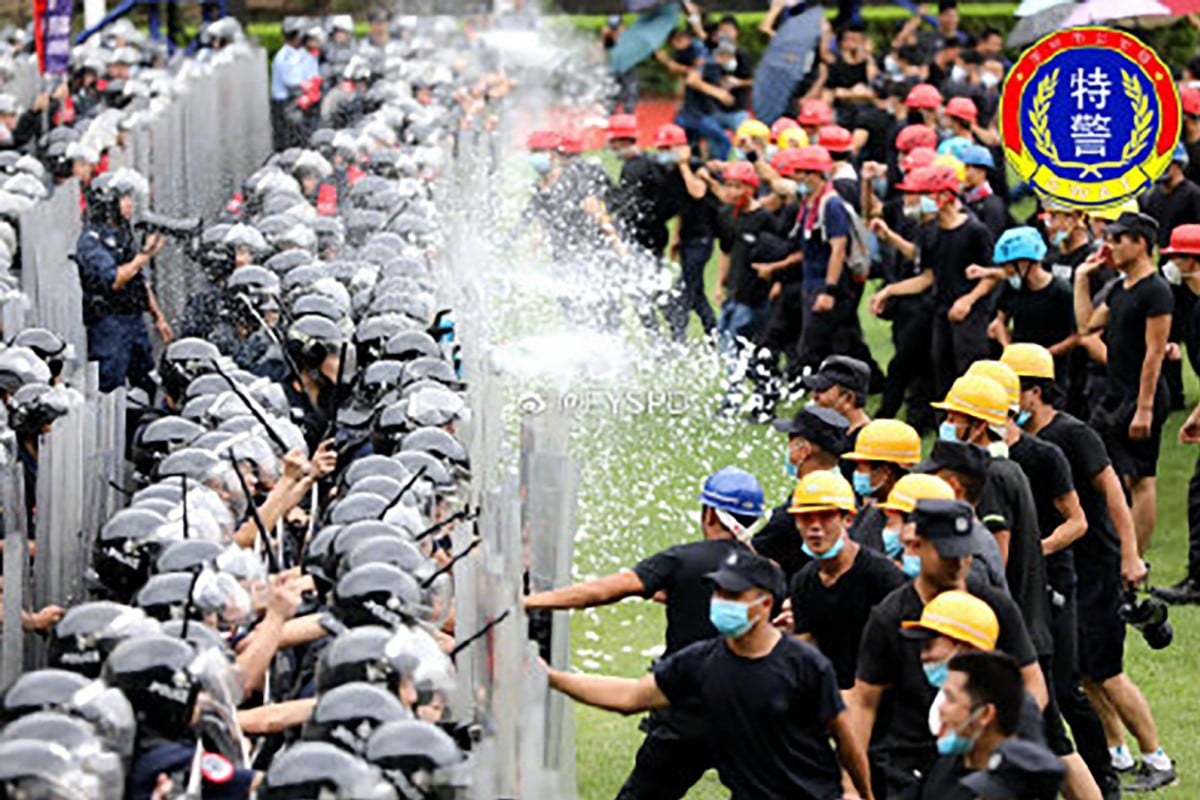
Shenzhen police broadcast live footage of a security exercise involving 12,000 officers rehearsing anti-riot drills. Photo: Weibo
More than 12,000 police officers assembled in Shenzhen in the southern Chinese province of Guangdong on Tuesday for a drill that included anti-riot measures similar to those seen on the streets of Hong Kong.
The drill was part of security preparations for the 70th anniversary of the People’s Republic of China on October 1, Shenzhen police said on the force’s Weibo newsfeed.
“A drill will be held to increase troop morale, practise and prepare for the security of celebrations, [and] maintain national political security and social stability,” police said.
China mobilises 190,000 police officers to prepare for 70th anniversary celebrations
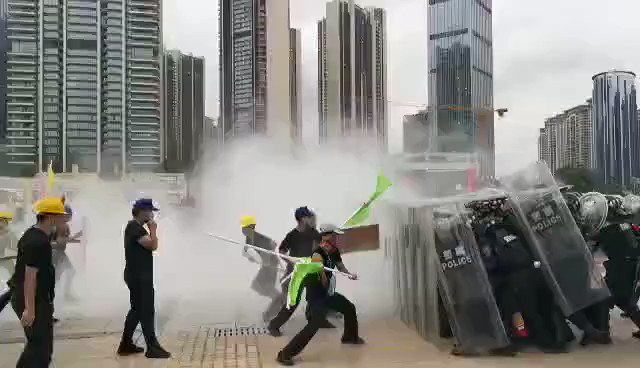
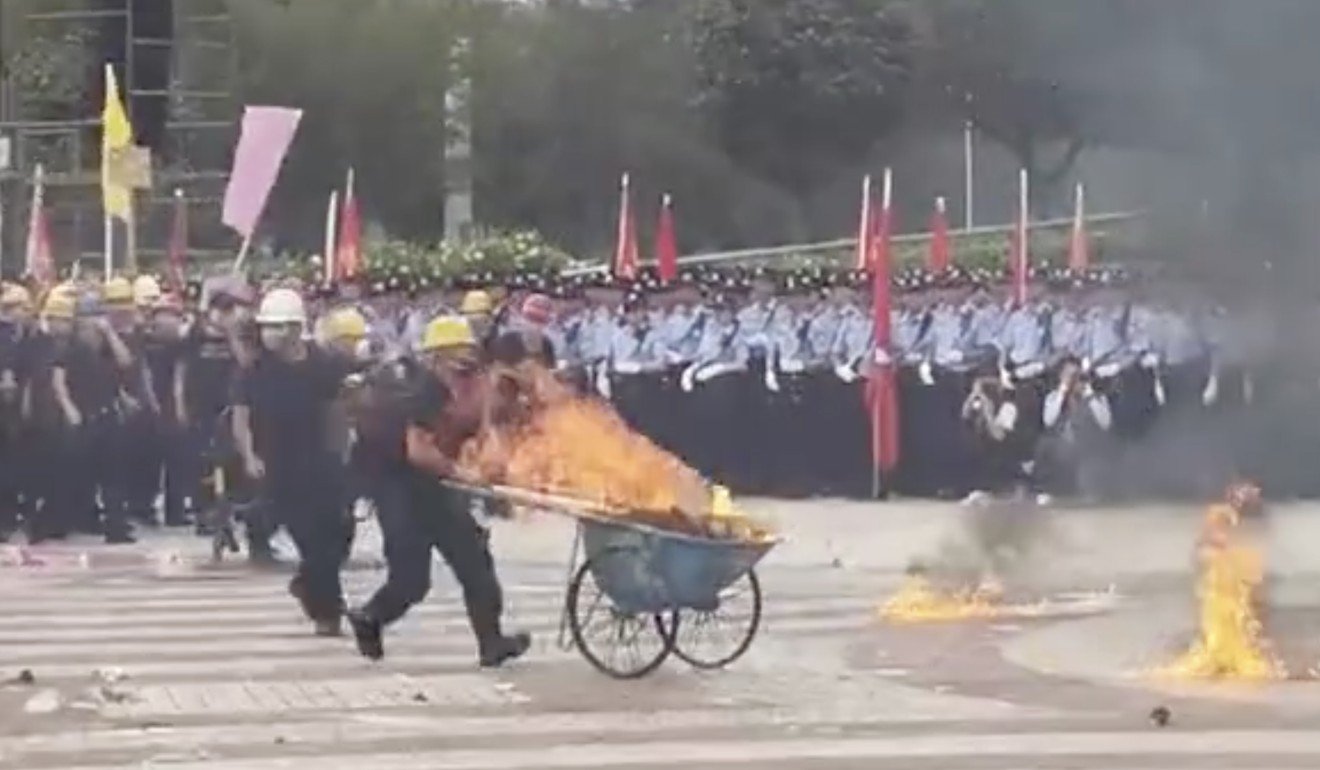
In live videos of the police drills shown on the Yizhibo network, officers in body armour, helmets and shields confronted groups of people in black shirts and red or yellow construction safety helmets – similar to those worn by Hong Kong protesters – who were holding flags, banners, batons and wooden boards.
“The practice is complete with mature anti-mob tactics. The police forces can present an anti-mob formation, which is flexible, suitable for different situations, with accurate aim and effective control,” a narrator said during the live broadcast.
As the drill escalated and more “rioters” were deployed, police fired tear gas and smoke covered the training ground.
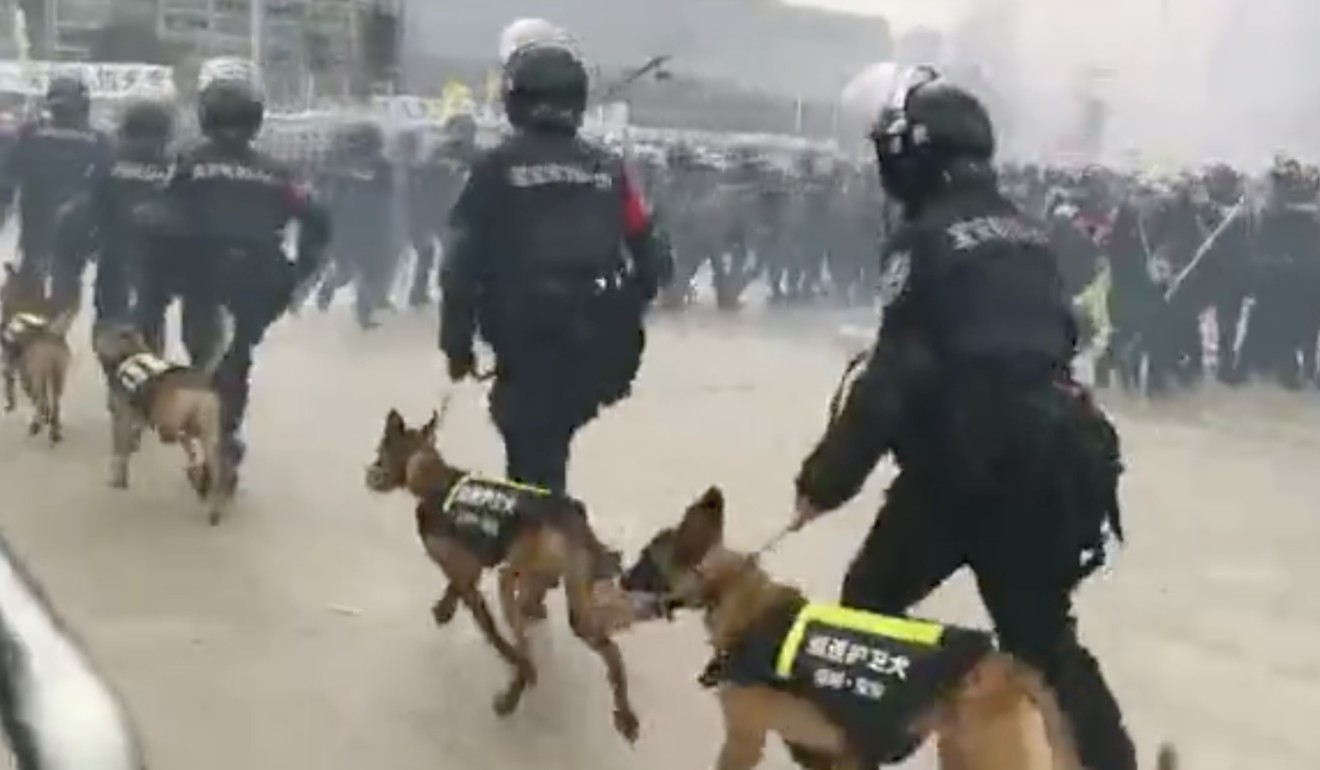
A few minutes later, the rioters fired home-made gas bombs then set bogies alight and drove them at the police lines. The officers changed formations and pressed the rioters, making arrests. Police handlers and their dogs were also on the scene.
A blazing bogie is driven towards police lines during Shenzhen police’s anti-riot exercise. Photo: Weibo
Other drills included anti-smuggling and search-and-rescue exercises involving personnel from the People’s Liberation Army.
The drill was presented as preparation for the 70th anniversary celebrations but it came amid continued violence in the streets of Hong Kong and two incidents of the Chinese national flag being thrown into Victoria Harbour.
Hong Kong has been engulfed in two months of turmoil stemming from opposition to the now-suspended extradition bill.
Police handlers and their dogs were deployed against people dressed like Hong Kong demonstrators. Photo: Weibo
“Is this hinting at Hong Kong?” a commenter on the Shenzhen police Weibo thread asked.
“We are doing drills today, and they can enter into real practice in Hong Kong in the future. We can send thousands of anti-mob squads over and strike hard at the radical traitors, those Hong Kong independence supporters,” another user said.
Since protests escalated in Hong Kong, Beijing has reiterated its “unflagging support” for embattled Hong Kong Chief Executive Carrie Lam Cheng Yuet-ngor and her administration to take lawful action to restore order, and warned that the city was entering “a most dangerous phase” with violence on the streets.
Source: SCMP
Posted in 70th anniversary, anti-riot officers, banners, batons, Beijing, black shirts, body armour, Carrie Lam Cheng Yuet-ngor, chinese police, confronted, construction safety helmet, dogs, drill, flags, gas bombs, Guangdong, guangdong province, helmets, Hong Kong, Hong Kong Chief Executive, Mass, migrant workers, national flag, People’s Liberation Army, People’s Liberation Army (PLA), People’s Republic of China, search-and-rescue exercises, Shenzhen, Shenzhen News Radio, shields, smoke, tear gas, Uncategorized, unpaid salaries, Victoria Harbour, Weibo, wooden boards, Yizhibo network |
Leave a Comment »
17/07/2019
- President Xi Jinping has shown himself capable of surprise, whether he is responding to the Hong Kong protests or the US trade war. But his failure to pardon political prisoners and rally China proves there are limits to his flexibility
President Xi Jinping waves as he reviews troops on Tiananmen Square during a Victory Day military parade in September 2015. He has signed two amnesty orders since taking office, one to mark the 70th anniversary of the end of the second world war in 2015, and the other to celebrate the 70th anniversary of the founding of the People’s Republic China this year. Photo: EPA
To mark the 70th anniversary of the founding of the People’s Republic of China, Beijing has granted special pardons to
. This is the
amnesty since the Communist Party took control of the country, and the second since Xi Jinping took office. The previous amnesty was announced in 2015, on the occasion of the
of the end of the second world war.
Before Beijing declared the latest amnesty for Chinese and foreign individuals, I had expected Xi to take this chance to pardon
(although there are no political crimes under the Chinese penal code, in reality those facing political persecution are often convicted of criminal offences). It would have demonstrated the stated aims of the amnesty, which include continuing the fine traditions of Chinese civilisation, such as cautious punishment and benevolence to prisoners. It would also have shown there is still a sliver of space for political openness in the
.
Out of the nine categories announced, political prisoners could have fallen under the sixth category – those aged 75 and above and with serious physical disabilities. But the Chinese government also stated it would not pardon those who refused to repent or were deemed dangerous to society, provisions that would exclude political prisoners.
Since Xi came to power, Beijing has strengthened its
over public opinion, suppressed dissidents and
, and emphasised ideology in the fields of thought and culture, such that the authority of the party and Xi has reached an
. Yet, considering China’s current social situation, it should be difficult, but not impossible, for Xi to pardon political prisoners and send a reassuring signal to society.
Beijing had declared seven amnesties before 1975, but none between 1975 and 2015 – not even during the two relatively relaxed decades, the
and the
. The amnesty of 2015 was unexpected because while the 70th anniversary of China’s victory against Japan was major, it was also just a commemorative celebration. To some extent, it illustrated Xi’s ability to surprise – and he has sprung more surprises since.
Recently, contrary to many observers’ expectations, Xi did not push for tough measures against the
anti-extradition protests in Hong Kong. Last year, when
had a crisis of confidence and many believed Xi would ramp up the policy of promoting the state sector over the private sector, he made a 180-degree turn towards
.
Then there are the
between China and the United States: public opinion expected an agreement to be signed, but Xi wanted a renegotiation and a
text. It is clear from all this that Xi understands the strategy of advance and retreat. If a situation is unfavourable for his or the party’s rule, he will adjust his policy.
And the current political climate in China would seem to warrant an adjustment. Xi’s leftist practices have alienated many and caused resentment in some sections of the party and society; in particular, he has destroyed the party’s relationship with
. However, the liberal faction of the party has realised the
of alienating intellectuals, and is calling on top-level cadres to rebuild the relationship with scholars to strengthen the legitimacy of the party’s rule.
Internationally, an amnesty is a humanitarian measure that creates an atmosphere of reconciliation and regulates the political climate. Xi, who has abolished a term limit on the presidency, wants to maintain stable,
. To rally the Chinese people behind him at
, it is reasonable to loosen the tightly wound spring that is Chinese society, and restore some flexibility. Special pardons would alleviate social conflict, reunite intellectuals, ease tension with the party’s critics, and avoid worsening the social divide.
Have the extradition protests sealed Hong Kong’s fate with Beijing?
In announcing the latest amnesty, Beijing emphasised the need to exude institutional confidence,
China as a great nation in a new era of prosperity, and to project an image of an advanced culture that is open, democratic and respects the rule of law.
China has a tradition of holding small celebrations every five years and big celebrations every 10 years. To highlight the great achievements and high morals of Xi, the new helmsman steering his people towards socialism, a wider net was cast for the latest special pardons: nine categories of prisoners, compared to four categories in 2015.
However, in setting stricter conditions to exclude some from the amnesty – in particular, political prisoners – Beijing has revealed the hypocrisy of its special pardons, to say nothing of its failure to enhance institutional confidence.
In short, Xi has squandered what could have been a good move to unite the Chinese people. Whatever his reasons might be, this amnesty should make one thing clear to the world: although Xi can be opportunistic and flexible in his ruling strategy, he is intransigent on the fundamental question of
and is well and truly stuck.
Posted in 70th anniversary, Beijing, founding, lost opportunity, People’s Republic China, President Xi Jinping, rare amnesty, Tiananmen Square, Uncategorized, Victory Day military parade |
Leave a Comment »
09/07/2019
- Ambassador to China Vikram Misri says they will be ‘meeting more and more in common waters’, and more exchanges are needed
- He also says preparations are under way for President Xi Jinping to visit India
The INS Kolkata arrives in Qingdao for PLA Navy 70th anniversary celebrations in April.
The Indian ambassador called for more communication between the two navies. Photo: Reuters
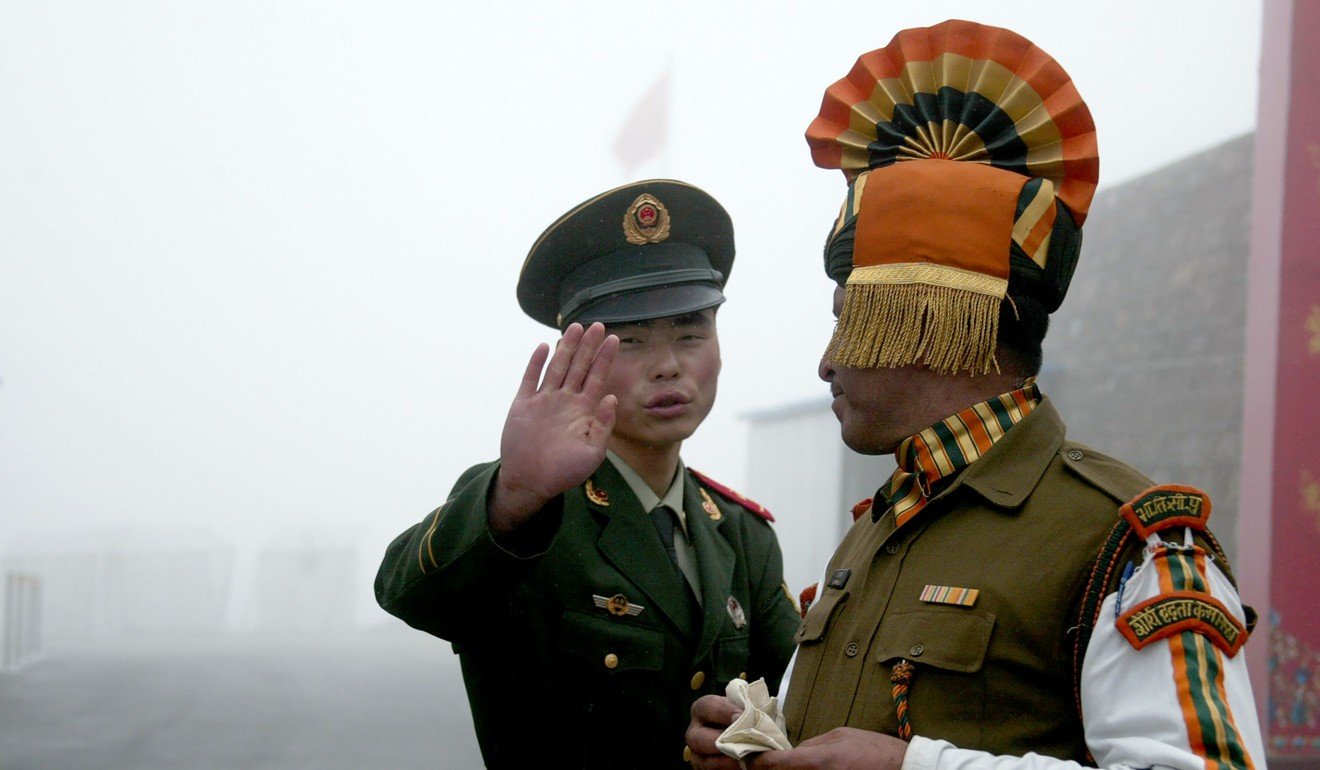
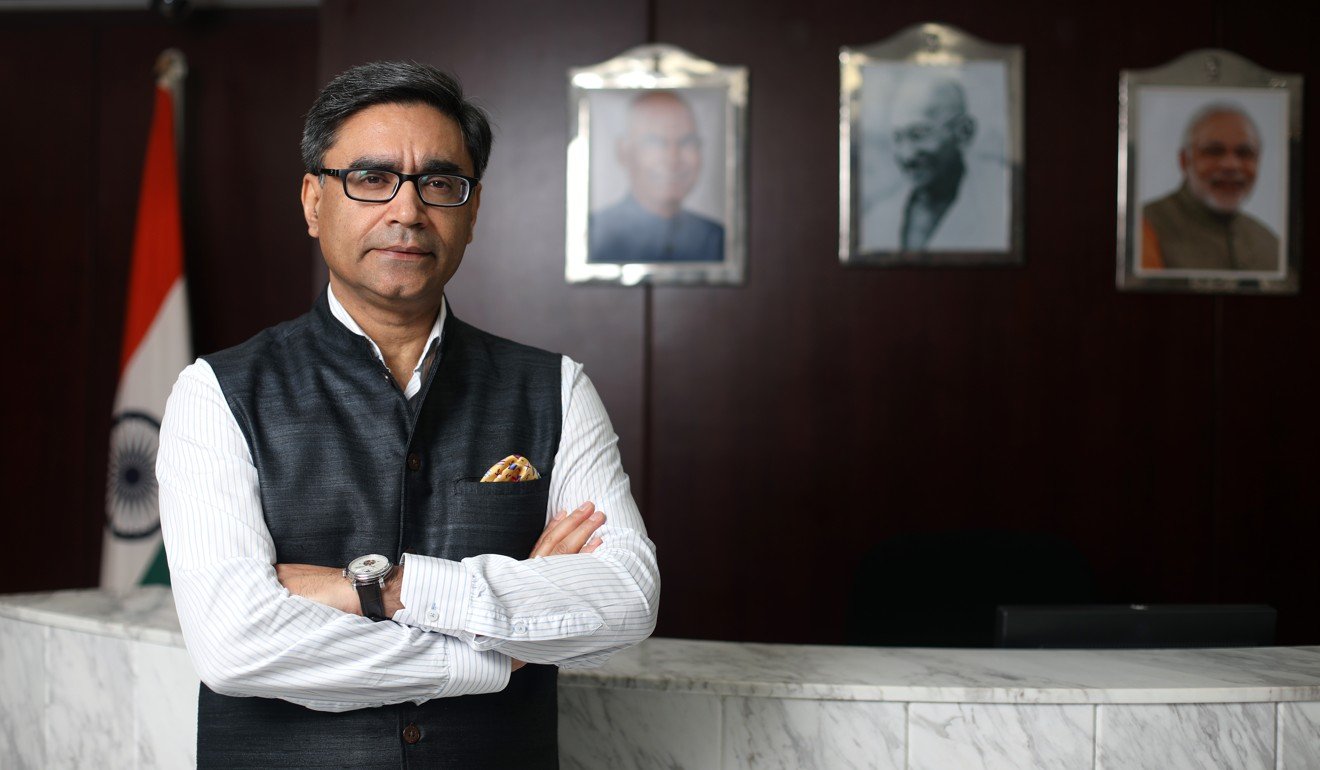
The Chinese and Indian navies should establish communication because they are increasingly operating within close proximity, according to India’s ambassador to China.
While the two nations’ militaries communicated extensively, it was mainly between their land forces, and that should be extended to the navies and air forces, Vikram Misri said.
“We need to talk about the two air forces and the two navies – especially the two navies – because we are operating in the same waters and increasingly in the coming years, we will be meeting more and more in common waters,” Misri said.
“I think it is important for us to develop those levels of understanding and communication,” he said. “There are some [navy and air force] exchanges now, but not as well developed as in the case of the land force.”
China and India have made efforts to repair their relations since a tense stand-off at the Doklam plateau two years ago, when communications between their forces along the border were seen as inadequate to contain the tension.
China and India have sought to repair relations after a tense stand-off at Doklam. Photo: AFP
Misri said the two nations had made incremental progress, and opened new points where “border personnel can meet and exchange information, or exchange views about any particular situation”.
The ambassador was visiting the Indian consulate in Hong Kong over the weekend, six months after taking up the post and six weeks after Prime Minister Narendra Modi was re-elected.
He said preparations were under way for Chinese President Xi Jinping to visit India, which was expected to happen in the fourth quarter, after they pledged earlier to strengthen cooperation.
Tensions between
have periodically flared along their 4,000km (2,485-mile) border, resulting in a brief war in 1962. Relations have also been strained by China’s ties with Pakistan, and India’s concern over China’s growing presence in the Indian Ocean.
India has also not signed on to China’s global trade and infrastructure strategy, the
, which has projects that run through the disputed Kashmir region.
“Our concerns with regards to this particular initiative are very clear, and we have continued to share them very, very frankly with our Chinese partners,” Misri said. “I think there is understanding on the part of our Chinese partners with regard to this.”
Indian ambassador to China Vikram Misri said New Delhi’s concerns on the Belt and Road Initiative were clear. Photo: Xiaomei Chen
But he said the two nations should not let their differences evolve into disputes, and they should focus on areas where they can cooperate.
One such area was maritime and investment cooperation in the Indo-Pacific region, including infrastructure and disaster response. The US in recent years has focused on the Indo-Pacific region, and has asked its allies to send naval vessels to the area as a counterbalance to Beijing.
“We have made the point that our vision of the Indo-Pacific is not a strategy, which sometimes is a concern on the part of some partners, aimed against any particular country,” Misri said. “It is definitely not a military alliance in any format.
“It is on the other hand a vision that aims at economic and development cooperation with our partners in the Indo-Pacific space,” he said, adding that India was discussing such cooperation with China.
He also said trilateral meetings between China, India and Russia would become more regular after their three leaders met on the sidelines of the
summit in Osaka, Japan last month, when they vowed to uphold multilateralism.
Those meetings would allow the nations to address challenges facing the international trading system and pushback against globalisation, but Misri said they should not be seen as a bid to counter the US, which is also involved in a trade battle with India.
India also had a trilateral meeting with Japan and the United States during the G20 summit.
“The fact that these countries seek us out also shows that they see value in engaging with India, and we have important issues to discuss in each of these settings,” he said. “None of our individual relationships is going to come at the cost of a relationship with any other partner.”
The ambassador said there could be a broader consensus on counterterrorism. Photo: AP
Misri also said there could be a broader consensus between China and India on counterterrorism. The two nations have clashed over Indian efforts to blacklist Masood Azhar, leader of the Pakistan-based terror group Jaish-e-Mohammed (JeM), at the United Nations, which China objected to for years – a move seen in India as being done at the behest of Islamabad.
Azhar was finally listed as a global terrorist by the UN in May, after JeM claimed responsibility for a deadly terror attack on Indian security forces in Pulwama in February, although the listing did not directly reference the attack.
“It could have happened earlier … but I’m glad that it did happen, and we hope to build on that – that should be taken as progress, and we hope to build on that in the coming years,” Misri said.
“Everybody is aware of the context in which the listing happened, and therefore, I don’t think it’s hidden from anybody as to what this was aimed at or who this was aimed at, or what the motivation for the action might have been.”
As for the tensions between India and Pakistan following the terror strike in Indian-controlled Kashmir, Misri said progress would be “largely dependent on Pakistan” and the actions it needed to take to address the “ecosystem of terror that prevails in different parts of that country”.
Source: SCMP
Posted in 70th anniversary, Ambassador Vikram Misri, Belt and Road Initiative (BRI), celebrations, Chinese navy, Chinese President Xi Jinping, communicate, counterterrorism, Doklam plateau, ecosystem of terror, Group of 20 (G20), Hong Kong, Indian ambassador to China, Indian consulate, indian navy, Indian-controlled Kashmir, INS Kolkata, Jaish-e-Mohammed (JeM), Japan, Masood Azhar, Osaka, pla navy, President Xi Jinping, Prime Minister Narendra Modi, Qingdao, Russia, Uncategorized, US, We need to talk |
Leave a Comment »
25/06/2019
BEIJING, June 24 (Xinhua) — A commemorative envelope was issued Monday by the China National Philatelic Corp. to mark the 55th anniversary of China-French diplomatic ties.
The envelope uses a painting, featuring two doves flying over the Great Wall, created jointly by prominent Chinese painter Han Meilin and France-based artist JonOne, said a press release from the company.
An ink painting of a panda by Han and a graffiti artwork inspired by the French national flag by JonOne are printed as the stamps on the envelope.
The envelope was part of a project launched by the China Foundation for Peace and Development (CFPD), in which leading foreign artists are invited to design commemorative envelopes together with Chinese artists to mark the 70th anniversary of the People’s Republic of China.
The project aims to showcase different cultures across the world and improve understanding between China and other countries, said Xu Jianguo, secretary-general of the CFPD.
\Source: Xinhua
Posted in 55th anniversary, 70th anniversary, China Foundation for Peace and Development (CFPD), China-French diplomatic ties, commemorative envelope, Great Wall, People's Republic of China (PRC), Uncategorized |
Leave a Comment »
20/05/2019
BEIJING, May 19 (Xinhua) — China will launch mass activities to celebrate the 70th anniversary of the founding of the People’s Republic of China (PRC).
The activities will take multiple forms across the country with patriotism at the core, according to a circular jointly issued by the General Office of the Communist Party of China Central Committee and the General Office of the State Council.
The activities will include touring urban and rural areas to fathom changes in the country, story-telling by citizens about endeavors to realize their dreams, thematic book reading, cherishing the memory of revolutionary martyrs, and national defense education activities, according to the circular.
The slogans of the 70th anniversary celebration were also unveiled in the circular.
Source: Xinhua
Posted in 70th anniversary, China alert, General Office of the Communist Party of China Central Committee, General Office of the State Council, national defense, People's Republic of China (PRC), PRC founding, revolutionary martyrs, slogans, Uncategorized |
Leave a Comment »









 CHINDIA ALERT: You'll be living in their world, very soon