Chindia Alert: You’ll be Living in their World Very Soon
aims to alert you to the threats and opportunities that China and India present. China and India require serious attention; case of ‘hidden dragon and crouching tiger’.
Without this attention, governments, businesses and, indeed, individuals may find themselves at a great disadvantage sooner rather than later.
The POSTs (front webpages) are mainly 'cuttings' from reliable sources, updated continuously.
The PAGEs (see Tabs, above) attempt to make the information more meaningful by putting some structure to the information we have researched and assembled since 2006.
People work at a construction site of a utility tunnel in Wuhan, central China’s Hubei Province, April 30, 2020. (Xinhua/Xiao Yijiu)
BEIJING, May 1 (Xinhua) — China is getting the world’s largest workforce back to work as the nationwide battle against COVID-19 has secured major strategic achievements.
The unprecedented fight has nurtured new trends in the workplace. For example, more attention is being paid to public health and e-commerce to boost consumption and emerging sectors brought by new applications based on the country’s rapid new infrastructure development of 5G networks and data centers.
In this aerial photo taken on April 29, 2020, representatives of frontline health workers fighting COVID-19 attend a bell-ringing ceremony at the Yellow Crane Tower, or Huanghelou, a landmark in Wuhan, central China’s Hubei Province. (Xinhua/Xiao Yijiu)
ANGELS OF PUBLIC HEALTH
Ye Man, head nurse of gastrointestinal department of Hubei General Hospital East District, one of the five remaining COVID-19 designated hospitals in Wuhan, is taking her first weeklong vacation since January.
The 34-year-old mother of two started to take a week off on Monday, one day after her hospital cleared all remaining confirmed COVID-19 patients. The nine ICU wards in her hospital had been kept occupied over the past several months.
Friday marked International Workers’ Day, and the start of China’s five-day public holiday. Ye said she planned to visit urban parks with her family during the holiday.
At her busiest point, she and her colleagues took care of a ward filled with 40 COVID-19 patients.
“It was a really tough time,” she recalled. She had to wear a protective gown and a mask for nine hours a day and be separated from her family to avoid possible cross-infections.
Wuhan, capital of central China’s Hubei Province and once hard hit by COVID-19, cleared all confirmed cases in hospitals on April 26. Over 42,000 medical workers mobilized nationwide to aid Hubei have contributed to achieving a decisive outcome in the fight to defend Hubei and Wuhan.
In an inspection tour to Wuhan on March 10, President Xi Jinping, also general secretary of the Communist Party of China Central Committee and chairman of the Central Military Commission, lauded medical workers as “the most beautiful angels” and “messengers of light and hope.”
To reward brave and dedicated medics, major tourist sites in Hubei are offering free entry to medical staff over the following two years.
Chinese President Xi Jinping, also general secretary of the Communist Party of China Central Committee and chairman of the Central Military Commission, learns about development of the black fungus industry in Jinmi Village of Xiaoling Township in Zhashui County, Shangluo City, northwest China’s Shaanxi Province, April 20, 2020. (Xinhua/Xie Huanchi)
LIVESTREAMING ANCHORS
“We have a new batch of supplies today. Those who did not get the goods should hurry to buy now,” said Li Xuying, a livestreaming anchorwoman selling agaric mushrooms in Zhashui, a small county deep in the Qinling Mountains in northwest China’s Shaanxi Province.
Li has been prepared for a boom of online shopping in the holiday, because online buyers rushed to her livestreaming website to place orders, after Xi inspected the county and chatted with her in the village of Jinmi during a recent tour to Shaanxi.
“I used to sell goods worth about 50,000 yuan (7,070 U.S. dollars) on average after a six-hour livestreaming session. Now the sales are 10 times that,” she said.
Li was one of the 10 sales staff sent by the local agricultural e-commerce firm to Chinese e-commerce platform Taobao’s headquarters for livestreaming training. She said livestreaming is effective in bridging buyers and farmers, through which viewers can watch planting and harvesting online.
With the number of netizens in China reaching 904 million in March, e-commerce has been one of the popular means of promoting the sale of farm produce and helping farmers shake off poverty. Despite the impact of COVID-19, the country is determined to eradicate absolute poverty by the end of this year.
Workers work at the construction site of a 5G base station at Chongqing Hi-tech Zone in Chongqing, southwest China, April 15, 2020. (Xinhua/Wang Quanchao)
HI-TECH WORKERS IN “NEW INFRASTRUCTURE” BUILDING
As an elasticity calculation engineer of Alibaba Cloud, Zhao Kun and his colleagues always stay on alert for high data flow, for example, brought by the anticipated online shopping spike during the holiday.
“The profession, which may sound obscure, is actually closely connected to everyone’s life, as cloud computing is the infrastructure supporting high-tech applications of artificial intelligence and blockchain,” said Zhao.
The Chinese leadership has underscored expediting “new infrastructure” development to boost industrial and consumption upgrading and catalyze new growth drivers.
Seizing the opportunities of industrial digitization and digital industrialization, China needs to expedite the construction of “new infrastructure” projects such as 5G networks and data centers, and deploy strategic emerging sectors and industries of the future including the digital economy, life health services and new materials, President Xi has said.
During the epidemic, Zhao and his colleagues expanded more than 100,000 cloud servers to ensure the stable operation of “cloud classrooms” and “cloud offices” for millions of people working and studying from home.
In the “new infrastructure” building, people like Zhao contribute to constructing the virtual infrastructure of an ecosystem, which enables e-commerce, e-payment, online teaching and the digital transformation of manufacturing and supply chain management.
In early April, China released a plan on promoting the transformation of enterprises toward digitalization and intelligence by further expanding the application of cloud and data technologies, to nurture new business models of the digital economy.
Chinese President Xi Jinping, also general secretary of the Communist Party of China Central Committee and chairman of the Central Military Commission, visits Xi’an Jiaotong University in Xi’an, capital of northwest China’s Shaanxi Province, April 22, 2020. Xi on Wednesday inspected the city of Xi’an during his trip to northwest China’s Shaanxi Province. (Xinhua/Ju Peng)
XI’AN, April 23 (Xinhua) — Xi Jinping, general secretary of the Communist Party of China Central Committee, on Wednesday visited an exhibition on the relocation of Jiaotong University from Shanghai to Xi’an and its development and achievements at the Xi’an Jiaotong University museum.
He met with 14 professors, who had been relocated along with the university decades ago
Chinese Premier Li Keqiang, also a member of the Standing Committee of the Political Bureau of the Communist Party of China (CPC) Central Committee, delivers a speech during the opening ceremony of a grand exhibition of achievements in commemoration of the 70th anniversary of the founding of the People’s Republic of China (PRC) at the Beijing Exhibition Center in Beijing, capital of China, Sept. 23, 2019. (Xinhua/Rao Aimin)
BEIJING, Sept. 23 (Xinhua) — A grand exhibition of achievements in commemoration of the 70th anniversary of the founding of the People’s Republic of China (PRC) opened Monday at the Beijing Exhibition Center.
Premier Li Keqiang, also a member of the Standing Committee of the Political Bureau of the Communist Party of China (CPC) Central Committee, attended the opening ceremony and delivered a speech.
The exhibition comprehensively reflects the practices, achievements and experience of the past 70 years, which witnessed great improvements in the country’s economy and people’s living conditions, said Li.
It also records the continuous rise of China’s international status and influence, as well as China’s contribution to the cause of world peace and development, according to Li.
Noting that China remains the largest developing country in the world, Li called for more efforts to secure even greater victories in the future.
The country should work for high-quality development, comprehensively deepen reform, and build a market-oriented international business environment based on the rule of law, said Li, adding that it will implement a proactive policy of opening up to the outside world and promote economic globalization.
The opening ceremony was presided over by Wang Huning, a member of the Standing Committee of the Political Bureau of the CPC Central Committee and a member of the Secretariat of the CPC Central Committee.
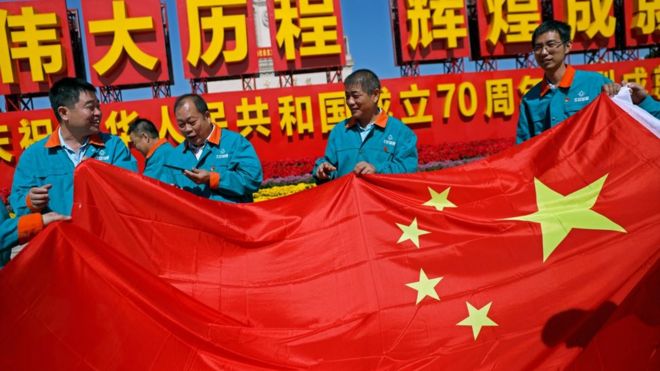
Image copyright EPAImage caption China is getting dressed up for its big birthday party
One week from now, the People’s Republic of China will mark its 70th anniversary with celebrations on a scale not seen in China in decades.
Beijing is pulling out all stops and 1 October will be flush with fireworks, fanfare and a huge military parade.
To ensure it goes smoothly, authorities have been ramping up security in the capital – and online – for weeks.
But with yet more protests expected in Hong Kong, the territory might just rain on China’s parade.
What is it all about?
The birth of modern China was declared on 1 October 1949, after the communists under Mao Zedong won the civil war that followed World War Two.
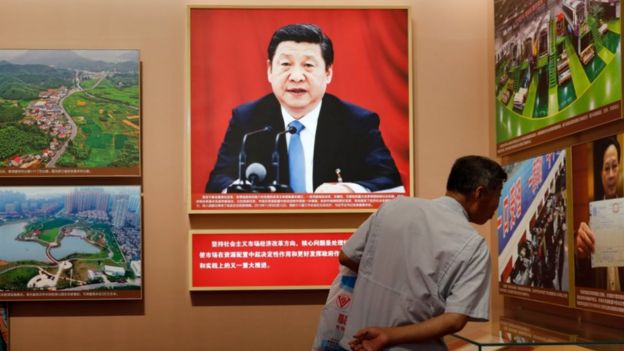
Image copyright EPAImage caption Exhibitions are highlighting the achievements of the Communist Party
The date is marked every year, but celebrations for this 70th anniversary are expected to eclipse previous events.
It’s the first big anniversary since China has emerged as a global power. While 10 years ago China was a superpower in the making, it is now the world’s second largest economy, almost eye-to-eye with the United States.
What to expect?
The main celebrations will take place in the capital, Beijing, where there will be a grand military parade with “advanced weapons” on display, followed by a “mass pageant”.
President Xi Jinping – considered the most powerful Chinese leader since Mao – will address the Chinese people. His speech is expected to celebrate China’s rapid growth and which will be closely watched for any indication of the country’s direction in the coming years.
The president will also hand out honours for contributions to the country and in the evening there will be a grand gala and fireworks show.
All official Chinese celebrations are carefully choreographed and the success of this one is particularly important to the government.
The Dos and Don’ts
The parade – open to invited guests only – will take place around Tiananmen Square in central Beijing. The surrounding area will be practically under lockdown, and in fact has been so several times already.
During rehearsals leading up to the big day, hotels near Tiananmen Square told guests that for several hours each day, no-one would be able to leave the hotel or return to it should they be out, leading to much travel chaos and rebookings.
Many shops and restaurants in the centre are also closed or have shortened hours and some subway stations are temporarily shut.
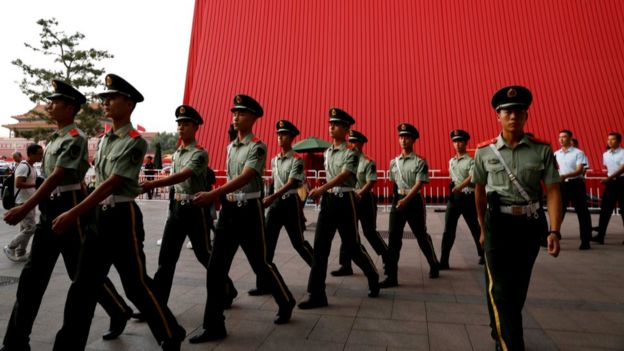
Image copyright EPAImage caption Security is tight ensure the party goes to plan
Trains to Beijing are running numerous safety checks on their passengers and vehicles going into the city are also being tightly watched.
On the big day itself, areas around Tiananmen Square will be blocked and guarded. Local residents will need to identify themselves if they want to pass.
To ensure the sun will shine brightly on the celebration in notoriously polluted Beijing, several coal plants and construction sites in and around the city have been ordered to stop work for the duration.
There’s also a ban on any low-flying aerial vehicles in place. That means anything from light aircraft to drones, balloons and even racing pigeons.
Censorship galore
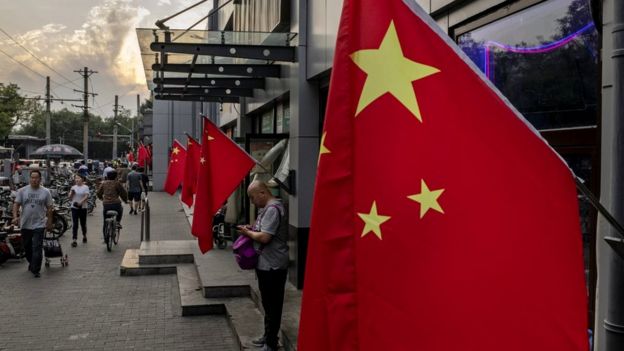
Across much of the city centre, there are national flags set up at every door. Voluntary inspectors are monitoring the streets and locals have told the BBC they’re being questioned after having even brief conversations with foreigners
One person said she was asked by an inspector: “Who were those foreigners? Why were they here?”
The tight control naturally extends online as well. Popular social media platform Weibo said it was deleting content that “distorts” or “insults” the country’s history ahead of the anniversary.
Image copyright GETTY IMAGESImage caption Every house and every shop is sporting a national flag
Chinese journalists are always expected to toe the party line anyway, but starting in October they will have to pass an extra test to prove they are versed particularly in Xi Jinping’s teachings, officially called Xi Jinping Thought on Socialism with Chinese Characteristics, which has been written into the constitution.
Whether or not they pass the exam will then determine whether they’ll be accredited as journalists.
“The fundamental point with this ‘training’ and indoctrination process isn’t so much about the content,” David Bandurski of China Media Watch told the BBC.
“It is about reinforcing the message and understanding among journalists that they work, first and foremost, for the Chinese Communist Party, and serve its agenda.”
So not only will the events be choreographed – the domestic coverage of them will also be tightly guarded.
What about Hong Kong?
Despite Beijing’s determination to let its achievements shine on 1 October, there’s a good chance Hong Kong will pull focus.
Anti-Beijing protests always take place in Hong Kong on China’s National Day, but this time, the activists know that the world is watching.
Anti-government protests have rocked the city for months and the situation shows no sign of dying down.
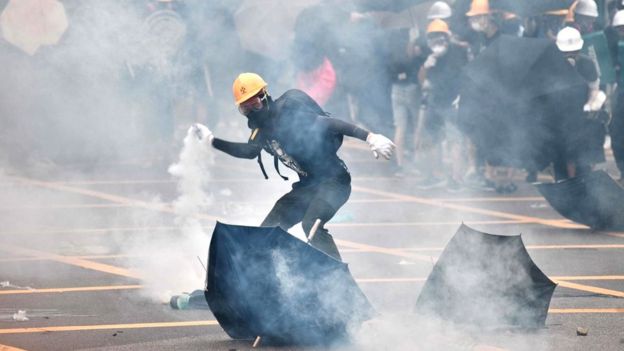
Clashes between police and activists have been becoming increasingly violent, with police using tear gas and activists storming parliament.
Image copyright AFPImage caption The protests have often escalated into violent clashes
That means two things for 1 October: official celebrations in the territory are being toned down to avoid clashes – the annual fireworks display has been cancelled – while at the same time, activists are planning to step up their protests.
On Sunday 29 September, a “Global Anti Totalitarianism March” is scheduled to take place at various locations around the world in support of Hong Kong.
On 1 October itself, a march in central Hong Kong is planned with everyone asked to wear black.
If the past weeks’ demonstrations are anything to go by, the smiles and celebrations in Beijing will be competing for media space with pictures of tear gas and angry young protesters in Hong Kong.
March 8 has devolved into a prime time for online sales campaigns and advertising rather than a moment to celebrate the achievements of women, critics say
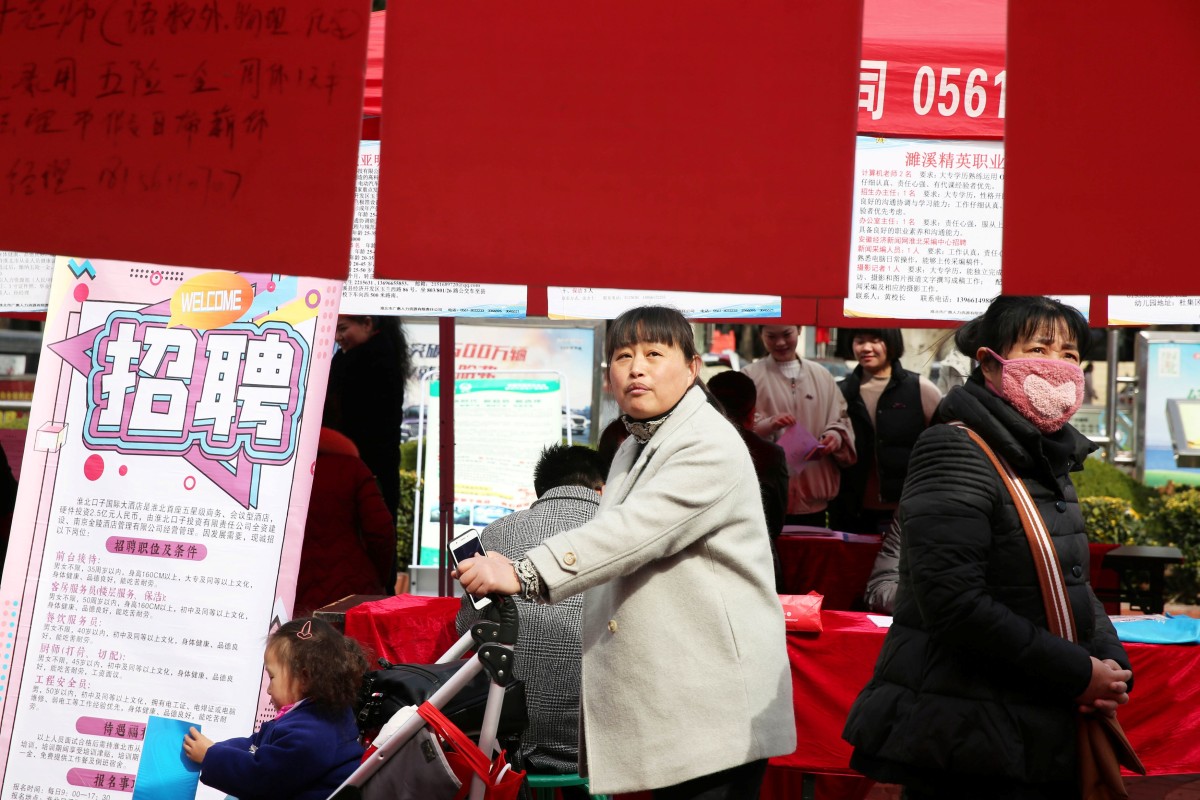
Job seekers look at the job advertisements at a job fair for women on the International Women’s Day in Huaibei, Anhui province, on Friday. Photo: Reuters
Every year around March 8, the internet in China is plastered with references to International Women’s Day.
Online commerce sites promote discounts on items from jewellery to massage machines to electronics; groups and individuals post “supportive” comments for the women in their lives; and retailers roll out advertising campaigns with “feminist” messages.
But critics say the true meaning of the day is being lost and the annual commemoration has become less of a chance to celebrate women’s achievements and more of an excuse to push spending.
It has also spawned a phenomenon called “Girls’ Day”, that reinforces the social preference for youth and beauty, they say.
International Women’s Day was first organised by the former Socialist Party of America in New York in 1909 and later became a fixture on calendars among socialists and in communist countries before being adopted by the United Nations in 1975 .
When marrying young is the norm, courageous Chinese women take back control by asking parents to “Meet me halfway”
In China, it has been celebrated since 1924, with women using the day to highlight the need for their rights.
But in recent years, it has also become a tradition for the Chinese public to celebrate March 7, the day before the official women’s day, as “Girls’ Day”, and for commercial platforms to brand March 8 as “Goddesses’ Day” or “Queens’ Day”, and offer discounts to attract sales.
Guo Jing, founder of No 74 Career Women’s Legal Hotline, said the commercial campaigns were diluting the original spirit of the day.
“Women’s day was meant to celebrate the spirit of women fighting for their rights, encouraging women’s independence and empowerment, that they can have all sorts of lives and not be a part attached to men,” Guo said.
“[The campaigns] give the impression that girls are innocent, without social experience, and ‘women’ are older, less attractive.”
Women need opportunities at work, at home and in public life, a rights advocate says. Photo: EPA
Even international firms have come under fire for linking their products with Girls’ Day. On Thursday, in an advertisements for the film Captain Marvel, Marvel Studios’ China team wrote on Weibo, “Happy Girls’ Day! Captain Marvel Brie Larson sends her wishes to all girls in China.”
Commenters said the first Marvel movie to showcase a woman superhero was undermining its message by highlighting a day with a mixed meaning.
“The film basically sells feminism, yet you are talking about Girls’ Day?” one comment said.
China gender and sexuality centre shuts down as censorship chill spreads
Other firms, such as sportswear company Nike, won a round of applause for breaking stereotypes with Dream Crazier video. The video centred on breakthroughs from female athletes around the globe, complete with Nike’s slogan, “Just do it”.
Feng Yuan, the co-founder of Beijing-based group Equality, which is dedicated to women’s rights and gender equality, said many shop owners or platforms wanted to turn any special day into a shopping bonanza, but they only appeared to be trying to please women.
“We should be alerted that the names of ‘Girls’ Day’ or ‘Goddess’s Day’ indicate that many regard women only as consumers, caretakers or an ‘empty vases’,” Feng said.
The focus on women’s appearance was driven home on Thursday night in a fumbled attempt by a university in the country’s north to mark the day. In a Weibo post, Shandong University claimed it was the founder of Girls’ Day on March 7, and the original meaning was “three plus seven equals 10. You score 10 out of 10 points for sweetness.” It claimed the day was for university students to care for women and for female students to showcase their attractiveness.
The post quickly met with criticism. The Intellectuals, an online media outlet, said “the day recognises women’s achievements, regardless of their nationality, ethnicity, language, culture, economic and political standing. It originated from North America and Europe’s workers’ movements in the early 20th century.
“Whether you call it Girls’ Day or Queens’ Day, it’s an insult to the true spirit of the day.”
On campuses throughout the country, it has become a tradition for banners with supportive messages to be put up on buildings and message boards. But rather than celebrating women, many of the banners sexualise them in what critics say amounts to a form of sexual harassment.
“I’ve met scores of women in the spring, but I’d rather be sleeping with you,” one banner read.
The sexualisation of the event is compounded by jokes online that play on the Chinese word for “day” and “sex” to suggest that the real meaning of the day is to “welcome girls into womanhood”.
Women’s rights advocates say the public needs to sever the sexual and commercial ties to the day and focus on the many areas in which women’s rights need to be improved.
How a Chinese #MeToo musical whipped up a storm before the censors stepped in
That includes the lifting of a ban on the official Weibo account of Feminist Voices, which before it was shut down without explanation on women’s day last year, had some 180,000 followers and published articles on sexual harassment, women’s rights or workplace equality.
More broadly, in 2018, women still on average made less than 80 per cent of the average salary for men, according to a report by Chinese recruitment platform Zhipin.com. The report said women tended to hit a glass ceiling for promotion and pay due to the demands of marriage and child rearing.
Women’s rights have gained some attention this week as national lawmakers and advisers have met in Beijing for their annual gatherings. Huang Xihua, a National People’s Congress delegate from Huizhou in Guangdong province, ignited debate at the congress with a called for the two-child policy to be scrapped and for unmarried women to be granted equal rights to have children.
Feng, from Equality, was clear about what still needed to be done.
“For women’s day, we don’t need flowery words of praise, but more women-friendly and gender-equal policies, giving women an equal position and opportunity in family, career and public lives,” she said.
The PM said Swacchh Bharat mission is a success adding that more than 3 lakh people gathered to participate in a cleanliness drive.
SNS Web | New Delhi | December 30, 2018 2:05 pm
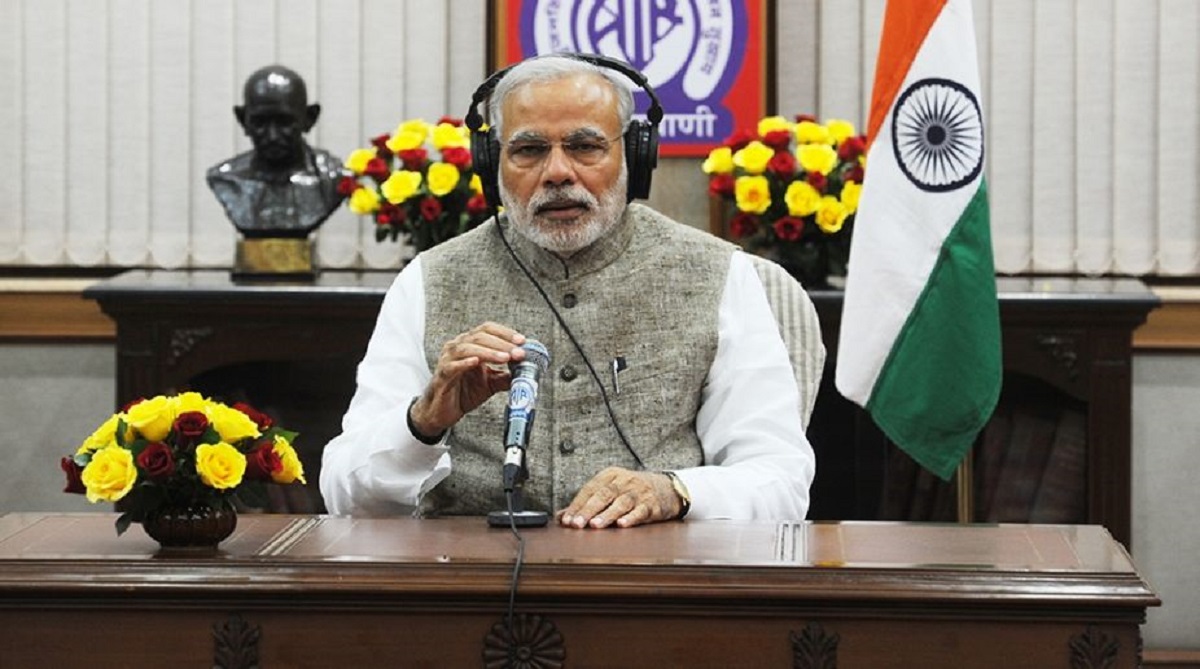
It was the 51st edition of his monthly address. (Photo: PIB)
Delivering his last Mann Ki Baat of 2018 on Sunday, Prime Minister Narendra Modi on Sunday said the achievements of his government in 2018 will fill everyone with glory.
He expressed hope that the journey towards the path of development will continue into 2019 as well.
It was the 51st edition of his monthly address.
Modi highlighted the achievements of the year in various sectors like economy, social sector, and sports among others saying it could happen because of the collective efforts of the people.
“Whether it is one’s own life or the life of the nation, we are advised to look back, and look ahead too… so that we can learn lessons from our mistakes and get the confidence to move ahead. You all must be thinking how do we remember 2018? The year 2018 would fill everyone with glory,” said Modi.
Talking about the accomplishments of his government in 2018, he said, “Year 2018 saw launching of world’s biggest health insurance scheme ‘Ayushman Bharat’; in honour of Sardar Vallabhbhai Patel, India witnessed the unveiling of the tallest statue in the world, ‘Statue of Unity’; electricity reached each and every village of the country; the ease of doing business in India improved notably; on the 75th anniversary of Azad Hind government, a tricolour was unfurled at Delhi’s Red Fort for the first time, and the highest United Nations Environment Award ‘Champions of the Earth’ was conferred upon India.”
The PM said Swacchh Bharat mission is a success adding that more than 3 lakh people gathered to participate in a cleanliness drive.
He also praised the achievements of Indian sportspersons, especially in Asian Games and Para Asian Games where India won many medals. He also mentioned the Indian cricket team and its outstanding performances in the recent games.
He spoke about the opening of India’s first multi-modal terminal on the Ganga river in Varanasi and Sikkim’s first airport.
“I hope this trail of success will continue in 2019 also,” he said.
He also wished the people for a host of upcoming festivals in the month of January, such as Makar Sakranti, Pongal, and Lohri.



 CHINDIA ALERT: You'll be living in their world, very soon