Archive for ‘Ahmedabad’

28/05/2020

India coronavirus: Trouble ahead for India’s fight against infections

Coronavirus in IndiaImage copyright GETTY IMAGES
Image caption India has more than 150,000 reported infections

On the face of it, things may not look bad.

Since the first case of coronavirus at the end of January, India has reported more than 150,000 Covid-19 infections. More than 4,000 people have died of the infection.

To put this in some context, as of 22 May, India’s testing positivity rate was around 4%, the death rate from the infection around 3% and the doubling rate of infection – or the amount of time it takes for the number of coronavirus cases to double – was 13 days. The recovery rate of infected patients was around 40%.

All this is markedly lower than in the countries badly hit by the pandemic.

Like elsewhere in the world, there are hotspots and clusters of infection.

More than 80% of the active cases are in five states – Maharashtra, Tamil Nadu, Delhi, Gujarat and Madhya Pradesh – and more than 60% of the cases in five cities, including Mumbai, Delhi and Ahmedabad, according to official data.

More than half of people who have died of the disease have been aged 60 and older and many have underlying conditions, hewing to the international data about elderly people being more vulnerable to the disease.

The more than two-month-long grinding lockdown, official data suggests, has prevented the loss of between 37,000 and 78,000 lives. A paper published in Harvard Data Science Review appears to support that – it shows an eight-week lockdown can prevent about two million cases and, at a 3% fatality rate, prevent some 60,000 deaths.

“Infection has remained limited to certain areas. This also gives us confidence to open up other areas. It is so far an urban disease,” says VK Paul, who heads the medical emergency management plan on Covid-19.

This is where such claims enter uncertain territory.
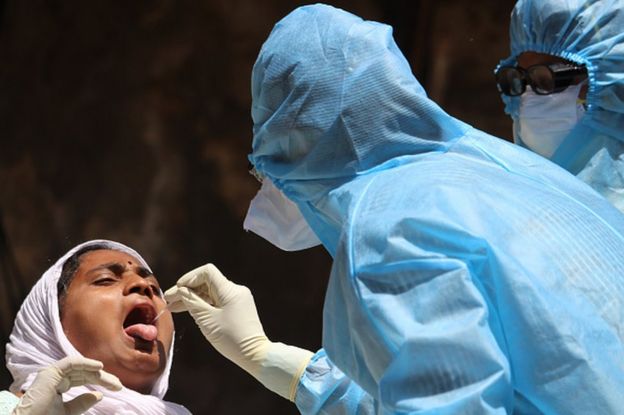
India testingImage copyright GETTY IMAGES
Image caption India has conducted some 180,000 tests so far

India is now among the top 10 countries worldwide in terms of total reported infections, and among the top five in the number of new cases.

Infections are rising sharply, up from 536 cases on 25 March when the first phase of the world’s harshest lockdown was imposed. The growth of infections is outpacing growth in testing – tests have doubled since April but cases have leapt fourfold.

Epidemiologists say the increase in reported infections is possibly because of increased testing. India has been testing up to 100,000 samples a day in the past week. Testing criteria has been expanded to include asymptomatic contacts of positive patients.

Yet, India’s testing remains one of the lowest in the world per head of population – 2,198 tests per million people.

The bungled lockdown at the end of March triggered an exodus of millions of informal workers who lost their jobs in the cities and began returning home in droves, first on foot and then by train. Some four million workers have travelled by rail from cities to their villages in more than half a dozen states in the past three weeks.

There is mounting evidence that this has already led to the spread of infection from the cities to the villages. And with the messy easing of the lockdown earlier this month, there are growing fears of infections spreading further in the cities.

Rising infections and a still-low fatality rate possibly points to milder infection in a younger population and a large number of asymptomatic cases. The focus, says Amitabh Kant, CEO of the government think-tank NITI Aayog, should be “bringing down fatalities and improving the recovery rate”.

But if the infection rate continues to grow, “things are going to get pretty grim in a few weeks time,” a leading virologist told me.
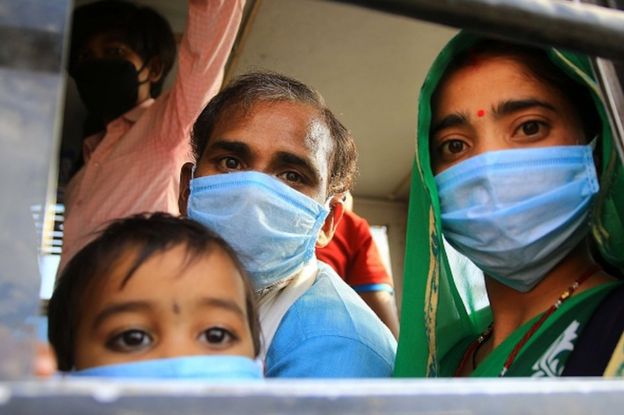
India lockdownImage copyright GETTY IMAGES
Image caption Millions of workers have fled the cities and returned to their villages after the lockdown

Doctors in the capital, Delhi, and the western city of Mumbai tell me they are already seeing a steady surge in Covid-19 admissions and worry about a looming shortage of hospital beds, including in critical care.

When the infection peaks in July, as is expected, a spike in infections could easily lead to many avoidable deaths as hospitals run out of beds for, or delay treatment to, infected patients who need timely oxygen support and clinical care to recover.

“That is the real worry. A critical-care bed needs an oxygen line, a ventilator, doctors, nursing staff. Everything will be under pressure,” Dr Ravi Dosi, who is heading a Covid-19 ward at a hospital in Indore, told me. His 50-bed ICU is already full of patients battling the infection.

With the lockdown easing, doctors are feeling jittery. “It’s a tactical nightmare because some people have begun going to work but there is a lot of fear”, says Dr Dosi.

“One co-worker sneezed in the office and 10-15 of his colleagues panicked and came to the hospital and demanded they get tested. These are the pressures that are building up.”

One reason for the confusion is the lack of – or the opacity of – adequate data on the pandemic to help frame a strategic and granular response.

Most experts say a one-size-fits-all strategy to contain the pandemic and impose and lift lockdowns will not work in India where different states will see infection peaks at different times. The reported infection rate – the number of infections for every 100 tests – in Maharashtra state, for example, is three times the national average.

“The infection is not spreading uniformly. India will see staggered waves,” a leading virologist, who insisted on anonymity, told me.

The lack of data means questions abound.

What about some 3,000 cases, which are not being assigned to any state because these people were found infected in places where they don’t live? (To put this into context, nine states in India have more than 3,000 cases.) How many of these cases have died or recovered?

Also, it is not clear whether the current data – sparse, and sporadic – is sufficient to map the future trajectory of the disease.

There is, for example, no robust estimate of carriers of the virus who have no symptoms – last month a senior government scientist said at least “80 out of every 100 Covid-19 patients may be asymptomatic or could be showing mild symptoms”.
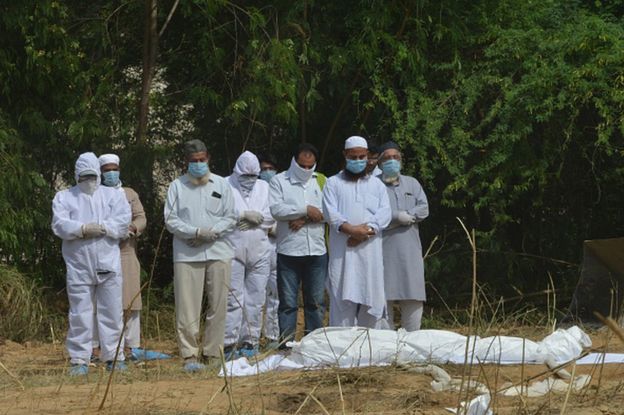
coronavirus victim burial in IndiaImage copyright GETTY IMAGES
Image caption More than 4,000 people have died of Covid-19 in India

If that is indeed true, then India’s fatality rate is bound to be lower. Atanu Biswas, a professor of statistics, says the predicted trajectory could change “with the huge inclusion of asymptomatic cases”. But, in the absence of data, India cannot be sure.

Also, epidemiologists say, measures like the doubling time of the infections and the reproduction number or R0 have their limitations. R0, or simply the R value, is a way of rating a disease’s ability to spread. The new coronavirus, Sars-CoV-2, has a reproduction number of about three, but estimates vary.

“These measures are good when we are in the middle of a pandemic, less robust with fewer cases. You do need forecasting models for at least a month’s projection to anticipate healthcare needs. We should always evaluate an aggregate of evidence, not just one measure, but a cascade of measures,” Bhramar Mukherjee, a professor of biostatistics and epidemiology at the University of Michigan, told me.

Others say even calculating the number of recorded infections every day is “not always a good indicator of how an infection is spreading”.

A better option would be to look at the number of new tests and new cases every day that would provide a “degree of standardisation”, K Srinath Reddy, president of the Public Health Foundation of India, told me.

Likewise, he believes, a measure of how many Covid-19 deaths have occurred compared with the size of a country’s population – the numbers of deaths per million people – is a better indicator of the fatality rate. Reason: the denominator – the country’s population – remains stable.

In the absence of robust and expansive data, India appears to be struggling to predict the future trajectory of the infection.

It is not clear yet how many deaths are not being reported, although there is no evidence of large scale “hidden deaths”.
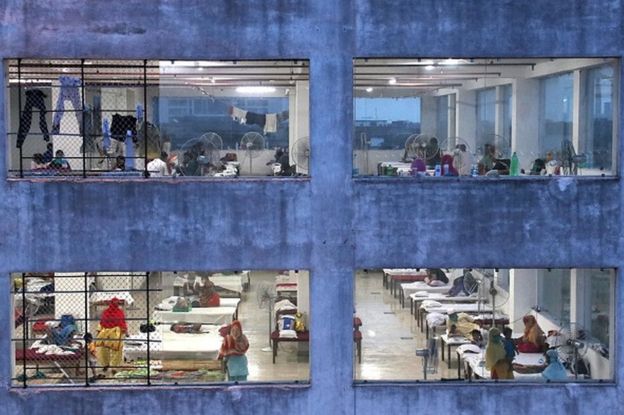
Coronavirus isolation ward in KolkataImage copyright GETTY IMAGES
Image caption A Covid-19 isolation ward in India

Epidemiologists say they would like to see clearer data on deaths due to pneumonia and influenza-like illnesses at this time over the past few years to quantify excess deaths and help with accurate reporting of Covid-19 deaths.

They would also like to see what racial disparities in infections and deaths there are to help improve containment in specific community areas. (In Louisiana, for example, African Americans accounted for 70% of Covid-19 deaths, while comprising 33% of the population.)

What is clear, say epidemiologists, is that India is as yet unable to get a grip on the extent of the spread of infection because of the still limited testing.

“We need reliable forecasting models with projection for the next few weeks for the country and the states,” says Dr Mukherjee.

Epidemiologists say India needs more testing and contact-tracing for both asymptomatic and symptomatic infections, as well as isolation and quarantine.

There’s also the need to test based on the “contact network” to stop super-spreader events – frontline workers, delivery workers, essential workers, practically anybody who interacts with a large group of people.

“We have to learn how to manage and minimise risk in our daily lives as the virus is going to be with us,” says Dr Mukherjee.

Without knowing the true number of infected cases India is, in the words of an epidemiologist, “flying blindfolded”.

That can seriously jeopardise India’s fight against the virus and hobble its response in reviving the broken economy.

Source: The BBC
25/02/2020

After raucous welcome in India, Trump clinches $3 billion military equipment sale

NEW DELHI (Reuters) – U.S. President Donald Trump said on Tuesday that India will buy $3 billion worth of military equipment, including attack helicopters, as the two countries deepen defence and commercial ties in an attempt to balance the weight of China in the region.

India and the United States were also making progress on a big trade deal, Trump said. Negotiators from the two sides have wrangled for months to narrow differences on farm goods, medical devices, digital trade and new tariffs.

Trump was accorded a massive reception in Indian Prime Minister Narendra Modi’s home state on Monday, with more than 100,000 people filling into a cricket stadium for a “Namaste Trump” rally.

On Tuesday, Trump sat down for one-on-one talks with Modi followed by delegation-level meetings to try and move forward on issues that have divided them, mainly the festering trade dispute.

After those meetings, Trump said his visit had been productive with the conclusion of deals to buy helicopters for the Indian military. India is buying 24 SeaHawk helicopters from Lockheed Martin equipped with Hellfire missiles worth $2.6 billion and also plans a follow-on order for six Apache helicopters.

India is modernising its military to narrow the gap with China and has increasingly turned to the United States over traditional supplier, Russia.

Trump said the two countries were also making progress on a trade deal, which had been an area of growing friction between them.

“Our teams have made tremendous progress on a comprehensive trade agreement and I’m optimistic we can reach a deal that will be of great importance to both countries,” said Trump in remarks made alongside Modi.

The two countries had initially planned to produce a “mini deal”, but that proved elusive.

Instead both sides are now aiming for a bigger package, including possibly a free trade agreement.

Trump said he also discussed with Modi, whom he called his “dear friend”, the importance of a secure 5G telecoms network in India, ahead of a planned airwaves auction by the country.

The United States has banned Huawei, arguing the use of its kit creates the potential for espionage by China – a claim denied by Huawei and Beijing – but India, where telecoms companies have long used network gear from the Chinese firm, is yet to make a call.

Trump described Monday’s rally in Ahmedabad and again praised Modi and spoke of the size of the crowd, claiming there were “thousands of people outside trying to get in..

“I would even imagine they were there more for you than for me, I would hope so,” he told Modi. “The people love you…every time I mentioned your name, they would cheer.”

In New Delhi, Trump was given a formal state welcome on Tuesday at the red sandstone presidential palace with a 21-cannon gun salute and a red coated honour guard on horseback on a smoggy day.

HUG GETS TIGHTER

India is one of the few big countries in the world where Trump’s personal approval rating is above 50% and Trump’s trip has got wall-to-wall coverage with commentators saying he had hit all the right notes on his first official visit to the world’s biggest democracy.

They were also effusive in their praise for Modi for pulling off a spectacular reception for Trump.

“Modi-Trump hug gets tighter,” ran a headline in the Times of India.

But in a sign of the underlying political tensions in India, violent protests broke out in Delhi on Monday over a new citizenship law that critics say discriminates against Muslims and is a further attempt to undermine the secular foundations of India’s democracy. They say the law is part of a pattern of divisiveness being followed by Modi’s Hindu nationalist Bharatiya Janata Party.

At least 7 people were killed and about 150 injured in the clashes that took place in another part of the capital, away from the centre of the city where Modi is hosting Trump.

In his speech on Monday, Trump extolled India’s rise as a stable and prosperous democracy as one of the achievements of the century. “You have done it as a tolerant country. And you have done it as a great, free country,” he said.

Delhi has also been struggling with high air pollution and on Tuesday the air quality was moderately poor at 193 on a government index that measures pollution up to a scale of 500. The WHO considers anything above 60 as unhealthy.

Source: Reuters

24/02/2020

‘Namaste Trump’: Modi holds huge rally for Trump’s visit

AHMEDABAD, India (Reuters) – Donald Trump was cheered by more than 100,000 Indians at the opening of the world’s largest cricket stadium on Monday, promising “an incredible trade deal” and “the most feared military equipment on the planet” at his biggest rally abroad.

Indians wore cardboard Trump masks and “Namaste Trump” hats to welcome the U.S. president at the huge new Motera stadium in Prime Minister Narendra Modi’s own political homeland, the western city of Ahmedabad.

Modi, a nationalist who won re-election last year and has shifted his country firmly to the right with policies that his critics decry as authoritarian and ethnically divisive, touts his relationship with Trump as proof of his own global standing.

U.S. officials have described Trump’s visit as a way to counter China’s rise as a superpower.

“You have done a great honour to our country. We will remember you forever, from this day onwards India will always hold a special place in our hearts,” Trump said to thunderous applause.

India is one of the few big countries in world where Trump’s personal approval rating is above 50%. It has built up ties with the United States in recent years as Washington’s relationship has become strained with India’s foe Pakistan.

“As we continue to build our defence cooperation, the United States looks forward to providing India with some of the best and most feared military equipment on the planet,” Trump said.

Trump said the two countries will sign deals on Tuesday to sell military helicopters worth $3 billion and that the United States must become the premier defence partner of India, which relied on Russian equipment during the Cold War. Reuters reported earlier that India has cleared the purchase of 24 helicopters from Lockheed Martin (LMT.N) worth $2.6 billion.

But in a sign of the underlying political tensions in India, violent protests broke out in Delhi – where Trump is due on Tuesday – over a new citizenship law that critics say discriminates against Muslims and is a further attempt to undermine the secular foundations of India’s democracy.

Vehicles were set on fire in the eastern part of Delhi, metal barricades torn down, and thick smoke billowed through the air as thousands of those who are supporting the new law clashed with those opposing it.

In his speech Trump extolled India’s rise as a stable and prosperous democracy as one of the achievements of the century. “You have done it as a tolerant country. And you have done it as a great, free country,” he said.

Trump planned to raise the issue of religious freedoms in India with Modi, an administration official said last week.

VERY BIG DEALS

In Ahmedabad, Modi embraced Trump as he stepped off Air Force One, along with his wife, Melania.

Folk dancers carrying colourful umbrellas danced alongside the red carpet as drummers, trumpeters and other musicians performed at the airport to welcome Trump and the U.S. delegation. Crowds lined the route along his cavalcade, many taking pictures on their phones.

The two sides did not manage to hammer out a trade deal ahead of the visit, with differences remaining over agriculture, medical devices, digital trade and proposed new tariffs. Trump said he was going to discuss economic ties with Modi, describing him as a tough negotiator.

“We will be making very, very major, among the biggest ever made, trade deals. We are in the early stages of discussion for an incredible trade agreement to reduce barriers of investment between the United States and India,” he said.

“And I am optimistic that working together, the prime minister and I can reach a fantastic deal that’s good and even great for both of our countries – except that he is a very tough negotiator.”

Modi, who has built a personal rapport with Trump, is pulling out the stops for the president although prospects for even a limited trade deal during the visit are seen as slim.

“There is so much that we share, shared values and ideals … shared opportunities and challenges, shared hopes and aspirations,” said Modi at the rally.

Trump, who faces his own re-election campaign this year, has frequently praised Modi for his crowd-pulling power.

Last year, Trump held a “Howdy Modi” rally with Modi in Houston, drawing 50,000 people, mainly Indian Americans. At the time, Trump likened Modi to Elvis Presley as a draw for crowds.

Later, Trump and his entourage which includes daughter Ivanka and son-in-law Jared Kushner flew to Agra to see the Taj Mahal at sunset. Children lined the route cheering and waving flags as his convoy drove past.

Trump and Melania posed for pictures at the Taj, the 17th century monument to love. “It’s incredible,” he told reporters.

Source: Reuters

22/02/2020

Trump in India: A brief history of US presidents’ trips

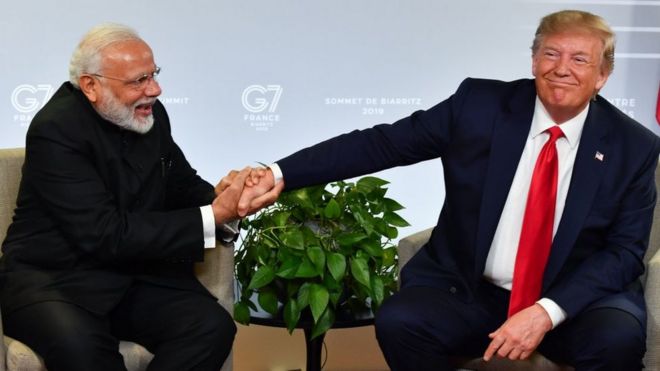
Indian Prime Minister Narendra Modi (L) and US President Donald Trump shakes hands as they speak during a bilateral meeting in Biarritz, south-west France on August 26, 2019.Image copyright GETTY IMAGES
Image caption Mr Trump is making his first official visit to India

US President Donald Trump is expecting a raucous welcome on his first official state visit to India on Monday and Tuesday.

He follows a long line of leaders who have made the journey. Some of his predecessors were greeted enthusiastically; others stumbled through diplomatic gaffes; one even had a village named after him.

Can history be a guide to how this diplomatic tryst might go? Here’s a brief look at past visits, ranked in order of how they went.

The good: President Eisenhower

Let’s begin at the beginning.

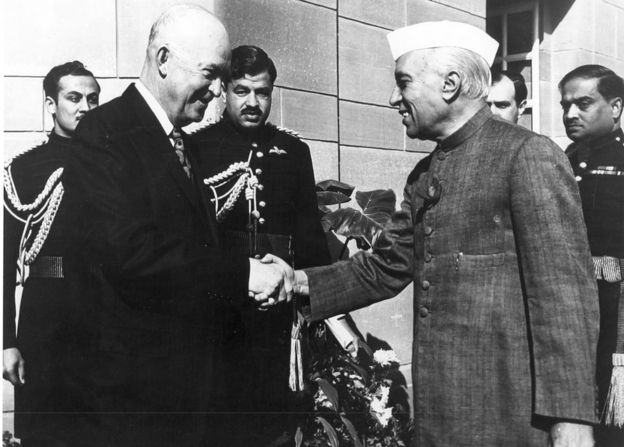
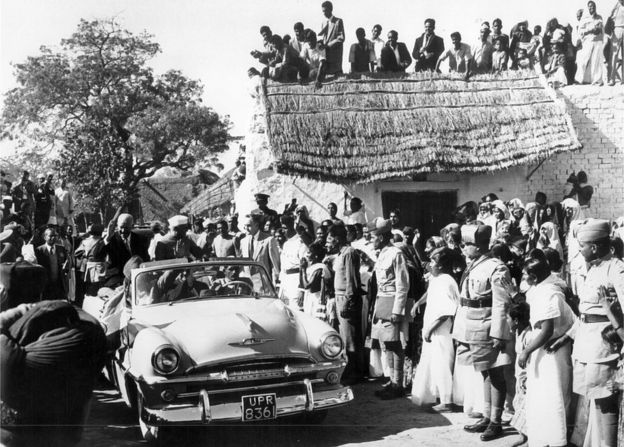
Dwight D Eisenhower, the first US president to visit India, was greeted with a 21-gun salute when he landed in the national capital, Delhi, in December 1959. Huge crowds lined the streets to catch a glimpse of the World War Two hero in his open-top car – Mr Trump is expecting a similar reception in Ahmedabad city, where he will be doing a road show.

President Eisenhower (L) with Prime Minister Jawaharlal NehruImage copyright US EMBASSY ARCHIVES
Image caption Dwight D Eisenhower, pictured with Prime Minister Jawaharlal Nehru, was the first US president to make the trip

The warmth between President Eisenhower and Indian Prime Minister Jawaharlal Nehru helped during what was a rocky phase in US-India ties. This was early in the Cold war, when the US and Pakistan had become become close allies, and India insisted on staying neutral or “non-aligned”. Like today, relations with China were at the core of the India-US equation, with Washington pressuring Delhi to take an aggressive stance with Beijing on the issue of Tibet.

But, on the whole, Eisenhower’s four-day trip was billed a success. And nearly every US president on a state visit to India has emulated his itinerary: he laid flowers at Mahatma Gandhi’s memorial, took in the splendour of the Taj Mahal, addressed parliament and spoke at Delhi’s iconic Ramlila grounds, which, according to one news report, attracted one million people.

When he left, Nehru said he had taken with him “a piece of our heart”.

President Eisenhower drove in open car to small village to get a glimpse of rural India on December 13, 1959.Image copyright US EMBASSY ARCHIVES
Image caption President Eisenhower was greeted by large crowds
Presentational white spaceThe game-changer: Bill Clinton

If there was a game-changing visit, it would be Bill Clinton’s in March 2000 with Prime Minister Atal Bihari Vajpayee. Mr Clinton’s arrival came after a two-decade lull – neither Ronald Reagan nor George Bush Snr made the journey East. It came at a tricky time as Washington had imposed sanctions on Delhi following its 1999 test of a nuclear bomb.

But, according to Navtej Sarna, a former Indian Ambassador to the US, the five-day trip was “a joyous visit”. It included stops in Hyderabad, a southern city that was emerging as a tech hub, and Mumbai, India’s financial capital. “He came and saw the economic and cyber potential of India, and democracy in action,” says Mr Sarna.

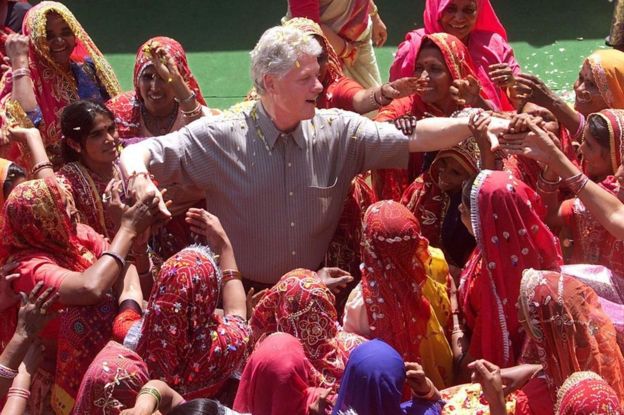
US President Bill Clinton shakes hands with local villagers after touring Nayla Village 23 March 2000.Image copyright GETTY IMAGES
Image caption Bill Clinton’s visit was described as “joyous”
Mr Clinton also danced with villagers, took a tiger safari and sampled Delhi’s famously creamy black dal (lentils) at a luxury hotel that has since been associated with the president.

The country’s reaction is perhaps best expressed in this New York Times headline: “Clinton fever – a delighted India has all the symptoms.”

The nuclear deal: George W Bush

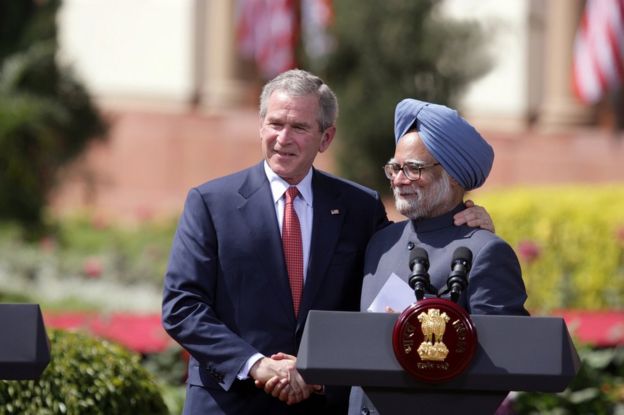
George W Bush, as Forbes magazine once put it, was the “best US president India’s ever had”. His three-day visit in March 2006 was a highlight in the two countries’ strategic relationship – especially in matters of trade and nuclear technology, subjects they have long wrangled over. His strong personal dynamic with Prime Minister Manmohan Singh was hard to miss – after he left office, Mr Bush, a keen artist, even painted a portrait of Mr Singh.

The two leaders are credited for a historic but controversial nuclear deal, which was signed during Mr Bush’s visit. It brought India, which had for decades refused to sign the Nuclear Non-Proliferation Treaty (NPT), out of isolation. Energy-hungry India got access to US civil nuclear technology in exchange for opening its nuclear facilities to inspection.

George W Bush (L) with Manmohan Singh (R)Image copyright US EMBASSY ARCHIVES
Image caption George W Bush and Manmohan Singh had a very good relationship
However, while the visit was substantive, it was not as spectacular as others – there was no trip to the Taj, nor an address to parliament. But the timing was important. Anti-US sentiment over the invasion of Iraq was running high – left-wing MPs had staged a protest against Mr Bush’s visit, and there were demonstrations in other parts of India.

Double visit: Barack Obama

Barack Obama was the only president to make two official visits. First, in 2010 with Prime Minister Manmohan Singh, and then in 2015 with Prime Minister Narendra Modi.

On his first visit – in a break from the past – he landed in Mumbai, instead of Delhi, with a large trade delegation. This was not just about economic ties but a show of solidarity following the Mumbai terror attacks of 2008, which killed 166 people. Mr and Mrs Obama even stayed at the Taj Mahal hotel, one of the main targets.

It was significant that the US president declared support for India to join a reformed and expanded UN Security Council, says Alyssa Ayres, a former US deputy assistant secretary of state for South Asia. “That all these years later nothing has changed in the UN system is another matter, but that was a major policy shift for the United States.”

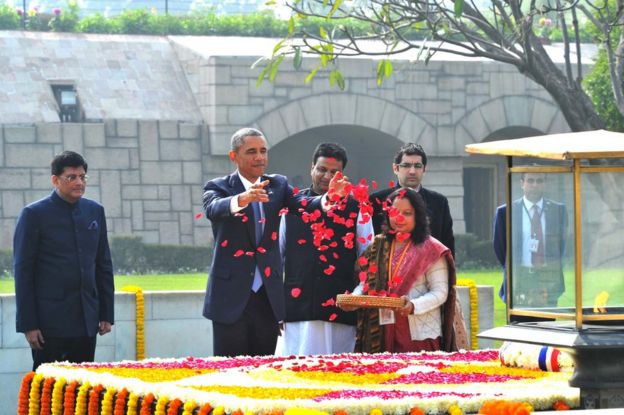
US President Barack Obama paying floral tributes at the samadhi of Mahatma Gandhi at Rajghat in Delhi.Image copyright US EMBASSY ARCHIVES
Image caption Barack Obama visited India twice
Mr Obama returned in 2015 as chief guest at India’s Republic Day celebrations, at PM Modi’s invitation. Trade, defence and climate change were at the heart of the talks. The trip also emphasised an Indo-Pacific strategy, where both leaders expressed unease over Beijing’s provocations in the South China Sea.

The not-so-good: Jimmy Carter

Although Jimmy Carter’s two-day visit in 1978 was a thaw in India-US relations, it was not free of hiccups.

With some 500 reporters in tow, Carter followed a packed itinerary: he met Prime Minister Morarji Desai, addressed a joint session of parliament, went to the Taj Mahal, and dropped by a village just outside Delhi.

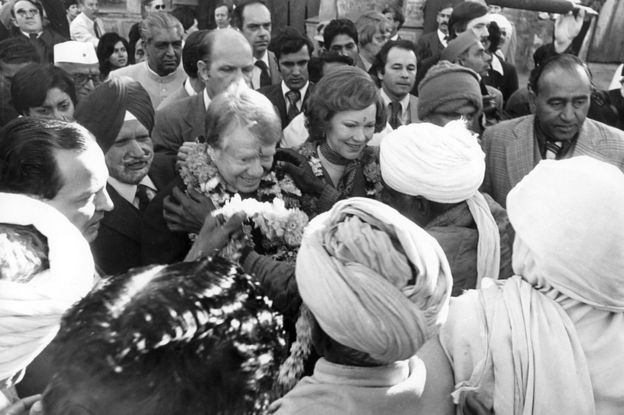
The village, Chuma Kheragaon, had a personal connection: Carter’s mother, Lillian, had visited here when she was in India as a member of the Peace Corps in the late 1960s. So when Carter and his wife, Rosalynn, made the trip, they gave the village money and its first television set. It was even renamed “Carterpuri”, a moniker it still holds.

Jimmy Carter being greeted by villagers of 'Carterpuri'Image copyright US EMBASSY ARCHIVES
Image caption Jimmy Carter being greeted by villagers of ‘Carterpuri’
But beyond the photo-ops, India and the US were sparring. India was building its nuclear programme, and had conducted its first test in 1974. The US wanted India to sign the NPF, which sought to stop the spread of nuclear weapons. But India refused, saying the agreement discriminated against developing countries.

In a leaked conversation that made headlines and threatened to derail the visit, Mr Carter promised his Secretary of State, Cyrus Vance, a “very cold and very blunt” letter to Desai. The two leaders signed a declaration, promising greater global co-operation, but Carter left India without the assurances he had hoped for.

The ugly: Richard Nixon

Richard Nixon was no stranger to India when he arrived in August 1969 for a day-long state visit. He had been here as vice-president in 1953, and before that on personal trips. But, by all accounts, he wasn’t a fan.

“Nixon disliked Indians in general and despised [Prime Minister] Indira Gandhi,” according to Gary Bass, author of Blood Telegram: Nixon, Kissinger and a Forgotten Genocide. And, he adds, the feeling was said to be mutual.

This was also at the height of the Cold War, and India’s non-alignment policy “appalled” American presidents. Mr Bass says that under Gandhi, India’s neutrality had turned into a “noticeably pro-Soviet foreign policy”.

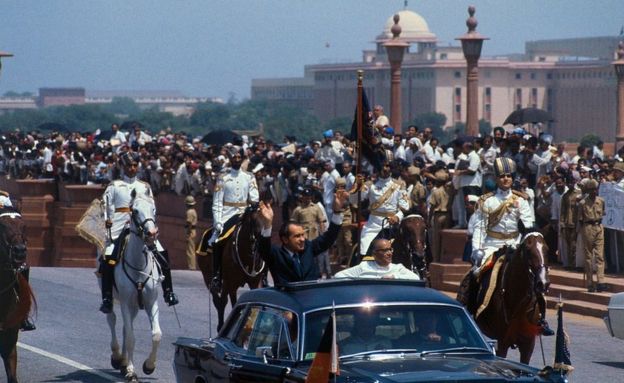
President Richard Nixon waves to crowds as he rides in open car with the acting president of India, Mohammad Hidyatullah, in motorcade from airport upon arrival here July 31.Image copyright GETTY IMAGES
Image caption Richard Nixon waves to the crowds alongside Mohammad Hidyatullah, India’s acting president
The relationship only turned frostier after the trip as India backed Bangladesh (then East Pakistan) in its fight for independence from Pakistan, a close American ally. The differences were laid bare when Gandhi visited the White House in 1971. Declassified state department cables later revealed that Nixon referred to her as an “old witch”.

And the future: Donald Trump

The US and India have certainly had their ups and downs, but during the last official visit in 2015, Mr Obama and Mr Modi signed a declaration of friendship: “Chalein saath saath (Let’s move forward together)…” it began.

President Trump’s visit will take the relationship forward, but it’s unclear how.

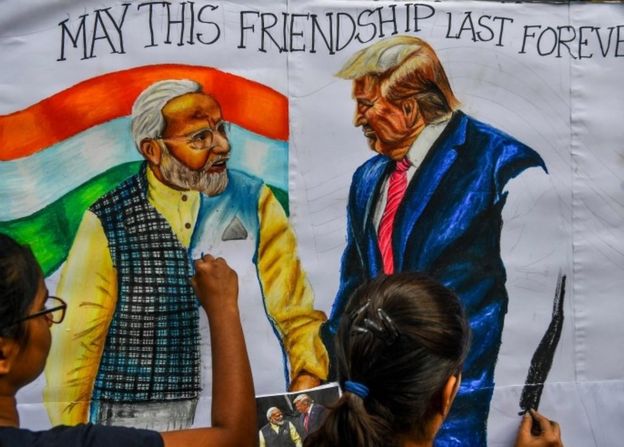
Students paint on canvas faces of US President Donald Trump (R) and India"s Prime Minister Narendra Modi, in the street in Mumbai on February 21, 2020, ahead of the visit of US President in IndiaImage copyright AFP

His arrival in Ahmedabad, the main city in PM Modi’s home state of Gujarat, followed by a big arena event, is expected to draw a massive crowd. It will echo President Eisenhower’s rally in Delhi years ago, perhaps cementing the personal ties between the two leaders.

But while Mr Trump’s trip will be packed with pageantry, it could be light on policy. Unlike other presidential visits, this one is not expected to yield concrete agreements, with the trade deal Mr Trump so badly wants looking unlikely.

Source: The BBC
20/02/2020

Ahead of Trump’s visit, Indian city cleans the swamp

LUCKNOW (Reuters) – U.S. President Donald Trump vowed to “drain the swamp” of lobbyists and elites in Washington D.C. Now, one Indian city is racing to clean up a stagnant river as he prepares to visit.

Trump arrives in India on Feb. 24 on a maiden two-day trip that aims to repair bilateral relations hurt by a trade spat.

He plans to visit the western city of Ahmedabad and India’s capital New Delhi, as well as Agra, where he will view the famed monument to love, the Taj Mahal, at sunset.

In the city, authorities are on a clean-up drive, including the polluted waters of the Yamuna river, that backs on to the monument complex.

Jal Singh Meena, an officer with the Agra Ganga Nahar, the government body that manages the canal network that feeds into the Yamuna in Agra, said on Thursday an additional 17 million litres of water are being released from three locks in the week preceding Trump’s visit on Monday- more than double the usual amount.

The extra flow had been ordered “to keep it clean and remove the foul smell,” he told Reuters.

On Thursday, workers scrubbed walls and fountains at the monument, commissioned in 1632 by Mughal emperor Shah Jahan in memory of his late wife Mumtaz, TV channels showed.

India’s best-known attraction, the Taj Mahal is visited by nearly seven million tourists a year, according to official data, but has been blighted by overcrowding and pollution.

Along with polluted water, authorities are battling some of the world’s filthiest air that stains the white marble of the monument, and increasingly aggressive troops of monkeys that have been known to attack visitors.

District authorities have denied local media reports they have relocated some of the more troublesome primates for the visit, and that a bridge on a proposed route taken by Trump will be unable to bear the weight of his armour-plated limousine known as “The Beast”.

Source: Reuters

18/02/2020

Hero worship: India’s Trump superfans gear up for his arrival

KONNEY/NEW DELHI, India (Reuters) – Bussa Krishna first began worshipping Donald Trump four years ago when the U.S. president appeared to him a dream.

Since then, after a run of good fortune, the Indian real estate broker has transformed his modest home into a shrine to the U.S. leader, who is due in India on Monday for a two-day visit.

“My love for him has transformed into reverence. That has given me immense happiness. Hence instead of praying to other gods, I started praying to him,” Krishna told Reuters.

Krishna, who lives alone in a village in the southern state of Telangana, has erected a life-size statue to Trump in his yard, while his walls are scrawled with the leader’s name – to the annoyance of his extended family.

“I am facing difficulties because of my relatives,” Krishna said. “They tell me that I am disgracing them in society. I told them that just like you believe and worship Shiva, I believe and worship Trump. Neither of us can stop the other from doing so.”

Krishna is not the only Indian who reveres Trump.

In New Delhi, members of the Hindu Sena, a right-wing fringe group, have begun rehearsing a welcome song in his honour.

Its members say Trump shares their hatred of Islamic extremism, and it has drawn attention for boisterous celebrations of his birthday, including pretending to feed cake to photos of his face.

“We like Donald Trump because he openly spoke about India’s feelings,” Hindu Sena leader Vishnu Gupta told Reuters. “…He openly said that he would eliminate Islamic terrorism from its roots, that is why I am his fan.”

Trump, who like Indian Prime Minister Narendra Modi has a reputation as an unabashed populist who shows his enemies no mercy, is making his first visit to India.

Trump’s itinerary starts on Feb. 24 in the western city of Ahmedabad, where he will visit the former home of independence hero Mahatma and address an estimated 125,000 people at a rally. He is due in the capital the following day.

Source: Reuters

27/11/2019

Modi’s loss in state election raises questions about bullet train

MUMBAI (Reuters) – India’s richest state is set to be ruled by parties opposed to Prime Minister Narendra Modi’s nationalist Bharatiya Janata Party, jeopardising a Japanese-backed bullet-train project opposed by farmers.

The BJP’s inability to pull together voters in the westerly state of Maharashtra, of which Mumbai is capital, has meant that three parties, including a former BJP ally, will form the government. That is a major setback for Modi after his landslide victory in general elections this year.

It could also hinder the bullet train project, a $17 billion investment largely financed by a long-term, low-cost loan from Japan. The BJP was in power in both Maharashtra and Gujarat states when work began on project in 2017.

“We have always opposed the bullet train,” said Manisha Kayande, a spokesperson for the Shiv Sena, a former BJP ally whose leader is now set to head Maharashtra. “Our state is giving a major chunk of money for the project, when most of the track is in another state. This will definitely be re-framed,” .

The train will run from Mumbai to Ahmedabad, the main city in Gujarat state, a distance of 508 kilometres (315 miles). But it has run into obstacles acquiring land amid opposition from fruit farmers.

Any delay of the project is likely to undermine investor confidence, at a time when growth has slowed to its weakest pace in years.

Critics say India does not need the high-speed train and investment should go instead to improve the existing network.

“We are not against development or infrastructure projects, but at the same time farmers’ interests can’t be ignored. We will rethink about projects that farmers are opposing,” said a senior leader of Nationalist Congress Party, which is a part of the coalition government.

National High Speed Rail Corporation (NHSRCL), the government agency overseeing the project, had no immediate comment.

The authorities have acquired 548 hectares land out of the total requirement 1,380 hectares and the project was targeted to be operational by 2023 , the government told parliament in July.

Protests against land acquisitions are common in India, where tens of millions of farmers till small holdings. A planned $44 billion refinery to be run by a consortium including Saudi Aramco, the world’s biggest oil producer, is also struggling to secure land in Maharashtra.

Source: Reuters

05/07/2019

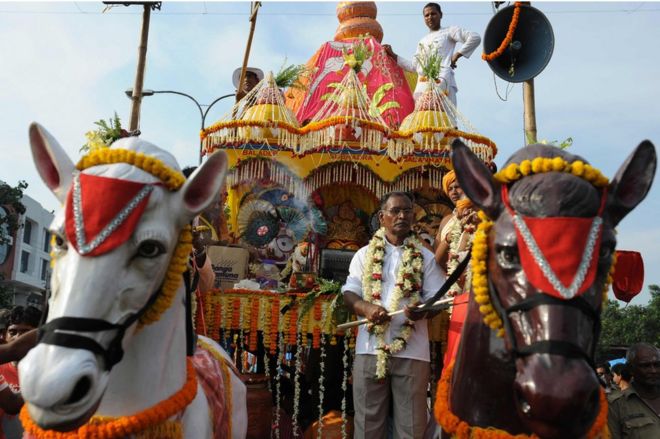
Rath Yatra: The legend behind world’s largest chariot festival

Indian devotees and members of the International Society for Krishna Consciousness (ISKCON) march alongside a chariot carrying a deity during the annual Rath Yatra Festival in Siliguri on June 24, 2009.Image copyright GETTY IMAGES
Image caption This journey is documented in undated Hindu sacred texts known as the Puranas written a few thousand years ago

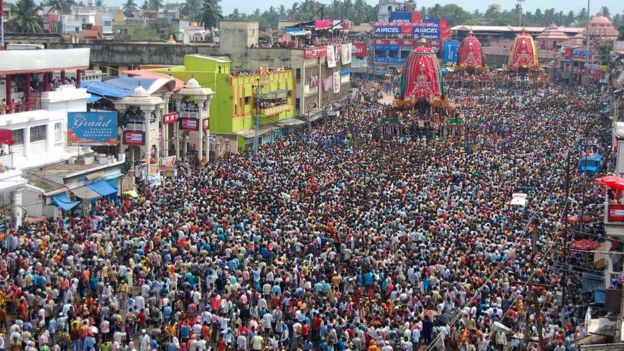
One of India’s biggest religious festivals, the Jagannath Puri Rath Yatra, gets under way on Thursday. The festival is unique in that three Hindu gods are taken out of their temples in a colourful procession to meet their devotees. The BBC’s Priyanka Pathak explains the legend behind the festival and its significance.

The biggest of these processions takes place in Puri in the eastern state of Orissa, while the other takes place in the western state of Gujarat.

Believed to be the oldest Rath Yatra or chariot procession in the world, this festival marks the annual ceremonial procession of Lord Jagannath, his elder brother Balabhadra and younger sister Subhadra, from their home temple to another temple, located in what is believed to be their aunt’s home.

This journey is documented in undated Hindu sacred texts known as the Puranas which are believed to have been written a few thousand years ago.

What makes it so interesting?

This is the only festival in the world where deities are taken out of temples to travel to devotees, and it is also the largest chariot procession in the world.

Millions of people come to watch as a “king” sweeps the road with a golden mop and three massive 18-wheeled chariots bearing the sibling deities make their way through massive crowds. Their chariots, which are mini architectural marvels, are constructed over 42 days from over 4,000 pieces of wood by the only family that has the hereditary rights to make them.

Devotees pull the chariots of Lord Jagannath, his brother Balabhadra and sister Devi Subhadra in front of the Lord Jagannath temple during the celebration of the �Rath Yatra� at Puri,Image copyright AFP

Legend says it always rains on the day of the procession. For a whole week before, the temple doors are shut and no one is allowed inside, because it is believed that the sibling deities have a fever after bathing in the sun with 108 pitchers of water. The breaking of their fever calls for a change of scene, which is why they go to their aunt’s home for a few days.

The size, pomp and splendour of this procession has even contributed a word to the English dictionary: Juggernaut.

What is the legend of the sibling deities?

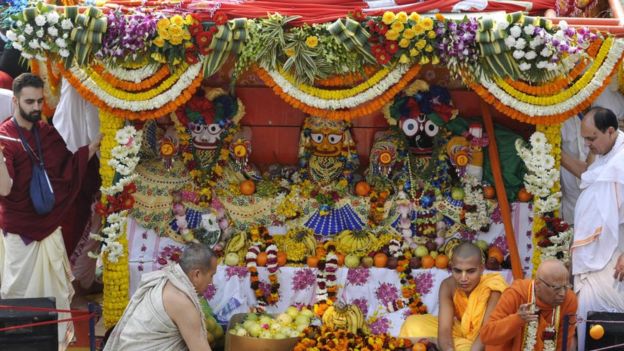
Unlike the ornate, carefully crafted metal idols everywhere else, these three deities are fashioned from wood, cloth and resin. They are malformed with large heads and no arms: reminders of the legend of an impatient King.

The legend begins in different ways.

One speaks of an arrogant Indrayumna, King of Puri in the east, who tried to steal the Hindu god Krishna’s heart. It had been immersed in the legendary Dwarka sea after his cremation and had reappeared to the tribes people of the place as an idol. When Indrayumna tried to claim its possession, the idol disappeared. The repentant king sought absolution from Krishna by sanctifying him in another form.

Devotees pull a chariot of Lord Jagannath, his brother Balabhadra and sister Subhadra during the Jagannath Rath Yatra, on February 17, 2019 in Noida, India.Image copyright GETTY IMAGES
Image caption Unlike the ornate, carefully crafted metal idols everywhere else, these three deities are fashioned from wood, cloth and resin

Another speaks of how Krishna’s grief-stuck siblings – his elder brother Balabhadra and younger sister Subhadra- rushed into the Dwarka sea carrying his half-cremated body. At the same moment, King Indrayumna dreamed that Krishna’s body had floated back up on his shores as a log.

The two legends merge here: Indrayumna decided to build a temple to house the log. His next task was to find someone to craft the idols from it. Legends say that Vishwakarma, God’s own architect, arrived as an old carpenter. He agreed to carve the idols, but on the condition that he was not to be disturbed. However, when he did not emerge from his workshop for weeks, going without food, water or rest, a worried and impatient King threw the door open.

At the time the images were only half-finished, but the carpenter disappeared. Still, believing the idols to be made from the very body of God, the King sanctified them and and placed them in the temple.

When the deities disintegrate, they are remade in the same half-done image with new wood every 12 years. They were last remade in 2015.

Why are there two rath yatras and how are they connected?

Dwarka in Gujarat – where Krishna’s half-cremated body is believed to have been immersed into the ocean – is located on the west coast of India and Puri in Orissa- where it is said to have re-emerged as a log – is located in the east.

About 500 hundred years ago, a travelling Hindu saint and temple priest of a Hanuman temple in Gujarat, Shree Sarangdasji, arrived in Puri to offer prayers at the historic Jagannathan temple.

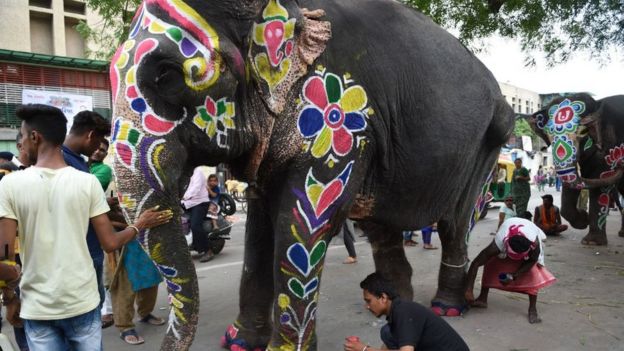
An Indian elephant is painted ahead of the annual Hindu festival Rath Yatra in Ahmedabad on July 3, 2019. - Rath Yatra, an annual Hindu festival, is scheduled to start on July 4 this year and will be led by some 15 elephantsImage copyright GETTY IMAGES

While sleeping at the temple guest house, it is believed that he received visionary instruction from Lord Jagannathan to go back to Ahmedabad in Gujarat and install three idols of Jagannathan, Balbhadra and Subhadra there. Carrying out the instructions received in his dream, he founded the Ahmedabad Jagannathan Temple.

By doing so, he sanctified the two locations – one where Krishna’s mortal remains began their journey from the west, to their transformation as Puri’s Lord Jagannathan in the east.

About 142 years ago, one of the founder’s disciples, Shree Narsinhdasji Maharaj, began the Ahmedabad Rath Yatra. The deities on chariots, pulled by elephants and humans, replicate their own journey in Puri, completing a set of rituals that sanctify the two places where Krishna’s mortal remains are believed to have come to rest.

What happens to the chariots and elephants after the journey?

At the end of the festival, the chariots are dismantled and their wood is used as fuel in the temple kitchens – believed to be the largest in the world that cook 56 things every day and feed anywhere between 2,000 to nearly 200,000 people.

The elephants are returned to the lands managed by the temple trusts to roam free – until the procession the following year.

This year’s festival was, however, marred by controversy over the elephants.

Following the death of some of the temple elephants in Gujarat, there was massive outcry over plans to replace them with elephants from the north-eastern state of Assam.

The four elephants would have had to make a perilous train journey of more than 3,100km (1,926 miles) in heatwave conditions to participate in the festival.

This decision was suspended by a wildlife official after activists went to court.


Source: The BBC
22/06/2019

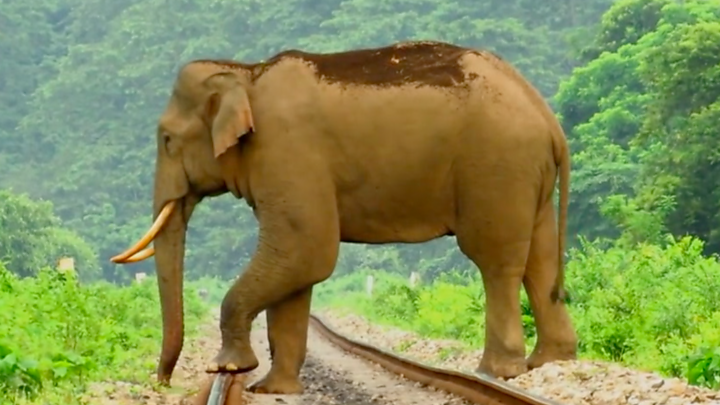
Fears for elephants facing 1,900 mile train journey in India

Decorated elephants stand prior to the arrival of Gujarat state Chief Minister, Narendra Modi to offer prayers at the the Lord Jagannath Mandir in Ahmedabad on July 9, 2013Image copyright AFP
Image caption Decorated elephants lead the procession at the Jagannath temple’s annual festival in Ahmedabad

Animal rights activists in India have criticised a plan by the Assam state government to send four elephants on a perilous train journey of more than 3,100km (1,926 miles) to participate in a temple ritual. They say the long journey could be dangerous for the animals and may even kill them, writes the BBC’s Geeta Pandey in Delhi.

The elephants are to be moved from Tinsukia town in the north-eastern state of Assam to the extreme west of the country – Ahmedabad city in Gujarat state.

Reports say the railway authorities in Assam, who have been asked to make travel arrangements for the elephants, are looking for a coach to transport them.

No date is set for their departure yet, but they are expected to reach Ahmedabad before 4 July to participate in the annual Rath Yatra (chariot procession) at the Jagannath temple. The train journey is expected to take three to four days.

In previous years, Prime Minister Narendra Modi, who hails from Gujarat, has participated in the festival and the elephant procession, although temple officials say he’s not expected to attend this year.

Temple trustee Mahendra Jha told BBC Gujarati that they decided to “borrow” the animals from Assam “for two months” because three of their own elephants died from old age last year.

But activists and conservationists say the plan to move the elephants is “cruel and completely inhuman”, especially since temperatures are more than 40C (104F) in many places along the northern Indian route these elephants are expected to take.

Media caption Human-elephant conflict destroying lives in India

“Most of north-western India is reeling under a heatwave. There have been reports of people dying from heat during train journeys,” Kaushik Barua, a wildlife conservationist based in the Assam state capital, Guwahati, told the BBC.

“The wagon in which the elephants will be transported is not climate-controlled. It will be hitched to a passenger train which will be travelling at a speed of 100km/h (62mph), so can you imagine the plight of the animals?”

Mr Barua warns the journey may prove “dangerous” for the animals.

“They can suffer from heatstroke, from shock, and even die.”

Under the law, he says, there’s no problem moving these elephants since all the paperwork is in order, “but where’s the animal welfare?”

Also weighing in on the debate is the opposition Congress party MP from Assam, Gaurav Gogoi, who’s petitioned India’s Environment Minister Prakash Javadekar to intervene.

“Roughly half of the country is struggling through its worst drought in six decades…. These are extreme conditions for the elephants to travel… The elephants may suffer from acute skin infection and dehydration,” Mr Gogoi wrote in his letter on Thursday.

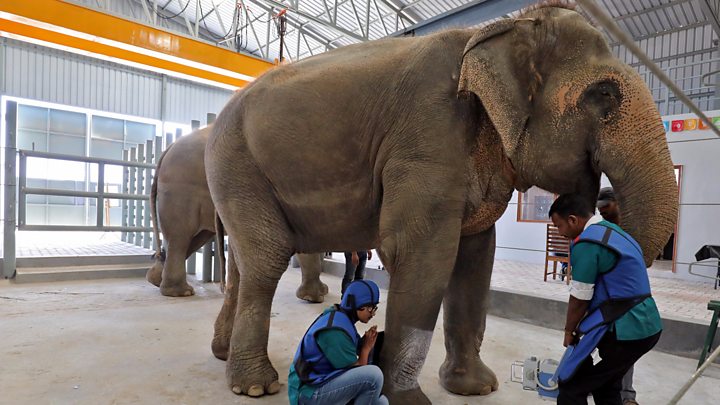
Media caption India’s first elephant hospital is run by the charity Wildlife SOS

“Therefore, I request the central government to intervene and instruct the state government to withdraw the decision as soon as possible.”

Elephants – both wild and captive – are a protected species in India and there are strict guidelines for their transportation, wildlife biologist Dr Bibhuti Prasad Lahkar told the BBC.

According to the rules, no elephant can be made to walk for more than 30km (18 miles) at a stretch or transported for more than six hours in one go.

The state’s wildlife officials, who’ve issued transit permits for the elephants, have so far refused to comment on the controversy. But after protests from activists and conservationists, “they have gone into a huddle, discussing a plan B,” according to a wildlife expert.

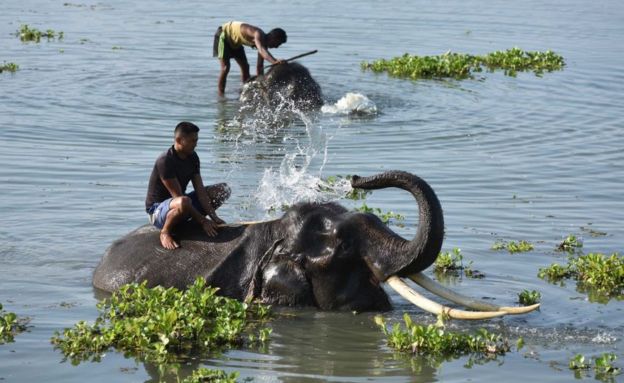
A mahout gives a bath to an elephant in a lake at Pobitora Wildlife Sanctuary on a hot summer day on June 05, 2018 in the Morigaon district, Assam, India.Image copyright GETTY IMAGES
Image caption Elephants are a protected species in India

“There’s some suggestion that the pachyderms may be moved in trucks to allow them the flexibility to stop if needed and that they could be accompanied by a forest department veterinarian to look after them,” he said.

Mr Barua, however, is blunt.

“Gujarat doesn’t need these elephants,” he says. “Wildlife laws prevent [the] display and exhibition of elephants. Laws ban performances by elephants in circuses, zoos are not allowed to exhibit them, so why should temples be allowed to use them in rituals or processions? Don’t elephants have rights?

“We worship Ganesha, the Elephant God. Why are the Gods then being put through such cruelty by a temple?”

Source: The BBC
01/05/2019

Why is a 2,500-year-old epic dominating polls in modern India?

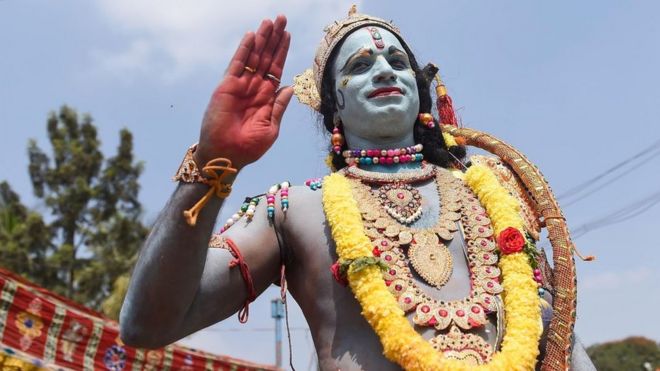
An Indian artist dressed as Lord Rama, a character from a Hindu mythological epic poem entitled Ramayana, gestures during Hanuman Jayanti festival in Bangalore on December 20, 2018.Image copyrightGETTY IMAGES
Image captionMany Hindus see the Ramayana’s protagonist, Ram, as a hero

With the Indian general election under way, the Ramayana, a 2,500-year-old Hindu mythological epic, is back in the spotlight. The BBC’s religious affairs reporter Priyanka Pathak explains why.

This year, like in previous elections, the conversation among many hardline Hindus has returned to the epic Ramayana and its protagonist, Ram.

A longstanding demand to construct a temple in the northern city of Ayodhya – a key point of tension between Hindus and Muslims – which Hindus believe is Ram’s birthplace, has become louder in recent months.

Hardline Hindus want the temple built on the same spot where a 16th Century mosque was demolished by Hindu mobs in 1992. They believe the Babri mosque was built after the destruction of a Hindu temple by a Muslim invader.

India’s Ayodhya site: Masses gather as Hindu-Muslim dispute simmers

The governing Bharatiya Janata Party (BJP) has promised, once again, to reconstruct the Ram Mandir (temple) in its election manifesto.

Like in previous elections, they hope that this pledge will draw in more Hindu voters. They also organised Hindu religious festivals on a grand scale in the lead-up to the polls.

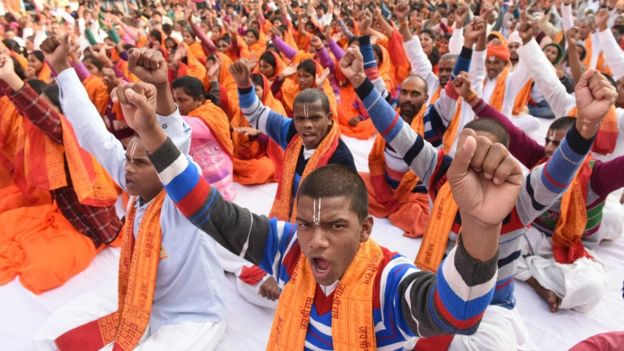
On 12 April, a large gathering of right-wing organisations was held at the iconic Ram Lila Maidan, a sprawling ground named after the god in the centre of the capital, Delhi, to celebrate “Ram’s birthday”.

People dressed in saffron robes wielded swords as they chanted “Jai Shree Ram”, which translates from the Hindi to “Hail Lord Ram”. They shouted slogans, reiterating their promise to Ram that they would reconstruct the temple.

Presentational grey line

What is the story of the Ramayana?

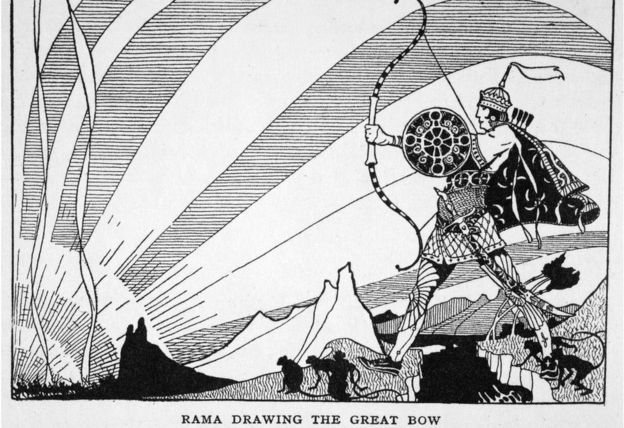
Rama Drawing the Great Bow', 1925. A scene form the Hindu epic poem the Ramayana. Rama preparing to fire the Brahmastra in his final victorious battle with the demon-king Ravana.Image copyrightHERITAGE IMAGES/GETTY
  • The epic tells the story of Ram, a beloved prince who is unaware of his own divinity
  • On the eve of his coronation, he is banished from his kingdom for 14 years by his father at the behest of his stepmother
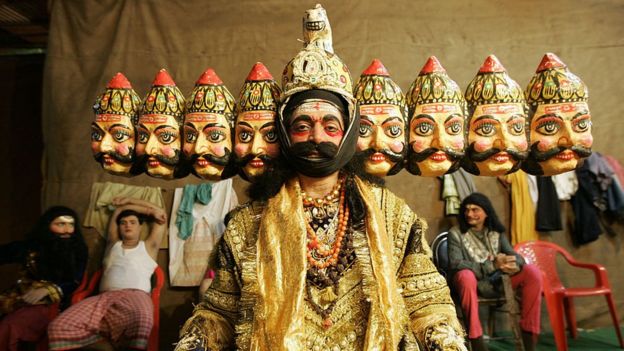
  • With his wife, Sita, and brother, Lakshman, he wanders through India’s forests – until the 10-headed demon king Ravana abducts Sita
  • Ram then fights and defeats Ravana to rescue Sita after which he establishes a just kingdom
  • The story of Ram’s pursuit of righteousness has made him a symbol of self-sacrifice and heroism for many Hindus
  • He is why this epic remains potent and has dominated India’s political discourse
Presentational grey line

Experts believe that the movement to build the temple, spearheaded by a powerful Hindu nationalist organisation called the Rashtriya Swayamsevak Sangh (RSS), has helped craft some sort of a collective Hindu identity in India.

This idea is something that the RSS, the ideological fountainhead of the BJP, has cultivated since the early 20th Century.

However, the movement found its zeitgeist moment only a century later.

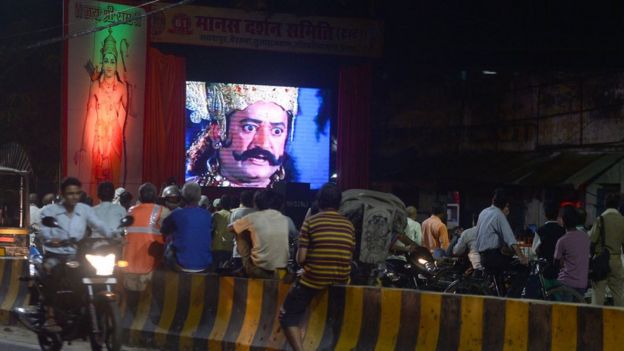
People sit along the road side watching an Indian epic television series of Ramayana, the story of the battle of Hindu god Rama over the demon king Ravana, as they celebrate Navratri (Nine Nights) culminating on the tenth night with the Dusshhra festival depicting the victory of Good over Evil, in Allahabad on September 25, 2017Image copyrightGETTY IMAGES
Image caption People in Ahmedabad city sitting along the road and watching a television series on the Ramayana

Several things happened almost concurrently during the late 1980s. First, a television show on the epic reminded 80 million viewers of the story and rekindled a love for its hero.

The serial broadcast a standardised story of the Ramayana, pulled together from many versions and variants. There is no official version of this sprawling epic although historical scholars consider the version by Valmiki, a sage and Sanskrit poet, to be the most authentic.

But really there are as many as 3,000 retellings of the story in around 22 languages, including some that eulogise Ravana while others say it was actually Ram’s brother Lakshman who killed the demon king.

Presentational grey line

India votes 2019

Presentational grey line

But what the television show did was give India a single narrative of the Ramayana. It also gave a single religion to a country “that was diverse and plural and included many different ways to be Indian”, says Arshia Sattar, a doctorate in south Asian languages, who has translated Valmiki’s Ramayana from Sanskrit into English.

The second big moment came in the late 1980s, when the Congress party led by Rajiv Gandhi – which has always styled itself as secular – decided to lay the foundation stone of the temple in Ayodhya with the help of Vishwa Hindu Parishad (VHP), a right-wing outfit, to woo Hindu votes in a close election.

The plan didn’t work – instead, it paved the way for the BJP, still a young party at the time, to seize what they saw as an opportunity to galvanise Hindu voters.

In September 1989, the party’s then president LK Advani launched a nationwide march for the temple. Bricks began to move from around India for the construction of the temple. The campaign was successful in mobilising communal sentiments and set in motion a series of events that would result in the demolition of the mosque. This, in turn, triggered nationwide riots.

VHP saints at Karsevak Puram taking park in Hindu Swabhiman Sammelan organized by the VHP to mark 25th anniversary Babri Masjid demolition, on December 6, 2017 in AyodhyaImage copyrightGETTY IMAGES
Image captionHindu activists are demanding the construction of the Ram Temple

But in the next elections, the BJP swept the polls. From that moment forward, the party – which was 12 years old at the time – became a national heavyweight.

It took its place as either the party leading the ruling government alliance or as the leading opposition party. For the BJP, the Ayodhya issue became a way to consolidate Hindu votes – something that used to be fragmented along caste lines.

This now well-known version of the epic, championing Ram, also became a convenient point for other Hindu organisations to rally around. This meant that other versions of the epic began to be stamped out.

For instance, in 2011, a Hindu nationalist student union and other affiliated right-wing groups succeeded in forcing Delhi University to drop an essay by the late poet and Ramayana scholar AK Ramanujan, which questioned how many versions of the epic existed, from its history curriculum.

“This may have been part of the general climate of intolerance and the battle over who had the right to tell the country’s history and its myths that was part of the Indian landscape between the 1980s and the 2000s,” literary critic and author Nilanjana Roy wrote of the incident in her blog in 2011.

An artist dressed up as th 10 faced Ravana from the mythological Ramayana at Shivaji Park for a Ram Lila show on the occasion of Dassera.Image copyrightGETTY IMAGES
Image captionRam fights and defeats the ten-headed demon Ravana in the Hindu epic

But for hardline Hindus, the cultural loss of other versions is simply collateral damage.

They believe that a sort of Hindu renaissance can be built around the epic, allowing Hindus to band together and revive their religion as a way of life that they believe was lost and can be re-established.

For instance, in September 2017, the Uttarakhand state minister for alternative medicine, proposed spending $3.6m (£2.8m) to find Sanjeevani – a mythical, glow-in-the-dark herb, described in the epic as having saved Ram and Lakshman from certain death.

The deputy chief minister of Uttar Pradesh has also suggested that science was so advanced during the time of the Ramayana that Sita was actually a test-tube baby. And the vice chancellor of an Indian university has claimed that Ravana, had a fleet of airplanes.

A series of such examples from Indian politicians and scholars can be seen as an attempt to bolster pride in the mythological epic. But they also evoke a nostalgia for a grand past, reawakening hope for a future that repeats the great feats of distance ancestors.

Source: The BBC

Law of Unintended Consequences

continuously updated blog about China & India

ChiaHou's Book Reviews

continuously updated blog about China & India

What's wrong with the world; and its economy

continuously updated blog about China & India