Archive for ‘All-China Women’s Federation’

19/11/2019

It’s a dirty job and I’m the one to do it, says millionaire who risks his reputation to break China’s litter habit

  • Every morning and night for the past four years, businessman Zhong Congrong has been on the streets of Chongqing to stop people dropping their litter
  • Admired as a welfare champion, the 54-year-old says he has been beaten and insulted for his cause
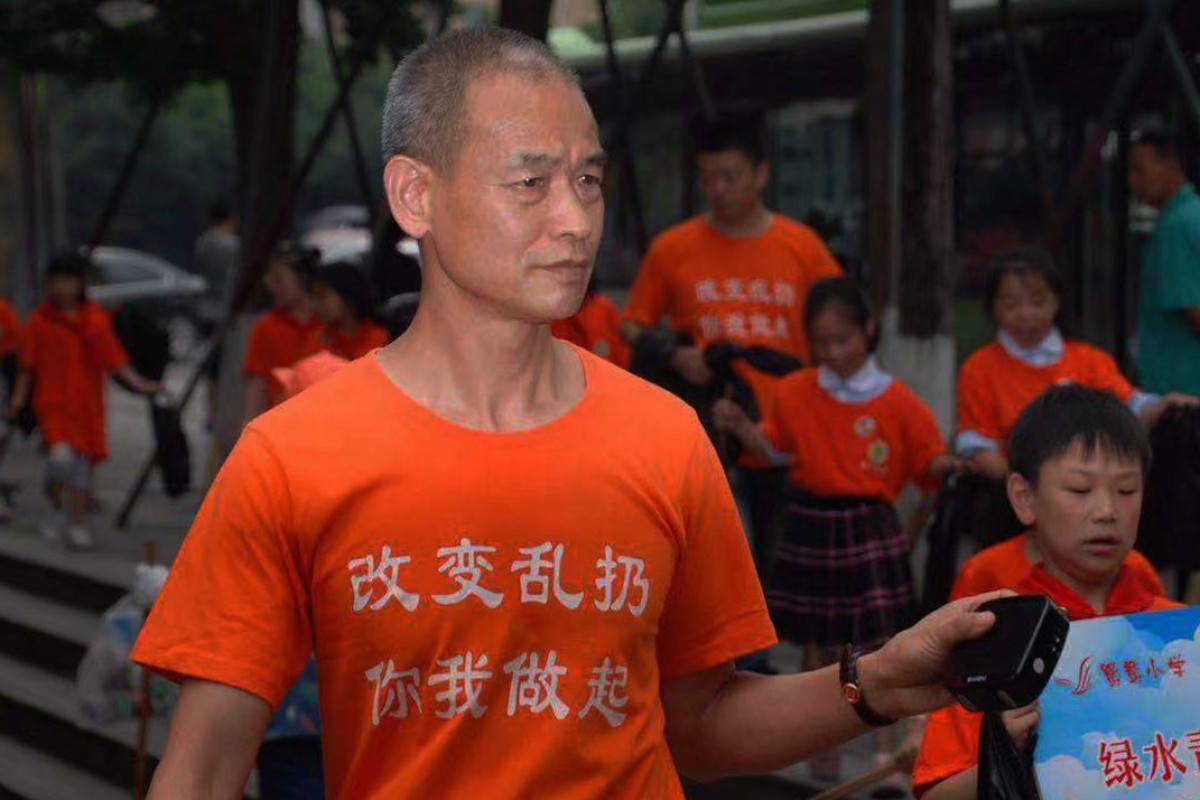
Zhong Congrong is a familiar figure on the streets of his hometown. Photo: Handout

Zhong Congrong owns three businesses in southwestern China which together are worth more than 100 million yuan (US$14.3 million), but he prefers to risk being labelled as an environment “nut” who wants to clean up Chongqing.

Every morning after breakfast and each evening after supper, the entrepreneur pulls on an orange T-shirt, gets into his Mercedes-Benz SUV and heads downtown. For one or two hours, he walks the streets, picking scraps of rubbish off the road and talking to passers-by about littering.

“It is my mission to change people’s bad habits and to raise their awareness of protecting the environment,” said Zhong, who has been on this mission for four years. It has brought the 54-year-old civic rewards, earned him a bruising or two from people who do not want to listen to his message and it nearly cost him his marriage.

Throughout it all, he has remained a persistent voice for the environment in the city of more than 30 million people and, as some of them have learned, he refuses to give up.
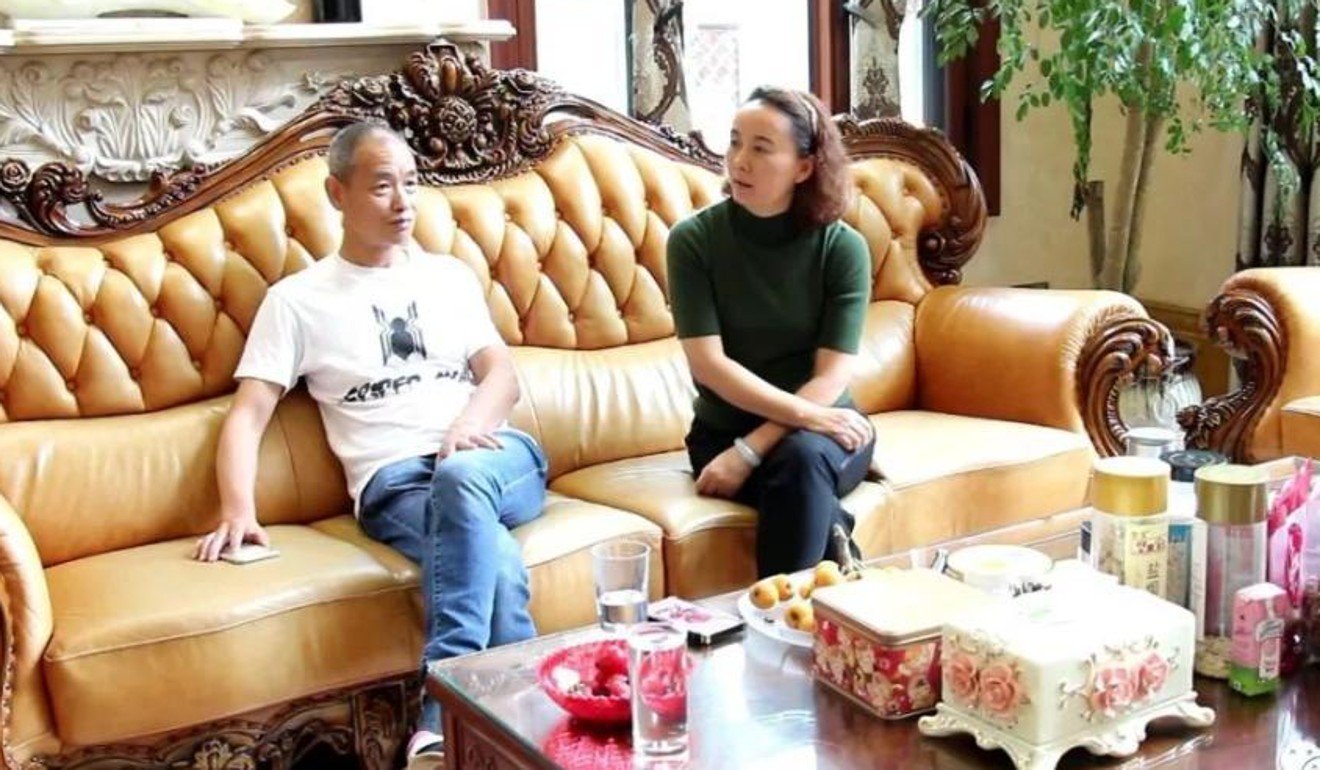
Yang Zuhui (right) has come to admire Zhong Congrong’s dedication to his litter picking mission, but she fears for her husband’s safety. Photo: Weibo

On mainland China, cities have banned littering and some hit offenders with fines as high as 200 yuan. However, the rules are rarely obeyed and feebly enforced, and while there are plenty of dustbins in public places, litter is still a nuisance.

Zhong said his mission started in 2015 after he met a woman in her 70s in Sanya, the southern coastal city on the South China Sea island of Hainan. He was struck by how dedicated she and her husband were when they went litter picking each day.

“They are retired professors from a prestigious university in Beijing,” Zhong said. “I chatted a lot with her and I asked her, ‘What’s the point of collecting rubbish every day? You clean up the beach today, but tomorrow new rubbish appears’.”

The way to solve the problem was to teach people to not litter, she told him, but she said she “dared not” try to do that. Zhong said that encounter gave him his purpose and he would dare to change attitudes.

Shanghai recycling scheme slips up on 9,000 tonnes of waste

Back home, Zhong watched and learned – concluding that customers of restaurants and fast food businesses tended to be the people who dropped rubbish most.

“Perhaps it’s because when people dine in restaurants, they throw their rubbish wherever they like. Going outside, they keep on doing it,” he said.

“People in shopping malls are generally more civilised.”
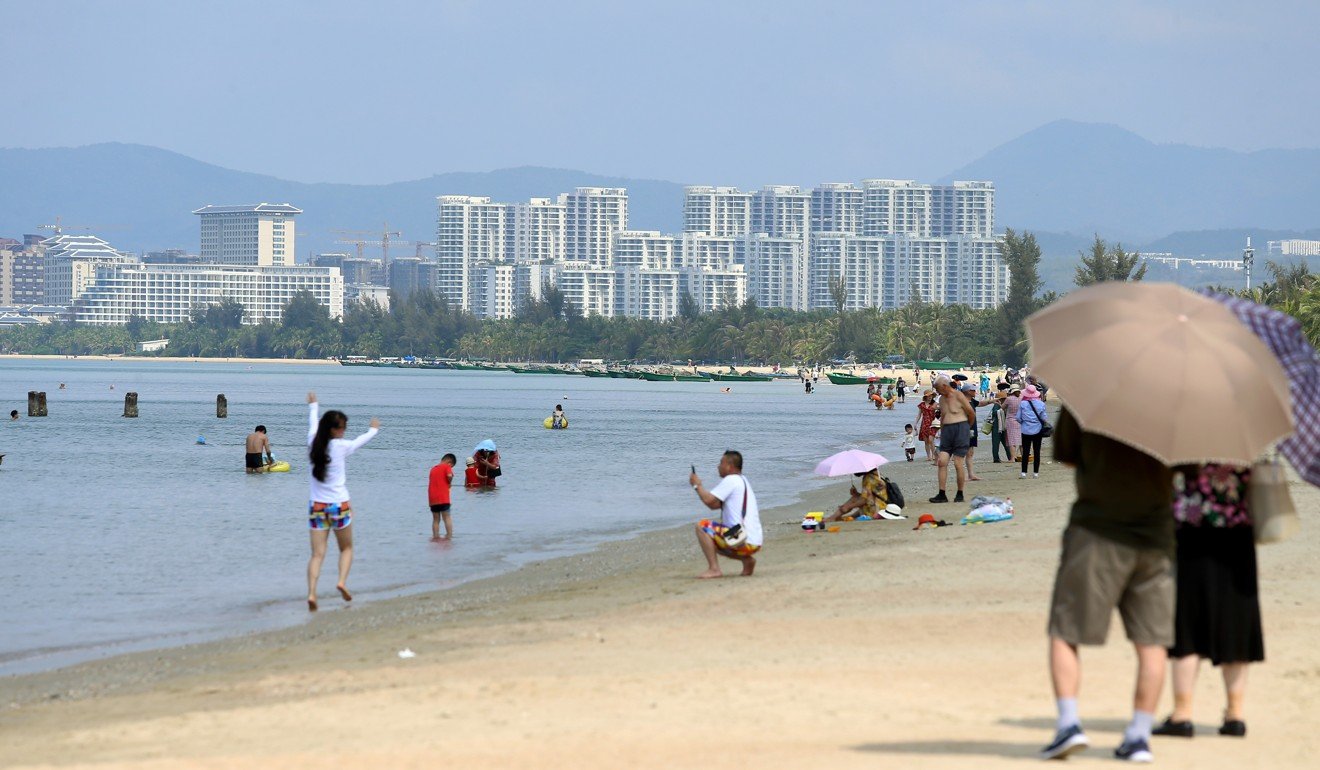
Zhong says his mission began in 2015 during a holiday on the island of Hainan. Photo: Dickson Lee

While on patrol, Zhong makes himself easy to see in an orange T-shirt that bears his clean-up message. His tools include a metal pincer for picking up tissue paper, plastic bags, drinks bottles, nappies and other everyday detritus and putting it into bins.

He also carries a voice recorder that sends out an appeal to restaurant customers: “To protect our environment and not to affect our kids’ healthy growing up, dear friends, please don’t throw rubbish.”

Can China sort its household waste recycling problem by 2020?

Zhong said that at first he felt afraid and self-conscious when he stood in front of a crowd of diners with his green gospel. But time and practise taught him he had almost nothing to fear, he said.

One of the bigger challenges is getting through to the many people who do not listen to him and refuse to dispose of their rubbish the right way.

“It’s normal that our society has various kinds of people and I need to face this reality,” Zhong said. “I was prepared in my mind that I would be called ‘nut’ since this is such an arduous but fruitless cause.”

He tackles the problem with his usual persistence, so argument and persuasion is all part of the job. When Zhong insists the rule breakers take their rubbish and bin it, some ignore him and others walk away – but he is ready with an answer.

“I tell them, ‘If you don’t pick it up, I guarantee that you will lose face today. I will let passers-by see and hear what a humiliating thing you have done. Everybody will then condemn you and you will be embarrassed’,” he said.

When people tell him what they do is none of his business, Zhong replies that what he is doing is in the public interest.

Sometimes there is a heavier price. Zhong said he once watched several men in their 20s throw rubbish onto the road from their car. He set off after them in his SUV. He waylaid them and asked them to clean up after themselves – the men refused, swore at him and beat him up. Their day ended in a police station.

Zhong said he hoped his work would bring “positive energy” to the employees of his vehicle components and packaging materials companies, but his mission was not about business prestige.

However, last year, he was named as one of the top 10 public welfare figures of Chongqing by the municipal government, while his family was honoured as a Chinese good family by the semi-governmental All-China Women’s Federation, a women’s rights organisation established in 1949.

Street cleaner who found US$22,000 in rubbish refuses to accept a reward

There were trials for Zhong closer to home – his wife, Yang Zuhui, did not support his mission at first and threatened to divorce him.

“It’s OK that you picked up trash on the street and you were just another cleaner there,” she told him in an interview with Hunan Television in 2017. “But what worried me was that you tried to persuade others – physical violence [against him] was inevitable.”

She also said: “My husband is not very tall and, on many occasions, he was at a disadvantage and got beaten up. I am worried about his personal safety.”
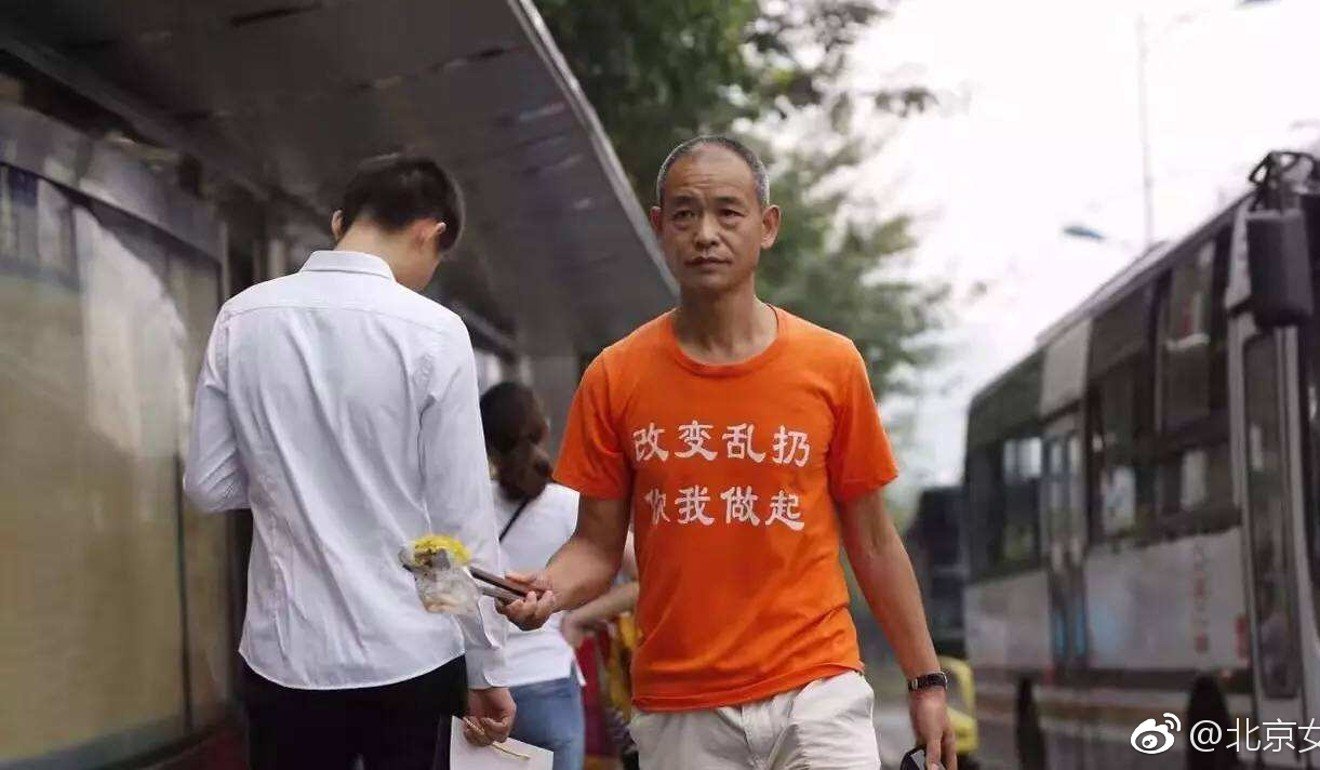
Zhong impressed his daughter’s schoolfriends with an inspiring speech. Photo: Weibo

But two years ago, their 10-year-old daughter helped change Yang’s attitude towards her husband’s mission after a school outing.

After lunch that day, Zhong gave the adults and children who had left rubbish behind one of his lectures.

His daughter, who was embarrassed by Zhong’s speech, came to appreciate him when classmates told her: “Your father is awesome. He is like a hero who protects the Earth.”

Yang was won over because she knew her husband was a determined man and once he decided on a course of action would not change his mind.

Their son – who is in his 20s and has returned to Chongqing after studying in France – always stands by his father, Zhong said.

“My son told me that environmental voluntary work normal abroad and it is respected,” he said.

Going out to collect rubbish has become part of Zhong’s life, he said.

“In the evening, if I stay at home, my wife and daughter will ask me ‘Why don’t you go to pick up rubbish?’”

He said it was important to go litter picking every day because the more he did it the more people he could influence.

“By breaking the littering habit, Chinese people can stand tall when they travel abroad,” Zhong said.

Source: SCMP

20/09/2019

China Focus: China publishes white paper on progress of women’s cause in 70 years

CHINA-BEIJING-SCIO-WOMEN'S CAUSE-WHITE PAPER (CN)

A white paper titled “Equality, Development and Sharing: Progress of Women’s Cause in 70 Years Since New China’s Founding” is released by the State Council Information Office in Beijing, capital of China, Sept. 19, 2019. China on Thursday issued a white paper on the progress of women’s cause in the past 70 years since the founding of the People’s Republic of China. TO GO WITH “China publishes white paper on progress of women’s cause in 70 years” (Xinhua/Zhang Yuwei)

BEIJING, Sept. 19 (Xinhua) — China on Thursday issued a white paper on the progress of women’s cause in the past 70 years since the founding of the People’s Republic of China (PRC).

The white paper, titled “Equality, Development and Sharing: Progress of Women’s Cause in 70 Years Since New China’s Founding,” was released by the State Council Information Office.

The founding of the PRC in 1949 ushered in a new era for women in China, changing their social status from an oppressed and enslaved group in the past thousands of years to masters of their own fate, the white paper said.

As the Chinese nation is rising and growing richer and stronger, Chinese women’s social status has undergone enormous changes, it said.

“The great achievements China has made in the development of women’s cause is attributed to the leadership of the Communist Party of China (CPC),” said Huang Xiaowei, vice president of the All-China Women’s Federation, at a press conference.

The progress made by Chinese women led by the CPC is not only of considerable significance to China’s national rejuvenation but also a notable contribution to human civilization progress, Huang said.

As China’s development has entered a new era, promoting gender equality and women’s overall development at a higher level not only meets opportunities but also has a long way to go, the white paper said.

Under the guidance of Xi Jinping Thought on Socialism with Chinese Characteristics for a New Era, China will always adhere to safeguarding and improving women’s livelihoods, promote women’s all-round development, and lead hundreds of millions of women in working for national rejuvenation, it said.

MORE WORKING WOMEN

China has promulgated laws and regulations to fully protect women’s economic rights and interests, especially the right to equal employment, ensuring equal pay to men and women for equal work and eliminating gender discrimination in employment, the white paper said.

Women account for 40 percent of the labor force in China. In 2017, there were 340 million working women, doubling the figure in 1978.

Women’s job options have greatly expanded. In 2010, 46.8 percent of women worked in industry and service sectors, up 24.8 percentage points from 1982.

HIGHER POLITICAL STATUS

China has drawn up and implemented laws to guarantee that women share equal rights with men to vote, to be elected, and to participate in the administration of state affairs, the white paper said, adding that over the past four decades since the reform and opening-up, new opportunities and channels have been opened to women to participate in politics.

In 2017, women accounted for 52.4 percent of public servants newly-recruited by the central government organs and their affiliates, and the proportion was 44 percent among local governments.

The ratio of women deputies to the 13th National People’s Congress (NPC) was 24.9 percent, 12.9 percentage points higher than that of the first NPC in 1954.

MORE EDUCATED WOMEN

Chinese women’s education level has been dramatically lifted over the past seven decades, according to the white paper.

The illiteracy rate among females aged 15 and above dropped from 90 percent before the founding of the PRC to 7.3 percent in 2017, which was a historic change.

The gender gap in the nine-year compulsory education has been basically eliminated. In 2017, the net primary school enrollment rates of boys and girls were both 99.9 percent while the proportions of girls in primary schools and junior high schools were 46.5 percent and 46.4 percent respectively, 18.5 and 20.8 percentage points higher than those in 1951 respectively

In 2017, the gross high school enrollment rate was 88.3 percent, with girls accounting for 47.7 percent of all students in high schools.

Meanwhile, women accounted for 52.5 percent of students in regular institutions of higher education, 28.4 percentage points higher than in 1978, 32.7 percentage points higher than in 1949.

HEALTHIER WOMEN

Women’s health has further improved in China. Women’s average life expectancy grew to 79.4 years in 2015, an increase of 10.1 years over 1981 and 42.7 years over 1949, according to the white paper.

The maternal mortality rate has fallen 79.4 percent from 88.8 per 100,000 in 1990 to 18.3 per 100,000 in 2018, meaning that China has achieved the United Nations Millennium Development Goals ahead of time.

Source: Xinhua

04/09/2019

Across China: Poverty-reduction workshops bring new life to ethnic minority women

LANZHOU, Sept. 3 (Xinhua) — Bound by lower education levels, traditions and household responsibilities, most ethnic minority women in China’s impoverished regions have never dared to think of ways other than farming to help their families gain a better life.

However, with the government campaign to eradicate poverty gathering steam, small manufacturing workshops are bringing jobs to their doorsteps and empowering the women to take new roles in their families.

Ma Xiuping, living in a village in Linxia Hui Autonomous Prefecture, northwest China’s Gansu Province, could not hide her excitement when recalling the first time she was paid by the factory she started working in.

“I could barely read, and I never imagined I could get a salary like urban workers,” said Ma, who is in her 50s.

The rural cooperative Ma works at makes traditional cloth shoes and employs more than 50 impoverished women workers.

In Gansu Province, such poverty-alleviation factories have created jobs for more than 8,000 women who were once trapped working on farms and taking care of all the family chores, and for them, a different life has started.

“Now I don’t have to ask my husband for money, which makes me more confident,” said the 28-year-old Ma Fatumai who worked at the same workshop with Ma Xiuping. For her first month of work, she earned 1,350 yuan (about 190 U.S. dollars).

For Huang Ayingshe, who works in another poverty-reduction workshop in the prefecture, a job also means more association with the outside world, which she says is “much more fun” than staying at home.

As the deadline to eradicate absolute poverty by 2020 approaches, China is focusing efforts on the nation’s poorest people, and Gansu Province is one of the major battlefields.

Answering the central leadership’s call for “precision poverty alleviation,” which demands tailored policies to suit different local situations, the province seeks to tap the power of women in the battle to wipe out absolute poverty by 2020.

In July, the All-China Women’s Federation held a meeting in the Linxia Hui Autonomous Prefecture, which stressed women’s roles in fighting poverty and called on them to contribute their strength.

Official data showed that China lifted 13.86 million people in rural areas out of poverty in 2018, with the number of impoverished rural residents dropping from 98.99 million in late 2012 to 16.6 million by the end of last year.

Source: Xinhua

Law of Unintended Consequences

continuously updated blog about China & India

ChiaHou's Book Reviews

continuously updated blog about China & India

What's wrong with the world; and its economy

continuously updated blog about China & India