Chindia Alert: You’ll be Living in their World Very Soon
aims to alert you to the threats and opportunities that China and India present. China and India require serious attention; case of ‘hidden dragon and crouching tiger’.
Without this attention, governments, businesses and, indeed, individuals may find themselves at a great disadvantage sooner rather than later.
The POSTs (front webpages) are mainly 'cuttings' from reliable sources, updated continuously.
The PAGEs (see Tabs, above) attempt to make the information more meaningful by putting some structure to the information we have researched and assembled since 2006.
An antibody engineered from the animal’s immune system was found to neutralise the virus that causes Covid-19
American and Belgian researchers hope the discovery may help protect humans from the deadly illness
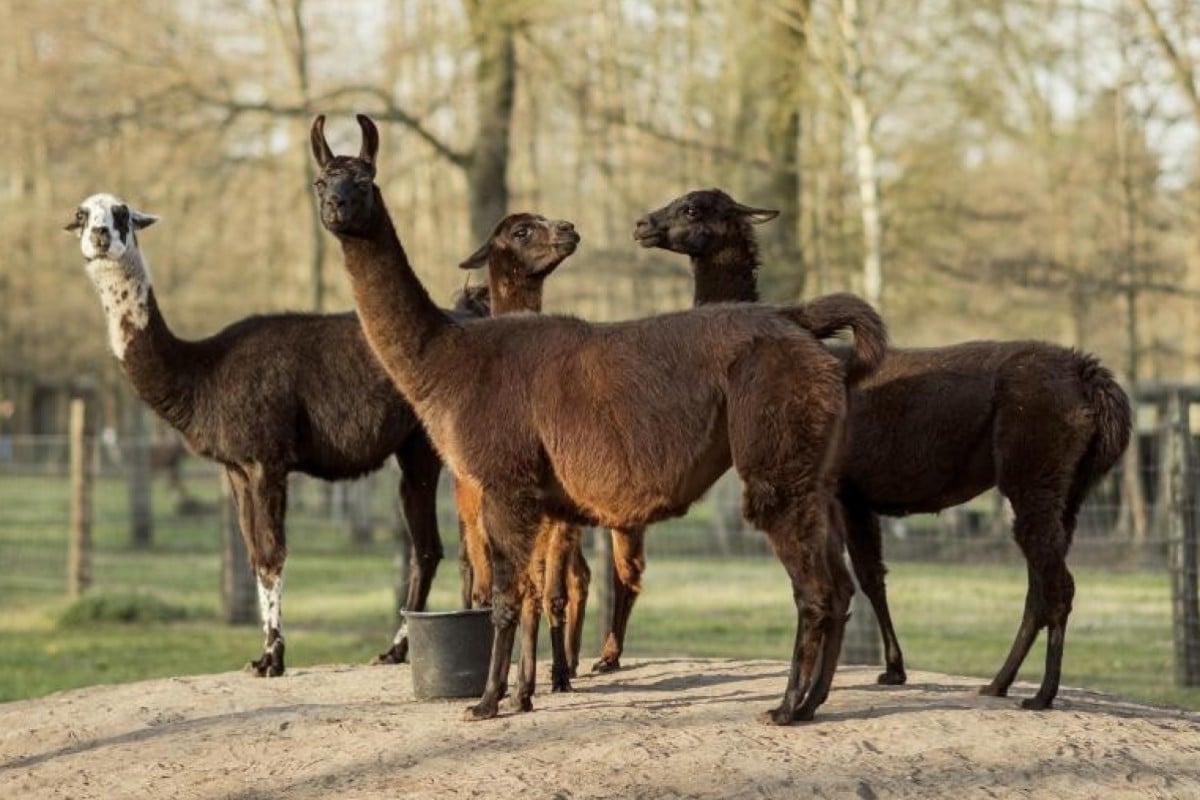
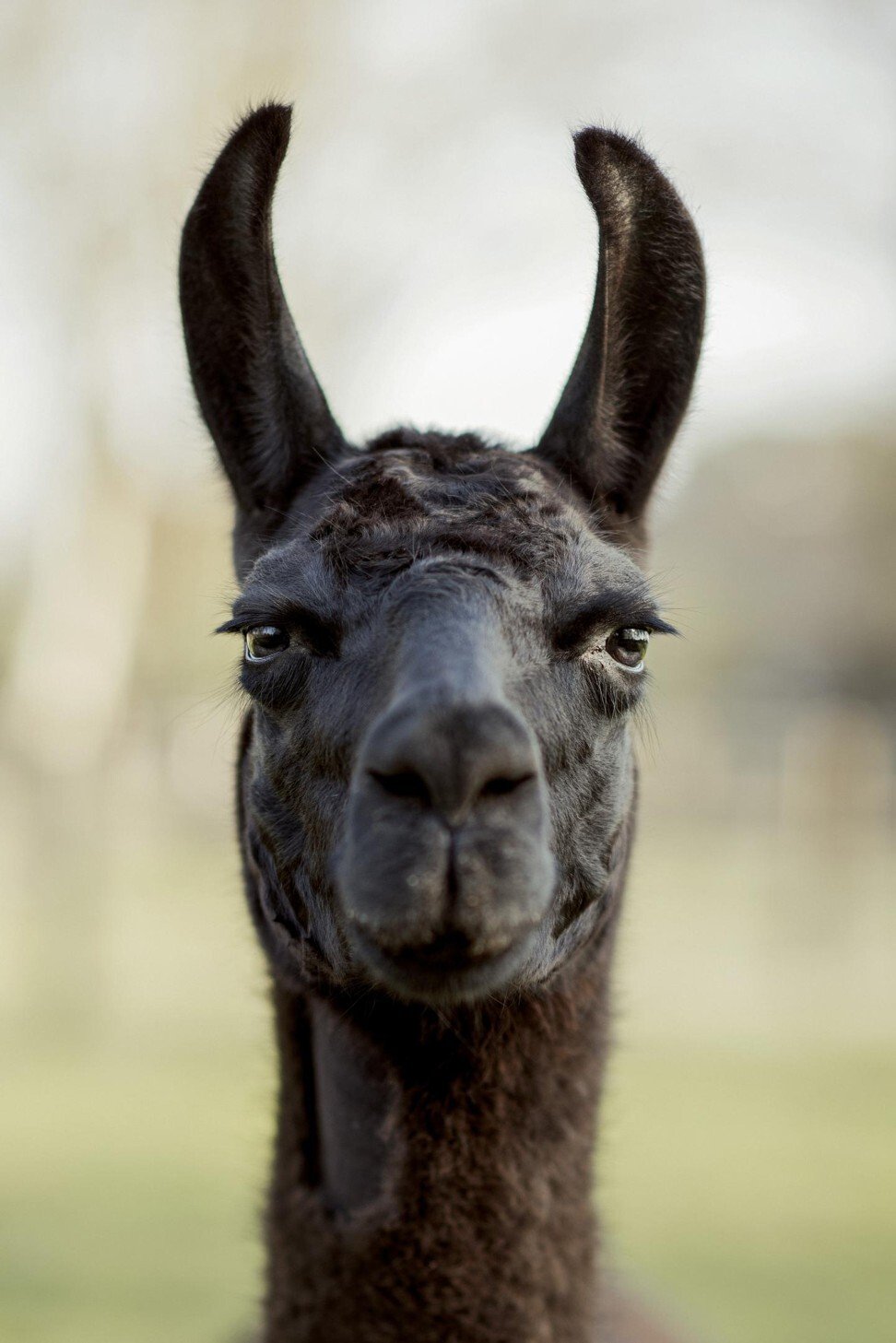
Winter the llama (front) lives on a farm operated by Ghent University’s Vlaams Institute for Biotechnology. Photo: Tim Coppens
A Belgian llama could hold the key to producing an antibody that neutralises the coronavirus that causes Covid-19.
More studies and clinical trials are needed to see if it can be used in humans to treat Covid-19, but the team of American and Belgian scientists who engineered the antibody said they were encouraged by their preliminary findings, which will be published in the journal Cell next week.
Jason McLellan, from the University of Texas at Austin and co-author of the study, described it as one of the “first antibodies known to neutralise Sars-CoV-2”, the official name for the virus.
“With antibody therapies, you’re directly giving somebody the protective antibodies and so, immediately after treatment, they should be protected,” he wrote in a press release.
“The antibodies could also be used to treat somebody who is already sick to lessen the severity of the disease.”
Winter the llama produced antibodies that proved effective against the Sars-CoV-2 virus. Photo: Tim Coppens
The scientists have been working on coronaviruses – including severe acute respiratory syndrome (Sars) and Middle East respiratory syndrome (Mers) – for years.
In 2016 they injected the llama, named Winter, with Sars and Mers in the hope of developing a treatment for the diseases.
“I thought this would be a small side project,” said Dorien De Vlieger from Ghent University in Belgium, who helped to isolate antibodies against coronaviruses from the llamas.
China’s race for a Covid-19 vaccine hits a hurdle – no outbreak at home
1 May 2020
“Now the scientific impact of this project became bigger than I could ever expect. It’s amazing how unpredictable viruses can be.”
A llama’s immune system produces two types of antibodies when it detects pathogens, one similar to human antibodies and one that is about a quarter of the size.
The antibodies produced by Winter were found to be effective in targeting the Sars virus’s spike protein, which allows it to bind to human cells.
Chinese firm ready to make 100 million Coronavirus vaccine doses if trials are successful
This year they decided to test the antibodies Winter had produced during the Sars experiment to see if it could prove effective against Covid-19.
Although it did bind itself to the Sars-CoV-2 virus it did so “weakly”, so the team then linked two copies of the antibody together to make it bind more effectively.
Oxford vaccine effective in monkeys, heading for mass production in India
30 Apr 2020
“That was exciting to me because I’d been working on this for years. But there wasn’t a big need for a coronavirus treatment then. This was just basic research,” said Daniel Wrapp from the University of Texas, a co-author of the study.
The smaller type of antibodies produced by llamas, called single-domain antibodies or nanobodies, can be used in an inhaler, according to Wrapp.
“That makes them potentially really interesting as a drug for a respiratory pathogen because you’re delivering it right to the site of infection,” said Wrapp.
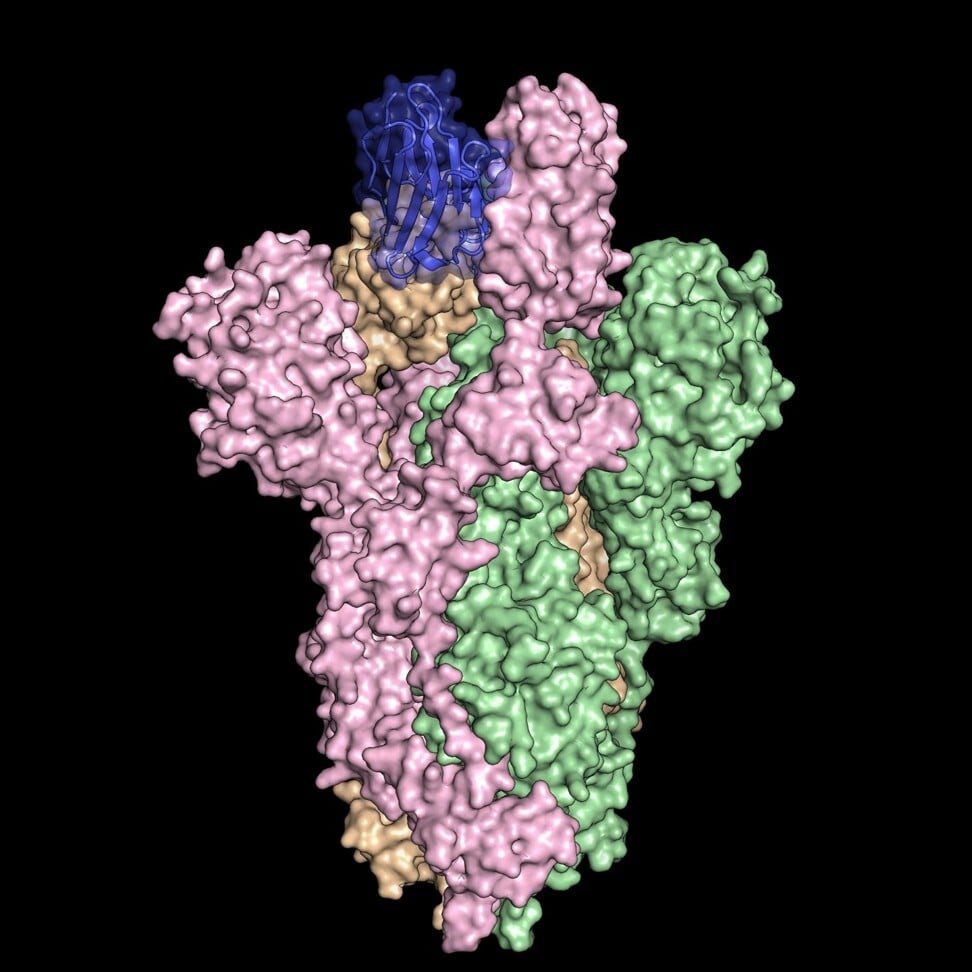
Researchers created an antibody dubbed VHH-72Fc (blue) that binds tightly to the Sars-CoV-2 spike protein (pink, green and orange), blocking the virus from infecting cells. Photo: University of Texas at Austin
The researchers are preparing for more trials with hamsters or primates to further test the antibody, before taking it to human trials.
The main subject of the study, Winter the llama, is now four years old and lives on a farm operated by Ghent University’s Vlaams Institute for Biotechnologym which said it has around 130 other llamas and alpacas at the facility.
– The last nine poverty-stricken county-level regions in east China’s Anhui Province have been removed from the country’s list of impoverished counties.
– This marks that all county-level regions in the Yangtze River Delta, consisting of Shanghai and the provinces of Jiangsu, Zhejiang and Anhui, have been officially lifted out of poverty for the first time in history.
HEFEI, April 29 (Xinhua) — Sitting in front of his smartphone, Zhang Chuanfeng touts dried sweet potatoes to viewers on China’s popular video-sharing app Douyin, also known as TikTok.
“These are made from sweet potatoes I grew myself. They are sweet and have an excellent texture,” said Zhang while livestreaming in Tangjiahui Township of Jinzhai County in east China’s Anhui Province. Tucked away in the boundless Dabie Mountains, the township used to have the biggest poor population in the county.
Aerial photo taken on April 16, 2020 shows residential buildings in Dawan Village of Jinzhai County, east China’s Anhui Province. (Xinhua/Liu Junxi)
Jinzhai County is among the last nine county-level regions in Anhui that have been removed from the country’s list of impoverished counties, according to an announcement issued by the provincial government Wednesday. They are also the last group of county-level regions that bid farewell to poverty in the Yangtze River Delta.
E-COMMERCE
Zhang might seem like a typical e-commerce businessman reaping success in China’s booming livestreaming industry. But his road to success has been a lot bumpier: he suffers from dwarfism.
A little more than 1.4 meters tall, Zhang has a babyface, making him “look like a junior school student,” he said. But the man, 38, is the father of a nine-year-old boy.
For Zhang, life was tough before 2014. “Nobody wanted me because of my ‘disabilities’ when I went out to look for jobs,” he said. “I was turned down again and again.”
Zhang was put on the government’s poverty list in 2014 as China implemented targeted poverty-relief measures. With the help of local officials, he got a bank loan of 10,000 yuan (about 1,400 U.S. dollars) and bought 22 lambs. He tended the animals whole-heartedly and seized every opportunity to learn how to raise them more professionally.
Zhang Chuanfeng feeds his lambs in Zhufan Village of Jinzhai County, east China’s Anhui Province, April 26, 2017. (Xinhua/Zhang Duan)
Within a year, the number of his lambs expanded to hundreds. In 2016, Zhang’s earnings exceeded 100,000 yuan, more than enough for him to cast off poverty.
Riding on this success, Zhang began to seek new opportunities. He rented a shop and started selling products online to embrace an e-commerce strategy the local government introduced in 2017.
More than 100 online shops, including Zhang’s, in the county have helped more than 7,000 poverty-stricken households sell about 73 million yuan worth of local specialties since 2018. Zhang alone earned 500,000 yuan from a sales revenue of 5 million yuan last year.
A villager arranges local specialties for sale at Dawan Village of Jinzhai County, east China’s Anhui Province, April 17, 2020. (Xinhua/Liu Junxi)
WICKERWORK SUCCESS
About 100 km north of Jinzhai lies Funan, a place that used to be vulnerable to constant floods.
Zhang Chaoling, who lives by the Huaihe River in Funan County, had to flee her hometown at a young age due to floods, but has flourished on a willow plantation along the river later.
“The land is largely covered by silt following continual flooding in the past. It is an ideal place to plant willows and make wickerwork,” Zhang said.
Zhang left her hometown for Guangzhou in 1993 and found a job in a garment factory. A few years later, she founded a trading company with her husband in Guangzhou, selling wickerwork products from her hometown to other countries.
Zhang returned to her hometown and set up a wickerwork production base in 2011. Funan is famous for its delicate wickerwork. Skilled craftsmen traditionally use local willow as a raw material to weave products such as baskets, furniture and home decorations.
A villager arranges wickerwork products in Funan County, east China’s Anhui Province, April 15, 2020. (Photo by Zhou Mu/Xinhua)
“The flood is well controlled now. I remember the last huge flood came in 2007,” Zhang said.
Taking advantage of the fertile land along the Huaihe River, she plants over 130 hectares of willow trees and employs hundreds of locals mostly in their 50s and 60s.
“I can process 100 to 150 kg of willow twigs per day, from which I make around 80 yuan,” said Geng Shifen, who peels willow twigs with a clamp next to the plantation.
A total of 130,000 people are engaged in the wickerwork industry in Funan, creating an output of nearly 9 billion yuan in 2019, and helping 15,000 locals shake off poverty, local statistics showed.
POVERTY REDUCTION FEAT
The Anhui provincial government Wednesday announced that its last nine county-level regions including Jinzhai and Funan are removed from the country’s list of impoverished counties.
This marks that all 31 impoverished county-level regions in Anhui have shaken off poverty, echoing China’s efforts to eradicate absolute poverty by the end of 2020.
With the announcement, all county-level regions in the Yangtze River Delta have been officially lifted out of poverty for the first time in history.
A bus runs on a rural road in Jinzhai County, east China’s Anhui Province, April 17, 2020. (Xinhua/Liu Junxi)
Covering a 358,000-square-km expanse, the Yangtze River Delta, consisting of Shanghai and the provinces of Jiangsu, Zhejiang and Anhui, is one of the most populated and economically dynamic areas in China, contributing one-fourth of the country’s GDP.
Anhui had a population of 63.65 million as of 2019, official data showed. The poor population in the province had decreased from 4.84 million in 2014 to 87,000 in 2019, and the poverty headcount ratio had been reduced from 9.1 percent to 0.16 percent during the period, according to the provincial poverty relief office.
A county can be removed from the list if its impoverished population drops to less than 2 percent, according to a national mechanism established in April 2016 to eliminate poverty in affected regions. The ratio can be loosened to 3 percent in the western region.
By the end of 2019, 5.51 million people in China were still living in poverty.
“We will continue our work to prevent people from returning to poverty, and help the remaining poor population shake off poverty by all means,” said Jiang Hong, director of the Anhui provincial poverty relief office.
Six animals inoculated with vaccine candidate then exposed to virus did not catch Covid-19 after 28 days
Up to 60 million doses could be produced by Serum Institute of India this year
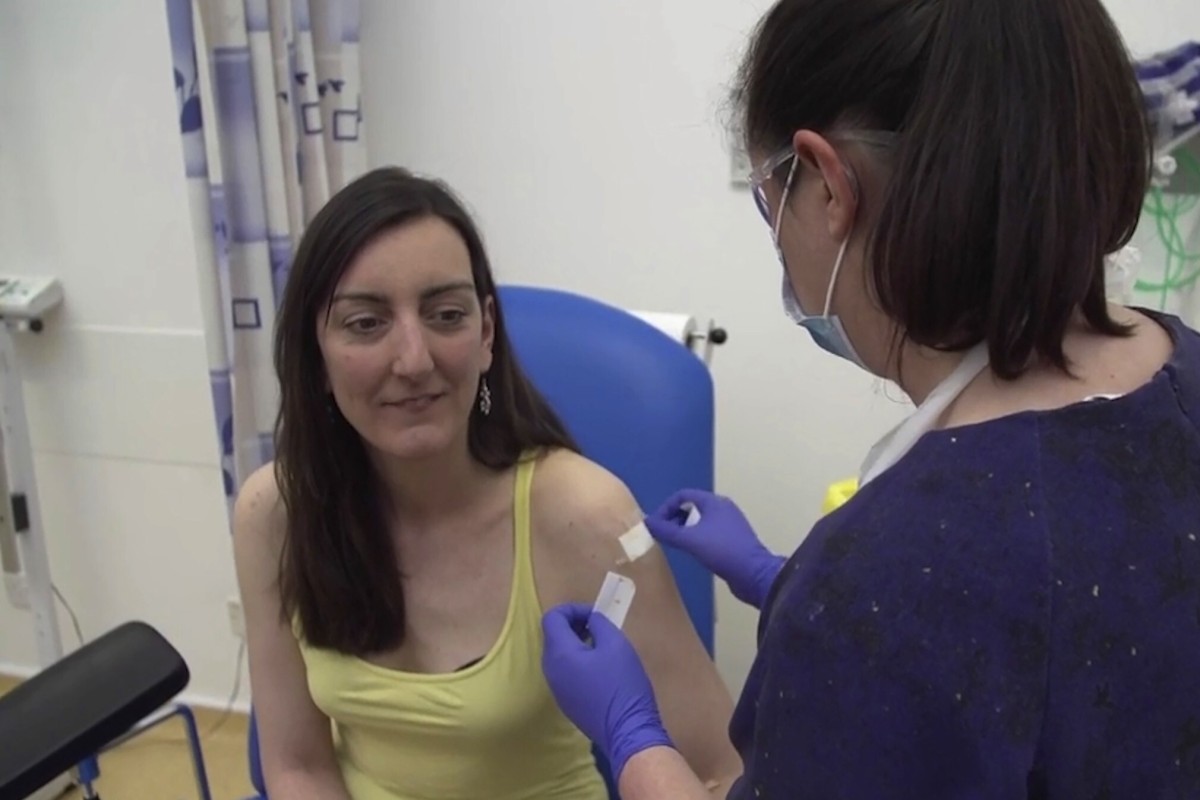
Microbiologist Elisa Granato gets an injection on Thursday as part of the first human trials in Britain for a potential coronavirus vaccine. Photo: University of Oxford via AP
A leading candidate for a Covid-19 vaccine has shown promising results in animal trials, and is expected to see mass production in India within months.
The Serum Institute of India, the world’s largest maker of vaccines by volume, said on Tuesday that it plans this year to produce up to 60 million doses of a potential vaccine developed by the University of Oxford, which is under clinical trial in Britain.
While the vaccine candidate, called “ChAdOx1 nCoV-19”, is yet to be proven to work against Covid-19, Serum decided to start manufacturing it as it had shown success in animal trials and had progressed to tests on humans, Serum Chief Executive Adar Poonawalla said.
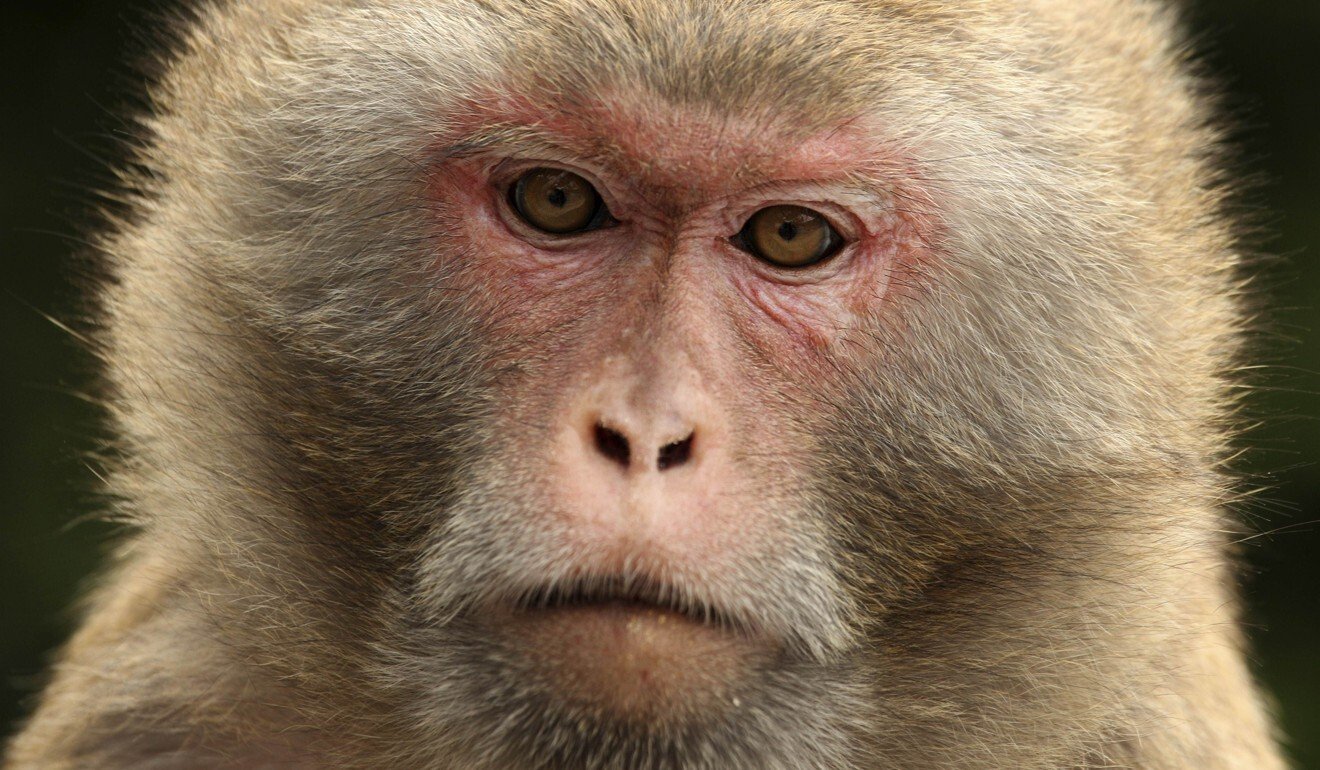
Six rhesus macaque monkeys were inoculated with the vaccine candidate at the National Institutes of Health’s Rocky Mountain Laboratory in Montana last month, according to The New York Times.
Covid-19 vaccine trial starts in Oxford, but remdesivir treatment reportedly flops in China tests
The subjects were exposed afterwards to large quantities of the novel coronavirus, but all six remained healthy after more than 28 days, the newspaper reported, citing researcher Vincent Munster, who conducted the test.
More than 3 million people have been reported to be infected globally and over 210,000 have died from Covid-19, the respiratory disease caused by the coronavirus.
“They are a bunch of very qualified, great scientists [at Oxford] … That’s why we said we will go with this and that’s why we are confident,” Poonawalla told Reuters in a phone interview.
“Being a private limited company, not accountable to public investors or bankers, I can take a little risk and sideline some of the other commercial products and projects that I had planned in my existing facility,” Poonawalla said.
Bill Gates hopes his virus vaccine ‘manufacturing within a year’
27 Apr 2020
As many as 100 potential Covid-19 candidate vaccines are now under development by biotech and research teams around the world, and at least five of these are in preliminary testing in people in what are known as phase one clinical trials.
Poonawalla said he hoped trials of the Oxford vaccine, due to finish in about September, would be successful. Oxford scientists said last week the main focus of initial tests was to ascertain not only whether the vaccine worked but that it induced good immune responses and no unacceptable side effects.
Serum, owned by the Indian billionaire Cyrus Poonawalla, plans to make the vaccine at its two manufacturing plants in the western city of Pune, aiming to produce up to 400 million doses next year if all goes well, Poonawalla said.
“A majority of the vaccine, at least initially, would have to go to our countrymen before it goes abroad,” he said, adding that Serum would leave it to the Indian government to decide which countries would get how much of the vaccine and when.
Rhesus macaque monkeys are often used in animal testing because of their similarity to humans. Photo: AFP
Serum envisages a price of 1,000 rupees (US$14.70) per vaccine, but governments would give it to people without charge, he said.
He said Prime Minister Narendra Modi’s office was “very closely” involved in the vaccine production and the company is hoping the government will help foot the cost of making it.
Over roughly the next five months, Serum will spend some 300 million to 400 million rupees (US$4.4 million to US$5.9 million) on making around 3-5 million doses per month, he said. “[The government] are very happy to share some risk and fund something with us, but we haven’t really pencilled anything down yet,” Poonawalla said.
Coronavirus: clinical trial begins on third vaccine candidate in China
22 Apr 2020
Serum has also partnered with the US biotech firm Codagenix and Austria’s Themis on two other Covid-19 vaccine candidates and plans to announce a fourth alliance in a couple of weeks, he said.
Serum’s board last week also agreed to invest roughly 6 billion rupees (US$8.8 billion) on making a new manufacturing unit to solely produce coronavirus vaccines, Poonawalla said.
Image caption Hatkarwadi hasn’t seen decent rains in three years
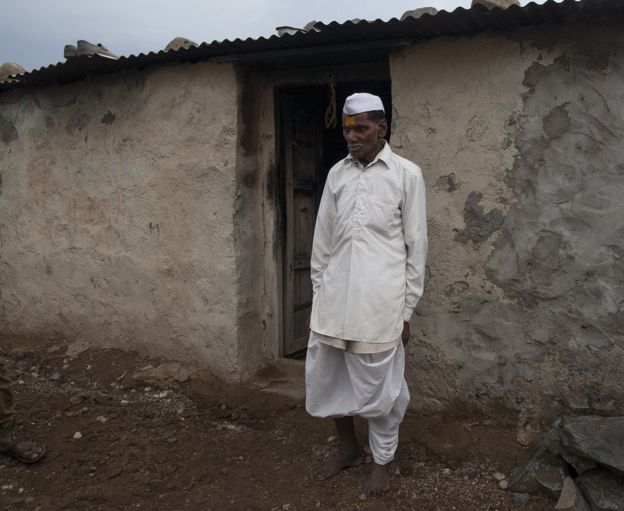
Every morning Dagadu Beldar, 75, wakes up and cooks rice and lentils in his village home in India’s western state of Maharashtra. After that, there’s little else to do.
For the past three years, Mr Beldar has lived alone in his gloomy one-room hut in Hatkarwadi, a stony hillside outback ringed by forests. Drought forced his wife and three sons out of the village. The earth was parched and the wells were dry. There was little water to drink and bathe in, and the family’s millet farm lay barren.
Two sons found work at a sugar factory in Sangli, a cane-growing district some 400km (248 miles) away. Their mother looked after the third son, who went to school there. Hatkarwadi had become a bad memory.
With age, Mr Beldare is going deaf. He mostly keeps to himself in his dark room.
“He’s a very lonely man. He hasn’t seen his family in three years. All because of water,” says Ganesh Sadgar, a neighbour.
Image caption Dagadu Beldar lives alone after his family left the village because of lack of water
Across the lane, 75-year-old Kishan Sadgar’s only son left home a decade ago to work in a sugar factory far away. He lives with his wife and a pet dog. “My son hardly comes home,” he says. “And when he comes he wants to leave after two or three days because there’s no water here.”
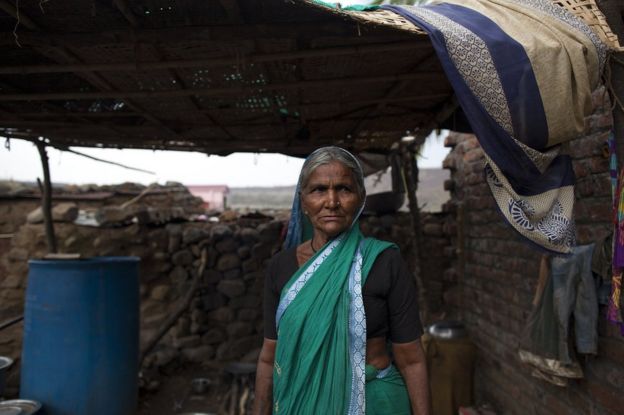
A few doors away, Saga Bai lives with her 14-year-old deaf mute daughter, Parvati. Her only son, Appa, left home years ago to work in a factory. “He hardly comes home. He says he will come only if it rains,” says Ms Bai.
And Ganesh Sadgar, the only graduate in the village, is unable to find a bride because “no woman wants to come here because there’s no water”.
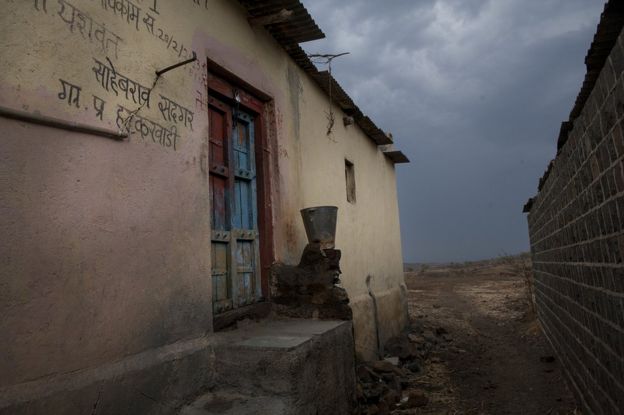
Hatkarwadi is located in Beed, a sprawling sun-baked district which has been impoverished by lack of rain. Not long ago, more than 1,200 people lived in its 125 squat homes. More than half of them, mostly men, have left, leaving behind bolted, abandoned homes. These water refugees eke a living in faraway towns and cities, where they have found work in cane farms, sugar factories, construction sites or as taxi drivers.
Image caption Yashwant Sahibrao Sadgar locked his home and left the village a year ago because of lack of water
“There is no water. Why should people stay here?” says Bhimrao Beldar, the 42-year-old headman of the village.
The night before I arrived in the village, there had been a brief burst of rain. Next morning, promising grey clouds seemed to be the harbinger of bountiful rains. By mid-afternoon, however, the sky began burning again, extinguishing any such hopes. That’s how fickle hopes are here. The last time the village had “decent rains” was three years ago.
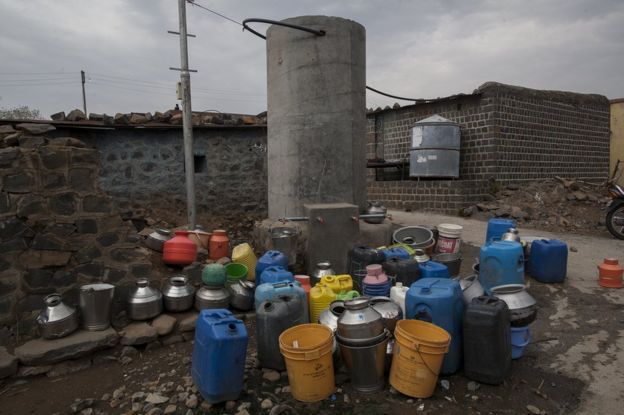
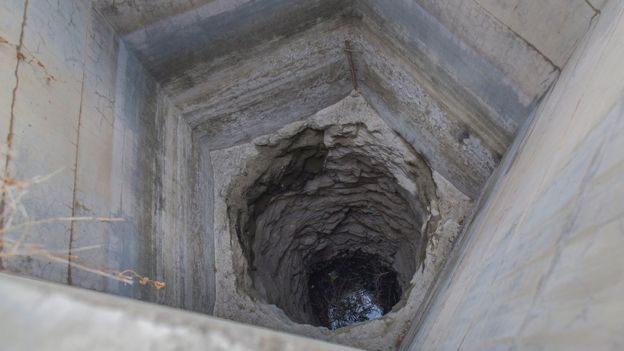
The cruel summer has sucked the life out of Hatkarwadi. The earth is brown and cracked. Cotton and millet farms have withered away. Only two of the 35 wells have some water left. There are a dozen borewells, but the fast receding water table is forcing farmers to drill deep – up to 650ft – to extract water.
Image caption The only source of water is a few functioning borewells
Even a minor gale snaps electricity lines, so the borewells often don’t work. Water tankers – the lifeline of the drought-hit – refuse to supply because of the precarious state of the narrow strip of tar which serves as the connecting road to the village.
There’s nothing to feed the animals, so 300 buffaloes have been moved to a fodder camp uphill where the animals live with their owners under tarp. Some 75 new toilets built under a federal government programme to end open defecation lie unused because there’s no water. Most villagers borrow drinking and bathing water from well-to-do neighbours who own borewells.
Hatkarwadi is a speck on the map of Beed, where more than a million people have been hit by the drought. Deforestation has reduced forest cover to a bare 2% of the total area of the district. Only 16% of the farms are irrigated. When monsoons are good, the rain-fed farms yield cotton, soya bean, sugarcane, sorghum and millet for 650,000 farmers.
Image caption Most of the village’s 35 wells are dry
For the last six years, Beed has seen declining rainfall. Irregular rainfall patterns have been playing havoc with crops. A 10-day-pause in rainfall can end up damaging crops. Last year’s abundant rains – 99% of the average yearly rainfall of 690mm – still led to crop failure because there were four long interruptions.
The main Godavari river is running dry. Nearly all of the 140 big and small dams in Beed are out of water, as are the 800-odd wells. Two of the major dams now have what officials call “dead water” – low lying stored water, contaminated with sediments and mud. This is the water which is being pumped into ponds from where nearly a thousand tankers pick up supplies, spike them with chlorine and transport them to 300-odd thirsty villages.
Image caption Saga Bai says her son returns to the village ‘only when it rains’
Half of Beed’s 800,000 cattle have been moved to more than 600 cattle camps because of lack of fodder. More than 40,000 people have taken up work under a jobs for work scheme, and officials are opening it up for others to prevent people from going into penury. The drought hasn’t spared people living in towns: the 250,000 residents of Beed town are getting piped water only once a week or sometimes a fortnight.
“This is the worst drought in a decade,” says Astik Kumar Pandey, the senior-most official of Beed. “We are hoping that our drinking water supplies last until end of July and then we have abundant rains”.
The crippling drought in Maharashtra is part of a larger climate catastrophe which has gripped India. More than 40% of the land, by one estimate, is facing drought and more than 500 million people living in at least 10 states are badly affected.
Media caption ‘Men don’t care about drought as women fetch the water’
P Sainath, the founder and editor of the online People’s Archive of Rural India, says the lack of water is an “explosive problem”. But drought alone has not contributed to the crisis, he says. It also has to do with the appropriation of water by the well-to-do at the expense of the poor, and the skewed allocation of water.
“The transfer of water from the farms to the industry, from food crops to water guzzling cash crops, from rural to urban areas, and from livelihood to lifestyle purposes for multiple swimming polls in urban high-rises has also led to this situation.”
Back in his office in Beed, Astik Kumar Pandey peers over a live map tracking the movement of GPS-tagged water tankers in the district. It’s a dense mass of red (stationary tankers picking up supplies) and green (tankers on their way with water) trucks clogging the heart of the district.
“This is how bad the situation is. We are hoping that the rains arrive soon”.
Wildlife park in southwest of country issues warning after tourist throws 10,000 yuan worth of banknotes into enclosure
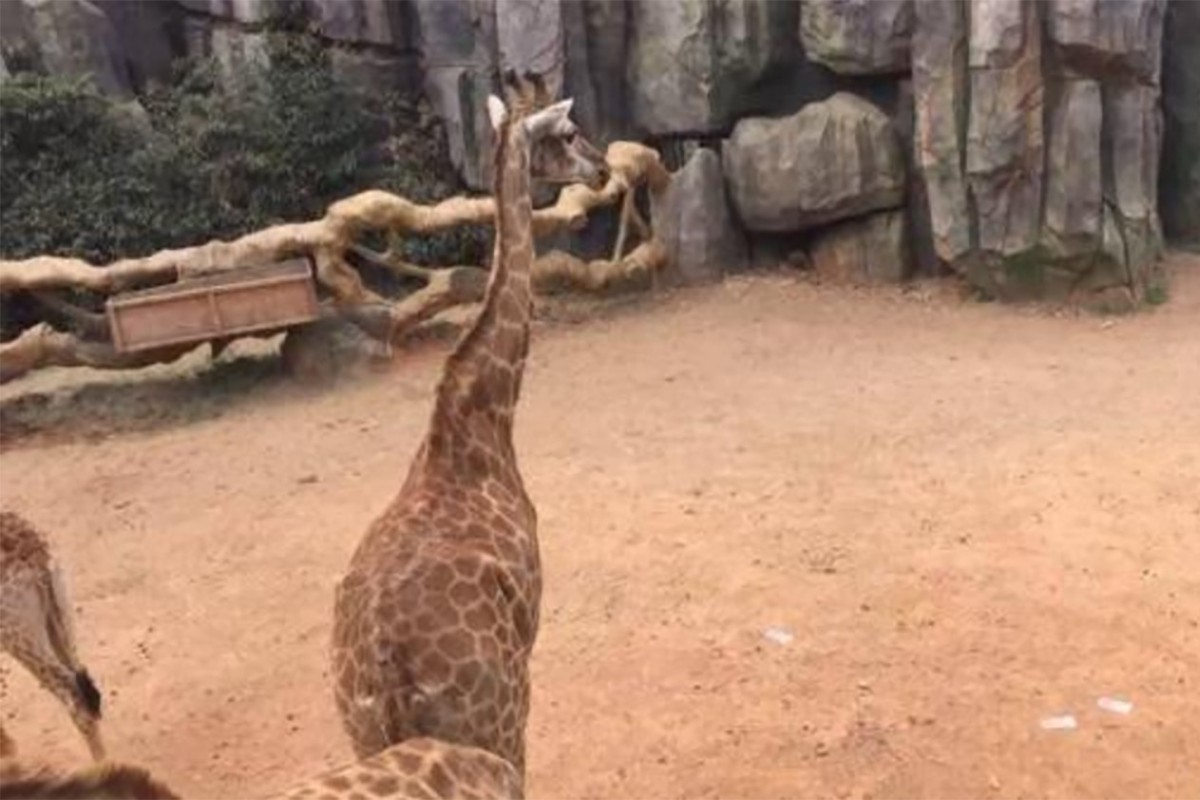
The money was thrown into the giraffe enclosure on Tuesday. Photo: Toutiao
A wildlife park in southwestern China is looking for a visitor who tried to feed its giraffes almost US$1,500 worth of cash.
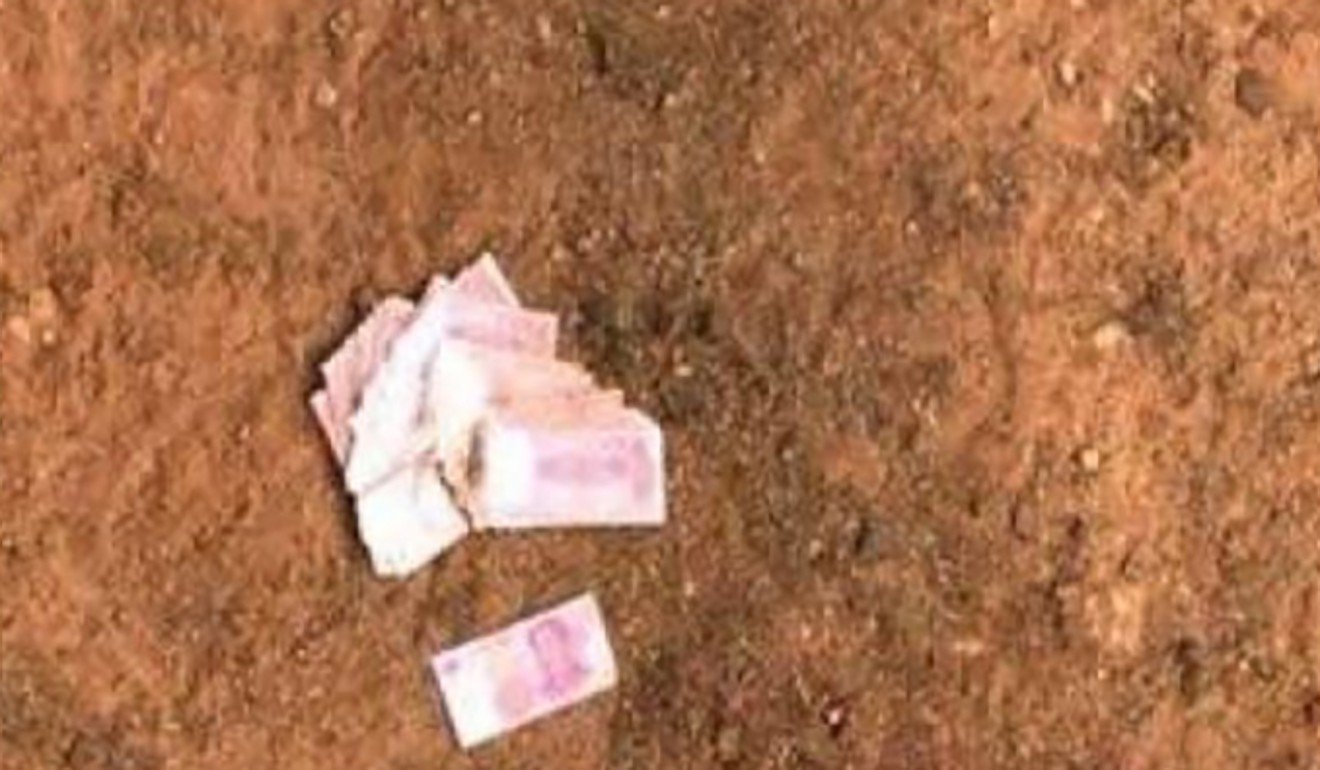
Staff at the Yunnan Wildlife Park discovered on Tuesday that someone had thrown 10,000 yuan in banknotes into the giraffe enclosure and then disappeared, the park said later that day.
“Some tourists love to feed animals food when visiting zoos, but have you seen people who feed them renminbi?” the park said in a notice issued on WeChat, China’s most popular social media platform.
The banknotes landed in the giraffe enclosure just before noon and staff had to distract the animals with food while they picked up the money, it said.
Nearly 10,000 yuan, mostly in 100 yuan notes, was retrieved. Staff then questioned visitors in the area but they all denied any knowledge of the incident, it said.
Surveillance camera footage showed that the money was thrown from a blind spot, it added.
“So far no one has come to claim ownership of the money. The police are also helping us look for the owner,” a worker from the tourists’ service centre told the South China Morning Post on Wednesday.
Staff had to remind visitors that strange objects could harm the animals. Photo: toutiao
“As we search for the owner, may we also kindly advise tourists not to drop litter or feed animals ‘strange things’?” the notice said.
“Taking different food provided by tourists can give the animals nutritional disorders, and as a result influence their growth and reproduction. And if they eat objects that are indigestible, such as plastic bags, they can die or suffer life-threatening injuries.”
The wildlife park said it was hoping to return the cash to its owner if he or she can be traced.










 CHINDIA ALERT: You'll be living in their world, very soon