Chindia Alert: You’ll be Living in their World Very Soon
aims to alert you to the threats and opportunities that China and India present. China and India require serious attention; case of ‘hidden dragon and crouching tiger’.
Without this attention, governments, businesses and, indeed, individuals may find themselves at a great disadvantage sooner rather than later.
The POSTs (front webpages) are mainly 'cuttings' from reliable sources, updated continuously.
The PAGEs (see Tabs, above) attempt to make the information more meaningful by putting some structure to the information we have researched and assembled since 2006.
BEIJING (Reuters) – China reported on Saturday a rise in new coronavirus cases, as authorities try to head off a second wave of infections, particularly from imported and asymptomatic cases, as curbs on cities and travel are lifted.
The National Health Commission said 46 new cases were reported on Friday, including 42 involving travellers from abroad, up from 42 cases a day earlier.
In its statement the commission added that 34 new asymptomatic cases were reported, down from 47 the previous day.
Mainland China’s tally of infections now stands at 81,953. The death toll rose by three to 3,339.
Tough curbs imposed since January helped rein in infections sharply from the height of the pandemic in February. But policymakers fear a second wave triggered by arrivals from overseas or asymptomatic patients.
Northeastern Heilongjiang recently reported a spike in new cases because of Chinese nationals entering the province from Russia, which has seen a surge of cases.
Provincial health officials said it had 22 new imported cases on Friday, all Chinese nationals coming from Russia, and one new local case, in its capital of Harbin.
Inner Mongolia had a daily tally of 27 new imported cases by Saturday morning, all from Russia, the region’s health authority said.
The central province of Hubei, where the virus emerged late last year, reported no new cases for a seventh successive day.
A rise in virus infections has prompted authorities in Guangzhou to step up scrutiny of foreigners, ordering bars and restaurants not to serve clients who appear to be of African origin, the U.S. consulate in the southern city said.
Anyone with “African contacts” faces mandatory virus tests followed by quarantine, regardless of recent travel history or previous isolation, it said in a statement.
It advised African-Americans or those who feel they might be suspected of contact with nationals of African origin to avoid the city.
Since the epidemic broke out in the provincial capital of Wuhan, it has spread around the world, infecting 1.6 million people and killing more than 100,000.
Image copyright GETTY IMAGESImage caption Chief Executive Carrie Lam said the majority of Hong Kong’s cases had been imported
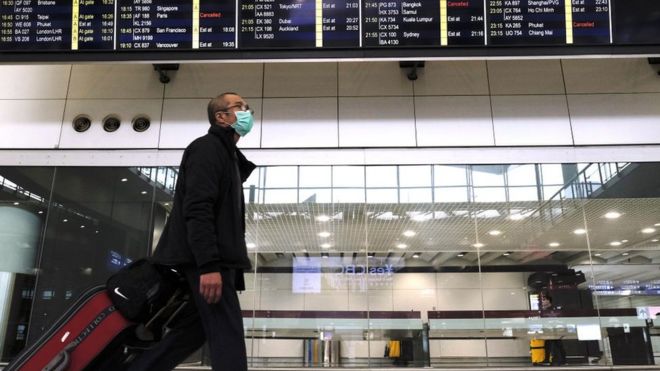
Hong Kong will quarantine all people arriving from abroad for 14 days, its leader Carrie Lam has said.
The restrictions, which will kick in on Thursday, will not apply to those from Macau or Taiwan. Entrants from mainland China already had to self-isolate.
Ms Lam said the majority of Hong Kong’s cases had been imported, adding that “strict measures” were needed.
Hong Kong has seen 57 new infections over the past two weeks, 50 of which were imported, said Ms Lam.
“If we exclude these imported, we only have seven local cases in the past week,” she said.
“If we do not impose strict measures, our previous efforts could be wasted.”
Ms Lam also advised residents to avoid all non-essential travel.
There are at least 155 confirmed cases in the territory, which detected its first cases in January.
The territory – a special administrative region of China – has so far been able to avoid the contagion seen elsewhere, thanks partly to a quick government response.
In January, cross-border travel with mainland China was slashed. Soon afterwards, health workers went on strike to demand a total border shutdown.
Some of the restrictions in the Asia-Pacific region, as of 17 March:
Australia – All travellers will have to self-isolate for 14 days. Foreign nationals who have been to China, Iran, Korea and Italy not allowed in
New Zealand – Everyone entering the country will have to self-isolate for 14 days. This excludes those from small Pacific islands with no confirmed virus cases
South Korea – Travellers from China’s Hubei province not allowed in. International arrivals from certain countries will need to submit papers on their health condition
Singapore – All visitors with travel history to France, Germany, Italy, Spain, South Korea and China banned from entering or transiting. Residents with recent history to these countries will have to self-isolate for 14 days. All those entering from Japan, Switzerland, the UK and Asean countries will have to self-isolate for 14 days
Malaysia – All foreign visitors have been banned, all Malaysians will not be allowed to travel overseas until 31 March. All returning Malaysians will have to self quarantine for 14 days
Japan – Ban on entry to travellers who have been to parts of China, South Korea, Iran or Italy in 14 days before arrival
The number of confirmed coronavirus cases and deaths outside China has now surpassed the number inside.
More than 100,000 people have been infected outside China, while just over 80,000 cases have been reported inside.
There have been more than 182,000 confirmed cases of coronavirus globally and over 7,000 deaths, according to a tally from Johns Hopkins University.
Media caption Steps the NHS says you should take to protect yourself from Covid-19
Cooperation on ‘soft’ issues like public health can provide an ‘opportunity for improvement’ in the nations’ broader relationship, international affairs expert says
Foreign ministers agree to do all they can to ensure Chinese President Xi Jinping’s planned visits to east Asian neighbours go ahead later this year
South Korea on Thursday reported 505 new coronavirus cases, its largest increase yet. Photo: AP
has created a fresh challenge to Beijing’s delicate relationship with its northeast Asian neighbours, but experts say the unprecedented public health crisis could draw them closer, at least for now.
China’s Foreign Minister Wang Yi held separate conversations with his South Korean and Japanese counterparts on Wednesday as Beijing scrambles to deal with the growing risk of imported infections from the two countries.
In a sign of the “strong momentum at the leadership level on both sides”, Wang and Japanese Minister for Foreign Affairs Toshimitsu Motegi agreed to ensure Chinese President Xi Jinping’s state visit to Japan later this year goes ahead as planned, despite mounting fears the virus outbreak will become a pandemic.
China’s foreign ministry said on Thursday that Yang Jiechi, Wang’s predecessor and Xi’s top aide on foreign affairs, would visit Japan on Friday. His trip is expected to pave the way for Xi’s high stakes visit in the spring, observers said.
But Benoit Hardy-Chartrand, an international affairs expert at Temple University in Tokyo, said that if the outbreak did not subside in the next few weeks, Japanese Prime Minister Shinzo Abe’s government would come under intense pressure to delay the visit.
“Despite reassuring official pronouncements, no one would be surprised if the visit was postponed to a later date,” he said. “With an already declining approval rate, the Abe administration would be hard-pressed to go ahead with the summit.”
During her phone call with Wang, South Korean Foreign Minister Kang Kyung-wha urged China to refrain from carrying out what she described as “excessive” restrictions and forcible quarantine measures against visitors from her country, the Yonhap news agency reported.
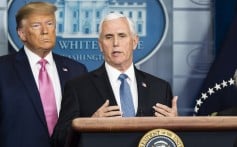
White House announces coronavirus ‘coordinator’ to lead response under Pence
on Thursday reported 505 new coronavirus cases – its largest increase yet and the first time any country has confirmed more daily cases than China. The outbreak has now spread to more than 30 countries and killed more than 2,800 people.
US-CHINA TRADE WAR
In the cities of Qingdao and Weihai in east China’s Shandong province – both of which are home to large South Korean and Japanese communities – local authorities have begun to quarantine arrivals from the two countries, while similar measures targeting South Koreans in particular have been introduced in Shenyang and Nanjing.
This is the first time China, where the coronavirus originated and which earlier criticised other nations for overreacting to the outbreak, has introduced country-specific measures in the name of disease control.
The move sparked fierce criticism in South Korea, with more than 750,000 people signing an online petition calling for a ban on Chinese visitors.
The foreign ministry in Seoul said that about 40 nations and regions had imposed some sort of restrictions on South Korean visitors.
Both South Korea and Japan – which were among the first to offer support and aid to China when the epidemic took hold – have imposed only partial restrictions on Chinese travellers, mostly those from Hubei, the province at the centre of the contagion.
Wang again thanked South Korea for its support and defended China’s control measures, saying they were necessary to reduce the cross-border movement of people and restrict the spread of the disease, China’s foreign ministry said.
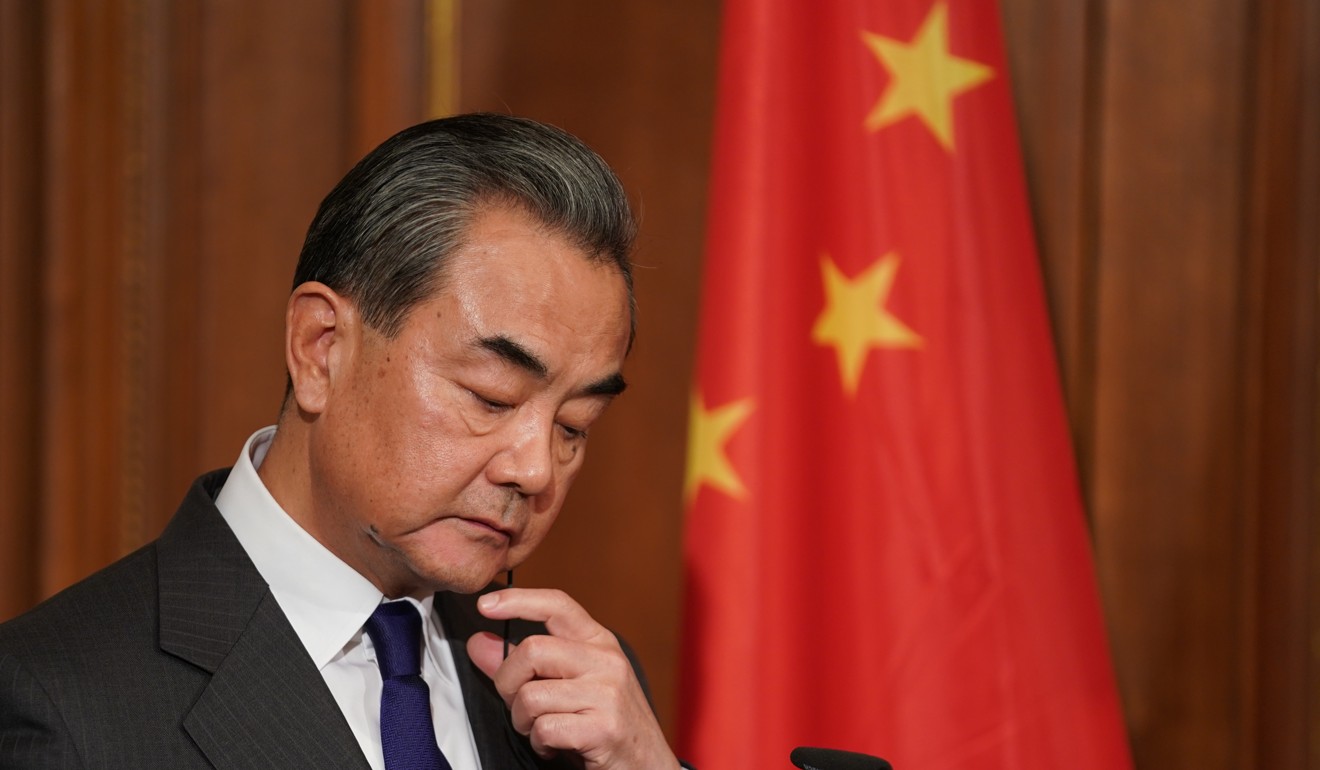
China’s Foreign Minister Wang Yi. Photo: EPA-EFE
Yonhap said both Wang and Kang also agreed that Xi’s proposed trip to South Korea in the first half of the year would proceed as planned.
Chinese experts said the coronavirus had deepened distrust and antagonism towards China in both countries, with many South Koreans and Japanese blaming China for the spread of the disease.
Li Wen, an expert from the China Institute of International Studies, said the coronavirus crisis had seen the rise of the “China threat” in South Korea, with its government under enormous pressure to get tough on its giant neighbour.
According to Yonhap, Kang urged South Korean diplomats in China earlier this month to help minimise any negative impact the epidemic might have had on relations between the two countries.
Hardy-Chartrand said relations between China and South Korea remained tense because of Seoul’s deployment of the American-madeTHAAD missile defence system, which in turn led to Beijing introducing unofficial sanctions that caused resentment among South Koreans.
Hongkongers stuck in Japan with airlines reluctant to fly them home
28 Feb 2020
But the latest spat over the control measures was unlikely to be a major obstacle to regional relations, he said.
“Overall, cooperation on so-called soft issues like public health, as we are witnessing at the moment, can provide an opportunity for further improvement in the broader relationship, at least in the short term,” he said.
China-Japan relations might also benefit from closer cooperation on disease control given uncertainty in the region over the US-China trade war, the North Korean denuclearisation impasse, the United States’ commitment to its allies, and the coronavirus outbreak, he said.
“I am less sanguine about the mid- to long-term prospects for Sino-Japanese relations, given that the sources of the tensions that we saw from 2010 to 2017, namely the East China Sea territorial dispute and other historical issues, remain wholly unresolved,” he said.
According to a Pew study in December, 85 per cent of Japanese have an unfavourable view of China, the highest among 34 countries surveyed, while 63 per cent of South Koreans see China negatively.
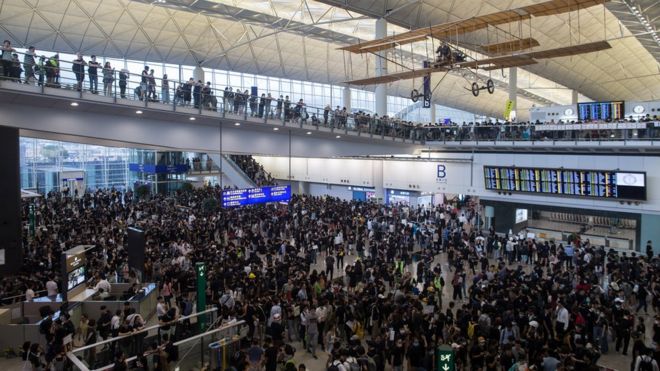
Image copyright EPAImage caption Officials say about 5,000 gathered for the fourth day of protests at the airport
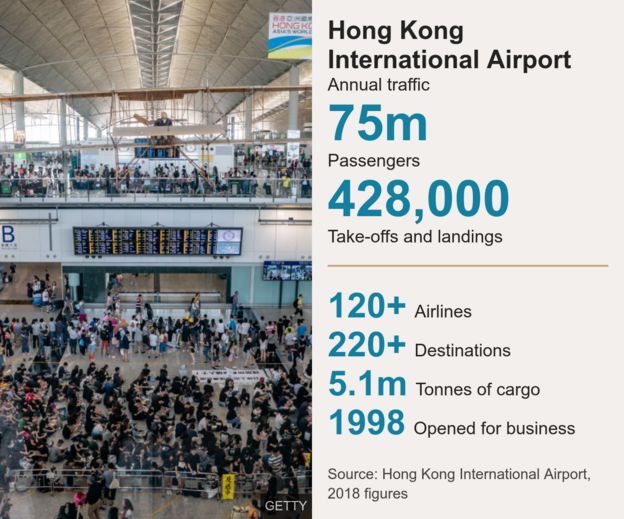
Hong Kong International Airport cancelled all departures on Monday, as thousands of anti-government protesters occupied and caused disruption.
Passengers have been told not to travel to the airport, which is one of the world’s busiest transport hubs.
In a statement, officials blamed “seriously disrupted” operations.
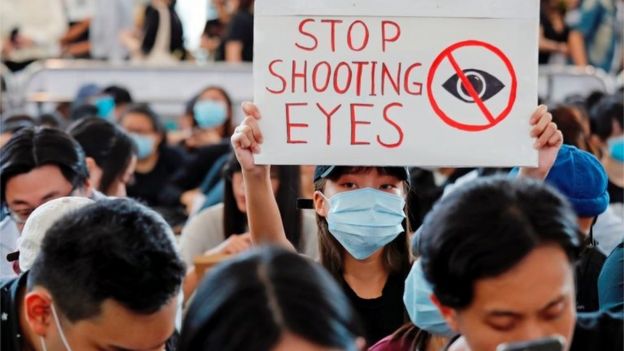
Many of those protesting are critical of the actions of police, who on Sunday were filmed firing tear gas and rubber bullets at close range.
Some protesters wore bandages over their eyes in response to images of a woman bleeding heavily from her eye on Sunday, having reportedly been shot by a police projectile.
In a statement on Monday afternoon, Hong Kong’s Airport Authority said they were cancelling all flights that were not yet checked in.
More than 160 flights scheduled to leave after 18:00 local time (10:00 GMT) will now not depart.
Arrivals already heading into Hong Kong will still be allowed to land, but other scheduled flights have been cancelled.
Officials are now working to reopen the airport by 06:00 on Tuesday, a statement said.
Some passengers expressed annoyance at the disruption. “It’s very frustrating and scary for some people,” one man from Pakistan told the BBC. “We’ll just have to wait for our next flight.”
Helena Morgan, from the UK, said she was set to return to the UK to get her exam results on Thursday. “I’m hoping we get back for them and we’re not on a flight,” she said.
But others were more understanding of the protests. “I was expecting something, given all the news,” one arrival, Gurinda Singh, told Reuters news agency.
As rumours spread that police plan to move in on protesters on Monday evening, thousands opted to leave on foot. There are large backlogs for transport back into the centre, local reports say.
The BBC’s Stephen McDonell, who is at the scene, says the airport has effectively shut down while authorities work out how to deal with the crisis.
Hong Kong’s mass demonstrations and unrest show no sign of abating, more than two months after they were sparked by a controversial extradition bill.
Beijing officials have strongly condemned Sunday’s violence and linked violent protesters to “terrorism”.
Image copyright REUTERSImage caption Many of those who gathered carried signs condemning police conduct
What happened on Sunday?
On Sunday afternoon, a peaceful rally in the city’s Victoria Park led to clashes when protesters moved out of the area and marched along a major road despite a police ban.
There were confrontations in several central districts and police used rubber bullets in an attempt to disperse the demonstrators.
In the bustling central Wan Chai district, petrol bombs and bricks were thrown at police, who responded by charging at protesters.
A number of people, including a police officer, were injured in the clashes.
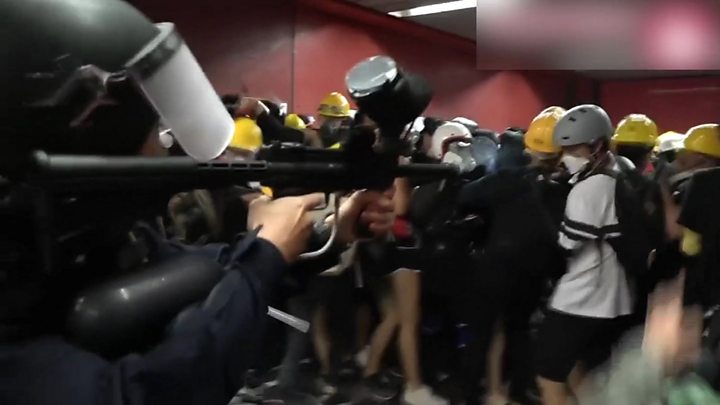
Videos on social media also showed officers storming enclosed railway stations and firing tear gas.
Footage inside another station showed officers firing what appeared to be rubber bullets at close range and several police officers beating people with batons.
Media caption Violence erupts in HK train stations
Local media outlets reported that suspected undercover police officers had dressed-up as protesters to make surprise arrests.
While protests in the city have turned increasingly violent, there were no reports of arrests during the three previous days of the airport sit-in.
What has the reaction been?
On Monday the Chinese authorities, who have not yet physically intervened to quell the unrest, used their strongest language yet to condemn violent protesters.
“Hong Kong’s radical demonstrators have repeatedly used extremely dangerous tools to attack police officers, which already constitutes a serious violent crime, and also shows the first signs of terrorism emerging,” Yang Guang, a spokesman for the Hong Kong and Macau Affairs Office (HKMAO), said at a press briefing.
“This wantonly tramples on Hong Kong’s rule of law and social order.”
Demonstrations started in June in opposition to a proposed extradition bill, which would have allowed suspected criminals to be sent to mainland China for trial.
Critics said it would undermine Hong Kong’s legal freedoms, and could be used to silence political dissidents.
Although the government has now suspended the bill, demonstrators want it to be fully withdrawn.
Their demands have broadened to include calls for an independent inquiry into alleged police brutality, and an amnesty for all arrested protesters.
Hong Kong is part of China but its citizens have more autonomy than those on the mainland.
It has a free press and judicial independence under the so-called “one country, two systems” approach – freedoms which activists fear are being increasingly eroded.






 CHINDIA ALERT: You'll be living in their world, very soon