Chindia Alert: You’ll be Living in their World Very Soon
aims to alert you to the threats and opportunities that China and India present. China and India require serious attention; case of ‘hidden dragon and crouching tiger’.
Without this attention, governments, businesses and, indeed, individuals may find themselves at a great disadvantage sooner rather than later.
The POSTs (front webpages) are mainly 'cuttings' from reliable sources, updated continuously.
The PAGEs (see Tabs, above) attempt to make the information more meaningful by putting some structure to the information we have researched and assembled since 2006.
Wuhan, where the first cases of the novel coronavirus were detected, is ending a 76-day lockdown
A day before the lockdown was fully lifted, Tencent announces a slew of initiatives focused on helping to revive the digital industry in the city
Passengers leaving Wuhan city are pictured at the Hankou Railway Station in Wuhan city, central China’s Hubei province, on Wednesday morning, April 08, 2020. Photo: SCMP/Simon Song
A day before China lifted a months-long lockdown of Wuhan city, the initial epicentre of the coronavirus pandemic, Chinese internet giant Tencent Holdings pledged to invest in digital government, online education and artificial intelligence (AI) in the city, among other fields.
“During the epidemic, Tencent has been supporting Hubei and Wuhan’s fight against the virus through funds and technology,” the company best known for its gaming business said in a statement posted on Tuesday on WeChat. “In the future, we will also fully support Wuhan’s post-pandemic reconstruction and continue to support the development of Wuhan’s digital industry.”
China’s major tech companies have played a big role in the fight against the coronavirus, and are now playing their part in the economic recovery of Wuhan and other areas that have suffered under extended travel restrictions and business closures.
and Pinduoduo each announced their own initiatives to help revive sales of farm goods from Hubei as the province emerges from its months-long lockdown.
Popular mobile payments app Alipay also created a dedicated section for Wuhan merchants to allow users to buy from merchants in the city, and offered loans to small local merchants in need of financial support, according to an Alipay statement. Alipay is operated by Ant Financial, an affiliate of Alibaba, which owns the South China Morning Post.
How tech has helped China in its public health battle with coronavirus
23 Mar 2020
Wuhan, an industrial powerhouse for the steel, semiconductors and automotive sectors, is emerging from an unprecedented lockdown which began on January 23 and prevented people from moving in and out of the city.
Since restrictions began easing gradually in late March, business activity has shown signs of recovery: Tencent’s mobile payment platform WeChat Pay recorded a 162 per cent increase in offline transactions in a 10-day period from March 25, compared to the same period the previous month, according to a separate statement by Tencent on Wednesday.
Searches for “work resumption certificates” – which businesses need to submit to local authorities to prove their staff can safely restart work – also increased 320 per cent on Baidu, China’s biggest search engine, in the past month, Baidu said in a report on Wednesday.
Tencent declined to provide specific details regarding the size of its latest investment in Wuhan or a timeline for its implementation, but said in the statement that it will involve closer cooperation with city authorities in the areas of digital government, education, smart mobility, AI and cybersecurity to help the city with its digital industries.
Among these initiatives, it will push ahead with a plan to build a headquarters focusing on digital industries in Wuhan, specifically digitalisation for the government and smart city initiatives.
It will also establish a base in Wuhan for its online education initiatives, set up an AI lab and cybersecurity academy and build a school focusing on smart mobility in collaboration with Chinese carmaker Dongfeng Motor Corporation, the company said in the statement.
The enterprise collaboration industry in China is forecast to achieve a compound annual growth rate of 12.4 per cent over five years to reach US$7 billion by 2024
Tencent has been accused of using its market dominance with WeChat to stifle competition. Photo: Reuters
Tencent’s super app WeChat, with a user base of 1.2 billion people, has blocked links from a ByteDance remote work tool as Chinese tech giants fight for dominance in the burgeoning enterprise collaboration market.
The latest move adds another ByteDance app to WeChat’s blacklist, which already includes Douyin, the Chinese version of TikTok, and its sister platform Xigua Video, amid ongoing accusations that Tencent uses its market dominance to stifle competition.
Feishu, the Chinese version of ByteDance’s productivity tool Lark, said Saturday that users could not open any of its links on WeChat, nor could they share name cards to invite colleagues.
Feishu said WeChat did not provide advance notice of the ban, adding that the move has “significantly affected work efficiency and user experience” at a time when many companies in China have moved their office operations online to limit the spread of coronavirus infections.
Instead, Lark users need to copy the link and open it in a browser instead of opening it directly via WeChat.
Tencent launches new social apps as flagships WeChat and QQ show their age
13 Dec 2019
A WeChat representative declined to comment other than to cite the company’s regulations on external links. The rules, introduced in October 2019, said the platform will punish websites or apps that send links to “mislead or entice users to download or redirect to an external app”. Punishment includes blocking their domain name from opening in WeChat.
Xie Xin, a ByteDance vice president overseeing Feishu, said the app does not support sign-ups using a WeChat account nor does it enable the sharing of documents or messages on the Tencent app.
In addition to blocking the ByteDance app, WeChat also suspended two tech-focused media websites, 36Kr and ITHome, from publishing posts on the platform after they reported the Lark case over the weekend. The relevant articles have also been removed from WeChat.
The WeChat representative said it did not force media to delete their articles. Rather, the media in question have violated WeChat’s rules on multiple occasions.
The enterprise collaboration industry in China, which has received a huge boost from the health crisis, is forecast to achieve a compound annual growth rate of 12.4 per cent over five years to reach nearly 49 billion yuan (US$7 billion) by 2024, according to the Qianzhan Industry Research Institute.
Feishu is a small but fast-emerging player in the sector, jumping 40 places from late January to become the 15th most downloaded business iOS app on Monday. However, it still lags far behind Alibaba’s DingTalk and Tencent’s WeChat Work and Tencent Meeting, which ranked as the top three among business iOS apps in China as of Monday, according to App Annie.
Alibaba is the parent company of the South China Morning Post.Tencent has also blocked apps from other Chinese tech giants. Links from Taobao, Alibaba’s online marketplace, and Haokan, a short video app from Baidu, cannot be accessed on WeChat. In contrast, Tencent allows the sharing of links from JD.com and PDD pages, online marketplaces in which it owns a financial stake.
“Having more than 1 billion users, [WeChat] has a monopolistic position in the market,” said Wang Sixin, a professor at the Communication University of China who specialises in media policy and rules. “Under these circumstances, Tencent has to have legitimate reasons to block other apps, otherwise it’s taking advantage of its dominance to force out smaller rivals.”
In April 2019, a Chinese lawyer sued Tencent under the country’s anti-monopoly law, charging that the company’s actions infringed on his rights as a user. In December, the intellectual property court in Beijing heard the case, with Tencent representatives arguing that WeChat did not prevent users from sharing links and using the app on other platforms, Southern Metropolis Daily reported. The court has not yet reached a verdict.
Besides enterprise collaboration, Tencent and ByteDance are coming up against each other in other markets. Last week Tencent began testing a short video function for WeChat, a sector dominated by TikTok and Douyin, while ByteDance plans to
BEIJING, Dec. 21 (Xinhua) — Ask the silver-haired residents of the elderly care community Yinheyuan in central Beijing what they know about artificial intelligence (AI), and they will probably throw the question to the smart speakers within their reach.
These smart speakers, capable of interacting with users with voice-recognition technologies, are also part of the answer. Via voice command, senior residents can control lights, TVs and other home appliances, order food or ask for help.
AI is no longer a technical term used exclusively by professionals in China. Both young and old are enjoying the benefits of the growing smart economy.
After personal computers (PC), PC internet and mobile internet, the growth focus of China’s digital economy is shifting to smart technologies like AI, said Baidu Chairman and CEO Robin Li at the World Internet Conference in October.
In the smart economy era, Li predicted a declining reliance on cellphones and a rising popularity of other smart devices. AI chips, cloud computing services, among others, would become the new digital infrastructure, while innovative businesses will flourish as transport, health, education and other sectors go smart.
Wearable devices, smart home appliances, autonomous driving and smart cities are among the fastest-growing fields in the smart economy.
China is the largest smart speaker market in the world, accounting for 36 percent of global shipments in the third quarter of 2019, according to global market firm Strategy Analytics. It found in a July and August survey that 63 percent of Chinese people without a smart speaker planned to buy one within the following year. Another 22 percent planned to make a purchase later on.
Chinese firms are stepping up investment in 5G, AI and the Internet of Things to gain a foothold in the emerging field. By end-June, China had over 1,200 AI-related enterprises, according to the Ministry of Industry and Information Technology.
Baidu launched its autonomous driving open platform ApollBo in 2017 to coordinate cross-sector efforts in this field. It has launched several L4 autonomous driving vehicles in partnership with leading automobile companies, and a fleet of Apollo-powered robotaxis are now taking test runs in central China’s Changsha.
Nurturing a smart economy is also on the government agenda. China has passed a guideline to boost the integration of AI and the real economy this year, and plans to build some 20 national AI innovative development pilot zones by 2023.
The country’s AI sector is forecast to be worth more than 160 billion yuan (about 22.83 billion U.S. dollars) in 2020, spurring related sectors to exceed 1 trillion yuan, said Lin Nianxiu, deputy director with the National Development and Reform Commission, citing industrial data.
Lin said China would focus on 100 firms dedicated to AI technologies and relevant applications, improve the industrial ecosystem, facilitate the deep integration of AI and the real economy, and intensify its international collaboration on AI technology, standards, industries, laws and regulations and ethics.
China’s talent is turning away from multinationals and towards domestic tech champions in the search for a more fulfilling career
Change in sentiment comes amid raging US-China tech war and perceptions of ‘bamboo ceiling’ in the West
An increasing number of Chinese jobseekers are looking towards domestic tech firms. Image: SCMP
Molly Liu left her hometown Beijing to pursue a master’s degree in the United States in the 1990s.
After graduation, she fought hard to win an entry-level position at a US-based consultancy and after a period was later sent back to China to help the company’s expansion.
In the land of opportunity, the ambitious US firm showered her with avenues to pursue her career and she ended up working in Hong Kong as well as being one of the first people on the ground for the consultancy in Shanghai, Beijing, Taipei and Singapore.
Times have changed, though. Recently, her only son, Ben Zhang, turned down a hard-to-get job offer from a Boeing subsidiary in the US after gaining a master’s degree in computer science from Carnegie Mellon University in Pittsburgh, Pennsylvania.
Chinese students educated in the US are now looking more at jobs in China. Photo: SCMP
He decided to return to Beijing in 2018 and now works as a product manager at Chinese smartphone maker Xiaomi. He is convinced that the start-up turned tech major can offer him the same sort of opportunities today that the US tech consultancy offered his mother in the 1990s.
This family story about the career choices of two different generations of US-educated Chinese students reflects a wider trend. Once upon a time, US corporations could cherry-pick top Chinese talent from American universities with the promise of large salaries, generous benefits and the chance to work at market-leading organisations.
Today, China’s cutting-edge technology companies – often referred to as China Tech Corporation (CTC) – are the most sought-after employers among many Chinese students, who want more than just a cushy life.
This marks another blow for multinational corporations (MNCs) already struggling to do business in China amid a myriad of restrictions and growing hostility towards them as the US-China trade and tech war gathers pace.
“What I look for in a job is not money. My parents are not counting on me to support them,” says 28-year-old Zhang, whose team in Xiaomi is working on a wide array of connected devices, from televisions to lamps to smart locks. “What I care about most is personal improvement and access to the best resources a company can offer.”
“In Boeing, I could probably work on a new product once every two to three years. But at Xiaomi, every three months, we can roll out a new product,” he added. “You can bring so many things into people’s everyday lives in China, like using your voice to control a TV or an air conditioner – things you can only imagine in the US.”
Zhang is not alone and many Chinese today perceive a “bamboo ceiling” in the US, where they are more often seen as engineers rather than executives.
One Chinese executive who now oversees the technology unit of a listed finance and insurance firm in China said that he used to lead a team of 20 engineers at one of the world’s most valuable tech companies in Silicon Valley.
“My job was to keep optimising the performance of a product [in Silicon Valley],” he said.
“But within three years in China, I was promoted to the chief scientist of our entire company, leading a team of 1,000,” said the man, who asked to remain anonymous as some of his family still reside in the US.
How Trump’s assault on Huawei is forcing the world to contemplate a digital iron curtain
According to an April survey by professional networking site LinkedIn, an increasing number of Chinese jobseekers share Zhang’s outlook. LinkedIn compiled a list of the top 25 most desired employers in China, and about 60 per cent were local Chinese companies, with 13 of them internet firms.
CTC bagged four of the top five spots, with e-commerce giant Alibaba, search giant operator Baidu and Bytedance – which operates short video hit TikTok – taking the lead.
Tesla ranked sixth behind its Chinese challenger Nio. Amazon, the only other foreign company in the top ten, ranked eighth.
Alibaba is the owner of the South China Morning Post.
Li Qiang, executive vice-president of Zhaopin, one of China’s largest online recruiters, described the rising status of CTC among jobseekers as “the dawning of a new era”.
“Nowadays, there is nothing a multinational can offer that a domestic firm cannot, be it a compensation package or the chance to be part of international expansion,” said Beijing-based Li.
“Jobseekers are not particularly looking for domestic firms or multinational firms. They are after good firms and most of the good firms in China these days happen to be domestic tech firms,” said Li.
Li’s comments reflect the wider opportunities within the domestic economy for Chinese jobseekers today, after the rise of many successful private-sector companies and a thriving start-up scene over the past 10 years, meaning it’s not just a one-way street to a state-owned enterprise (SOE) any longer.
A survey by Zhaopin in late 2018 found that 28 per cent of Chinese university students said MNCs were their employer of choice, down from 33.6 per cent in 2017.
Even on pay and benefits, CTC is catching up with multinationals. Zhang said Xiaomi matched the offer from the Boeing unit in the US and many leading tech firms offer benefits such as gym memberships and childcare facilities.
And the rags-to-riches stories of many leading China tech entrepreneurs, some of whom have become billionaires, continue to grab media attention and inspire the younger generation.
To be sure, Chinese students would still rather work for an MNC than an SOE – but the rise of CTC can be seen in company rankings and in the total number of CTC companies in the top employer list, according to Zhaopin.
For a growing number of Chinese students, the doors to America are closing
William Wu, China country manager of global employer brand consultancy Universum, said that the one element Chinese jobseekers pay most attention to these days is whether or not a job can be “a good reference point for a future career”. And a growing number of private Chinese companies now have global brand recognition.
A recent survey by Universum shows that Apple and Siemens were the only two Western names in the top 10 ideal employers for Chinese students in the engineering sector this year, while there were four foreign firms in the top 10 list in 2017.
Huawei Technologies, the Chinese telecoms giant that has been put on a US trade blacklist after the Trump administration said it was a national security risk, ranked top in the Universum list. Xiaomi, the smartphone maker Ben Zhang works for, ranked second while Apple, one of the most valuable tech firms in the US, ranked seventh.
It seems that China’s rising clout in the world is now an attractive factor for jobseekers.
“Every engineer would like to see the technology they’ve worked on have the potential to change the world one day,” said Li Yan, head of multimedia understanding at Chinese short video major Kuaishou. “In the old times Chinese companies were at the bottom of the global value chain, now they are climbing up, providing more opportunities for talent to create world-changing products.”
At Beijing-based Kuaishou, Li’s 100-strong artificial intelligence algorithm team – many of whom joined from Microsoft Asia Research – is working to make machines understand content better than humans by studying the millions of user-generated videos on the company’s platform every day.
CTC companies do have a strong home advantage, with big Western firms having to navigate a myriad of restrictions.
For example, the “Great Firewall” lets Chinese authorities control the content and information reaching the country’s 800 million-plus internet population. Western firms also face other forms of red tape, such as having to form joint ventures with local partners.
Amazon earlier this year announced the close of its China marketplace, giving up the brutal fight with Chinese online shopping giants such as Alibaba to capture domestic e-commerce market share. Oracle China reportedly laid off 900 people in March as it winds down its research and development center in the country.
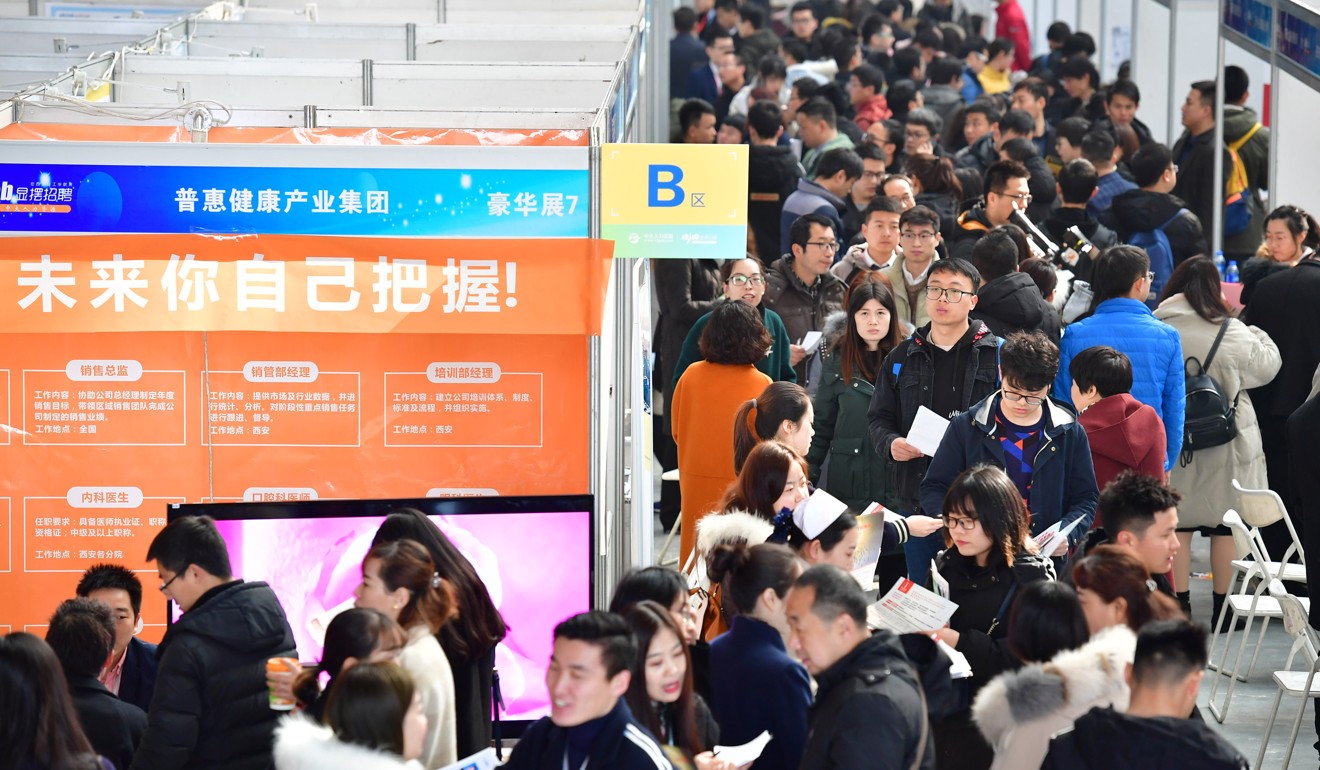
Job applicants visit a provincial job fair at Qujiang International Conference and Exhibition Center in Xian, northwest China’s Shaanxi Province in February. Photo: Xinhua
Oracle has never confirmed the number of lay-offs but said the job cuts formed part of an overall global strategy transformation.
However, there has been little sympathy for those losing their jobs in China, judging by social media posts.
Some people posted that those working for big US tech firms are not “wolf” enough compared with counterparts who work for local tech firms, referring to the long work-hours culture of the domestic tech scene.
A viral story titled “Why there should be no pity for the sacked Oracle China employees” said the company was Beijing’s biggest nursery because of the flexible “work from home” culture and generous compensation package offered to employees.
Oracle said to begin mass lay-offs in China as part of global move to cloud services
“They had every chance to join rising domestic internet firms. But they settled for high salary and low work pressure, which eventually made them frogs in boiling water. Why pity them?” said the article, adding that the earlier people give up on the “glory” of working for MNCs, the quicker they will benefit.
Not all Chinese workers would agree, and there has been a recent backlash against the “996” culture within China’s tech sector, where people routinely work from 9am to 9pm, six days a week.
With geopolitical uncertainty growing day by day, though, many Chinese are asking why leave the family behind for an uncertain fate overseas?
A survey done by consultancy BCG and The Network in 2018 showed that only one in three China residents was willing to move abroad for work, down from 61 per cent in 2014. The country is also the 20th most popular destination worldwide to relocate for a job, compared with 29th in the 2014.
“One of my graduate classmates in the US just gave up a six-digit package at Oracle and joined drone maker DJI in Shenzhen,” said Ben Zhang. “I asked what prompted his return to China. He sent me the viral article and asked, ‘who wants a life that one can see the end of from the very beginning?’”
BEIJING (Reuters) – It’s the most sensitive day of the year for China’s internet, the anniversary of the bloody June 4 crackdown on pro-democracy protests at Tiananmen Square, and with under two weeks to go, China’s robot censors are working overtime.
Censors at Chinese internet companies say tools to detect and block content related to the 1989 crackdown have reached unprecedented levels of accuracy, aided by machine learning and voice and image recognition.
“We sometimes say that the artificial intelligence is a scalpel, and a human is a machete,” said one content screening employee at Beijing Bytedance Co Ltd, who asked not to be identified because they are not authorised to speak to media.
Two employees at the firm said censorship of the Tiananmen crackdown, along with other highly sensitive issues including Taiwan and Tibet, is now largely automated.
Posts that allude to dates, images and names associated with the protests are automatically rejected.
“When I first began this kind of work four years ago there was opportunity to remove the images of Tiananmen, but now the artificial intelligence is very accurate,” one of the people said.
Four censors, working across Bytedance, Weibo Corp and Baidu Inc apps said they censor between 5,000-10,000 pieces of information a day, or five to seven pieces a minute, most of which they said were pornographic or violent content.
Despite advances in AI censorship, current-day tourist snaps in the square are sometimes unintentionally blocked, one of the censors said.
Bytedance declined to comment, while Weibo and Baidu did not respond to requests for comment.
SENSITIVE PERIOD
The Tiananmen crackdown is a taboo subject in China 30 years after the government sent tanks to quell student-led protests calling for democratic reforms. Beijing has never released a death toll but estimates from human rights groups and witnesses range from several hundred to several thousand.
June 4th itself is marked by a cat-and-mouse game as people use more and more obscure references on social media sites, with obvious allusions blocked immediately. In some years, even the word “today” has been scrubbed.
In 2012, China’s most-watched stock index fell 64.89 points on the anniversary day here, echoing the date of the original event in what analysts said was likely a strange coincidence rather than a deliberate reference.
Still, censors blocked access to the term “Shanghai stock market” and to the index numbers themselves on microblogs, along with other obscure references to sensitive issues.
While companies censorship tools are becoming more refined, analysts, academics and users say heavy-handed policies mean sensitive periods before anniversaries and political events have become catch-alls for a wide range of sensitive content.
In the lead-up to this year’s Tiananmen Square anniversary, censorship on social media has targeted LGBT groups, labour and environment activists and NGOs, they say.
Upgrades to censorship tech have been urged on by new policies introduced by the Cyberspace Administration of China (CAC). The group was set up – and officially led – by President Xi Jinping, whose tenure has been defined by increasingly strict ideological control of the internet.
The CAC did not respond to a request for comment.
Last November, the CAC introduced new rules aimed at quashing dissent online in China, where “falsifying the history of the Communist Party” on the internet is a punishable offence for both platforms and individuals.
The new rules require assessment reports and site visits for any internet platform that could be used to “socially mobilise” or lead to “major changes in public opinion”, including access to real names, network addresses, times of use, chat logs and call logs.
One official who works for CAC told Reuters the recent boost in online censorship is “very likely” linked to the upcoming anniversary.
“There is constant communication with the companies during this time,” said the official, who declined to directly talk about the Tiananmen, instead referring to the “the sensitive period in June”.
Companies, which are largely responsible for their own censorship, receive little in the way of directives from the CAC, but are responsible for creating guidelines in their own “internal ethical and party units”, the official said.
SECRET FACTS
With Xi’s tightening grip on the internet, the flow of information has been centralised under the Communist Party’s Propaganda Department and state media network. Censors and company staff say this reduces the pressure of censoring some events, including major political news, natural disasters and diplomatic visits.
“When it comes to news, the rule is simple… If it is not from state media first, it is not authorised, especially regarding the leaders and political items,” said one Baidu staffer.
“We have a basic list of keywords which include the 1989 details, but (AI) can more easily select those.”
Punishment for failing to properly censor content can be severe.
In the past six weeks, popular services including a Netease Inc news app, Tencent Holdings Ltd’s news app TianTian, and Sina Corp have all been hit with suspensions ranging from days to weeks, according to the CAC, meaning services are made temporarily unavailable on apps stores and online.
For internet users and activists, penalties can range from fines to jail time for spreading information about sensitive events online.
In China, social media accounts are linked to real names and national ID numbers by law, and companies are legally compelled to offer user information to authorities when requested.
“It has become normal to know things and also understand that they can’t be shared,” said one user, Andrew Hu. “They’re secret facts.”
In 2015, Hu spent three days in detention in his home region of Inner Mongolia after posting a comment about air pollution onto an unrelated image that alluded to the Tiananmen crackdown on Twitter-like social media site Weibo.
Hu, who declined to use his full Chinese name to avoid further run-ins with the law, said when police officers came to his parents house while he was on leave from his job in Beijing he was surprised, but not frightened.
“The responsible authorities and the internet users are equally confused,” said Hu. “Even if the enforcement is irregular, they know the simple option is to increase pressure.”
Image copyrightREUTERSImage caption This year marks the 30th anniversary of the pro-democracy protests
A promotional video for camera company Leica has sparked backlash in China for featuring a famous Tiananmen Square image.
The video depicts photographers working in conflicts around the world, including a photographer covering the 1989 protests.
People on Chinese social media site Weibo have called for a boycott of the camera brand.
Leica has distanced itself from the video.
“Tank Man” was a lone protester who brought a column of tanks to a standstill during a crackdown on pro-democracy protesters in Beijing in 1989.
He refused to move out of the way and climbed onto the leading tank to speak to the driver. He was later pulled away from the scene by two men. What happened to him remains unknown.
Users on Chinese social media site Weibo have been forbidden from commenting on recent official posts by Leica. However some people are managing to post carefully worded comments on earlier official Leica posts, BBC Monitoring has found.
A search of the hashtag Leica shows that 42,000 users have left posts on Weibo but only 10 are available to view.
Some comments urge users to “boycott the camera” and joke about the company being linked to “patriotic Huawei”.
Chinese technology giant Huawei has been restricted by the US and other countries over security concerns in telecommunications networks. Consumers in China have rallied around the company, which uses Leica technology in its latest mobile phones.
A spokeswoman for Leica told the South China Morning Post that the film was not an officially sanctioned marketing film commissioned by the company. However it features Leica cameras and the company’s logo at the end of the footage.
They added that the company “must therefore distance itself from the content shown in the video and regrets any misunderstandings of false conclusions that may have been drawn”.
The BBC has contacted Leica for additional comment.
How China keeps Tiananmen off the internet
By Kerry Allen, BBC Monitoring China analyst
China has banned all activists’ commemorations of the 1989 Tiananmen incident for years and has strictly regulated online discussion of it.
If users search for “Tiananmen” on domestic search engines like Baidu or social media platforms like Sina Weibo, they only see sunny pictures of the Forbidden City in Beijing. If any pictures of tanks running along Chang’an Avenue are visible in image searches, they are only from Victory Day parades.
Hundreds of references to 4 June 1989 are banned all-year round by thousands of cyber police, and Weibo steps up censorship of even seemingly innocuous references to the incident on its anniversary.
Simple candle emojis, and number sequences that reference the date, such as “46” and “64” (4 June) and “1989” (the year of the protests), are instantly deleted. Small businesses also struggle to market items on 4 June every year, if their sale price is 46 or 64 yuan. Such advertising posts are swiftly removed by nervous censors.
But creative users always find ways of circumventing the censors. For example in 2014, when Taylor Swift released her 1989 album, the album cover featuring the words “T.S.” and “1989” was seen as an effective metaphor by users to talk about the incident – as T.S. could be taken to mean “Tiananmen Square”.
More than one million Chinese students and workers occupied Tiananmen Square in 1989, beginning the largest political protest in communist China’s history. Six weeks of protests ended with the bloody crackdown on protesters of 3-4 June.
Estimates of the death toll range from several hundred to more than 1,000.
China’s statement at the end of June 1989 said that 200 civilians and several dozen security personnel had died in Beijing following the suppression of “counter-revolutionary riots” on 4 June 1989.






 CHINDIA ALERT: You'll be living in their world, very soon