Chindia Alert: You’ll be Living in their World Very Soon
aims to alert you to the threats and opportunities that China and India present. China and India require serious attention; case of ‘hidden dragon and crouching tiger’.
Without this attention, governments, businesses and, indeed, individuals may find themselves at a great disadvantage sooner rather than later.
The POSTs (front webpages) are mainly 'cuttings' from reliable sources, updated continuously.
The PAGEs (see Tabs, above) attempt to make the information more meaningful by putting some structure to the information we have researched and assembled since 2006.
Image copyrightGETTY IMAGESImage captionAn Indian man watches the news broadcasting images of the released Indian pilot
As tensions between India and Pakistan escalated following a deadly suicide attack last month, there was another battle being played out on the airwaves. Television stations in both countries were accused of sensationalism and partiality. But how far did they take it? The BBC’s Rajini Vaidyanathan in Delhi and Secunder Kermani in Islamabad take a look.
It was drama that was almost made for television.
The relationship between India and Pakistan – tense at the best of times – came to a head on 26 February when India announced it had launched airstrikes on militant camps in Pakistan’s Balakot region as “retaliation” for a suicide attack that had killed 40 troops in Indian-administered Kashmir almost two weeks earlier.
A day later, on 27 February, Pakistan shot down an Indian jet fighter and captured its pilot.
Abhinandan Varthaman was freed as a “peace gesture”, and Pakistan PM Imran Khan warned that neither country could afford a miscalculation, with a nuclear arsenal on each side.
Suddenly people were hooked, India’s TV journalists included.
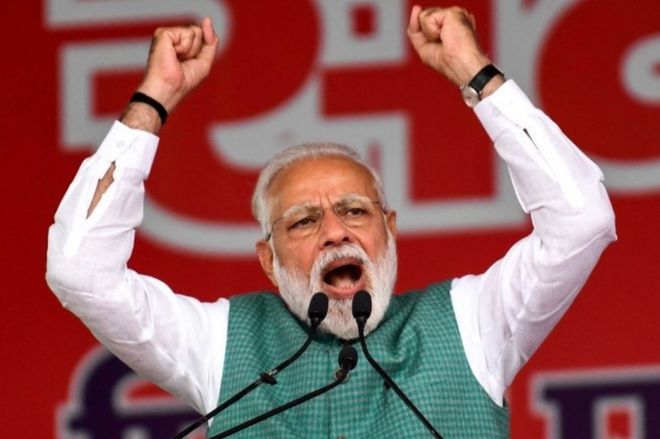
Image copyrightAFPImage captionIndian PM Narendra Modi is accused of exploiting India-Pakistan hostilities for political gain
So were they more patriots than journalists?
Rajini Vaidyanathan: Indian television networks showed no restraint when it came to their breathless coverage of the story. Rolling news was at fever pitch.
The coverage often fell into jingoism and nationalism, with headlines such as “Pakistan teaches India a lesson”, “Dastardly Pakistan”, and “Stay Calm and Back India” prominently displayed on screens.
Some reporters and commentators called for India to use missiles and strike back. One reporter in south India hosted an entire segment dressed in combat fatigues, holding a toy gun.
And while I was reporting on the return of the Indian pilot at the international border between the two countries in the northern city of Amritsar, I saw a woman getting an Indian flag painted on her cheek. “I’m a journalist too,” she said, as she smiled at me in slight embarrassment.
Print journalist Salil Tripathi wrote a scathing critique of the way reporters in both India and Pakistan covered the events, arguing they had lost all sense of impartiality and perspective. “Not one of the fulminating television-news anchors exhibited the criticality demanded of their profession,” she said.
Media captionIndia and Pakistan’s ‘war-mongering’ media
Secunder Kermani: Shortly after shooting down at least one Indian plane last week, the Pakistani military held a press conference.
As it ended, the journalists there began chanting “Pakistan Zindabad” (Long Live Pakistan). It wasn’t the only example of “journalistic patriotism” during the recent crisis.
Two anchors from private channel 92 News donned military uniforms as they presented the news – though other Pakistani journalists criticised their decision.
But on the whole, while Indian TV presenters angrily demanded military action, journalists in Pakistan were more restrained, with many mocking what they called the “war mongering and hysteria” across the border.
In response to Indian media reports about farmers refusing to export tomatoes to Pakistan anymore for instance, one popular presenter tweeted about a “Tomatical strike” – a reference to Indian claims they carried out a “surgical strike” in 2016 during another period of conflict between the countries.
Media analyst Adnan Rehmat noted that while the Pakistani media did play a “peace monger as opposed to a warmonger” role, in doing so, it was following the lead of Pakistani officials who warned against the risks of escalation, which “served as a cue for the media.”
What were they reporting?
Rajini Vaidyanathan: As TV networks furiously broadcast bulletins from makeshift “war rooms” complete with virtual reality missiles, questions were raised not just about the reporters but what they were reporting.
Indian channels were quick to swallow the government version of events, rather than question or challenge it, said Shailaja Bajpai, media editor at The Print. “The media has stopped asking any kind of legitimate questions, by and large,” she said. “There’s no pretence of objectiveness.”
In recent years in fact, a handful of commentators have complained about the lack of critical questioning in the Indian media.
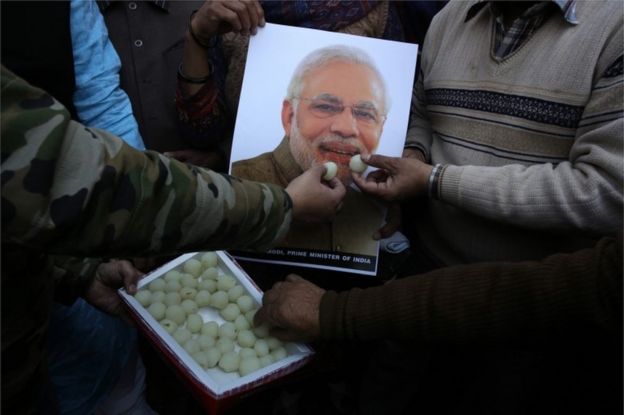
Image copyrightAFPImage captionIndians celebrated news of the strikes
“For some in the Indian press corps the very thought of challenging the ‘official version’ of events is the equivalent of being anti-national”, said Ms Bajpai. “We know there have been intelligence lapses but nobody is questioning that.”
Senior defence and science reporter Pallava Bagla agreed. “The first casualty in a war is always factual information. Sometimes nationalistic fervour can make facts fade away,” he said.
This critique isn’t unique to India, or even this period in time. During the 2003 Iraq war, western journalists embedded with their country’s militaries were also, on many occasions, simply reporting the official narrative.
Secunder Kermani: In Pakistan, both media and public reacted with scepticism to Indian claims about the damage caused by the airstrikes in Balakot, which India claimed killed a large number of Jaish-e-Mohammad (JeM) militants in a training camp.
Hamid Mir, one of the most influential TV anchors in the country travelled to the area and proclaimed, “We haven’t seen any such (militant) infrastructure… we haven’t seen any bodies, any funerals.”
“Actually,” he paused, “We have found one body… this crow.” The camera panned down to a dead crow, while Mr Mir asked viewers if the crow “looks like a terrorist or not?”
There seems to be no evidence to substantiate Indian claims that a militant training camp was hit, but other journalists working for international outlets, including the BBC, found evidence of a madrassa, linked to JeM, near the site.
Image copyrightPLANET LABS INC./HANDOUT VIA REUTERSImage captionThe satellite image shows a close-up of a madrassa near Balakot in Pakistan’s Khyber Paktunkhwa
A photo of a signpost giving directions to the madrassa even surfaced on social media. It described the madrassa as being “under the supervision of Masood Azhar”. Mr Azhar is the founder of JeM.
The signpost’s existence was confirmed by a BBC reporter and Al Jazeera, though by the time Reuters visited it had apparently been removed. Despite this, the madrassa and its links received little to no coverage in the Pakistani press.
Media analyst Adnan Rehmat told the BBC that “there was no emphasis on investigating independently or thoroughly enough” the status of the madrassa.
In Pakistan, reporting on alleged links between the intelligence services and militant groups is often seen as a “red line”. Journalists fear for their physical safety, whilst editors know their newspapers or TV channels could face severe pressure if they publish anything that could be construed as “anti-state”.
Who did it better: Khan or Modi?
Rajini Vaidyanathan: With a general election due in a few months, PM Narendra Modi continued with his campaign schedule, mentioning the crisis in some of his stump speeches. But he never directly addressed the ongoing tensions through an address to the nation or a press conference.
This was not a surprise. Mr Modi rarely holds news conference or gives interviews to the media. When news of the suicide attack broke, Mr Modi was criticised for continuing with a photo shoot.
Image copyrightAFPImage captionImran Khan was praised for his measured approach
The leader of the main opposition Congress party, Rahul Gandhi, dubbed him a “Prime Time Minister” claiming the PM had carried on filming for three hours. PM Modi has also been accused of managing his military response as a way to court votes.
At a campaign rally in his home state of Gujarat he seemed unflustered by his critics, quipping “they’re busy with strikes on Modi, and Modi is launching strikes on terror.”
Secunder Kermani: Imran Khan won praise even from many of his critics in Pakistan, for his measured approach to the conflict. In two appearances on state TV, and one in parliament, he appeared firm, but also called for dialogue with India.
His stance helped set the comparatively more measured tone for Pakistani media coverage.
Officials in Islamabad, buoyed by Mr Khan’s decision to release the captured Indian pilot, have portrayed themselves as the more responsible side, which made overtures for peace.
On Twitter, a hashtag calling for Mr Khan to be awarded a Nobel Peace Prize was trending for a while. But his lack of specific references to JeM, mean internationally there is likely to be scepticism, at least initially, about his claims that Pakistan will no longer tolerate militant groups targeting India.
The Chinese foreign ministry on Thursday released a statement in Chinese following the visit of vice-foreign minister Kong Xuanyou to Pakistan, lauding Islamabad’s response.
WORLDUpdated: Mar 07, 2019 16:42 IST
Sutirtho Patranobis
Hindustan Times, Beijing
Kong visited Pakistan as Islamabad faced pressure from global powers to act against groups carrying out attacks in India, including Jaish-e-Mohammed (JeM), which claimed responsibility for the February 14 attack that killed 40 CRPF personnel in Pulwama.(REUTERS File Photo)
China has praised Pakistan for its handling of the tense situation with India, appreciating Islamabad’s “restraint” in the aftermath of the Pulwama terror attack in Jammu and Kashmir in February.
The Chinese foreign ministry on Thursday released a statement in Chinese following the visit of vice-foreign minister Kong Xuanyou to Pakistan, lauding Islamabad’s response.
“China has paid close attention to the present situation between Pakistan and India, and appreciates Pakistan remaining calm and exercising restraint from the beginning, and persisting in pushing to lower the temperature with India via dialogue,” the foreign ministry statement said.
It paraphrased Kong’s discussions with Pakistan’s leadership comprising Prime Minister Imran Khan, army chief General Qamar Javed Bajwa and foreign minister Shah Mehmood Qureshi.
In turn, the statement quoted the Pakistani side thanking China’s “objective and fair position” on the situation and for its efforts to promote the “cooling” of the situation.
Kong visited Pakistan as Islamabad faced pressure from global powers to act against groups carrying out attacks in India, including Jaish-e-Mohammed (JeM), which claimed responsibility for the February 14 attack that killed 40 CRPF personnel in Pulwama.
The Pulwama suicide attack – the worst in Kashmir in decades – led to the most serious conflict in years between the nuclear-armed neighbours with India carrying out a strike on a JeM camp in Balakot and then a dogfight over the skies of Kashmir.
The crisis seems to have eased after Pakistan returned IAF Wing Commander Abhinandan Varthaman last Friday, nearly two days after he was captured.
Kong was quoted as telling the Pakistani leadership that China maintains that the sovereignty and territorial integrity of all countries should be earnestly respected and that Beijing is unwilling to see acts that violate the norms of international relations.
The statement quoted Kong as saying that China calls on Pakistan and India to refrain from taking actions to aggravate the situation, show goodwill and flexibility, launch dialogue as soon as possible, and work together to maintain regional peace and stability.
China is willing to continue to play a constructive role in this regard, Kong is quoted to have said.
According to the statement, the Pakistani leaders appreciated China’s objective and fair position on the situation in Pakistan and India and thanked China for its efforts to promote the cooling of the situation.
It added that the Pakistani side reiterated that it is unwilling to see an escalation of the situation and is willing to resolve the contradictions and differences between the two sides through dialogue and peacefully, and welcomes China and the international community to play an active role in this regard.
Image copyrightAFPImage captionMr Modi is accused of exploiting India-Pakistan hostilities for political gain
A gaffe is when a politician tells the truth, American political journalist Michael Kinsley said.
Last week, a prominent leader of India’s ruling Hindu nationalist Bharatiya Janata Party (BJP) appeared to have done exactly that. BS Yeddyurappa said the armed aerial hostilities between India and Pakistan would help his party win some two dozen seats in the upcoming general election.
The remark by Mr Yeddyurappa, former chief minister of Karnataka, was remarkable in its candour. Not surprisingly, it was immediately seized upon by opposition parties. They said it was a brazen admission of the fact that Prime Minister Narendra Modi’s party was mining the tensions between the nuclear-armed rivals ahead of general elections, which are barely a month away. Mr Modi’s party is looking at a second term in power.
Mr Yeddyurappa’s plain-spokenness appeared to have embarrassed even the BJP. Federal minister VK Singh issued a statement, saying the government’s decision to carry out air strikes in Pakistan last week was to “safeguard our nation and ensure safety of our citizens, not to win a few seats”. No political party can afford to concede that it was exploiting a near war for electoral gains.
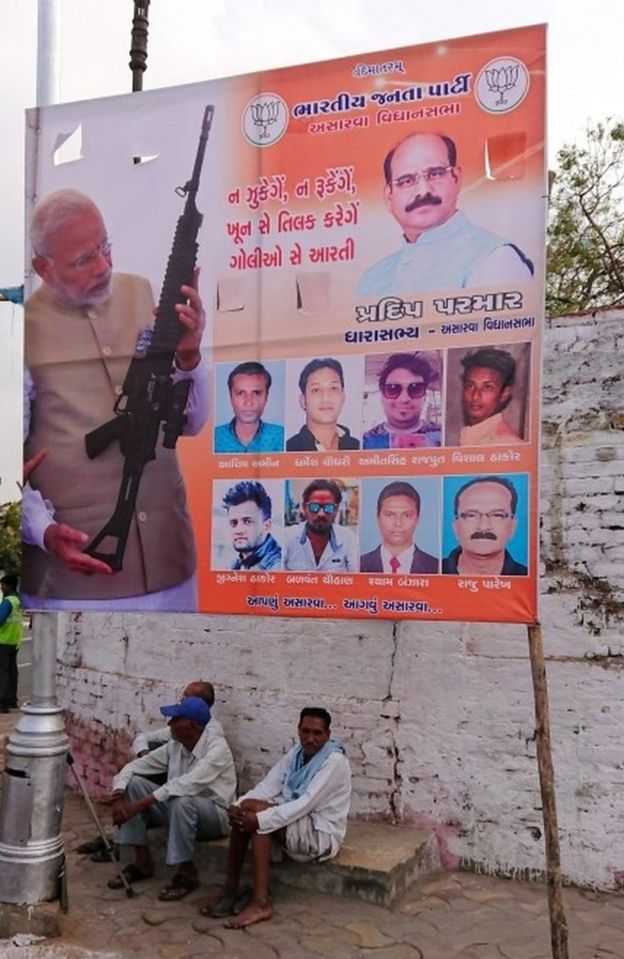
Image copyrightAFPImage captionThe BJP has put up election posters of Mr Modi posing with guns
Even as tensions between India and Pakistan ratcheted up last week, Mr Modi went on with business as usual. Hours after the Indian attack in Pakistan’s Balakot region, he told a packed election meeting that the country was in safe hands and would “no longer be helpless in the face of terror”. Next morning, Pakistan retaliated and captured an Indian pilot who ejected from a downed fighter jet. Two days later, Pakistan returned the pilot to India.
Mr Modi then told a gathering of scientists that India’s aerial strikes were merely a “pilot project” and hinted there was more to come. Elsewhere, his party chief Amit Shah said India had killed more than 250 militants in the Balakot attack even as senior defence officials said they didn’t know how many had died. Gaudy BJP posters showing Mr Modi holding guns and flanked by soldiers, fighter jets and orange explosions have been put up in parts of the country. “Really uncomfortable with pictures of soldiers on election posters and podiums. This should be banned. Surely the uniform is sullied by vote gathering in its name,” tweeted Barkha Dutt, an Indian television journalist and author.
Mr Modi has appealed to the opposition to refrain from politicising the hostilities. The opposition parties are peeved because they believe Mr Modi has not kept his word. Last week, they issued a statement saying “national security must transcend narrow political considerations”.
‘Petty political gain’
But can the recent conflict fetch more votes for Mr Modi? In other words, can national security become a campaign plank?
Many believe Mr Modi is likely to make national security the pivot of his campaign. Before last month’s suicide attack – claimed by Pakistan-based militants – killed more than 40 Indian paramilitaries in Kashmir, Mr Modi was looking a little vulnerable. His party had lost three state elections on the trot to the Congress party. Looming farm and jobs crises were threatening to hurt the BJP’s prospects.
Now, many believe, Mr Modi’s chances look brighter as he positions himself as a “muscular” protector of the country’s borders. “This is one of the worst attempts to use war to win [an] election, and to use national security as petty political gain. But I don’t know whether it will succeed or not,” says Yogendra Yadav, a politician and psephologist.
Image copyrightEPAImage captionMany Indians have celebrated India’s strike in Pakistani territory
Evidence is mixed on whether national security helps ruling parties win elections in India. Ashutosh Varshney, a professor of political science at Brown University in the US, says previous national security disruptions in India were “distant from the national elections”.
The wars in 1962 (against China) and 1971 (against Pakistan) broke out after general elections. Elections were still two years away when India and Pakistan fought a war in 1965. The 2001 attack on the Indian parliament that brought the two countries to the brink of war happened two years after a general election. The Mumbai attacks in 2008 took place five months before the elections in 2009 – and the then ruling Congress party won without making national security a campaign plank.
For one, he says, it comes just weeks ahead of a general election in a highly polarised country. The vast expansion of the urban middle class means that national security has a larger constituency. And most importantly, according to Dr Varshney, “the nature of the regime in Delhi” is an important variable. “Hindu nationalists have always been tougher on national security than the Congress. And with rare exceptions, national security does not dominate the horizons of regional parties, governed as they are by caste and regional identities.”
Bhanu Joshi, a political scientist also at Brown University, believes Mr Modi’s adoption of a muscular and robust foreign policy and his frequent international trips to meet foreign leaders may have touched a chord with a section of voters. “During my work in northern India, people would continuously invoke the improvement in India’s stature in the international arena. These perceptions get reinforced with an event like [the] Balakot strikes and form impressions which I think voters, particularly on a bipolar contest of India and Pakistan, care about,” says Mr Joshi.
Others like Milan Vaishnav, senior fellow and director of the South Asia Program at the Carnegie Endowment for International Peace, echo a similar sentiment. He told me that although foreign policy has never been a “mass” issue in India’s domestic politics, “given the proximity of the conflict to the elections, the salience of Pakistan, and the ability of the Modi government to claim credit for striking back hard, I expect it will become an important part of the campaign”.
But Dr Vaishnav believes it will not displace the economy and farm distress as an issue, especially in village communities. “Where it will help the BJP most is among swing voters, especially in urban constituencies. If there were fence-sitters unsure of how to vote in 2019, this emotive issue might compel them to stick with the incumbent.”
How the opposition counters Mr Modi’s agenda-setting on national security will be interesting to watch. Even if the hostilities end up giving a slight bump to BJP prospects in the crucial bellwether states in the north, it could help take the party over the winning line. But then even a week is a long time in politics.
IAF strike on Jaish camp in Pakistan updates: IAF pilot who engaged Pakistan jets missing in action, said the government. India verifying Pak claims on his custody. Follow live updates here:
Pakistani aircraft violated Indian air space in the Nowshera sector of Jammu and Kashmir’s Rajouri district on Wednesday morning. The Indian Air Force scrambled jets and pushed them back. News agency ANI has reported that a Pakistan Air Force F-16 was shot down in Indian retaliatory fire in Nowshera’s Lam valley.
The Pakistani jets had entered into Indian air space over Rajouri district this morning, sources said.
The air space violation by Pakistani jets comes a day after Indian Air Force jets flew across the Line of Control to blow up Jaish-e-Mohammed’s biggest terror camp.
Watch| India lost one MiG 21, pilot who engaged Pak jets ‘missing in action’: Govt
Army’s Eastern Command chief visits Panagarh base in West Bengal amid escalating tensions
Amid heightened tensions between India and Pakistan, Army’s Eastern Command chief Lt General Manoj Naravane visited Panagarh base in West Bengal on Wednesday and reviewed operational preparedness, a defence official said.
Lt Gen Naravane, General Officer Commanding-in-Chief, Eastern Command, emphasised the need for remaining alert at all times to meet the emerging security challenges, the official said.
4:50 pm IST
“Whole country is proud of this brave son,” Arvind Kejriwal tweets for IAF pilot’s safe return
“I pray for the safety of Indian Air Force pilot Wing Commander Abhinandan,” tweeted Arvind Kejriwal. “Whole country is proud of this brave son and everyone is hoping for his safe return. We all stand united to keep our country safe and strong,” Arvind Kejriwal said in the tweet.
4:35 pm IST
Pakistan has long denied its role in terror acts in India
In his last televised statement, Imran Khan appeared to ignore the claims made by Jaish. Pakistan has long denied its role in terror acts in India, which has handed it over several dossiers containing evidence of involvement of terror groups working from its soil.
4:33 pm IST
Imran Khan’s fresh call for dialogue comes in the wake of Pulwama terror attack
Imran Khan’s fresh call for dialogue comes in the wake of India’s effort to corner Pakistan among international community in the wake of Pulwama terror attack, in which at least 40 soldiers were killed. Pakistan-based Jaish-e-Mohammed claimed responsibility for the attack.
4:26 pm IST
Imran Khan calls for talks to de-escalate rising tensions with India over Kashmir
Pakistani Prime Minister Imran Khan calls for talks to de-escalate rising tensions with India over Kashmir.
3:57 pm IST
Better sense should prevail: Imran Khan after Pak strike
“We offered that we are ready for any kind of investigation after Pulwama attack in India. We didn’t take action on Tuesday morning because we weren’t aware of the damage caused by air strike by India. We did not want to cause much collateral damage in India when there was not much damage on our side. The only motive of Pakistan’s strike today was to demonstrate that we have the capability to hit back.
All the wars have happened due to miscalculation. With all the weapons that Pakistan and India have, can we afford to miscalculate. If we take to war neither I nor Mr Narendra Modi would be in a position to control its course. This is why I suggest that better sense should prevail,” said Imran Khan.
3:25 pm IST
IAF pilot who engaged Pak jets missing in action: Govt
IAF pilot who engaged Pakistan jets missing in action, said the government. India verifying Pak claims on his custody.
Pakistan used air force to target military installations, attempt foiled successfully, the government added.
3:20 pm IST
Foreign ministry and Air Vice Marshal brief media
Foreign ministry and Air Vice Marshal briefed the media.
3:00 pm IST
Maharashtra on high alert amid border tensions
Maharashtra and its capital Mumbai have been put on high alert’ in the wake of the rising tensions on the country’s north-west border, official sources said in Mumbai on Wednesday.
Heightened security was seen in Mumbai, the commercial capital of the country. Police vigil has been enhanced in Pune, Nagpur, Aurangabad, Nashik and Kolhapur as well. The government is ensuring there is no disturbance to the ongoing HSC (Class XII) examinations in the state, reported news agency IANS.
2:45 pm IST
Pakistan closes its airspace for commercial flights
Pakistan has closed its airspace for commercial flights, the Civil Aviation Authority (CAA) announced on Wednesday amid escalating tensions with India.
The aviation authority made the announcement on Twitter after Major General Asif Ghafoor, Director General of the Pakistan Army’s media wing, Inter-Services Public Relations (ISPR), acknowledged the closure of Pakistan’s airspace due to the security situation, Dawn News reported.
2:35 pm IST
Air India avoiding route of Pakistan air space with immediate effect
Air India avoiding route of Pakistan air space with immediate effect. India use Pakistan airspace for flights to Gulf countries, Europe and USA, said an Air India official
1:25 pm IST
Pakistan says 2 IAF jets shot down, India rejects claim
There are no reports of any IAF jet suffering damage in action by India’s adversaries, defence sources said on Wednesday according to news agency PTI.
Earlier in the day, Pakistan claimed it shot down two Indian military aircraft over Pakistani air space and arrested at least one of the pilots, according to PTI.
1:20 pm IST
Army, BSF troops along IB, LoC on highest degree of alertness: Officials
The Army and BSF have been put on the highest degree of alertness along the border in Jammu after air space violations by the neighbouring country and the night-long heavy firing and shelling by Pakistani troops on forward and civilians areas across the LoC which stopped on Wednesday, reported news agency PTI.
Authorities have ordered temporary closure of educational institutions in a 5-km radius along the Line of Control (LoC) in Rajouri and Poonch districts on Wednesday amid mounting tensions between the two countries, following the Pulwama terror attack on February 14 and an Indian air strike on Jaish-e-Mohammed camp inside Pakistan on Tuesday.
1:14 pm IST
Defence minister Nirmala Sitharaman chairs DAC meeting
The Defence Acquisition Council (DAC) chaired by defence minister Nirmala Sitharaman met here today and accorded approval for acquisition of defence equipment for about Rs 2700 crores.
Approval was granted for procurement of three Cadet Training ships for the Indian Navy, which would be utilised to provide basic sea training for officer cadets including women officer undertrainees. The ships would be capable of undertaking Hospital Ship duties, providing Humanitarian Assistance and Disaster Relief, undertaking Search and Rescue (SAR) missions and Non-Combatant Evacuation Operations.
1:08 am IST
China reiterates call for India and Pakistan to exercise restraint
China’s Foreign Ministry on Wednesday said it reiterated its call for India and Pakistan to exercise restraint.
Ministry spokesman Lu Kang made the comment at a regular news briefing in Beijing.
1:00 pm IST
PM Modi rushes to review security situation: Report
Prime Minister Narendra Modi cut short his address at a function in Vigyan Bhawan on Wednesday and rushed to attend a meeting to review the security situation arising out of Pakistan’s attempt to violate Indian air space, reported news agency ANI.
Modi was replying to the questions from youngsters during the National Youth Festival 2019 when he was handed over a small piece of paper by an official of Prime Minister Office (PMO).
The Prime Minister immediately stopped and walked towards the panelist where Union minister Rajyavardhan Rathore was also present.
12:53 pm IST
Pakistan stops domestic, international flight operations from Lahore, Multan, Faisalabad, Sialkot and Islamabad
Pakistan immediately stops its domestic and international flight operations from Lahore, Multan, Faisalabad, Sialkot and Islamabad airports, reported news agency ANI.
12:30 pm IST
Sensex turns negative; cracks over 200 points
The benchmark BSE Sensex gave up all early gains and fell over 200 points in afternoon trade Wednesday on widespread selling after Pakistani fighter jets violated Indian air space in Jammu and Kashmir.
After dropping 238 points, the Sensex was trading 161.74 points, or 0.46 per cent, down at 35,811.97 after hitting a low of 35,735.33. The gauge rallied nearly 400 points in morning trade.
The 50-share Nifty also fell 62.55 points, or 0.58 per cent, to 10,772.75.
According to brokers, investor sentiment took a beating after Pakistan claimed that it shot down two Indian military aircraft over Pakistani air space and arrested one of the pilots.
The Pakistani fighter jets on Wednesday violated Indian air space in Jammu and Kashmir’s Poonch and Nowshera sectors.
12:08 pm IST
Rajnath reviews security situation
Home Minister Rajnath Singh Wednesday reviewed the security situation in the country, especially along the border with Pakistan, a day after Indian fighter jets bombed the biggest camp of terror group Jaish-e-Mohammad in that country, officials said.
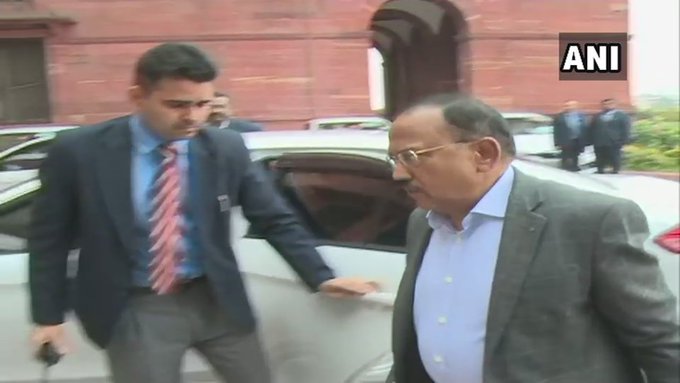
During the meeting, attended by National Security Advisor Ajit Doval among others, a detailed presentation was given about the security situation in the country and steps taken to ensure peace in all sensitive places.
Singh directed the officials to ensure the Border Security Force, which guards the India-Pakistan border continues to remain on highest level of alertness so that any misadventure from across the border could be foiled, a home ministry official said.
12:01 pm IST
‘Don’t want to escalate tensions, but we are prepared’, says Pakistan
“Today, Pakistan Air Force undertook strikes across Line of Control from within Pakistani airspace. This was not a retaliation to continued Indian belligerence. Pakistan has therefore, taken strikes at non military target, avoiding human loss and collateral damage. Sole purpose being to demonstrate our right, will and capability for self defence.
We have no intention of escalation, but are fully prepared to do so if forced into that paradigm. That is why we undertook the action with clear warning and in broad daylight. For the last few years, India has been trying to establish what they call “a new normal” a thinly veiled term for doing acts of aggression at whatever pretext they wish on a given day.
If India is striking at so called terrorist backers without a shred of evidence, we also retain reciprocal rights to retaliate against elements that enjoy Indian patronage while carrying out acts of terror in Pakistan. We do not wish to go to that route and wish that India gives peace a chance and to resolve issues like a mature democratic nation,” read a statement released by Pakistan on Wednesday.
11:50 am IST
National Security Advisor Ajit Doval arrives at Home Ministry
National Security Advisor Ajit Doval arrived at the Home Ministry in Delhi.
Hope India, Pak conduct dialogue to establish facts through investigation: Wang Yi
“As a mutual friend to both India and Pakistan, we hope that they can conduct dialogue to establish facts through investigation to keep things under control and maintain peace and stability in the region. In this process China is playing a constructive role not the opposite,” said China’s foreign minister Wang Yi.
11:42 am IST
Russia, China and India reaffirmed strong opposition to terrorism: Wang Yi
“Russia, China and India reaffirmed strong opposition to terrorism. At the same time we (China) believe Pakistan has always been opposed to terrorism. China appreciates statements from Indian and Pak friends saying they’ll exercise restraint and avoid escalation of situation,” said China’s foreign minister Wang Yi.
11:37 am IST
Pakistani jets violate Indian air space in Nowshera
Pakistani jets violated Indian air space in Jammu and Kashmir’s Nowshera sector but were successfully confronted.
An official said the jets were immediately pushed back by Indian jets on air patrol.
10:55 am IST
Discussed establishment of UN led global counter-terrorism mechanism: Swaraj
“We need a global strategy, global cooperation. I’m happy to tell you today we discussed the establishment of UN led global counter-terrorism mechanism and finalising CCIT (Comprehensive Convention on International Terrorism) proposed by India to implement it,” said external affairs minister Sushma Swaraj in Wuzhen, China.
“As far as Pulwama is concerned, I had raised this issue in the bilateral meeting with Mr Wang Yi and also at RIC (Russia-India-China) forum,” she added.
10:42 am IST
All countries need to show ‘zero tolerance’ towards terrorism: Sushma Swaraj
Terrorists attacks like Pulwama are a grim reminder for the need of all countries to show ‘zero tolerance’ towards terrorism, external affairs minister Sushma Swaraj said on Wednesday, a day after India conducted pre-emptive air strikes deep inside Pakistan hitting Jaish-e-Mohammad training camps.
The operation was carried out in light of Pakistan’s refusal to acknowledge and act against terror groups operating from its soil and credible information that JeM was planning attacks in India, she said.
10:10 am IST
India’s response to Pulwama attack top agenda of Opposition meet
Left parties will participate in the meeting of the opposition parties, scheduled to be held later today. They had earlier said that they will not participate in the meeting. Pulwama attack and India’s response to it are on the agenda of discussion, reported news agency ANI.
9:55 am IST
Defence minister to meet Army, IAF, Navy chiefs shortly
Defence minister Nirmala Sitharaman, Army Chief General Bipin Rawat, Chief of the Air Staff Air Chief Marshal Birender Singh Dhanoa and Navy Chief Admiral Sunil Lanba will attend DAC (Defence Acquisition Council) meeting shortly today.
9:35 am IST
Mumbai on high alert, govt asks schools to exercise caution
In the wake of air strikes carried out by the Indian Air Force (IAF) on terror camps in Pakistan’s Balakot, the Maharashtra government has called for office bearers of the School & Co. Bus Owner’s Association to ensure the safety of school children keeping the prevailing situation in mind, reported news agency ANI.
Chief Minister Devendra Fadnavis told the state legislature that security has been tightened across the city and appealed to people not to panic.
After intelligence informed Mumbai police to be on high alert, the vigilance and CCTV surveillance has been increased in places like the airport, railway stations, and other key locations.
9:22 am IST
2 Jaish terrorists killed
At least two Jaish terrorists were killed in an encounter that broke out with security forces in Shopian district of Jammu and Kashmir, officials said.
9:20 am IST
Villagers being shifted to safer places
After cross LoC shelling and ceasefire violations , the villagers in some areas of Jammu and Kashmir’s Uri are being shifted to safer places according to officials.
9:05 am IST
Balakot camp blown up by IAF was Jaish’s preferred training spot for 18 yrs
Balakot’s Jaba Top first emerged as a preferred training ground for militants in the time of President Zia-ul-Haq. It was an ideal place for a camp for non-state actors — remote, located near a small town, yet far enough from it, on a wooded hilltop, and on Pakistani territory in the Khyber-Pakhtunkhwa. India crossed into Pakistan’s territory in 1971 (and then again, its aircraft on Tuesday), and so the Pakistanis may have thought it was a good place to host a training camp for militants whom the rest of the world called terrorists.
8:58 am IST
Underscore priority of de-escalating current tensions by avoiding military action: Mike Pompeo to Pak foreign minister
“I spoke to Pakistani foreign minister Shah Mehmood Qureshi to underscore the priority of de-escalating current tensions by avoiding military action and the urgency of Pakistan taking meaningful action against terrorist groups operating on its soil,” said US Secy of State Mike Pompeo, according to news agency ANI.
8:50 am IST
Objective was to act against terrorist infrastructure: Sushma Swaraj in China
“It wasn’t a military op, no military installation targeted. Objective was to act against terrorist infrastructure of JeM to preempt another terror attack in India. India doesn’t wish to see further escalation of situation. It’ll continue to act with responsibility and restraint,” said external affairs minister Sushma Swaraj at the 16th Foreign Ministers meeting of Russia-India-China (RIC) in Wuzhen, China.
8:45 am IST
Target selected to avoid civilian casualties: Sushma Swaraj
“In the light of continuing refusal of Pak to acknowledge and act against terror groups on its territory and based on credible info that JeM was planning other attacks in parts of India, GoI decided to take preemptive action and target was selected in order to avoid civilian casualties,” said external affairs minister Sushma Swaraj at the 16th foreign ministers meeting of Russia-India-China (RIC) in Wuzhen, China, reported news agency ANI.
8:43 am IST
Pakistan outrightly denied any knowledge of Pulwama attack: Sushma Swaraj
“Such dastardly terrorist attacks are a grim reminder for the need of all the countries to show zero tolerance to terrorism and take decisive action against it.
Following the Pulwama terrorist attack instead of taking seriously the calls by international community to act against Jaish-e-Mohammed and other terror groups based in Pakistan, it denied any knowledge of the attack and outrightly dismissed claims by Jaish-e-Mohammed,” said external affairs minister Sushma Swaraj at the 16th foreign ministers meeting of Russia-India-China (RIC) in Wuzhen, China, reported news agency ANI.
8:40 am IST
Did the US know of India’s strike on Balakot? And how much?
Asked about India’s right to self-defence, President Donald Trump told reporters last week, “India is looking at something very strong. And, I mean, India just lost almost 50 people and… with an attack, so I can understand that also.”
And his national security adviser John Bolton had on his own told reporters at a briefing that he had conveyed to his Indian counterpart Ajit Doval in a phone call “that we support India’s right to self-defence”.
8:37 am IST
Only 7 people knew of timing of air strike
On February 18, Prime Minister Narendra Modi had approved the strike. According to intelligence officials, only seven people knew of this decision – Modi, Doval, the three service chiefs, and the heads of RAW and Intelligence Bureau.
Starting February 22, the Air Force started flying night sorties from various frontline bases to confuse the Pakistanis. On February 25, intelligence inputs suggested the presence of a large number of JeM terrorists, around 300-350, at the Balakot camp. The same evening it was decided to go ahead with the strike immediately. Modi knew by late evening that an attack could happen in the next few hours.
8:31 am IST
Exercise ‘maximum restraint’: UN chief to India, Pakistan
UN chief Antonio Guterres is following the situation between India and Pakistan “very closely” and has appealed to the governments of both nations to exercise “maximum restraint” to ensure the situation does not deteriorate further, a top UN official said Tuesday.
The UN Secretary General’s remarks came after Indian Air Force (IAF) carried out a pre-dawn air strike on a terror training camp inside Pakistan.
8:27 am IST
Pak must take ‘action’ against terror groups: US after IAF strikes
Encounter underway between militants, security forces in J-K’s Shopian
An encounter broke out on Wednesday between militants and security forces in Shopian district of Jammu and Kashmir, officials said. Security forces launched a cordon and search operation in Meemendar area of Shopian following information about presence of militants there, the officials said.
They said the search operation turned into an encounter after militants opened firing towards the security forces, who retaliated.
The IAF strike on Jaish camp in Balakot deep across LoC comes a day before the foreign ministers of Russia, India, and China (RIC) are expected to meet in the eastern China town of Wuzhen under the RIC mechanism.
China has urged India and [pakistan to exercise restrain after the Indian Air Force hit a Jaish camp in Balakot acro(AP file photo)
China on Tuesday urged India to fight terrorism through “international cooperation” hours after the Indian air force carried out a targeted strike on a Jaish-e-Mohammed (JeM) camplocated across the Line of Control (LoC).
India should create “favourable” conditions internationally to fight terrorism, China added possibly in an oblique reference to New Delhi’s failure to convince Beijing to allow Jaish-e-Mohammed chief, Azhar Masood to be designated as a terrorist at the UN Security Council.
The strike comes a day before the foreign ministers of Russia, India, and China (RIC) are expected to meet in the eastern China town of Wuzhen under the RIC mechanism.
Responding to a question on the air strike, the foreign ministry spokesperson, Lu Kang said both India and Pakistan — one of China’s closest allies — should maintain restraint.
“We have taken note of relevant reports. I want to say that India and Pakistan are both important countries. A sound relationship and cooperation serve the interests of peace and stability in South Asia. Both parties (should) remain restrained and do more to improve bilateral relations,” Lu Kang said.
“As for India’s claims on taking action against terrorism, fighting terrorism is a global practice. It needs to be dealt with international cooperation. And India needs to create a favourable condition internationally for the same,” Lu said.
The Chinese foreign ministry’s reaction came soon after foreign secretary, VK Gokhale confirmed that Indian forces carried out a strike on the biggest camp of the terror group Jaih e Mohammed in Balakot area early on Tuesday.
“Credible intelligence was received that JeM was attempting another suicide terror attack in various parts of the country, and the fidayeen jihadis were being trained for this purpose. In the face of imminent danger, a preemptive strike became absolutely necessary,” the foreign secretary said.
The Chinese foreign ministry reacted carefully, keeping in mind its close ties with Pakistan and the fact that India’s decision to carry out the strike was triggered by JeM-planned Pulwama attack that killed 40 CRPF personnel.
Interestingly, Chinese foreign minister, Wang Yi and his Pakistani counterpart, Shah Mehmood Qureshi spoke over phone about the Pulwama attack and its aftermath over the phone on Monday evening.
“Qureshi informed Wang of Pakistan’s stance on and measures to deal with the attack, reaffirming the country’s sincerity and resolution to communicate with India and find out the truth of the incident,” a report by China’s official news agency, Xinhua, said.
“Qureshi said Pakistan’s position on maintaining regional peace and fighting terrorism will remain unchanged and it is willing to join hands with other countries to cooperate in this area,” it added.
In the phone conversation, Wang said China supports Pakistan and India to resolve the issue through dialogue as soon as possible and avoid an escalation of the situation.
“He called on both sides to collaborate on fighting terrorism and jointly safeguard the security and stability of South Asia,” the report said.
Meanwhile, the Pulwama terrorist attack and the listing of Azhar as a global terrorist by the UN is expected to prominently figure at the 16th RIC foreign ministers’ meeting being held here on Wednesday.
Besides attending the annual trilateral meeting, external affairs minister Sushma Swaraj would also hold bilateral talks with Chinese FM Wang and Russian counterpart, Sergei Lavrov on the sidelines of the meeting.
Swaraj’s meeting with Wang assumes significance as it will be the first high-level interaction between the two countries after the Pulwama terror attack and Tuesday’s air strike.
China, a veto-wielding member of the UNSC, has consistently blocked India, the US, the UK and France’s efforts to list Azhar as a global terrorist since 2016 but endorsed a scathing statement issued by UN Security Council on February 21 on the Pulwama attack.
The Prime Minister had earlier in the day chaired the Cabinet Committee on Security (CCS) after India carried out ‘non-military pre-emptive’ airstrikes targeting the JeM camp across the LoC.
Hours after India’s offensive on Pakistan-based terror camps across the LoC, Prime Minister Narendra Modi “assured that the country was in safe hands”.
“Today I assure the countrymen, the country is in safe hands,” PM Modi said while addressing a public rally in Rajasthan’s Churu.
“I pledge on this soil, I will not let the country die, I will not let the country stop, I will not let the country bend. It is my promise to Mother India, I will protect your honour,” he added.
Speaking on the One Rank One Pension (OROP), PM Modi said he was happy that the scheme had benefited over 20 lakh military families across the country including thousands of families of Churu and Rajasthan.
The Prime Minister had earlier in the day chaired the Cabinet Committee on Security (CCS) after India carried out “non-military pre-emptive” air strikes targeting the JeM camp across the LoC.
Foreign Secretary Vijay Gokhale addressing the media said India had received credible information on JeM attempting other attacks in the country and therefore a pre-emptive strike had become necessary.
He said the non-military pre-emptive action was targeted specifically at the JeM camp adding that the selection of the target was also conditioned to avoid civilian casualties.
In a 21-minute offensive, 12 Mirage 2000 jets carried out the strike at around 3.30 am and dropped 1000 Kg bombs on terror camps across LOC, completely destroying it.
The IAF jets struck terror camps and launch pads across the LoC in Balakot at around 3.45 am, Muzaffarabad at around 3.48 am and Chakoti at around 3.58 am.
The camp in Balakot was led by Maulana Yusuf Azhar alias Ustad Ghauri, brother-in-law of JeM Chief Masood Azhar. Yusuf Azhar was on the Interpol list and among the most wanted in India.
Following the airstrikes, many leaders including that of the opposition lauded the action of the IAF and praised the PM for giving a free hand to the security forces after the Pulwama terror attack.
Over 44 CRPF personnel were killed and many injured on February 14 in one of the deadliest terror strikes in Jammu-Kashmir when a Jaish-e-Mohammad (JeM) suicide bomber blew up an explosive-laden vehicle near their bus in Pulwama district.






 CHINDIA ALERT: You'll be living in their world, very soon
India and Pakistan: How the war was fought in TV studios
As tensions between India and Pakistan escalated following a deadly suicide attack last month, there was another battle being played out on the airwaves. Television stations in both countries were accused of sensationalism and partiality. But how far did they take it? The BBC’s Rajini Vaidyanathan in Delhi and Secunder Kermani in Islamabad take a look.
It was drama that was almost made for television.
The relationship between India and Pakistan – tense at the best of times – came to a head on 26 February when India announced it had launched airstrikes on militant camps in Pakistan’s Balakot region as “retaliation” for a suicide attack that had killed 40 troops in Indian-administered Kashmir almost two weeks earlier.
A day later, on 27 February, Pakistan shot down an Indian jet fighter and captured its pilot.
Abhinandan Varthaman was freed as a “peace gesture”, and Pakistan PM Imran Khan warned that neither country could afford a miscalculation, with a nuclear arsenal on each side.
Suddenly people were hooked, India’s TV journalists included.
So were they more patriots than journalists?
Rajini Vaidyanathan: Indian television networks showed no restraint when it came to their breathless coverage of the story. Rolling news was at fever pitch.
The coverage often fell into jingoism and nationalism, with headlines such as “Pakistan teaches India a lesson”, “Dastardly Pakistan”, and “Stay Calm and Back India” prominently displayed on screens.
Some reporters and commentators called for India to use missiles and strike back. One reporter in south India hosted an entire segment dressed in combat fatigues, holding a toy gun.
And while I was reporting on the return of the Indian pilot at the international border between the two countries in the northern city of Amritsar, I saw a woman getting an Indian flag painted on her cheek. “I’m a journalist too,” she said, as she smiled at me in slight embarrassment.
Print journalist Salil Tripathi wrote a scathing critique of the way reporters in both India and Pakistan covered the events, arguing they had lost all sense of impartiality and perspective. “Not one of the fulminating television-news anchors exhibited the criticality demanded of their profession,” she said.
Secunder Kermani: Shortly after shooting down at least one Indian plane last week, the Pakistani military held a press conference.
As it ended, the journalists there began chanting “Pakistan Zindabad” (Long Live Pakistan). It wasn’t the only example of “journalistic patriotism” during the recent crisis.
Two anchors from private channel 92 News donned military uniforms as they presented the news – though other Pakistani journalists criticised their decision.
But on the whole, while Indian TV presenters angrily demanded military action, journalists in Pakistan were more restrained, with many mocking what they called the “war mongering and hysteria” across the border.
In response to Indian media reports about farmers refusing to export tomatoes to Pakistan anymore for instance, one popular presenter tweeted about a “Tomatical strike” – a reference to Indian claims they carried out a “surgical strike” in 2016 during another period of conflict between the countries.
Media analyst Adnan Rehmat noted that while the Pakistani media did play a “peace monger as opposed to a warmonger” role, in doing so, it was following the lead of Pakistani officials who warned against the risks of escalation, which “served as a cue for the media.”
What were they reporting?
Rajini Vaidyanathan: As TV networks furiously broadcast bulletins from makeshift “war rooms” complete with virtual reality missiles, questions were raised not just about the reporters but what they were reporting.
Indian channels were quick to swallow the government version of events, rather than question or challenge it, said Shailaja Bajpai, media editor at The Print. “The media has stopped asking any kind of legitimate questions, by and large,” she said. “There’s no pretence of objectiveness.”
In recent years in fact, a handful of commentators have complained about the lack of critical questioning in the Indian media.
“For some in the Indian press corps the very thought of challenging the ‘official version’ of events is the equivalent of being anti-national”, said Ms Bajpai. “We know there have been intelligence lapses but nobody is questioning that.”
Senior defence and science reporter Pallava Bagla agreed. “The first casualty in a war is always factual information. Sometimes nationalistic fervour can make facts fade away,” he said.
This critique isn’t unique to India, or even this period in time. During the 2003 Iraq war, western journalists embedded with their country’s militaries were also, on many occasions, simply reporting the official narrative.
Secunder Kermani: In Pakistan, both media and public reacted with scepticism to Indian claims about the damage caused by the airstrikes in Balakot, which India claimed killed a large number of Jaish-e-Mohammad (JeM) militants in a training camp.
Hamid Mir, one of the most influential TV anchors in the country travelled to the area and proclaimed, “We haven’t seen any such (militant) infrastructure… we haven’t seen any bodies, any funerals.”
“Actually,” he paused, “We have found one body… this crow.” The camera panned down to a dead crow, while Mr Mir asked viewers if the crow “looks like a terrorist or not?”
There seems to be no evidence to substantiate Indian claims that a militant training camp was hit, but other journalists working for international outlets, including the BBC, found evidence of a madrassa, linked to JeM, near the site.
A photo of a signpost giving directions to the madrassa even surfaced on social media. It described the madrassa as being “under the supervision of Masood Azhar”. Mr Azhar is the founder of JeM.
The signpost’s existence was confirmed by a BBC reporter and Al Jazeera, though by the time Reuters visited it had apparently been removed. Despite this, the madrassa and its links received little to no coverage in the Pakistani press.
Media analyst Adnan Rehmat told the BBC that “there was no emphasis on investigating independently or thoroughly enough” the status of the madrassa.
In Pakistan, reporting on alleged links between the intelligence services and militant groups is often seen as a “red line”. Journalists fear for their physical safety, whilst editors know their newspapers or TV channels could face severe pressure if they publish anything that could be construed as “anti-state”.
Who did it better: Khan or Modi?
Rajini Vaidyanathan: With a general election due in a few months, PM Narendra Modi continued with his campaign schedule, mentioning the crisis in some of his stump speeches. But he never directly addressed the ongoing tensions through an address to the nation or a press conference.
This was not a surprise. Mr Modi rarely holds news conference or gives interviews to the media. When news of the suicide attack broke, Mr Modi was criticised for continuing with a photo shoot.
The leader of the main opposition Congress party, Rahul Gandhi, dubbed him a “Prime Time Minister” claiming the PM had carried on filming for three hours. PM Modi has also been accused of managing his military response as a way to court votes.
At a campaign rally in his home state of Gujarat he seemed unflustered by his critics, quipping “they’re busy with strikes on Modi, and Modi is launching strikes on terror.”
Secunder Kermani: Imran Khan won praise even from many of his critics in Pakistan, for his measured approach to the conflict. In two appearances on state TV, and one in parliament, he appeared firm, but also called for dialogue with India.
His stance helped set the comparatively more measured tone for Pakistani media coverage.
Officials in Islamabad, buoyed by Mr Khan’s decision to release the captured Indian pilot, have portrayed themselves as the more responsible side, which made overtures for peace.
On Twitter, a hashtag calling for Mr Khan to be awarded a Nobel Peace Prize was trending for a while. But his lack of specific references to JeM, mean internationally there is likely to be scepticism, at least initially, about his claims that Pakistan will no longer tolerate militant groups targeting India.
Source: The BBC
Posted in Adnan Rehmat, airstrikes, airwaves, Al Jazeera, Balakot, BBC, BBC reporter, campaign schedule, casualty, combat fatigues, commentators, congress party, critical questioning, Dastardly Pakistan, Delhi, escalation, factual information, fought, general election, Hamid Mir, hashtag, Imran Khan, India alert, Indian jet fighter, international border, Islamabad, Islamist militant groups, Jaish-e-Mohammad (JeM), JeM, jingoism and nationalism, Journalist, Kashmir, madrassa, Masood Azhar, Media analyst, media editor, militant camps, militants, missiles, nationalistic fervour, Nobel Peace Prize, Pakistan, Pakistani, Pakistani military, Pallava Bagla, pilot, PM Narendra Modi, press, press conference, Prime Time Minister, rahul gandhi, Rajini Vaidyanathan, red line, retaliation, Reuters, Salil Tripathi, Secunder Kermani, Senior defence and science reporter, sensationalism and partiality, Shailaja Bajpai, signpost's, suicide attack, Surgical strike, The Print, Tomatical strike, toy gun, training camp, TV anchors, TV journalists, TV studios, Twitter, Uncategorized, war, war mongering and hysteria, warmonger, Wg Cdr Abhinandan Varthaman | Leave a Comment »