Archive for ‘Bangalore’

27/03/2020

Coronavirus: Can one woman make kindness catch on in India?


Caremongers posterImage copyright CAREMONGERS INDIA

With India under lockdown and social distancing being advised to deal with the threat of the coronavirus, an online collective of “Caremongers” is reaching out to help the elderly and other vulnerable groups.

It started last week when Mahita Nagaraj, a digital marketing professional and single mum, received a call from a close friend in the UK requesting her to help arrange some medicines for her “very elderly parents”.

Within hours, she heard from another friend living in the US with a similar question: can you ensure that my parents have provisions for the month?

Ms Nagaraj, who lives in the southern city of Bengaluru (formerly Bangalore), says that set her thinking about other friends whose elderly parents didn’t have anyone to call upon.

So, she posted a message on Facebook asking people to get in touch if they needed help.

The response she got was “overwhelming”. People reached out to her from all over India and, surprisingly, most who got in touch said they wanted to help out too.

And thus was born Caremongers India – a Facebook group, asking people to “stop scaremongering and start caremongering” – on 17 March.

“There is so much scaremongering in the current scenario,” says Ms Nagaraj. “We are trying to address the feeling of helplessness in the people. We are telling people to stop spreading fear and panic, and instead spread love.”
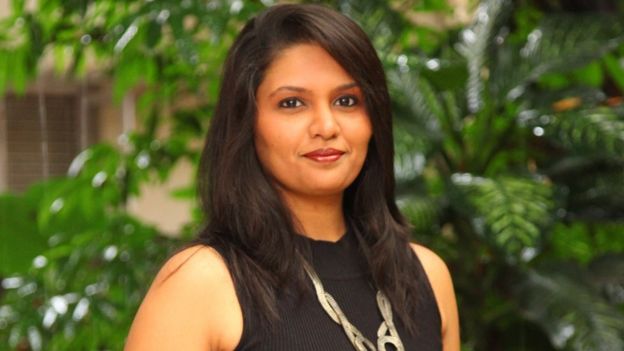
Mahita NagarajImage copyright CAREMONGERS INDIA
Image caption Mahita Nagaraj set up Caremongers India after her friends called her to seek help

Ms Nagaraj says she learnt about caremongering from a BBC article from Canada. The concept actually started in Toronto to help vulnerable people, but within days it spread to cover almost all of Canada with tens of thousands signing up.

Reports of altruism have come in from other parts of the world too. Britons are delivering soup to the elderly, in the US neighbours are helping those quarantined with buying groceries and one Long Island mother, infected with the virus, wrote about a neighbour who cooked a lasagne and left it outside her door.

Along with all the fear and panic caused by the coronavirus, the pandemic has also seen kindness go viral across the globe, with neighbours and complete strangers pitching in to help.

In India too, caremongering took off from the word go – in the first 24 hours, the Facebook group had 200 members. A week later, it has become a pan-India network with more than 6,500 volunteers.

Ms Nagaraj says she realised that on Facebook, most people were getting in touch to offer help, but only a few were asking for help. So, on Friday night, she launched a helpline number and since then, “it’s gone crazy”.

Caremongers India offers help to those who are most at risk of health complications due to the virus like the elderly, the disabled, those with pre-existing health conditions and anyone with an infant under a year.

In less than a week, Ms Nagaraj says, she has received thousands of calls and messages and although a large number of them have been to verify whether the number is genuine, she has also taken hundreds of requests for assistance.

Listed on the Caremongers India page are countless examples of assistance sought and provided; and testimonials and messages of gratitude.Transparent line (white space)

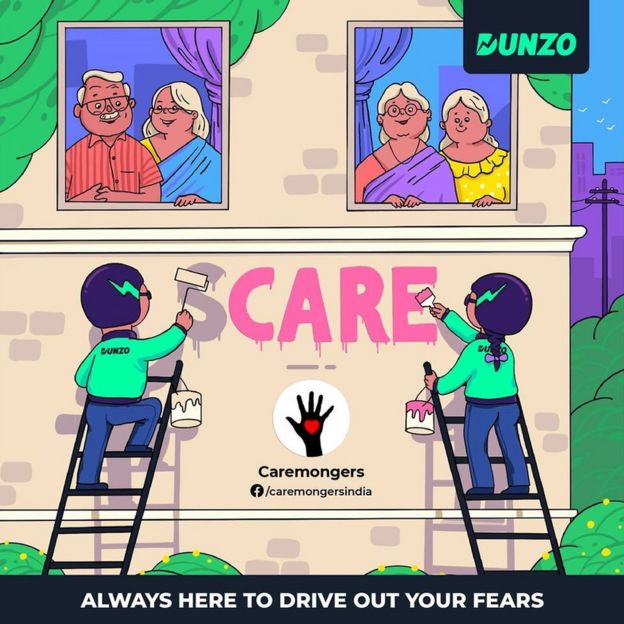
Wiping away the scareImage copyright IMAGE COURTESY: DUNZOTransparent line (white space)Besides those calling in from within India, Ms Nagaraj has been fielding dozens of calls from people across the globe seeking help for their elderly parents and grandparents.

“When people give their requirement and address, we match the requester with the closest volunteer,” she explains.

So last Saturday, when Amit Joshi, a resident of an upscale apartment block in the Delhi suburb of Noida, called the helpline, he was connected to Caremonger Madhavi Juneja, who also lives in Noida.

“We woke up to the news that our apartment complex was under lockdown,” Mr Joshi told me.

A resident had tested positive for the coronavirus and Mr Joshi was informed that they would not be allowed to leave home for a week.

“Police had put up barricades outside on the road and our complex was swamped with disaster management teams and health officials. Everything around us was shuttered. There was complete panic,” he says.

Mr Joshi, who lives with his wife and elderly parents, says his biggest worry was how to get essentials like bread and milk.

Banner image reading 'more about coronavirus'
Banner

And when he received a random WhatsApp forward from a colleague about Caremongers India, he decided to call them.

A few hours later, Ms Juneja, a psychotherapist and life coach, turned up at the gate of Mr Joshi’s housing society and handed over the supplies to him.

“I wore a mask and took my bottle of hand sanitiser and drove to his complex to carry out the delivery,” she said.

“Because the street was barricaded, I parked my car and then walked. If I had left it outside, someone else could have taken it. After I handed over the package to him, I sanitised my hands and got back into my car.”
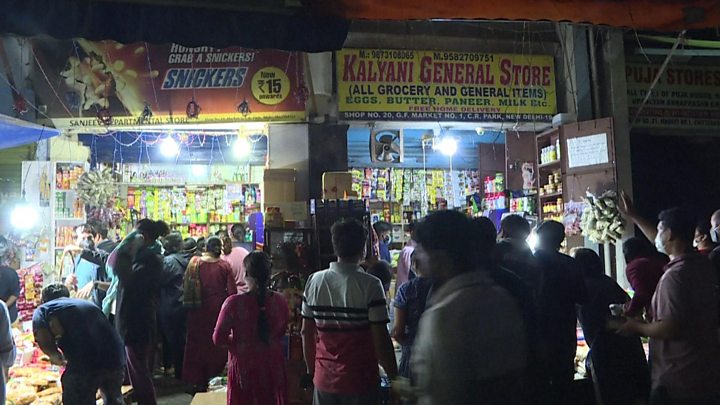
Media caption People panicked after Narendra Modi said nobody should leave their homes, and did not mention the status of essential supplies

Mr Joshi says, “In trying times like these, to have people selflessly reaching out to those in need has strengthened my belief in humanity.”

Ms Nagaraj says it’s “so heartening” to see that so many people want to help.

“Every request we receive is very special when we fulfil it. When a daughter calls to say her dad who lives alone requires provisions, we work hard to ensure he gets it.”

Ms Nagaraj says caremongering has taken over life and even her home.

“It’s not easy to answer 450 calls a day,” she says, “but when you help others, you go to bed thinking you haven’t wasted your day and that’s good enough for me.”

Source: The BBC
19/03/2020

Coronavirus: Indian cities go eerily quiet as cases rise

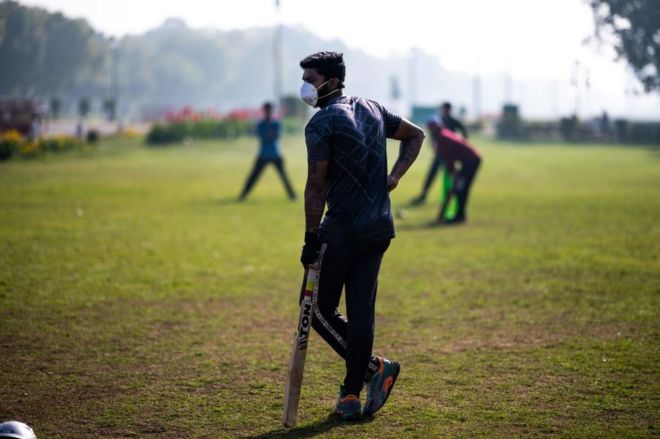
A youth (C) wearing a facemask as a preventive measure against the COVID-19 coronavirus plays cricket with his friends at a park in New Delhi on March 18, 2020.Image copyright GETTY IMAGES
Image caption Small groups of young people can be seen playing sports as schools, colleges and even gyms are shut.

Life in India has changed dramatically as the world’s second-most populous country grapples with the coronavirus outbreak.

Otherwise crowded and chaotic cities have quietened down as people stay home, traffic slows and even weddings shrink in size and scale.

India has confirmed 151 active cases and three deaths – but public health experts fear that the low count is the result of limited testing and under-reporting. The country has only conducted about 12,000 tests so far, partly because of a shortage of testing kits.

So it’s still unclear if and to what extent community transmission exists in India – community transmission means a patient had no known contact with another confirmed case or travelled from a country badly affected by the pandemic.

However, India’s central government, several state governments and city administrations have already responded with drastic measures.

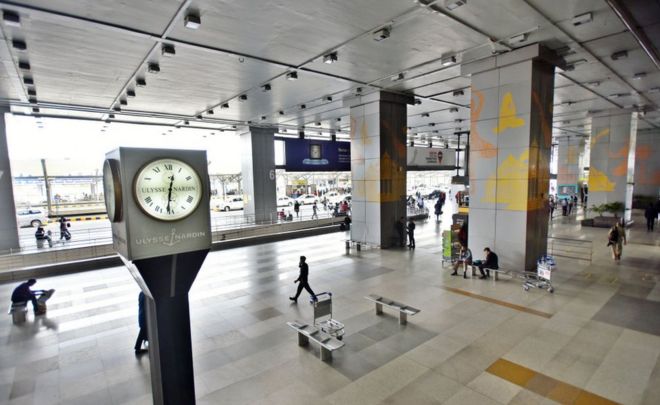
Low footfall seen at Indira Gandhi International (IGI) Airport amid rising coronavirus fear on March 16, 2020 in New Delhi, India.Image copyright GETTY IMAGES

The Indira Gandhi international airport in the national capital Delhi, is the country’s busiest airport but it appears deserted nowadays.

India has barred entry to everyone, including citizens, flying from certain countries, including the UK and most European nations. It has also cancelled most entry visas to people (excluding citizens) flying in from other countries.

This has led to numerous flight cancellations.

Airlines are also struggling as fewer people are flying even within India, wary that new regulations could see them stranded away from their homes. Two of India’s top airlines are reportedly considering grounding planes amid plummeting demand for flights.

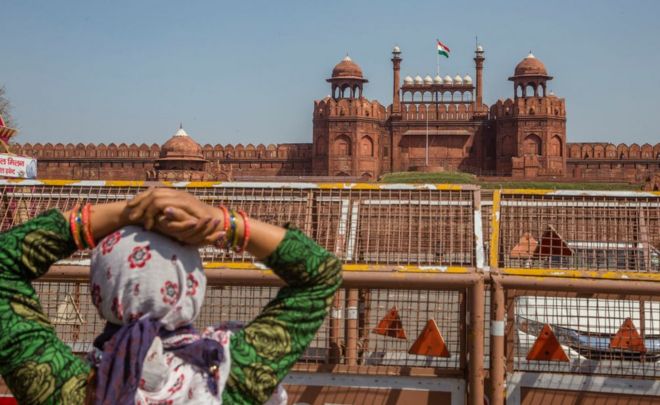
An Indian tourist disappointed to see the Red Fort, closed for tourists to prevent spread of Covid-19, as she look towards the ford on March 17, 2020 in New Delhi, India.Image copyright GETTY IMAGES

Popular Indian monuments – such as the 16th Century Red Fort in Delhi – have been shut to visitors to prevent large gatherings.

Taj Mahal, the country’s most iconic monument, closed its doors on Tuesday, along with more than 140 other monuments and museums.

With fewer people visiting and closures of public places likely to go up, tourism is expected to take a huge hit across India – the Taj alone draws as many as 70,000 people a day.

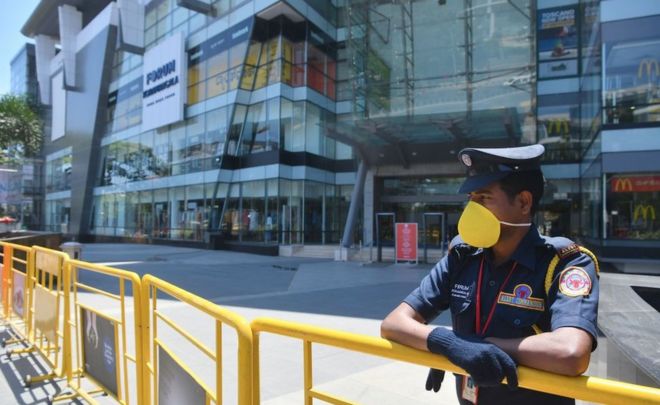
A security personnel stands guard in front of a closed shopping mall amid concerns over the spread of the COVID-19 novel coronavirus, in Bangalore on March 16, 2020.Image copyright GETTY IMAGES

Bangalore, an IT hub in southern India, is among the major cities that has shut down its malls – such as the one above – and schools, colleges, cinema halls and other public places have been closed since late last week. Other major cities such as Delhi, the financial hub Mumbai and Hyderabad in the south, have done the same.

City officials have also imposed restrictions on large gatherings such as weddings, cricket matches or any public ticketed events.

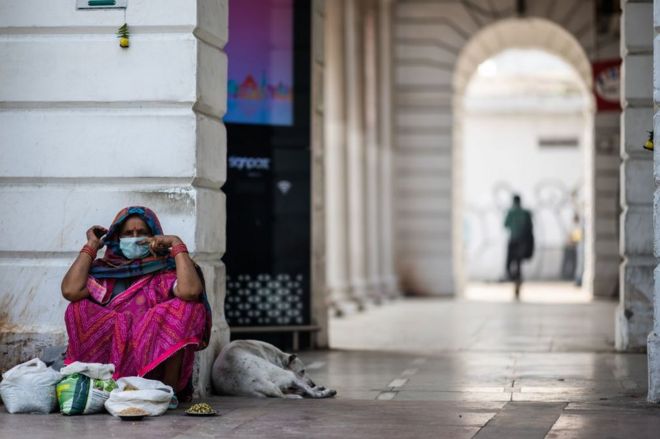
A bird feed vendor wearing a facemask as a preventive measure against the COVID-19 coronavirus waits for customers at a market area in New Delhi on March 19, 2020Image copyright GETTY IMAGES

Some of Delhi’s busiest spots, such as Connaught Place, are mostly empty.

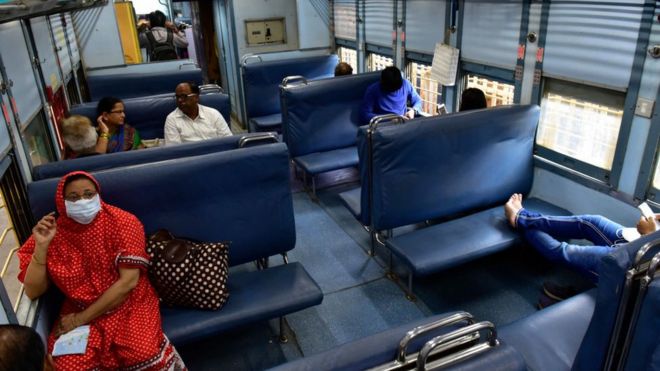
There has also been a significant drop in the number of people using trains, which remain the most popular form of transport in India.

Around 25% to 30% drop of passenger traveling from Mumbai to Pune in Deccan Queen was observed after coronavirus outbreak, at CSMT, on March 16, 2020 in Mumbai, India.Image copyright GETTY IMAGES

The service from Mumbai to Pune city – which takes about three to four hours – has seen about a 30% fall in passenger traffic, according to some estimates.

The western state of Maharashtra, where both cities are located, has reported the highest number of cases in India so far. The central railways has already cancelled 23 long distance trains going to and from Mumbai – officials say the reason is both the virus and the lower number of passengers.

Overall, more than 150 trains have been cancelled across India. This number could increase in coming days.

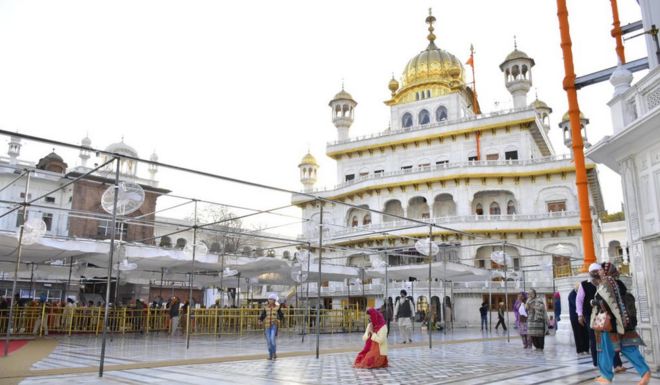
Low footfall of devotees seen at Golden Temple due to the spread of coronavirus (COVID-19) on March 17, 2020 in Amritsar, India.Image copyright GETTY IMAGES

Many holy sites, including the Golden Temple – one of the holiest shrines in Sikhism – remain open, although the footfall is much lower. It’s quite unusual to see such few people in what is one of India’s busiest shrines.

Tirumala Tirupati, the richest Hindu temple, has cancelled many of its daily rituals and is restricting the number of pilgrims for the first time.

Some major Hindu temples, such as the Siddhivinayak temple in the heart of Mumbai, and the Vaishno Devi cave shrine, have closed.

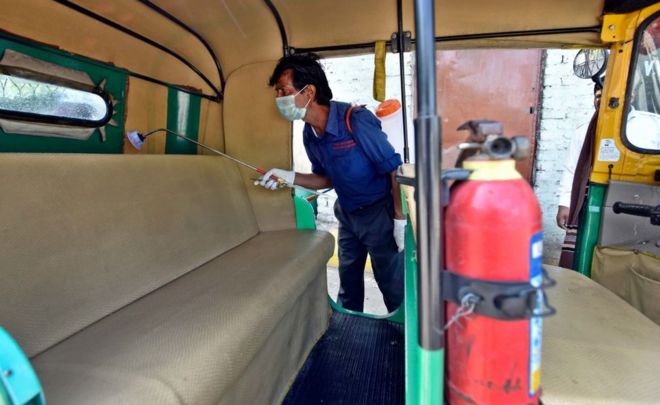
DTC cleaning staff chemically disinfect and sanitize auto rickshaw as a precautionary measure in view of coronavirus concerns, at Vasant Vihar Depot on March 17, 2020 in New Delhi, India.Image copyright GETTY IMAGES

City officials in Delhi have begun sanitising auto rickshaws and taxis to contain the spread of the virus.

Public transport poses a major challenge to containing the outbreak. But it continues to be used regularly across India, even as governments encourage people to stay home as much as possible.

But not all offices have work from home options, and this is especially a challenge for the millions who work in India’s informal sector – these include domestic help, street vendors and daily wage workers.

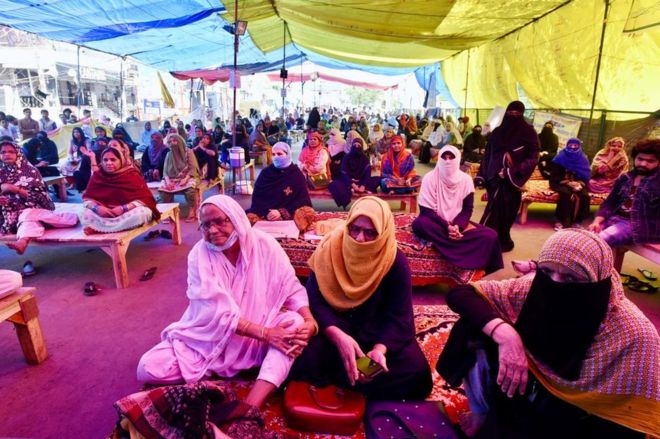
Women of Shaheen Bagh continue their sit-in protest against the CAA-NRC-NPR despite the Coronavirus advisory issued by Delhi government, at Shaheen Bagh on March 17, 2020 in New Delhi, India.Image copyright GETTY IMAGES

Surprisingly, sit-in protests against India’s controversial new citizenship law continue in some cities, including Delhi and Bangalore.

The most prominent of these, pictured above, is happening in Delhi’s Shaheen Bagh neighbourhood. Thousands of protesters, mostly Muslim women, have been demonstrating against the law, which critics say is anti-Muslim, since December.

But Delhi has shut down schools, colleges, gyms, night clubs, spas and swimming pools – and Chief Minister Arvind Kejriwal has said all social, political and religious gatherings with more than 50 people would be stopped.

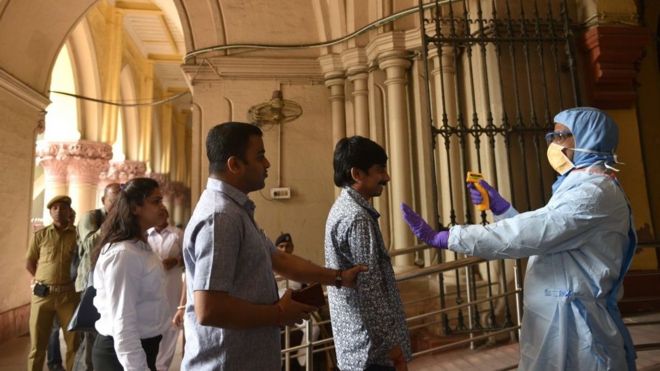
Doctor of West Bengal Health Government Department conduct thermal screening as prevention from coronavirus (COVID-19) infection at Kolkata High Court in Kolkata, India on Tuesday, March 17, 2020.Image copyright GETTY IMAGES

Temperature checks have become a common feature across cities – here, people are being screened before they enter the high court in the eastern city of Kolkata (formerly Calcutta).

This practice has been adopted at airports, corporate offices and several other places that remain open despite the restrictions.

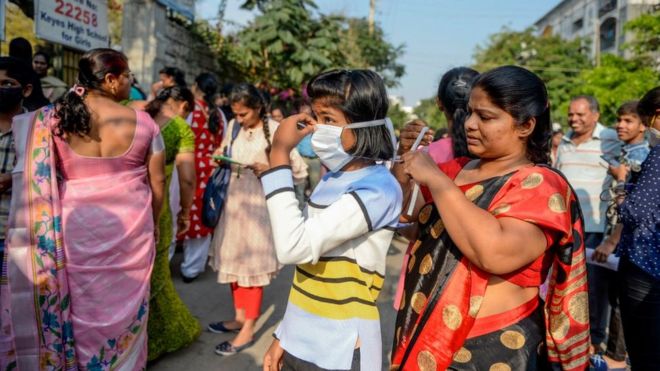
A mother ties a facemask on her daughter amid concerns over the spread of the COVID-19 coronavirus as she attends the first day of her tenth class examinations in Secunderabad, the twin city of Hyderabad, on March 19, 2020.Image copyright GETTY IMAGES

In the southern city of Hyderabad, students appeared for their school-leaving exams, but they came armed with masks.

Delhi, however, has postponed all school examinations.

Experts say India could impose more sweeping lockdowns as the toll climbs further.

Source: The BBC
16/03/2020

Mumbai is India’s most ‘forgetful’ city, says Uber

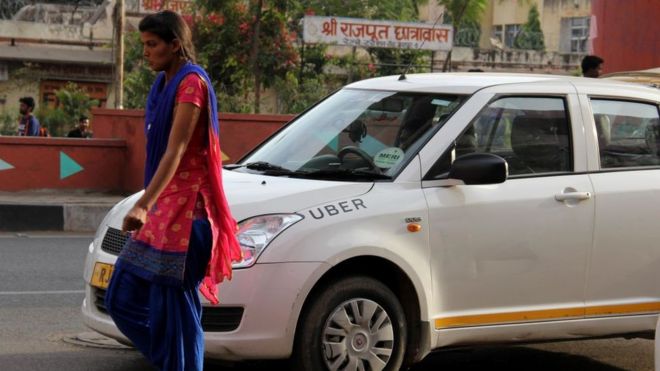
A lady walks past an Uber cab in IndiaImage copyright NURPHOTO
Image caption Uber’s annual Lost & Found Index lists items that passengers leave behind

Mumbai is India’s most “forgetful” city, according to Uber’s Lost & Found Index 2020, followed by Kolkata (formerly Calcutta) and Allahabad.

This is an annual database compiled by the cab aggregator, based on what passengers in different countries leave behind in Uber’s taxis.

Phones top the list in India, which also includes items as unusual as artificial acrylic teeth.

Uber found 3 August 2019 to be the “most forgetful” day in its survey.

India’s capital, Delhi, ranked fourth among the 10 most forgetful cities, followed by the southern city of Bangalore at number 5.

The list of the top 20 most unique lost items also includes mangoes, safari suits, brooms, military shoes and copies of Becoming, Michelle Obama’s memoir.

Uber found that Thursdays and Fridays are the most “forgetful” days of the week, and afternoons – between 13:00 and 15:00 – are the most likely hours when people lose things.

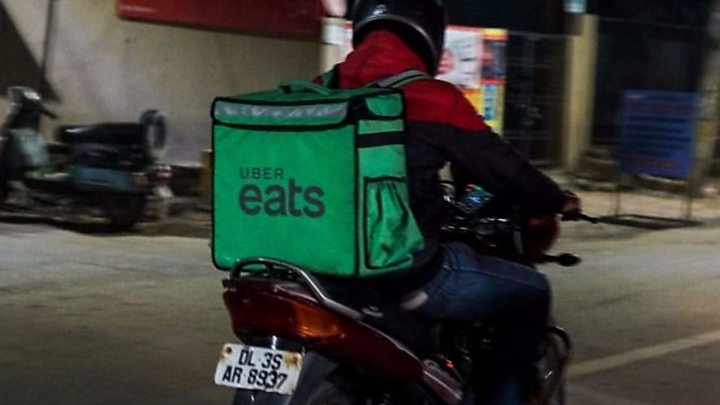
Media caption Why Uber Eats couldn’t deliver in India

The data suggests that people are most likely to leave behind a guitar on Saturdays and Sundays, and their lunch boxes on Tuesdays, Wednesdays and Thursdays.

Source: The BBC
21/02/2020

India woman held for chanting ‘long live Pakistan’ at citizenship protest

Amulya Leona at the protest event in BangaloreImage copyright ANI
Image caption Ms Leona was charged with sedition at a protest event in Bangalore city

An Indian woman has been arrested and charged with sedition for chanting “long live Pakistan” at a protest in the southern city of Bangalore.

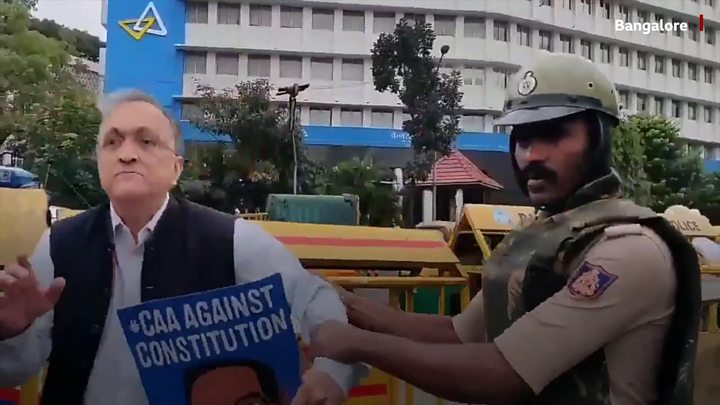
Amulya Leona was participating in a demonstration against a controversial citizenship law, which critics say discriminates against Muslims.

Her comments were immediately condemned by a prominent local Muslim politician.

Asaduddin Owaisi, who was at the rally, said neither he nor his party supported India’s “enemy nation Pakistan”.

Muslim politicians in Hindu-majority India are often targeted as being “pro-Pakistan” by political rivals, particularly in the last few years. The neighbouring countries have a historically tense relationship, fighting three wars since Pakistan’s formation following the partition of India in 1947.

After the incident at the protest against the Citizenship Amendment Act (CAA) went viral, Ms Leona and her family were the target of massive outrage.

Clips of her comment were circulated widely, and her father has complained that a group of people came to his house and forced him to chant “hail mother India”. They also told him that he had not brought his daughter up properly and threatened him against getting bail for her.

Police in the district told BBC Hindi that they are investigating his complaint, adding that Ms Leona would be produced before a judicial magistrate in 14 days.

What is the CAA?

The law offers amnesty to non-Muslim illegal immigrants from three countries – Pakistan, Bangladesh and Afghanistan.

It amends India’s 64-year-old citizenship law, which currently prohibits illegal migrants from becoming Indian citizens.

Media caption Anti-citizenship law protests spread across Indian cities

It also expedites the path to Indian citizenship for members of six religious minority communities – Hindu, Sikh, Buddhist, Jain, Parsi and Christian – if they can prove that they are from Muslim-majority Pakistan, Afghanistan or Bangladesh. They will now only have to live or work in India for six years – instead of 11 years – before becoming eligible to apply for citizenship.

The government says this will give sanctuary to people fleeing religious persecution, but critics argue that it will marginalise India’s Muslim minority.

Source: The BBC

20/02/2020

Container slides off truck killing 19 in India freak accident

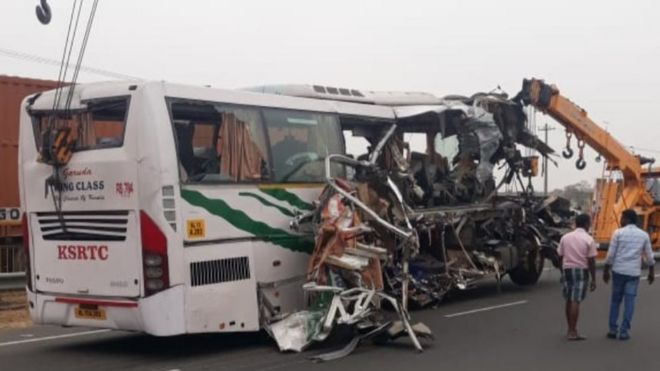
The bus after the accidentImage copyright TIRUPUR MANIKANDAN

At least 19 people have been killed in a freak accident in southern India, after a container slipped off a truck and rammed into a passenger bus.

Police are investigating the incident, but officials say the container came off its hinges after one of the wheels of the truck had a puncture.

“There were about 48 people in the bus, and several are in a critical condition,” an official told BBC Hindi.

The incident occurred around 3:30am local time (21:50 GMT), police said.

The bus was on a highway when the container slipped off the truck, which was in the opposite lane. It then rolled onto the other side, colliding with the bus.

The Volvo bus, owned by the Kerala state transport corporation, was travelling from Bangalore city in the neighbouring state of Karnataka to Ernakulam in Kerala.

The district collector, Dr Vijay Karthikeyan, told BBC Hindi that the cause of the accident was still being investigated.

The driver of the truck is reportedly absconding.

Source: The BBC

10/12/2019

Bangalore: Dummies in police uniforms ‘control’ city traffic

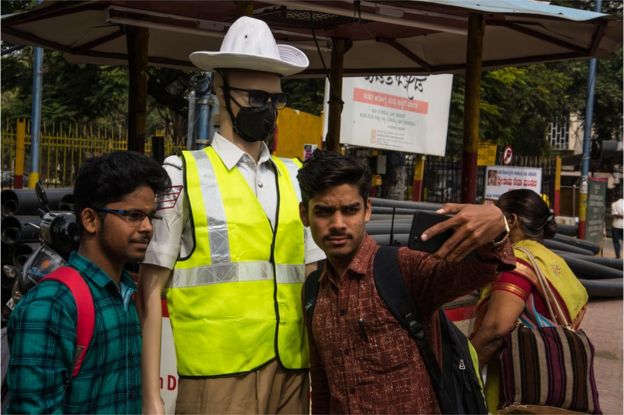
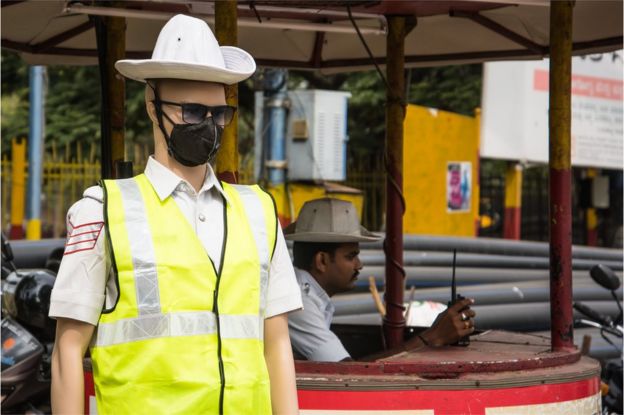
Traffic police mannequinImage copyright ASIF SAUD
Image caption The mannequins have been installed at major traffic crossings

One of India’s most gridlocked cities has come up with an unconventional solution to rein in errant drivers.

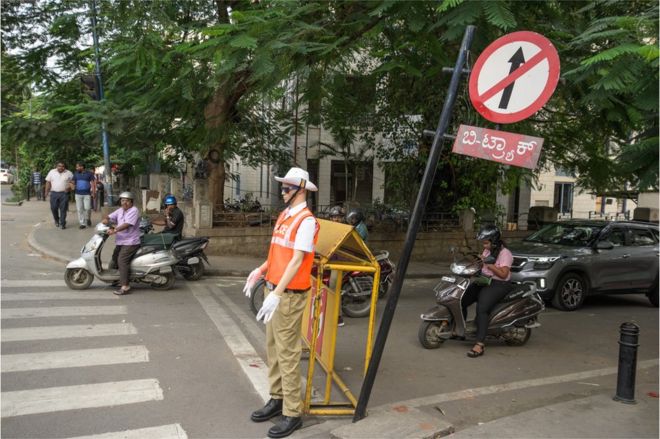
Mannequins dressed up as traffic police have been placed on roads in the southern city of Bangalore.

Dressed in police caps, white shirts and brown trousers, and wearing sunglasses, the mannequins are now on duty at congested junctions.

It’s hoped drivers will mistake them for real police and think twice about breaking the rules of the road.

Home to India’s IT industry, Bangalore has eight million registered vehicles on its streets. This number is expected to grow to more than 10 million by 2022.

At 18.7 km/h (11.61 mph) traffic speeds in the city are the second slowest in the country after Mumbai (18.5 km/h), according to a study by an office commute platform, MovinSync Technology Solutions. Cameras at traffic junctions have recorded more than 20,000 traffic violations every day.

But commuters have mixed feelings on whether mannequins can actually step in to help their real police counterparts.

Some feel they do.

“They look good. It is only when you look closely that you feel it is not a real police constable. So it is making people wear their helmets at traffic junctions and drive their two-wheelers,” says Gautam T, a college student.

Gautam and his college mate Talah Fazal had taken a selfie with one of the mannequins placed in the southern part of the city.

Asif SaudImage copyright ASIF SAUD

Similarly, Saravana – who goes by a single name – and drives a three-wheeled auto-rickshaw, had parked his vehicle near a no-parking sign board right next to a mannequin in the central business district. But he said: “It makes you not jump the traffic signal.”

On Twitter, the tone has been largely one of amusement and derision.

Presentational white space

Saleela Kappan, a public relations professional, said she found the concept “ridiculous”.

“These mannequins look too fit and fair compared to our Indian policemen to be posted on the road. I don’t think it will serve any purpose because people violate traffic rules even when policemen themselves are present at these junctions.”

Traffic police mannequinImage copyright ASIF SAUD

BR Ravikante Gowda, a senior traffic police officer in Bangalore, explaining the reasoning behind this initiatives said: “The idea of placing these mannequins at a different location every day is because people behave differently when there is a policeman present at the junction. When he is not there, their behaviour is different.”

A constable, who did not want to be named, said that police also confuse drivers by mixing things up.

“It’s been a couple of weeks since we got them here. There is some hesitancy in jumping the traffic lights. They are confused when we replace the mannequin daily with one of our colleagues.”

Source: Thr BBC

30/10/2019

The explosive truth about the link between Chinese fireworks and India’s dim Diwali

  • Black market imports from China, confusing regulations and pollution concerns are undermining India’s fireworks industry
  • Industry sources say Diwali sales this year were down by 30 per cent
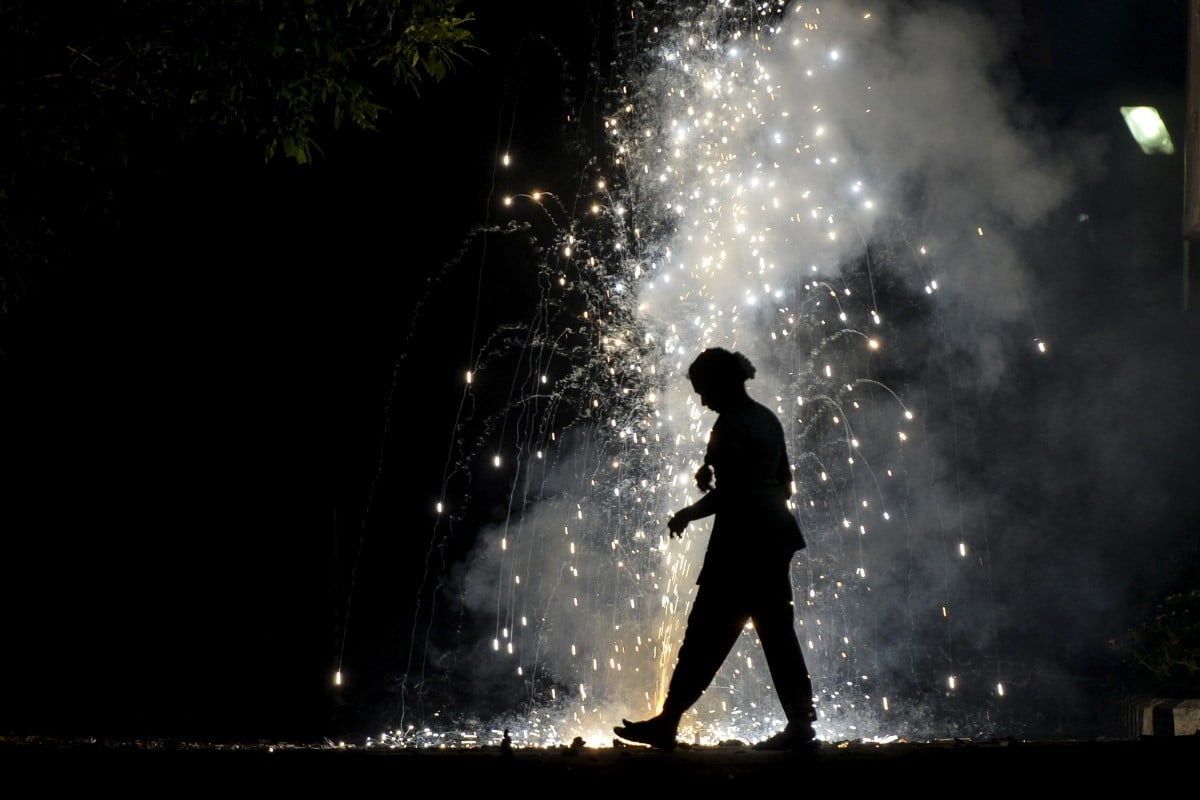
A woman is silhouetted by lit firecrackers during Diwali celebrations in Chennai. Photo: AFP

Arumugam Chinnaswamy set up his makeshift booth selling firecrackers in a Chennai neighbourhood a week ahead of Diwali, the Hindu festival of lights, with great expectations of doing a brisk trade.

Yet a week later, he has been forced to pack up more than half his stock in the hope he’ll have better luck next year.

“Four years ago, I sold firecrackers worth 800,000 rupees (US$11,288) on the eve of Diwali alone. This year, the sales have not even been a quarter of that,” said Chinnaswamy, 65, painting a grim picture that will be recognised by many in the Indian fireworks industry.

Chinnaswamy buys his firecrackers in Sivakasi, an industrial town in the southern Indian state of Tamil Nadu that produces more than 90 per cent of the country’s fireworks.

Sivakasi’s dry climate has helped to make it the firework capital of India and many production facilities in the town have been in the business for close to a century. For the most part, the industry has resisted mechanisation and still deals in handmade products. Its 1,100-plus manufacturing units provide jobs for 800,000 mostly uneducated workers and its diligent labour force have earned the town the nickname of ‘Little Japan’.
A worker lays firecrackers in an outdoor yard at a manufacturing unit involved in the production of firecrackers ahead of the Hindu festival of Diwali, in Sivakasi. Photo: AFP

But this reputation is under threat, struggling under the weight of an anti-pollution campaign, regulatory uncertainty and the arrival of cheap black-market Chinese imports. Irregular monsoons and a slowdown-induced cash crunch have not helped matters either.

Industry figures estimate the Diwali sales of India’s 80 billion-rupee firecracker industry took a 30 per cent drop this year.

A TOXIC PROBLEM

With pollution in Indian cities among the worst in the world, the government has come under pressure to do something about the nation’s toxic air – a problem that becomes more acute during Diwali due to the toxic fumes emitted when celebratory fireworks are set off. This Diwali, for instance, many areas in New Delhi recorded an Air Quality Index (AQI) of 999, the highest possible reading (the recommended limit is 60).

That makes the fireworks industry seem like an easy target when it comes to meeting government air quality targets.

Trouble began brewing in October last year when the Supreme Court banned the manufacture of traditional fireworks containing barium nitrate, a chief polluter. That decision put a rocket under the industry, as barium nitrate is cheap and is used in about 75 per cent of all firecrackers in India.

Factories in Sivakasi responded with a four-month shutdown protest that decimated annual production levels by up to a third.

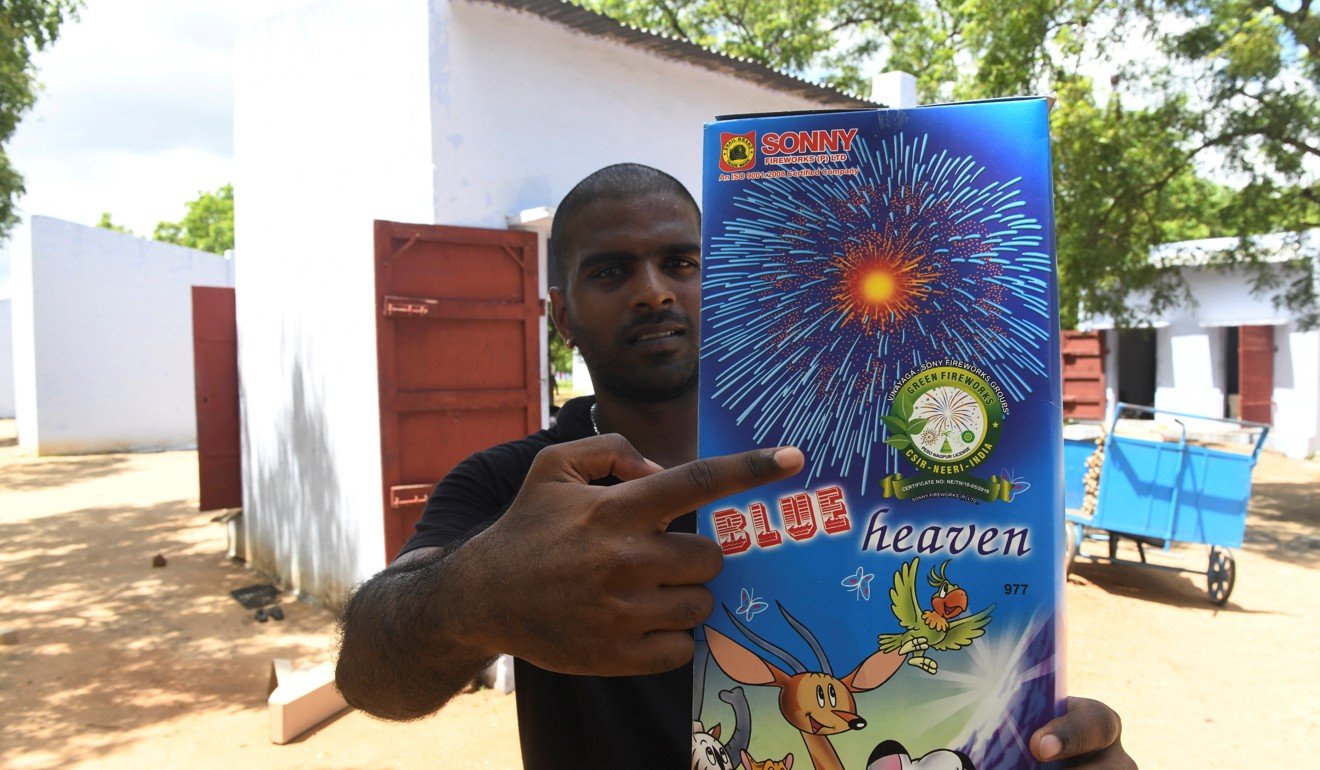
A seal denotes environment friendly ‘Green Fireworks’ at a manufacturing unit in Sivakasi. Photo: AFP

Apparently realising it had overstepped the mark – and that enforcing the Supreme Court regulations would be next to impossible – the government stepped in to rescue the industry, offering its assistance in the manufacture of environment-friendly crackers containing fewer pollutants, but it was too little, too late.

“The Supreme Court verdict was simply Delhi-centric with the vague idea of [cracking down on] urban pollution. It lacked any on-the-ground knowledge of the fireworks industry,” said Tamil Selvan, president of the Indian Fireworks Association, which represents more than 200 medium and large manufacturers.

Singapore travellers give Hong Kong a miss over Diwali long weekend

“Fireworks are low-hanging fruit for the anti-pollution drive as the industry is unorganised. Could the government or judiciary place a similar blanket ban on more pollution-causing industries like automobiles, plastics or tobacco?” asked Selvan.

CHINESE COMPETITION

The industry has also been hit by a flood of cheap Chinese firecrackers that are smuggled into the country on the black market.

In September, the country’s federal anti-smuggling agency, the Directorate of Revenue Intelligence, cautioned various government departments that huge quantities of Chinese-produced firecrackers had reached Indian soil in the lead up to Diwali.

But industry sources complain they have seen little action from the government to combat the problem.

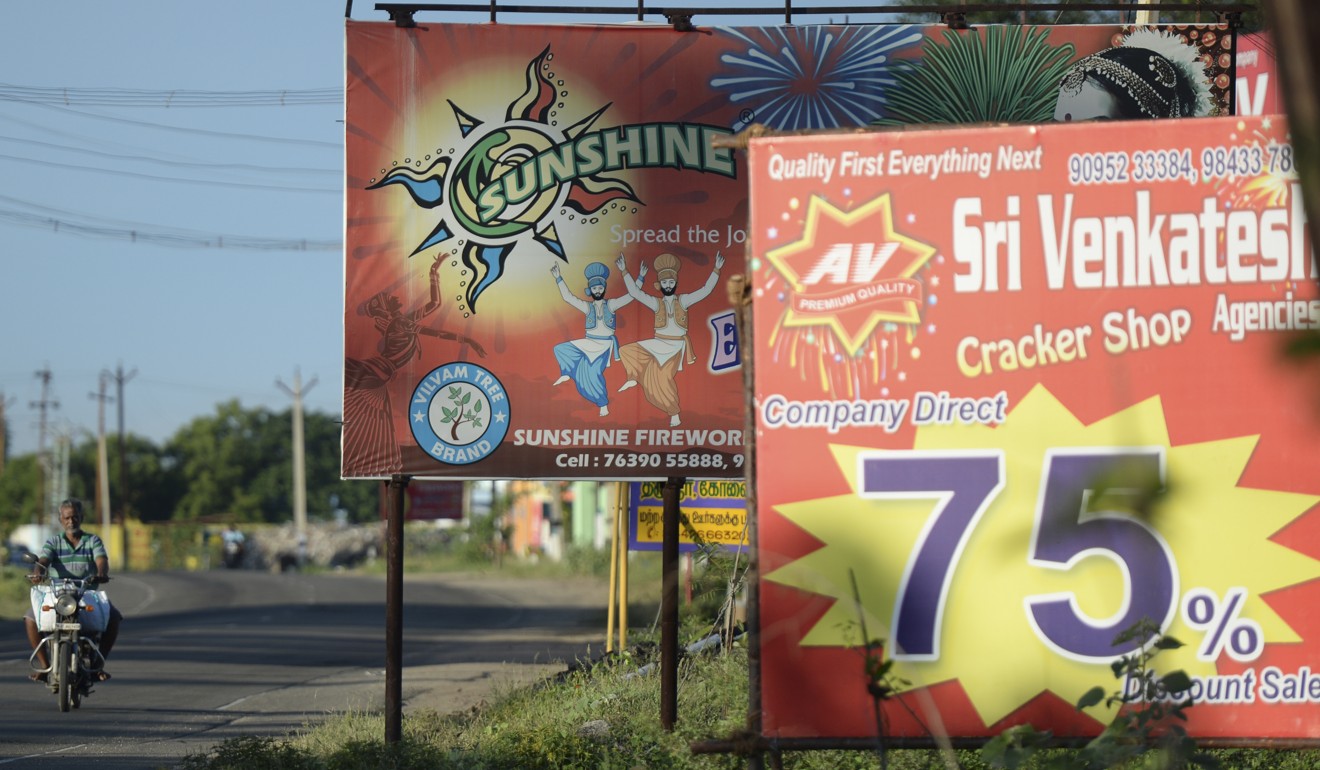
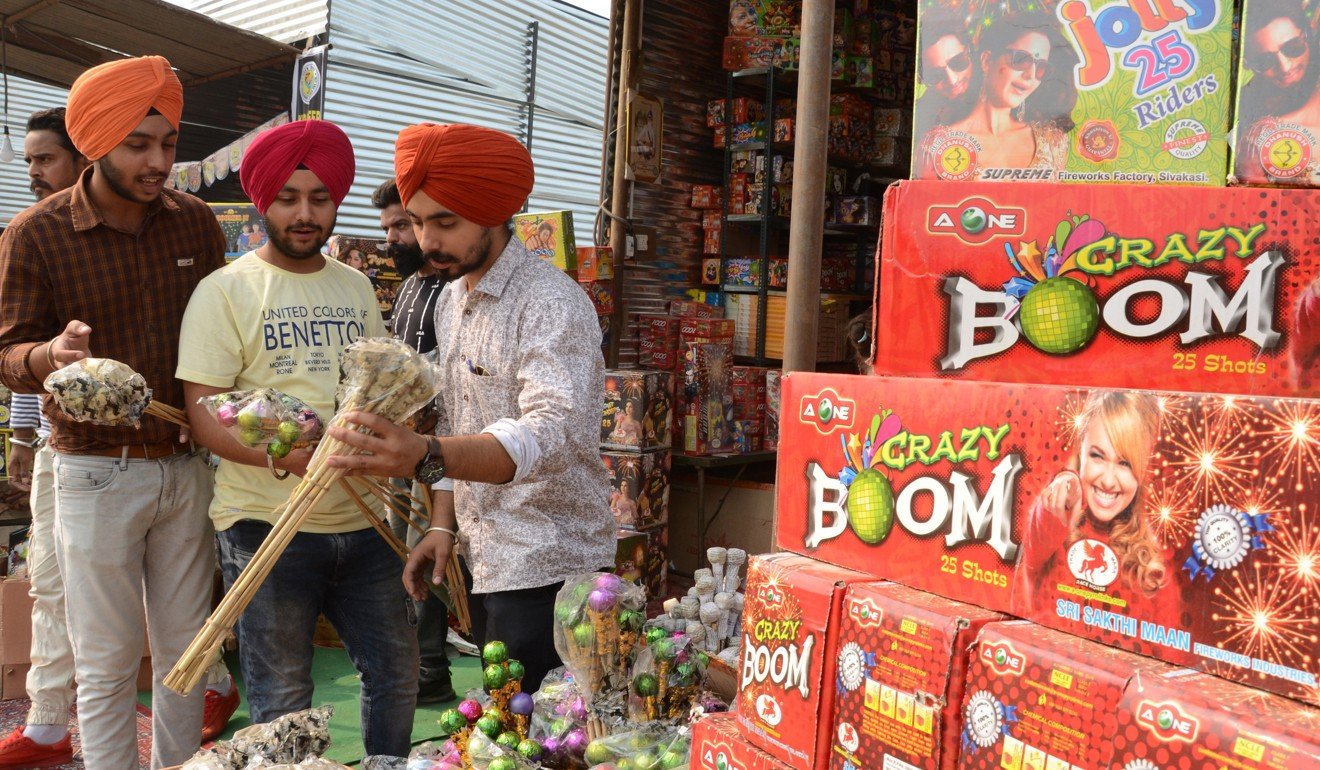
An advert for firecrackers ahead of the Hindu festival of Diwali, in Sivakasi. Photo: AFP

Legally, Indian manufacturers can neither import nor export firecrackers. The Indian firecracker industry is the second-largest in the world after China’s.

Raja Chandrashekar, chief of the Federation of Tamil Nadu Fireworks Traders, a lobbying body, said low-end Indian-manufactured firecrackers such as roll caps and dot caps – popular among children – had struggled to compete with Chinese-made pop pops and throw bombs.

“Despite our repeated complaints to government bodies, Chinese firecrackers find a way into India, particularly in the northern parts. This is severely affecting our business,” said Chandrashekar.

While more Chinese fireworks might be entering India, the effect has been to undermine the industry, resulting in fewer sales overall.

FIZZLING OUT?

The Sivakasi fireworks industry faces other problems, too. Not least among these is the use of child labour, which had been rampant until a government crackdown a few years ago, and the practice of some factories to operate without proper licences and with questionable safety standards.

But despite the darker aspects of the industry, its role goes beyond merely helping Diwali celebrations go with a bang every year.

India is crazy about gold. But can the love last as prices skyrocket?

“The livelihoods of over five million people who are indirectly involved in the business, in areas such as trade and transport, depend on the survival of the industry,” said Chandrashekar.

That survival looks increasingly in question. Dull sales of fireworks have been reported in major cities including New Delhi, Mumbai, Bangalore and Hyderabad, though exact numbers can be hard to come by due to the unregulated nature of the industry and unreliable numbers shared by manufacturers.

So great has the resultant outcry been that some cynics even wonder whether the industry is struggling as much as it claims or whether it is part of a ploy by manufacturers to gain more government concessions and avoid any further crackdown.

“These firecracker manufacturers lie through their teeth about the Diwali sales for self-serving motives such as tax avoidance. The overall business is healthy,” said Vijay Kumar, editor of the Sivakasi-based monthly magazine Pyro India News.

“Though there was a 30-40 per cent shortage in annual production, all the manufactured products have been sold this year. No large stockpile is left with any manufacturer.”

Customers buy firecrackers on the eve of the Hindu festival of Diwali in Amritsar. Photo: AFP

Still, regardless of the manufacturers’ motives, the result of the industry’s struggles has been that street sellers like Chinnaswamy have fewer fireworks to sell – and they are struggling even to sell those.

Chinnaswamy says people are confused about the government’s anti-pollution drive and about what firecrackers are now legal and this has discouraged them from buying. Despite the government’s effort to promote “green crackers” he says these are too hard to come by to be a ready solution, at least for this year.

“There was no clarity on what type of firecrackers, whether green crackers or otherwise, can be set off and at what time of the day. Many consumers even asked me whether or not the conventional firecrackers are totally banned while there was much misinformation floating about on social media,” said Chinnaswamy.

Shaking his head, all he can do is hope that next year his Diwali goes with more of a bang.

Source: SCMP

Law of Unintended Consequences

continuously updated blog about China & India

ChiaHou's Book Reviews

continuously updated blog about China & India

What's wrong with the world; and its economy

continuously updated blog about China & India