Chindia Alert: You’ll be Living in their World Very Soon
aims to alert you to the threats and opportunities that China and India present. China and India require serious attention; case of ‘hidden dragon and crouching tiger’.
Without this attention, governments, businesses and, indeed, individuals may find themselves at a great disadvantage sooner rather than later.
The POSTs (front webpages) are mainly 'cuttings' from reliable sources, updated continuously.
The PAGEs (see Tabs, above) attempt to make the information more meaningful by putting some structure to the information we have researched and assembled since 2006.
with punitive environmental trade regulations that should leave the waste exporting nations in delirium. Last week, the Malaysian Environment Minister, Yeo Bee Yin,
that countries should manage their own waste, and that Malaysia will take care of its own.
Modern economic theory maintains that the trade of global “goods” and services should be optimised by countries embracing their competitive advantages – letting others excel where their own advantages exist.
What it did not account for is the trade in “bads” between nations, whereby a country’s externalities (in this case waste) are sent to another’s shores to take advantage of the other country’s “competitive advantages” – low labour costs and lax environmental enforcement.
As a result of the planet’s awakening to the vast challenges of what do to with plastic in its second life, we now have two large-scale trade wars to contend with. One is between the two largest economies, the
. The other is much broader in scope, undercutting the previously perceived values of globalisation, using environmental trade barriers as a proxy for national benefit.
is not the only ill which countries share with one another, but it is one that has generated the most sharing of ideas and momentum across virtually every country on the planet.
To put the scale into context, one can conservatively estimate that at least 10 per cent of the plastic waste sent to Asia for recycling was of quality too poor to make value from.
If all of this “poor quality” material from the European Union alone was returned to its rightful exporting countries for the past 10 years of their exports, they would receive over 95,000 40-feet containers, each containing 35 metric tons of material. This would create a line of containers over 1,150km (715 miles) long.
A global reckoning on waste is under way, thanks to China
It may not be likely that all 95,000 containers will be returned to their ports of origin, but it is clear that the ability to keep moving this volume of material offshore will quickly evaporate, creating all types of disruptions and needing innovative interventions to solve the complex plastic waste challenge.
Join us, and industry leaders and influencers, at our action-based plastic circular economy forum –
BANGKOK (Reuters) – Southeast Asian leaders opened a two-day summit in Bangkok on Saturday, though it was unclear what progress their 10-country group could make on disputes in the South China Sea and the plight of ethnic Rohingya fleeing Myanmar.
Formed more than half a century ago, the Association of Southeast Asian Nations (ASEAN) has historically struggled with challenges facing the region because it works only by consensus and is reluctant to become involved in any matter regarded as internal to a member state.
Thai Prime Minister Prayuth Chan-ocha was making his debut as a civilian leader representing current chair Thailand, after a general election in March that opposition parties say was designed to ensure his victory five years after the former army chief seized power in a 2014 coup.
Officials are expected to discuss a Code of Conduct (COC) for negotiations over the South China Sea, one of the world’s busiest waterways and a potential flashpoint, as it is claimed by several ASEAN members as well as China.
However, it was unlikely much progress would be made, though member nations might discuss the June 9 collision of a Philippine boat and a Chinese fishing vessel.
“It is encouraging to see that the ASEAN-China talks on the COC have continued,” said Marty Natalegawa, former foreign minister of Indonesia.
“However, there is real risk that developments on the ground – or more precisely at sea – are far outpacing the COC’s progress thereby possibly rendering it irrelevant.”
Philippine President Rodrigo Duterte has accepted China’s proposal to jointly investigate allegations that a Chinese fishing vessel abandoned 22 Filipinos after it sank their boat in the South China Sea, his spokesman said on Saturday.
Rights groups have also called on ASEAN leaders to rethink support for plans to repatriate Rohingya Muslims who have fled member state Myanmar, where activists say returnees could face discrimination and persecution.
More than 700,000 Rohingya crossed into Bangladesh in 2017, according to U.N. agencies, after a crackdown by Myanmar’s military sparked by Rohingya insurgent attacks on the security forces.
However, it is unlikely that there will be any criticism of Myanmar at the summit over the Rohingya, said Prapat Thepchatree, a political science professor at Thailand’s Thammasat University said.
“This issue has been a very sensitive one for ASEAN,” he said.
Host country Thailand deployed about 10,000 security forces around Bangkok for the summit, mindful of a decade ago when Thailand last hosted an ASEAN summit and dozens of protesters loyal to military-ousted former premier Thaksin Shinawatra forced their way into the meeting venue.
But on Saturday morning, only a small group of people had planned to stage a protest to call Prayuth’s election the product of a rigged system.
The group, called Citizens Wanting Elections, was stopped by police before it could reach a meeting point near the summit venue. The group later released a statement welcoming visiting leaders but criticising Prayuth.
“The individual who serves as President of ASEAN, who welcomes everyone today, did not come from a clean and fair election,” the letter said.
Are increasing diplomatic tensions behind tighter inspections and cancelled orders?
Farmers switch to other crops in bid to beat barriers
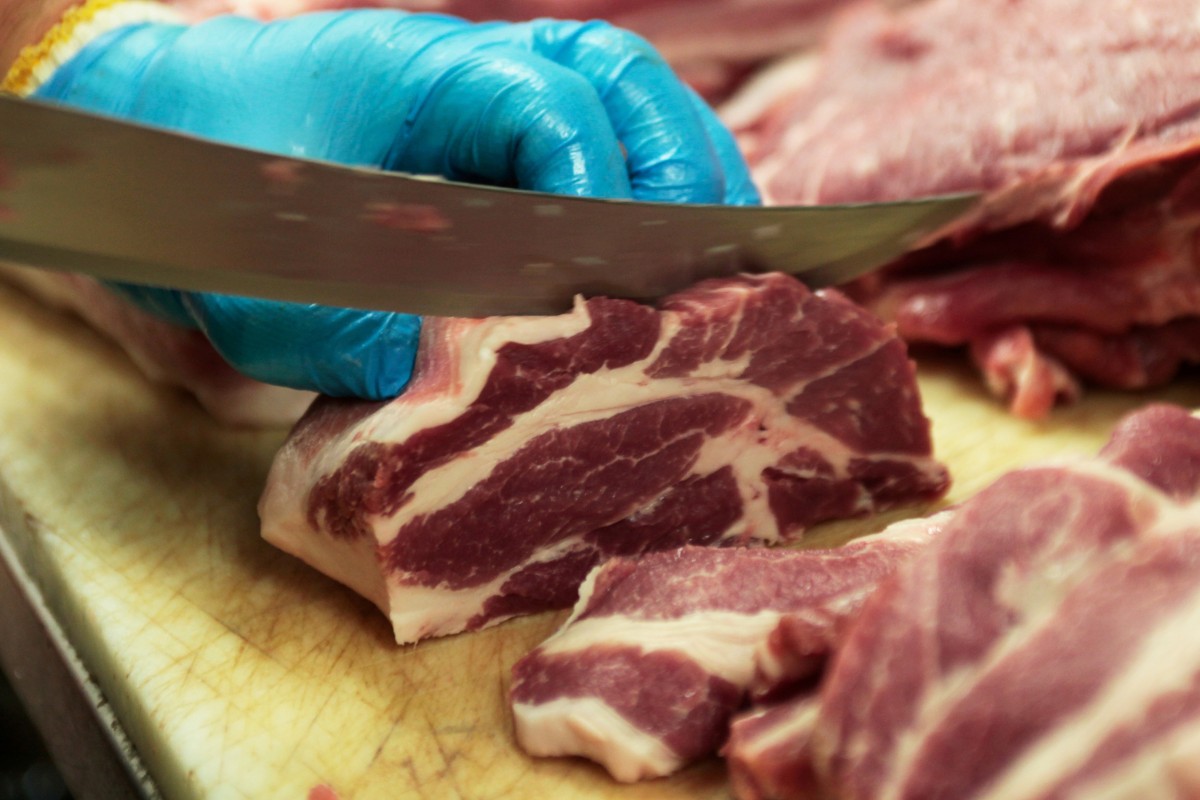
Canadian exporters of pork, soybeans and peas say they are facing delays and increased inspections at Chinese ports. Photo: Reuters
A growing list of Canadian farm exports is facing obstacles at Chinese ports, raising concerns that a bitter diplomatic dispute between the two countries may be to blame.
Sellers of Canadian soybeans and peas say they are experiencing unusual obstacles and Ottawa also warned last week that China was holding up pork shipments over paperwork issues.
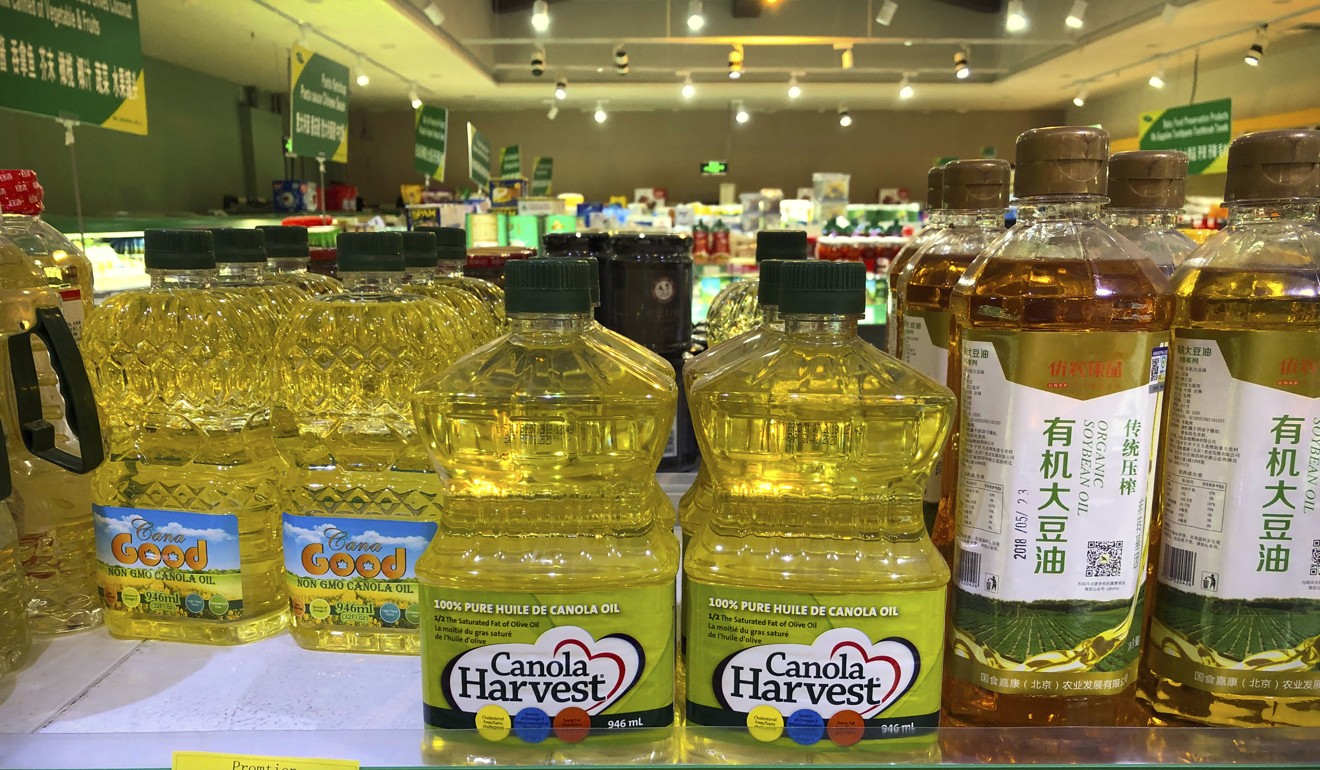
China has already blocked Canadian canola from Richardson International and Viterra, two of Canada’s biggest farm exporters, saying that shipments had pests. Other China-bound canola cargoes have been cancelled, forcing exporters to re-sell elsewhere at discount.
Canadian politicians have said the concerns are baseless, and noted that China detained two Canadians after Canada arrested an executive of Chinese telecom company Huawei Technologies Co Ltd in December at the United States’ request. China has used non-tariff barriers before during diplomatic tensions, most recently against Australian coal.
China has already blocked canola from two of Canada’s biggest farm exporters, while other China-bound canola cargoes have been cancelled. Photo: AP
Increasing tensions with China, a top buyer for most Canadian farm commodities, have forced farmers to plant other crops, such as wheat, that they hope will not face barriers.
China bought US$2.01 billion worth of Canada’s canola and $381 million worth of its pork last year.
The spread of African swine fever through China’s pig herd has reduced China’s need for canola and soybeans to process into feed ingredients but, since January, port soybean inspections that routinely take a few days now require three weeks, causing Chinese buyers to avoid Canadian products, according to Dwight Gerling, president of Canadian exporter DG Global.
“They’re basically sending out the signal, ‘You buy from Canada, we’re going to make your life difficult,’” Gerling said.
Earlier this year, a Chinese buyer told Gerling that a government inspector had found ants in 34 containers (roughly 680 tonnes) of the Canadian soybeans he shipped there.
Such a finding would be rare, since the soybeans were stored in concrete silos in Canada and shipped in sealed containers in late autumn, said Gerling, who concluded the buyer was trying to avoid the new hassles of buying from Canada.
“It’s just them playing games. (Beijing) is just going to keep putting the screws to us,” he said.
China’s General Administration of Customs did not reply to a request for comment. Government officials have said their canola ban is a regular inspection and quarantine measure to protect China’s farm production and ecological safety.
In a statement, the Canadian agriculture department said it could not confirm that China had imposed stricter measures against farm goods other than canola. Ottawa said this month it hoped to send a delegation to China to discuss the issue.
Gerling’s company has halted soybean sales to China and found other buyers in Southeast Asia.
An official at a state-owned crusher in southern China confirmed that port inspections had tightened on Canadian soybean cargoes.
“We don’t have Canadian cargoes coming in as we can’t blatantly commit such wrongdoing when the atmosphere is so intense,” the official said on condition of anonymity.
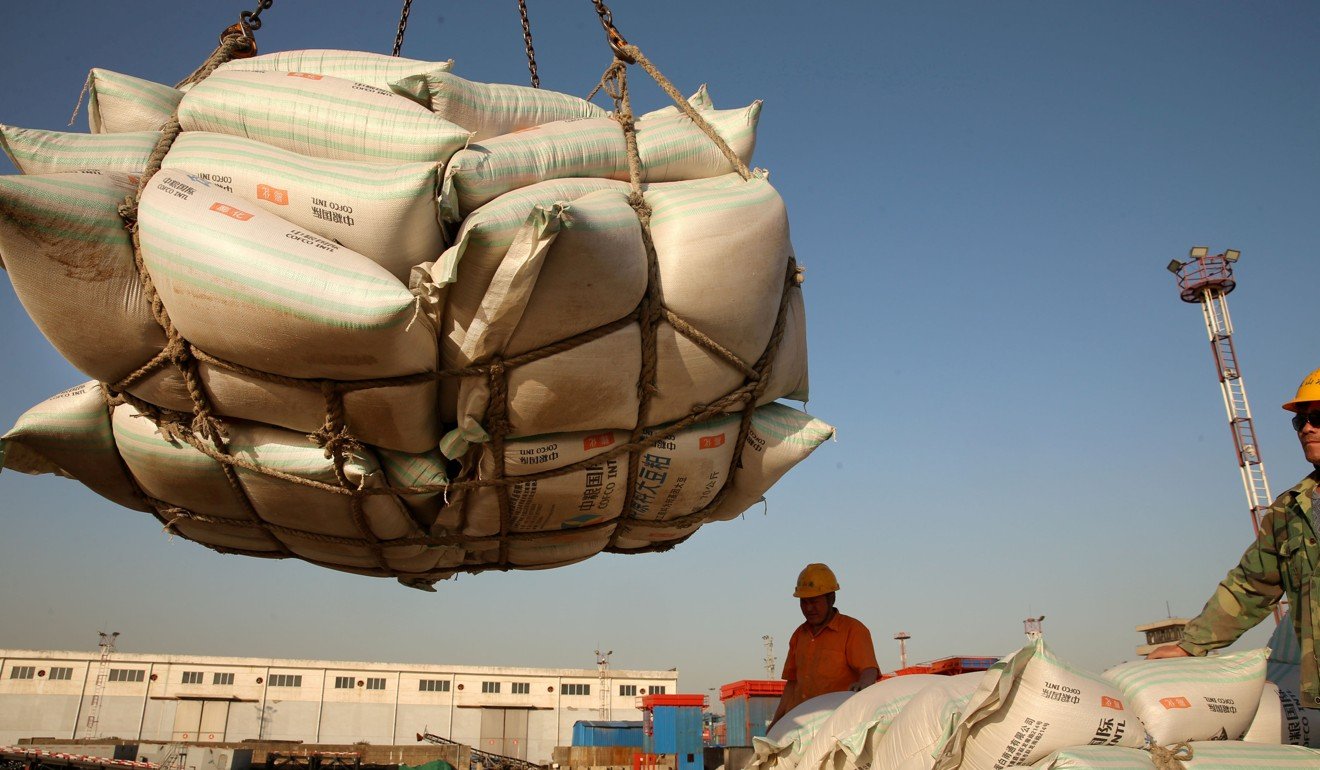
Soybeans from Canada are facing delays when they reach Chinese ports, according to traders. Photo: Reuters
Another official in northern China said his crushing plant scrapped plans to buy Canadian soybeans when the trade dispute flared.
Canada shipped $1.2 billion worth of soybeans to China in 2018, up sharply year over year, according to the Soy Canada industry group, as China and the United States fought a trade war. But sales have now slowed to a trickle.
Canola has taken the brunt of China’s measures.
Chinese buyers have cancelled at least 10 cargoes of Canadian canola in the past few weeks, according to a Singapore-based trader at a company that runs crushing facilities in China. Some cargoes, around 60,000 tonnes each, have been resold to buyers in Pakistan and Bangladesh at deep discounts, the trader said.
“It is devastating for exporters,” the trader said.
Canada gets tough with China on canola ban, demands contamination proof
Intercontinental Exchange (ICE) canola futures fell to a more than four-year low on Tuesday as supplies piled up. Growers intend to sow the smallest crop in three years.
On Monday last week, Ottawa said some Canadian pork exporters used an outdated form to certify shipments to China, causing delays. Such issues arise regularly in commodity trading, but rarely with damaging consequences, said Canadian Pork Council spokesman Gary Stordy.
Canadian pea exporters fear they could be next. China imported C$533 million worth of Canadian peas in 2018, according to industry group Pulse Canada, but the pace has slowed.
Chinese authorities have begun scrutinising import documents and product samples more closely, according to Taimy Cruz, director of logistics at Toronto-based BroadGrain Commodities.
China Inspection and Quarantine Authorities now tests samples of each pea shipment before authorising it for import. They also restrict in some cases the number of soybean shipments allowed under one licence, slowing the flow, she said.
Similarly, import authorities now require soybean shipments that change vessels in Singapore and Shanghai – a routine practice called trans-shipping – to reach their destination on a single ship, she said.
While BroadGrain has not seen its cargoes turned back, it has reduced sales to China to avoid risk, concentrating on the Indian subcontinent and South America, she said.
“We have to be extra careful,” Cruz said. “They are very strict now.”
Women make up nearly half of India’s 900 million voters, but they are still poorly represented in the country’s law-making bodies. One political party is trying to correct the balance by nominating 41% female candidates. The BBC’s Geeta Pandey travelled to the state of West Bengal to see how they are faring.
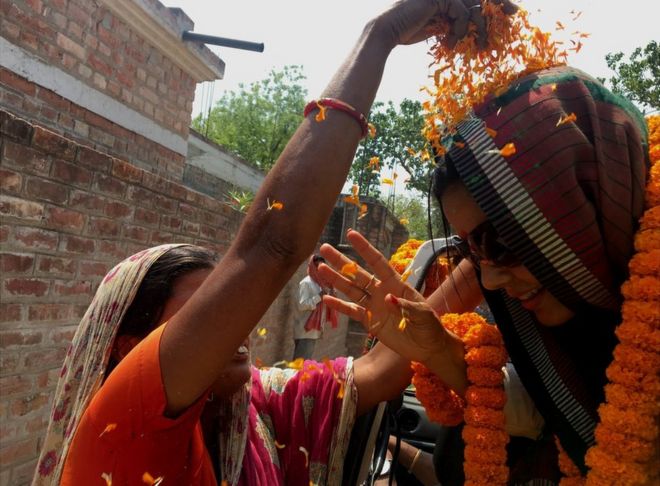
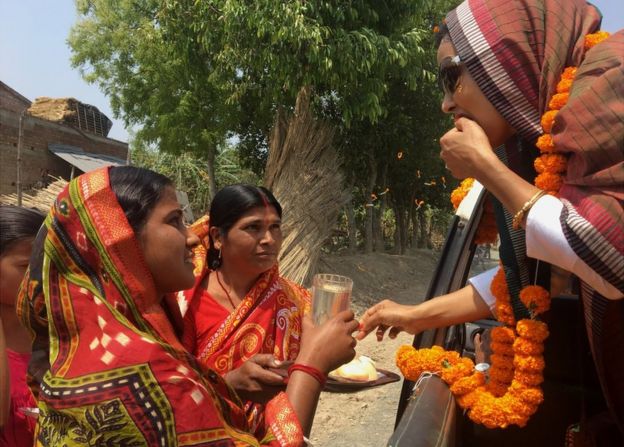
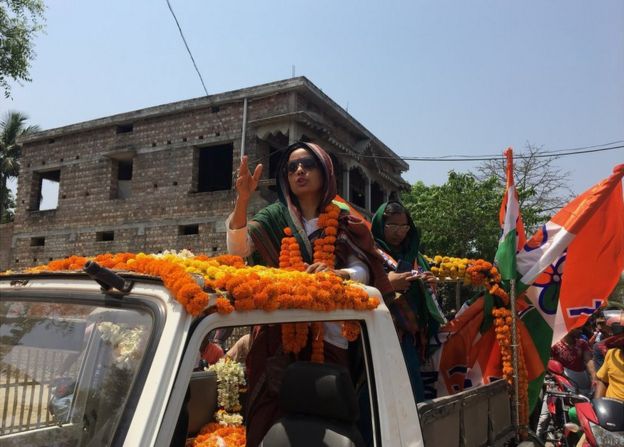
On a bright sunny morning, as an open jeep decorated with bright yellow and orange flowers hurtles along the dirt track from one village to the next, women in colourful saris and men rush to greet Mahua Moitra.
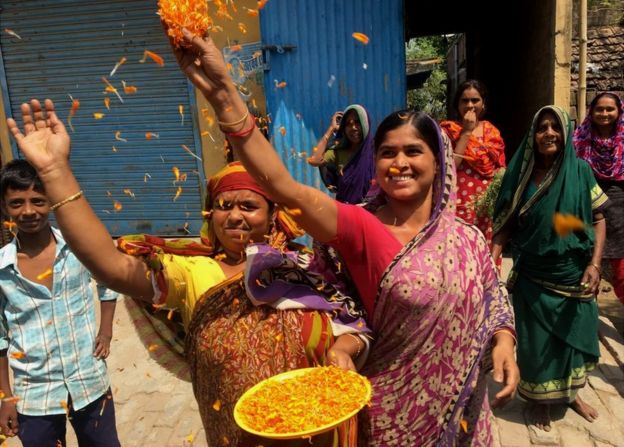
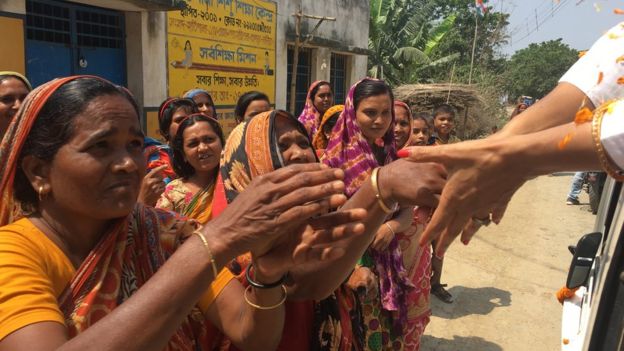
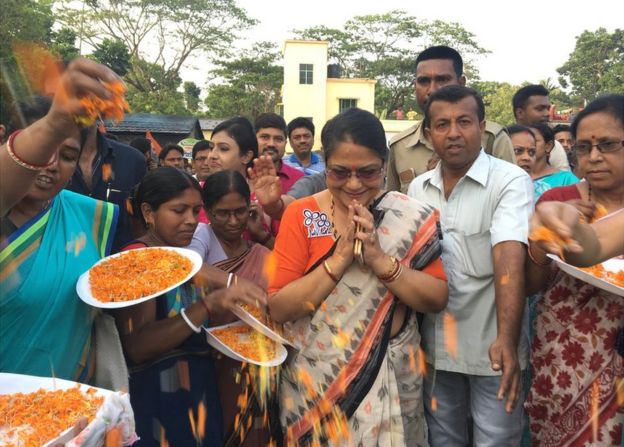
They shower bright orange marigold petals on her, place garlands around her neck and many reach out to shake and kiss her hands. She waves at them, greeting them with her palms joined: “Give me your blessings.”
Young men and women whip out their smartphones to take photos and selfies. On the way, she’s offered coconut water and sweets.
Ms Moitra, who is contesting the general election as a candidate of the state’s governing Trinamool Congress Party (TMC), is campaigning in her constituency Krishnanagar.
Image caption On the campaign trail, women offer coconut water and sweetsImage caption Supporters throw marigold petals at Mahua Moitra
In one village, party workers tell her about an old man who’s too ill to come to meet her, so she walks to his home to greet him.
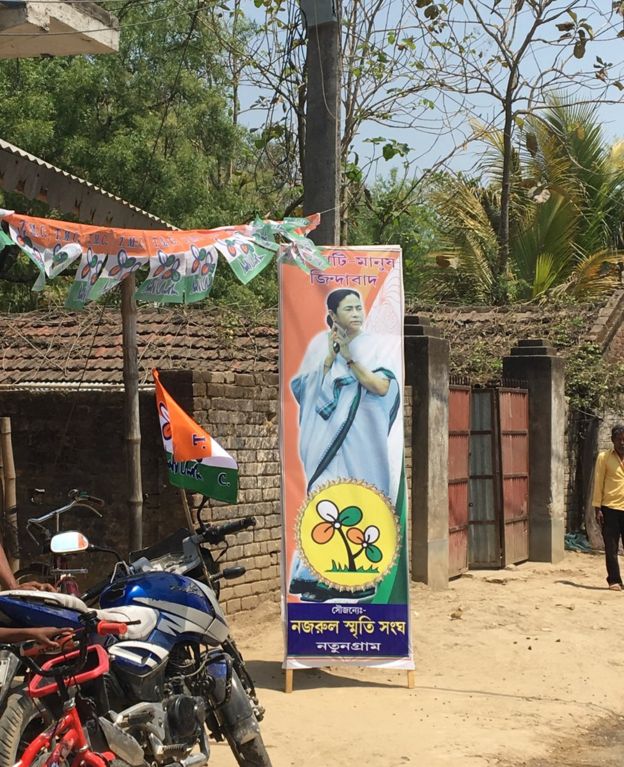
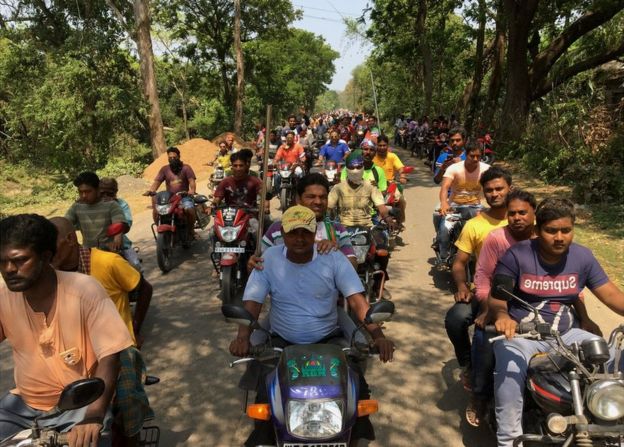
Her jeep is followed by dozens of bikes and their riders, all young men, chanting slogans like “Long live Trinamool Congress, Long live Mamata Banerjee.”
The loud, colourful procession is led by a small truck, fitted with loudspeakers, from which announcements asking people to vote for Ms Moitra are played on a loop.
With the election season well under way in India and political leaders criss-crossing the length and breadth of the country, addressing rallies, I’m travelling across the country to see if the high-decibel campaigns are addressing the real issues that actually affect millions of people. One of them is getting more women into parliament.
A bill to reserve 33% of seats for women in parliament and regional assemblies has been pending since 1996, so the decision by the TMC – led by West Bengal Chief Minister Mamata Banerjee – to give 41% of her party nominations to women has created a huge buzz.
Image caption Ms Moitra quit her banker’s job in London to return to India and enter politics
Ms Banerjee, who set up the TMC in 1998 after falling out with the Congress party, is a feisty politician who was named one of Time magazine’s 100 most influential people in the world in 2012.
Her female candidates, says my BBC Bengali colleague Subhajyoti Ghosh, are an “interesting mix” of career politicians and first-timers. They include actors, doctors, a tribal activist and the 25-year-old widow of a recently-murdered politician.
Ms Moitra, the TMC’s national spokesperson and a member of the state assembly since 2016, is among 17 women who have made it to the party’s list of 42 general election nominees.
A former investment banker with JP Morgan, she gave up a well-paying job in London in 2009 to return to the heat and dust of Indian politics.
Her decision left her family aghast. Her parents, she told me, thought she was “insane”. Some party workers too had their doubts – “she’s a memsahib”, they said at the time, “she won’t survive”.
Image caption Mamata Banerjee was named one of Time magazine’s 100 most influential people in the world in 2012But she has survived – and thrived. In 2016, she won the Karimpur assembly seat that no non-Left party had won since 1972 and has now set her eyes on the national parliament.
She’s agreed to let me follow her on the campaign trail, so for two days I’ve been a “fly on the wall” – standing behind her in her jeep, travelling in her car, watching her strategise with party workers, aides and confidants.
The previous evening, I had watched her be the chief guest at a college cricket match and address a gathering at the local market in Plassey.
A four-hour drive from Kolkata, Plassey is the site of the famous 1757 battle between the British East India Company and the local ruler supported by the French.
Image caption Her jeep is followed by dozens of supporters on bikesImage caption Many women reach out to shake hands with Ms Moitra
“What’s the point of saying you killed all those terrorists in Pakistan? It’s not important who you killed in Pakistan or how many. What’s important is you failed to protect our soldiers.”
She talks about how the government has failed to create jobs and accuses the BJP of trying to divide Hindus and Muslims.
“You have taken away our livelihoods and you’re trying to teach us about [the Hindu god] Ram and [Muslim saint] Rahim? I don’t have to write my religion on my forehead,” she declares to loud claps from her supporters.
Elections in the past were to change the government, she says, but this election is to save the constitution of India. “It is no ordinary vote.”
Her main rival is the BJP’s Kalyan Chaubey, a former footballer who played in goal for India. So drawing a football analogy, she declares: “I’m an A-league centre-forward player, stop my goal if you can. I am here to win.”
Kakoli Ghosh Dastidar, a founder member of the TMC and two-term MP, says to nominate so many women is part of a “continuous process” followed by Mamata Banerjee because “you can’t develop a society without uplifting the status of its women”.
In the last general election in 2014, she points out that the party nominated 33% women and 12 of their 34 MPs in the outgoing lower house were women.
Ms Banerjee, she says, believes that gender sensitive laws will come only if more women are in power.
At a campaign rally that Dr Ghosh Dastidar addresses in Kumhra Kashipur village in her constituency Barasat, women are seated in the front rows.
Their opinion though is divided over whether having more women in parliament will actually benefit other women.
Image caption Dr Kakoli Ghosh Dastidar is among the founder members of the TMC and a two-term MP
Supriya Biswas says it’s easier if their MP is a woman because then it’s easier to approach her. “For, who can understand a woman better than a woman?”
Archana Mallick and Meena Mouli, who live just across from the rally ground, point to the broken roads near their homes and complain about poor medical facilities in their village. They say that the candidate’s gender is “inconsequential” and what’s important is “who works for our benefit”.
Saswati Ghosh, professor of economics at Kolkata’s City College, says that politics in India is “still very patriarchal” and it’s “absolutely necessary” to elect more women MPs.
“It is important to have more women in lawmaking bodies because I think after a certain number, you’ll reach the threshold level and that will lead to change. I don’t know if 33% is the magic number that will change the quality of discourse, maybe 25% can do the trick?”
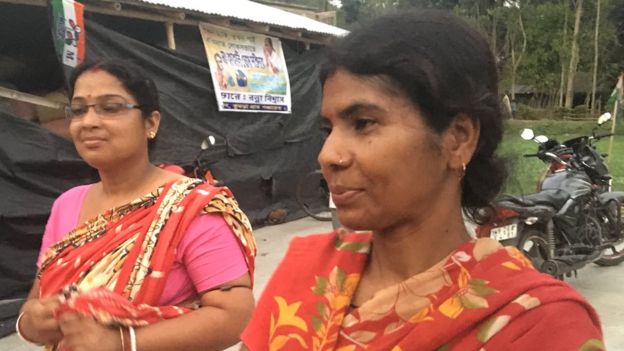
Image caption Archana Mallick and Meena Mouli say a candidate’s gender is “inconsequential”
Critics, however, question whether celebrities are the right candidates to bring about that change.
Prof Ghosh says actors and celebrities make for “winnable candidates” and that’s why all parties choose them even though sometimes they may not be the right candidates to reach that threshold.
But, she says that Ms Banerjee is a strong leader who’s regarded by many women as “a role model who inspires more women to come into politics”.
And that’s something that many Indians think the country sorely needs.
In their manifestos, the main opposition Congress party has promised to pass the women’s reservation bill, if elected to power. So has the ruling Bharatiya Janata Party, although it had made similar promises in its last manifesto and did nothing about it.
By allotting 41% seats to women, Ms Banerjee has shown that one doesn’t need to set artificial quotas to elect more women.
NEW DELHI (Reuters) – India’s main opposition Congress party will reserve a third of federal government jobs for women if it comes into power, its chief Rahul Gandhi said on Wednesday, in a sign women’s rights are rising up the political agenda for next month’s election.
Over the last week, two powerful parties from eastern India said they would field women in a third of parliamentary races, putting pressure on Prime Minister Narendra Modi’s ruling Bharatiya Janata Party (BJP) and other big parties to follow suit.
India ranks at 149 out of 193 countries – worse than neighbouring Afghanistan, Bhutan, Bangladesh and Pakistan – for the percentage of women in national parliaments, according to the Inter-Parliamentary Union, an independent organisation promoting democracy.
“…Frankly, I don’t see enough women in leadership positions. I don’t see them leading enough companies, I don’t see them leading enough states, I don’t see enough of them in the Lok Sabha and the Vidhan Sabhas,” Gandhi said in the southern city of Chennai, referring to India’s lower house of parliament and state legislatures.
Federal government jobs in India are already subject to numerous quotas, including one passed in January that reserves 10 percent of openings for people outside high income brackets.
Gandhi also said that Congress would pass the Women’s Reservation Bill this year if it came to power. The bill, which reserves 33 percent of the seats in national and state assemblies for women, has been on hold for two decades despite being championed by Congress and the BJP at different points.
The BJP, which says it has empowered women through nationwide schemes including clean fuel and sanitation, questioned how the Congress jobs plan would be implemented.
“For how many generations have people talked about reservation in party positions, reservation for elections, reservation in jobs? But it doesn’t seem to happen,” BJP spokesperson Shaina N.C. said.
There are currently 66 women out of a total 543 elected members in India’s lower house of parliament. At 12 percent, this is the highest ever proportion of women in the Lok Sabha.
Women make up nearly half of all voters in the country of 1.3 billion people, according to the Election Commission of India. Based on recent state polls, women will likely head to voting stations in droves for the elections due by May, surpassing male turnout, analysts predict.
On Tuesday, Mamata Banerjee, chief minister of West Bengal state, said her All India Trinamool Congress party would field 17 women candidates across 42 seats.
Earlier, on Sunday, the Biju Janata Dal, which rules Odisha state in eastern India, said it would reserve seven of 21 seats it is contesting for women candidates.
“33% reservation in parliament will give them bigger role in highest policy making body,” Naveen Patnaik, leader of the BJD and Odisha’s chief minister, said in a tweet.
“Women of our nation rightfully deserve this from all of us.”
PM Modi said that he told him ‘let us fight against poverty and illiteracy’ and Khan gave his word saying he is a Pathan’s son, ‘but went back on it’.
SNS Web | New Delhi | February 25, 2019 10:53 am
Pakistan Prime Minister Imran Khan on Sunday asked his Indian counterpart Narendra Modi to “give peace a chance” and assured him that he “stands by” his words and will “immediately act” if New Delhi provides Islamabad with “actionable intelligence” on the Pulwama attack.
Khan’s remarks came a day after PM Modi in a rally in Rajasthan, recalled his conversation with the Pakistan PM during a congratulatory call after he became the country’s premier.
PM Modi had told him “let us fight against poverty and illiteracy” and Khan gave his word saying he is a Pathan’s son “but went back on it”.
“There is consensus in the entire world against terrorism. We are moving ahead with strength to punish the perpetrators of terrorism…The scores will be settled this time, settled for good…This is a changed India, this pain will not be tolerated…We know how to crush terrorism,” PM Modi further said.
A statement released by the Pakistan Prime Minister’s Office said, “PM Imran Khan stand by his words that if India gives us actionable intelligence, we will immediately act.”
PM Modi should “give peace a chance”, Khan said in the statement.
In his first statement issued since the February 14 attack, Pakistani Prime Minister Imran Khan had on Tuesday accused India of blaming his country “without evidence” and warned of retaliation against any military action by India.
However, he assured India that he would act against the perpetrators of the deadly Pulwama terror attack, carried out by Pakistan-based Jaish-e-Mohammad (JeM) terror group and said that the issue between the two countries can be solved through dialogue.
India had called Khan’s offer to investigate the attack if provided proof as a “lame excuse”.
The already sour relations between India and Pakistan have worsened over the past few weeks as New Delhi accused Islamabad of the Pulwama attack.
India has accused Islamabad’s spy agency ISI of being involved in the attack and has maintained that the terror group JeM is a “child of the Pakistan Army”.
Following the attack, India immediately withdrew the ‘Most Favoured Nation’ status granted to Pakistan and initiated steps to isolate the neighbouring country from the international community.
Earlier, India had also announced its decision to stop the flow of its share of water from the Beas, Ravi and Sutlej to Pakistan.
Prime Minister Narendra Modi had in many of his public speeches after the attack, said that the security forces have been given full freedom to decide the future course of action regarding the terrorist attack in Pulwama.
India’s neighbours, including Sri Lanka, Maldives, Nepal, Bangladesh, Afghanistan and Bhutan—and other countries like Saudi Arabia, UAE, Iran, Russia, Germany, Canada, UK, Australia and Canada came out in strong support of New Delhi following the terror attack.
Over 44 CRPF personnel were killed and many injured on February 14 in one of the deadliest terror strikes in Jammu-Kashmir when a Jaish-e-Mohammad (JeM) suicide bomber blew up an explosive-laden vehicle near their bus in Pulwama district.
The bus was part of a convoy of 78 vehicles carrying around 2500 CRPF personnel from Jammu to Srinagar.






 CHINDIA ALERT: You'll be living in their world, very soon