Chindia Alert: You’ll be Living in their World Very Soon
aims to alert you to the threats and opportunities that China and India present. China and India require serious attention; case of ‘hidden dragon and crouching tiger’.
Without this attention, governments, businesses and, indeed, individuals may find themselves at a great disadvantage sooner rather than later.
The POSTs (front webpages) are mainly 'cuttings' from reliable sources, updated continuously.
The PAGEs (see Tabs, above) attempt to make the information more meaningful by putting some structure to the information we have researched and assembled since 2006.
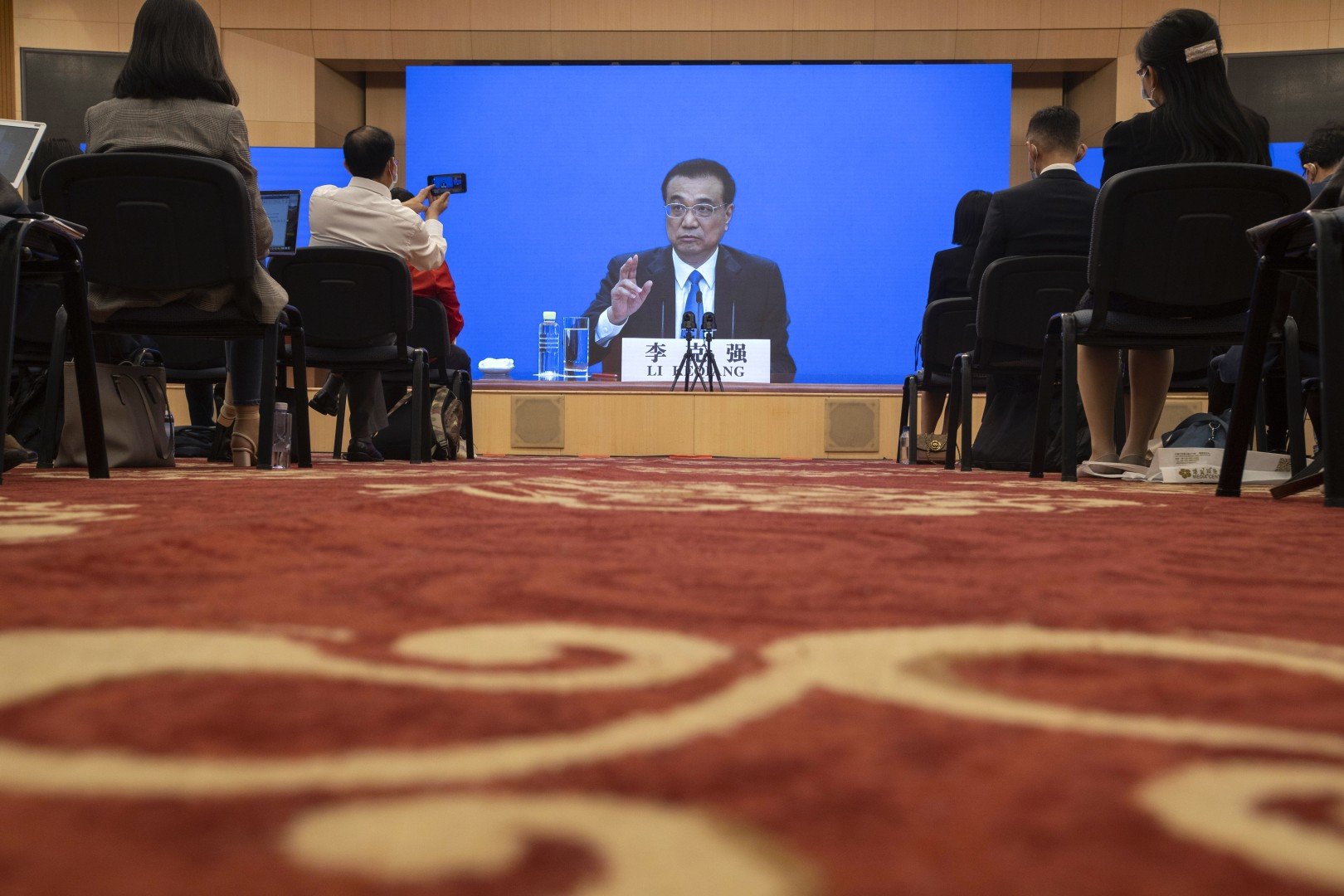
Li held a press conference to mark the end of the parliamentary session. This is the South China Morning Post’s live coverage.
Reporting by Wendy Wu, Gary Cheung, Frank Tang, Mai Jun, Sarah Zheng, Kinling Lo, Linda Lew, Coco Feng, Liu Zhen, Laura Zhou, Echo Xie, Keegan Elmer, Catherine Wong, Zhuang Pinghui, Tony Cheung
6:05PM
The End
Li’s key points
The main points from Li’s press conference:
The central government will stick to the principle of “one country, two systems”, and “Hong Kong people governing Hong Kong” with a high degree of autonomy. The NPC’s resolution for a
. But he said at the press conference that “peaceful reunification” was still Beijing’s policy and the mainland was open to further exchanges with Taiwan.
Even though the central government did not set a GDP growth target, China will implement
On the difficult and unpredictable external factors faced by China, Li said the pandemic had hit the world severely, greatly reducing exchanges between countries.
If conditions persisted, there would be more dangers to the global economy, which could undermine efforts to contain the coronavirus.
Combating the virus required an open economy to ensure the supply of goods for public health, he said.
He said China would to continue to open up and maintain the stability of the supply chain.
5:46PM
Rise in pensions
Li said that given the tough economic times, Beijing would expand coverage of subsistence allowances and unemployment benefits as well as increase pensions for the elderly.
“There can be no loopholes – if there are any gaps, then this will make people feel there is no hope for the future,” he said. “As the saying goes, the people are the foundation of a state and when the foundation is solid, the state enjoys tranquility.”
5:41PM
Ending poverty
Li said that even with the fallout from the coronavirus pandemic, the country was still determined to reach its goal of eliminating poverty by 2020.
He said there were some 5 million people living below the poverty line before the outbreak, and more may have fallen below it since then, making eliminating poverty a “daunting task”.
5:36PM
Questions
So far Li has taken nine questions, of which four were from foreign media, one was from Hong Kong and one from Taiwan.
Li said the central government must work hard to help business flourish, aiming at having 10,000 new enterprises registered each day.
The government must get rid of all unnecessary restrictions on the market, foster fair competition and create tangible wealth, he said.
He said there had been a surge in new kinds of businesses, such as online platforms, during the pandemic, and some of these businesses had seen their revenue grow by two-thirds.
5:20PM
China-US tensions
On escalations in China-US tensions and speculation about a new Cold War, Li acknowledged new challenges between the two countries, but said there was room for bilateral cooperation, including on the economy and technology.
Their relationship could be either mutually beneficial or mutually harmful, he said.
was not good for either country or the world, Li said.
Referring to a phase one trade deal reached in January, Li said the two countries should continue to follow through on the consensus reached by the leaders of both countries.
He said trade and economic cooperation should be based on market forces. There were differences in each other’s systems, and conflicts were inevitable, but the key was how to handle the problems.
We need to mutually respect each other’s core interests and search for areas for cooperation, Li said.
The US had in recent days issued a strategic policy that appeared to signal that Washington had abandoned its engagement policy towards Beijing.
He also spoke of new investment by a hi-tech US company in the central Chinese city of Wuhan, an example he said reflected the importance of business ties and cooperation between the countries.
Li had earlier sent a congratulatory letter to the company, the US conglomerate Honeywell.
5:11PM
Hong Kong and the national security law
Asked whether the NPC’s resolution for a national security law for Hong Kong
meant that Beijing had abandoned the “one country, two systems” model for Hong Kong, Li said the law was to secure the long-term stability of “one country, two systems”.
He said that “one country, two systems” and a high degree of autonomy were long an important part of Beijing’s basic state policy, and had been implemented from the start.
He said the national security law resolution was designed “for the steady implementation of one country, two systems and Hong Kong’s long-term stability and prosperity”.
5:04PM
Growth for jobs
Li said growth would be needed to support job creation, one issue of greatest public concern.
About one-third of recent comments left on the State Council’s website were on employment.
China was committed to helping businesses survive and retain jobs, he said.
University students are expected to graduate and enter the workforce in record numbers this year.
4:59PM
‘No change’ on Taiwan
Li said that Beijing’s cross-strait policy would not change, and that the mainland Chinese government was open to further exchanges with Taiwan to move forward on “peaceful reunification” with the self-ruled island.
He rejected all “Taiwanese independence forces” and external interference in Taiwan.
He said Beijing remained committed to the 1992 consensus – the political understanding that there is only “one China” but that each side has its own understanding of what this means.
Last week, Taiwanese President Tsai Ing-wen officially started her second term, after a landslide election win in January that many saw as an endorsement of her harder stand against Beijing.
Li said Beijing would continue to pay high attention to the island, adding that no Taiwanese died from the coronavirus in mainland China.
4:50PM
Jobs – not infrastructure
Li said the government’s measures to counter the coronavirus would focus on
About 70 per cent of the funds would support people’s income and boost consumption.
Smaller firms would also be targeted for support.
“The central government will live on a tight budget,” Li said.
4:44PM
‘No cover-up allowed’
Li said China had successfully controlled the coronavirus within its borders and Beijing had acted in a transparent and timely manner throughout the pandemic.
“No cover-up will ever be allowed,” he said.
Li said there were two main challenges in the pandemic: controlling the virus outbreak and reopening the economy. International cooperation was important for both.
“We may have to live with Covid-19 for some time to come,” he said.
4:36PM
Coronavirus inquiry
In response to a question about the origins of the coronavirus and calls for an
Li said that getting a clear, scientific understanding of the source of the virus could contribute to global public health.
He also referred to the World Health Assembly’s endorsement of an independent review into the World Health Organisation’s handling of the pandemic and its animal origins.
Li said the virus had no borders and much was still not known about it, adding that the international community needed to work together to keep the virus in check and create a vaccine.
Beijing and Washington have sparred over the origin of the virus, and earlier the Chinese foreign ministry condemned the US and Australia for their calls of an independent investigation into Beijing’s response to the pandemic.
The US has accused Beijing of cover-ups and a lack of transparency, while a Chinese foreign ministry spokesman suggested earlier that the US could be the origin of the virus.
Li said Beijing was open to international cooperation on research and development for a vaccine. Washington has accused China of seeking to steal its vaccine research, a charge that Beijing has strongly rejected.
Economic stability
The cabinet is determined to stabilise the economy, according to Li.
“If there are big changes, we still have policy room, including on the fiscal, financial and social security fronts,” he said.
“We are confident that under the strong leadership of [President] Xi Jinping and with joint efforts across the nation, we will be able to prevail in the difficulties and achieve the goal of building a moderately prosperous society.”
Chinese businesses still face grim economic reality despite Covid-19 restrictions being lifted
Coronavirus and the economy
Li said the Chinese economy was deeply integrated into the global economy, so China would not be immune from the impact of the coronavirus.
Economic development remained key to solving China’s problems today, Li said.
Li starts his annual press conference by saying that the restrictions imposed for Covid-19 will not affect his communication with the media.
Earlier, Li Zhanshu, chairman of the Standing Committee of the National People’s Congress, presided over a near-unanimous vote to pass a resolution on a national security law for Hong Kong that would ban separatism, subversion, foreign interference, and terrorism in the city.
The votes were 2,878 in favour, one against, six abstentions, and one who did not press the button to vote.
Critics say the move to enact a national security law will end the “one country, two systems” model in Hong Kong. The United States said on Thursday that Hong Kong was no longer autonomous from China, a decision that could end the city’s special trading status with the US.
This year all journalists are restricted to the press centre, the first time that the media have not been in the same room as the premier at his annual press conference.
Journalists waiting for the presser can watch a live broadcast of the NPC’s closing ceremony at the press centre’s lounge. But vote count is not shown at the broadcast. Photos: Jun Mai
All journalists attending the conference were tested for the coronavirus at 6am today and had to wait for the results at the Diaoyutai Hotel.
PLA commander says new law will help to crack down on separatist and foreign forces in ‘two sessions’ interview
Military has ‘determination, confidence and ability’ to safeguard national security interests and Hong Kong prosperity
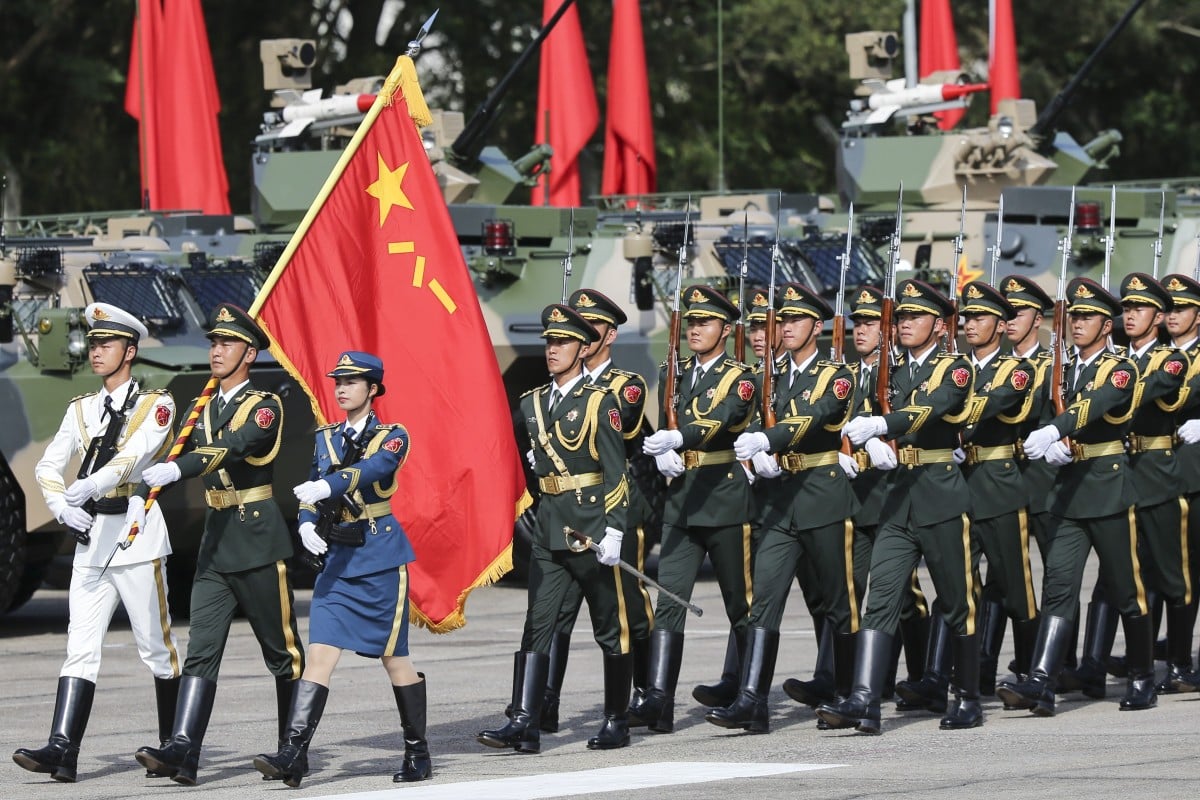
China’s People’s Liberation Army has said its Hong Kong garrison will “resolutely” safeguard national security and sovereignty. Photo: Sam Tsang
The People’s Liberation Army has said the Chinese military will “resolutely” safeguard China’s national security and sovereignty, in its first statement since Beijing announced plans to impose a sweeping national security law in Hong Kong.
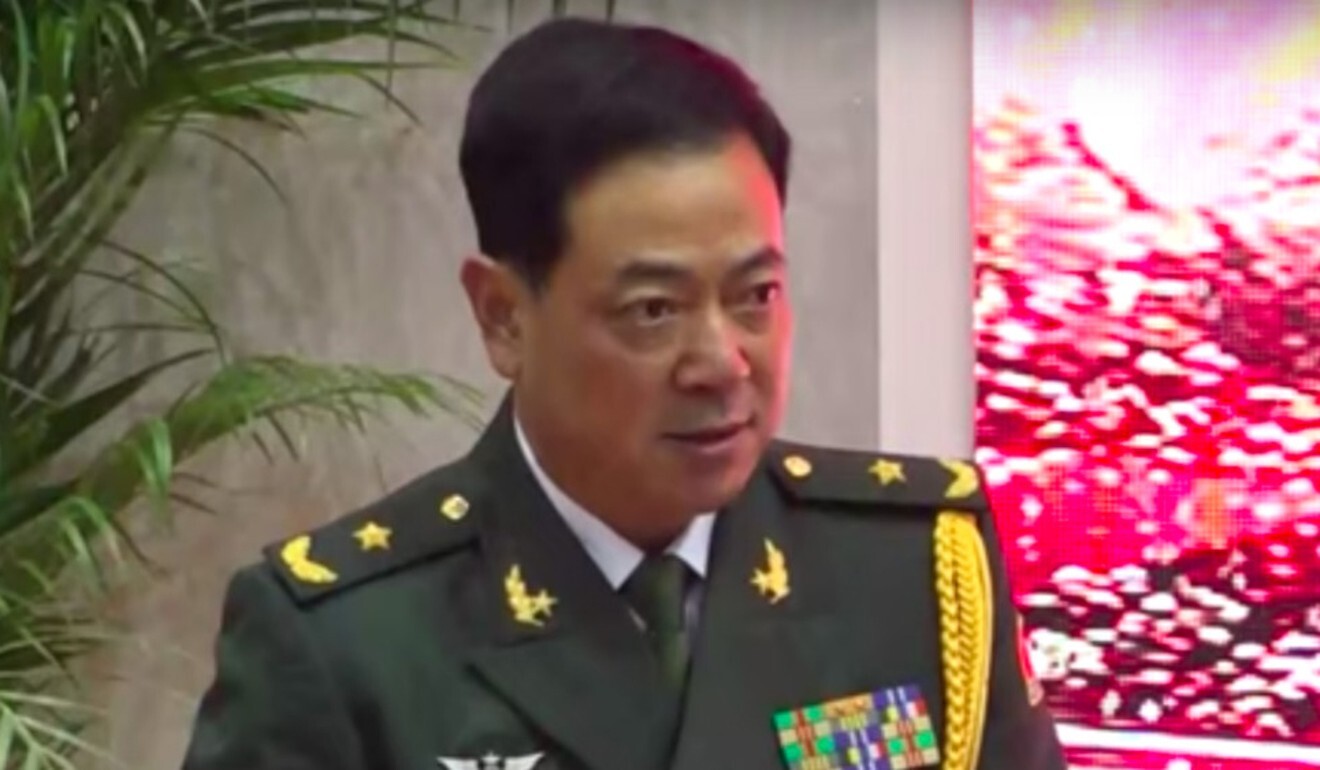
Chen Daoxiang, commander of the PLA’s Hong Kong garrison, said it would “act with firm resolve to implement the central government’s decision and plans” as well as continuing to implement the “one country, two systems” policy in the city.
How China is drafting a new Hong Kong national security law at the National People’s Congress
Speaking on the sidelines of China’s annual parliamentary meetings, also known as the
, Chen told state broadcaster CCTV that the new law would help to crack down on separatist and foreign forces aiming to undermine China’s national unity.
“[The garrison] will implement, according to law, various tasks delegated by the party and the people, and has the determination, confidence and ability to safeguard national security and development interest as well as Hong Kong’s continuing prosperity,” he said.
Commander of the PLA Hong Kong garrison Chen Daoxiang. Photo: Weibo
The proposal to impose a national security law in Hong Kong – which will give Beijing more direct control over the city – was introduced by China’s legislature on Friday. Beijing has blamed foreign forces for inciting last year’s months-long protests in Hong Kong, sparked by opposition to a separate and now-withdrawn extradition bill, and described the unrest as a grave threat to national security.
Separately, CCTV reported that a group of top military officials said in a session on Tuesday that there was a “great urgency” for Beijing to impose the law in a bid to address the “new risks and challenges” in governing the city.
The officials, who included Central Military Commission vice-chairmen Xu Qiliang and Zhang Youxia, said the plan was a “very timely, necessary and important” step to prevent and punish efforts to undermine China’s national sovereignty and security.
They reiterated the PLA’s commitment to opposing intervention from foreign forces in Hong Kong as well as maintaining China’s national unity and territorial integrity.
“Hong Kong affairs are purely China’s internal affairs. We resolutely oppose efforts by any foreign country, organisation and individual in interfering with Hong Kong affairs, and will resolutely guard against and contain any attempts by external forces in … engaging any separatist, subversion and infiltration activities,” they said, according to CCTV.
The planned national security law has drawn strong condemnation from the US government, with Secretary of State Mike Pompeo calling it a “death knell” for the territory’s relative autonomy. White House national security adviser Robert O’Brien said on Sunday that the US government would likely impose sanctions on China if Beijing went ahead with the plan.
President may suspend act that gives preferential treatment to people from the city, if Beijing passes national security law
Policymaking body clarifies that Tsai’s remarks were aimed at letting Beijing know there would be ‘serious consequences’ over the legislation
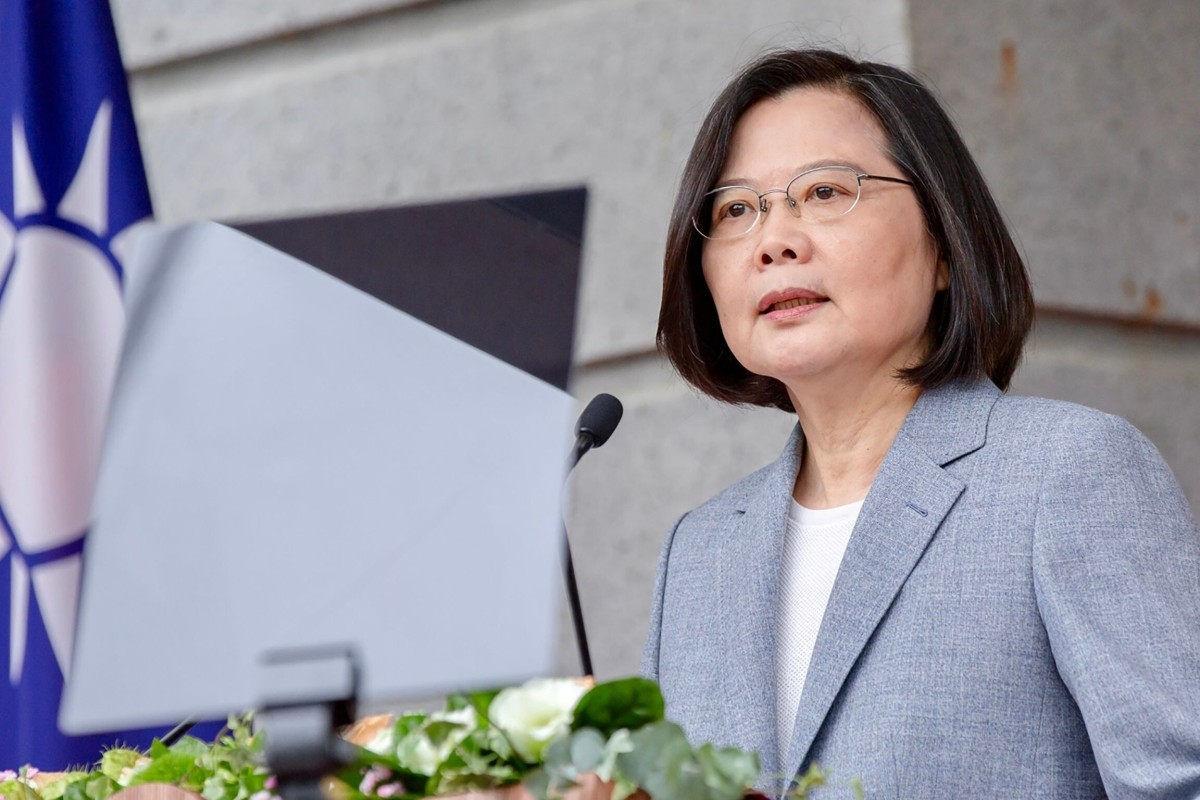
President Tsai Ing-wen said if Beijing’s national security law was implemented in Hong Kong it would seriously erode the city’s freedoms and judicial independence. Photo: AFP
Taiwan’s mainland policymaker on Monday clarified that the self-ruled island would continue to support Hong Kong, after President Tsai Ing-wen said its special status could be revoked if Beijing passed a controversial national security law for the city.
Tsai said in a Facebook post on Sunday that she might consider invoking Article 60 of the Laws and Regulations Regarding Hong Kong and Macau Affairs by suspending the “application of all or part of the provisions of the act” if the National People’s Congress bypassed Hong Kong’s Legislative Council to approve the security law.
That would mean an end to the preferential treatment given to people from Hong Kong and Macau, including to visit and invest in the self-ruled island.
Tsai said Beijing’s move would break its promise for Hong Kong to remain unchanged for 50 years after it was handed over to China, and for the city to be run with a high degree of autonomy.
Tear gas fired as thousands protest Beijing’s planned national security law for Hong Kong
In a statement on Monday, Taiwan’s Mainland Affairs Council responded to criticism from opposition lawmakers that Tsai planned to “dump” Hong Kong people after using them to win January’s presidential election.
“What the president said in her Facebook post did not mean ‘giving up on Hong Kong’, rather she meant to let Beijing know there would be serious consequences if the Chinese Communist Party National People’s Congress passes a Hong Kong version of the [mainland] national security law,” the statement said.
It said that the island’s authorities would continue to offer necessary assistance for Hong Kong people in view of the latest developments in the city.
Tsai’s strong support for the mass protests in Hong Kong last year – triggered by a now-shelved extradition bill – helped win the backing of many young voters in the Taiwan election in early January. The youth vote was seen as an essential part of her turnaround in the campaign – she had been expected to lose the race to mainland-friendly Kuomintang candidate Han Kuo-yu but ended up being re-elected for a second term in a landslide.
In her Facebook post, Tsai, from the Democratic Progressive Party, said if the national security law was implemented, it would seriously erode Hong Kong’s freedoms and judicial independence.
Taiwan to fire up missile programme as Tsai puts focus on asymmetric warfare against mainland China
23 May 2020
Opposition lawmakers said what Tsai was suggesting – suspending the city’s special status – was unthinkable as it would essentially mean shutting the door to Hong Kong people doing business, studying or fleeing to Taiwan to avoid penalties for their protest actions in the city.
KMT legislator Charles Chen I-hsin said he and others on Monday proposed that the legislature revise the act to allow Hong Kong people to seek refuge in Taiwan in the absence of a formal political asylum law.
In response, the Mainland Affairs Council said Tsai had made clear that the government would continue to help Hong Kong people in need, and that would continue in the future.
Chinese President Xi Jinping, also general secretary of the Communist Party of China Central Committee and chairman of the Central Military Commission, takes part in a deliberation with his fellow deputies from the delegation of Inner Mongolia Autonomous Region at the third session of the 13th National People’s Congress (NPC) in Beijing, capital of China, May 22, 2020. (Xinhua/Ju Peng)
BEIJING, May 23 (Xinhua) — “What is people first?” Chinese President Xi Jinping asked, before offering his own answer when he was talking with lawmakers at the ongoing national legislative session.
“So many people worked together to save a single patient. This, in essence, embodies doing whatever it takes (to save lives),” he said.
Xi, also general secretary of the Communist Party of China Central Committee and chairman of the Central Military Commission, is a deputy to the 13th National People’s Congress.
During his deliberations with fellow deputies from Inner Mongolia Autonomous Region on Friday, “people” was a keyword.
Xi referred to a story told by another deputy that morning. Luo Jie, from the COVID-19 hard-hit province of Hubei, told reporters at the session how medical workers in his hospital spent 47 days saving an 87-year-old COVID-19 patient.
“About 10 medical workers meticulously took care of the patient for dozens of days, and finally saved the patient’s life,” Xi said. “I am really impressed.”
In the COVID-19 pandemic, health workers around the world got to know the elderly are the most difficult to treat and require the most sophisticated medical resources. China has given every patient equal treatment irrespective of their age or wealth.
Chinese President Xi Jinping, also general secretary of the Communist Party of China Central Committee and chairman of the Central Military Commission, takes part in a deliberation with his fellow deputies from the delegation of Inner Mongolia Autonomous Region at the third session of the 13th National People’s Congress (NPC) in Beijing, capital of China, May 22, 2020. (Xinhua/Huang Jingwen)
In Hubei alone, more than 3,600 COVID-19 patients over the age of 80 have been cured. In the provincial capital Wuhan, seven centenarian patients have been cured.
“We mobilized from around the nation the best doctors, the most advanced equipment and the most needed resources to Hubei and Wuhan, going all out to save lives,” Xi said during the deliberations, adding that the eldest patient cured is 108 years old.
“We are willing to save lives at all costs. No matter how old the patients are and how serious their conditions have become, we never give up,” Xi said.
Xi joined political advisors and lawmakers on Thursday and Friday in paying silent tribute to the lives lost to COVID-19 as the top political advisory body and the national legislature opened their annual sessions.
This year’s government work report said China’s economy posted negative growth in the first quarter of this year, but it was “a price worth paying” to contain COVID-19 as life is invaluable.
“As a developing country with 1.4 billion people, it is only by overcoming enormous difficulties that China has been able to contain COVID-19 in such a short time while also ensuring our people’s basic needs,” the report said.
Epidemic response is a reflection of China’s governing philosophy.
The fundamental goal for the Party to unite and lead the people in revolution, development and reform is “to ensure a better life for them,” Xi said.
The nation’s average life expectancy reached 77 years in 2018, more than double that in 1949, when the people’s republic was founded.
Chinese people are not just living longer but better lives, with more material wealth and broader choices to pursue individual dreams. All rural poor will bid farewell to poverty this year as part of the goal of building a moderately prosperous society in all respects.
The Party’s long-term governance, Xi said, rests on “always maintaining close bond with the people.”
“We must always remain true to the people’s aspiration and work in concert with them through thick and thin,” Xi said.
Countries must respect each others’ systems and be wary of US political forces who want to ‘hijack relations’, Wang tells press conference at ‘two sessions’
Beijing is not looking for confrontation and wants to work with Washington to fight coronavirus, minister says
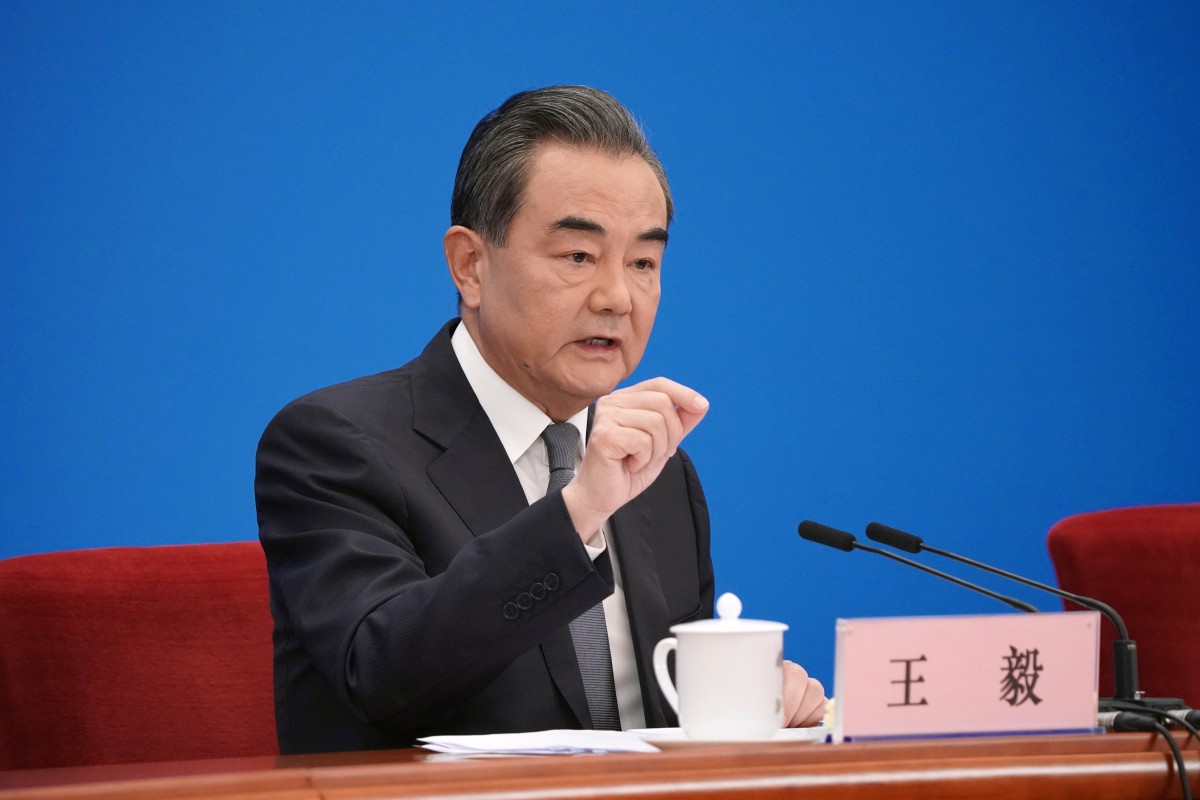
Foreign Minister Wang Yi said China did not want to replace or change the US. Photo: Xinhua
China and the US should try to avoid a new cold war and find new ways to cooperate despite their differences, China’s Foreign Minister Wang Yi said on Sunday.
“We need to be alert to efforts by some political forces in America to hijack China-US relations and who try to push the two countries towards a so-called ‘new cold war’.
“This is a dangerous attempt to turn back the course of history,” Wang told a press conference on the sidelines of the annual parliamentary meetings known as the ‘two sessions’.
Ties between the two countries have further worsened due to escalating tensions over the handling of the Covid-19 pandemic.
Voices calling for decoupling have been on the rise in the US, with some arguing that the two countries are edging towards a new cold war akin to that against the Soviet Union.
Wang called for the two countries to respect each other’s political systems and to find a way to get along despite their differences.
The two nations should step up cooperation on global pandemic control, and coordinate on macro policies to deal with the economic impact.
“China has no intention of changing the United States, much less replacing it. The US should give up the wishful thinking that it can change China.”
“For the benefit of the two peoples, as well as the future and well-being of humankind, China and the US should and must find a way to coexist peacefully despite the differences in system and cultures of the two societies.”
Wang said China will not seek confrontation with the United States, but China is determined to protect its sovereignty, territorial integrity and development.
Xie Haifeng’s story is one of luck and resilience and he has made it his mission to help others through adversity
Professional dancer owes part of his success to the city of Hong Kong and one of its doctors who helped survivors through recovery
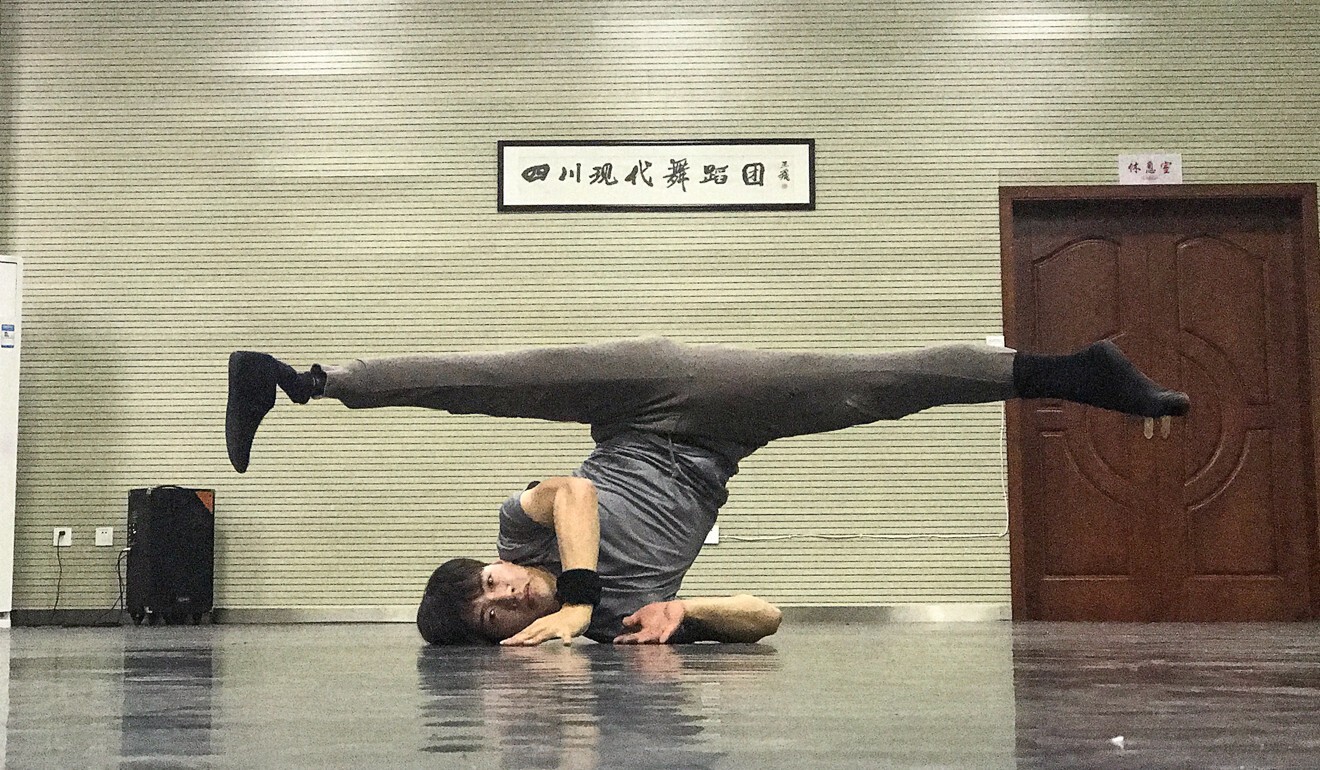
Xie Haifeng was 15 when he lost his leg in one of modern China’s most devastating disasters. Photo: Handout
When the rumbling began, Xie Haifeng thought someone was shaking his bed. Perhaps one of the other 800 children in the school dormitory was being naughty. Or maybe it was a small quake. Then came the unmistakable sound of screams.
Xie, then a 15-year-old pupil at Muyi Town Middle School in the southwestern Chinese province of Sichuan, started running. He fell as the dorm building collapsed around him. When he tried to stand up, he realised something was missing. His left leg was gone.
What Xie thought was a small quake turned out to be one of the most devastating disasters in modern Chinese history.
The Sichuan earthquake of May 2008 left at least 87,000 people dead and shook the country to its core. It was less than three month before Beijing would host its first Olympic Games, an opportunity to show the world its strength and ambition.
Instead, 7,444 schools had crumbled like tofu in an area known to be seismically active. Their rubble was a stark demonstration of the weak foundation of China’s progress and its tragic consequences. At Xie’s school, the shoddily built walls and ceilings crushed 600 children. Only 300 survived.
It still frightens me to recall the earthquake.Xie Haifeng, dancer
Xie considers himself lucky. “If I had run just one second more slowly, I would have been dead. If I had run one second faster, I would have been completely fine. But anyway, I am lucky to be alive,” he said. A dozen years later, his story is also one of resilience. Defying all the odds, Xie is now a professional dancer for a troupe in Sichuan and has made it his mission to help others through adversity.
The journey from his hospital bed to the stage was long and difficult and even though many years have passed, “it still frightens me to recall the earthquake”. But, he said: “I have forgiven fate and accepted the reality that I have only one leg.”
Xie’s trauma was a particularly difficult blow to his family. His older sister was already handicapped, after injuring her arm in an accident. When his mother, a migrant worker in the northwestern province of Gansu, arrived at the hospital a few days after the earthquake, she had no idea of the extent of Xie’s condition.
“When I woke up in the evening, I saw my mother weeping beside my bed. I told myself I should be strong,” Xie said, adding that his mother initially thought he had suffered only bruises. He was sent for treatment to a hospital in the prosperous southern city of Shenzhen, along with other survivors who had been left with disabilities by the earthquake.
Defying all the odds, Xie Haifeng is now a professional dancer. Photo: Handout
It was there that Xie was inspired to make the most of his life. A team of athletes visited the hospital and he was shocked to see one of them, a volleyball player, walking on a prosthetic leg.
Xie began to wear a prosthesis and after rehabilitation training returned to his hometown in 2009 where he was admitted to Qingchuan High School. At first, he was self-conscious and felt inferior to his peers. He did not dare to wear shorts in summer and said he seldom talked to the other students.
The following year he was introduced to members of the Chengdu Disabled People’s Art Troupe, where he found a new and welcoming home. Xie quit school and joined the troupe, despite his parents’ opposition. They were convinced study was the only way for rural students like their son to get out of poverty.
Xie learned Sichuan opera and was soon performing its art of bian lian, or
– a skill that requires rapid mask changes in a dazzling sleight of hand – on stage until the troupe was disbanded in 2011, leaving him unemployed for six months.
China marks 10-year anniversary of Sichuan earthquake
But the misfortune led to an improbable opportunity when he was hired by the Sichuan Provincial Disabled People’s Art Troupe and trained to dance. At 19, and with no experience, Xie found the training far more difficult than those who had started at the more usual age of five or six.
His body was too stiff, he said, and in the first months he spent 10 hours each day just stretching and building flexibility. It was just the beginning of a long and often arduous process.
“That agony is too much to be described,” Xie said about the pain of dancing on a prosthetic leg. “During the first six months’ training, I broke three artificial legs.”
More than once, he wondered whether he had chosen the right path. But, ultimately, his gruelling effort paid off and Xie has performed in Singapore, Hong Kong and Macau. In 2013, he won a gold medal at a national dancing competition for people with disabilities.
“My dances won me applause and recognition from the audience. I feel relieved and I think my heart belongs to the stage,” he said.
Xie broke three artificial legs during his first six months of dance training. Photo: Handout
Xie said he owed part of his success to Hong Kong which in 2008 donated HK$20 billion (US$2.5 billion) in aid to Sichuan and sent doctors to treat the injured. Among the volunteers was Poon Tak-lun, a Hong Kong orthopaedist who flew to Sichuan every two weeks from 2008 to 2013 to treat patients.
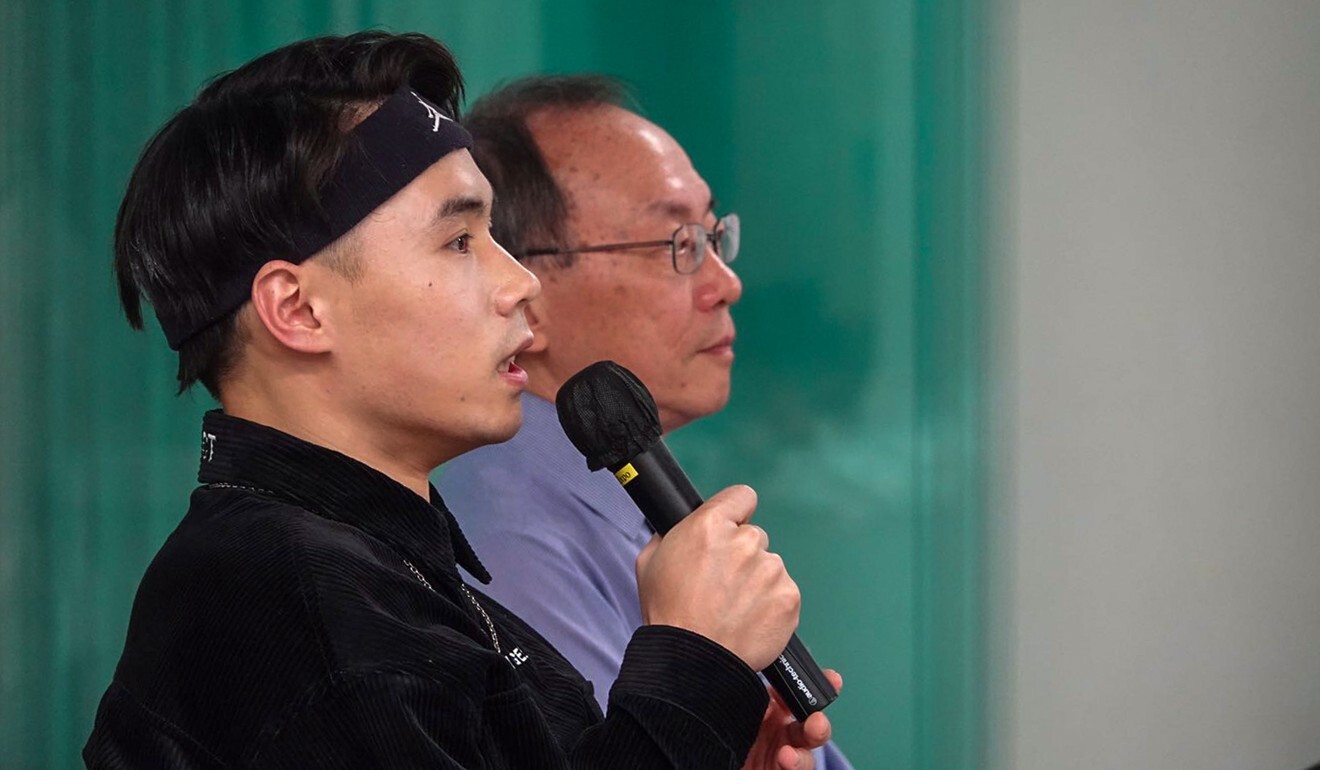
At a gala show in 2013 to express gratitude from the people of Sichuan to Hong Kong, Xie met Poon and the two became good friends, thanks to their common interest in the arts.
“Dr Poon promised to pay for all the costs of installing and repairing my artificial leg in the future. He told me to focus on dancing without worrying about the leg’s costs,” Xie said.
Xie Haifeng (pictured left with friend Poon Tak-lun) gives a speech to students in Hong Kong. Photo: Handout
Grateful for the help he received from Poon and Hong Kong, Xie has sought to return the favour by doing what he does best.
“I have no other skills except dancing and performing. So I thought of sharing my experience to encourage young students in Hong Kong,” he said.
Xie travels to Hong Kong about twice a year to perform and visit schools. In 2019, he visited the city four times, performing dances and Sichuan opera, and giving speeches at more than 10 primary and secondary schools.
“I encourage them to study hard. I said there are many people in this world who have more difficulties than them but still insist on pursuing their dreams, so they should not give up their dreams,” Xie said.
When he is not dancing and giving inspirational speeches, Xie said he lived a life like everyone else – climbing mountains, swimming and proudly walking on the leg he gained after almost losing everything in Sichuan’s deadly earthquake.
LONDON (Reuters) – China has betrayed the people of Hong Kong so the West should stop kowtowing to Beijing for an illusory great pot of gold, said Chris Patten, the last governor of the former British colony.
Beijing is set to impose new national security legislation on Hong Kong after a sustained campaign of pro-democracy protests last year in the city, which enjoys many freedoms not allowed on mainland China.
“The Hong Kong people have been betrayed by China,” Patten was quoted as saying by The Times newspaper. Britain has a “moral, economic and legal” duty to stand up for Hong Kong, he said.
Patten watched as the British flag was lowered over Hong Kong when the colony was handed back to China in 1997 after more than 150 years of British rule.
Hong Kong’s autonomy was guaranteed under the “one country, two systems” agreement principle enshrined in the 1984 Sino-British Joint Declaration signed by then Chinese Premier Zhao Ziyang and British Prime Minister Margaret Thatcher.
But China’s plans to impose national security laws on Hong Kong risk destroying the Declaration, Patten said. The United States has branded the laws a “death knell” for the city’s autonomy.
“What we are seeing is a new Chinese dictatorship,” Patten said. “The British government should make it clear that what we are seeing is a complete destruction of the Joint Declaration.”
Hong Kong leader Carrie Lam said her government will “fully cooperate” with the Chinese parliament to safeguard national security, which she said would not affect rights, freedoms or judicial independence.
Patten said the West should stop chasing the illusory promise of Chinese gold.
“We should stop being fooled that somehow at the end of the all the kowtowing there’s this great pot of gold waiting for us. It’s always been an illusion,” Patten said.
“We keep on kidding ourselves that unless we do everything that China wants we will somehow miss out on great trading opportunities. It’s drivel.”
The British government did not immediately comment on Saturday.
Prime Minister Boris Johnson’s spokesman said on Friday the government was monitoring the situation and as a party to the Joint Declaration the UK was committed to the upholding Hong Kong’s autonomy and respecting the one country, two systems model.
The tech investment push is part of a fiscal package waiting to be signed off by the National People’s Congress, which convenes this week
This initiative will reduce China’s dependence on foreign technology, echoing objectives set forth previously in the ‘Made in China 2025’ programme
A conductor rehearses the military band on the sidelines of the National People’s Congress in Beijing’s Great Hall of the People in March of last year. China’s legislature is expected to sign off on a massive tech-led stimulus plan. Photo: AP
Beijing is accelerating its bid for global leadership in key technologies, planning to pump more than a trillion dollars into the economy through the roll-out of everything from next-generation wireless networks to artificial intelligence (AI).
In the master plan backed by President Xi Jinping himself, China will invest an estimated 10 trillion yuan (US$1.4 trillion) over six years to 2025, calling on urban governments and private hi-tech giants like Huawei Technologies to help lay 5G wireless networks, install cameras and sensors, and develop AI software that will underpin
and Huawei to SenseTime Group at the expense of US companies.
As tech nationalism mounts, the investment drive will reduce China’s dependence on foreign technology, echoing objectives set forth previously in the “Made in China 2025”
programme. Such initiatives have already drawn fierce criticism from the Trump administration, resulting in moves to block the rise of Chinese tech companies such as Huawei.
How will China’s annual legislative meetings affect the stock investor? Five key industries to watch
18 May 2020
“Nothing like this has happened before, this is China’s gambit to win the global tech race,” said Digital China Holdings chief operating officer Maria Kwok, as she sat in a Hong Kong office surrounded by facial recognition cameras and sensors. “Starting this year, we are really beginning to see the money flow through.”
The tech investment push is part of a fiscal package waiting to be signed off by China’s legislature, the National People’s Congress, which convenes this week. The government is expected to announce infrastructure funding of as much as US$563 billion this year, against the backdrop of the country’s worst economic performance since the Mao era.
The nation’s biggest purveyors of cloud computing and data analysis Alibaba, the parent company of the South China Morning Post, and Tencent Holding will be linchpins of the upcoming endeavour. China has already entrusted Huawei, the world’s largest telecommunications equipment supplier, to help galvanise 5G. Tech leaders including Pony Ma Huateng and Jack Ma are espousing the programme.
Maria Kwok’s company is a government-backed information technology systems integration provider, among many that are jumping at the chance. In the southern city of Guangzhou, Digital China is bringing half a million units of project housing online, including a complex three quarters the size of Central Park in New York City. To find a home, a user just has to log on to an app, scan their face and verify their identity. Leases can be signed digitally via smartphone and the renting authority is automatically flagged if a tenant’s payment is late.
China is no stranger to far-reaching plans with massive price tags that appear to achieve little. There is no guarantee this programme will deliver the economic rejuvenation its proponents promise. Unlike previous efforts to resuscitate the economy with “dumb” bridges and highways, this newly laid digital infrastructure will help national champions develop cutting-edge technologies.
“China’s new stimulus plan will likely lead to a consolidation of industrial internet
providers, and could lead to the emergence of some larger companies able to compete with global leaders, such as GE and Siemens,” said Nannan Kou, head of research at BloombergNEF, in a report. “One bet is on industrial internet-of-things (IoT) platforms, as China aims to cultivate three world leading companies in this area by 2025.”
China is not alone in pumping money into the technology sector as a way to get out of the post-coronavirus economic slump. Earlier this month, South Korea said AI and wireless communications would be at the core of it its “New Deal” to create jobs and boost growth.
Nothing like this has happened before, this is China’s gambit to win the global tech raceMaria Kwok, COO at Digital China Holdings
The 10 trillion yuan that China is estimated to spend from now until 2025 encompasses areas typically considered leading edge, such as AI and IoT, as well as items such as ultra-high voltage lines and high-speed rail, according to the government-backed China Centre for Information Industry Development. More than 20 of mainland China’s 31 provinces and regions have announced projects totaling over 1 trillion yuan with active participation from private capital, a state-backed newspaper reported on Wednesday.
Separate estimates by Morgan Stanley put new infrastructure at around US$180 billion each year for the next 11 years – or US$1.98 trillion in total. Those calculations also include power and rail lines. That annual figure would be almost double the past three-year average, the investment bank said in a March report that listed key stock beneficiaries including companies such as China Tower Corp, Alibaba, GDS Holdings, Quanta Computer and Advantech Co.
Beijing’s half-formed vision is already stirring a plethora of stocks, a big reason why five of China’s 10 best-performing stocks this year are tech plays like networking gear maker Dawning Information Industry and Apple supplier GoerTek. The bare outlines of the master plan were enough to drive pundits toward everything from satellite operators to broadband providers.
China’s telecoms carriers push to complete ‘political task’ of 5G network roll-out amid coronavirus crisis
6 Mar 2020
It is unlikely that US companies will benefit much from the tech-led stimulus and in some cases they stand to lose existing business. Earlier this year, when the country’s largest telecoms carrier China Mobile awarded contracts worth 37 billion yuan for 5G base stations, the lion’s share went to Huawei and other Chinese companies. Sweden’s Ericsson got only a little over 10 per cent of the business in the first four months. In one of its projects, Digital China will help the northeastern city of Changchun swap out American cloud computing staples IBM, Oracle and EMC with home-grown technology.
It is in data centres that a considerable chunk of the new infrastructure development will take place. Over 20 provinces have launched policies to support enterprises using cloud computing services, according to a March research note from UBS Group.
Tony Yu, chief executive of Chinese server maker H3C, said that his company was seeing a significant increase in demand for data centre services from some of the country’s top internet companies. “Rapid growth in up-and-coming sectors will bring a new force to China’s economy after the pandemic passes,” he told Bloomberg News.
From there, more investment should flow. Bain Capital-backed data centre operator ChinData Group estimated that for every one dollar spent on data centres another US$5 to US$10 in investment in related sectors would take place, including in networking, power grid and advanced equipment manufacturing. “A whole host of supply chain companies will benefit,” the company said in a statement.
There is concern about whether this long-term strategy provides much in the way of stimulus now, and where the money will come from. “It’s impossible to prop up China’s economy with new infrastructure alone,” said Zhu Tian, professor of economics at China Europe International Business School in Shanghai. “If you are worried about the government’s added debt levels and their debt servicing abilities right now, of course you wouldn’t do it. But it’s a necessary thing to do at a time of crisis.”
Digital China is confident that follow-up projects from its housing initiative in Guangzhou could generate 30 million yuan in revenue for the company. It is also hoping to replicate those efforts with local governments in the northeastern province of Jilin, where it has 3.3 billion yuan worth of projects approved. These include building a so-called city brain that will for the first time connect databases including traffic, schools and civil matters such as marriage registry. “The concept of smart cities has been touted for years but now we are finally seeing the investment,” said Kwok.
The rhetoric towards the self-ruled island has hardened in Premier Li Keqiang’s annual work report
Beijing regards Taiwan as one of its core national interests and says it ‘resolutely opposes’ any separatist activity
Beijing regards reunification with Taiwan as one of its core interests. Photo: EPA-EFE
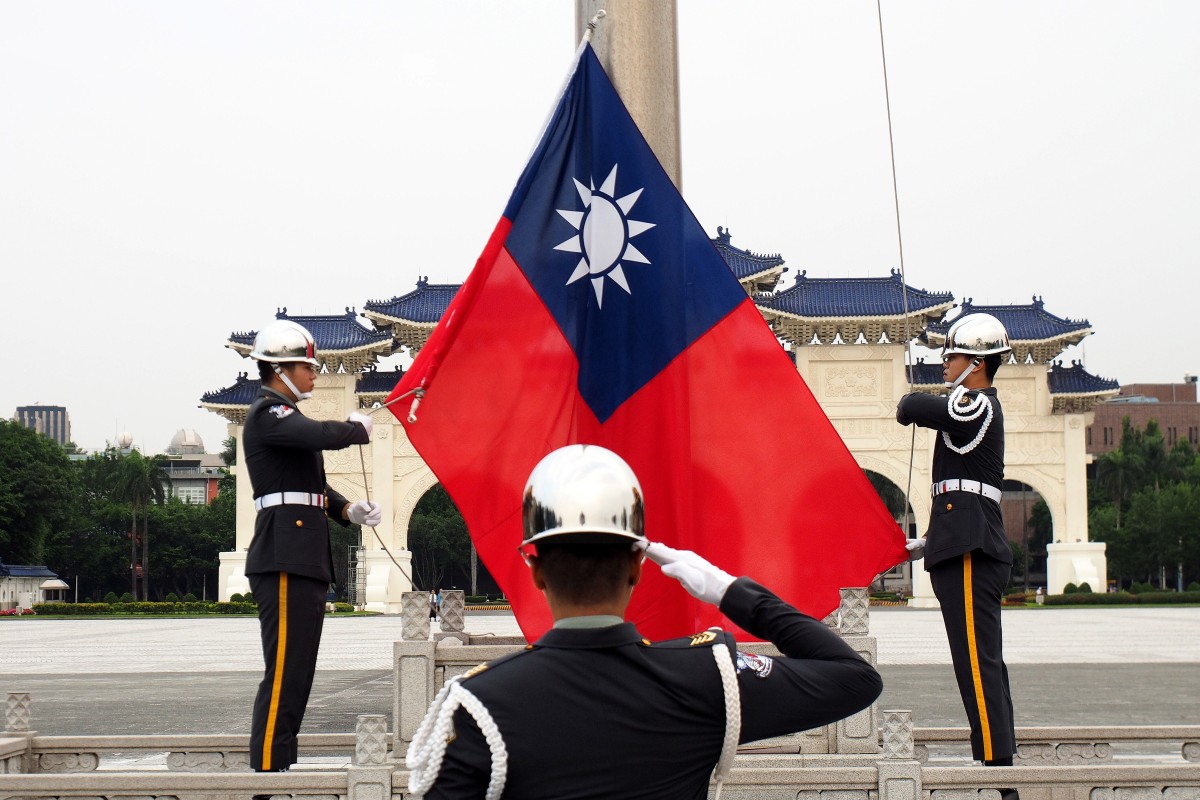
Beijing has hardened its rhetoric towards Taiwan, removing references to “peaceful reunification”, in the government’s annual work report.
Observers said the change reflected the stronger stance Beijing would adopt in tackling the Taiwan issue, which it regards as one of its key national interests.
The past six work reports since President Xi Jinping took power in 2013 stressed peaceful reunification and the 1992 consensus – under which both sides tacitly agree there is only one China, but have different interpretations on what this means.
But the latest report from Premier Li Keqiang took a different tone, saying: “We will adhere to the major principles and policies on work related to Taiwan and resolutely oppose and deter any separatist activities seeking ‘Taiwan independence’.”
US to sell US$180 million worth of submarine-launched torpedoes to Taiwan
21 May 2020
“We will improve institutional arrangements, policies, and measures to encourage exchanges and cooperation between the two sides of the Taiwan Strait, further cross-strait integrated development, and protect the well-being of our compatriots in Taiwan,” the report said.
“We will encourage them to join us in opposing ‘Taiwan independence’ and promoting China’s reunification.
“With these efforts, we can surely create a beautiful future for the rejuvenation of the Chinese nation,” it said, dropping a clause that described the process as “peaceful”.
The 1992 consensus allows leeway for both parties to negotiate an agreement, but President Tsai Ing-wen has said the island would never accept it as the basis for cross-strait relations.
Taiwan’s Mainland Affairs Council said on Friday that the “one country, two systems” framework, touted by Beijing as a political basis for unification, had harmed cross-strait relations. It called for the two sides to work together to resolve their differences.
Tang Shao-cheng, an international relations specialist at Taiwan’s National Chengchi University, said the change in wording and tone of the Taiwan section of the work report could be seen as a warning to Tsai’s independence-leaning Democratic Progressive Party (DPP).
“Not mentioning ‘peace’ suggests Beijing is considering unification both by peaceful means and by force,” Tang said.
President Xi Jinping and Premier Li Keqiang at the National People’s Congress opening session on Friday. Photo: Kyodo
Derek Grossman, an analyst from US-based think tank Rand Corporation, said Beijing would continue to put pressure on the island using diplomatic, military, economic and psychological means.
“Beijing will continue to send military aircraft near the island … [it] could decide to end the Economic Cooperation Framework Agreement which has remained active in spite of Tsai’s election in 2016; Beijing could steal one or more diplomatic partners from Taipei. I would expect these types of actions to be on the table,” Grossman said.
How would mainland China attack Taiwan? A video outlines one scenario
22 May 2020
Sun Yun, director of the China programme at the Stimson Centre think tank in the US, said Beijing faced a dilemma on whether to continue economic integration with Taiwan because that had not had the political effect it wanted.
“The obstacles to unification are not economic, but political. Taiwan is unwilling to pursue unification with an authoritarian mainland. To solve that issue, presumably the mainland could pursue political reform. But in reality, the Chinese Communist Party is unwilling,” she said.
“If the economic and political approach doesn’t work, what’s left is the military approach. But with US intervention, the mainland will not prevail.”
Beijing recently warned Washington it would respond after US Secretary of State
, and demanded that the US stop selling arms to the island.
Joshua Eisenman, a professor from the University of Notre Dame in Indiana, said Beijing was running out of countermeasures, since its actions had only hardened attitudes on the island and enhanced the sense of Taiwanese identity.
“As I see it, all that remains is for the [Chinese Communist Party[ to sit down and talk to the DPP without preconditions and establish a modus vivendi for cross-strait relations,” he said.
China will not set an economic growth goal for this year as it deals with the fallout from the coronavirus pandemic.
It is the first time Beijing has not had a gross domestic product (GDP) target since 1990 when records began.
The announcement was made by Premier Li Keqiang at the start of the country’s annual parliament meeting.
The world’s second largest economy shrank by 6.8% in the first quarter from a year ago as lockdowns paralysed businesses.
“This is because our country will face some factors that are difficult to predict in its development due to the great uncertainty regarding the Covid-19 pandemic and the world economic and trade environment,” Premier Li said.
The country’s leadership has promised to boost economic support measures amid growing concerns that rising unemployment could threaten social stability.
The move comes as tensions between Beijing and Washington are becoming increasingly strained over the coronavirus pandemic, trade and Hong Kong.
On Thursday, President Donald Trump stepped up his attacks on China, suggesting that the country’s leader, Xi Jinping, is behind a “disinformation and propaganda attack on the United States and Europe.”
It came as Mr Trump and other Republicans have escalated their criticism of Beijing’s handling of the early stages of the outbreak.
Also on Thursday, China announced plans to impose new national security legislation on Hong Kong after last year’s pro-democracy protests.
The announcement was met with a warning from Mr Trump that the US would react “very strongly” against any attempt to gain more control over the former British colony.
Separately, two US senators have proposed legislation to punish Chinese entities involved in enforcing the planned new laws and penalise banks that do business with them.
Earlier this week, the US Senate unanimously passed a proposal to delist Chinese companies from American stock exchanges if they fail to comply with US financial reporting standards.
US-listed Chinese companies have come under increasing scrutiny in recent weeks after Luckin Coffee revealed that an internal investigation found hundreds of millions of dollars of its sales last year were “fabricated”.














 CHINDIA ALERT: You'll be living in their world, very soon