Chindia Alert: You’ll be Living in their World Very Soon
aims to alert you to the threats and opportunities that China and India present. China and India require serious attention; case of ‘hidden dragon and crouching tiger’.
Without this attention, governments, businesses and, indeed, individuals may find themselves at a great disadvantage sooner rather than later.
The POSTs (front webpages) are mainly 'cuttings' from reliable sources, updated continuously.
The PAGEs (see Tabs, above) attempt to make the information more meaningful by putting some structure to the information we have researched and assembled since 2006.
SYDNEY (Reuters) – A Solomon Islands task force recommended to the government on Friday that the South Pacific archipelago sever its long-standing ties with Taiwan and normalise diplomatic relations with Beijing.
The recommendation is likely to help Beijing peel away another ally from self-ruled Taiwan, which Beijing considers a wayward province with no right to state-to-state ties.
The parliamentary task force advised the government to switch ties to China and invite it to establish a diplomatic mission in the capital, Honiara, on the island of Guadalcanal, according to a copy of its report obtained by Reuters.
“The findings reveal that Solomon Islands stands to benefit a lot if it switches and normalizes diplomatic relations with PRC,” the task force said, referring to China by its official name of the People’s Republic of China.
The recommendation was discussed at a cabinet meeting on Friday, two sources with direct knowledge of the issue said. It has not been presented to parliament.
Prime Minister Manasseh Sogavare has repeatedly said the government would not make a formal decision until reviewing the findings of the task force, which has toured the Pacific studying Chinese aid and bilateral financing.
Taiwan’s representative office in the Solomon Islands called the report a “fallacy” in a Facebook post and said the task force members did not conduct proper fact-finding.
The government of the Solomon Islands did not respond to questions.
China’s foreign ministry did not immediately comment.
A diplomatic switch by the Solomons would reduce the number of countries that recognise Taiwan to 16, after El Salvador in Central America, Burkina Faso in West Africa and the Dominican Republic in the Caribbean, all switched to Beijing last year.
The South Pacific has been a diplomatic stronghold for Taiwan, where formal ties with six island nations make up more than a third of its total alliances, though China has in recent years been expanding its influence in the region.
Solomon Island lawmakers who support maintaining ties with Taiwan will want the report to be made public, and to get feedback before any decision is made, according to one of the sources.
Taiwan’s supporters, who include many university students, would like the decision delayed until Sogavare travels to the U.N. General Assembly meeting in New York later this month, in the hope talks he has there might save the Taiwan alliance.
The issue has divided loyalties in the former British protectorate, an archipelago of just over 600,000 people.
The United States has criticised China for pushing poor countries into debt, mainly through lending for large-scale infrastructure projects, and accused China of using “predatory economics” to destabilise the Indo-Pacific region.
China denies that.
One Solomon Islands province has said it would not be responsible for repaying any debts incurred by the government, according to media reports.
Chinese Premier Li Keqiang meets with Kazakh President Kassym-Jomart Tokayev at the Diaoyutai State Guesthouse in Beijing, capital of China, Sept. 11, 2019. (Xinhua/Rao Aimin)
BEIJING, Sept. 11 (Xinhua) — Chinese Premier Li Keqiang met with Kazakh President Kassym-Jomart Tokayev here on Wednesday.
Calling Kazakhstan China’s friendly neighbor and comprehensive strategic partner, Li said the two countries enjoy solid political mutual trust, fruitful cooperation results and a long-standing friendship.
China stands ready to better synergize the Belt and Road Initiative with Kazakhstan’s development strategy, Li said.
The two countries should intensify all-round cooperation, and jointly safeguard peace and stability in the region, he said.
Cooperation between China and Kazakhstan is based on mutual trust, geographical proximity, huge potential and broad prospects, Li said, promising that China will facilitate cooperation with Kazakhstan in energy, production capacity, nuclear electricity, finance, and science and technology.
The Chinese premier also called for better use of cross-border e-commerce platforms and expansion of bilateral trade.
Tokayev congratulated the People’s Republic of China on its 70th anniversary.
China is viewed as an important strategic partner of Kazakhstan, said Tokayev, reiterating that his country is willing to be an active participant in the construction of the Belt and Road, boost bilateral cooperation in all areas, and expand exports to China.
He added that Chinese enterprises are welcome to invest in Kazakhstan, and voiced hope for more tourism cooperation and closer exchanges among young people.
Chinese President Xi Jinping meets with Ho Iat Seng, the newly elected and appointed chief executive of the Macao Special Administrative Region, at the Great Hall of the People in Beijing, capital of China, Sept. 11, 2019. (Xinhua/Xie Huanchi)
BEIJING, Sept. 11 (Xinhua) — President Xi Jinping on Wednesday met with Ho Iat Seng, the newly elected and appointed chief executive of the Macao Special Administrative Region (SAR), at the Great Hall of the People in Beijing.
Xi congratulated Ho on his appointment by the central government as the fifth-term chief executive of the Macao SAR.
“You has long adhered to the position of loving the country and Macao, enthusiastically served the Macao society, worked wholeheartedly on public posts including as a member of the National People’s Congress Standing Committee and president of the Legislative Assembly of the Macao SAR, and made contributions to the country’s reform and opening up, modernization, as well as prosperity and stability of Macao,” Xi said to Ho, adding that the central government fully recognizes such efforts.
“Your nomination and election with overwhelming support fully show that you have won broad endorsement in Macao,” Xi told Ho.
This year marks the 20th anniversary of Macao’s return to the motherland.
For the past 20 years, under the leadership of two chief executives Edmund Ho Hau Wah and Chui Sai On, the Macao SAR government has united people from all walks of life, fully and accurately understood and implemented the principle of “one country, two systems,” firmly upheld the authority of the Constitution and the Basic Law, passed on the core values of loving the country and Macao, promoted Macao’s rapid economic growth, sustained improvement in people’s livelihood and social stability and harmony, demonstrating to the world a successful practice of “one country, two systems” with Macao characteristics, said Xi.
“One country, two systems” has proved to be a workable solution welcomed by the people, said Xi.
Xi hoped that Ho will accurately grasp Macao’s situation and the country’s strategic development needs, unite and lead the Macao SAR government and people from all walks of life to strive for the region’s long-term development and continue the successful implementation of “one country, two systems.”
Ho said he is honored to be appointed the fifth-term chief executive of the Macao SAR by the central government.
Ho pledged to, under the leadership of President Xi and the central government, firmly implement the “one country, two systems” principle, safeguard the authority of the Constitution and the Basic Law, maintain favorable relations between the central government and the Macao SAR, uphold the central government’s overall governing power, defend the country’s sovereignty, security and development interests and make steady progress in implementing the “one country, two systems” principle.
Han Zheng and other senior officials also attended the meeting.
Chinese Vice Premier Liu He, also a member of the Political Bureau of the Communist Party of China Central Committee, meets with Chairman of the U.S.-China Business Council (USCBC) Evan Greenberg at the latter’s request in Beijing, capital of China, on Sept. 12, 2019. (Xinhua/Liu Bin)
BEIJING, Sept. 12 (Xinhua) — Chinese Vice Premier Liu He on Thursday met with Chairman of the U.S.-China Business Council (USCBC) Evan Greenberg in Beijing at the latter’s request.
Liu, also a member of the Political Bureau of the Communist Party of China Central Committee, said China welcomes the U.S. side’s latest decision to delay an increase in tariffs, which was previously scheduled for Oct. 1.
The whole world looks forward to seeing progress in trade consultations between China and the United States, Liu said, adding that working groups of both sides will meet next week and have earnest discussions on trade balance, market access, protection of investors and other issues of common concern.
The U.S. business sector does not want to see a hike in tariffs, and hopes that the two countries will solve their differences through consultations and bring bilateral trade back to normal, Greenberg said.
The USCBC is willing to play a positive role in this regard, he added.
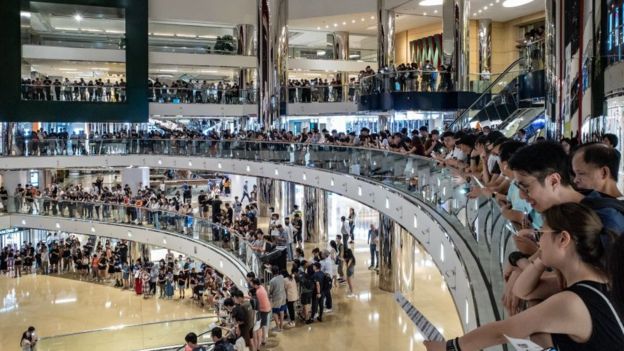
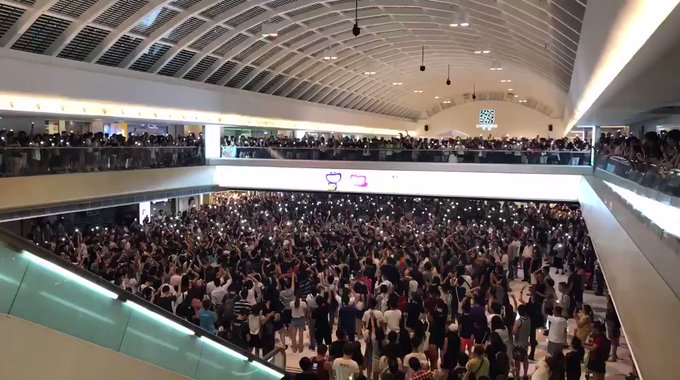
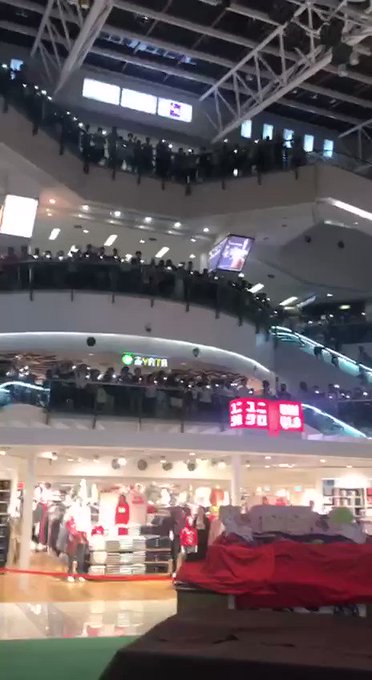
On Tuesday night, thousands of protesters gathered in shopping malls across Hong Kong chanting slogans and singing Glory to Hong Kong.
Image copyright GETTY IMAGESImage caption Many protesters flooded shopping malls
In the popular shopping district of Mongkok, a sea of protesters dressed in black were seen congregating across the different levels of one mall.
Jason Y. Ng
✔@jasonyng
Hundreds of shoppers spontaneously assembled at a mall atrium and broke into song. They sang “Glory to Hong Kong,” an ersatz national anthem (coz we aren’t a national and haven’t the right to an anthem). People ask what Communist China is most afraid of—the answer is right here.
Another video showed protesters chanting “Go Hong Kong” – a phrase that has been used frequently as a sign of encouragement.
Shopping malls have been the scene of clashes in recent weeks, with one incident in July seeing riot police fight battles with protesters inside a mall in the district of Sha Tin.
Without true democracy, HKer shall never surrender! This video shows citizens are gathered in a mall and cheering each other up after singing the song of #HKprotest “Glory to Hong Kong”.
The new rallying cry has joined other popular songs used by the protest movement, including Do You Hear the People Sing? from musical Les Miserables and the Christian hymn Sing Hallelujah to the Lord.
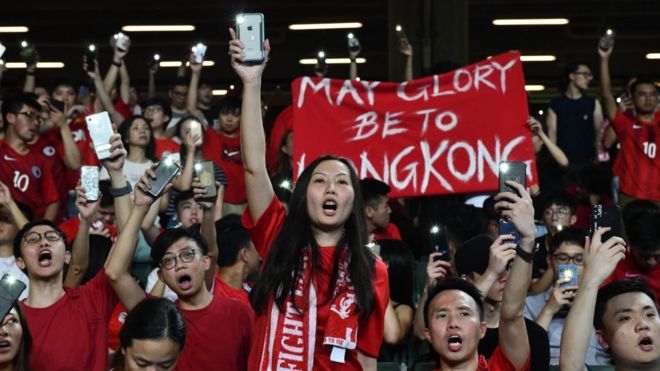
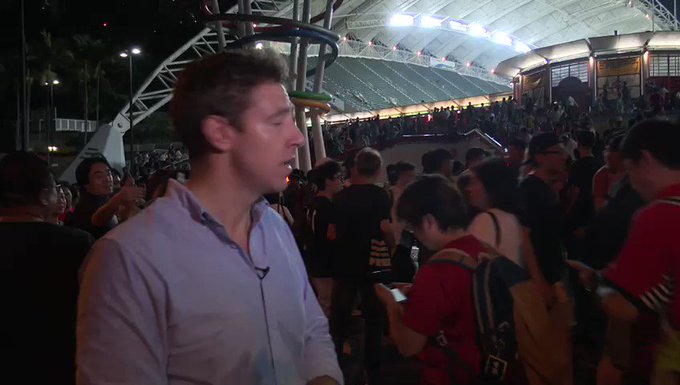
It was also heard at the Hong Kong v Iran football match on Tuesday at Hong Kong Stadium.
#Hongkong soccer fans booing the #Chinese national anthem tonight. Footy fans also have their backs to the field. Carrie Lam’s administration had been planning to introduce tough new penalties for booing the anthem but this can’t be easy to bring in in the city’s current climate. https://twitter.com/SCMPHongKong/status/1171411414801534977 …
The 2022 Fifa World Cup qualifier saw thousands of protesting booing when the Chinese national anthem played before the start of the game.
The jeering, which could be heard from outside the stadium, was intended as a clear “message” to Beijing that they do not want to be part of China in the future, says the BBC’s Nick Beake who was at the game.
Nick Beake
✔@Beaking_News
VIDEO: The moment #HongKong football fans began booing #China national anthem before the start of their @FIFAWorldCup qualifier against #Iran. #CarrieLam ‘s govt has delayed (another) controversial new law that could give 3 year prison term for disrespecting anthem. @BBCWorld
Hong Kong, formerly a British colony, returned to Chinese rule in 1997.
Under the “one country, two systems” rule, the city is granted a high level of autonomy, an independent judiciary and rights such as freedom of speech.
But those freedoms – the Basic Law – expire in 2047 and it is not clear what Hong Kong’s status will then be.
There has been growing anti-mainland sentiment in recent years, and anger at what many feel is increasing mainland interference in Hong Kong affairs.
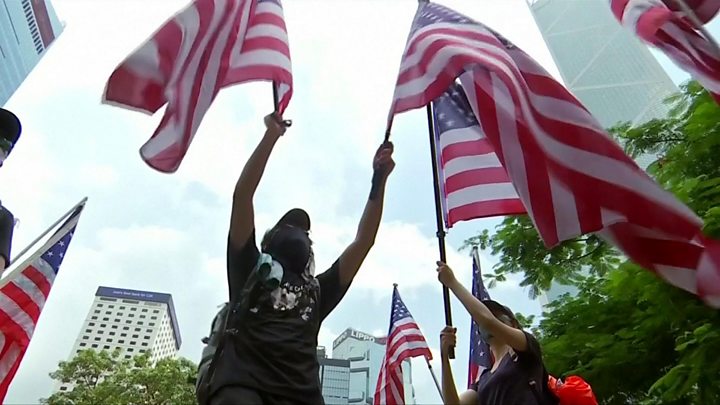
Media caption Protesters sang the US anthem outside the consulate
This reached a tipping point when the Hong Kong parliament proposed a new law that would have enabled suspects in Hong Kong to be extradited to China.
Hundreds of thousands of people marched on the streets in protest of the law, demanding that it be abandoned. The government initially suspended in June, and then finally dropped earlier this week – almost three months after protests first begun.
But protesters have said this is “too little, too late”, and their demands have evolved into calls for a much wider set of reforms, including a call for universal suffrage.
Agriculture ministry says long-term goal is achievable despite the loss of a third of domestic livestock owing to impact of disease
Observers believe foreign producers will never be able to produce enough to satisfy the world’s largest market for the meat
A pork vendor sleeps at a stall at a Beijing wholesale market. Photo: Simon Song
China will continue to strive for self-sufficiency in pork production although its farming industry has suffered a devastating blow after African swine fever wiped out about one-third of its hog herds, officials said on Wednesday.
Yu Kangzhen, a vice-minister for agriculture, said it was unrealistic for China to pin its hope on imports in meeting the country’s demand for pork.
Last year, China consumed about half of the world’s pork but more than 95 per cent was sourced from domestic supplies, which have taken a serious hit this year due to swine fever.
The disease is deadly for pigs, although not for humans, and there is currently no cure or vaccine.
“Even at its highest level, imports accounted for about 2 per cent of China’s domestic production,” said Yu at a press conference in Beijing.
“So from the statistics alone, we can see that we must adhere to the principle of self-sufficiency if we are to meet our demand for meat, and this also explains why we have put forward a 95 per cent self-sufficiency target.”
According to Yu, the total global trade in pork last year was 8 million tonnes – less than 15 per cent of China’s total production of 54 mi
Peng Shaozong, an official from the pricing department of the National Development and Reform Commission (NDRC), expressed confidence that foreign suppliers would be interested in filling any gaps in the Chinese market.
“Imports are guided by the market. If there is money to be made [in selling to China], they will definitely come,” said Peng on the sidelines of the press conference.
Pan Chenjun, from agribusiness bank Rabobank, said China’s pork production was expected to continue to fall in the coming year, putting pressure on the country’s US$140 billion pork industry.
In July, China’s pig population had fallen by 32.2 per cent from a year earlier, and was down 9.4 per cent compared with the previous month, according to latest government figures.
However, Pan said the government’s 95 per cent self-sufficiency target was in line with market realities.
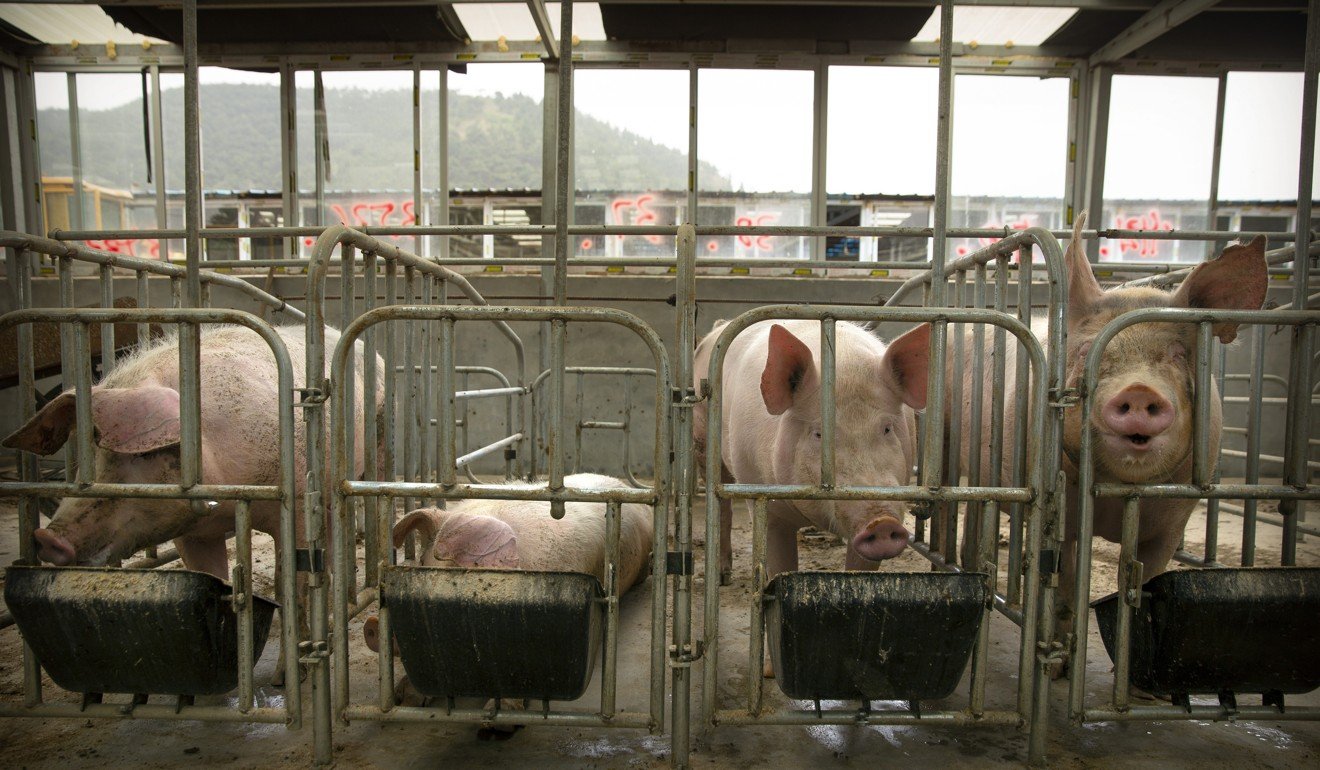
China’s domestic pig stocks have fallen by a third. Photo: AP
“In any case, the 95 per cent [self-sufficiency] goal is reasonable, as China’s pork market size is too big, and imports, despite rising this year, still represent just a small part,” Pan said.
Although China’s domestic shortfall may offer a windfall to foreign suppliers, they must obtain government approval before they could sell to China.
On Monday, Beijing approved imports from 25 Brazilian meat factories, bringing the country’s total number to 89.
On Wednesday, Danish officials completed a three-day trip to China, saying they expected to increase pork exports to China.
Danish food minister Mogens Jensen attended the opening of a new meat processing facility near Shanghai operated by Danish Crown.
China imported 230,000 tonnes of pork from Denmark in 2018, according to the country’s foreign ministry.
On Tuesday, the Chinese State Council issued a new set of guidelines to support the industry, outlining measures such as increased subsidies to boost domestic production in the face of worsening pork shortages that have sent prices to record highs.
The consumer price index released on Tuesday reinforced the bleak picture of a tight market supply as the data showed that pork prices rose by 46.7 per cent in August compared with a year earlier, almost double the 27 per cent rise witnessed in July.
Prices of pork are one of the major indicators used by Chinese citizens to gauge their well-being and, at the moment, that well-being is being eroded rapidly.
According to NDRC, China has already spent a total of 3.23 billion yuan (US$454 million) in subsidies so far this year to tackle the pork shortage crisis.
“As much as 1.1 billion yuan has been newly added under the budget of the central government, with the focus on supporting western provinces in the Yangtze River basin to carry out farm improvement works to control pollution and reduce livestock and poultry waste,” Peng from the NDRC said.
However, a report published by research firm Gavekal Dragonomics on Wednesday cautioned that the government’s plans to soften the blow on the industry might not be effective.
“As the overhaul of pig-raising practices to eliminate the disease would take years even if the government was moving more aggressively, high prices and pork shortages are going to persist,” the report said.
ANKARA (Reuters) – Turkey sees opportunity to boost trade with the United States amid Washington’s trade war with Beijing, the Turkish trade minister said on Tuesday, reinforcing an ambitious goal of quadrupling the bilateral trade to $100 billion (81.1 billion pounds) a year.
“We have determined that the issues between the U.S. and China will create a significant opportunity for trade in various sectors,” Trade Minister Ruhsar Pekcan told a joint press conference with U.S. Secretary of Commerce Wilbur Ross.
“We have expressed to the U.S. side our readiness to provide goods,” she said.
Pekcan added that trade and investment would be the main topic when U.S. President Donald Trump and Turkish counterpart Tayyip Erdogan meet during the United Nations General Assembly later this month in New York.
On Saturday, Turkey asked the United States to lift trade barriers during talks aimed at sharply increasing bilateral commerce.
Washington and Ankara’s goal of $100 billion in trade a year comes despite the prospect of U.S. sanctions over Turkey’s purchase of Russian S-400 missile defence systems. The United States says trade with Turkey totalled $24 billion in 2017, with the U.S. surplus standing at $1.5 billion.
The White House said in May it was ending a preferential trade agreement with Turkey, saying Turkey’s level of economic development meant it was no longer eligible for the support.
Merkel makes the case on sensitive issues in Beijing without being offensive, observer says
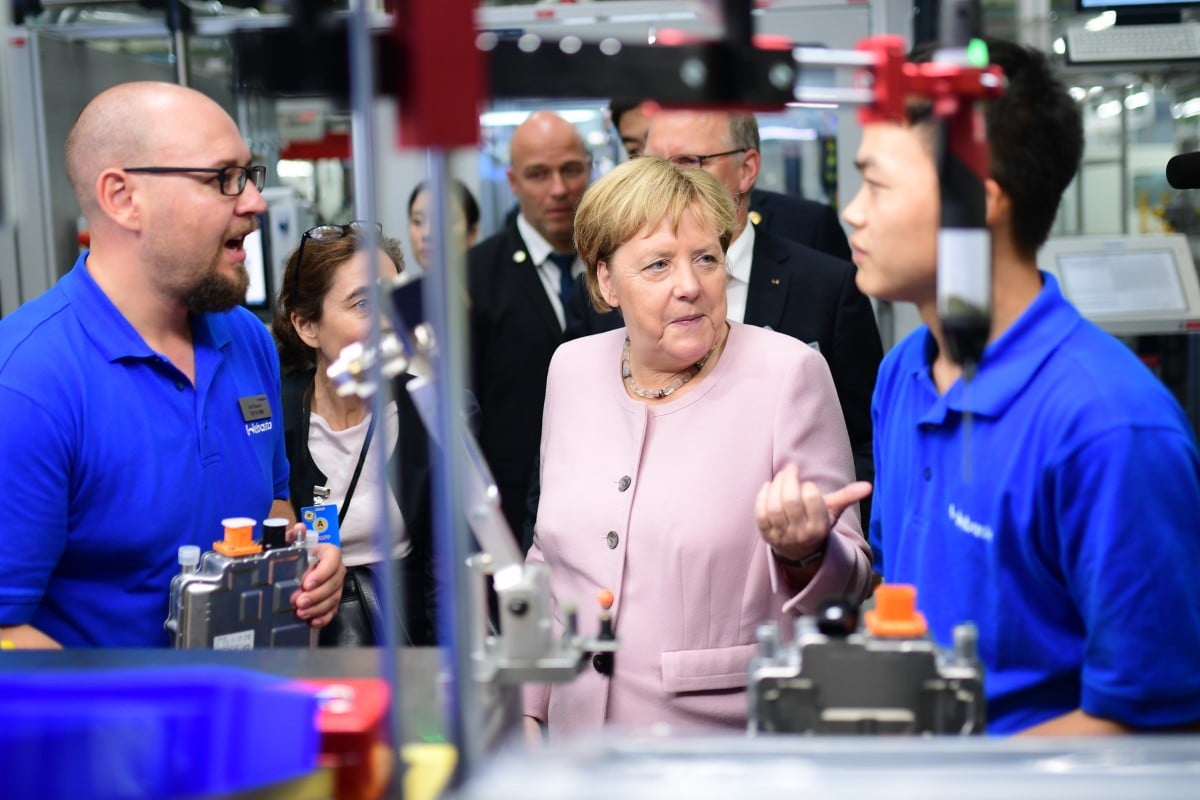
German Chancellor Angela Merkel (centre) talks to staff at manufacturer Webasto during a visit in Wuhan on Saturday. Photo: EPA-EFE
German Chancellor Angela Merkel may be slowly declining in influence in European politics but she remains the EU’s strongest voice in dealing with China, analysts said after her latest trip to China last week.
During the two-day visit, Merkel and Chinese President Xi Jinping discussed the sensitive topic of Hong Kong and the social credit system in China.
German diplomats also averted a plan by Chinese officials to scrap a joint press conference by Merkel and Chinese Premier Li Keqiang out of concerns that it could be dominated by questions about the escalating protests in Hong Kong.
Two sources told the South China Morning Post that the Chinese side initially suggested not letting journalists ask questions during the press conference. German diplomats persisted, saying that Merkel would hold her own press conference to take media questions, the sources said.
Germany’s Angela Merkel renews call for peaceful resolution to Hong Kong protests
After talks with the Chinese president and premier, Merkel said Beijing had listened to her views about resolving the Hong Kong conflict without violence, adding: “This is important.”
She said she also pressed the European Union’s position that the Sino-British Joint Declaration on Hong Kong remained effective, countering Beijing’s assertion that the 1984 document has ceased to be valid.
“Merkel navigated the narrow line to raise these sensitive issues without being overly offensive,” said Jan Weidenfeld, of the Berlin-based Mercator Institute for China Studies.
Joerg Wuttke, president of the EU Chamber of Commerce in China, said Merkel’s biggest achievement was to raise the issue about the social credit system in China, a policy that aims to rank every individual and corporate entity based on their compliance with state-stipulated social norms.
“It is important to us that she makes the Chinese leadership aware that the German business community would like to get better briefed and prepared for this major change in company compliance by the Chinese authorities,” Wuttke said. “Merkel was the first foreign leader to do so.”
Despite Merkel’s tough approach, China’s foreign ministry was full of praise for the German leader’s visit, saying both sides were “satisfied” with the outcomes.
“This is Chancellor Merkel’s 12th China visit, so she should be one of the Western leaders who visited China the most times and knows China the best,” ministry spokeswoman Hua Chunying said on Monday.
Hong Kong is a matter for China, Premier Li Keqiang tells Angela Merkel
Back home, however, German media and businesses remained sceptical about the future.
Bild, the country’s biggest-circulation newspaper, has been following closely the arrest of Hong Kong pro-democracy activist Joshua Wong Chi-fung, who was detained at Hong Kong airport on his way to Berlin at the newspaper’s invitation. Wong was later cleared to travel abroad.
Several newspapers have put pressure on Merkel to speak out for Hong Kong, with one calling on her to replace a stop in mainland China with one in the former British colony, which she refused.
On the business side, German businesses also urged Merkel to caution Beijing against sending troops to Hong Kong out of concerns that the lucrative Chinese market would become subject to international sanctions.
Another concern is the slow pace of structural reforms that would open up Chinese markets to foreign businesses.
German Chancellor Angela Merkel visits Wuhan Yangtze River Bridge in Wuhan, capital city of central China’s Hubei Province, Sept. 7, 2019. German Chancellor Angela Merkel visited Wuhan on Saturday. (Xinhua/Xiao Yijiu)
WUHAN, Sept. 7 (Xinhua) — Angela Merkel Saturday visited central China’s Wuhan during her 12th trip to the country as German Chancellor since 2005.
Before Wuhan, capital city of Hubei province, Merkel had visited a number of cities besides Beijing during her China trips in the past.
When talking with students of Huazhong University of Science and Technology, Merkel highlighted the importance of international cooperation in the era of globalization, and called on the students to be participants.
Saying that a nation’s prosperity is part of the prosperity of the whole world, she voiced her hope that students should shoulder common responsibilities to combat global challenges.
In the speech, Merkel reviewed her past trips to China. In Shenyang, she witnessed economic upgrading. In Chengdu she learned about development of western China. In Shenzhen she saw remarkable progress brought by the reform and opening-up.
She said quite a few noted German companies including Siemens, and small and medium-sized innovation enterprises are operating business in Wuhan. Wuhan and Duisburg became the first pair of sister cities between China and Germany in 1982.
Merkel exchanged views with students on internet, artificial intelligence, intelligent manufacturing, and environmental protection.
Before wrapping up her trip, Merkel also visited a local hospital and a factory of the German company Webasto.
BEIJING, Sept. 7 (Xinhua) — China’s National Museum of Classic Books unveiled an exhibition in Beijing Saturday to showcase the preservation and inheritance of ancient Chinese books over the past 70 years since the founding of the People’s Republic of China (PRC).
More than 330 precious collections from over 70 public institutions and private collectors around the country, ranging from ancient government archives, maps, manuscripts to paintings, have been put on display.
The exhibition, sponsored by the Ministry of Culture and Tourism and the National Cultural Heritage Administration, is the largest of its kind since the founding of the PRC in 1949.
With digital virtual sand table demonstration, holographic and immersive digital scenes, the curator tries to use diversified means and modern technologies to facilitate audience experience.










 CHINDIA ALERT: You'll be living in their world, very soon