Archive for ‘Belt and Road (B&R)’

22/09/2019

Spotlight: China, Azerbaijan pledge to strengthen cooperation

AZERBAIJAN-BAKU-LI ZHANSHU-VISIT

Li Zhanshu (L), chairman of the Standing Committee of the National People’s Congress of China, meets with Azerbaijani President Ilham Aliyev in Baku, Azerbaijan, Sept. 19, 2019. Li paid an official goodwill visit to Azerbaijan from Sept. 19 to 21 at the invitation of Ogtay Asadov, speaker of the National Assembly of Azerbaijan. (Xinhua/Pang Xinglei)

BAKU, Sept. 21 (Xinhua) — Li Zhanshu, chairman of the Standing Committee of the National People’s Congress (NPC) of China, and top Azerbaijani officials have agreed here to strengthen bilateral cooperation in various areas.

During an official goodwill visit from Thursday to Saturday, Li met with Azerbaijani President Ilham Aliyev and conveyed Chinese President Xi Jinping’s cordial greetings to him.

Li briefed Aliyev on the great achievements of the People’s Republic of China since its founding 70 years ago, saying that the Communist Party of China is forging ahead on the road of socialism with Chinese characteristics in line with China’s national conditions.

The socialism with Chinese characteristics has now entered a new era, and China under the leadership of Xi is striving to achieve its “two centenary goals” and realize the Chinese dream of the great rejuvenation of the Chinese nation, Li told Aliyev.

China deems Azerbaijan as an important partner in Eurasia and is ready to implement the blueprint made by Xi and Aliyev on the development of bilateral ties, further cement political mutual trust, strengthen practical cooperation in various areas, and jointly safeguard the two countries’ security and development interests, Li said.

Aliyev asked Li to convey his best wishes to Xi and said he had witnessed the great changes in China with his own eyes during his repeated trips to the country and that he admired such achievements.

Azerbaijan-China relations are developing rapidly with a rosy future, he said, adding that his country firmly adheres to the one-China principle, and intends to combat jointly with China the “three forces” of terrorism, separatism and extremism, and improve their coordination and cooperation on international and regional issues.

LEGISLATIVE EXCHANGES

During a meeting with Ogtay Asadov, speaker of the National Assembly of Azerbaijan, Li said his visit was aimed at strengthening cooperation between the two legislatures and implementing the important consensuses reached by the two heads of state.

The Chinese top legislator suggested both sides increase interactions at various levels, exchange experience on governing the countries, and provide legal assurance for bilateral practical cooperation.

Every country has a unique history, national situation and culture, so different civilizations should coexist harmoniously and learn from each other, Li said.

The NPC of China is willing to work with the National Assembly of Azerbaijan to promote cultural and people-to-people exchanges between the two countries, learn from each other, and cement public support for bilateral relations, he said.

Asadov said Li was the first top Chinese legislator to visit Azerbaijan in 19 years and that the trip has injected new vitality into the development of bilateral relations and the interactions between the two legislatures.

Azerbaijan and China have signed many cooperation deals and the two legislatures should help to deliver on the agreements, Asadov said.

An increasing number of Azerbaijani people are interested in Chinese culture and there is a need to promote educational, cultural and youth exchanges, he said.

ECONOMIC COOPERATION

At a meeting with Azerbaijani Prime Minister Novruz Mammadov, Li said Azerbaijan is located at the junction of Europe and Asia and is an important country along the Belt and Road.

Li said China is ready to boost economic and trade exchanges with Azerbaijan and enhance cooperation with the country in jointly building the Belt and Road and achieve more cooperation outcomes in such fields as energy, agriculture, transportation, logistics, tourism and informatization.

He welcomed Azerbaijan to the second China International Import Expo to be held in early November in Shanghai.

Mammadov said his country was among the earliest participants in the Belt and Road Initiative and is ready to expand cooperation with China in various areas.

He welcomed more Chinese investments in Azerbaijan and expected cooperation with China on the construction of a Trans-Caspian International Transport Corridor so that more Chinese goods can hit the Eurasian market via Azerbaijan.

During his stay in Baku, Li also visited the Heydar Aliyev Center and a carpet museum, and laid a wreath at the tomb of former President Heydar Aliyev and the Eternal Flame.

Source: Xinhua

06/09/2019

China-Arab States Tour Operators Conference 2019 held in Ningxia

CHINA-NINGXIA-YINCHUAN-ARAB STATES-TOUR OPERATORS CONFERENCE (CN)

Vinsensius Jemadu, a senior official of Indonesian Tourism Ministry who is in charge of exploring the tourism market in China, delivers a speech at the China-Arab States Tour Operators Conference 2019 in Yinchuan, northwest China’s Ningxia Hui Autonomous Region, Sept. 4, 2019. The four-day China-Arab States Tour Operators Conference 2019 was opened here on Sept. 4, focusing on the future development of tourism along the Belt and Road through promotional events, project signings and tour routes explorations, according to Ningxia’s department of culture and tourism. (Xinhua/Li Mangmang)

Source: Xinhua

03/09/2019

China, Arab states to promote Belt and Road tourism

YINCHUAN, Sept. 2 (Xinhua) — China and Arab states are seeking to boost cooperation in tourism along the Belt and Road at an upcoming conference in Yinchuan, capital of northwest China’s Ningxia Hui Autonomous Region.

As part of the fourth China-Arab States Expo, the 2019 China-Arab States Tour Operators Conference will be held on Sept. 4-7.

More than 100 representatives from 13 countries including Egypt, and a dozen Chinese provinces, autonomous regions and municipalities are expected to hold discussions on tourism exchanges.

The conference will focus on the future development of tourism along the Belt and Road through promotional events, project signings and tour routes explorations, according to the regional department of culture and tourism.

“Ningxia is reaching out to the world under the Belt and Road Initiative,” said Zhao Mingxia, deputy head of the department.

As a pivot along the ancient Silk Road, Ningxia astonishes tourists with its picturesque landscape, a combination of both the beauty of Chinese southern canal towns and the magnificent scenery of the north

Source: Xinhua

16/08/2019

China-Arab States tourism fair to be held in NW China

YINCHUAN, Aug. 15 (Xinhua) — The China-Arab States Tour Operators Conference 2019 will be held from Sept. 4 to 7 in Yinchuan, capital of northwest China’s Ningxia Hui Autonomous Region, local authorities said Thursday.

According to the region’s department of culture and tourism, the four-day event will include a series of activities such as tourism resources promotion, tourism cooperation and exchange between China and Arab countries, and investment project negotiation.

Tourism officials from Indonesia, Morocco and Chad, as well as some 120 traders from China and 15 countries along the Belt and Road including Singapore, the Republic of Korea and Egypt, will participate.

Tourism resources and products such as the starry sky, the Great Wall, intangible cultural heritage and wine in Ningxia will be presented in the form of a stage drama at the fair.

Foreign participants will also introduce their tourism resources to further integrate Ningxia into regional tourism along the Belt and Road.

Traditional handicrafts such as papercutting, embroidery, wood carving and clay sculptures will be displayed to propel the development of the cultural tourism industry in the region, according to Zhao Mingxia, deputy director of the culture and tourism department.

Source: Xinhua

24/07/2019

China, Angola agree to further intensify ties

CHINA-BEIJING-WANG YI-ANGOLAN FM-MEETING (CN)

Chinese State Councilor and Foreign Minister Wang Yi(R) meets with Angolan Foreign Minister Manuel Domingos Augusto, who is also Angolan President Joao Lourenco’s special envoy, in Beijing, capital of China, July 23, 2019. (Xinhua/Shen Hong)

BEIJING, July 23 (Xinhua) — Chinese State Councilor and Foreign Minister Wang Yi met with Angolan Foreign Minister Manuel Domingos Augusto here Tuesday, pledging to further develop bilateral ties.

Wang said that China is ready to implement consensus reached by leaders of the two countries and strengthen strategic communication with Angola.

He called on the two sides to press ahead pragmatic cooperation on the platform of the Belt and Road and the Forum on China-Africa Cooperation.

The Chinese side will continue to encourage its enterprises and financial institutions to cooperate with the Angolan side, provide assistance within its capability and facilitate the African country’s economic diversification, Wang said.

Augusto, who is visiting China as a special envoy of Angolan President Joao Lourenco, appreciated China’s long-term support to Angola’s development and voiced his country’s willingness to continue pragmatic cooperation.

Source: Xinhua

14/07/2019

Will Narendra Modi’s snub of Xi Jinping’s belt and road derail China-India ties?

  • The Indian prime minister refused to back the Chinese leader’s ambitious global infrastructure vision at a summit last week, but the apparent snub is not getting in the way of amicable ties between Asia’s two biggest economies
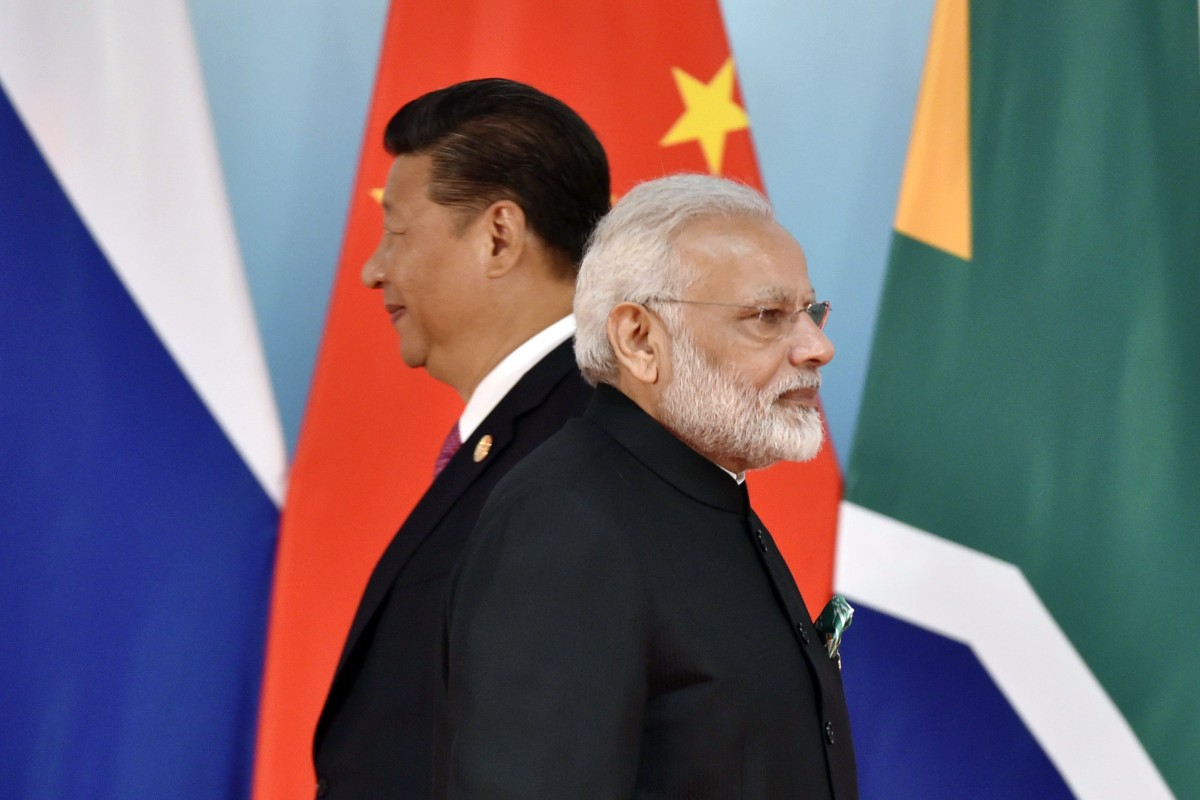
Chinese President Xi Jinping and Indian Prime Minister Narendra Modi at the BRICS Summit at the Xiamen International Conference and Exhibition Center in 2017. Photo: AFP
Their informal summit in Wuhan last year created all the right optics; even their chemistry seemed on point. So, when 
Indian Prime Minister Narendra Modi

and

Chinese President Xi Jinping

met last week on the sidelines of the Shanghai Cooperation Organisation (SCO), the bonhomie seemed like it was there to stay.

But a day later, cracks appeared to emerge. India, holding on to its long-stated position, delivered a public snub to China by refusing to endorse its ambitious, trillion-dollar 
Belt and Road Initiative

(BRI) in the SCO summit’s Bishkek declaration.

Now, after equal parts public bonhomie and disagreement over the BRI, where do 
India-China ties

finally stand? Somewhere in the middle, by all indications.

With just 10 days before Xi and Modi meet again at the Russia-India-China (RIC) trilateral meeting on the sidelines of the

Group of 20 (G20) summit

in Osaka, there have been increasing signs that both countries may now be trialling a fresh approach to diplomacy – one that neither sidesteps contentious issues nor does it allow differences to derail ties.

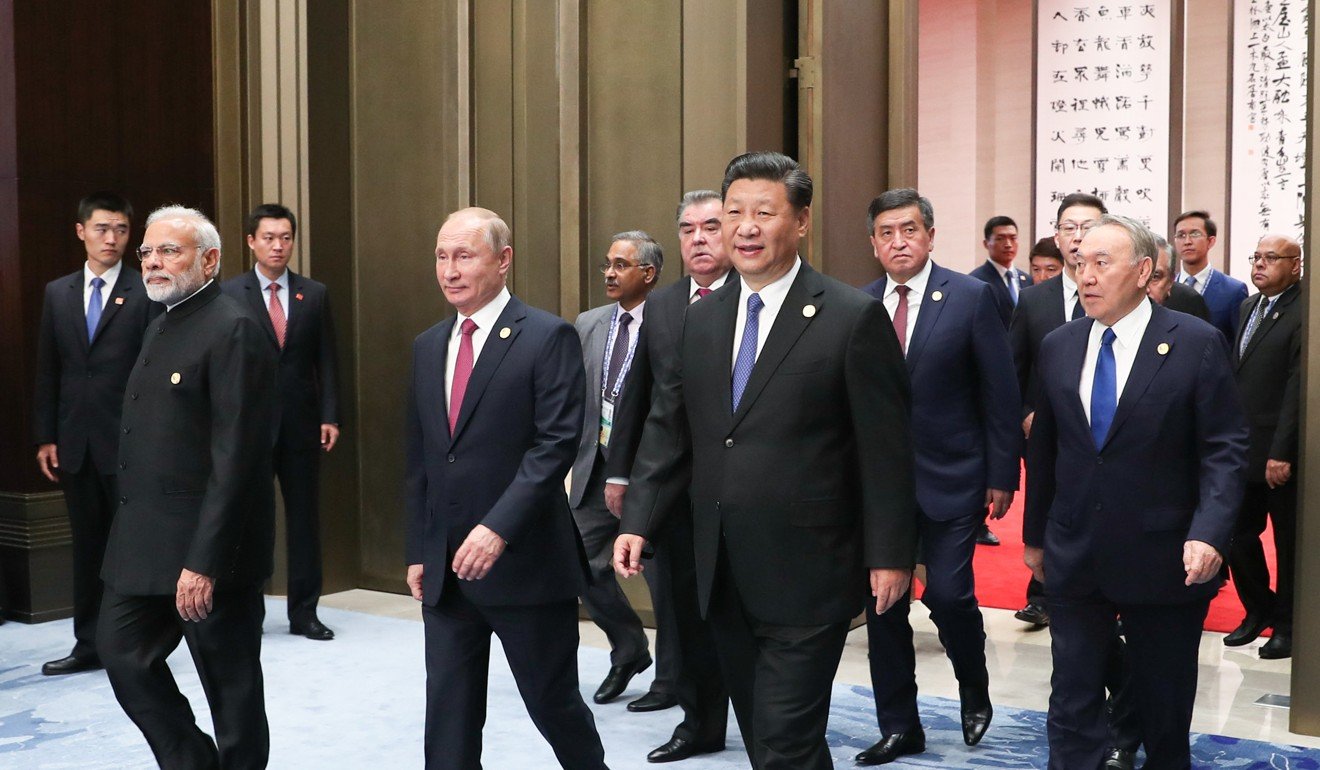
Chinese President Xi Jinping leads other leaders of Shanghai Cooperation Organisation: Russia’s Vladimir Putin and India’s Narendra Modi at the 2018 summit. Photo: Xinhua
Such an approach would delink the thorny issues – like the

decades-old border dispute

and the BRI – from other non-contentious issues of cooperation in other sectors.

But the jury is still out on whether it will pay off, especially given the historical distrust and the baggage that both countries carry.

ROAD BUMPS GALORE

In the last week alone, there have been at least three flashpoints in the Sino-India relationship.

While the dust was still settling on India’s refusal to sign the Bishkek declaration endorsing the BRI, reports emerged that the 

Maldives

was expected to scrap plans to build jointly with China an ocean observatory overlooking the Indian Ocean. The news came a week after Modi had visited the Maldives capital Male in early June.

For Modi 2.0, India’s US-China balancing act just got trickier

The Maldives’ decision to build the observatory was first mulled in December 2017, raising the Indian establishment’s hackles as it would have given China a presence in the region.

Another irritant between India and China has seemed to be the proposed 16-nation 

Regional Comprehensive Economic Partnership

(RCEP). India has been lukewarm on the free-trade bloc, frustrating the Chinese. Indications have been that China is likely to push for a 13-member bloc at the coming RCEP meeting in Thailand on June 20, excluding India.

BRI and border issues have not managed to overshadow the remaining business between the two countries Narayani Basu

Yet, despite all this, there has been no let down in engagement levels between Modi and Xi. Both leaders are expected to meet at the RIC summit on June 29 to 30, and have at least two more meetings planned this year alone – an informal Xi-Modi summit in India
in October and the BRICS summit on November 13 to 14.
For Narayani Basu, a New Delhi-based author and independent foreign policy analyst with a special focus on China, such sustained engagement between the two countries signals a new level of maturity.
“There has been a fairly successful attempt at delinking historical geopolitical and territorial issues from issues which are economic in nature,” Basu said. “As a result, the BRI and border issues have not managed to overshadow the remaining business between the two countries.”
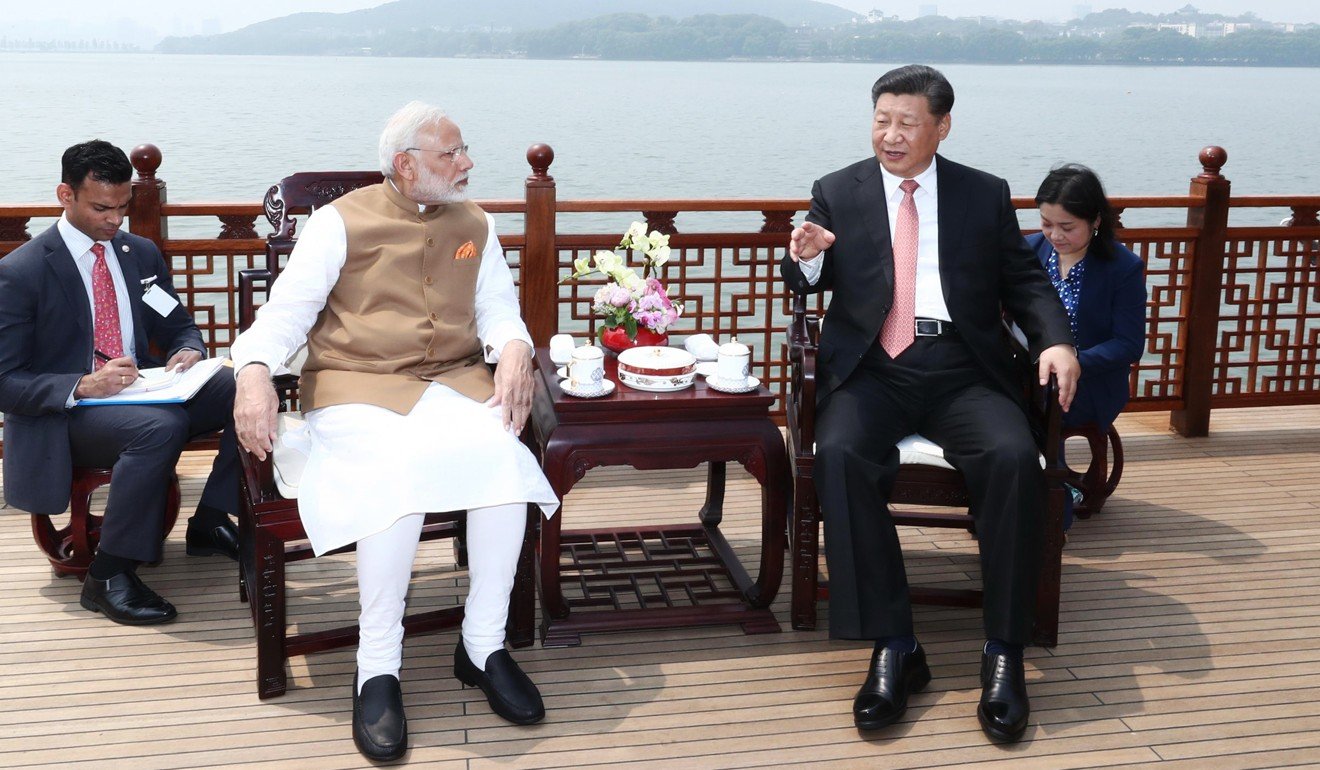
Indian Prime Minister Narendra Modi speaks with Chinese President Xi Jinping in Wuhan. Photo: Xinhua

STRONG LEADERS, STRONGER AGENDAS

The approach might also have to do with where both leaders currently stand.

Modi and his Bharatiya Janata Party (BJP) have freshly emerged from a landslide

victory in the Indian polls

. Through the campaign, Modi portrayed a hardline image of himself and his government, especially on issues of national security. Similarly, Xi has emerged as a stronger leader since his reappointment last year – his approach marked by a higher-than-ever emphasis on economic nationalism and connectivity. Modi made a reference to this in his SCO meeting with Xi.

Basu said Sino-India ties were also being guided by the personalities of both leaders – strong, with harder-than-before agendas.
Did Japan and India just launch a counter to belt and road?
“They both came back on agendas based on consolidation of power, protection of sovereignty and nationalism. These are all issues that will not allow either side to blink easily. “So, even as both leaders are looking to move forward, they also do not want to compromise on their core issues – primary among them being territorial sovereignty,” she said.

The message is loud – India’s opposition to the BRI does not mean India will allow adversarial relations to develop between the two Sana Hashmi

In his SCO summit speech, Modi brought up territorial sovereignty as a thinly veiled reference to China’s BRI, saying India only supported connectivity projects that are based on “respect of sovereignty” and “regional integrity”.
Sana Hashmi, an analyst with Perth-based think tank Future Directions International and author of China’s Approach Towards Territorial Disputes: Lessons and Prospects, agreed that India was not letting historical issues get in the way of its relationship with Beijing.
Hashmi noted that India’s main objections to BRI revolved around one component – the China-
Pakistan

Economic Corridor (CPEC), which runs through the disputed region of Kashmir.

“But to make sure this does not affect the relationship, PM Modi and President Xi are meeting numerous times,” Hashmi said. “The message is loud – India’s opposition to the BRI does not mean India will allow adversarial relations to develop between the two.”

A NEED FOR EACH OTHER

Another factor that has likely prompted the new approach between India and China is their need for each other, particularly as both Asian powers navigate bumpy relationships with US under 

China is caught in a protracted

battle with the US over trade deficits

and is reeling from the tariffs imposed on Chinese imports to America. India, too, has seen a similar but smaller version of this trade battle play out – things have escalated especially since the Trump administration withdrew its preferential trade treatment towards India. Responding to this, India imposed tariffs on 28 US products over the weekend.

Move over, ‘Made in China’. It’s ‘Made in Bangladesh’ era now
In such a context, a stronger relationship between the two Asian giants might be in mutual interest.
Basu said the scope for the relationship to deliver on, especially economically, is vast.

“Despite the chemistry, India and China’s promises to each other on the economic front haven’t materialised on the ground. Major projects as well as investments in each country are stuck.”

Source: SCMP

13/07/2019

Chinese, Hungarian FMs eye closer exchanges, more cooperation

HUNGARY-BUDAPEST-CHINA-WANG YI-VISIT

Visiting Chinese State Councilor and Foreign Minister Wang Yi (L) shakes hands with Hungarian Minister of Foreign Affairs and Trade Peter Szijjarto prior to their talks in Budapest, Hungary, July 12, 2019. (Xinhua/Attila Volgyi)

BUDAPEST, July 12 (Xinhua) — Visiting Chinese State Councilor and Foreign Minister Wang Yi and Hungarian Minister of Foreign Affairs and Trade Peter Szijjarto held talks on Friday, pledging closer exchanges and more cooperation.

Noting this year marks the 70th anniversary of the establishment of China-Hungary diplomatic relations, Wang said the two countries have always respected and supported each other, showing mutual trust over the past seven decades. And in 2017, bilateral relations entered a new historical stage when a comprehensive strategic partnership was established by the leaders of two nations.

In face of increasingly unstable and uncertain international situation, Hungary, Wang said, has taken a clear-cut stance to develop friendly relations with China, firmly support the building of the Belt and Road and participate in the China and Central and Eastern European Countries (CEEC) cooperation.

Calling Hungary a reliable and trustworthy partner, the Chinese top diplomat said China will continue to back Hungary’s development path in line with its own national conditions, and support it to safeguard its legitimate rights and interests and to play a more important role in the European Union (EU) and the world.

The two sides should seize the opportunity of the 70th anniversary of establishment of bilateral diplomatic relations, maintaining, consolidating and developing the China-Hungary comprehensive strategic partnership, as well as deepening exchanges at all levels, said Wang.

The two sides should enhance all-around cooperation based on the principle of extensive consultation, joint contribution and shared benefits, he said, while also calling on the two sides to strengthen strategic coordination to safeguard their common rights and interests as well as international fairness and justice.

On his part, Szijjarto said Hungary-China bilateral relations are at their best in history.

Hungary is the first European country to sign the Belt and Road cooperation agreement with China, which aligns well with Hungary’s “Opening to the East” policy, corresponds to the China-EU cooperation, and is conducive to promote the Eurasian interconnection, he said.

Hungary is willing to work with China to maintain closer high-level exchanges, expand cooperation in areas like trade, investment, finance, and education, and closely coordinate and cooperate in multilateral affairs, so as to promote bilateral relations to make new progress, said Szijjarto.

On Thursday, the Chinese top diplomat also attended the opening ceremony of a photo exhibition marking the 70th anniversary of the establishment of China-Hungary diplomatic relations here in the Hungarian capital.

Source: Xinhua

12/07/2019

Top Chinese, Vietnamese legislators hold talks on cooperation

CHINA-BEIJING-LI ZHANSHU-VIETNAM-TALKS (CN)

Li Zhanshu (R), chairman of the Standing Committee of the National People’s Congress of China, holds talks with visiting Chairwoman of the National Assembly of Vietnam Nguyen Thi Kim Ngan, in Beijing, capital of China, July 11, 2019. (Xinhua/Zhang Ling)

BEIJING, July 12 (Xinhua) — Top Chinese legislator Li Zhanshu held talks with visiting Chairwoman of the National Assembly of Vietnam Nguyen Thi Kim Ngan on Thursday, agreeing to enhance exchanges and cooperation between the two countries’ legislative bodies.

Li, chairman of the Standing Committee of the National People’s Congress of China, told Ngan that China stands ready to work with Vietnam to comprehensively implement the important consensus reached by the leaders of the two parties and the two states.

Li called on the two sides to accelerate cooperation on jointly building the “Belt and Road” and the “Two Corridors, One Economic Circle,” jointly safeguard peace and stability at sea, as well as constantly improve the friendship between their people.

On the ties between the two legislative bodies, the National People’s Congress of China and the National Assembly of Vietnam, Li said they could provide legal support for bilateral cooperation. He called on both sides to learn from each other through increased communication, promote people-to-people, local and youth exchanges, and strengthen coordination within multilateral mechanisms.

Ngan said Vietnam is willing to work with China to fully implement the important consensus reached by the leaders of the two parties and the two states, to enhance mutually beneficial cooperation in various fields and promote friendship between the two peoples.

The National Assembly of Vietnam is looking forward to stronger ties with the National People’s Congress of China so as to make greater contributions to the growth of relations between the two countries, she said.

At the invitation of Li, Ngan visited China from Monday to Friday.

Source: Xinhua

04/07/2019

Sri Lanka could help Chinese manufacturers offset trade war impact

  • Development minister leads high-level investment forum in Beijing
  • Points to free trade agreements and preferential duty deals to offset trade war pressures for Chinese factories
Sri Lankan Minister for Development Strategies and International Trade Malik Samarawickrama at the Sri Lanka Investment Forum in Beijing on Wednesday. Photo: Simon Song
Sri Lanka is wooing Chinese manufacturers, urging them to make use of its preferential duty-free treatment by the US and Europe as a way to offset the growing tariff pressure of the trade war.
The country’s development minister, Malik Samarawickrama, was in Beijing on Wednesday as part of an investment forum at the Sri Lankan embassy attended by dozens of Chinese businesspeople.
“China has invested heavily in infrastructure and they are assisting us to invest in ports, roads, railways, water supplies and so on. Now we would like China to get involved in setting up their manufacturing plants in Sri Lanka, primarily for the purpose of exports,” he said.
“They can make use of the preferential market access we have – we have duty free access to the European Union countries and we have free trade agreements with Pakistan, Singapore and India. And, since the cost of manufacturing in China is going up, we would like the Chinese to look at Sri Lanka for their manufacturing and we want it to be exported back to China.”
Sri Lanka, bruised from Easter bombings, seeks US$1 billion loan from China
Along with trade officials and diplomats, Samarawickrama, one of Sri Lanka’s most senior government ministers, was also keen to boost investor confidence following the deadly Easter Sunday bombings in Colombo which killed 253 people.
“Let me assure you, absolutely, Sri Lanka is safe for investment,” he told the dozens of representatives from Chinese state-owned and private companies who attended the forum.

“We must bring to your notice that none of the industries have been affected as a result of the bombings and none of the export orders were cancelled or delayed. This is a testament to the resilience of the economy.”

China is one of Sri Lanka’s largest trading partners and – sometimes controversially – the largest financier of its booming new infrastructure. Other big lenders to the island nation are the Asian Development Bank and Japan.

Earlier this year the Sri Lankan government signed a US$989.5 million loan agreement with China’s Export-Import Bank for a major new motorway project. And last month Sri Lanka’s finance ministry confirmed it was in talks with the China-led Asian Infrastructure Investment Bank (AIIB) for a further loan of nearly US$1 billion for energy and motorways.

Did Japan and India just launch a counter to China’s Belt and Road?
The surge of Chinese investment has raised concerns that Sri Lanka could become caught up in the rivalry between China and India as Beijing seeks to expand its influence in South Asia and the Indian Ocean.
Last month, Sri Lanka signed an agreement with India and Japan to jointly develop the East Container Terminal at the Port of Colombo, which some observers said could become a competitor to the China-funded Hambantota Port, and was perhaps a sign that the island nation was seeking to neutralise the growing influence of China.
Samarawickrama denied claims the involvement of Japan and India in Sri Lanka’s biggest port project was to counter China’s influence.
Under the agreement, he said, the terminal was owned by Sri Lanka Port Authority, with a 51 per cent stake, while Japan and India would develop the remaining 49 per cent.
“We need the expertise from Japan,” Samarawickrama said. “We need the Indians to get involved in the operation because 75 per cent of the transshipment cargoes in the Colombo port come from India and India is extremely important to us.
“They are the operators of the terminal and they are not building any ports.”
Source: SCMP
29/06/2019

Belt and Road Economic Information Partnership to build info bridge

BEIJING, June 28 (Xinhua) – Set to build an “information bridge” for the Belt and Road Initiative (BRI) construction, attendees of the Belt and Road Economic Information Partnership (BREIP) in Beijing believed it would reduce the “information deficit” between countries.

The partnership, designed to eliminate information asymmetry in implementing the BRI, offers demonstration, guidance and services to participants of the BRI, and create a new platform for international cooperation.

The platform of BRInfo, operated and maintained by China Economic Information Service (CEIS) under Xinhua News Agency, allows BREIP members to share information and conduct cooperation.

Alfred Schipke, IMF Senior Resident Representative for China, said it would be important to strengthen policy frameworks and foster capacity development in China and in partner countries.

“The effective sharing of information will be more and more important. Here, the BREIP could be a key platform,” Schipke said.

New commercial opportunities will surely be created with information from professional institutions and needs of enterprises brought together, so as to promote mutual understanding, said Liu Zhengrong, vice president of Xinhua News Agency.

The BREIP, offering news service and information assurance, has provided a platform of news and economic information for countries and regions to expand cooperation, noted Marat Abulkhatin, first deputy chief editor of TASS Russian News Agency.

Domestic information reports growing significance now in global market, and under the BRInfo mechanism, news agencies can help to further eliminate information asymmetry, said Raphael Juan, director of markets at Brazilian CMA News Agency.

Polish government and enterprises look forward to better understanding different market situations and making better decisions with the economic information shared on the BREIP, said Ryszard Marcin Nizewski, product director with Polish Press Agency.

The BRI has made great contributions to international trade and the international economy, and its achievements have far exceeded expectations. It is believed that the BREIP will also become a multi-faceted cooperation tool, according to Dzmitry Prymshyts, deputy director for Research and Innovation of the Institute of Economics of the National Academy of Sciences of Belarus.

This platform could decrease the “information deficit” between countries while growing into a timely, objective and solid source of information, Prymshyts said.

The BREIP, established in Beijing on Thursday, was initiated by Xinhua News Agency and co-founded by more than 30 institutions including well-known news agencies, information service providers, research institutions, chambers of commerce and associations from more than 20 countries and regions in Asia, Europe, Africa, Latin America and Oceania.

Source: Xinhua

Law of Unintended Consequences

continuously updated blog about China & India

ChiaHou's Book Reviews

continuously updated blog about China & India

What's wrong with the world; and its economy

continuously updated blog about China & India