Archive for ‘Belt and Road (B&R)’

17/06/2019

Oil tanker attacks: did Iran’s ties with China just go up in smoke?

  • Washington has blamed Tehran for an attack on two oil tankers near the Strait of Hormuz, putting pressure on Iran’s allies like China
  • Beijing usually backs its trade partner – but experts say the trade war with the US and problems with Huawei may have changed the equation
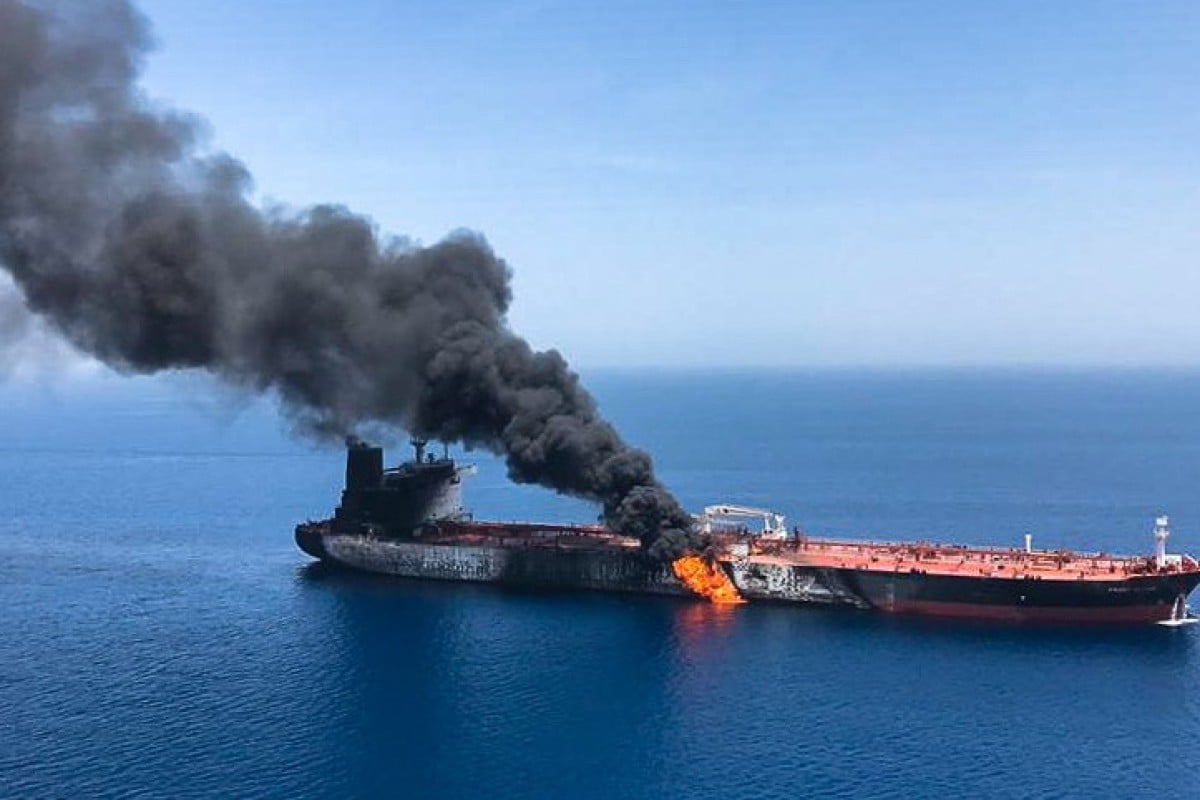
A tanker burns in the Gulf of Oman after a mystery attack that the United States has blamed on Iran. Photo: AFP
When 
Shinzo Abe

headed to Tehran this week for the first visit by a sitting Japanese prime minister in four decades, some in the diplomatic world imagined he could be the man to bring

Iran

back to the negotiating table with the

United States

.

Those hopes were torpedoed on Thursday when, on the same day Abe was meeting Iran’s supreme leader Ayatollah Khamenei, explosions ripped through two oil tankers, one Japanese and one Norwegian, near the Strait of Hormuz, a strategically significant shipping lane.
The attack immediately overshadowed an earlier success for Abe, who had met President Hassan Rowhani a day before and was assured Iran would stick to the terms of a 2015 agreement limiting its nuclear activities.
Washington accused Iran of being behind the attack on the tankers, releasing a video on Friday that it said showed Iran’s revolutionary guard removing an unexploded mine from one of the ships, and warning that it would “defend its interests”.
Iranian President Hassan Rowhani and Japanese Prime Minister Shinzo Abe meet Iran’s Supreme Leader Ayatollah Ali Khamenei in Tehran. Photo: Reuters

Tehran, for its part, claimed to have been set up, with its foreign minister Mohammad Javad Zarif saying “suspicious doesn’t begin to describe” the incident. So much, then, for hopes of mediation.

US President

Donald Trump

, who had encouraged the Japanese leader’s visit, admitted on Twitter soon afterwards that when it came to negotiating, “they are not ready, and neither are we!”

Still, the incident exposed more than just the naivety of those hoping for an Abe-led breakthrough. In raising the stakes in Washington’s confrontation with Tehran, it also threw the spotlight on Iran’s dwindling number of allies – and perhaps most significantly on its largest trading partner, China – which face mounting pressure to rethink the relationship.

Tanker attacks: world divided over Iran role as Saudi prince breaks silence
The day after the attack, China’s President

Xi Jinping

said Beijing would promote its ties with Iran “however the situation changes” – a comment made during a meeting with Iranian President Hassan Rowhani on the sidelines of the Shanghai Cooperation Organisation summit in Kyrgyzstan – but diplomatic observers question just how far China can go in accommodating its controversial trading partner.

BEST FRIENDS FOREVER?

Iran has long been able to count on support from China, which accounts for 30 per cent of the Islamic republic’s exports and imports, and its willingness to defy US pressure is a gamble at least partly based on an assumption it can continue to count on Beijing’s support.

As Iran’s largest economic partner – Chinese direct investment in Iran hit a record high of nearly US$4 billion last year, according to data analysis project ChinaMed – Beijing already plays a key role in relieving US pressure on Iran, said Mohsen Shariatinia, assistant professor of regional studies at Shahid Beheshti University in Tehran.

But experts warn that reliance will come into question as China becomes increasingly hamstrung by its own problems.

China has enough problems of its own, starting with US pressure on Huawei. Photo: EPA
Chief among Beijing’s headaches are its

trade war

with Washington and the related assault on its

5G

giant

Huawei

– which, as analysts point out, originally ignited over allegations it was defying US sanctions on Iran. Beijing will also be well aware of the need to keep

Saudi Arabia

, its second-biggest oil supplier and Tehran’s critic-in-chief, happy.

On the other hand, analysts say, China will be wary of being seen to abandon its old friend, as doing so would send a message to other nations at odds with Washington that they could no longer look to China as a diversification strategy.
“This could mean Chinese investment is vulnerable to US interference,” said Esfandyar Batmanghelidj, founder of Bourse Bazaar, a media company that supports business diplomacy between Europe and Iran.
Sanctions drive Iranian students away from US towards Asia
Doing so, Batmanghelidj said, would put a question mark over one of China’s most significant foreign policies of recent years – President Xi’s signature

Belt and Road Initiative

to fund infrastructure across Eurasia.

THE BELT AND ROAD QUESTION
Tensions between Iran and the US have reached boiling point in recent weeks, after the Trump administration last month ended waivers on sanctions for nations importing Iranian oil – a move the US says is aimed at making the republic “radioactive to the international community” and which Rowhani has described as an “economic war against Iran”.
So far, China has largely stuck by the Islamic Republic, continuing to buy fuel from it despite the latest wave of US sanctions on Iranian oil that followed Trump’s decision last year to withdraw the US from the landmark 2015 agreement curbing Tehran’s nuclear development.
The deal had been widely lauded as a triumph of multilateralism and the dawning of a new economic era for Iran.
US releases video of ‘Iranian forces removing unexploded mine’ from ship
Part of its eagerness to support Iran has stemmed from the Islamic Republic’s key position in the Belt and Road plan. In 2017 alone, China signed deals for more than US$15 billion in Iranian infrastructure investment, according to the

Chinese Communist Party

mouthpiece China Daily.

Planned projects include high-speed rail lines, upgrades to the nation’s electrical grid, and natural gas pipelines. The two nations have also vowed to boost bilateral trade to US$600 billion in the next seven years.
“China sees Iran as its Western gateway, where not only is it a big market in itself, but it will also be the gateway to the rest of the 
Middle East

and ultimately to Europe for China,” said Anoush Ehteshami, professor of international relations at Durham University in Britain.

Nisha Mary Mathew, at the Middle East Institute in Singapore, said that China’s relationship with Iran was not just economic – but primarily strategic, with both nations envisioning an international order that was no longer dominated by the US and its Western allies.
DEFIANCE, FOR NOW
If the belt and road gives China good reason to stick with Iran, there are plenty of voices urging just that action. As Andrea Ghiselli at Shanghai’s Fudan University pointed out, US sanctions until now have only strengthened the hardline factions in Iran’s government.
The combination of the US withdrawal from the nuclear deal – which had the support of the international community – along with Europe’s tepid efforts to rescue it, may have emboldened those favouring resistance over negotiation.
Xi’s supportive comments in Kyrgyzstan were only the latest in a string of remarks from China that could encourage such factions.
If Trump kills off Huawei, do Asia’s 5G dreams die?
After China’s Foreign Minister Wang Yi met Iranian Foreign Minister Mohammad Javad Zarif in Beijing last month, the ministry’s spokesman Lu Kang said China’s economic relationship with Iran was “reasonable and lawful”.
Two months prior to that, China’s Minister of Commerce Zhong Shan, while hosting his Iranian counterpart Farhad Dejpasand, had claimed China’s “determination to maintain and develop the China-Iran comprehensive strategic partnership is unshakeable”.
Chinese President Xi Jinping with Iranian President Hassan Rowhani. Photo: AFP

Even so, the pressure is getting to some. In February, Foreign Minister Zarif temporarily resigned, in what Andrea Ghiselli at Fudan University in Shanghai called a clear sign of the “changing and precarious power balance with Iran’s foreign policy establishment”.

And nowhere is the pressure felt more keenly than the economy and China’s ability to serve as a lifeline.

“The real anxiety in Iran right now is about market share,” said Bourse and Bazaar’s Batmanghelidj. “If you’re exporting zero oil and your customers are buying oil elsewhere, you lose market share.

“The government wants to know if it agreed to go back to the negotiating table and the US promised sanctions relief, that there are people who are going to buy in significant volume.”

TURNING POINT: HUAWEI

For many analysts, the event most likely to have changed the equation in Beijing’s eyes is the arrest by the Canadian authorities of 

Meng Wanzhou

, the chief financial officer of Chinese telecom giant Huawei.

Meng’s arrest came at the request of the US government, which claimed her company had violated sanctions by selling equipment to Iran.
Many observers saw the action as Washington’s way of signalling to Chinese companies that they would face repercussions if they eased the pressure on Iran by continuing to trade.
Huawei’s chief financial officer Meng Wanzhou. Photo: Reuters

“Going after Huawei was about going after Chinese enterprises – signalling that they can no longer trade with Iran with impunity,” Batmanghelidj said.

Since then, Chinese firms have shown increased skittishness towards trading with Iran. According to China’s General Customs Administration, Chinese exports to Iran declined by more than half between October 2018 and February 2019, from over US$1 billion to just under US$500 million.

Mohammad Ali Shabani, a researcher at the School of Oriental and African Studies in London, said other countries in the region were now watching to see if China would blink in the face of US pressure. “This could have dire consequences for China’s image as a reliable partner,” he said.

NOT JUST ABOUT AMERICA

There are reasons beyond US pressure that may factor into Beijing’s thinking. It has long stated its opposition to Iranian nuclear weapons development, and Chinese Foreign Minister Wang Yi has said that China is “ready” to take on “its due responsibilities and make a greater contribution to world peace and common development”.

Trade war: here are Beijing’s options – and none look any good

Zhao Hong, at the Research School of Southeast Asian Studies at Xiamen University, said that in stepping up as a responsible world power Beijing faced a dilemma over its approach to Iran.
“Chinese leaders have to painfully balance an impulse towards economic cooperation with Iran against other vital interests, including convincing Washington that China is a responsible stakeholder,” he wrote in the Journal of Contemporary China.
Saudi Aramco's Ras Tanura oil refinery. The country is China’s second-largest oil supplier after Russia. Photo: Reuters
Saudi Aramco’s Ras Tanura oil refinery. The country is China’s second-largest oil supplier after Russia. Photo: Reuters

Then there is China’s relationship with Iran’s chief adversary, Saudi Arabia, to consider. Riyadh is China’s second-largest oil supplier, behind Russia, and it plays a central role in Beijing’s energy strategy.

According to International Trade Centre data, more than 12 per cent of China’s imported oil came from Saudi Arabia last year, compared with just 6 per cent from Iran. Last year, Saudi Arabia shipped 56.73 million tonnes of oil to China, or 1.135 million barrels per day.

Why would Kim Jong-un trust Trump, now that he’s ripped up Iran’s nuclear deal?

This April, China imported 6.3 million tonnes of oil from Saudi Arabia, nearly twice the 3.24 million tonnes it imported from Iran, according to China’s General Administration of Customs.

Iran’s comparatively small share of China’s oil imports market and its heavy reliance on China as a trading partner add up to a deeply uneven relationship, experts say, and it is this imbalance that will encourage the US that China may be open to rethinking its ties.

As Jon Alterman, director of the Middle East programme at Washington DC think tank the Centre for Strategic and International Studies, pointed out, while China was Iran’s largest trading partner, Iran represented less than 1 per cent of China’s international trade.

“Iran needs China,” Alterman said. “But to China, Iran is expendable.”

Source: SCMP

14/06/2019

China, Kyrgyzstan agree to enhance ties to new heights

KYRGYZSTAN-BISHKEK-CHINA-PRESIDENTS-TALKS

Chinese President Xi Jinping and his Kyrgyz counterpart Sooronbay Jeenbekov hold talks in Bishkek, Kyrgyzstan, June 13, 2019. Xi and Jeenbekov held talks here Thursday, agreeing to take their countries’ comprehensive strategic partnership to new heights. (Xinhua/Li Xueren)

BISHKEK, June 13 (Xinhua) — Chinese President Xi Jinping and his Kyrgyz counterpart, Sooronbay Jeenbekov, held talks here Thursday, agreeing to take their countries’ comprehensive strategic partnership to new heights.

Xi arrived in the Central Asian country Wednesday for a state visit and the Shanghai Cooperation Organization (SCO) summit.

China-Kyrgyzstan relations have withstood the test of international vicissitudes and achieved leapfrog development over the past 27 years since the establishment of the diplomatic relationship. The two countries have set a fine example of a new type of state-to-state relations featuring mutual respect, equality and win-win cooperation, Xi said.

China will continue to support Kyrgyzstan’s own choice of development path and all policy measures taken by the Kyrgyz government to safeguard national independence, sovereignty and security, Xi said.

Xi also said China is ready to join hands with Kyrgyzstan to deepen their traditional friendship and mutually beneficial cooperation, so as to better benefit the two peoples.

The Chinese president stressed that jointly building the Belt and Road has become the focus of China-Kyrgyzstan cooperation, calling on the two countries to deepen the alignment of their development strategies, tap new potential of partnerships and explore new space of cooperation.

Cooperation in trade and investment should be expanded and major programs must be well implemented, Xi said, adding that China is willing to import more green and quality agro-products from Kyrgyzstan.

China will continue to support Kyrgyzstan’s economic and social development, including jointly building drinking water facilities, roads, hospitals and other projects to improve people’s livelihood.

Xi also called for closer people-to-people and sub-national exchanges.

Amid efforts to enhance security cooperation, the two countries should step up fight against the “three forces” of terrorism, separatism and extremism, transnational organized crime and drug trafficking, Xi said.

On the SCO, Xi said China applauds Kyrgyzstan’s efforts to promote cooperation in various fields since taking over the rotating presidency of the SCO.

China supports Kyrgyzstan in hosting the Bishkek summit, which will be held on Friday, and encourages the SCO member states to gather more consensus, tap potential of cooperation and build a community with a shared future that benefits all sides, Xi said.

For his part, Jeenbekov said he has met with the Chinese president for three times in more than a year, fully demonstrating the high level of the bilateral relations and the willingness of both sides to strengthen cooperation.

Kyrgyzstan will always be “a good neighbor, good friend and good partner” of China, he said.

Jeenbekov conveyed congratulations on the 70th anniversary of the founding of the People’s Republic of China and on the remarkable achievements made by the Chinese people under the leadership of Xi and the Communist Party of China.

Xi’s vision and experience on state governance are of great significance to Kyrgyzstan, Jeenbekov said.

The president thanked China for its long-term and huge assistance and support to Kyrgyzstan in its national development and the improvement of the people’s livelihood.

Kyrgyzstan firmly adheres to the one-China policy, Jeenbekov said, adding that the affairs of ethnic minorities in China are its internal affairs and that his country supports policies and measures taken by the Chinese government in this regard.

Kyrgyzstan stays committed to the fight against the “three forces,” he said.

Noting that Kyrgyzstan’s national development strategy corresponds to the Belt and Road Initiative (BRI), Jeenbekov said his country is ready to set up institutionalized arrangements to promote their alignment, deepen cooperation with China in areas such as trade, investment, energy, agriculture, transport and on local levels, as well as increase cultural and people-to-people exchanges.

Kyrgyzstan and China hold similar stances on international and regional issues, laying a sound foundation for the two countries to strengthen multilateral coordination, he said.

The Kyrgyz side appreciates China’s valuable support to Kyrgyzstan during its SCO presidency and in hosting the Bishkek summit, he said.

After the talks, the two presidents signed a joint statement on further deepening the comprehensive strategic partnership between the two countries, and witnessed the exchanges of bilateral cooperation documents.

The two sides will continue the visits and meetings between leaders of the two countries to regularly exchange views on bilateral relations and international and regional issues of common concern, according to the joint statement.

Both sides will continue to support each other on issues related to their core interests, such as national sovereignty, security and territorial integrity, said the statement.

Noting that there is great potential for cooperation to synergize the BRI with Kyrgyzstan’s national development strategy 2018-2040, the statement said the two sides will look for more common grounds of interests and realize common development based on the principle of win-win cooperation.

The two sides also pledged to support the central role of the United Nations in international affairs and the building of an open world economy, voicing resolute opposition to unilateralism and protectionism.

Source: Xinhua

30/05/2019

China’s top legislator meets Nigerien president

CHINA-BEIJING-LI ZHANSHU-NIGER'S PRESIDENT-MEETING (CN)

Li Zhanshu (R), chairman of the Standing Committee of the National People’s Congress (NPC), meets with Niger’s President Mahamadou Issoufou at the Great Hall of the People in Beijing, capital of China, May 29, 2019. (Xinhua/Pang Xinglei)

BEIJING, May 29 (Xinhua) — China’s top legislator Li Zhanshu met with visiting Nigerien President Mahamadou Issoufou on Wednesday, exchanging views on pushing forward the relationship between the two countries.

Li, chairman of the Standing Committee of the National People’s Congress (NPC), said China stands ready to work with Niger to implement the important consensus made by the two heads of state to lift the bilateral ties to a higher level.

Both the Chinese and African people experienced anti-imperialist and anti-colonial struggles in the past, and both face the task of getting rid of poverty and backwardness and achieving development and prosperity, Li said.

China and Africa have created a new model of South-South cooperation, Li said.

The NPC is willing to strengthen exchanges with the National Assembly of Niger and promote state-to-state friendly cooperation, he said.

Issoufou said Niger thanks China for its long-term support and assistance, and is willing to learn from China’s development experience, actively participate in jointly building the Belt and Road and strengthen pragmatic cooperation.

Source: Xinhua

29/05/2019

Chinese foundation to help poor pupils along Belt and Road

BEIJING, May 28 (Xinhua) — A leading Chinese foundation plans to give about 200,000 aid packages to primary school students in countries along the Belt and Road in 2019, the foundation’s official said Tuesday.

The “care package” is a project carried out by China Foundation for Poverty Alleviation since 2009, providing stationary, textbooks and other everyday items to primary schools in poor rural areas.

Yan Zhitao, deputy secretary-general of the foundation, said the project started reaching out to foreign recipients last year and would expand this year to help overseas pupils in need.

Over the past decade, the care package project has collected donations amounting to 700 million yuan (101 million U.S. dollars) and aided more than 6 million pupils in China.

Source: Xinhua

22/05/2019

Chinese, Kyrgyz officials vow to enhance bilateral cooperation

 KYRGYZSTAN-BISHKEK-CHYNGYZ AIDARBEKOV-CHINA-WANG YI-MEETING

Visiting Chinese State Councilor and Foreign Minister Wang Yi (L) and Kyrgyz Foreign Minister Chyngyz Aidarbekov attend a signing ceremony of the Cooperation Program from 2020 to 2021 between Chinese Foreign Ministry and Kyrgyz Foreign Ministry in Bishkek, Kyrgyzstan, on May 21, 2019. (Xinhua/Li Yong)

BISHKEK, May 21 (Xinhua) — Visiting Chinese State Councilor and Foreign Minister Wang Yi on Tuesday held talks with Kyrgyz Foreign Minister Chyngyz Aidarbekov in Bishkek, vowing to enhance cooperation in various fields between the two countries.

Wang noted that China and Kyrgyzstan are friendly neighbors and comprehensive strategic partners linked by mountains and rivers. The two heads of states reached a wide range of consensuses on further developing bilateral comprehensive strategic partnership on the sidelines of the second Belt and Road Forum of International Cooperation in Beijing in April.

Taking the opportunity of jointly building the Belt and Road, China is ready to pursue coordination of the development strategies between China and Kyrgyzstan and effectively implement the key projects for the benefit of the two peoples, the Chinese state councilor said during the meeting.

To this end, the two sides should work to build closer people-to-people ties, promote local-level cooperation, further strengthen security cooperation ties and expand cooperation in fighting the “three forces” of terrorism, separatism and extremism, transnational crime and drug trafficking, said Wang, adding that China fully supports Kyrgyzstan in hosting the summit of the Shanghai Cooperation Organization in June to promote further cooperation among the member states.

Wang stressed that the sustained, steady and sound development of bilateral relations serves the fundamental interests of the two peoples. China appreciates Kyrgyzstan’s firm support on some major issues concerning Taiwan and Xinjiang, and will resolutely support Kyrgyzstan’s independent choice of development path as well as its internal and external policies to maintain national independence, sovereignty and security.

For his part, Aidarbekov extended warm congratulations on the 70th anniversary of the founding of the People’s Republic of China and expressed sincere admiration for China’s great achievements during the 40 years of reform and opening up.

He noted that Kyrgyzstan attaches great importance to the comprehensive strategic partnership between the two countries, fully supports the Belt and Road Initiative, and is ready to further promote bilateral cooperation in the fields of trade, investment, energy, transportation, agriculture and disaster relief.

The Kyrgyz foreign minister stressed that his country firmly upholds the one-China policy, fully supports China’s stance on its internal affairs including Taiwan and Xinjiang issues and hopes the mutual political trust between the two countries can be further strengthened.

Following their talks, the two officials signed the Cooperation Program from 2020 to 2021 between Chinese Foreign Ministry and Kyrgyz Foreign Ministry and jointly met with the press.

Source: Xinhua

18/05/2019

China hopes Iran nuclear deal “fully implemented”: FM

CHINA-BEIJING-WANG YI-IRAN-MEETING (CN)

Chinese State Councilor and Foreign Minister Wang Yi (R) meets with visiting Iranian Foreign Minister Mohammad Javad Zarif in Beijing, capital of China, May 17, 2019. (Xinhua/Yin Bogu)

BEIJING, May 17 (Xinhua) — China hopes to work with the Iranian side to eliminate complicated disturbing factors and make efforts for the full implementation of the Iran nuclear deal, Chinese State Councilor and Foreign Minister Wang Yi said on Friday.

Wang made the remarks when meeting with visiting Iranian Foreign Minister Mohammad Javad Zarif.

“China firmly opposes unilateral sanctions and the so-called ‘long-arm jurisdiction’ imposed by the United States on Iran,” Wang said, pledging to maintain the Joint Comprehensive Plan of Action, also known as the Iran nuclear deal, and safeguard the authority of the United Nations and basic norms governing international relations.

China welcomes Iran to actively take part in the joint building of the Belt and Road and hopes to strengthen mutually beneficial cooperation, Wang said.

Zarif praised China for its important role in defending the Iran nuclear deal and vowed to strengthen bilateral and multilateral coordination so as to safeguard multilateralism and common interests of the two countries.

Source: Xinhua

26/04/2019

Interview: Belt and Road helps Latin America to achieve UN 2030 agenda, says ECLAC official

BEIJING, April 26 (Xinhua) — The China-proposed Belt and Road Initiative (BRI) facilitates the compliance with the UN 2030 Agenda for Sustainable Development and the realization of the 17 Sustainable Development Goals in Latin America, said a senior official of a UN body based in Latin America.

Mario Cimoli, deputy executive secretary of the Economic Commission for Latin America and the caribbean (ECLAC), made the remarks in an interview with Xinhua.

Also as chief of the division of production, productivity and management of ECLAC, Cimoli has arrived in Beijing to participate in the second Belt and Road Forum for International Cooperation on April 25-27.

So far, 18 Latin American countries have signed the Memorandum of Understanding on jointly building the Belt and Road cooperation with China.

“The countries in Latin America view China as a fundamental actor,” he said. “The fact that 18 Latin American countries have joined the Belt and Road Initiative means that these countries think that China is necessary and China is also aware of the importance of dialogue. It’s a historical process.”

In his opinion, the BRI makes “greater integration, greater multilateralism and more dialogue” possible and “does good to Latin America.”

He said that both the 2030 Agenda and the BRI seek sustainable development and reduction of inequality and poverty, without contradicting with the proper model of each country.

“Given that the growth rates of Latin America will not be very high for the next few years, a rational process of cooperation such as the Belt and Road will surely help the region and allow each country to seek and improve their model of development and growth,” the ECLAC official said.

The BRI is a much more horizontal dialogue, a platform, in that sense that it is a process that helps and allows a much more positive coexistence despite current global tensions, he said.

In the dialogue with China, Latin America can demonstrate the importance of being an integrated area of trade, policies, and infrastructures in order to trade better with Asia, he said.

Cimoli also affirmed that the incorporation of new technologies in Latin America is a course under discussion, and dialogue with China can accelerate and improve the process.

Cimoli said his one observation of his ongoing China trip is the extensive use of electronic commerce among ordinary people.

He said when he went out to buy something, he found almost everyone use e-payments.

The way in which technologies immerge into the daily life of Chinese citizens is an example and would be a valuable contribution of China to the world and especially to Latin America, Cimoli said.

“The example of China shows the role that a state should play to trigger the technological development. In this dialogue with China, Latin America surely has to learn from the pragmatism of China,” he said.

The ECLAC official mentioned that China invests over 2 percent of its GDP in science and technology, while the average investment of Latin American countries in the field is between 0.4 and 0.5 percent of its GDP, plus, it appears to be swaying instead of stable state policies.

“There is a lot of cooperation to be done, much experience to be shared and much a platform for dialogue like the Belt and Road Initiative could do,” said Cimoli.

Source: Xinhua

03/03/2019

China Focus: Industrial upgrade moves fast in Xinjiang

URUMQI, March 2 (Xinhua) — Farmers at a small village in western Xinjiang hardly had any days off this winter. Production at a walnut processing factory is going full throttle to meet demand.

Yusup Tursun and his wife are walnut farmers in Kupchi Village in Yecheng County on the edge of the Taklimakan Desert. The couple has been hired by a new walnut processing facility in the village, with the husband a quality inspector and his wife working part-time cracking nuts.

As a main base for walnut production, Yecheng has over 38,000 hectares of high-quality thin-shell walnut groves.

“It used to be quite difficult to sell the walnuts. The factories, with so many products, have made it easier for the sales,” Yusup said.

Seven companies make products from the nuts — walnut milk, walnut candies and edible oil. The shells are made into coloring agent and pollutant-absorbing carbon.

Diversity in the walnut products pushed the industry output to a new high of 2 billion yuan (about 299 million U.S. dollars). Three in every five people work in the walnut industry in Yecheng, where 550,000 people live.

Across Xinjiang, processing facilities are established to add value to agricultural products. Transport and logistical services are improved to boost the sales of Xinjiang’s signature agricultural products such as Hami melons, Korla pears and Turpan grapes.

UP THE VALUE CHAIN

Xinjiang is also moving up the value chain in two of its traditional industries — cotton and coal.

As one of the main cotton production bases in China, Xinjiang holds sway in the textile industry. By making full use of its cotton resources and geographical advantages as a portal for opening up, the region no longer sees itself as just a production base for raw materials. Starting from 2014, China’s leading garment and apparel makers including Ruyi Group, HoDo Group, and Huafu Fashion Co. Ltd invested in the region and built factories.

These factories have produced added benefits and created jobs for the local people. Xinjiang produces 1.5 million tons of yarn and over 40 million ready-made garments every year. More than 400,000 people work in the industry.

In the eastern part of the coal-rich Junggar Basin, workers have found that the snow is cleaner than before. The Zhundong Economic Technological Development Park, about 200 km west of Urumqi, is home to China’s largest coal field.

A stringent environmental requirement is applied to the park, said Ren Jianpin, director of the management committee of the park. Coal enterprises are required to control coal dust, install equipment to recycle water and coal slags are processed into construction materials, he said.

The park is focused on boosting high-end industries in aluminum and silicon materials, which generate more value and have less impact on the environment, he said.

GOING HI-TECH

Last year, a large-scale bio-based plant went into operation in Usu City to turn corn into nylon. The Cathay Industrial Biotech, a Shanghai-based biotech company, is the investor.

Nylon is usually made from petroleum, and the use of crops such as corn and wheat to make recyclable and environment-friendly nylon has promising business prospects, said Wang Hongbo, vice general manager of the company’s Usu branch.

The Usu branch will have an annual output of 100,000 tons of bio-based polyamide, and it is expected to boost the development of downstream industries in the future, he said.

The oil-rich city of Karamay has also received a hi-tech boost as cloud computing firms eye the dry and cold weather in the area. Karamay is home to many key state-level projects and IT-industry leaders, including a global cloud service data center for Huawei, data centers for the China National Petroleum Corp. (CNPC) and China Mobile.

Xinjiang is making new breakthroughs in precision machining, new materials, manufacturing and textiles.

Data from the regional statistics bureau show that the value added of the hi-tech manufacturing in Xinjiang rose by 32.1 percent year-on-year in 2018.

FURTHER OPENING UP

As a core area on the Silk Road Economic Belt, Xinjiang has maintained solid growth momentum in foreign trade. Foreign trade volume between Xinjiang and 36 countries and regions along the Belt and Road (B&R) totaled about 291.5 billion yuan (43.5 billion U.S. dollars) in 2018, up 13.5 percent year on year.

Economic observers say that there is still much room for Xinjiang to scale up its processing trade to raise the level of imports and exports.

Xinjiang will further develop an export-oriented economy in 2019 and participate in economic exchanges with neighboring countries, according to the regional government’s work report released in January.

Source: Xinhua

Law of Unintended Consequences

continuously updated blog about China & India

ChiaHou's Book Reviews

continuously updated blog about China & India

What's wrong with the world; and its economy

continuously updated blog about China & India