19/02/2020
- US secretary of state is eager to promote US investment as an alternative to China, which holds the lion’s share of Angola’s foreign debt
- Isabel dos Santos, the former president’s daughter, became Africa’s richest woman but now stands accused of massive fraud
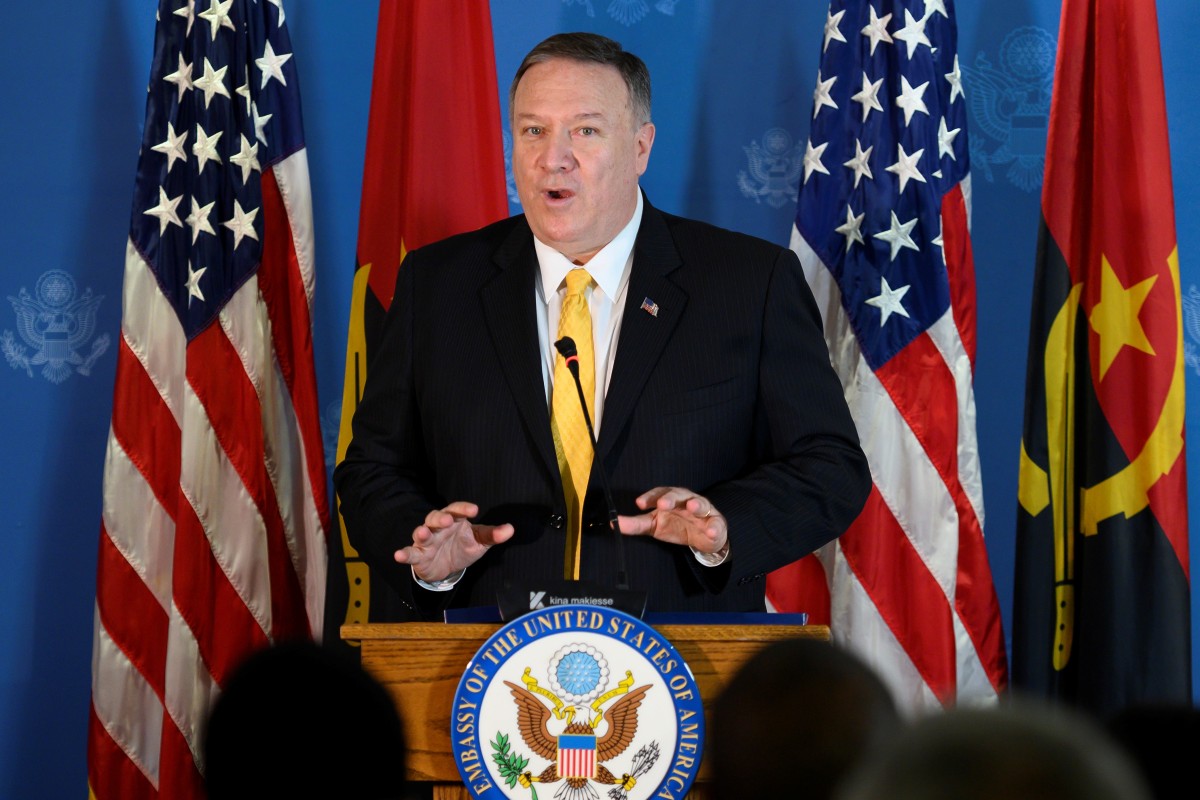
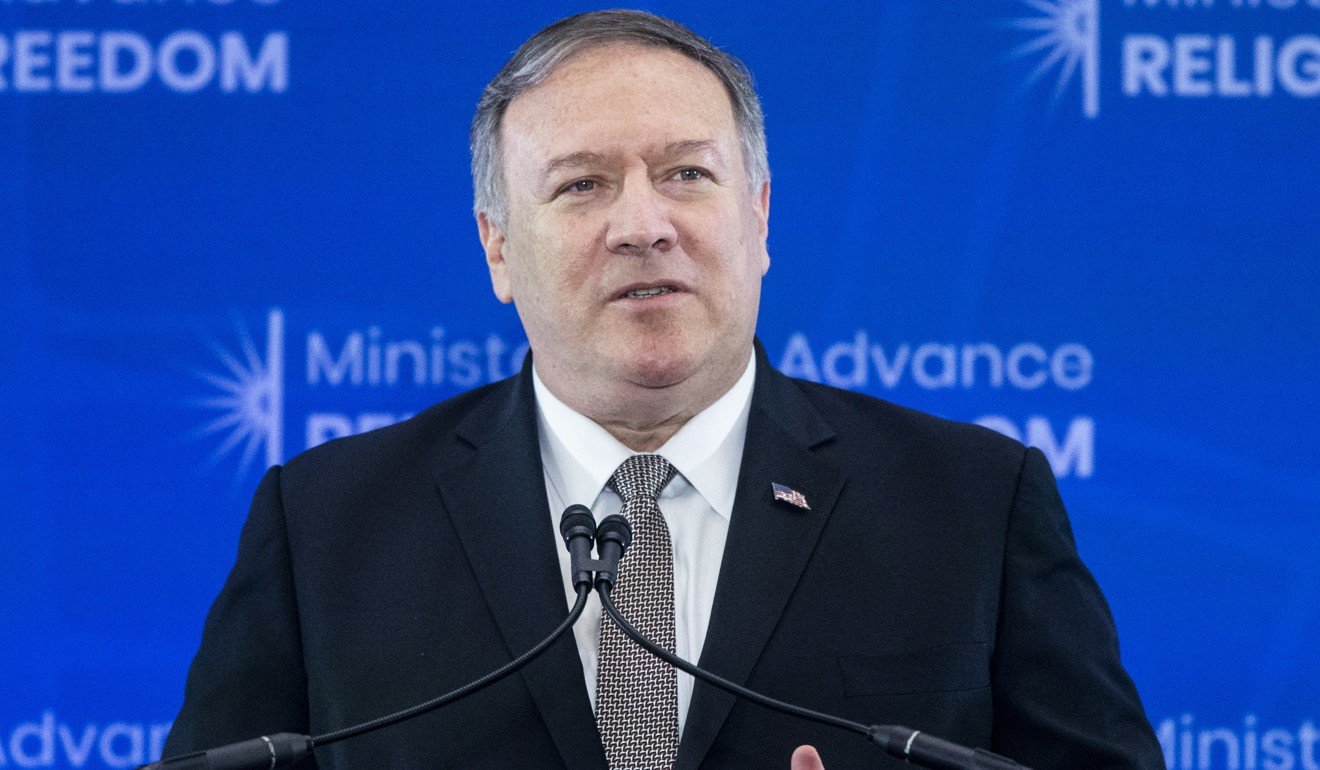
US Secretary of State Mike Pompeo in Luanda, Angola. Photo: Reuters
US Secretary of State Mike Pompeo denounced corruption and touted American business on Monday during the second leg of an African tour in Angola, where the government is seeking to claw back billions of dollars looted from state coffers.
Pompeo is aiming to promote US investment as an alternative to Chinese loans while assuaging concerns over a planned US military withdrawal and the expansion of visa restrictions targeting four African countries.
In Angola’s capital Luanda, Pompeo met with President Joao Lourenco, who took office in 2017 promising wide-ranging economic reforms and a crackdown on the endemic corruption that marked his predecessor Jose Eduardo dos Santos’ four-decade rule.
“Here in Angola, damage from corruption is pretty clear,” he told a group of businessmen following that meeting. “This reform agenda that the president put in place has to stick.”
Here in Angola, damage from corruption is pretty clear Mike Pompeo
Portugal’s public prosecutor has ordered the seizure of bank accounts belonging to
, the former president’s billionaire daughter, who is a suspect in an Angolan fraud investigation. Reputedly the richest woman in Africa, she has repeatedly denied any wrongdoing.
Angola, with Sub-Saharan Africa’s third-largest economy and its second-largest oil producer is ranked as one of the world’s most corrupt nations, in 165th place on a list of 180 countries, according to anti-corruption group Transparency International.
US oil majors ExxonMobil and Chevron have significant stakes in Angolan oilfields.
Last year, Chevron signed onto a consortium to develop Angola’s natural gas assets alongside Italy’s Eni, France’s Total, BP and Angolan state oil company Sonangol.
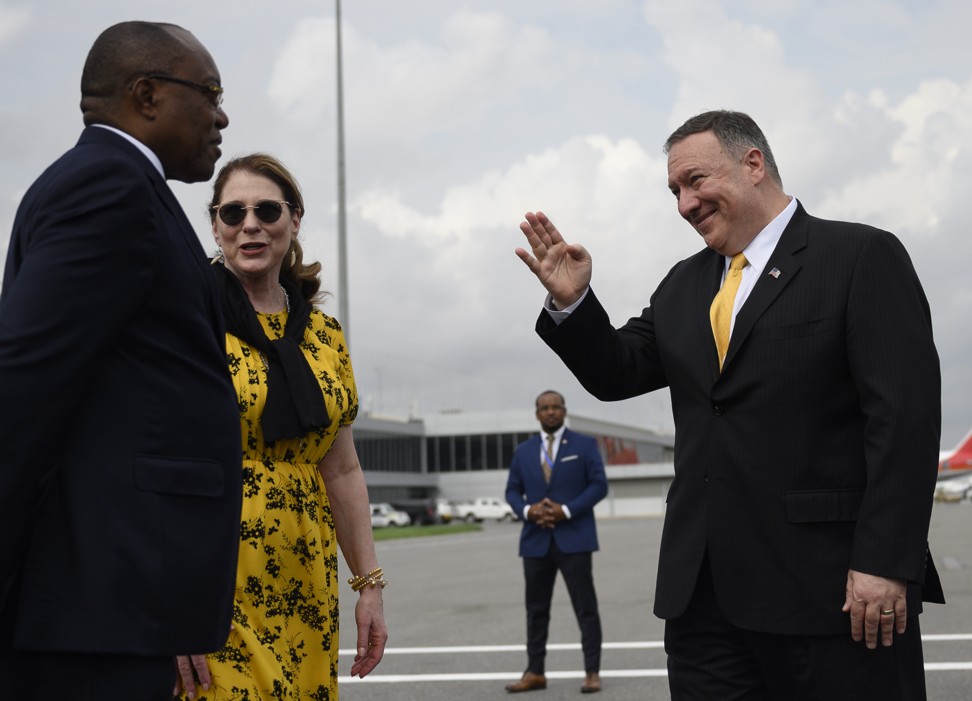
Mike Pompeo and his wife Susan greet Angola Foreign Minister Manuel Domingos Augusto in Luanda on Monday. Pool photo: AFP
“We’ve got a group of energy companies that have put more than US$2 billion in a natural gas project. That will rebound to the benefit of the American businesses for sure, but to the Angolan people for sure as well,” Pompeo said.
With a revamped International Development Finance Corporation and its new Prosper Africa trade and investment strategy, the administration is seeking to combat Chinese influence on the continent.
But the push comes as some governments are questioning US President Donald Trump’s commitment to Africa.
Do Africa’s emerging nations know the secret of China’s economic miracle?
The White House last month tightened visa restrictions on nationals from Sudan, Tanzania, Eritrea and Nigeria.
West African governments are also worried about a proposed US troop withdrawal from the region just as Islamist groups with links to Islamic State and al-Qaeda are gaining ground.
During the first leg of his African trip in Senegal on Sunday, Pompeo sought to put some of those fears to rest.
“We have an obligation to get security right here, in the region. It’s what will permit economic growth, and we’re determined to do that,” he told reporters.
Source: SCMP
Posted in Al-Qaeda, alternative, Angola, Angola Foreign, Angolan oilfields, belt and road projects, BP, Chevron, Chinese, corruption, eager, Eritrea, ExxonMobil Corp, France’s Total, International Development Finance Corporation, Investment, Islamic state, Italy’s Eni, Luanda, Mike Pompeo, natural gas project, Nigeria, Portugal’s public prosecutor, Prosper Africa trade and investment strategy, Sonangol, Sudan, Tanzania, Transparency International, Trump administration, Uncategorized, US Secretary of State, West African governments, White House |
Leave a Comment »
27/11/2019
- But Washington still commands more diplomatic influence, analyst says
- Beijing extends its reach as its interests grow abroad and as Taipei loses allies
China has 276 embassies, consulates and other missions around the world, surpassing the US with 273 missions, according to a global index. Photo: AP
China has overtaken the United States to have the biggest number of diplomatic outposts around the world, as its international ambitions and economic interests expand.
According to the 2019 Global Diplomacy Index, released by the Lowy Institute in Australia on Wednesday, China has 276 embassies, consulates and other missions globally, surpassing the US with 273 missions. France was third on 267.
Bonnie Bley, the index report’s lead researcher, said that while a country’s total did not equate to diplomatic influence, “diplomatic infrastructure is still important”
“China’s newly held lead serves as a telling metric of national ambition and international priorities,” Bley said.
Beijing has 169 embassies or high commissions, while Washington has 168. However, China had 96 consulates while the US had 88, suggesting that Beijing’s diplomatic expansion was closely linked to its economic interests, she said.
Beijing bulks up diplomacy budget as China extends global reach
Renmin University international relations professor Shi Yinhong said China had close and growing trade and investment ties with many developing countries, especially those taking part in the Belt and Road Initiative, increasing the need for consulates.
“One of the consulates’ main goals is to serve the citizens and businesses located in those countries,” Shi said.
Beijing has also expanded its reach at Taipei’s expense. Since 2016, when the index was first published, Taiwan’s total number of embassies fell from 22 to 15, the biggest drop among the 61 places ranked.
China opened five new embassies – in El Salvador, Burkina Faso, Gambia, São Tomé and Príncipe and the Dominican Republic – countries that severed official diplomatic ties with Taiwan. This directly contributed to China’s lead over the US, the report said.
Beijing’s diplomatic expansion also comes as the US, under the administration of President Donald Trump, is taking an “America first” approach to foreign policy.
Sri Lanka rejects fears of China’s ‘debt-trap diplomacy’ in belt and road projects
Trump has sought to cut funding to the US State Department and the White House has not appointed US ambassadors for at least 17 countries, including Brazil and Egypt, according to the American Foreign Service Association.
“Even though the US has a strong diplomatic base but it is not so proactive any more. It has fewer consulates and fewer foreign service workers,” Shi said.
“For the long term, China is in a more advantageous position.”
But a country’s diplomatic ability and influence did not rest on the number of foreign service postings and the US still held more international diplomatic sway than China, he added.
Some of China’s biggest diplomatic missions include Islamabad in Pakistan, Washington and London.
Source: SCMP
Posted in 2019 Global Diplomacy Index, American Foreign Service Association, “America first”, Beijing, belt and road projects, biggest, boast, Brazil, Burkina Faso, China alert, commands, diplomatic, Dominican Republic, Egypt, Gambia, influence, Islamabad, London, network, Pakistan, President Donald Trump, Renmin University, São Tomé and Príncipe, São Tome, Sri Lanka, Taipei, Uncategorized, United States, US State Department, Washington, White House, world’s |
Leave a Comment »
25/11/2019
Chinese State Councilor and Foreign Minister Wang Yi meets with Governor of Shizuoka Prefecture Heita Kawakatsu in Shizuoka, Japan, Nov. 24, 2019. (Xinhua/Guo Dan)
SHIZUOKA, Japan, Nov. 24 (Xinhua) — China and Japan should usher in a new era of local-level exchanges in the 21st century, Chinese State Councilor and Foreign Minister Wang Yi said here on Sunday.
Wang, who attended the Group of 20 (G20) Foreign Ministers’ Meeting in Nagoya, made the remarks during a meeting with Governor of Shizuoka Prefecture Heita Kawakatsu.
Wang said that although the relations between the two countries have experienced ups and downs, friendly people-to-people and local-level exchanges have always been the cornerstone of communication between China and Japan. More than 250 pairs of sister cities have been established between the two countries, he noted.
The two sides should keep pace with the times, jointly open up a new era of local-level exchanges in the 21st century and push for continuous improvement and development of bilateral relations, Wang said.
Shizuoka has always had a unique and important position in the friendly exchanges between China and Japan, and it is hoped that Shizuoka will continue to play a leading role in promoting the friendly cooperation between the two countries, he said.
Kawakatsu introduced the historical origin and current development of Shizuoka’s friendly exchanges with China, saying that whether the development of Japan-China relations is smooth or experiences ups and downs, the friendly feelings of the Japanese people towards China have never changed.
Shizuoka has forged friendly relations with many provinces and cities in China, especially with Zhejiang Province for 37 years, he said, adding that the people of Shizuoka are proud of their special relationship with China and their contributions to Japan-China friendship, he said.
Kawakatsu said he highly appreciates the Belt and Road Initiative and sees it as an important opportunity for Shizuoka to expand friendly cooperation with China, adding that the prefecture is ready to fully support and actively participate in the joint construction of the Belt and Road projects.
Shizuoka’s door is always open to Chinese friends and the prefecture welcomes more Chinese tourists, he added.
Source: Xinhua
Posted in belt and road projects, Chinese State Councilor and Foreign Minister Wang Yi, Governor of Shizuoka Prefecture, Group of 20 (G20) Foreign Ministers' Meeting, Japan-China friendship, joint construction, Nagoya, Uncategorized, zhejiang province |
Leave a Comment »
31/07/2019
- China’s Wang Yi and US’ Mike Pompeo at summit in Thailand to sell their visions of future for Southeast Asia
- Analysts expect pragmatism from Asean as world’s two biggest economic powers play diplomatic game
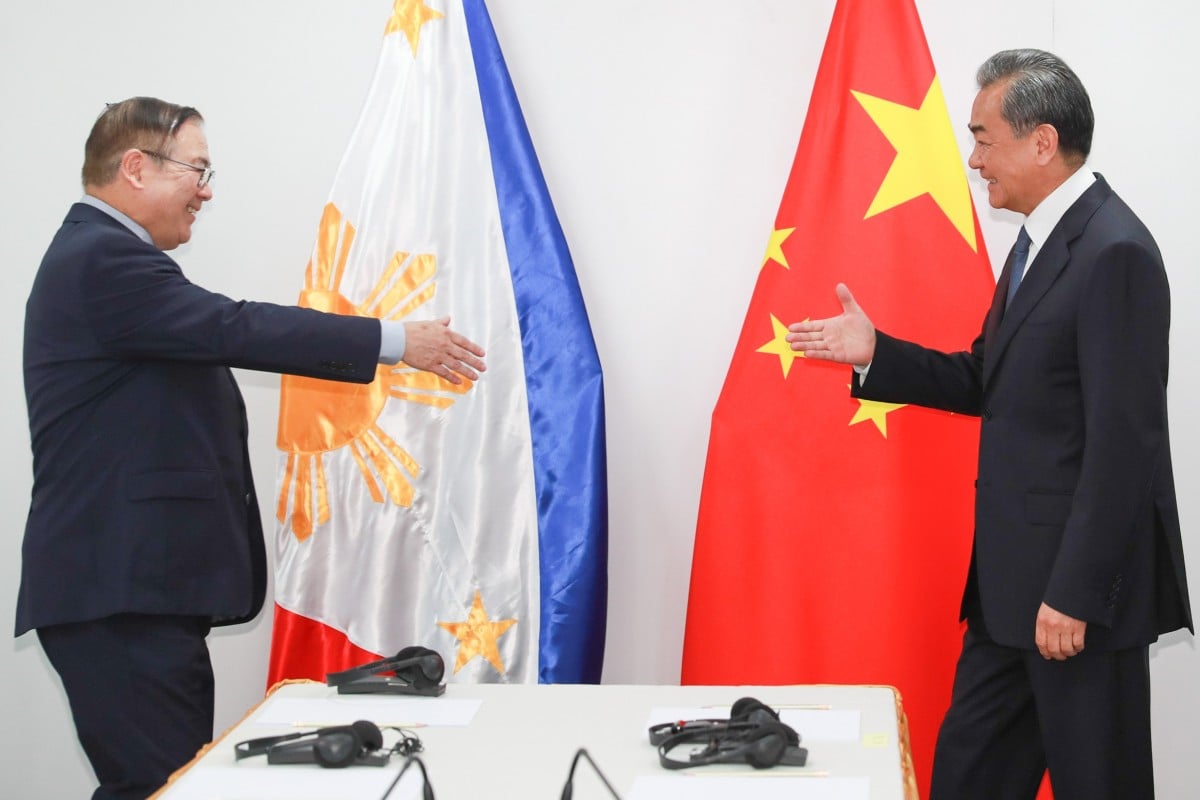
Chinese Foreign Minister Wang Yi (right) greets his Philippine counterpart Teodoro Locsin at the Asean meeting in Bangkok, Thailand. Photo: Xinhua
China and the United States are on a mission to strengthen ties with allies and expand their influence in Southeast Asia this week as their trade war enters a second year.
US Secretary of State Mike Pompeo arrived for a meeting of the Association of Southeast Asian Nations (Asean) in Bangkok on Wednesday to promote the US-led Indo-Pacific strategy, while Chinese Foreign Minister Wang Yi touched down a day earlier to advance Beijing’s Belt and Road Initiative.
The US Department of State said Pompeo’s trip was aimed at deepening Washington’s “long-standing alliances and vibrant bilateral relations with these countries, and [to] reaffirm our commitment to Asean, which is central to our vision for the Indo-Pacific region”.
In Beijing on Wednesday, Chinese foreign ministry spokeswoman Hua Chunying said that while their meeting was yet to be set, Wang and Pompeo were expected to meet and talk “frankly” about bilateral relations.
“I think that it is indeed necessary for China and the United States to maintain communication, as the two countries face many situations,” Hua said. “The issues would be communicated frankly”.
The Indo-Pacific strategy is a military and economic framework to contain China’s expansion into the Pacific and Indian oceans, and give an alternative to Beijing’s flagship belt and road development programme.
En route to Thailand, Pompeo said that after a stalled start to US Indo-Pacific policy during the Barack Obama administration, Washington’s strategy was well on its way to bearing fruit for the US and its allies.
South China Sea tensions, US-China trade war loom over Asean summit
“We have watched these coalitions build out,” he said.
Pompeo dismissed claims that China’s sphere of influence among Asean members was growing, saying such speculation was “not factually accurate”.
“[Asean countries] are looking for partners that are going to help them build out their economies and to take good care of their people,” he said, pledging greater engagement from President Donald Trump’s administration.
Pompeo was expected to sit down on Friday with his South Korean and Japanese counterparts to consolidate their trilateral alliance in the region.
He was also expected to hold talks with Thai Foreign Minister Don Pramudwinai that day.
US Secretary of State Mike Pompeo is expected to meet Chinese Foreign Minister Wang Yi at Asean in Thailand. Photo: EPA-EFE
Meanwhile, Wang launched his belt and road pitch to his Cambodian, Philippine and Indonesian counterparts after he arrived in Thailand for the gathering, which ends on Saturday.
The belt and road projects are largely commercial and aimed at strengthening land and sea infrastructure linking Asia, Europe and Africa. But they raised suspicion in the West that they are aimed at eroding the US-led world order.
During his meeting with Philippine Foreign Affairs Secretary Teodoro Locsin, Wang said: “China is willing to have high-level exchanges with the Philippines, to deepen the mutual trust, and promote the Belt and Road Initiative [in the Philippines] … to accelerate the development of regional infrastructure.”
Can China’s trade boost with Asean help get the Regional Comprehensive Economic Partnership over the line?
This year’s Asean forum was taking place as countries were more receptive to Chinese initiatives, in part due to the unpredictability of the US administration, according to Rajeev Ranjan Charturvedy, a visiting fellow at the S. Rajaratnam School of International Studies at Nanyang Technological University in Singapore.
“Policy uncertainties under the Trump administration have already pushed some Asean countries towards China in ways that would have seemed unlikely a few years ago,” Charturvedy said.
Analysts said Trump’s “America first” approach shaped his Asean policy. The president had vowed to apply “punishments” to countries – including Asean member states – for contributing to the US trade deficit.
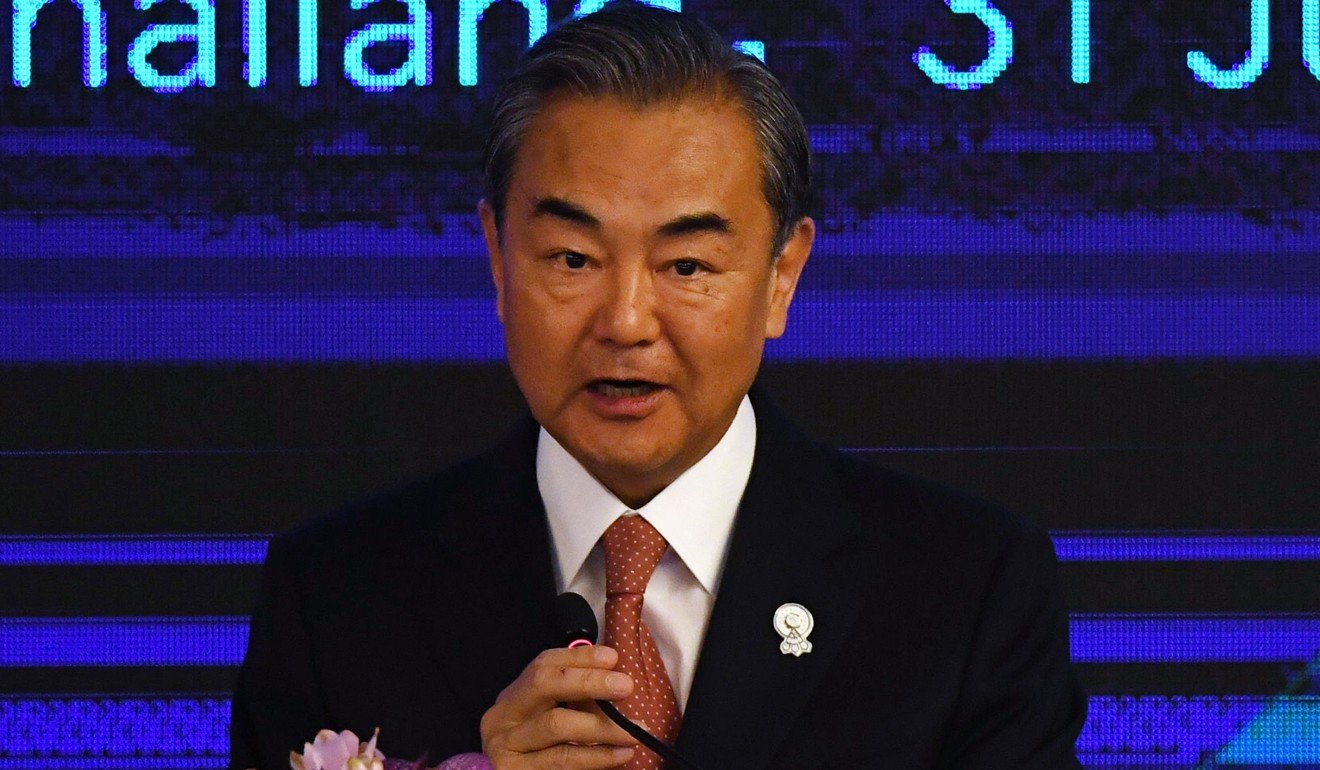
Chinese Foreign Minister Wang Yi is talking to Asean counterparts at a time when they are receptive to China’s proposals, an analyst says. Photo: AFP
Trump was absent at the Asean summit in Singapore last year, leading to concerns that Washington’s commitment to Asia was declining.
Charturvedy said the Asean forum’s focus was about building constructive regionalism, but China’s attitudes to security could pose a challenge.
“[However] Asean countries clearly hope not to be forced to choose between the US and Chinese offers. Rather, they would like more freedom of choice while accommodating for a larger role for China in the region,” he said.
Clarita Carlos, a professor of political science at the University of the Philippines, suggested that Asean members would be pragmatic during the forum.
Robert Lighthizer warns Vietnam over trade deficit with US
They would try to find their own balance between the two major powers – as countries rather than a bloc – to try to maximise each state’s interests and advantages, Carlos said.
“Vietnam has a love-hate relationship with China, especially as a winner in the ongoing US-China trade war,” she said. “Singapore has close relations with China. There are also ups and downs in the relationship with China for Brunei, Malaysia and Indonesia.”
Source: SCMP
Posted in africa, Asia, Association of Southeast Asian Nations (ASEAN), Bangkok, Barack Obama administration, Beijing, belt and road development programme, Belt and Road Initiative (BRI), belt and road projects, Brunei, Cambodian, China alert, China court Asean members, Chinese foreign minister Wang Yi, diplomatic game, Don Pramudwinai, enters second year, Europe, Indo-Pacific strategy, Indonesia, Indonesian, land infrastructure, Malaysia, Mike Pompeo, Philippine, Philippine Foreign Affairs Secretary, pragmatism, President Donald Trump, Regional Comprehensive Economic Partnership, Regional Comprehensive Economic Partnership (RCEP), S. Rajaratnam School of International Studies, sea infrastructure, Singapore, Singapore’s Nanyang Technological University, Southeast Asia, strengthen Indo-Pacific ties, summit, Teodoro Locsin, Thai Foreign Minister, Thailand, trade war, Trump administration, Uncategorized, United States, University of the Philippines, US court Asean members, visions of future, Washington |
Leave a Comment »
27/06/2019
- Joyce Msuya of the UN Environment Programme is full of praise for Beijing’s success in tackling air pollution but says there is work still to be done
- Commitment to environmental protection seen at home must be extended to infrastructure projects developed overseas, she says
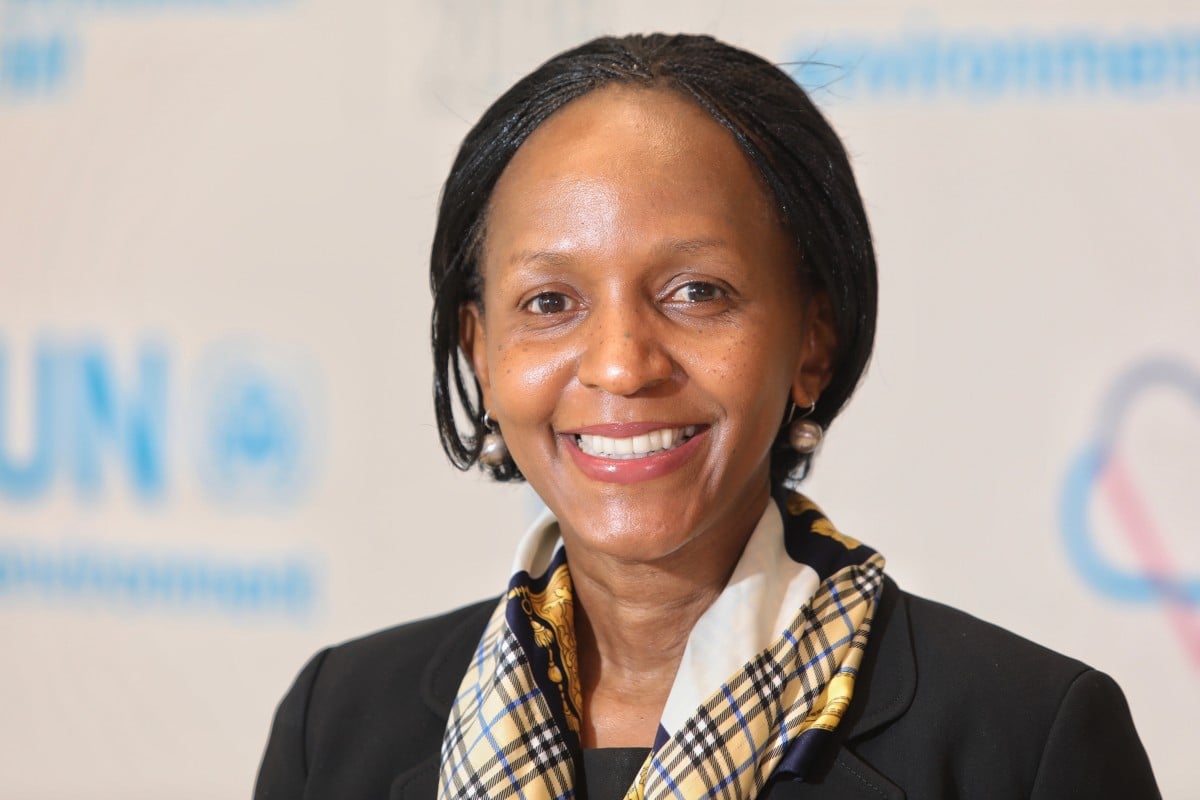
Joyce Msuya, acting head of the UN Environment Programme, says bad infrastructure can have a negative environmental impact. Photo: Simon Song
The United Nations’ environment chief has appealed to China to apply the same environmental standards to infrastructure projects it develops overseas under its Belt and Road Initiative as it does to those built on its own soil.
“We know from history, bad infrastructure can lead to negative environmental impact,” said Joyce Msuya, acting executive director of the UN Environment Programme. “Given China’s record on and interest in environmental protection, we hope and expect they will apply the same spirit as they invest in developing countries.”
While acknowledging the value of infrastructure building in developing nations, Msuya said it was equally important to consider the environmental implications of
“We are interested in working with member countries that have been beneficiaries [of Chinese investment] to see what concerns, if any, what risks, if any, they see,” she said in an interview on the sidelines of an event in Hangzhou, capital of east China’s Zhejiang province, to mark World Environment Day, which fell on Wednesday.
Scores of countries are involved in Beijing’s multibillion-dollar belt and road plan in one way or another, but as it has expanded so too have the concerns over its environmental impact.
In late 2017, the WWF issued a report claiming that the development of two motorway projects in Myanmar would have a negative environmental impact on about half of its population.
China ‘facing uphill struggle’ in fight against pollution
On China’s efforts to tackle pollution at home, Msuya said that although the move towards a greener economy might require communities to make sacrifices in the short term, these would be outweighed by the long-term benefits.
China has been fighting a “war on pollution” since 2013 but as
have grown so too have concerns that industry unfriendly environmental efforts might be relegated to the back burner. The nation’s gross domestic product grew by just 6.6 per cent in 2018, its slowest rate since 1990, and for the past year it has been embroiled in a stinging trade war with the United States.
China has been fighting a “war on pollution” since 2013. Photo: Simon Song
Msuya said that while Beijing had done a good job in improving air quality, it still had some way to go on issues like water, soil and noise pollution.
“China is quite diverse, with many provinces … so the scale of the challenge of dealing with pollution is more complex,” she said. “[But] by building on its experience of cleaning the air, I have full confidence in the Chinese government.”
Pollution in northern China up 16 per cent in January as industrial activity spikes
According to a report issued by Beijing on Wednesday, average levels of PM2.5 – the tiny airborne particles that are particularly harmful to health – in more than 70 cities across
China fell by an average of 42 per cent in the five years through 2018.
Smog levels in the Chinese capital fell 43 per cent in the period, but the average reading in the city last year was still more than five times the World Health Organisation’s recommended safe level.
Air quality was the main theme of the Hangzhou event.
Msuya has first-hand experience of Beijing’s air quality having worked in the city as the World Bank Group’s regional coordinator for East Asia and the Pacific between 2011 and 2014.
“When I moved to Beijing in 2011, I honestly didn’t know how bad the air pollution was.
My son was six at the time and I always made sure he wore a mask when he went out to play,” she said.
“Fast forward to now, and China has shown us that the problem of air pollution can be tackled if everyone participates.”
Source: SCMP
Posted in air pollution, belt and road plan, belt and road projects, China alert, green and clean, Hangzhou, infrastructure projects, mask, UN Environment Programme, UN’s environment chief, Uncategorized, United States, urges, World Environment Day, WWF, Zhejiang, zhejiang province |
Leave a Comment »




 CHINDIA ALERT: You'll be living in their world, very soon