Archive for ‘Bengaluru’

23/04/2020

Locked-down Indian economy in its worst quarter since mid-1990s: Reuters poll

BENGALURU (Reuters) – The Indian economy is likely to suffer its worst quarter since the mid-1990s, hit by the ongoing lockdown imposed to stem the spread of coronavirus, according to a Reuters poll, which predicted a mild and gradual recovery.

Over 2.6 million people tmsnrt.rs/3aIRuz7 have been infected by the coronavirus worldwide and more than 180,000 have died. Business and household lockdowns have disrupted supply chains globally, bringing growth to a halt.

The April 17-22 Reuters poll predicted the economy expanded at an annual pace of 3.0% last quarter but will shrink 5.2% in the three months ending in June, far weaker than expectations in a poll published last month for 4.0% and 2.0% growth, respectively.

The predicted contraction would be the first – under any gross domestic product calculation, which has changed a few times – since the mid-1990s, when official reporting for quarterly data began.

“The extended lockdown until early May adds further downside risk to our view of a 5% year-on-year GDP fall in the current quarter, the worst in the last few decades,” said Prakash Sakpal, Asia economist at ING.

“We don’t consider economic stimulus as strong enough to position the economy for a speedy recovery once the pandemic ends,” he said.

(Graphic: Reuters poll graphic on coronavirus impact on the Indian economy IMAGE link: here)

The Indian government announced a spending package of 1.7 trillion rupees in March to cushion the economy from the initial lockdown, which has been extended until May 3.

In an emergency meeting last week, the Reserve Bank of India cut its deposit rate again, after reducing it on March 27 and lowering the main policy rate by 75 basis points. It also announced another round of targeted long-term repo operations to ease liquidity.

But even with those measures, 40% of economists, or 13 of 32 – who provided quarterly figures – predicted an outright recession this year. Only one had expected a recession last month.

In the worst case, a smaller sample of respondents predicted, the economy would contract 9.3% in the current quarter. That compares with 0.5% growth in the previous poll’s worst-case forecast in late March, underscoring how rapidly the outlook has deteriorated.

The latest poll’s consensus view still shows the economy recovering again slowly in the July-September quarter, growing 0.8%, then 4.2% in October-December and 6.0% in the final quarter of the fiscal year, in early 2021.

But that compares with considerably more optimistic near-term forecasts of 3.3%, 5.0% and 5.6%, respectively, in the previous poll.

“A rebound in economic activity following the disruption is expected, but the low starting point of growth implies a gradual recovery,” said Upasana Chachra, chief India economist at Morgan Stanley.

“Indeed, before disruptions related to COVID-19, growth was slowing, with domestic issues of risk aversion in financial sector … (and) those concerns will likely stay after the COVID-19 disruptions have passed unless the policy response is much larger than expected,” she said.

The unemployment rate has tripled to 23.8% since the lockdown started on March 25, according to the Centre for Monitoring Indian Economy, a Mumbai-based research firm.

The Indian economy was now forecast to expand 1.5% in the fiscal year ending on March 31, 2021 – the weakest since 1991 and significantly lower than 3.6% predicted in late March. It probably grew 4.6% in the fiscal year that just ended.

Under a worst-case scenario, the median showed the economy shrinking 1.0% this fiscal year. That would be the first officially reported economic contraction for a 12-month period since GDP was reported to have contracted for calendar year 1979.

“Unless fiscal policy is also loosened aggressively alongside monetary policy, there is a big risk the drastic economic slowdown currently underway morphs into an annual contraction in output and that the recovery is hampered,” said Shilan Shah, senior India economist at Capital Economics.

All 37 economists who answered a separate question unanimously said the RBI would follow up with more easing, including lowering the repo and reverse repo rates and expanding the new long-term loans programme.

The RBI was expected to cut its repo rate by another 40 basis points to 4.00% by the end of this quarter. Already lowered twice over the past month by a cumulative 115 basis points, the reverse repo rate was forecast to be trimmed by another 25 points by end-June to 3.50%.

Source: Reuters

27/03/2020

Coronavirus: Can one woman make kindness catch on in India?


Caremongers posterImage copyright CAREMONGERS INDIA

With India under lockdown and social distancing being advised to deal with the threat of the coronavirus, an online collective of “Caremongers” is reaching out to help the elderly and other vulnerable groups.

It started last week when Mahita Nagaraj, a digital marketing professional and single mum, received a call from a close friend in the UK requesting her to help arrange some medicines for her “very elderly parents”.

Within hours, she heard from another friend living in the US with a similar question: can you ensure that my parents have provisions for the month?

Ms Nagaraj, who lives in the southern city of Bengaluru (formerly Bangalore), says that set her thinking about other friends whose elderly parents didn’t have anyone to call upon.

So, she posted a message on Facebook asking people to get in touch if they needed help.

The response she got was “overwhelming”. People reached out to her from all over India and, surprisingly, most who got in touch said they wanted to help out too.

And thus was born Caremongers India – a Facebook group, asking people to “stop scaremongering and start caremongering” – on 17 March.

“There is so much scaremongering in the current scenario,” says Ms Nagaraj. “We are trying to address the feeling of helplessness in the people. We are telling people to stop spreading fear and panic, and instead spread love.”

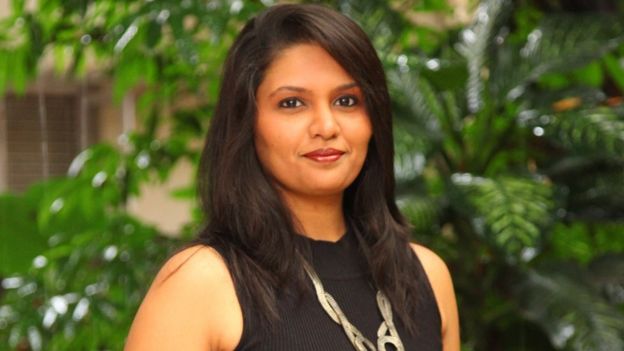
Mahita NagarajImage copyright CAREMONGERS INDIA
Image caption Mahita Nagaraj set up Caremongers India after her friends called her to seek help

Ms Nagaraj says she learnt about caremongering from a BBC article from Canada. The concept actually started in Toronto to help vulnerable people, but within days it spread to cover almost all of Canada with tens of thousands signing up.

Reports of altruism have come in from other parts of the world too. Britons are delivering soup to the elderly, in the US neighbours are helping those quarantined with buying groceries and one Long Island mother, infected with the virus, wrote about a neighbour who cooked a lasagne and left it outside her door.

Along with all the fear and panic caused by the coronavirus, the pandemic has also seen kindness go viral across the globe, with neighbours and complete strangers pitching in to help.

In India too, caremongering took off from the word go – in the first 24 hours, the Facebook group had 200 members. A week later, it has become a pan-India network with more than 6,500 volunteers.

Ms Nagaraj says she realised that on Facebook, most people were getting in touch to offer help, but only a few were asking for help. So, on Friday night, she launched a helpline number and since then, “it’s gone crazy”.

Caremongers India offers help to those who are most at risk of health complications due to the virus like the elderly, the disabled, those with pre-existing health conditions and anyone with an infant under a year.

In less than a week, Ms Nagaraj says, she has received thousands of calls and messages and although a large number of them have been to verify whether the number is genuine, she has also taken hundreds of requests for assistance.

Listed on the Caremongers India page are countless examples of assistance sought and provided; and testimonials and messages of gratitude.Transparent line (white space)

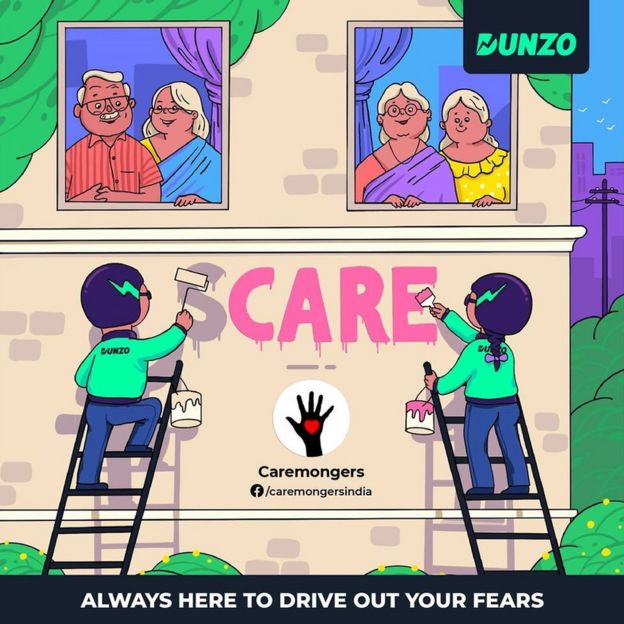
Wiping away the scareImage copyright IMAGE COURTESY: DUNZOTransparent line (white space)Besides those calling in from within India, Ms Nagaraj has been fielding dozens of calls from people across the globe seeking help for their elderly parents and grandparents.

“When people give their requirement and address, we match the requester with the closest volunteer,” she explains.

So last Saturday, when Amit Joshi, a resident of an upscale apartment block in the Delhi suburb of Noida, called the helpline, he was connected to Caremonger Madhavi Juneja, who also lives in Noida.

“We woke up to the news that our apartment complex was under lockdown,” Mr Joshi told me.

A resident had tested positive for the coronavirus and Mr Joshi was informed that they would not be allowed to leave home for a week.

“Police had put up barricades outside on the road and our complex was swamped with disaster management teams and health officials. Everything around us was shuttered. There was complete panic,” he says.

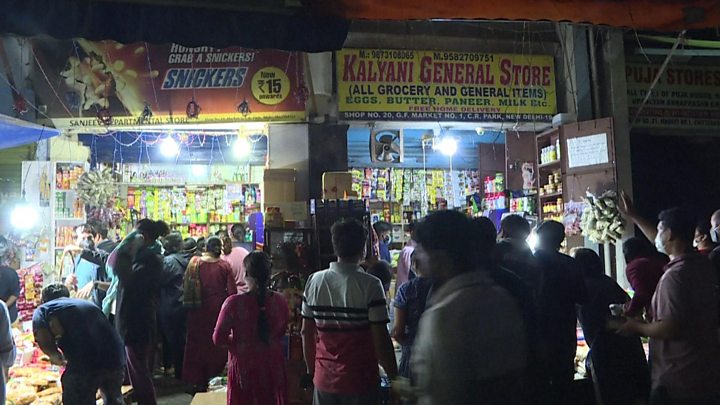
Mr Joshi, who lives with his wife and elderly parents, says his biggest worry was how to get essentials like bread and milk.

Banner image reading 'more about coronavirus'
Banner

And when he received a random WhatsApp forward from a colleague about Caremongers India, he decided to call them.

A few hours later, Ms Juneja, a psychotherapist and life coach, turned up at the gate of Mr Joshi’s housing society and handed over the supplies to him.

“I wore a mask and took my bottle of hand sanitiser and drove to his complex to carry out the delivery,” she said.

“Because the street was barricaded, I parked my car and then walked. If I had left it outside, someone else could have taken it. After I handed over the package to him, I sanitised my hands and got back into my car.”

Media caption People panicked after Narendra Modi said nobody should leave their homes, and did not mention the status of essential supplies

Mr Joshi says, “In trying times like these, to have people selflessly reaching out to those in need has strengthened my belief in humanity.”

Ms Nagaraj says it’s “so heartening” to see that so many people want to help.

“Every request we receive is very special when we fulfil it. When a daughter calls to say her dad who lives alone requires provisions, we work hard to ensure he gets it.”

Ms Nagaraj says caremongering has taken over life and even her home.

“It’s not easy to answer 450 calls a day,” she says, “but when you help others, you go to bed thinking you haven’t wasted your day and that’s good enough for me.”

Source: The BBC

18/04/2019

India election 2019: Can West Bengal’s female candidates win?

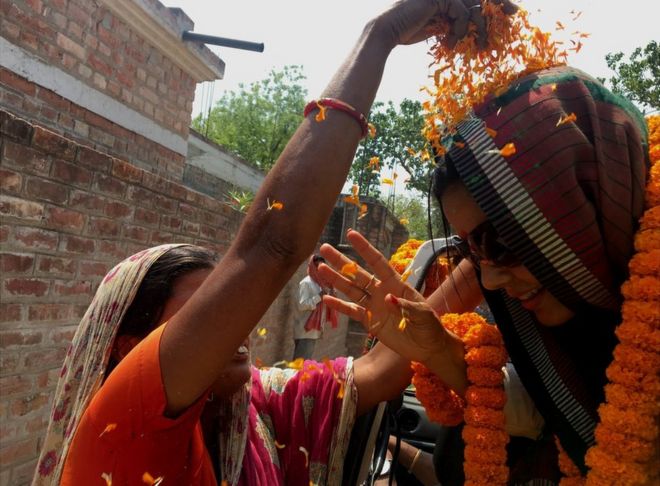
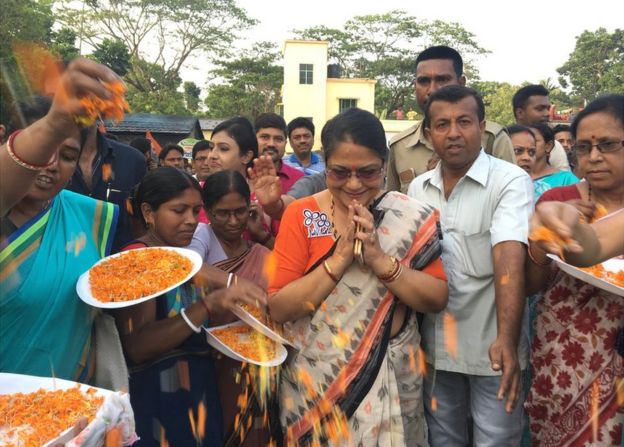
A supporter throws marigold petals at Mahua Moitra
Presentational white space

Women make up nearly half of India’s 900 million voters, but they are still poorly represented in the country’s law-making bodies. One political party is trying to correct the balance by nominating 41% female candidates. The BBC’s Geeta Pandey travelled to the state of West Bengal to see how they are faring.

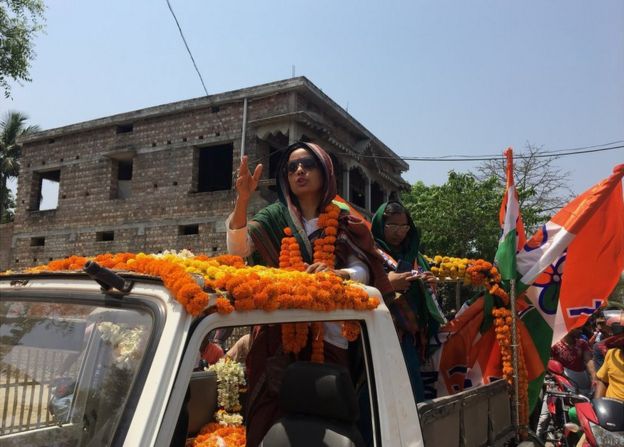
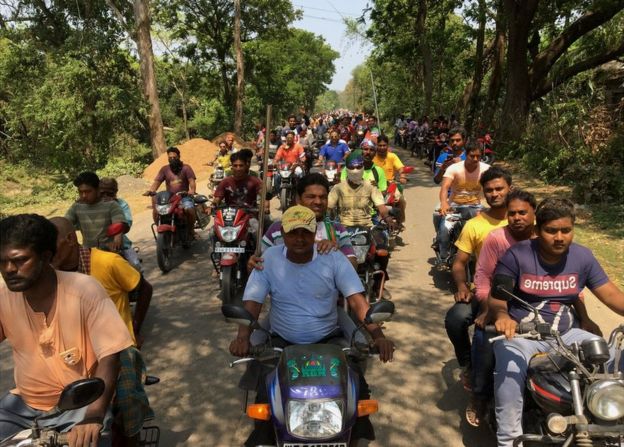
On a bright sunny morning, as an open jeep decorated with bright yellow and orange flowers hurtles along the dirt track from one village to the next, women in colourful saris and men rush to greet Mahua Moitra.

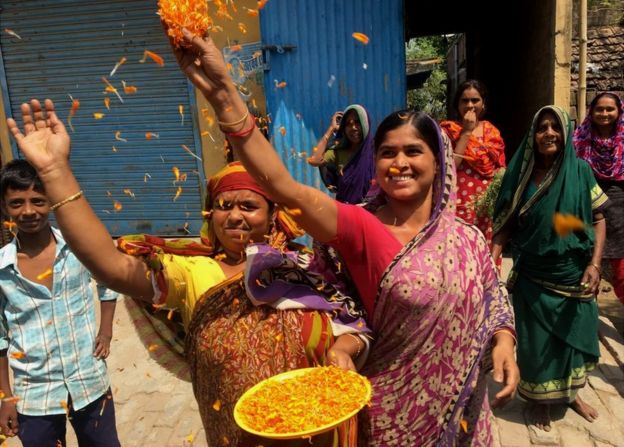
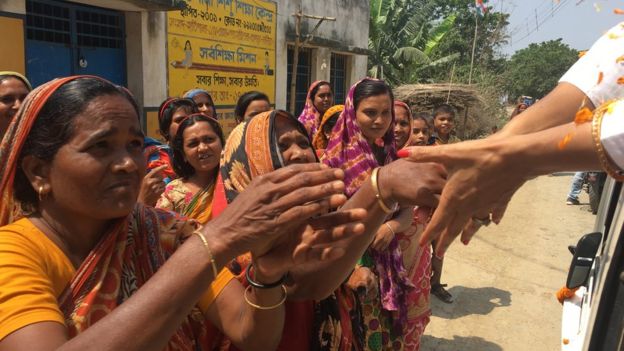
They shower bright orange marigold petals on her, place garlands around her neck and many reach out to shake and kiss her hands. She waves at them, greeting them with her palms joined: “Give me your blessings.”

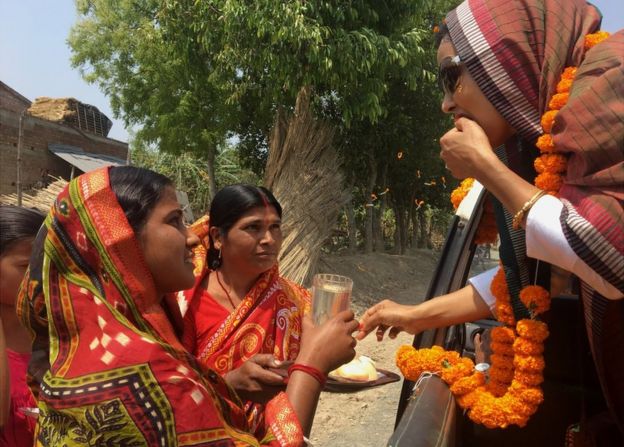
Young men and women whip out their smartphones to take photos and selfies. On the way, she’s offered coconut water and sweets.

Ms Moitra, who is contesting the general election as a candidate of the state’s governing Trinamool Congress Party (TMC), is campaigning in her constituency Krishnanagar.

Women offer sweets to Mahua Moitra
Image caption On the campaign trail, women offer coconut water and sweets
Presentational white space
Women throw marigold petals at Mahua Moitra
Image caption Supporters throw marigold petals at Mahua Moitra
Presentational white space

In one village, party workers tell her about an old man who’s too ill to come to meet her, so she walks to his home to greet him.

Her jeep is followed by dozens of bikes and their riders, all young men, chanting slogans like “Long live Trinamool Congress, Long live Mamata Banerjee.”

The loud, colourful procession is led by a small truck, fitted with loudspeakers, from which announcements asking people to vote for Ms Moitra are played on a loop.

With the election season well under way in India and political leaders criss-crossing the length and breadth of the country, addressing rallies, I’m travelling across the country to see if the high-decibel campaigns are addressing the real issues that actually affect millions of people. One of them is getting more women into parliament.

In India, only 11% of members of parliament are women, and in state assemblies it’s 9%. In a list of 193 countries this year, India was ranked 149th for female representation in parliament – below Pakistan, Bangladesh and Afghanistan.

A bill to reserve 33% of seats for women in parliament and regional assemblies has been pending since 1996, so the decision by the TMC – led by West Bengal Chief Minister Mamata Banerjee – to give 41% of her party nominations to women has created a huge buzz.

Mahua Moitra during her road show
Image caption Ms Moitra quit her banker’s job in London to return to India and enter politics
Presentational white space

Ms Banerjee, who set up the TMC in 1998 after falling out with the Congress party, is a feisty politician who was named one of Time magazine’s 100 most influential people in the world in 2012.

Her female candidates, says my BBC Bengali colleague Subhajyoti Ghosh, are an “interesting mix” of career politicians and first-timers. They include actors, doctors, a tribal activist and the 25-year-old widow of a recently-murdered politician.

Ms Moitra, the TMC’s national spokesperson and a member of the state assembly since 2016, is among 17 women who have made it to the party’s list of 42 general election nominees.

Presentational grey line

Read more from Geeta Pandey

Presentational grey line

A former investment banker with JP Morgan, she gave up a well-paying job in London in 2009 to return to the heat and dust of Indian politics.

Her decision left her family aghast. Her parents, she told me, thought she was “insane”. Some party workers too had their doubts – “she’s a memsahib”, they said at the time, “she won’t survive”.

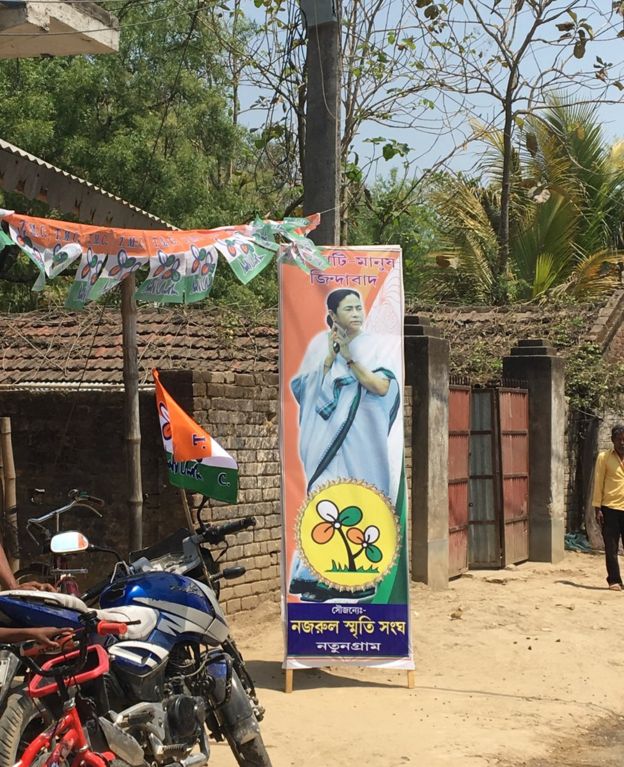
A poster of Mamata Banerjee in West Bengal
Image caption Mamata Banerjee was named one of Time magazine’s 100 most influential people in the world in 2012
Presentational white spaceBut she has survived – and thrived. In 2016, she won the Karimpur assembly seat that no non-Left party had won since 1972 and has now set her eyes on the national parliament.

She’s agreed to let me follow her on the campaign trail, so for two days I’ve been a “fly on the wall” – standing behind her in her jeep, travelling in her car, watching her strategise with party workers, aides and confidants.

The previous evening, I had watched her be the chief guest at a college cricket match and address a gathering at the local market in Plassey.

A four-hour drive from Kolkata, Plassey is the site of the famous 1757 battle between the British East India Company and the local ruler supported by the French.

Ms Moitra takes her spot to speak and clearly takes aim at Prime Minister Narendra Modi and his Bharatiya Janata Party (BJP) as she talks about a deadly suicide attack in Kashmir and India’s subsequent air raid in Pakistan.

The bike riders
Image caption Her jeep is followed by dozens of supporters on bikes
Presentational white space
Women shaking hands
Image caption Many women reach out to shake hands with Ms Moitra

“What’s the point of saying you killed all those terrorists in Pakistan? It’s not important who you killed in Pakistan or how many. What’s important is you failed to protect our soldiers.”

She talks about how the government has failed to create jobs and accuses the BJP of trying to divide Hindus and Muslims.

“You have taken away our livelihoods and you’re trying to teach us about [the Hindu god] Ram and [Muslim saint] Rahim? I don’t have to write my religion on my forehead,” she declares to loud claps from her supporters.

Elections in the past were to change the government, she says, but this election is to save the constitution of India. “It is no ordinary vote.”

Her main rival is the BJP’s Kalyan Chaubey, a former footballer who played in goal for India. So drawing a football analogy, she declares: “I’m an A-league centre-forward player, stop my goal if you can. I am here to win.”

Kakoli Ghosh Dastidar, a founder member of the TMC and two-term MP, says to nominate so many women is part of a “continuous process” followed by Mamata Banerjee because “you can’t develop a society without uplifting the status of its women”.

In the last general election in 2014, she points out that the party nominated 33% women and 12 of their 34 MPs in the outgoing lower house were women.

Ms Banerjee, she says, believes that gender sensitive laws will come only if more women are in power.

At a campaign rally that Dr Ghosh Dastidar addresses in Kumhra Kashipur village in her constituency Barasat, women are seated in the front rows.

Their opinion though is divided over whether having more women in parliament will actually benefit other women.

Dr Kakoli Ghosh Dastidar being welcomed in her constituency
Image caption Dr Kakoli Ghosh Dastidar is among the founder members of the TMC and a two-term MP
Presentational white space

Supriya Biswas says it’s easier if their MP is a woman because then it’s easier to approach her. “For, who can understand a woman better than a woman?”

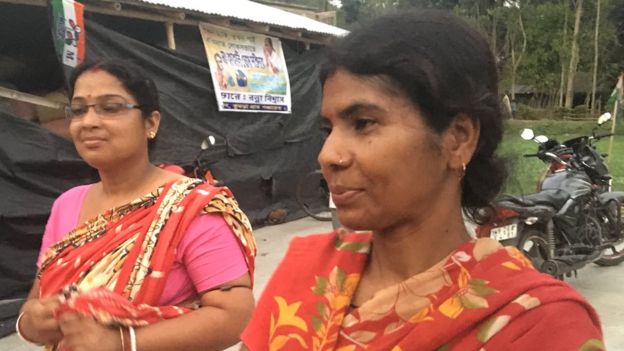
Archana Mallick and Meena Mouli, who live just across from the rally ground, point to the broken roads near their homes and complain about poor medical facilities in their village. They say that the candidate’s gender is “inconsequential” and what’s important is “who works for our benefit”.

Studies, however, show that female representatives bring economic growth to their constituencies because they are more concerned than men about issues such as water supply, electricity, road connectivity and health facilities.

Saswati Ghosh, professor of economics at Kolkata’s City College, says that politics in India is “still very patriarchal” and it’s “absolutely necessary” to elect more women MPs.

“It is important to have more women in lawmaking bodies because I think after a certain number, you’ll reach the threshold level and that will lead to change. I don’t know if 33% is the magic number that will change the quality of discourse, maybe 25% can do the trick?”

Archana Mallick and Meena Mouli say a candidate's gender is "inconsequential"
Image caption Archana Mallick and Meena Mouli say a candidate’s gender is “inconsequential”

Critics, however, question whether celebrities are the right candidates to bring about that change.

Prof Ghosh says actors and celebrities make for “winnable candidates” and that’s why all parties choose them even though sometimes they may not be the right candidates to reach that threshold.

But, she says that Ms Banerjee is a strong leader who’s regarded by many women as “a role model who inspires more women to come into politics”.

And that’s something that many Indians think the country sorely needs.

In their manifestos, the main opposition Congress party has promised to pass the women’s reservation bill, if elected to power. So has the ruling Bharatiya Janata Party, although it had made similar promises in its last manifesto and did nothing about it.

By allotting 41% seats to women, Ms Banerjee has shown that one doesn’t need to set artificial quotas to elect more women.

Source: The BBC

08/03/2019

IAF’s MiG-21 crashes after bird hit in Rajasthan’s Bikaner, pilot ejects

MiG-21 crash,IAF’s MiG-21,Rajasthan
The plane was on a routine training sortie and hence was unarmed.(Mint/ Representative Image)
A MiG-21 fighter jet of the Indian Air Force crashed in Rajasthan’s Bikaner on Friday. The plane crashed after it reportedly suffered a bird hit.
The plane had taken off from Nal near Bikaner. The pilot is said to have ejected safely.

Bikaner SP Pradeep Mohan Sharma said the MIG aircraft crashed in Shobhasar ki Dhani, 12 km from Bikaner city, news agency PTI reported.

Sharma said police teams have rushed the spot to cordon off the area. No loss of life has been reported.

A statement by the IAF said that the MiG-21 had taken off from the Indian Air Force’s Nal airbase in Rajasthan and that it was on a routine mission.

The IAF statement said, “Today afternoon a MiG-21 aircraft on a routine mission crashed after getting airborne from Nal near Bikaner. Initial inputs indicate the likely cause as bird hit after take off. Pilot of the aircraft ejected safely. A CoI [Court of Inquiry] will investigate the cause of the accident.”

In recent times, the IAF has witnessed a series of crashes involving fighter jets and choppers.

On February 1, a Mirage 2000 fighter jet had crashed during a routine testing flight. Both the pilots in the jet had died after their safety equipment gave way. The pilots were on an “acceptance sortie” of the Mirage 2000 trainer aircraft after it was overhauled by the Bengaluru-based Hindustan Aeronautics Limited (HAL).

Barely a fortnight later, two Surya Kiran Hawks were involved in a collision that led to the death of one pilot. The crash had taken place barely days before the 12 edition of Aero India.

On February 12, a MiG-27 fighter jet had crashed at the Pokhran firing range after taking off from the Jaisalmer air base. The jet was on a training mission. The pilot managed to eject safely from the jet before it crashed.

More recently, on February 27, a Mi17 helicopter of the Indian Air Force had crashed at Budgam in Kashmir. All six IAF personnel on board the chopper were killed. A civilian was also killed in the crash.

The MiG-21 fighter jet has been in the news recently after Wing Commander Abhinandan Varthaman, who was flying a similar aircraft shot down a Pakistani F-16 before crashing in Pakistan.

The MiG-21 is a supersonic jet fighter and interceptor aircraft, designed by the Mikoyan-Gurevich Design Bureau in the erstwhile Soviet Union.

Source: Hindustan Times

28/02/2019

Social media fake news fans tension between India and Pakistan

MUMBAI (Reuters) – With India and Pakistan standing on the brink of war this week, several false videos, pictures and messages circulated widely on social media, sparking anger and heightening tension in both countries.

The video of an injured pilot from a recent Indian air show and images from a 2005 earthquake have been taken out of context to attempt to mislead tens of millions on platforms like Twitter, Facebook and its messenger service, WhatsApp.

The spurt of fake news comes after New Delhi this week launched an air strike inside Pakistan, the first such move in over more than decades. India says the attack destroyed a militant camp run by the group that claimed responsibility for killing 40 paramilitary troops in Indian Kashmir on Feb 14. Pakistan denied there had been any casualties in the attack.
Tensions between the nuclear-armed nations peaked with both sides claiming they’d shot down each other’s fighter jets on Wednesday, and Pakistan capturing an Indian pilot.
As claims and counter claims poured in from both sides, social media became a hotbed of unverified news, pictures and video clips, according to fact checkers.
Partik Sinha, co-founder of one such fact-checking website, Alt News, said it had received requests to verify news from journalists and people on social media.
“It’s been crazy since Tuesday. There is so much out there that we know is fake, but we’re not able to fact-check all of it,” Sinha said.
A Facebook group that says it supports Amit Shah, the chief of India’s ruling Bharatiya Janata Party (BJP), posted images on Tuesday of the alleged destruction caused inside Pakistan by the Indian air strike.
Three photos posted on the group page showed debris from a destroyed building and bodies and have been shared hundreds of times.
Alt News said the pictures were from a 2005 earthquake in Kashmir.
India, where roughly 450 million people have smartphones, is already struggling with a huge fake news problem with misinformation having led to mass beatings and mob lynchings.
Facebook, WhatsApp and Twitter have begun to take steps to combat the issue, but as India heads toward general elections, due by May, fake news is getting more intensely politicized.
Another message circulated on a WhatsApp group supporting the BJP claimed the Indian jet was not shot down, but crashed due to a technical snag and blamed the opposition Congress party for failing to upgrade the jets during its tenure.
Similarly in Pakistan, a purported video of a second captured Indian pilot was being widely circulated. Fact-checking website Boom noted the clip was from an air show in the southern Indian city of Bengaluru, where two planes crashed on Feb. 19.
“Everyone has a role to play in ensuring misinformation doesn’t spread on the internet and we encourage people who use Twitter not to share information unless they can verify that it’s true,” a spokeswoman for Twitter said.
Source: Reuters
17/02/2019

Kashmiri Muslims evicted, threatened after deadly attack on Indian forces

SRINAGAR (Reuters) – India has warned against rising communal tensions across the country as Kashmiris living outside their state faced property evictions, job suspensions and attacks on social media after a suicide bomber killed 44 policemen in the region.

The car bomb attack on a security convoy on Thursday, claimed by Pakistan-based Islamist militant group Jaish-e-Mohammad and carried out by a 20-year-old Kashmiri man, was the worst in decades of insurgency in the disputed area, which is claimed in full by both the nuclear-armed neighbours but ruled in part.

As the bodies of the paramilitary policemen who died in the attack were returned to families across India this weekend, passionate crowds waving the Indian flag gathered in the streets to honour them and shouted demands for revenge. Pakistan has denied any role in the killings.

Kashmiri Muslims, meanwhile, are facing a backlash in Hindu-majority India, mainly in the northern states of Haryana and Uttarakhand, forcing the federal interior ministry to issue an advisory to all states to “ensure their safety and security and maintain communal harmony”.

Aqib Ahmad, a Kashmiri student in Uttarakhand capital Dehradun, said the owner of the house he was staying in had asked him to move out fearing an attack on his property. Rates for air tickets to Kashmir have sky-rocketed as tensions escalate, he said.

Two other students in Dehradun said they also had been asked to vacate their rooms immediately.


Local media reported that some Kashmiri students were assaulted by members of Hindu right-wing groups in Uttarakhand, while a Kashmiri man had been booked by the police in the southern city of Bengaluru under a colonial-era sedition law for a post allegedly backing the militants. Reuters was not able to independently verify the reports.

Police in Jammu and Kashmir (J&K) state said they were providing temporary accommodation to people returning to Kashmir. The police urged Kashmiris to contact their hotline for “speedy assistance in case they face any difficulties/harrasment”.

“TRAITOR”

Fear has engulfed Kashmiri students in Haryana’s Ambala district after a video on social media showed a village headman asking people to evict Kashmiri students in the area.

“In case it is not done, the person in whose residence such students are living will be considered as a traitor,” the man says in the video, whose authenticity Reuters has not been able to independently verify.


Police said they were investigating the matter.

Since the video surfaced on social media on Saturday, at least half a dozen Kashmiri students have been shifted to the hostel of a university campus in Ambala.

A Facebook user named Anshul Saxena, meanwhile, has claimed credit for getting people fired or suspended for posts he calls “anti-national”.

Saxena uploaded a screengrab of a suspension letter handed out to a Kashmiri employee of a pharmaceutical company who had allegedly written in favour of the attack.

The attack on India’s paramilitary police follows the deadliest year in Kashmir for security personnel since Prime Minister Narendra Modi’s Hindu nationalist Bharatiya Janata Party came to power nearly five years ago.

44 killed in worst Kashmir attack in decades
Government data shows 91 officers lost their lives in Kashmir last year, about 14 percent more than 2017. Thousands of people, including militants and civilians, have died since the insurgency began in late 1980s.
Political leaders from Kashmir appealed to the government to ensure security of Kashmiris across India, while many people on Twitter said their homes were open to Kashmiris seeking shelter.
“Understand the pain and anguish,” Mehbooba Mufti, former chief minister of J&K, said in a tweet. “But we must not allow such mischievous elements to use this as an excuse to persecute/harass people from J&K. Why should they suffer for somebody else’s action?”
Source: Reuters
Law of Unintended Consequences

continuously updated blog about China & India

ChiaHou's Book Reviews

continuously updated blog about China & India

What's wrong with the world; and its economy

continuously updated blog about China & India