Chindia Alert: You’ll be Living in their World Very Soon
aims to alert you to the threats and opportunities that China and India present. China and India require serious attention; case of ‘hidden dragon and crouching tiger’.
Without this attention, governments, businesses and, indeed, individuals may find themselves at a great disadvantage sooner rather than later.
The POSTs (front webpages) are mainly 'cuttings' from reliable sources, updated continuously.
The PAGEs (see Tabs, above) attempt to make the information more meaningful by putting some structure to the information we have researched and assembled since 2006.
NEW DELHI (Reuters) – India’s ruling party was projected to lose a key state election on Tuesday, the vote count showed, in its first electoral test since deadly anti-government protests erupted nearly two months ago.
The Hindu-nationalist Bharatiya Janata Party (BJP) led by Prime Minister Narendra Modi won a bigger majority in a general election in May, but it has lost a string of state elections since then.
The protests, in which at least 25 people have been killed, erupted across the country in mid-December, after the BJP passed a new citizenship law critics say violates India’s secular constitution and discriminates against minority Muslims.
In counting for state polls held in India’s capital New Delhi, data from India’s Election Commission showed the liberal Aam Aadmi Party, led by the city’s chief minister, Arvind Kejriwal, leading 57 out of 70 seats.
The BJP ran a campaign accusing protesters of supporting India’s arch-rival Pakistan and was projected to win 13 seats, up from three in 2015 but far below its own expectations. The party’s local chief Manoj Tiwari had predicted it would win a majority.
AAP activists in distinctive white boat-shaped caps danced outside party headquarters in New Delhi as the result became clear, TV channels showed.
Neelanjan Sircar, an assistant professor at Ashoka University near New Delhi, said that local issues, including delivery of basic services like education and health, appeared to sway voters towards the AAP, even as the BJP ran a polarising campaign on the back of Modi’s image.
“Modi is a larger than life character at the national level, which obviously gives the BJP a huge advantage in national politics,” Sircar said.
“But it doesn’t translate to state level politics, where the BJP often doesn’t have a charismatic face.”
Bespectacled former bureaucrat Kejriwal, 51, formed AAP in 2012 amid an anti-corruption movement that swept India.
The party won a stunning victory in 2015 state elections in the capital, wiping out the BJP and Congress, the party that has ruled India for half its post-independence history.
The Congress – the main opposition at national level – was projected to win no seats in Delhi on Tuesday, data showed, reflecting the deep decline in its fortunes.
NEW DELHI/MUMBAI (Reuters) – India’s ruling Bharatiya Janata Party (BJP) is set to sweep two state polls next week, the first since Prime Minister Narendra Modi’s landslide win in a parliamentary election in May, a leading pollster said.
The BJP is set to comfortably win elections in the western state of Maharashtra and the northern state of Haryana, leaving the main opposition Congress party trailing, according to a survey by polling agency CVoter released on Friday.
CVoter estimates that a BJP-led alliance in Maharashtra will pick up 194 of the 288 seats on offer. In Haryana, the party is predicted to win 83 of the state’s 90 seats, leaving just three for Congress.
Voting in the elections will be held on Monday with the results expected to be announced on Thursday.
Several Congress party officials conceded they had all but given up hope of posing a serious challenge to Modi and the BJP.
In particular, the resignation of Congress chief Rahul Gandhi in July, after weeks of drama following the loss to the BJP in the general election, has sown internal confusion, triggering infighting and exits, two party officials in New Delhi said.
“It’s going to be a rout, and it will deflate morale even further,” one of the officials said, referring to the state elections. “It’s like a slow-moving disaster.”
They requested anonymity because they are not authorised to speak to the media.
Pranav Jha, the secretary in charge of Congress’s communication department, said the party was undergoing a period of “cleansing and churning” and remained committed to taking on the BJP.
“The people of India…can see through the diversionary drama of the ruling party, and realise that jobs, economy and issues of farmers can only be put on track by the Congress party,” Jha told Reuters.
Modi, analysts say, has moved decisively, including withdrawing special rights for Muslim-majority Jammu and Kashmir state, and consolidating the BJP’s hold over India’s Hindu-majority electorate.
INFIGHTING, INDIFFERENCE
In Maharashtra, one of India’s most industrialised states which includes Mumbai, two Congress officials said the top leadership’s relative indifference and infighting had hurt their already weak campaign.
Congress’s state wing had asked for Gandhi, his mother and current party chief Sonia Gandhi, and his charismatic sister Priyanka Gandhi Vadra to join the campaign, one of the two officials said.
But only Rahul Gandhi came and spoke at a handful of rallies.
“Senior leaders from BJP have covered every district. They have been visiting Maharashtra for the last two months to build momentum,” said one Congress official, who is contesting the upcoming poll.
“There wasn’t any concrete effort from Congress leaders in New Delhi to give energy to our cadre,” he said.
The list of recent resignations from the party include Ashok Tanwar, Congress’s former chief in Haryana who quit earlier this month and is now campaigning against his old party.
“The state of affairs in the Congress party is so dire that the decision makers can’t win an election themselves, while the soldiers on ground who stay in touch with the masses are neglected,” Tanwar wrote in his resignation letter.
The situation has even riled Congress allies. Two leaders from the Nationalist Congress Party, which is in alliance with the Congress in Maharashtra, said their partner was slack.
“It looks like Congress is not very serious about the state elections,” one of the leaders said. “Congress is not in the picture. Congress leaders are not attacking the ruling party the way we expected.”
In New Delhi, Congress officials said there was a sense of inertia at the party headquarters, without any understanding of who will become president after Sonia Gandhi, who is only holding charge temporarily.
“Without a clear leadership, nothing is going to change,” one of the officials said, “If it continues like this, the party will fade away.”
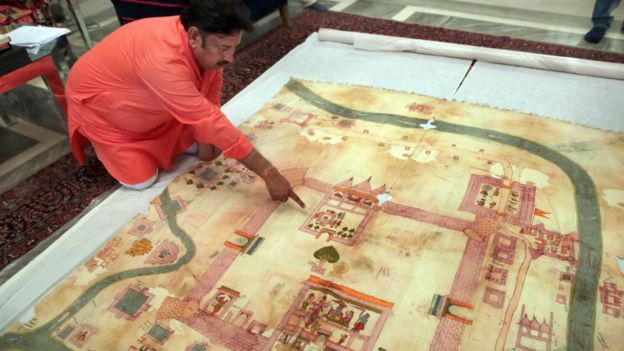
Image copyright AFPImage caption The dispute turned to violence in 1992 when a Hindu mob destroyed a mosque at the site
The Ayodhya dispute, which stretches back more than a century, is one of India’s thorniest court cases and goes to the heart of its identity politics.
Hindus believe that Ayodhya, a city in the northern state of Uttar Pradesh, is the birthplace of one of their most revered deities, Lord Ram.
But Muslims say they have worshipped there for generations.
A court case pertaining to the ownership of the land has been dragging on in the Supreme Court for years, but a verdict is expected next month.
The court concluded its final hearing into the case on Wednesday.
What is the row actually about?
At the centre of the row is a 16th Century mosque that was demolished by Hindu mobs in 1992, sparking riots that killed nearly 2,000 people.
Many Hindus believe that the Babri Masjid was actually constructed on the ruins of a Hindu temple that was demolished by Muslim invaders.
Muslims say they offered prayers at the mosque until December 1949 when some Hindus placed an idol of Ram in the mosque and began to worship the idols.
Over the decades since, the two religious groups have gone to court many times over who should control the site.
Since then, there have been calls to build a temple on the spot where the mosque once stood.
The case currently being heard by five judges in the top court is to determine who the land in question belongs to.
A verdict is expected between 4 and 15 November.
Hinduism is India’s majority religion and is thought to be more than 4,000 years old. India’s first Islamic dynasty was established in the early 13th Century.
Who is fighting the case?
The long and complicated property dispute has been dragging in various courts for more than a century.
This particular case is being fought between three main parties – two Hindu groups and the Muslim Waqf Board, which is responsible for the maintenance of Islamic properties in India.
Image copyright GETTY IMAGES
The Hindu litigants are the Hindu Mahasabha, a right-wing political party, and the Nirmohi Akhara, which is a sect of Hindu monks.
They filed a title dispute in the Allahabad High Court in 2002, a decade after the mosque was demolished.
A verdict in that case was pronounced in September 2010 – it determined that the 2.77 acres of the disputed land would be divided equally into three parts.
The court ruled that the site should be split, with the Muslim community getting control of a third, Hindus another third and the Nirmohi Akhara sect the remainder. Control of the main disputed section, where the mosque once stood, was given to Hindus.
The judgement also made three key observations.
It affirmed the disputed spot was the birthplace of Lord Ram, that the Babri Masjid was built after the demolition of a Hindu temple and that it was not built in accordance with the tenets of Islam.
The Supreme Court suspended this ruling in 2011 after both Hindu and Muslim groups appealed against it.
What are the other important legal developments?
In 1994 the Supreme Court, which was ruling on a related case, remarked that the concept of a mosque was “not integral to Islam”. This has bolstered the case made by Hindus who want control of the entire site.
In April 2018, senior lawyer Rajeev Dhavan filed a plea before the top court, asking judges to reconsider this observation.
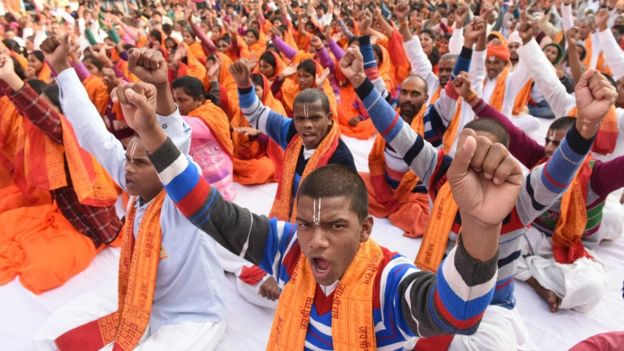
Image copyright GETTY IMAGESImage caption Hindu activists are demanding the construction of the Ram Temple
Have religious tensions eased in India in recent years?
Ever since the Narendra Modi-led Hindu nationalist BJP first came to power in 2014, India has seen deepening social and religious divisions.
The call for the construction of a Hindu temple in Ayodhya has grown particularly loud, and has mostly come from MPs, ministers and leaders from the BJP since it took office.
Restrictions on the sale and slaughter of cows – considered a holy animal by the majority Hindus – have led to vigilante killings of a number of people, most of them Muslims who were transporting cattle.
An uninhibited display of muscular Hindu nationalism in other areas has also contributed to religious tension.
Most recently, the country’s home minister Amit Shah said he would remove “illegal migrants” – understood to be Muslim – from the country through a government scheme that was used recently in the north-eastern state of Assam.
NEW DELHI/MUMBAI (Reuters) – India’s opposition Congress party selected past president Sonia Gandhi as its interim leader on Saturday, while it searches for a successor to her son Rahul Gandhi, who quit following a crushing election defeat by Prime Minister Narendra Modi.
The Congress Working Committee (CWC) unanimously decided to appoint Sonia Gandhi as “interim president pending the election of a regular president,” the party said in a statement late on Saturday night.
The committee wanted Rahul Gandhi to continue as its president but after he refused, they asked his mother to take over the reins instead, and she accepted, the statement said.
Sonia Gandhi is one of the most influential leaders of the Congress party and is credited with having brought the party back from the brink in 2004 with a surprise victory over the incumbent central government.
The widow of assassinated former Prime Minister Rajiv Gandhi, she was also the party’s longest serving president with 19 years at the helm, from 1998 to 2017, before handing over the baton to her son.
Congress, founded in 1885, is India’s oldest political party and dominated the country for decades after independence, led by generations of the Nehru-Gandhi family. The family produced three prime ministers: Jawaharlal Nehru, India’s first and longest-serving leader, his daughter Indira Gandhi and her son Rajiv.
However, Italian-born Sonia Gandhi faces a tall order to pull the party out of its worst crisis in decades and at the same time choose a worthy and dependable successor.
Party leaders and foot soldiers alike have been defecting to the ruling BJP. Remaining members have been dismayed at the party’s leadership vacuum following Modi’s re-election with a majority that surpassed his victory in 2014, and are questioning the party’s survival.
Rahul Gandhi, 49, announced his decision to quit as Congress leader in May, but the party leadership refused to accept it. They pressed him to reconsider, saying the party needed a unifying figure from the family to avoid splintering.
The party thanked Rahul Gandhi for his “exceptional leadership” during the state and general elections.
Last month in the southern state of Karnataka the defection of more than a dozen legislators from the ruling Congress-led coalition paved the way for Modi’s BJP to form a government.
Congress also appeared split in its response to Delhi’s decision to strip the state of Jammu and Kashmir of special constitutional status on Monday after putting the region on lockdown.
Some Congress members, including senior leader Jyotiraditya Scindia came out in support of the decision, and local media reported many in the party were supporting him.
Rahul Gandhi told reporters on Saturday night in New Delhi that considering there were reports of violence in Jammu and Kashmir, the government should provide transparent information about the actual situation on the ground.
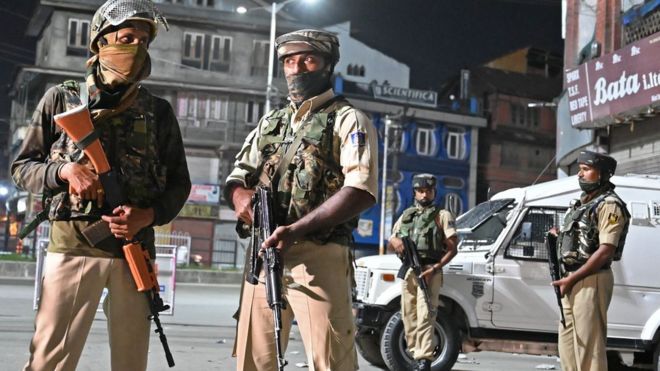
Image copyright AFPImage caption India has deployed tens of thousands of troops to Indian-administered Kashmir in recent days
India’s government has revoked part of the constitution that gives Indian-administered Kashmir special status, in an unprecedented move likely to spark unrest.
Article 370 is sensitive because it is what guarantees significant autonomy for the Muslim-majority state.
There has been a long-running insurgency on the Indian side.
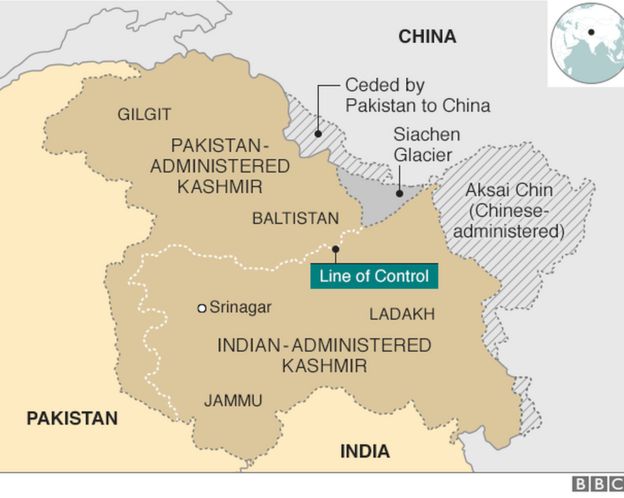
Nuclear powers India and Pakistan have fought two wars and a limited conflict over Kashmir since 1947.
The BBC’s Geeta Pandey in Delhi says that for many Kashmiris, Article 370 was the main justification for being a part of India and by revoking it, the BJP has irrevocably changed Delhi’s relationship with the region.
Pakistan condemned India’s decision to revoke the special status of its part of Kashmir as illegal, saying it would “exercise all possible options” to counter it.
“India is playing a dangerous game which will have serious consequences for regional peace and stability,” said Foreign Minister Shah Mehmood Qureshi.
But an Indian government source said there was no external implication as the Line of Control, the de facto border, and boundaries of Kashmir had not been altered.
Why are there tensions over Kashmir?
During the partition of the Indian subcontinent in 1947, some expected Jammu and Kashmir, like other Muslim-majority regions, to go to Pakistan.
But the ruler of the princely state, who had initially wanted Jammu and Kashmir to become independent, joined India in return for help against an invasion of tribesmen from Pakistan.
War broke out between India and Pakistan, and Kashmir effectively became partitioned.
The region, which remains one of the most militarised zones in the world, has been a flashpoint between India and Pakistan for more than six decades.
Atmosphere of fear
By Aamir Peerzada, BBC News, Srinagar
By the time we woke up this morning, the internet was gone and we now have no mobile connectivity.
If people step out of their homes, they see paramilitary forces on every street. Almost every major road is shut – we are hearing that more troops are being deployed.
No-one knows what is happening in other parts of the state – we can’t talk to anyone else.
People are concerned – they don’t know what is happening, they don’t know what is going to happen.
It’s an atmosphere of fear. People are scared to come out, they have stockpiled food for months.
Kashmiris have always been willing to defend the state’s special status. It looks like a long road ahead, and no-one knows what’s next.
What is Article 370?
In 1949, a special provision was added to India’s constitution providing autonomy to Jammu and Kashmir.
Article 370 allows the state to have its own constitution, a separate flag and independence over all matters except foreign affairs, defence and communications.
Another provision later added under Article 370 – 35A – gives special privileges to permanent residents, including state government jobs and the exclusive right to own property in the state.
It is seen as protecting the state’s distinct demographic character as the only Muslim-majority state in India.
So why is India’s move controversial?
The move by the Hindu nationalist BJP government prompted outrage in parliament, and some legal experts have called it an attack on the constitution.
Critics fear the move is designed to change the demographic make-up of India-administered Kashmir – by giving people from the rest of the country to right to acquire property and settle there permanently.
“They just want to occupy our land and want to make this Muslim-majority state like any other state and reduce us to a minority and disempower us totally.”
She added Article 370 was not given to the people of the state as a “gift”, but “a matter of constitutional guarantees given by the very same Indian parliament to the people of Jammu and Kashmir”.
Why is the government doing this?
The ruling BJP made revoking Article 370 part of the party’s 2019 election manifesto – and it won a landslide victory earlier this year.
It has argued that Article 370 has prevented the region’s development and its integration with India.
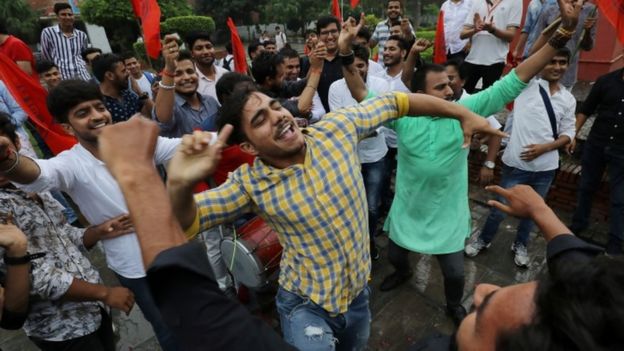
Image copyright REUTERSImage caption Supporters of India’s ruling BJP have been celebrating the move
An Indian government source said on Monday that the region’s special status had discouraged outside investment and affected its economy, while terrorism and smuggling were rife.
“A set of anachronistic provisions were not allowing the progress of Kashmir,” the source said. “The huge sum of money and resources which were going into the state were not being optimised.”
How did the government make the change?
India’s government announced a presidential order revoking all of Article 370 apart from one clause which says that the state is an integral part of India.
The order was met by massive protests from the opposition – but has now been signed into law by President Ram Nath Kovind.
The government also proposed dividing the state into two regions ruled by the central government, and a bill to that effect passed the upper house on Monday and will now go to the lower house where the BJP has a majority.
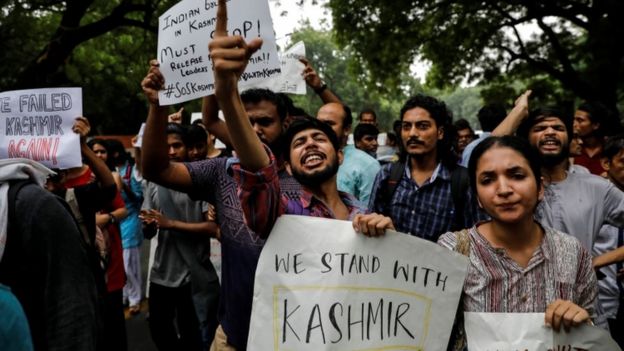
Image copyright REUTERSImage caption Opponents of the move have also been out in the streets of Delhi
Changing Article 370 also requires the assent of the state government, but Jammu and Kashmir has been under the rule of a governor since June 2018 when the BJP pulled out of a state government coalition with the regional People’s Democratic Party (PDP).
This effectively means the state has been ruled directly by Delhi through a governor, who has agreed to the bills.
What has been happening in Kashmir?
Indian-administered Kashmir is in a state of lockdown.
Curfew-like conditions have been imposed, and orders preventing the assembly of more than four people have been introduced.
Tens of thousands of Indian troops were deployed to the region ahead of Monday’s announcement and tourists were told to leave under warnings of a terror threat.
Media caption In December Yogita Limaye examined why there had been a rise in violence in Kashmir
In the hours before Monday’s announcement, two of the state’s former chief ministers – Omar Abdullah and Mehbooba Mufti – were placed under house arrest.
NEW DELHI (Reuters) – India’s ruling Bharatiya Janata Party (BJP) is preparing to meet coalition partners to discuss a new government, two BJP sources said on Monday, after exit polls predicted a better-than-expected result for it in a general election.
The talks would most likely be held on Tuesday afternoon, the two sources in the BJP said. They declined to be identified as they are not authorised to speak about the meeting.
Nalin Kohli, a spokesman for the BJP, declined to comment.
India’s seven-phase general election, billed as the world’s biggest democratic exercise, began on April 11 and ended on Sunday. Votes will be counted on Thursday and results are likely the same day.
Prime Minister Narendra Modi’s BJP-led National Democratic Alliance is projected to win anything between 339-365 seats in the 545-member lower house of parliament with the Congress-led opposition alliance getting only 77 to 108, an exit poll from India Today Axis showed on Sunday.
A party needs 272 seats to command a majority.
Indian stock markets and the rupee were sharply higher on expectation the business-friendly Modi would stay on at the helm.
The benchmark NSE share index was up 2.8%, its best single day since March 2016.
“I expect another 2-3% rally in the market in the next three to four days based on the cue,” said Samrat Dasgupta, a fund manager at Esquire Capital Investment Advisors.
Congress spokesman Sanjay Jha cast doubt on the exit polls, saying on Twitter he believed they were wrong.
“If the exit poll figures are true then my dog is a nuclear scientist,” Jha said, adding he expected the next prime minister would come from outside the BJP alliance.
Modi and his BJP faced criticism in the run-up to the election over unemployment, in particular for failing to provide opportunities to young people coming onto the job market, and for weak farm prices.
But Modi rallied his Hindu nationalist base and made national security a central theme of the campaign after a surge in tension with Pakistan in February following a suicide bomb attack in Indian-controlled Kashmir by Pakistan based militants.
Modi ordered air strikes on a suspected militant camp in Pakistan, which led to a surge in tension between the nuclear-armed neighbours.
But many Indians applauded Modi’s tough stand and he was able to attack the opposition for being soft on security.
Ram Madhav, a senior leader in the BJP, told Reuters partner ANI the results would be even better for the party than the exit polls were suggesting, particularly in West Bengal state.
West Bengal has the third largest number of members of parliament and has been hotly contested between the BJP and the Trinamool Congress, one of the most powerful parties in the coalition trying to unseat Modi.
“Bengal will surprise all the pollsters, we are hoping to do extremely well there,” Madhav said. “Everyone has seen the tremendous support for PM Modi and the BJP in Bengal.”
The seventh and the last phase of Lok Sabha election in West Bengal was hit by vandalism and rigging on Sunday amid polling in nine parliamentary constituencies with the ruling Trinamool Congress and the BJP locked in a bitter battle for power.
LOK SABHA ELECTIONSUpdated: May 19, 2019 11:19 IST
HT Correspondent
Hindustan Times, Kolkata
Kolkata Police personnel leaving for polling booth on the eve of final phase of Lok Shabha election from a Polling distribution center in Kolkata on Saturday . (ANI photo for representation)
Crude bombs were hurled at two places on Sunday in West Bengal, where polling is underway in nine constituencies in the last phase of polling of the Lok Sabha election amid reports of vandalism and malfunctioning EVMs.
Reports of bombs thrown in Gilaberia area in Deganga of North 24 Parganas district under Barasat constituency and in Raidighi of South 24 Parganas district under Mathurapur constituency came in as voters queued up in polling booths.
There were allegations that BJP supporters were beaten up and its camp office vandalised allegedly by TMC workers in Kultoli in Jaynagar Lok Sabha constituency as 14.17% polling was recorded till 9am from across the state.
Sayantan Basu, the BJP’s candidate for Basirhat constituency, alleged rigging in several areas and said police was doing nothing to stop it.
“People have queued up from as early as 4:30am to vote. But there are a lot of allegations of muscle flexing and rigging in areas such as Sandeshkhali, Hingalganj and Baduria. The inspector-in-charge of Shashan police station is virtually helping to rig in favour of the TMC,” Basu said.
“About 150 complaints were lodged with the EC (Election Commission) in the first three hours. I have not seen effective steps of the poll panel so far,” Basu, also the general secretary of the Bengal unit of the BJP, alleged.
Mala Roy, the TMC’s candidate in Kolkata South constituency, alleged that central force personnel did not allow her to enter booth number 72 in a polling station in Mudiali under her constituency. Roy said she went after learning that polling was stopped for 45 minutes. She said she will lodge a complaint with the poll watchdog.
Trinamool Congress’ Rajya Sabha member Sukhendu Sekhar Ray alleged Electronic Voting Machines in all the parliamentary constituencies were not working as he questioned the EC over the EVMs.
“Hundreds of EVMs found to be dysfunctional from the very start of poll in various booths of the 9 Parliamentary Constituencies Of West Bengal where elections are being held today,” Ray wrote on Facebook.
“Rs 3,173 crores sanctioned by the Government in April 2017 for purchase of 16 Lakh new EVMs. It seems that old and junk machines have been put on service in these 9 constituencies with the evil design to delay the process of voting,” he said.
“Because if the voters after waiting for hours together fail to cast their votes will leave the polling stations in disgust, which will affect percentage of polling severely. Shame Election Commission,” Ray said.
Widespread violence
Before this, the state witnessed numerous incidents of violence in the last six rounds of polling, which included vandalism, attacks on candidates, party workers, security officials and the media, and those of stopping voters from voting.
Sporadic incidents of booth capture, smashing and malfunctioning of electronic voting machines (EVM), intimidation of voters have also been reported from West Bengal in all these phases. Several workers of both the parties have also been killed in violence reported from across the state.
The past week also saw a high-pitched battle between the Bharatiya Janata Party and the TMC, during and in the immediate aftermath of BJP president Amit Shah’s roadshow in Kolkata, which included the vandalising of a bust of 19th century Bengali icon Ishwar Chandra Vidyasagar in an educational institute.
This led to the Election Commission bringing forward the campaign period by 19 hours, a move that received all-round criticism from opposition leaders.
The eastern state is important for both the TMC and the BJP as 42 seats are on offer — the third highest after Uttar Pradesh and Maharashtra — which the ruling party at the Centre is eyeing to offset possible losses in northern India, and which are crucial for chief minister Mamata Banerjee’s national political ambitions.
Candidates, as well as party workers, of both the TMC and BJP have accused each other of violence throughout the six phases of polling in the state.
During the sixth phase on May 12, the BJP’s candidate from Ghatal constituency Bharati Ghosh alleged she was heckled at a polling booth and pushed by some women supporters of the Trinamool Congress. The former Indian Police Service (IPS) officer, once considered close to chief minister Mamata Banerjee, also said stones were thrown at her convoy and that crude bombs were hurled at her car.
In Barrackpore parliamentary constituency, the BJP’s candidate Arjun Singh alleged he was “attacked by goondas” of the Trinamool Congress in the fifth phase on May 6. On the same day, at Bongaon Lok Sabha seat, one TMC worker and one cop were injured in the violence.
In Hooghly district, which borders Kolkata, the rented accommodation of BJP’s women’s wing chief Locket Chatterjee, an actor-turned-politician who is also the party’s candidate from the Hooghly Lok Sabha constituency, was allegedly vandalised on May 6 by TMC workers.
A complaint was also filed against Chatterjee for allegedly threatening a presiding officer at a poll booth in Hooghly constituency during the same phase.
Sporadic clashes were reported in West Bengal, especially from Asansol, in the fourth phase of the general election. The BJP’s sitting member of Parliament and candidate Babul Supriyo’s car was vandalised in Asansol allegedly by stone-throwing Trinamool Congress supporters. The minister escaped unharmed with only the rear glass of the vehicle being damaged.
On April 18, the second phase of polling, the Communist Party of India (Marxist) candidate and Raiganj sitting MP Mohammed Salim’s car was attacked when he went to a polling booth on Islampur. Reports of sporadic violence came from Darjeeling constituency as well.
Places such as Nalhati (Birbhum), Nanoor (Bolpur), Barabani (Asansol) and Suri (Birbhum) saw pitched battles between political workers involving knives and long sticks.
Crude bombs were hurled by unidentified men outside polling stations at Tiktikipara in Domkal, Murshidabad, and Kaliachawk in Malda South.
The Election Commission has deployed hundreds of security personnel forces to cover the booths in the battleground eastern state to ensure free and fair polling.
Image copyright REUTERSImage caption Economists say India’s growth is powered by the ‘top 100 million’ people
As India lumbers towards the final phase of an exhausting general election and Prime Minister Narendra Modi’s BJP seeks a second term in power, there’s some worrying news. The world’s fastest growing major economy appears to be headed for a slowdown.
The signs are everywhere. Economic growth slowed to 6.6% in the three months to December, the slowest in six quarters. Sales of cars and SUVs have slumped to a seven-year-low. Tractors and two-wheelers sales are down. Net profits for 334 companies (excluding banks and financials) are down 18% year-on-year, according to the Financial Express newspaper.
Image copyright GETTY IMAGESImage caption Sales of cars and SUVs have slumped to a seven-year-low.
One newspaper wondered whether India was “losing the consumption plot”. Taken together, all this points to a fall in both urban and rural incomes, leading to demand contraction. A crop glut has seen farm incomes drop. And credit stagnation, partly triggered by the collapse of a major non-banking financial institution, or a shadow bank, has led to a fall in lending and worsened matters.
Kaushik Basu, former chief economist of the World Bank and professor of economics at Cornell University, believes the slowdown is “much more serious” than he initially believed. “The evidence is now mounting to the point where it can no longer be ignored,” he told me.
One reason, he believes, is the controversial currency ban in 2016 – also called demonetisation – which adversely hit farmers. More than 80% of the currency circulating in India’s sprawling cash-driven economy was taken out of circulation in what, in the words of one of Prime Minister Modi’s own advisers, was a “massive, draconian, monetary shock”.
Image copyright AFP
“This was evident to all by early 2017. What many observers did not realise then – I did not – is that the shock made the farmers take on debts which ended up causing sustained hardship to them that is continuing and slowing down the agriculture sector.”
Over the last few days, Prime Minister Narendra Modi and his party’s top leadership have scaled up attacks on the Gandhi family, particularly on former prime minister Rajiv Gandhi.
LOK SABHA ELECTIONSUpdated: May 07, 2019 17:40 IST
HT Correspondent
Hindustan Times, New Delhi
Congress general secretary Priyanka Gandhi Vadra(PTI file photo)
Launching a scathing attack on the ruling BJP, Congress leader Priyanka Gandhi Vadra said on Tuesday that the saffron party’s “arrogance is like that of Duryodhan”, just days after Prime Minister Modi referred to Congress general secretary’s father and former prime minister Rajiv Gandhi “bhrashtachari no 1”.
Without naming anyone, Priyanka Gandhi Vadra said:” This country has never forgiven arrogance. Even Duryodhan had such arrogance, when Lord Krishna tried to make him see sense, he wanted to take him hostage.”
Speaking at a rally in Ambala for party candidate Kumari Selja, Priyanka Gandhi quoted poet Ramdhari Singh Dinkar to reinforce her remarks. “Jab naash manuj par chaata hai, pehle vivek mar jata hai (When doom looms, first thing a human loses is the ability to discern right from wrong).”
Priyanka Gandhi slams BJP, says party’s ‘arrogance like that of Duryodhan’
Priyanka Gandhi launched an attack on BJP while addressing a rally in Ambala.
The party incharge of eastern Uttar Pradesh added: “They never fulfil the promises they make at election time, instead they either seek votes in the name of martyrs or insult the martyr members of my family.”
Over the last few days, Prime Minister Narendra Modi and his party’s top leadership have scaled up attacks on the Gandhi family, particularly on former prime minister Rajiv Gandhi.
At a rally in Uttar Pradesh over the weekend, PM Modi had attacked Congress president Rahul Gandhi who has been hammering the BJP-led national coalition alleging corruption in the Rafale deal.
“Your father was termed Mr Clean by his courtiers, but his life ended as corrupt no 1,” PM Modi said, provoking a sharp response from the Congress and other opposition parties.
As she spoke at an election rally in Bengal on Tuesday, chief minister Mamata Banerjee said PM Modi’s attack was in bad taste. “Rajiv Gandhi died for the country. You may not like him but you should give respect to a departed leader,” Mamata Banerjee said.
The BJP response came soon after. Amit Shah, the party chief and its master strategist, wondered why PM Modi’s comment was made an issue when the latter spoke only the “truth”. “Is it not true that there was a Bofors scandal,” Shah told a public rally in Bengal insisting that the prime minister had only reminded the Congress about one fact. “It is not an insult to remind someone about the truth,” the BJP chief said.
MUMBAI/NEW DELHI (Reuters) – Police broke up clashes between rival groups of voters in West Bengal on Monday as some of India’s richest families and Bollywood stars also cast their ballots in Mumbai during the fourth phase of a massive, staggered general election.
In West Bengal, a populous eastern state crucial for Prime Minister Narendra Modi’s re-election bid, supporters of his Hindu nationalist Bharatiya Janata Party (BJP) clashed with others from the regional Trinamool Congress, police said.
TV footage showed armed security forces chasing away people wielding sticks, although it was initially difficult to determine the scale of the clashes.
There were no immediate reports of any poll-related injuries in West Bengal, where at least one person was killed and three injured during the third phase of voting last week.
The BJP is in a direct, and sometimes bloody, fight in West Bengal with Trinamool, whose chief Mamata Banerjee is one of Modi’s biggest critics and a potential prime ministerial candidate.
More than 127 million people are eligible to vote in this round of the seven-phase election held across 71 seats in nine states. Modi’s coalition won more than 75 percent of the seats in the previous election in 2014.
Many of the constituencies are in Uttar Pradesh in the north and western India’s Maharashtra, where the financial capital Mumbai is located. Uttar Pradesh elects the most lawmakers, with Maharashtra next. Both states are ruled by the BJP and its allies.
However, political analysts say the BJP may struggle to repeat its strong showing this time due mainly to a jobs shortage and weak farm prices, issues upon which the main opposition Congress party has seized.
‘SOME PROGRESS’
First-time voter Ankita Bhavke, a college student in Mumbai, said she voted for economic development.
“I want the country to be at par with the best in the world,” she said. “There’s been some progress in the last five years.”
India’s financial markets were closed on Monday for the election.
Mumbai is home to the massive Hindi film industry, as well as Asia’s wealthiest man, Mukesh Ambani, and India’s richest banker, Uday Kotak.
Ambani, who heads Reliance Industries, and Kotak, managing director of Kotak Mahindra Bank, created a stir this month by publicly endorsing an opposition Congress party candidate from their upscale South Mumbai constituency.
Mumbai, which has six seats, is India’s wealthiest city but ageing and insufficient infrastructure is a major concern. Six people were killed last month when part of a pedestrian bridge collapsed, recalling memories of a 2017 rush-hour stampede that killed at least 22 people on a narrow pedestrian bridge.
The election, the world’s biggest democratic exercise with about 900 million voters, started on April 11 with Modi in the lead amid heightened tension with long-time enemy Pakistan.
The last phase of voting is on May 19, with results released four days later.
There are a total of 545 seats in the Lok Sabha.
Modi sent warplanes into Pakistan in late February in response to a suicide attack by an Islamist militant group based there that killed 40 Indian police in the disputed Kashmir region.
Modi has sought votes on his tough response towards militancy and in recent days has evoked the deadly Easter Sunday bombings in nearby Sri Lanka.
Maidul Islam, a professor of political science at Kolkata’s Centre for Studies in Social Sciences, said long queues outside polling stations would indicate whether Modi’s national security pitch was working.
“Whenever there is a BJP kind of a wave, you see a higher voter turnout,” he said.






 CHINDIA ALERT: You'll be living in their world, very soon